Breaking News: Breitling Sold for €800m to Europe’s Biggest Private Equity Firm

CVC Capital Partners will take a majority stake in Breitling.

After having been on the block since November 2016 with a reported asking price of SFr1 billion, Breitling has been acquired by CVC Capital Partners, valuing the watchmaker at over €800m (US$870m or SFr867m), according to Bloomberg.

Theodore Schneider, the multimillionaire who inherited the firm from his father Ernest, will participate in the buyout for a 20% stake in the brand best known for its Navitimer and Chronomat aviator’s chronographs. With Breitling changing hands, only a few significant family-owned watchmakers remain in Switzerland, amongst them Patek Philippe and Audemars Piguet.

One of the biggest watchmakers in Switzerland that has long had John Travolta as its brand ambassador, Breitling reported sales of about SFr420m (US$424m) in 2016, and the new owners plan to grow that by focusing on the Chinese market. The transaction is expected to complete by June 2017.


Source: Bloomberg

Back to top.

You may also enjoy these.

Introducing the Maurice Lacroix Masterpiece Moon Retrograde

A double retrograde with moon phase, powered by an in-house movement.

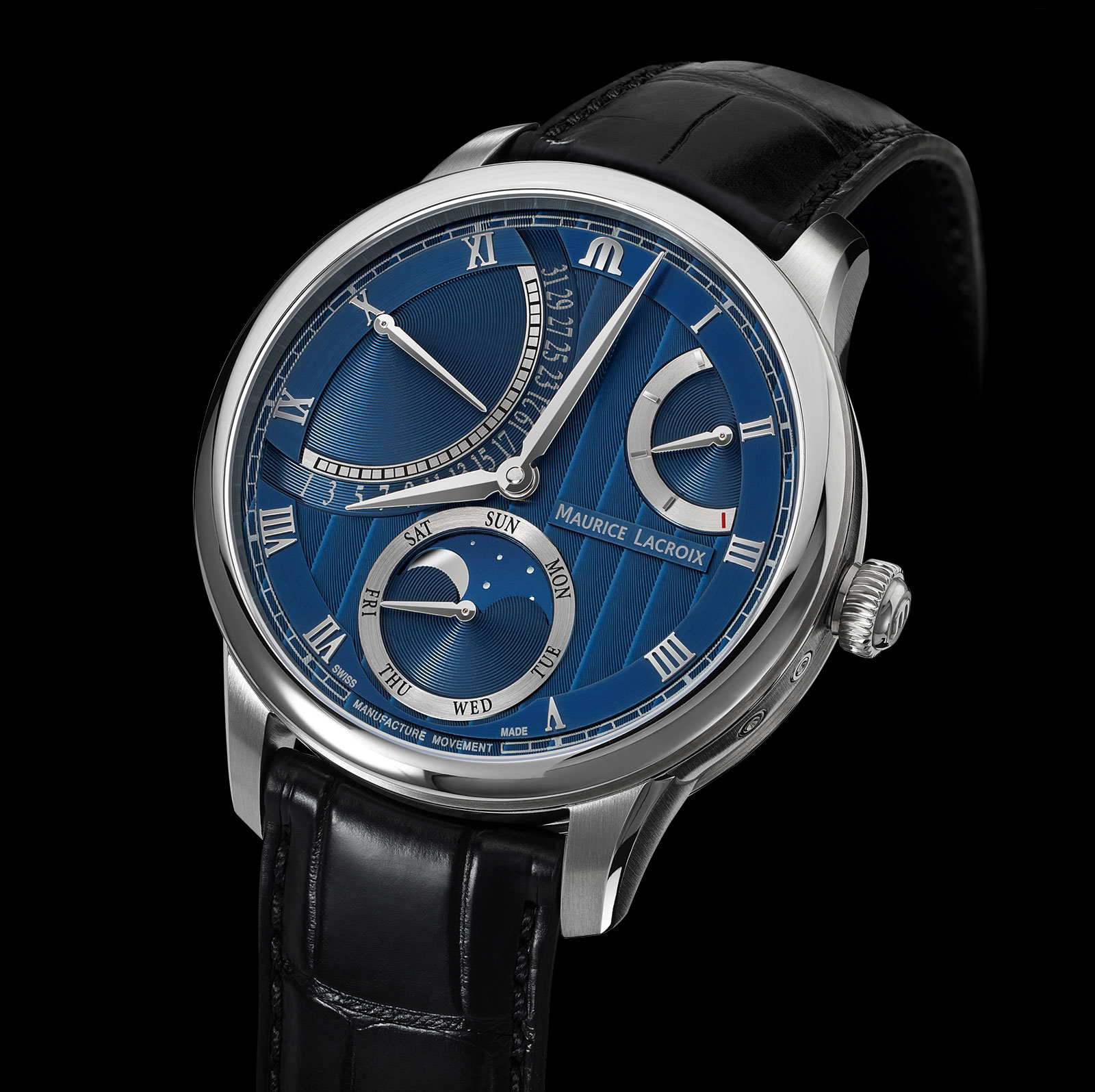
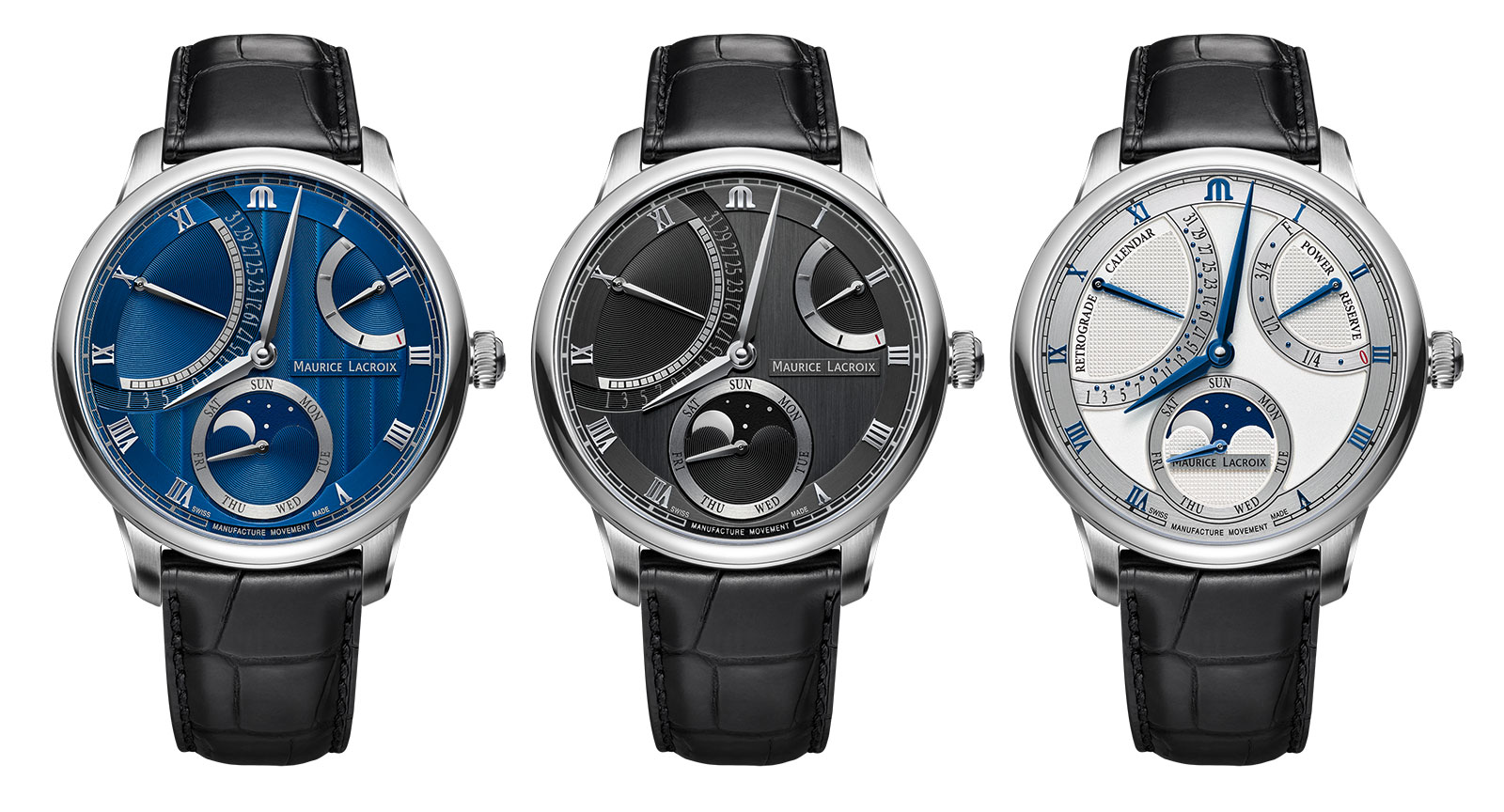
Available in three different guises, the Maurice Lacroix Masterpiece Moon Retrograde unveiled at Baselworld 2017 offers a retrograde displays of the date as well as power reserve, equipped with a proprietary movement. With the twin retrograde indicators, Maurice Lacroix pays tribute to the original Masterpiece wristwatch introduced in 2003.

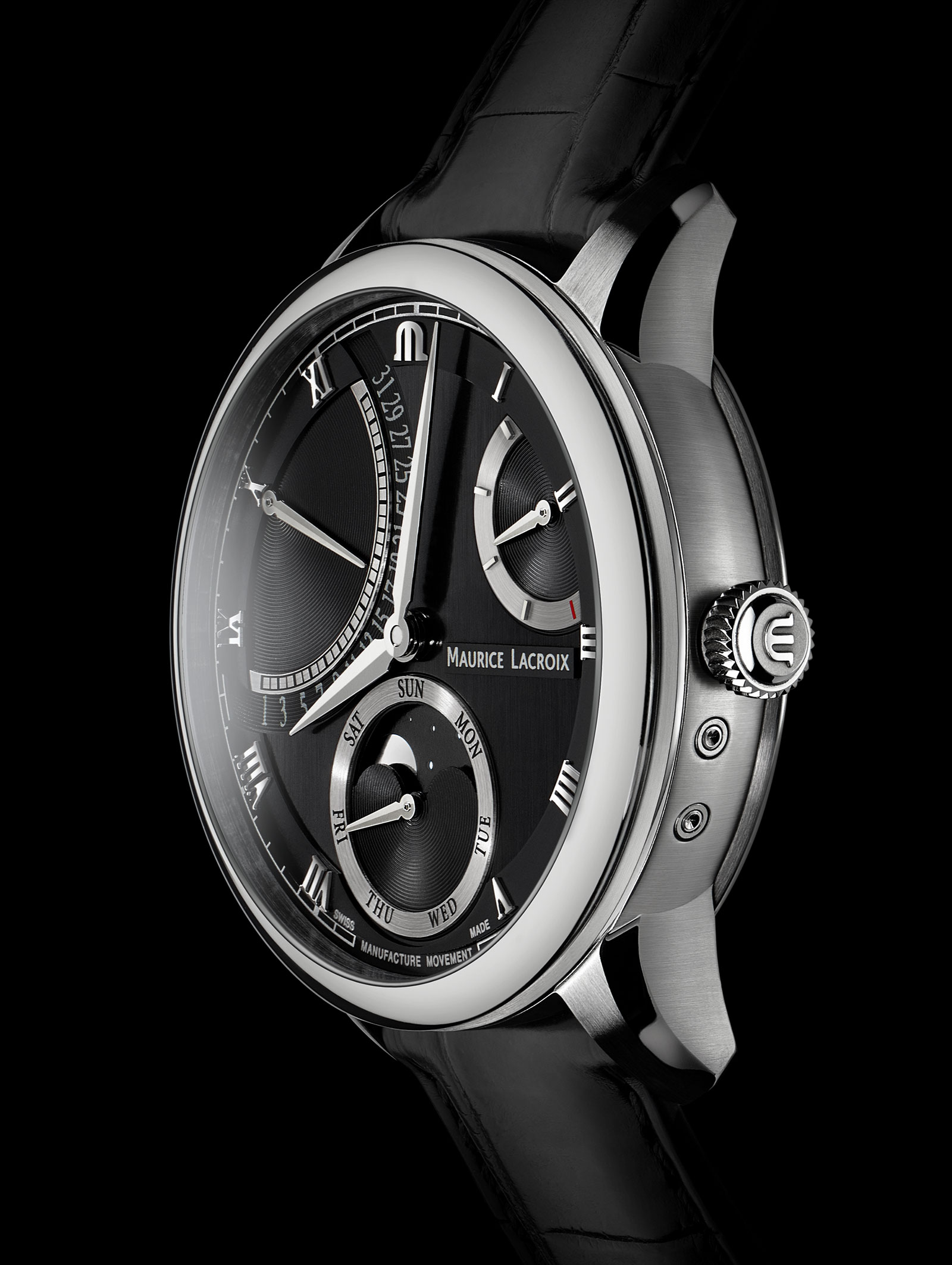
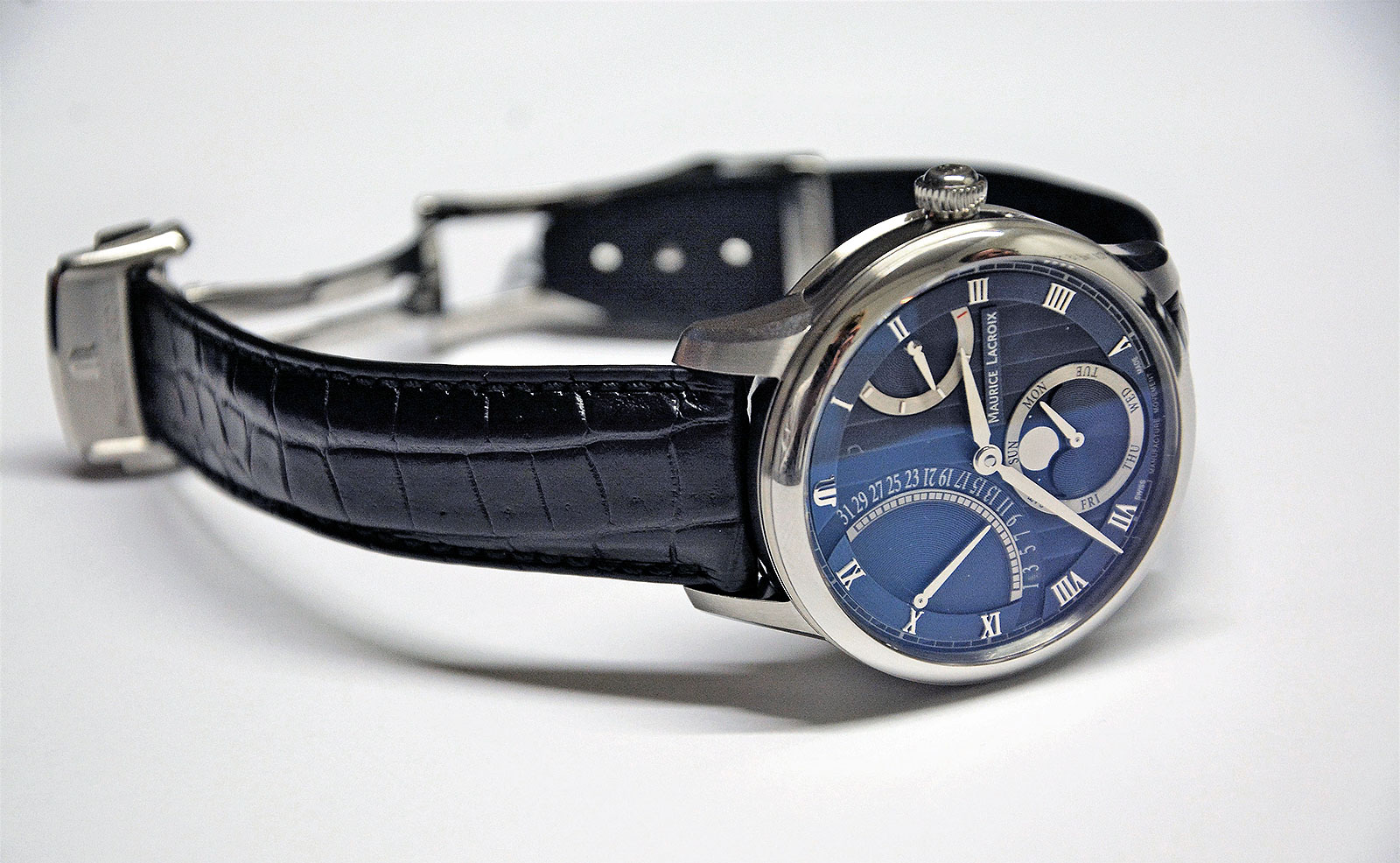
Hours and minutes are displayed traditionally via the central hands while the calendar function at 10 o’clock and the power reserve at two. Additionally, the watch displays the day of the week on the same sub-dial as the moon phase.

The Masterpiece Moon Retrograde is available with a blue, black or silver dial. Both the blue and black dials have rhodium-plated indices and hands, but different dial finishes. The black dial has a vertical brushing while the blue version is finished with Côtes de Genève, the same decoration often found on movement bridges.

The third colour option is a silver dial with blue hands and indices, matched with a Clous de Paris, or hobnail, pattern on the three sub-dials for the calendar, power reserve and moon phase.

Maurice Lacroix Masterpiece Moon Retrograde 5

As the retrograde display for the power reserve on the silver dial version is a little bigger, the power reserve indicators on the other two references are comparatively smaller, explaining the different position of the brand name on the dial.

The Moon Retrograde features a polished stainless steel case with a diameter of 43mm. Despite this quite large diameter and an impressive height of the case, the piece sits on the wrist very comfortably, thanks to the relatively short lugs.

Maurice Lacroix Masterpiece Moon Retrograde 3

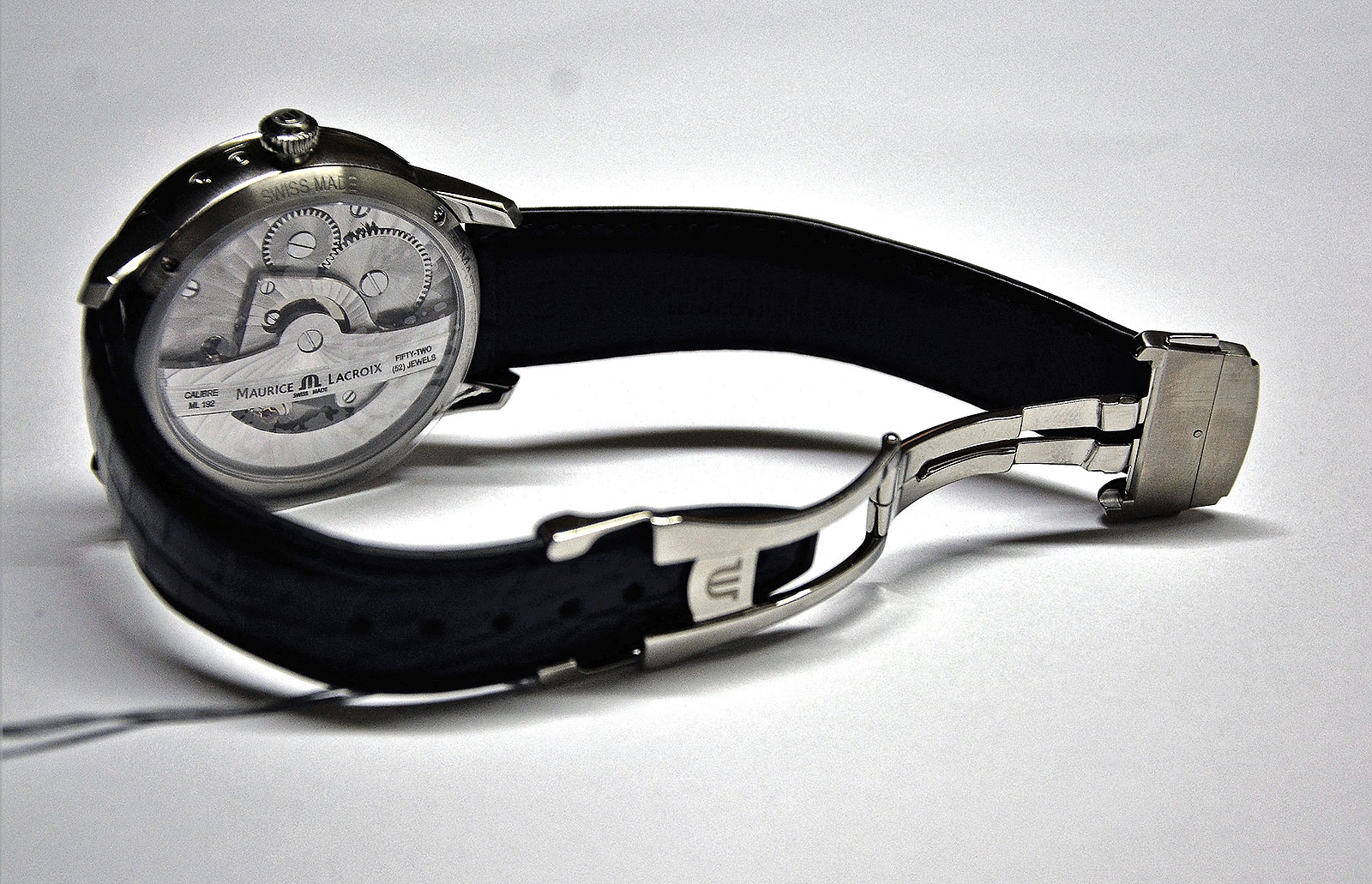
A see-through case back enables the beholder a view into the self-winding ML192 movement, which is an in-house calibre that contains 344 parts. It runs at 18,000 beats per hour and has a power reserve of approximately 52. The rhodium-plated bridges and the skeleton rotor are decorated with spiral Côtes de Genève.

Maurice Lacroix Masterpiece Moon Retrograde 1

Photos credit Philipp Kneller

Price and Availability

The Maurice Lacroix Masterpiece Moon Retrograde is fitted to a black crocodile strap with a folding buckle. The retail price is be SFr4900.


Back to top.

You may also enjoy these.

Hands-On with the MB&F LM1 Final Edition in Stainless Steel

The Legacy Machine 1 takes its final bow in an 18-piece limited edition.

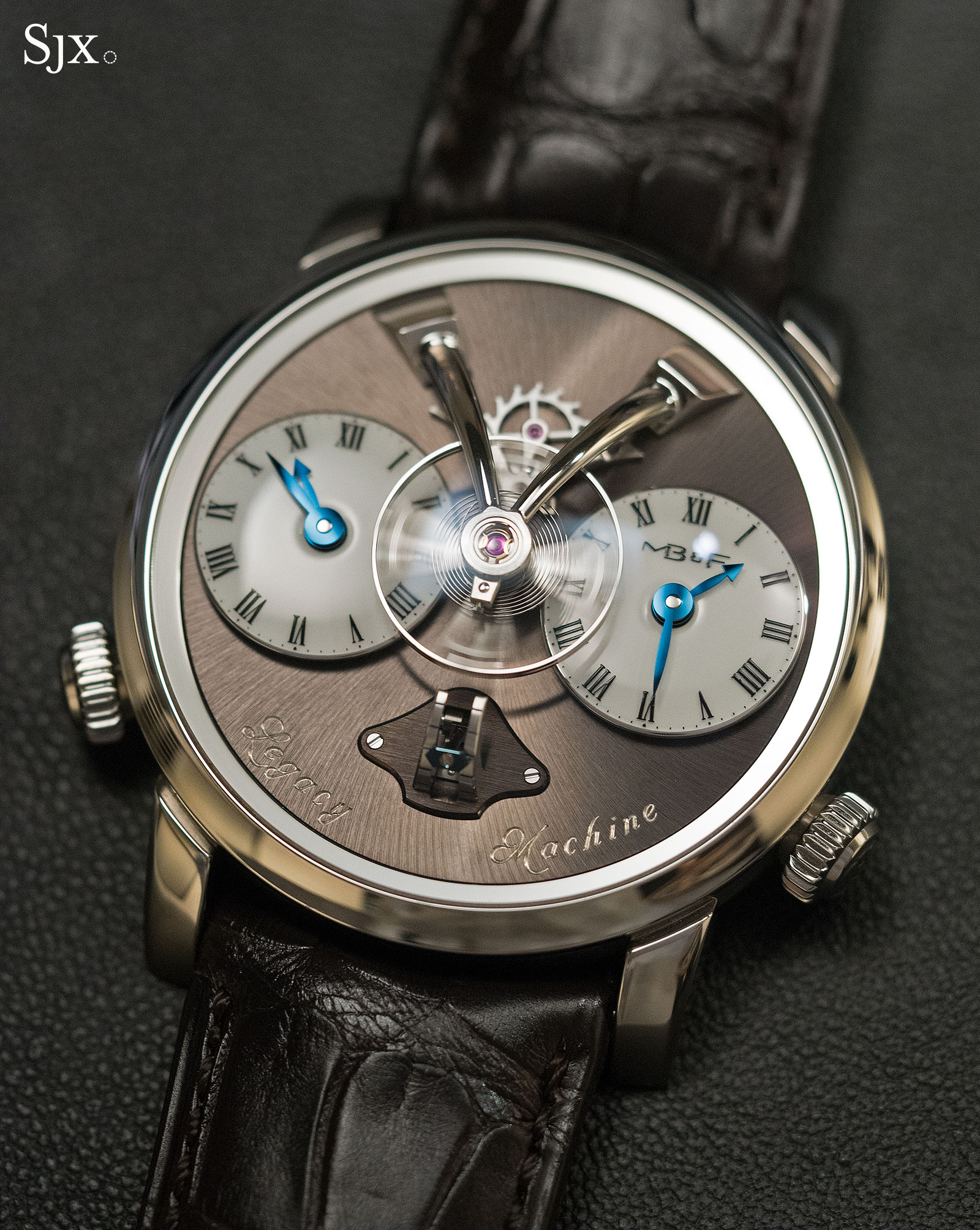
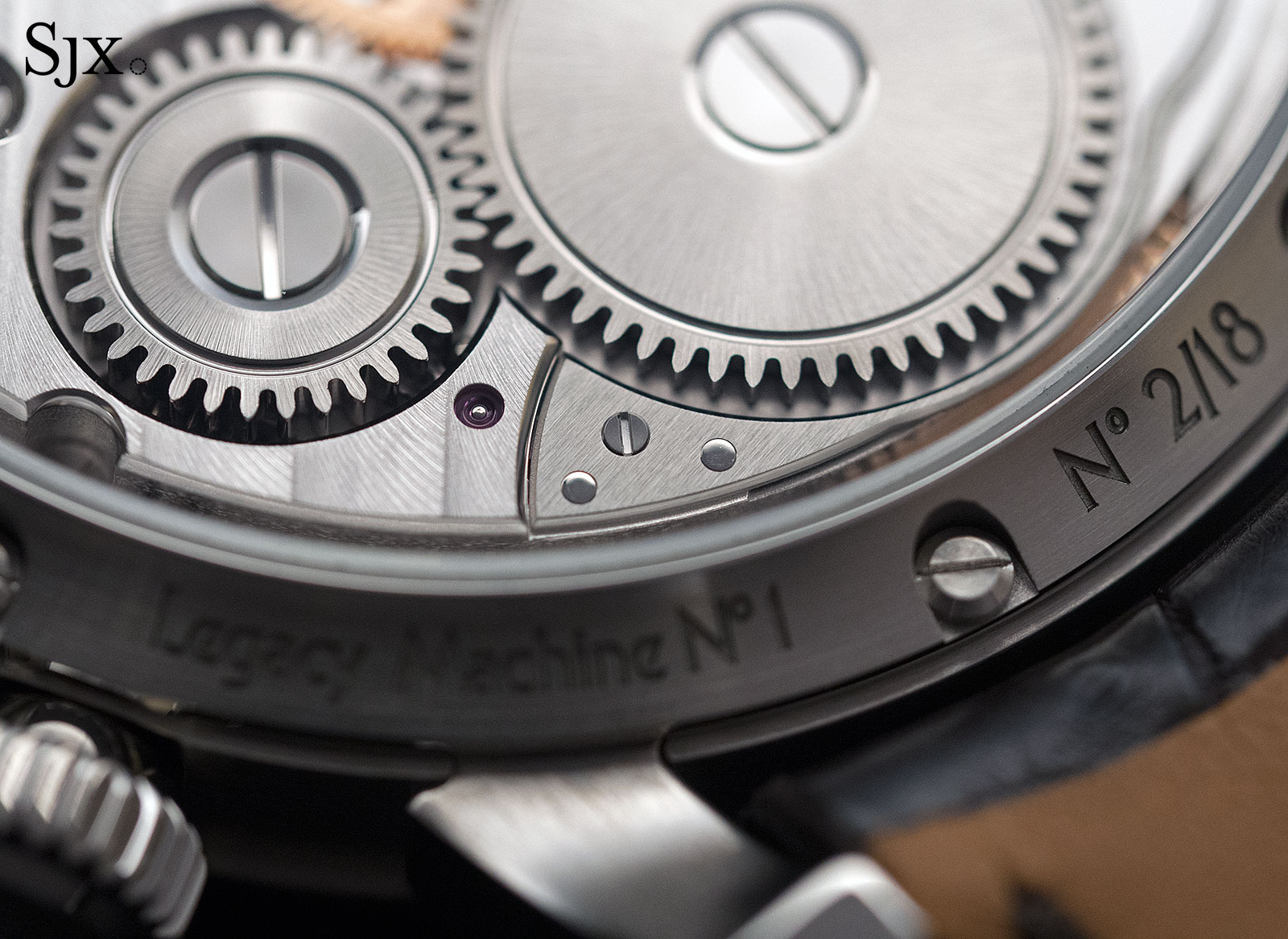
Introducing what seems like an eternity ago (but actually was just 2011), the MB&F Legacy Machine 1 ushered in a new era for the brand. Inspired by 19th century watchmaking, the LM1 was the first round, conventional looking wristwatch by MB&F, better known for its jellyfish watches and robot clocks. And now the LM1 has come to an end with the Final Edition.

Replicating the combination used for a limited edition produced for American watch blog Hodinkee in 2015, the LM1 Final Edition has a steel case and metallic brown dial. The dial is a hue that’s not too dark, perhaps chestnut, with the grained finish common to all Legacy Machine watches. While brown typically feels like a seasonal colour, the shade used here combined with the metallic finish gives it significant appeal. The colour of the dial gives it presence, without being loud.

MB&F LM1 Final Edition steel 2

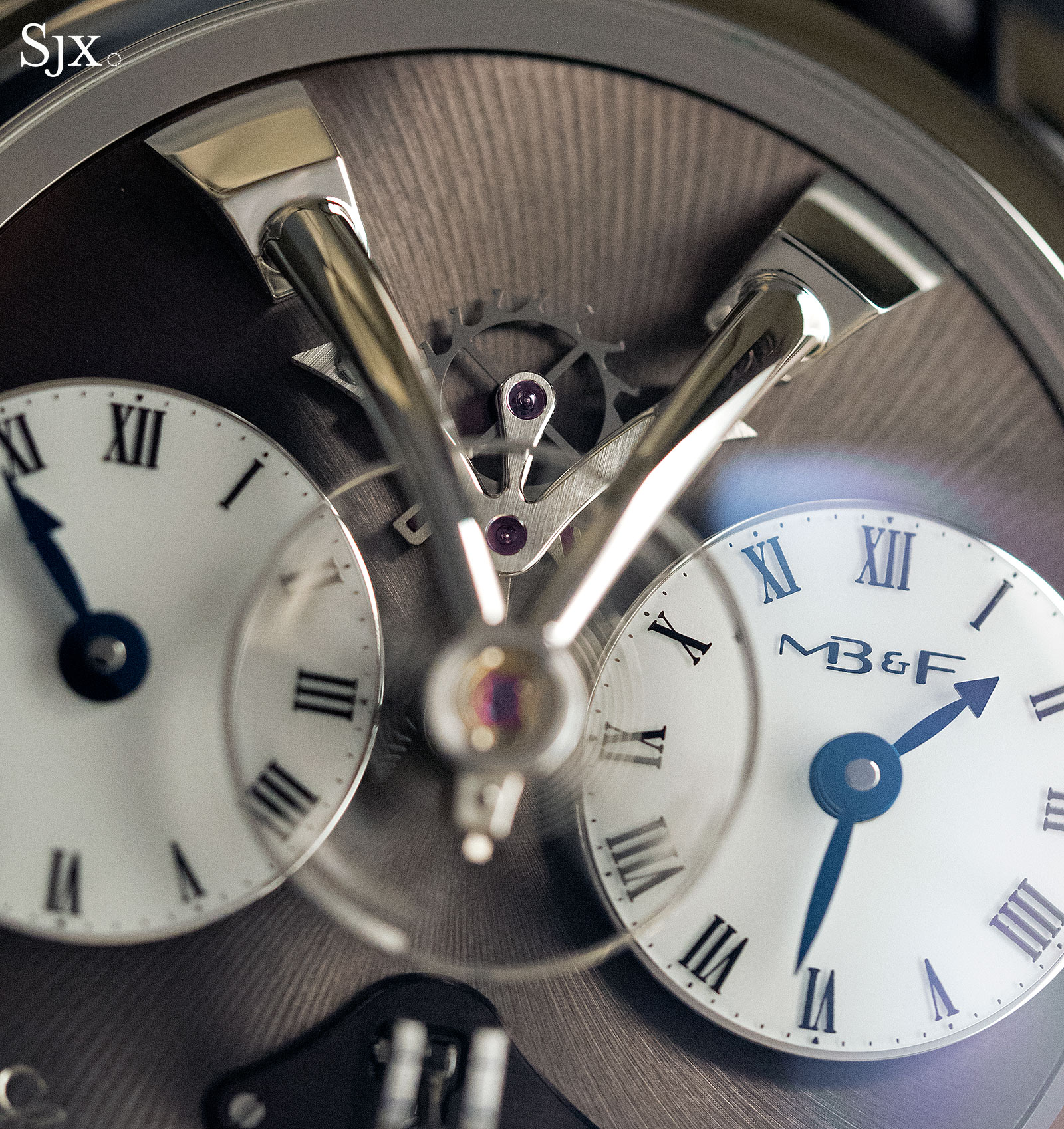
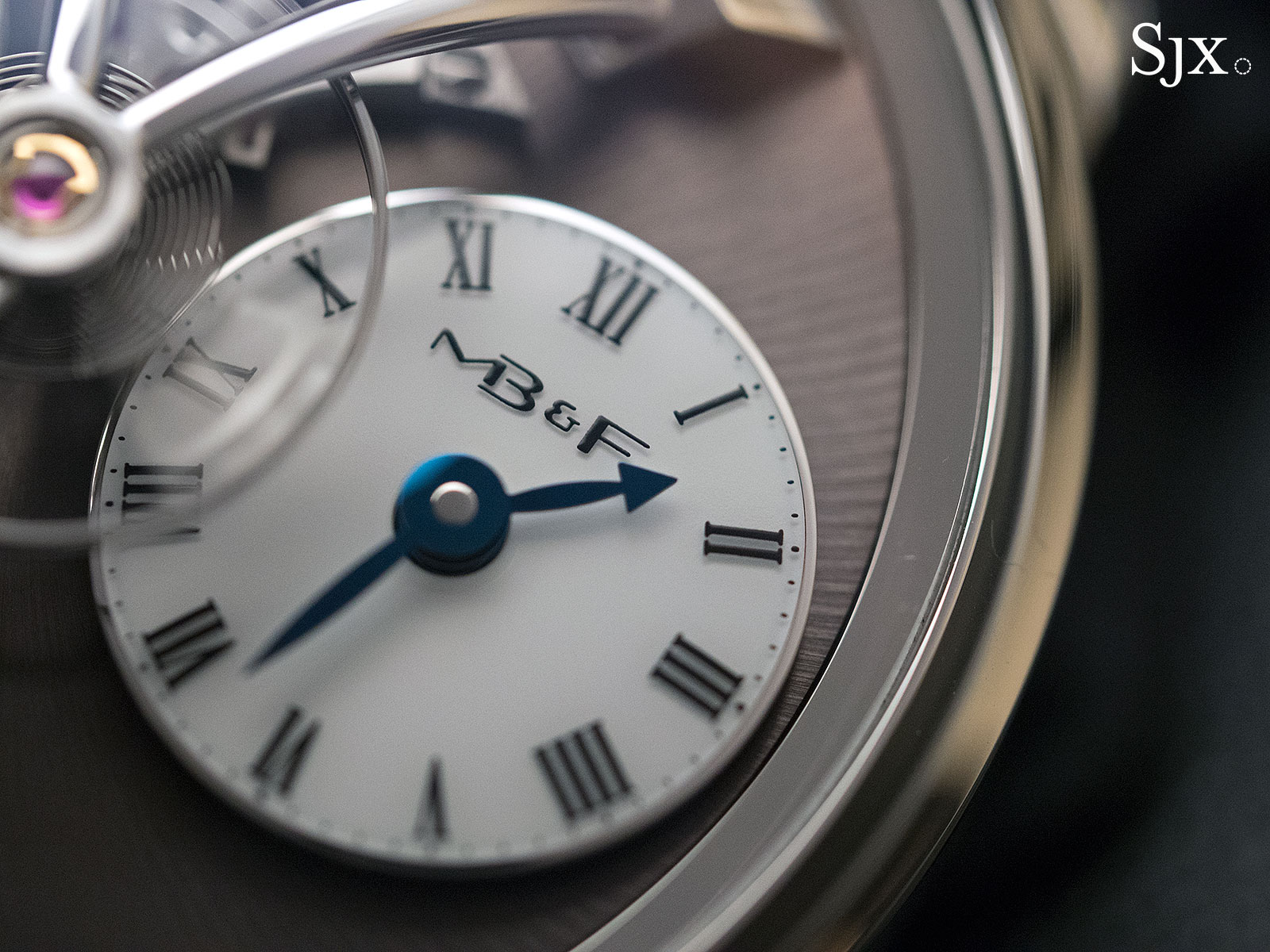
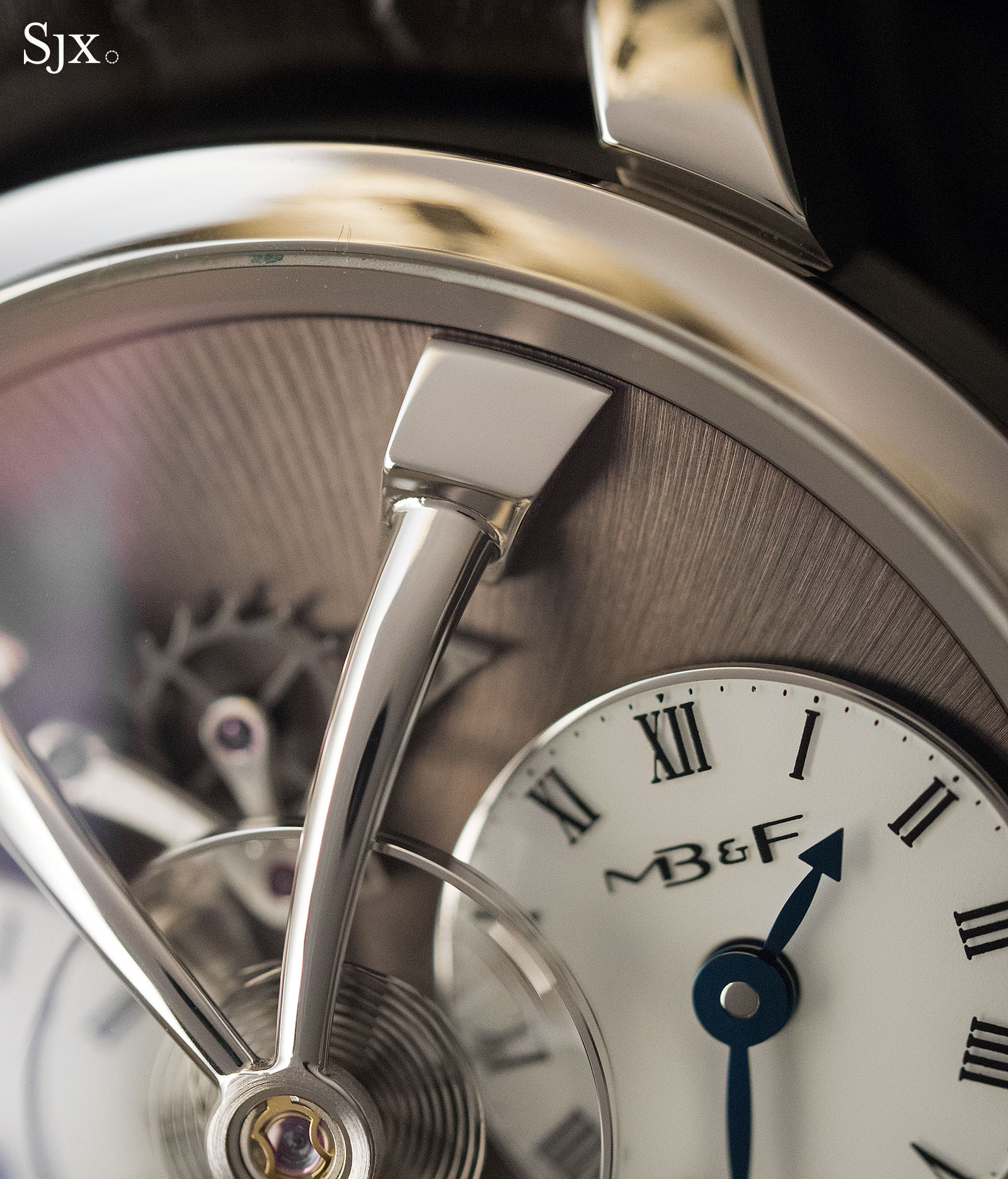
The logo and Roman numerals on the sub-dials are printed on the clear varnish, leaving them seemingly floating

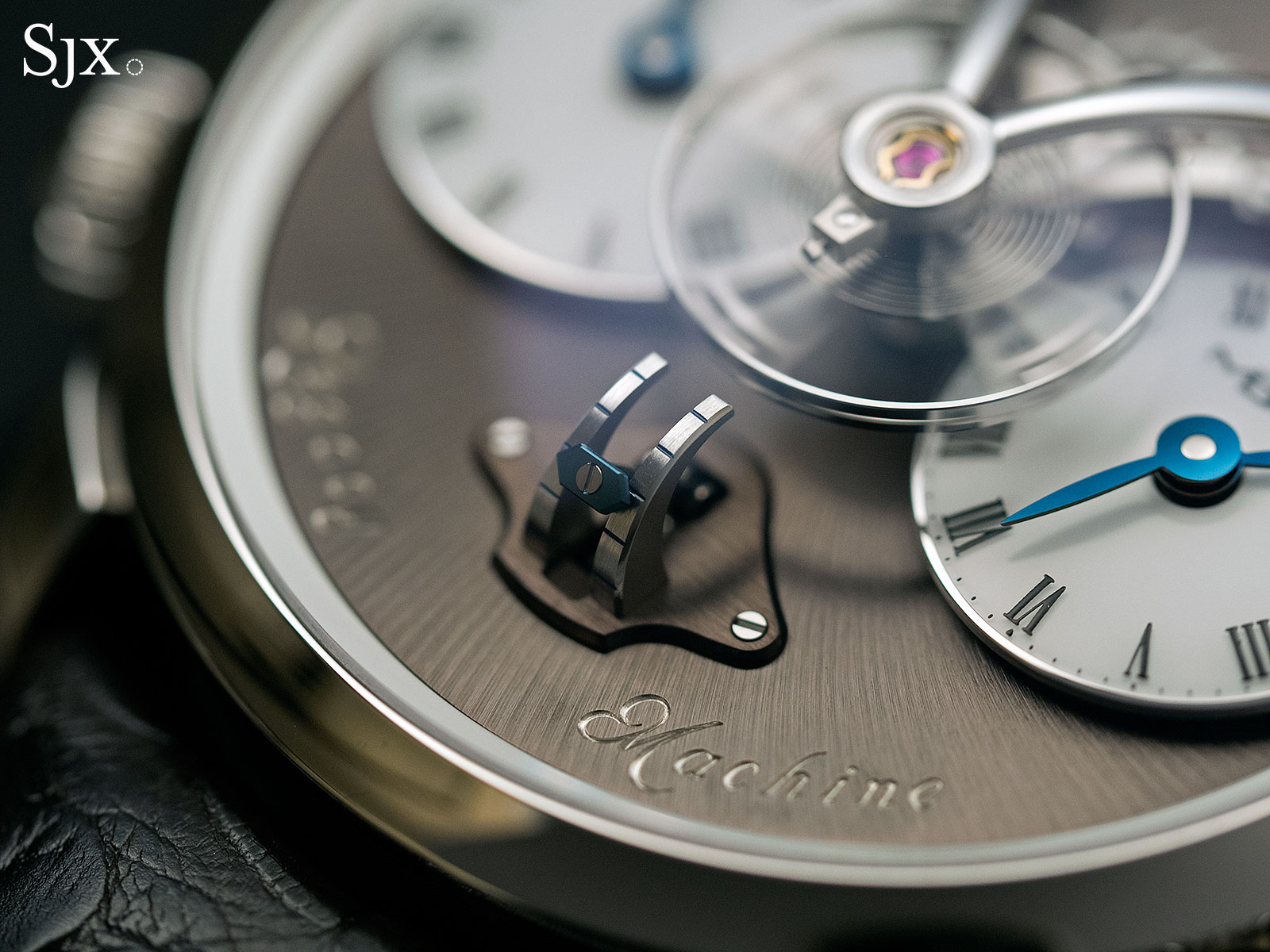
The vertical power reserve lever remains at six o’clock

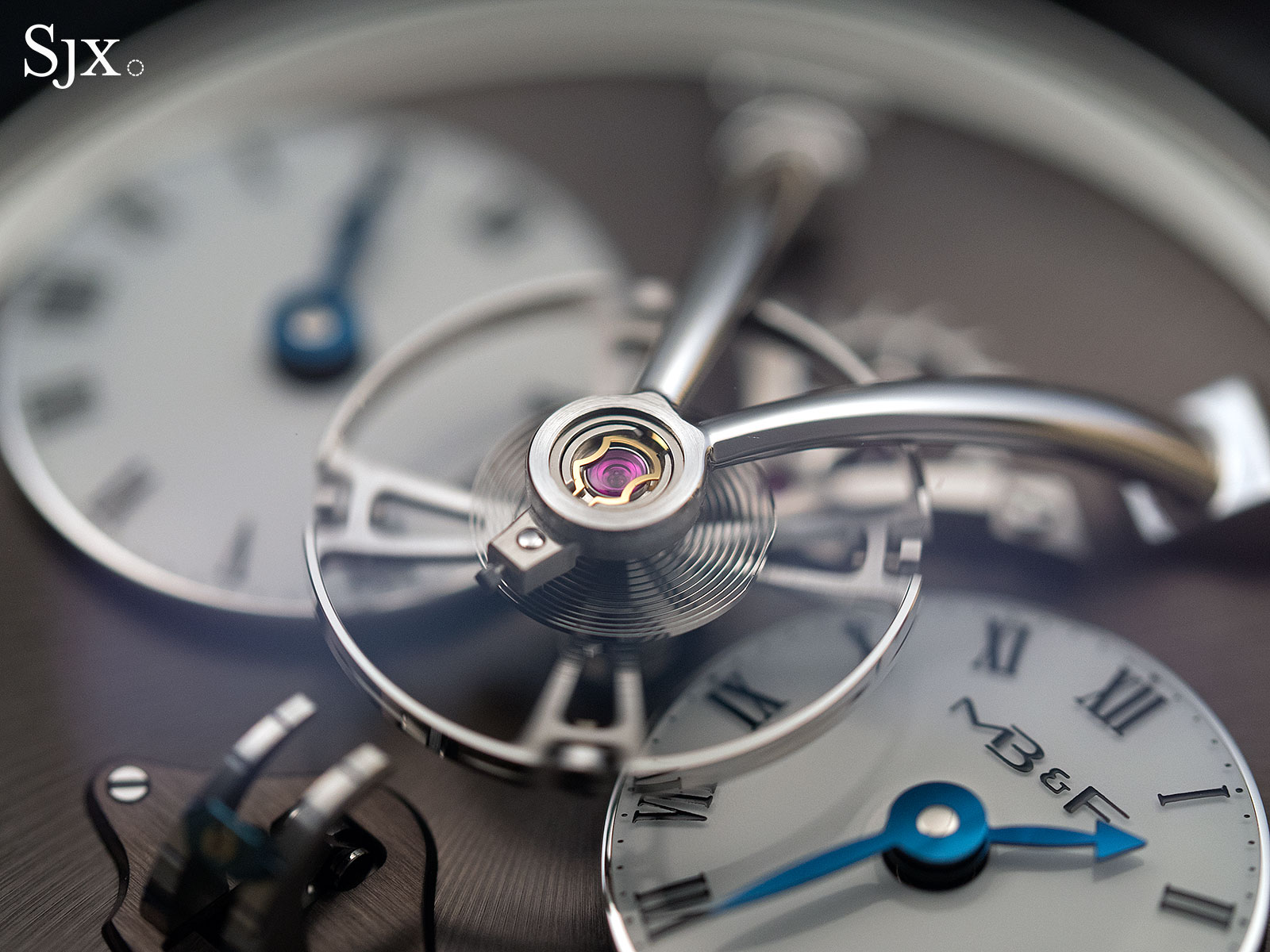
Beyond the colour, the front also differs from the earlier LM1s with the polished, rounded arms of the balance bridge. On its predecessors the arms were an angular, open-worked shape, while the LM1 Final Edition takes the rounded bridge from the LM101. And like the case, the balance bridge is steel, milled into shape by CNC machine and then polished by hand.

MB&F LM1 Final Edition steel 6

Being reminiscent of classical watchmaking as a form typically used for tourbillon bridges, the rounded steel bridge is more philosophically appropriate for the LM1, given the rationale behind its conception and the movement design.

MB&F LM1 Final Edition steel 5

MB&F LM1 Final Edition steel 4

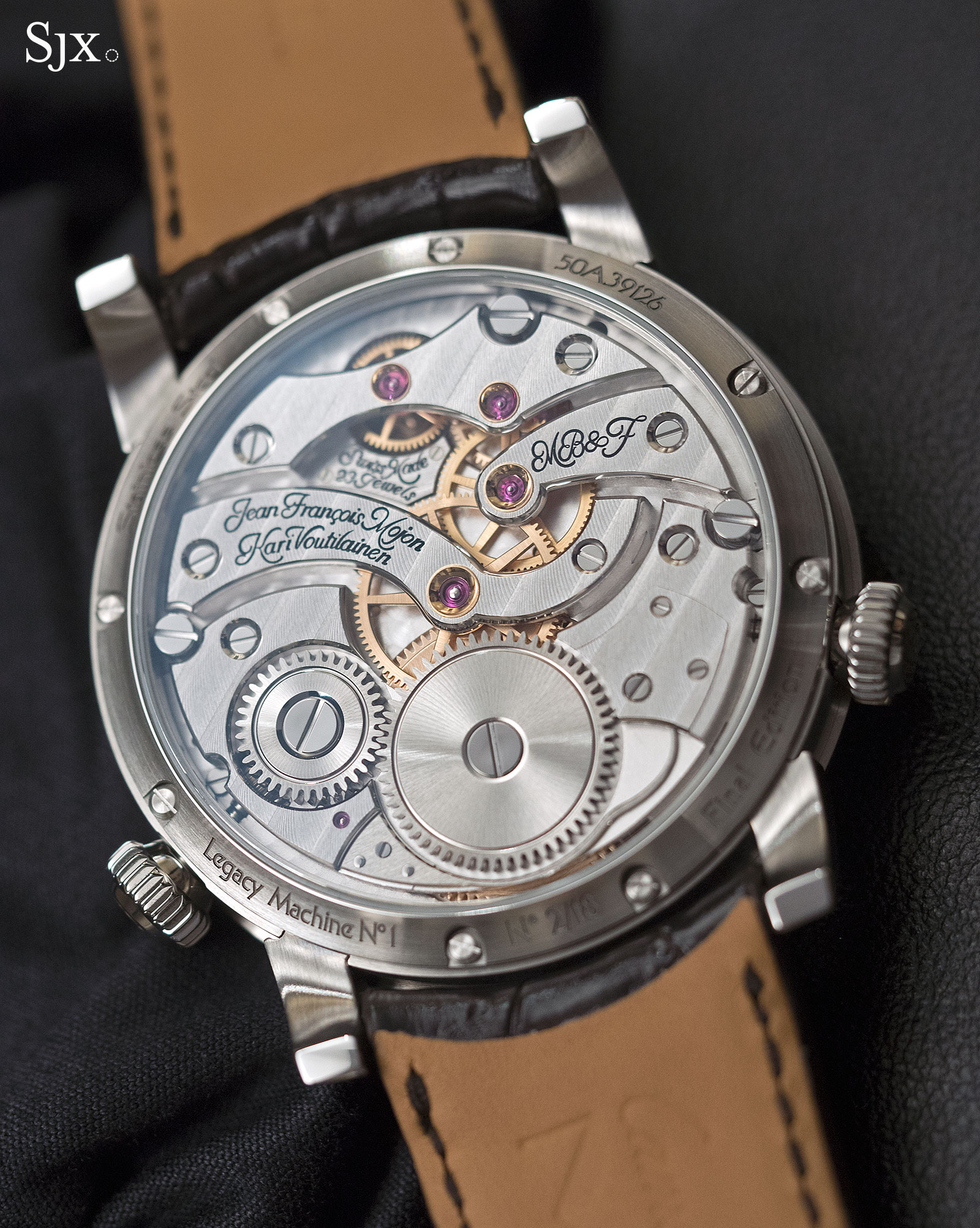
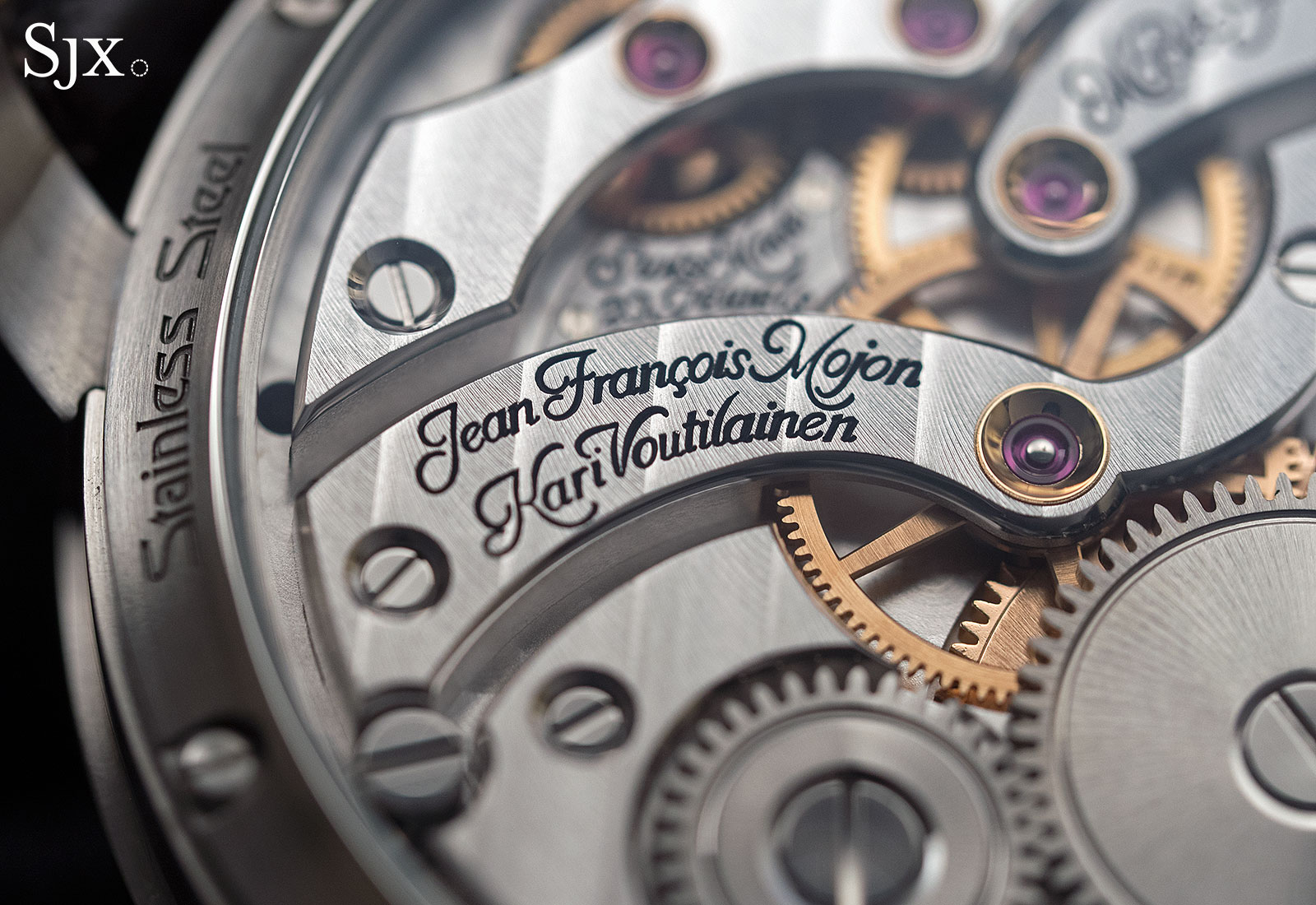
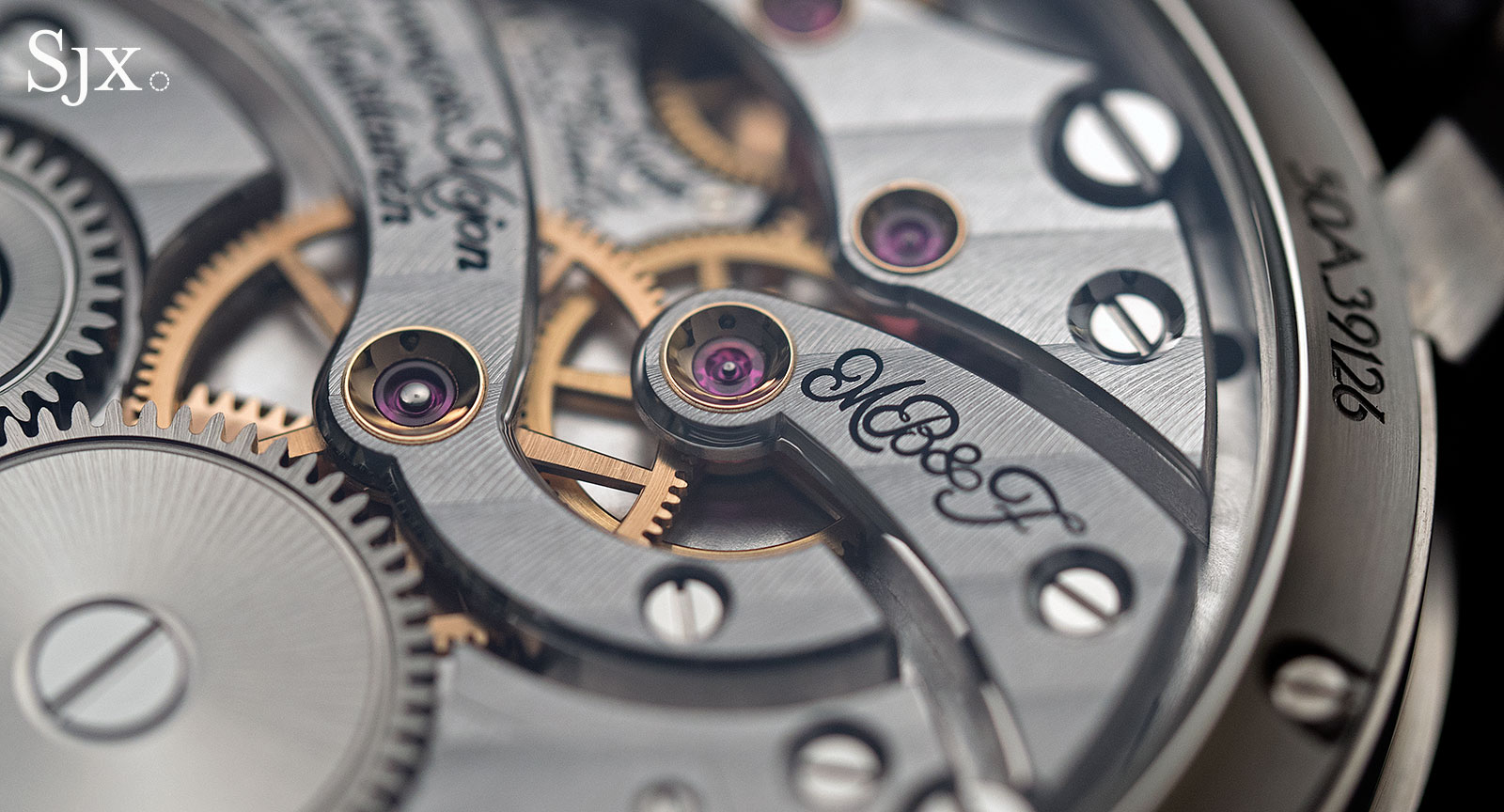
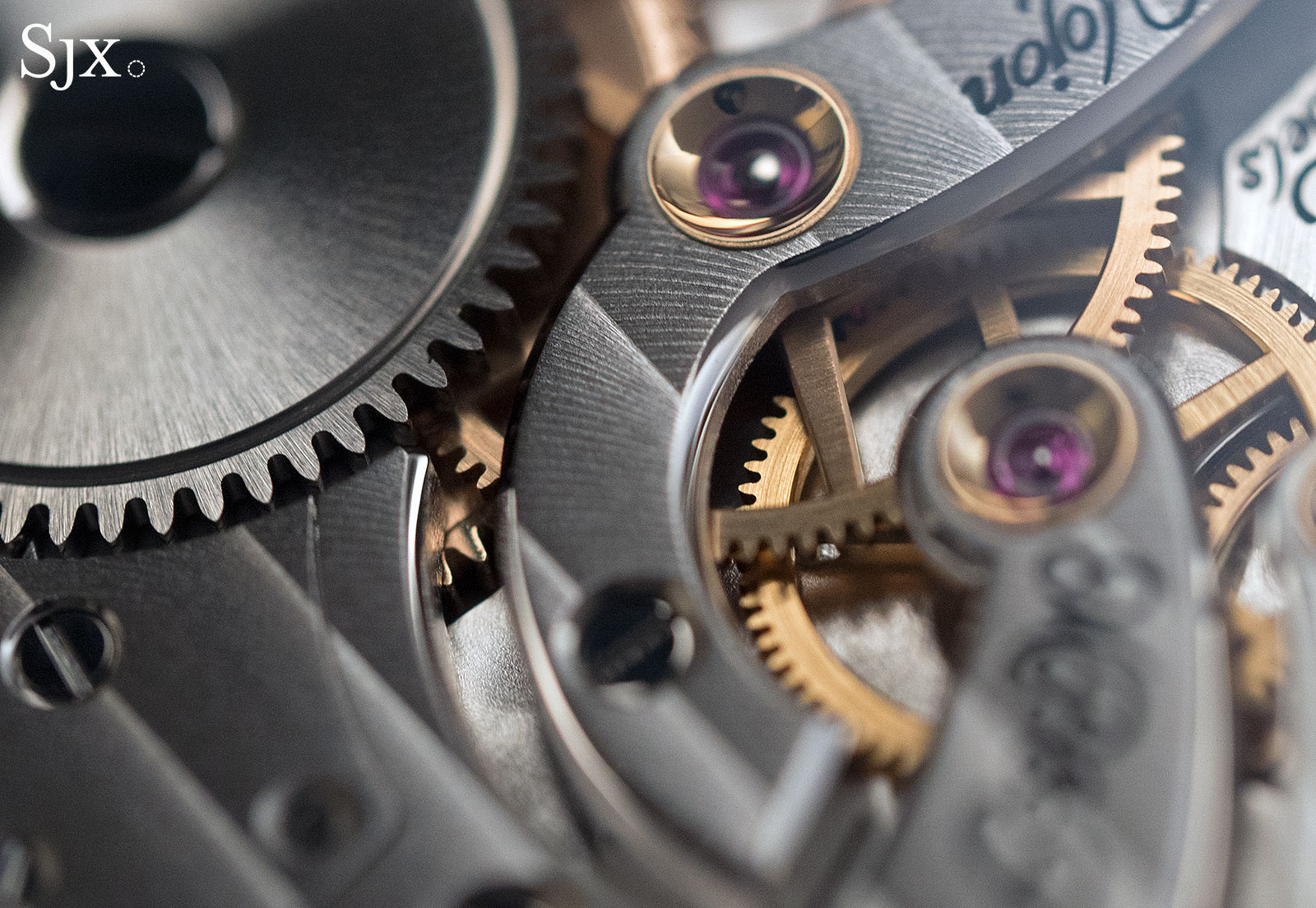
Mechanically the LM1 Final Edition is identical to its siblings, equipped with the hand-wound movement developed by Chronode and styled by Kari Voutilainen. Conceived to look like a vintage pocket watch movement, the bridges are long and curved, while four of the jewels are set in gold chatons.

MB&F LM1 Final Edition steel 8

MB&F LM1 Final Edition steel 12

MB&F LM1 Final Edition steel 9

The decoration is reminiscent of Voutilainen’s work, though not actually done by the Finnish watchmaker. So the Geneva stripes on the bridges, for instance, have a harder grain than those in Voutilainen’s watches. The finishing on the LM1 movement, however, very, very good and immediately appealing. Screws sit in polished countersinks while the bridges are all bordered by polished, rounded bevels.

MB&F LM1 Final Edition steel 10

MB&F LM1 Final Edition steel 11

Ironically the case is arguably where it stands apart from the other LM1s, though it’s in the least expensive material possible. The dimensions remain the same 44mm by 16mm, but it’s noticeably lighter due to the weight of steel.

The choice of steel is fashionable, suiting the current demand for the material as being something rare and collectible (even fellow independent watchmaker F.P. Journe used steel cases for the final run of his 38mm models). And MB&F’s announcement of the LM1 includes a hint that future final edition watches might be in steel as well.

Price and availability 

The LM1 Final Edition is priced at US$79,000 before taxes, and is available at MB&F retailers and boutiques.


Back to top.

You may also enjoy these.

Hands-On with the Audemars Piguet Royal Oak Extra-Thin in Yellow Gold

The Royal Oak "Jumbo" makes a comeback in yellow gold - and it's gorgeous.

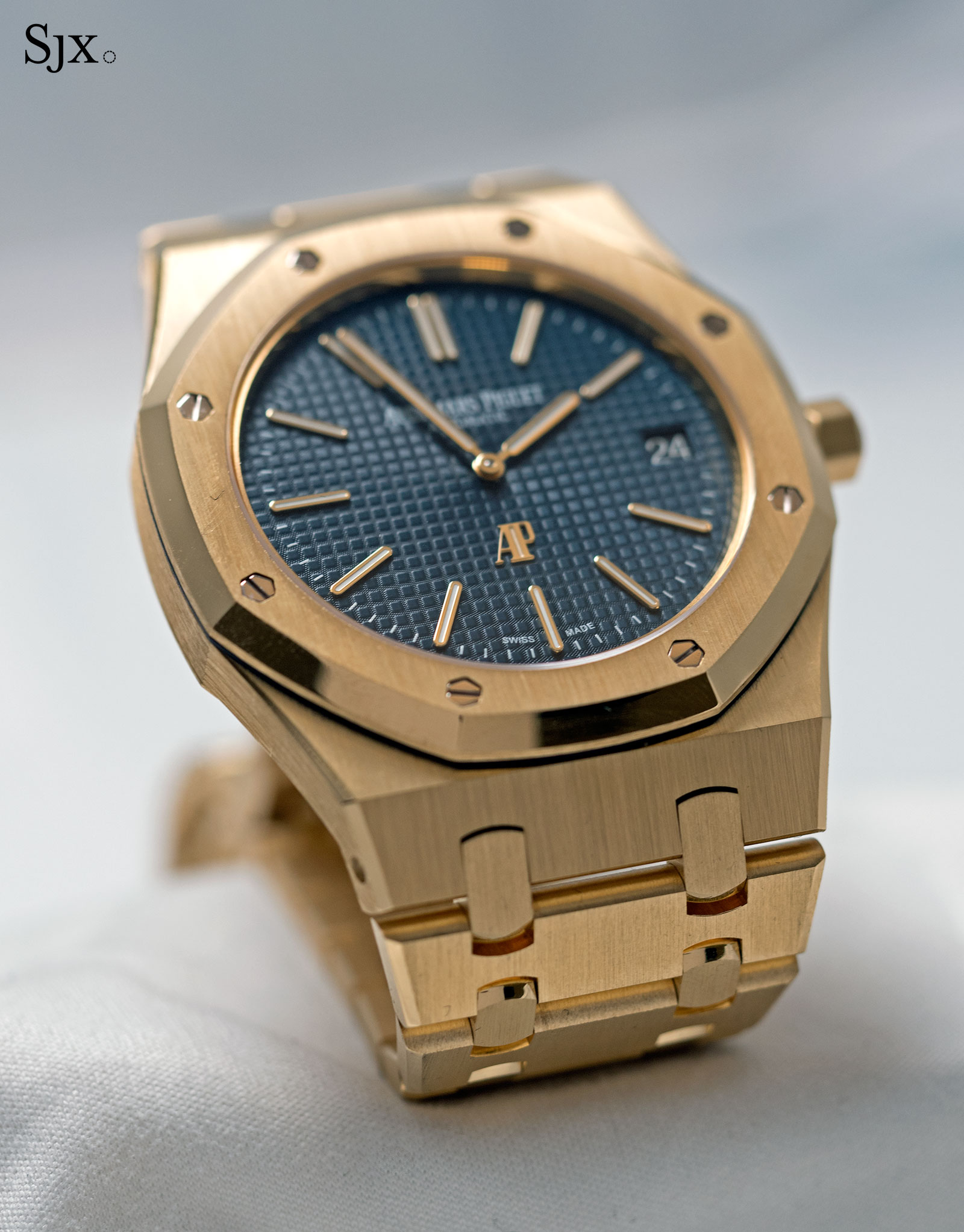
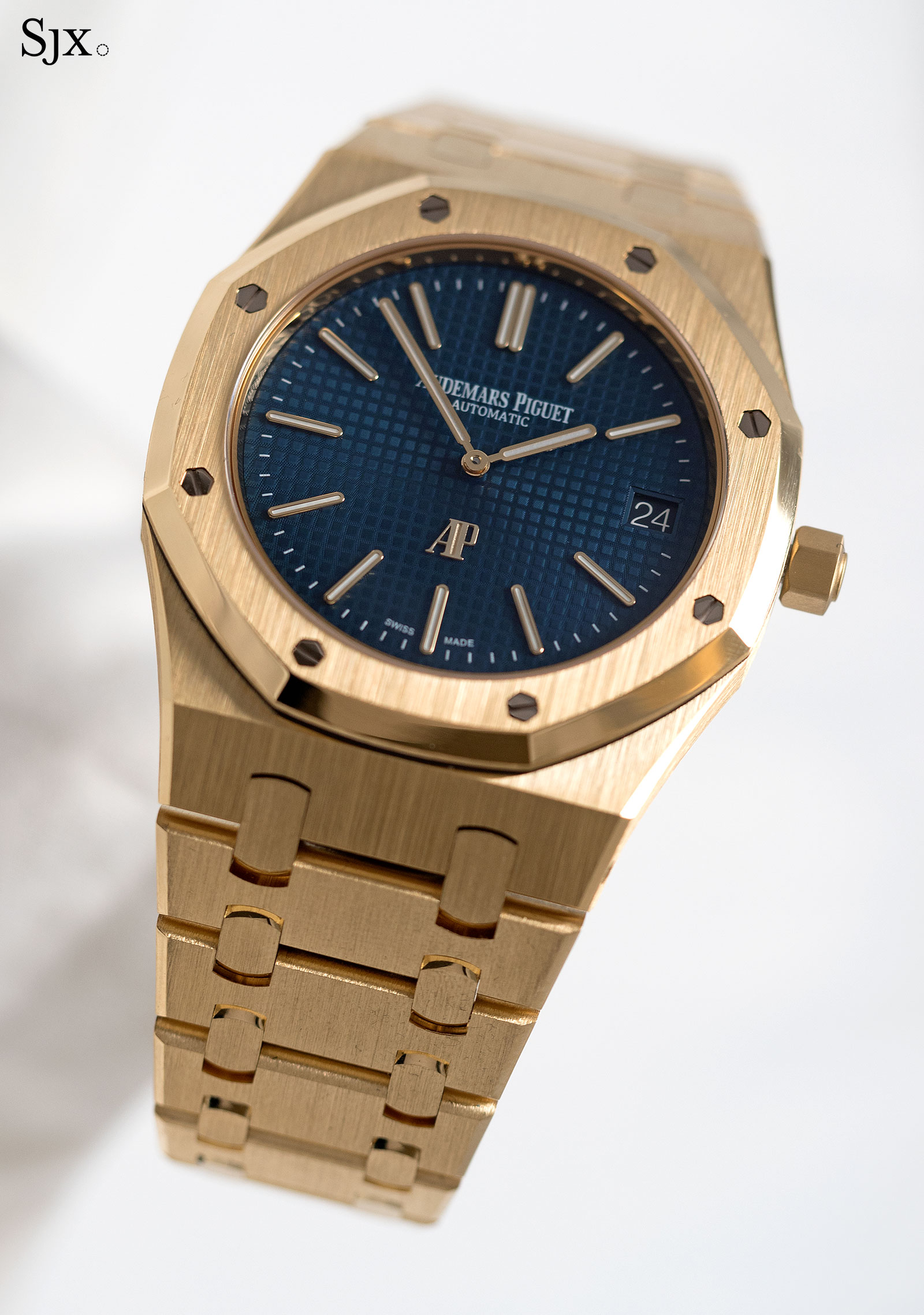
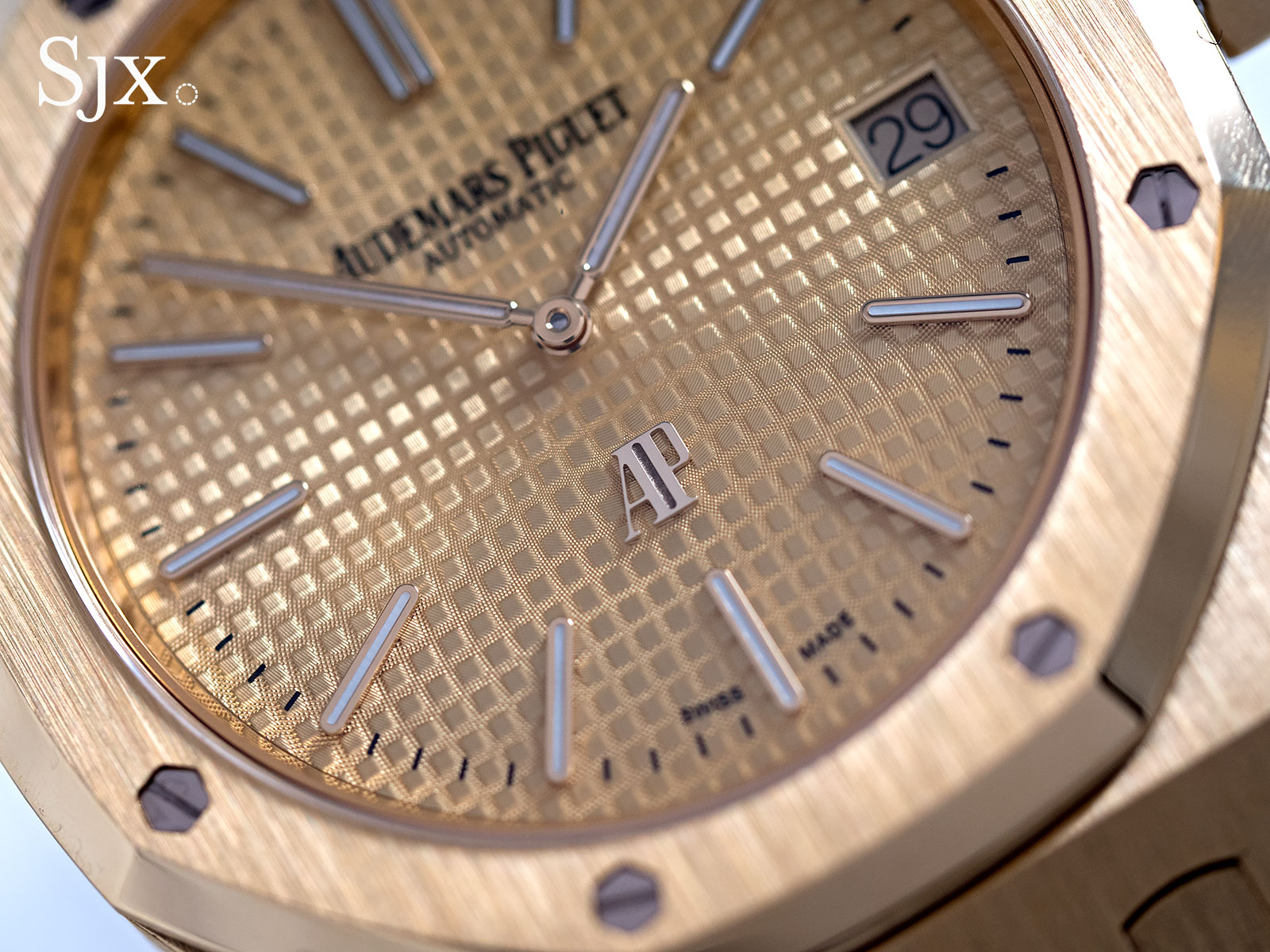
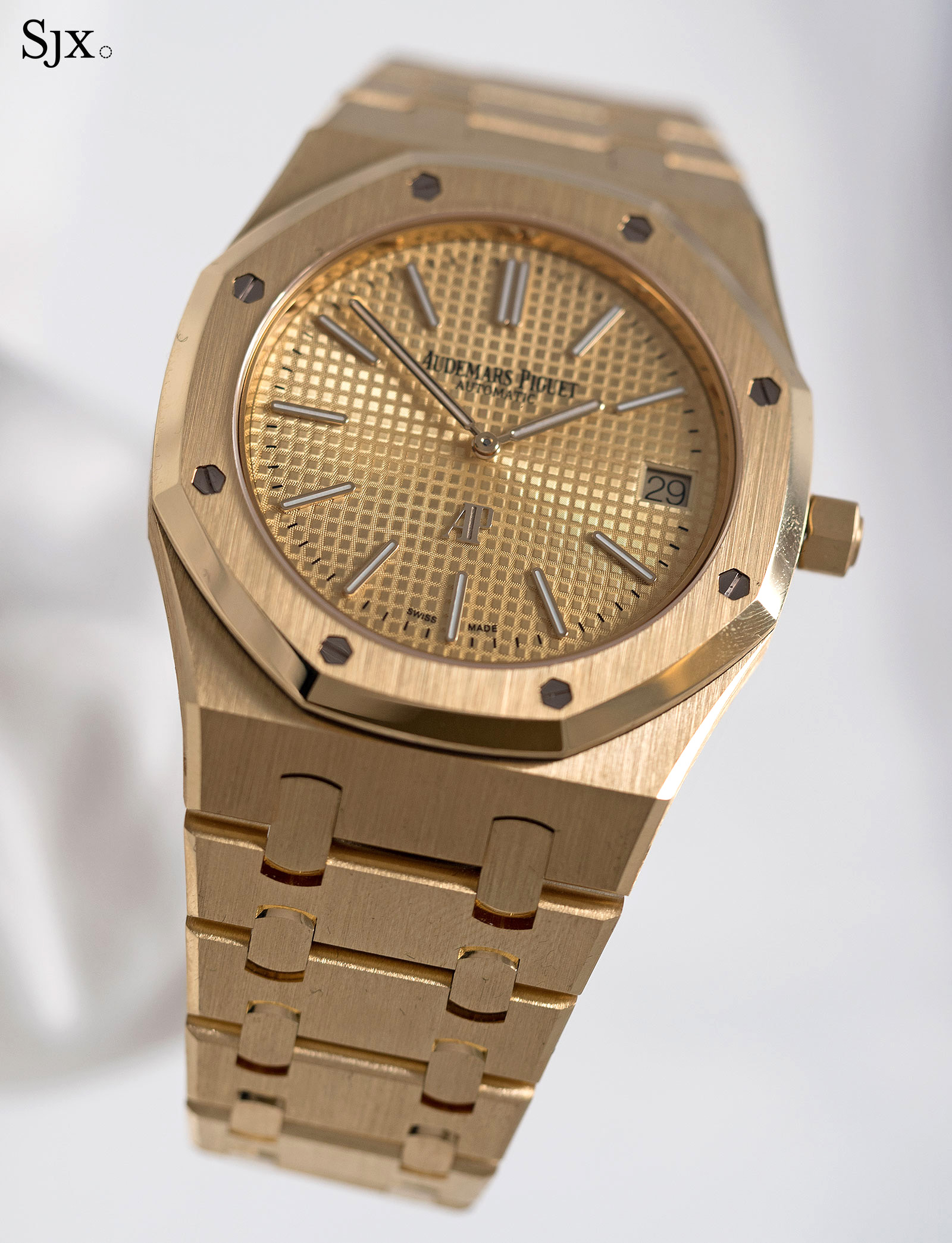
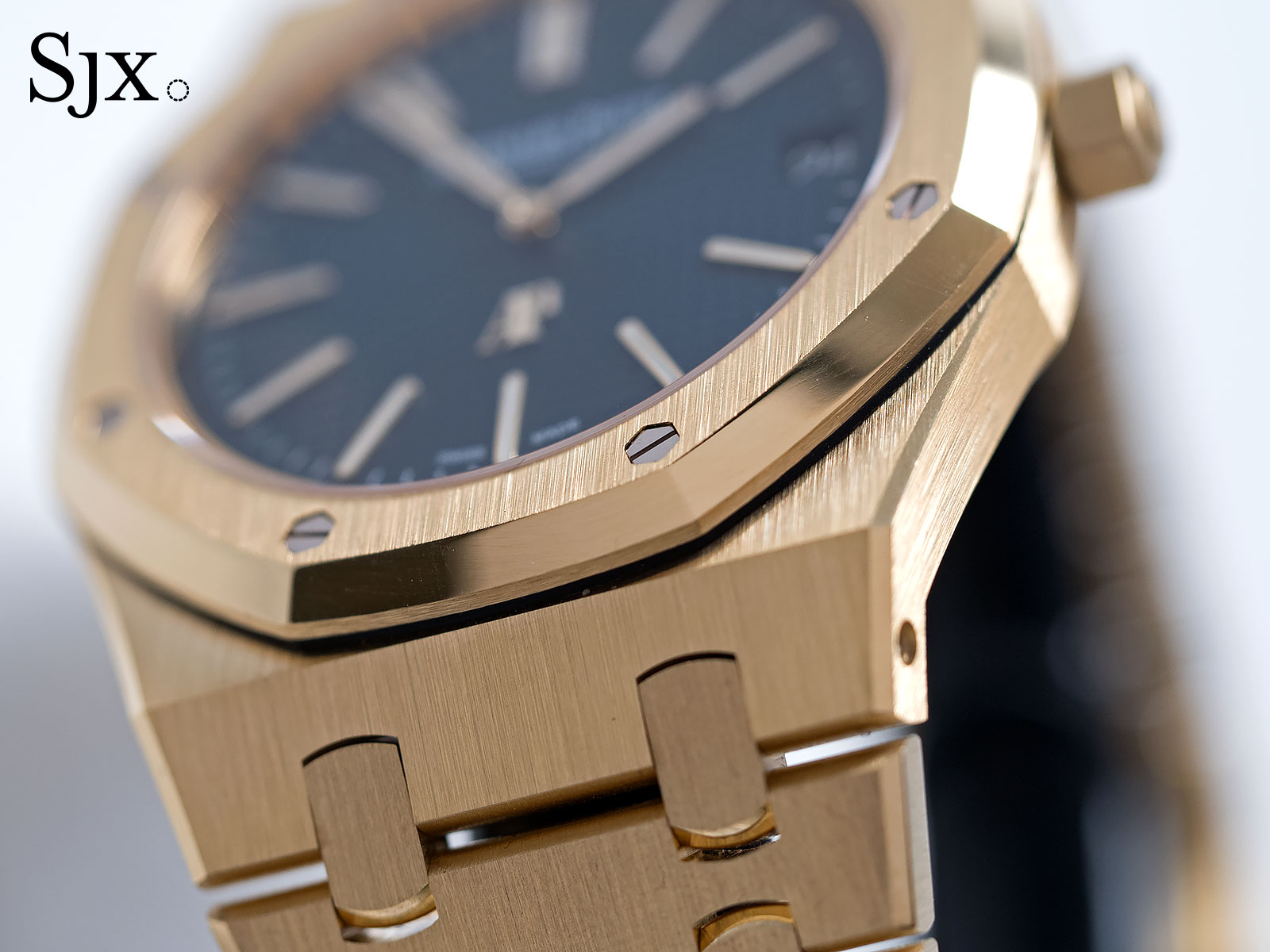
First introduced as a 50-piece, green dial limited edition for Singapore retailer The Hour Glass, the Audemars Piguet Royal Oak Extra-Thin in yellow gold was added to the regular line-up at SIHH 2017. And it is as good looking and expensive as it ever was.

A modern remake of the original Royal Oak “Jumbo” ref. 5402 of 1972, the Royal Oak Extra-Thin is a classic in steel and impressive in gold. It was originally available only in pink gold, which made it loud, but the yellow gold rendition comes across as slightly more classic. Yellow gold is after all one of the metals the Royal Oak was available in, back in the 1970s.

AP Royal Oak Extra Thin yellow gold blue

AP Royal Oak Extra Thin yellow gold blue dial

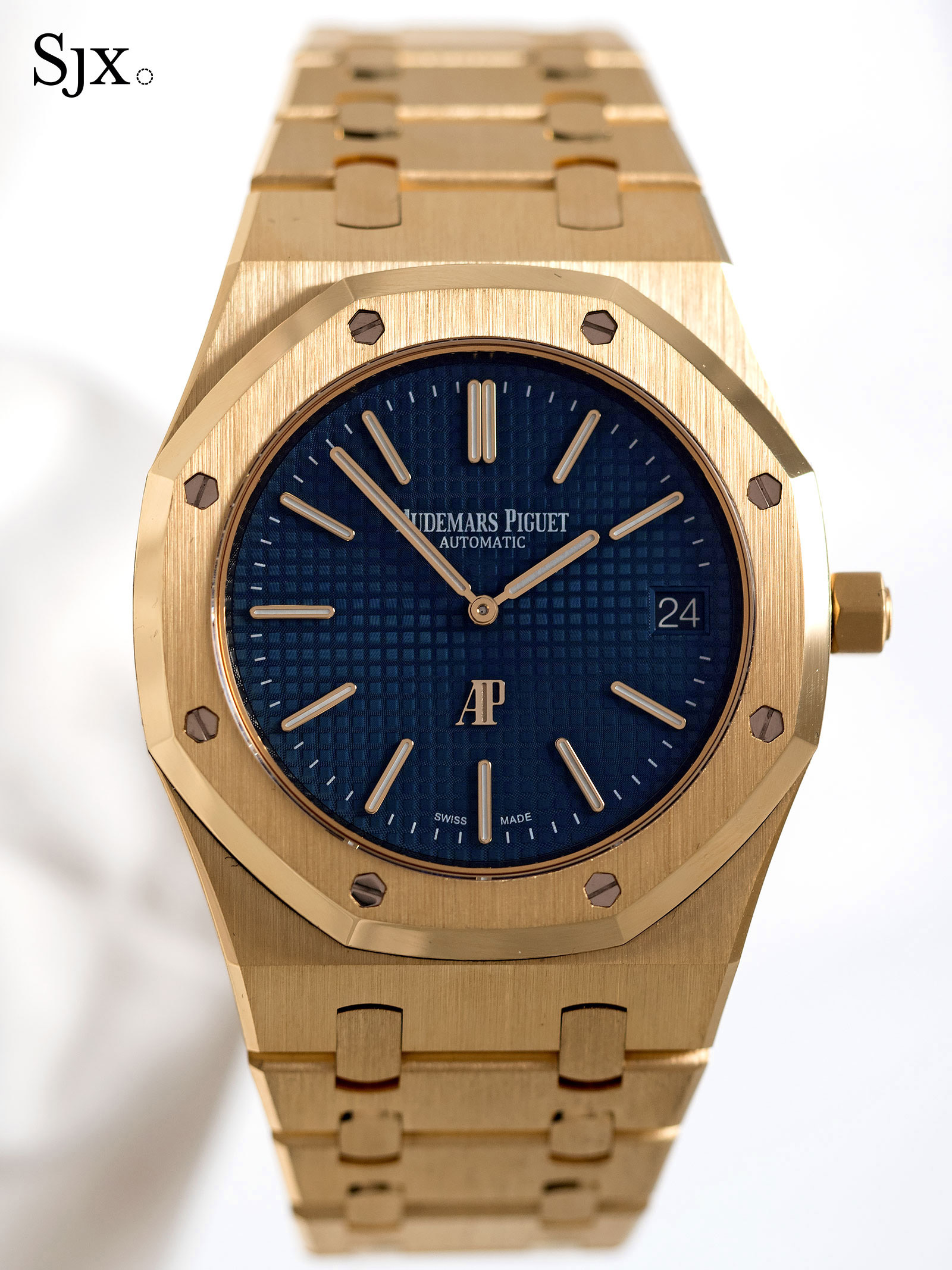
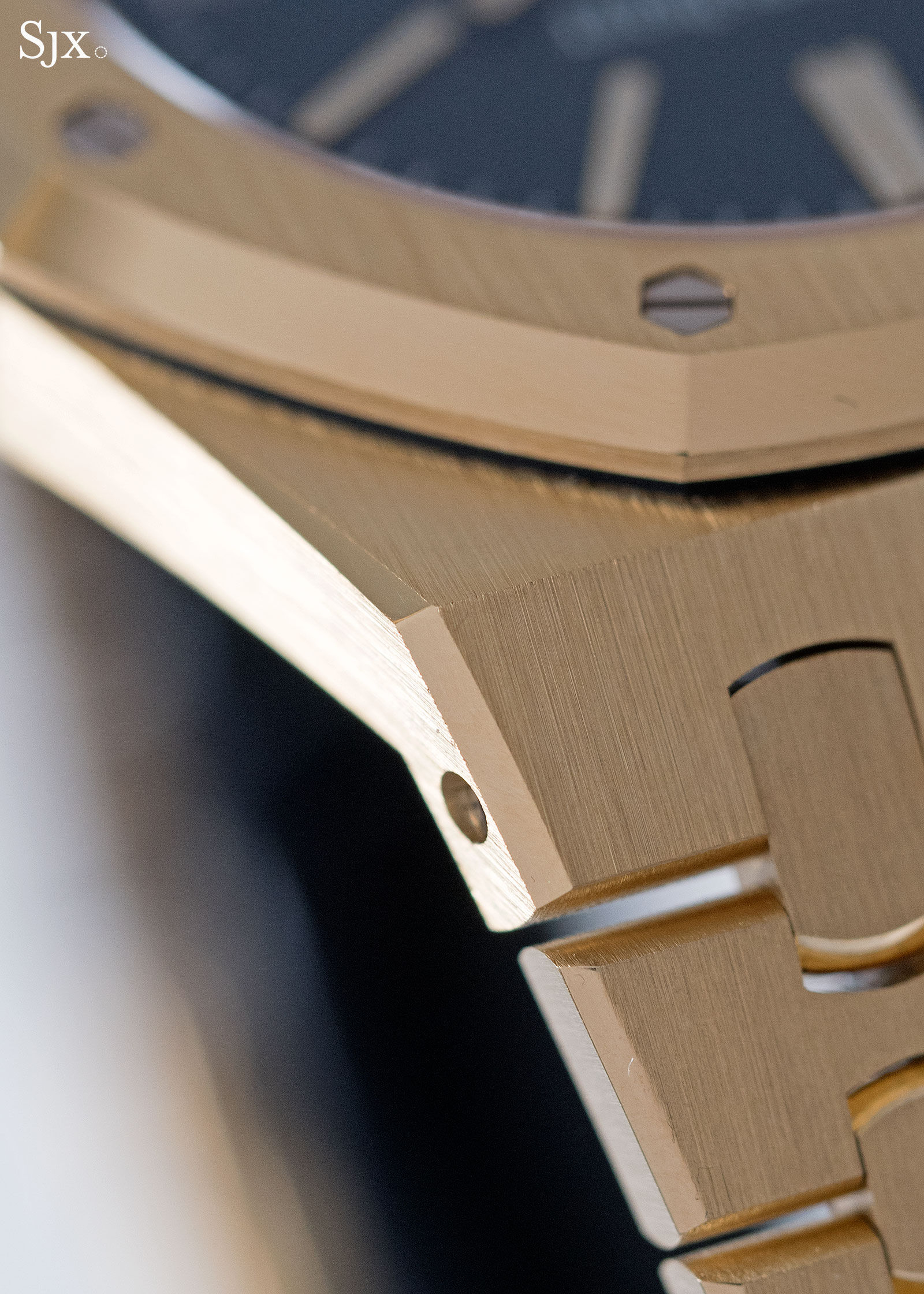
Available in either the classic dark blue or a newly introduced yellow gold finish, the Royal Oak Extra-Thin in yellow gold is physically identical to its siblings in steel and pink gold. The case is 39mm wide, thin at 8.1mm high. It cuts an elegant profile on the wrist, and is weighty despite being slim.

AP Royal Oak Extra Thin yellow gold 4

AP Royal Oak Extra Thin yellow gold 2

AP-Royal-Oak-Extra-Thin-yellow-gold-3

Because the case is essentially an agglomeration of flat surfaces, it feels somewhat angular on the wrist unlike its only peer, the Patek Philippe Nautilus, which is comprised more rounded shapes.

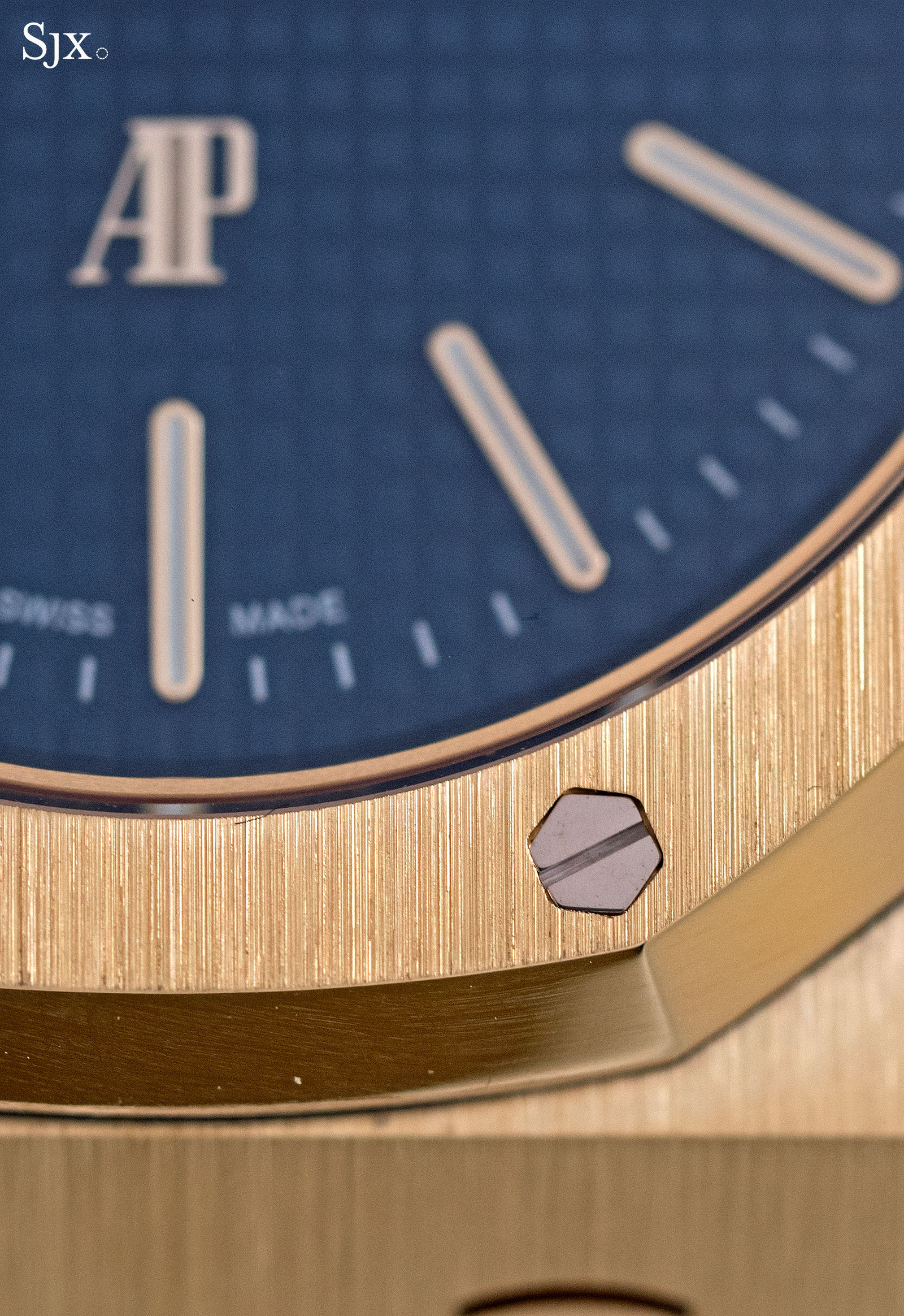
Yellow gold is not common in high-end men’s watches, especially from haute horlogerie names, but it’s an appeal look for someone who leans towards a lavish, slightly vintage feel. But like all other gold alloys, yellow gold is soft (marginally softer than white gold in fact), leaving the lovingly finished surfaces of the watch vulnerable to marring. There is perhaps no other watch that looks as good as the Royal Oak when factory fresh and pristine – the alternating polished and brushed surfaces on the case are gorgeous.

AP Royal Oak Extra Thin yellow gold

AP Royal Oak Extra Thin yellow gold blue 6

AP Royal Oak Extra Thin yellow gold blue 3

AP Royal Oak Extra Thin yellow gold blue 7

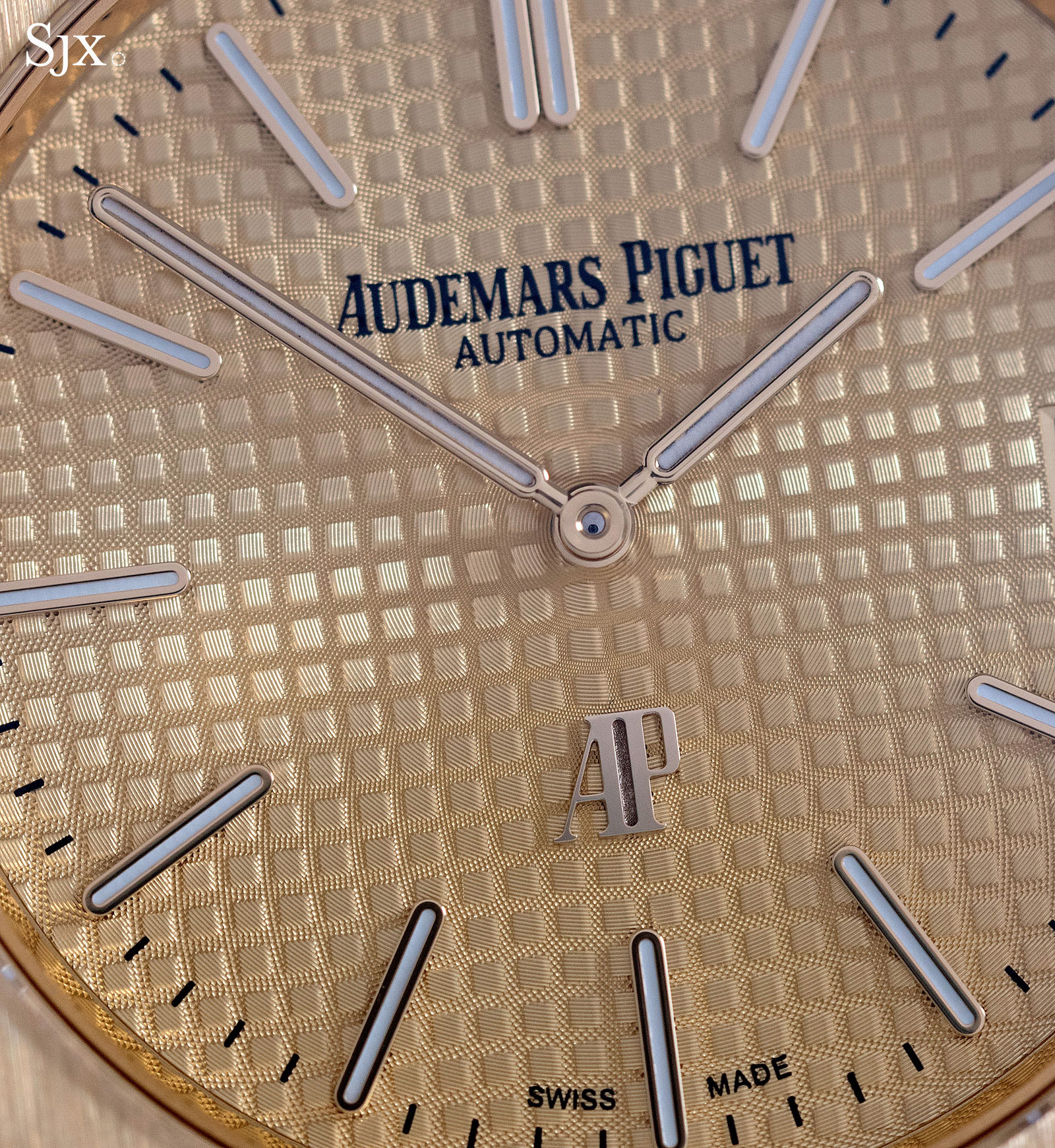
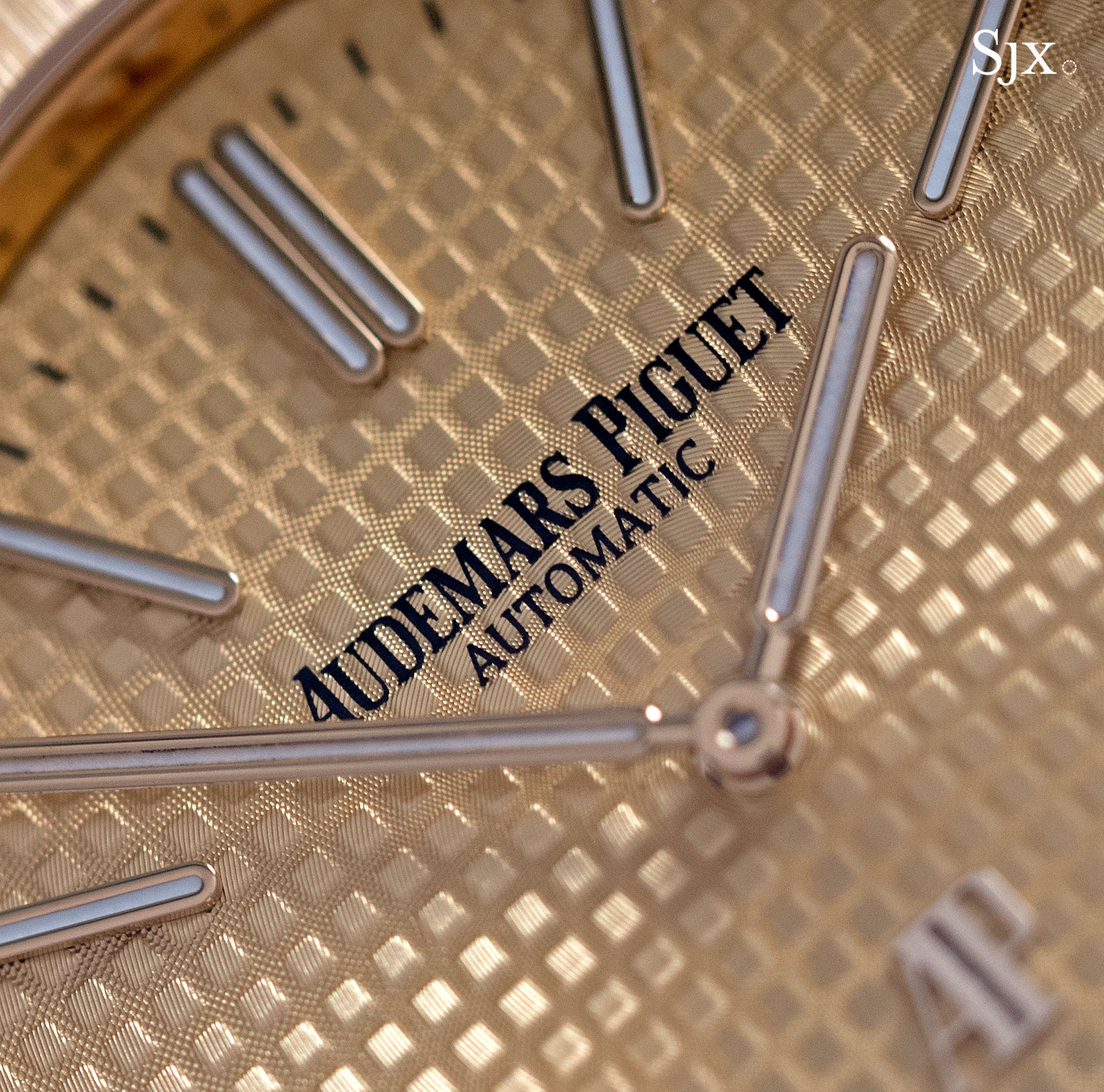
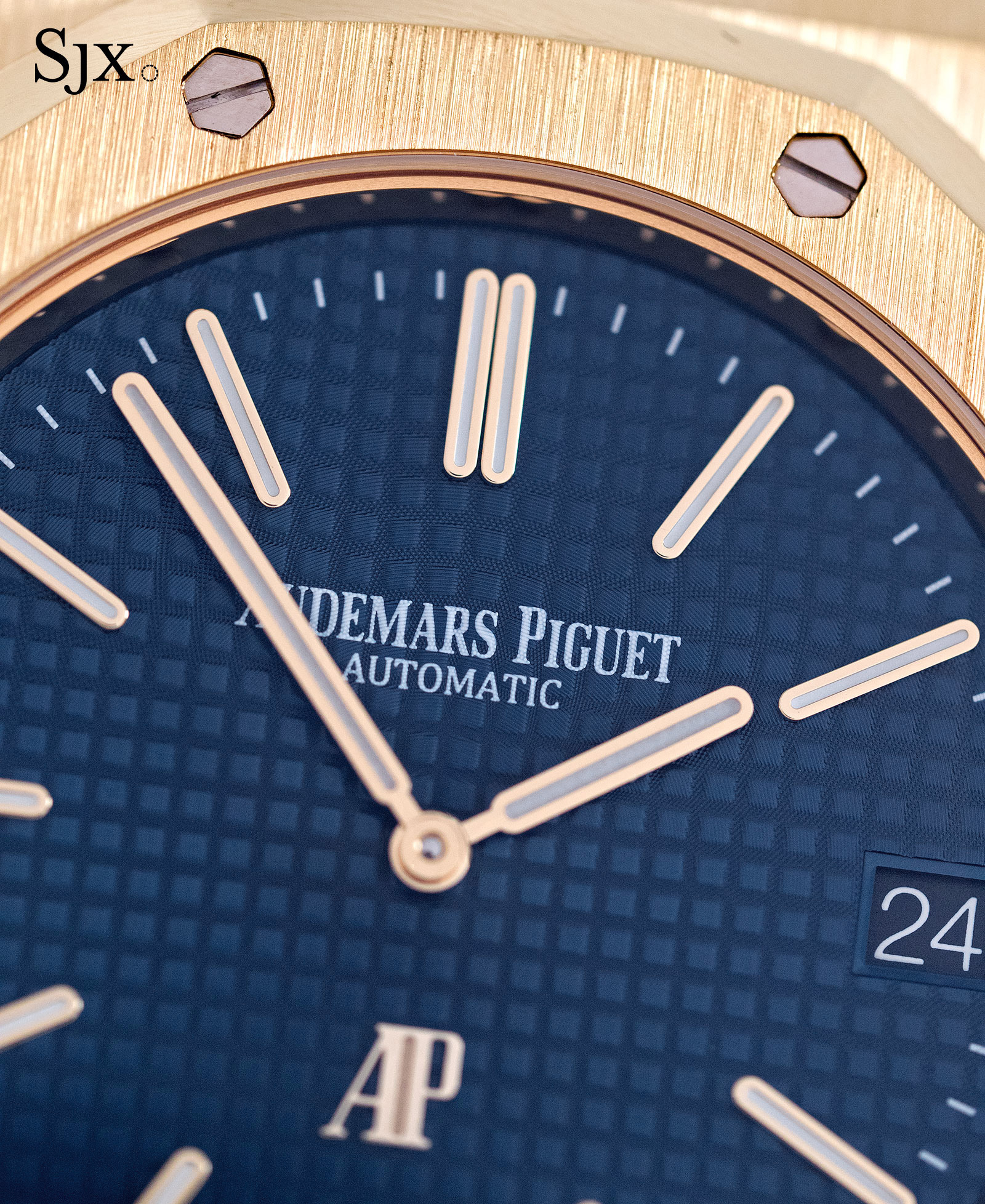
Both the blue and gilded dials have the same quintessential chequerboard tapisserie guilloche that’s a trademark of the Royal Oak. Done by hand on a rose engine – creating the telltale motif below the chequerboard – the dials are brass but fitted with solid gold hands and hour markers. Both colours are equally handsome, but the yellow gold finish has an edge in that it’s a less common colour that’s unashamedly loud while maintaining a modicum of style.

AP Royal Oak Extra Thin yellow gold 5

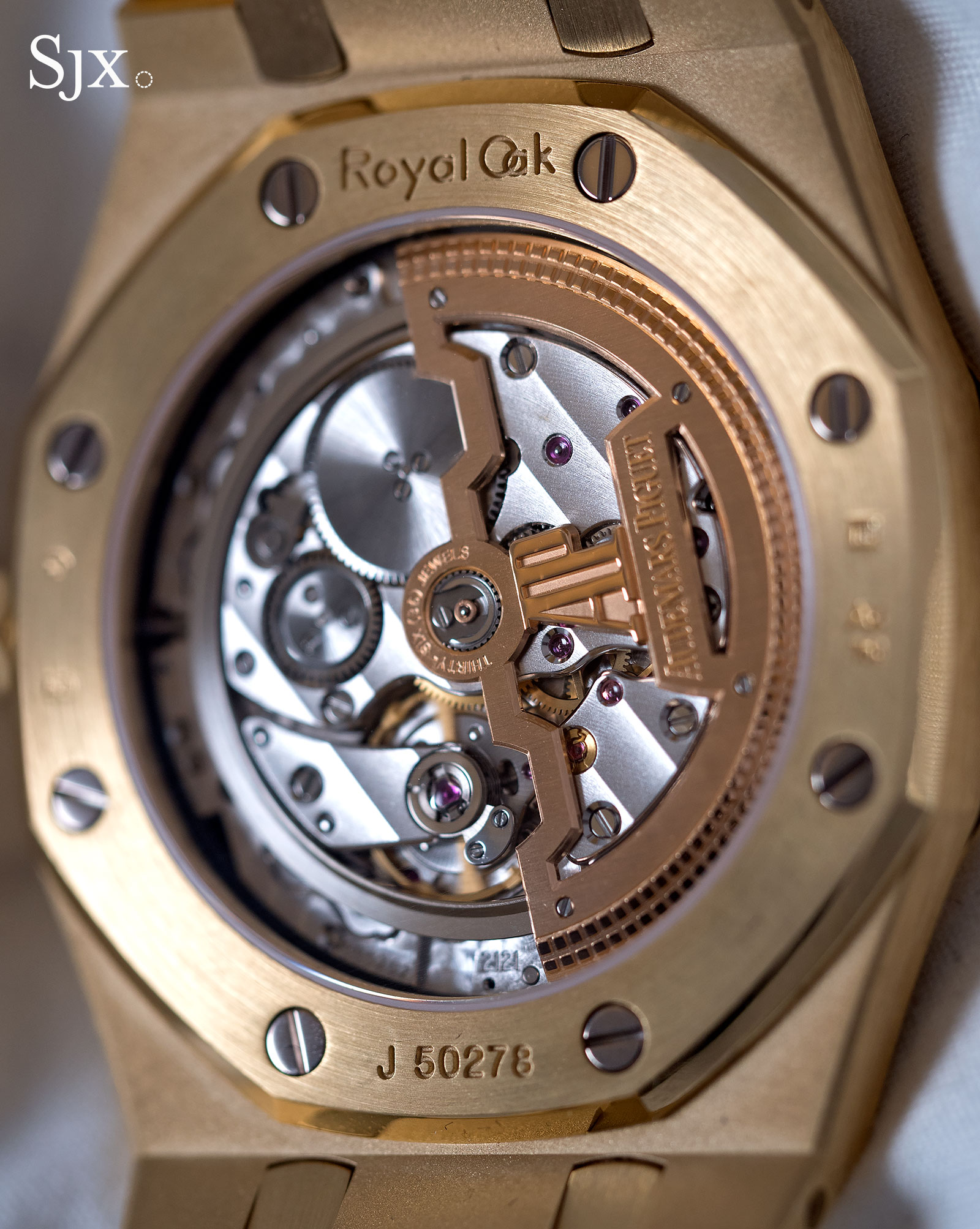
Mechanically the Royal Oak Extra-Thin is almost identical to the 1972 original, with the same calibre 2121 that was originally developed by Jaeger-LeCoultre as the calibre 920. A sophisticated and slim movement that’s withstood the test of time, the calibre 2121 has been slightly upgraded over the years, improving its robustness and reliability, but still lacks a quickset date – probably the singular weakness of the Royal Oak Extra-Thin.

Notably Audemars Piguet now owns the intellectual property for the calibre 2121 and produces the movement in-house. Because its slimness makes the 2121 more challenging than a run of the mill calibre, the movement is produced at Renaud & Papi, the complications specialist owned by Audemars Piguet better known for the tourbillon movements it produces for Richard Mille.

AP Royal Oak Extra Thin yellow gold blue 4

Like the calibre 2121 found in other Audemars Piguet watches, the movement inside the Extra-Thin can be customised with a personalised rotor that can be open-worked to form a variety of motifs.

Price and availability 

Available starting May 2017 at Audemars Piguet boutiques first and then at retailers, the Royal Oak Extra-Thin in yellow gold is available with a dark blue dial (ref. 15202BA.OO.1240BA.01) or a yellow gold dial (ref. 15202BA.OO.1240BA.02). Both are priced at US$55,400 or S$77,700.


Back to top.

You may also enjoy these.

Panerai Introduces Trio of Luminor 1950 PCYC Chrono Flyback Limited Editions

Three chronographs for the 2017 season of the world's premier classic yacht circuit.

Panerai chief executive Angelo Bonati is a keen sailor, and for that reason the watchmaker has been a sponsor of the Panerai Classic Yachts Challenge (PCYC) since 2004. Open only to yachts built of wood or metal before 1950 (known as “vintage yachts”) and before 1976 (“classic yachts”), as well as replicas of such yachts, the PCYC is comprised of several regattas over the course of the year.

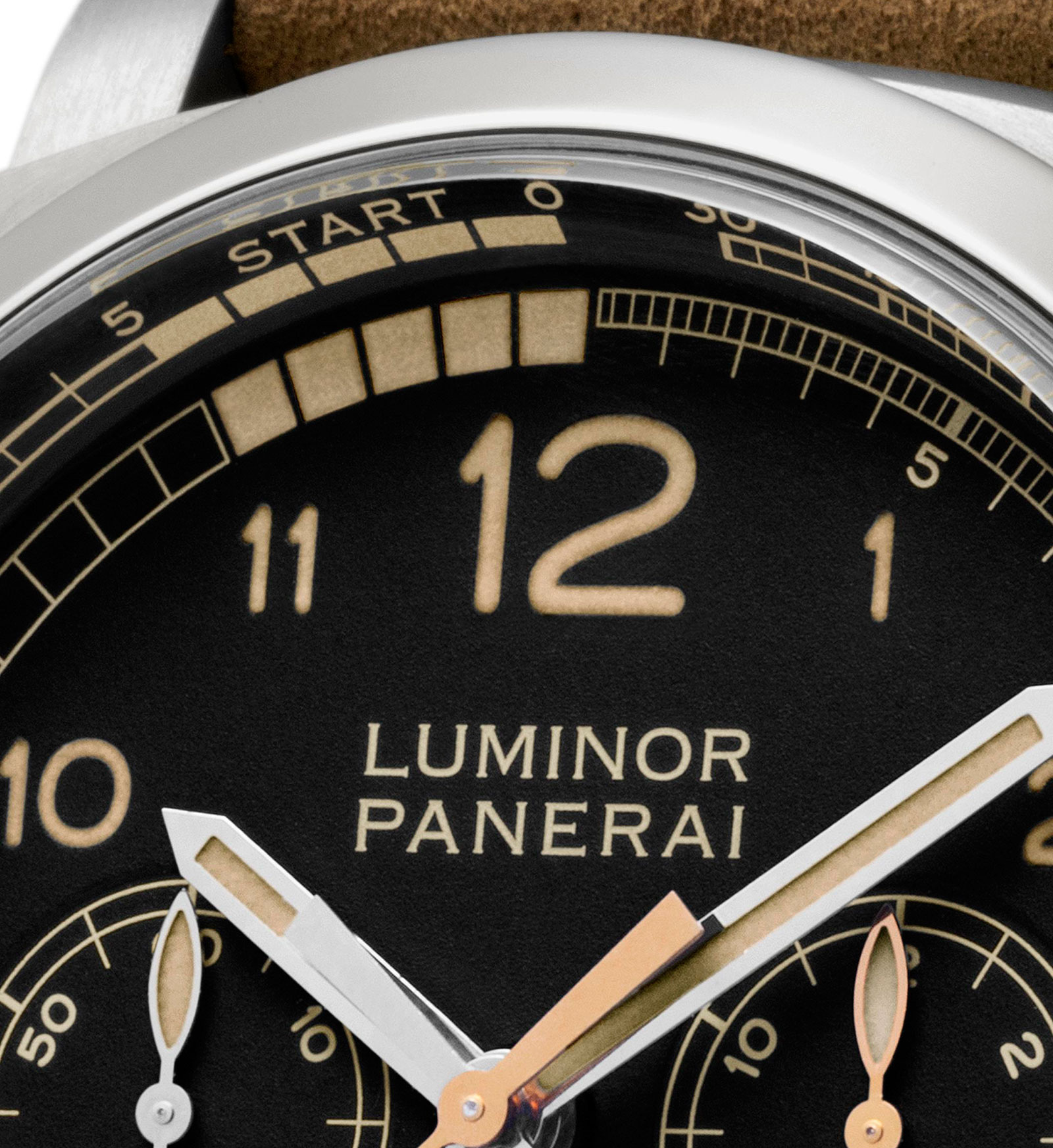
This year’s PCYC kicked off with a regatta in Antigua, which is followed by the Mediterranean circuit in spring. Alongside the start of the 2017 season was the launch of three Luminor 1950 PCYC chronographs – a pair in 44mm steel cases, and a 47mm model in titanium with regatta countdown.

Panerai Classic Yachts Challenge 2017 1

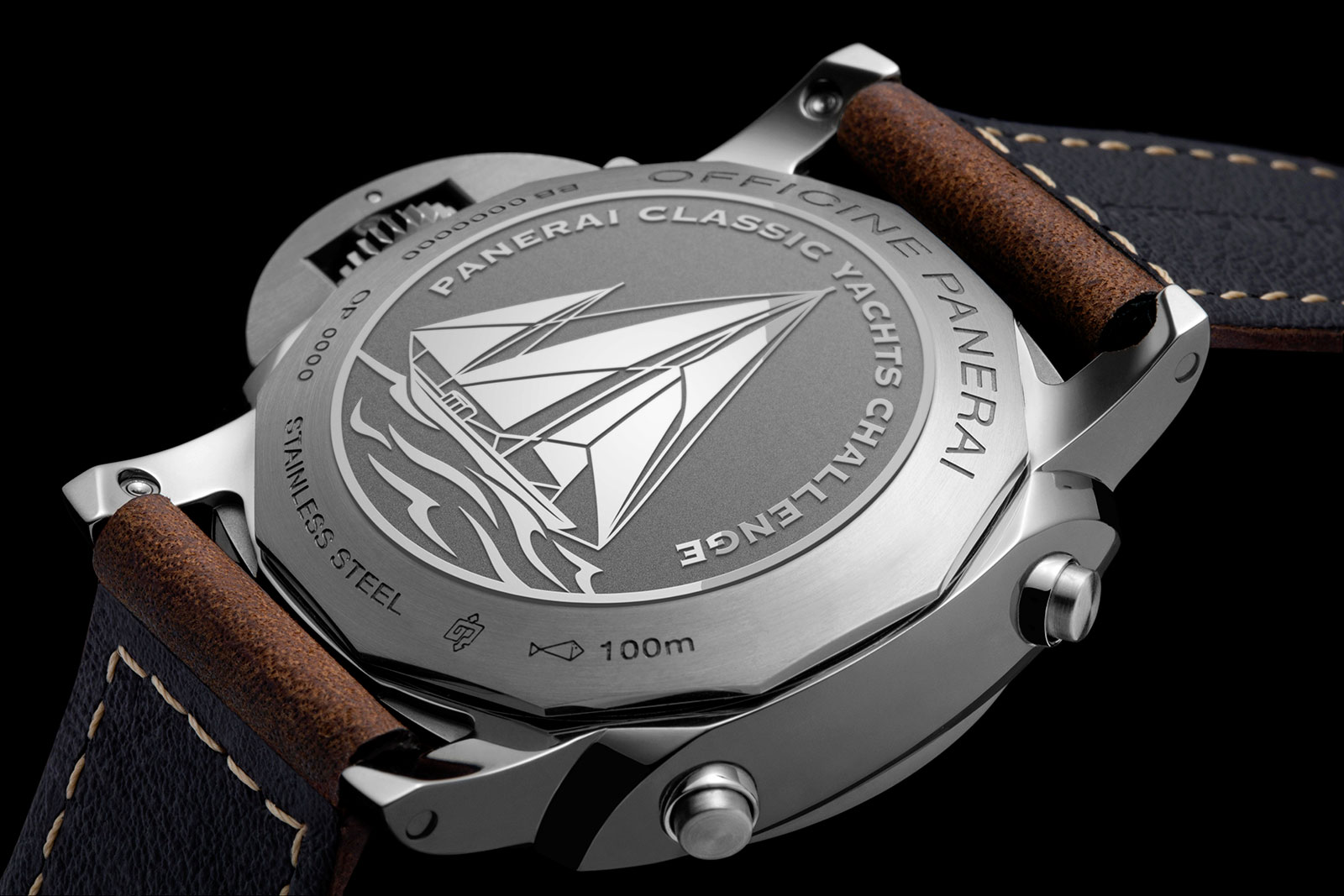
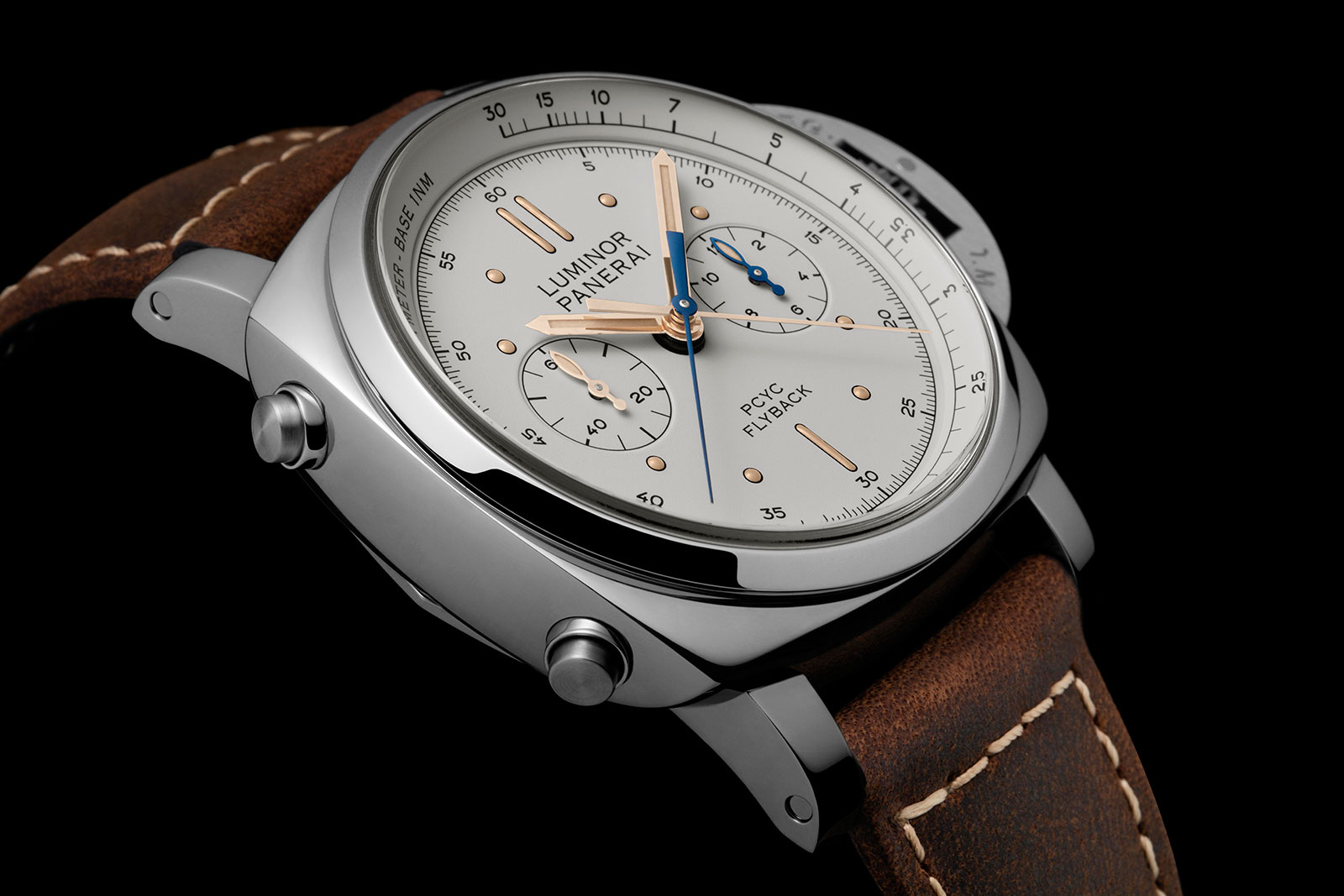
The Luminor 1950 PCYC 3 Days Chrono Flyback Automatic comes in two guises, with the dial in either black (PAM 653) or ivory (PAM 654). Both share the same 44mm steel case, as well as the P.9100 movement that’s automatic and features a flyback function. And like all of Panerai’s in-house chronograph movements it has a vertical clutch and column wheel – hidden beneath a solid case back engraved with the PCYC logo.

Panerai Luminor 1950 PCYC Chrono Flyback

Panerai Luminor 1950 PCYC Chrono Flyback PAM654

Both dials have the same nautical tachymetre with a scale in knots, which can measure the average speed of a boat over one nautical mile. The black dial has Arabic hour markers, while the ivory dial has dot-and-batons indices, but both feature faux-vintage Super-Luminova.

Panerai Panerai Luminor 1950 PCYC Chrono Flyback PAM 653

Panerai Panerai Luminor 1950 PCYC Chrono Flyback PAM 654


The Luminor 1950 Regatta PCYC 3 Days Chrono Flyback Automatic (PAM 652) is bigger and slightly fancier. The case is 47mm, titanium and contains the P.9100/R movement.

Panerai Luminor 1950 Regatta PCYC Chrono PAM652

A variant of Panerai’s in-house chronograph movement, the P.9100/R has an added regatta countdown function. The pusher at four o’clock moves the gold central minute hand backwards in one minute steps until it hits the desired countdown time.

Panerai Luminor 1950 Regatta PCYC Chrono PAM652 case Panerai Luminor 1950 Regatta PCYC Chrono PAM652 dial

Pressing the button at 10 o’clock starts the chronograph, which also starts the regatta countdown. The gold minute hand will proceed to countdown the minutes to the start of the race, signified by 12 o’clock on the dial, and then start recording the elapsed time after the start of the race once it passes the 12 o’clock marker.


Panerai Classic Yachts Challenge 2017 3

Price and availability 

The PCYC editions arrive in Panerai retailers and boutiques between July and August 2017. Prices in Euros are as follows:

Luminor 1950 Regatta PCYC 3 Days Chrono Flyback Automatic PAM00652 – €16,700

Luminor 1950 PCYC 3 Days Chrono Flyback Automatic PAM00653 – €12,000

Luminor 1950 PCYC 3 Days Chrono Flyback Automatic PAM00654 – €12,000

Panerai Classic Yachts Challenge 2017 2


Update April 28, 2017: Delivery date for the PCYC watches added.

Back to top.

You may also enjoy these.

Introducing the Fiona Krüger Petit Skull Celebration Eternity and Enigma

A pair of skull-shaped wristwatches with hand-lacquered dials in bright colours.

Fiona Krüger started her brand in 2013 with a skull-shaped watch, which has since become her signature theme. Inspired by Dia de los Muertos, or “Day of the Dead”, a Mexican festival that honours the dead, the wristwatch began as a project for Krüger’s postgraduate degree in luxury and design at Swiss design college ECAL.

Since then Krüger has introduced several different variations on the theme, but all revolving around the distinctive skull-cased case, including the latest additions to the line: the Eternity and Enigma.

Fiona Krüger Petit Skull Celebration Eternity and Enigma

Announced at Baselworld 2017, the pair are part of the Petit Skull collection, the smaller of the two case sizes offered by Fiona Krüger. The Eternity has a polished stainless steel case set with seven types of coloured gemstones, including diamonds and rubies, with each colour represents a day of the week, while the Enigma case is coated matte black.

Fiona Krüger Petit Skull Celebration Eternity

The Petit Skull case is still rather big, measuring 48mm long and 34mm wide, so it appears quite large on the wrist. But a height of 9.8mm as well as the skeletonized dial helps it feel slightly more delicate.

Despite the apparent size, the Skull sits on the wrist comfortably. Thanks to the lugs that are on the edge of the case back, the Petit Skull wears like a conventional watch watches. Nevertheless, the case form needs a bit of getting used to it.

Both the Eternity and Enigma share the same dial, made up of several layers. The primary layer is a polished base plate that’s PVD coated and hand-lacquered in bright colours. Over it are elements that ornament the skull, like the eyebrows. And the teeth of the skull along with the perlage-decorated “mouth” are a separate plate. Through the eyes of the skull, the balance wheel and the main spring can be seen.

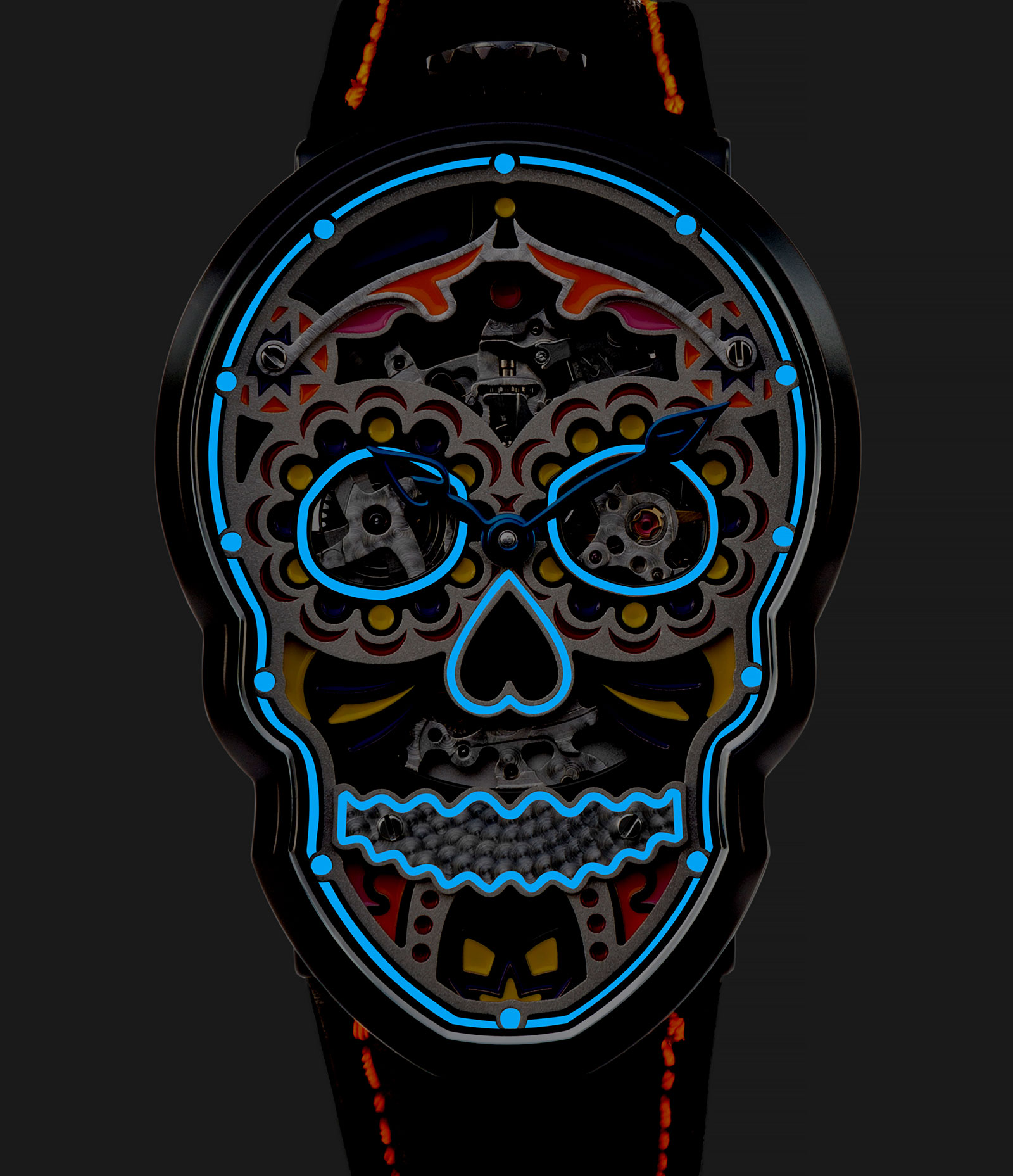
The dial is painted with Super-Luminova to ensure the legibility of the hands and indices as well as creating an outline of the skull in the dark.

Fiona Krüger Petit Skull Celebration Enigma lume

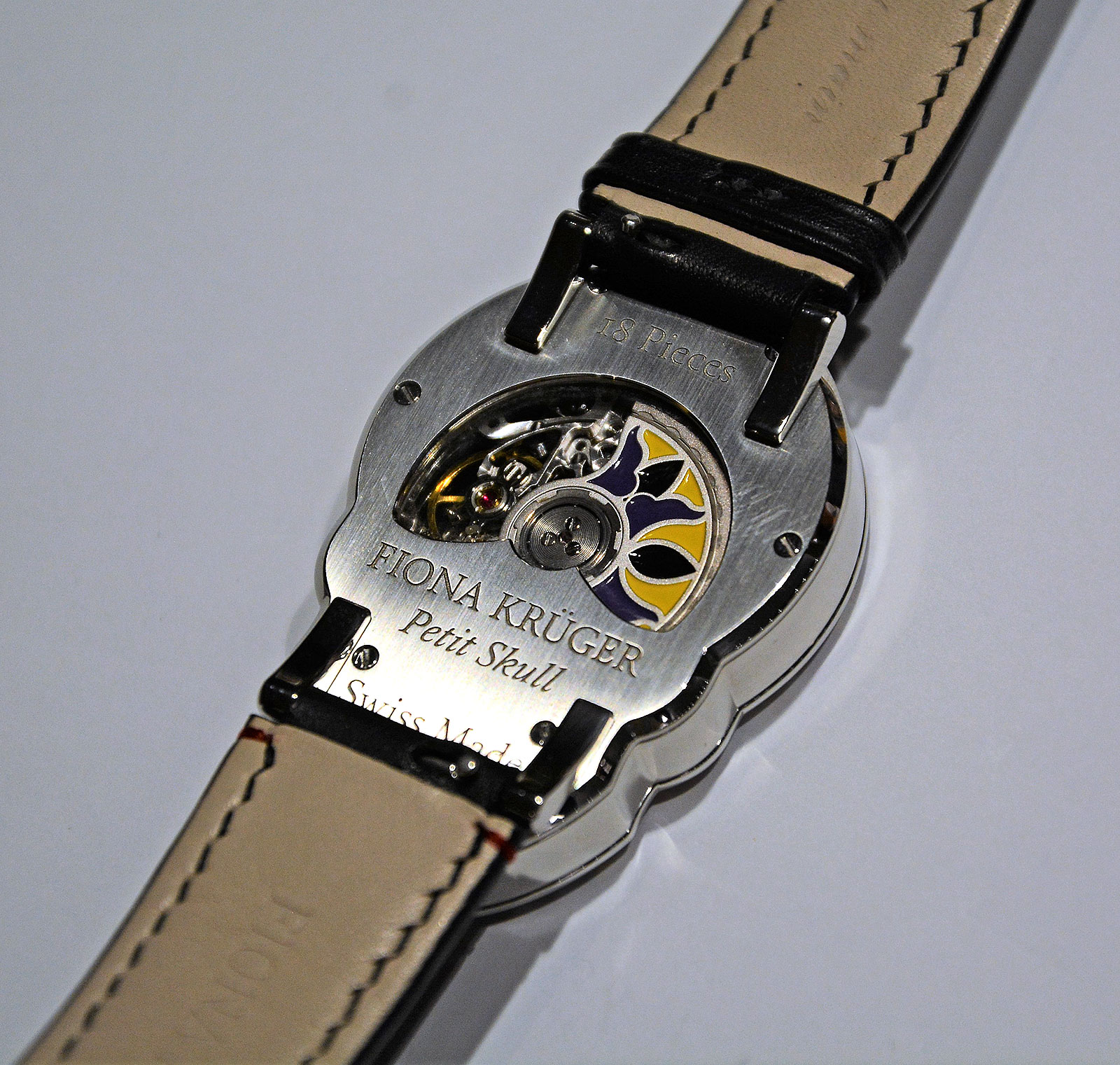
Partially visible through the sapphire crystal back that reveals the hand-painted rotor, the movement inside both the Eternity and Enigma is the Soprod A10, a time-only automatic.

Photo credit Philipp Kneller

Pricing and availability

The Fiona Krüger Petit Skull Celebration watches are limited to 18 pieces each, priced at SFr22,500.


Back to top.

You may also enjoy these.

Montblanc Introduces UNICEF World Time Limited Edition with Cities in Arabic, Chinese or English

Culminating with a US$1.5m donation to UNICEF in spring 2018.

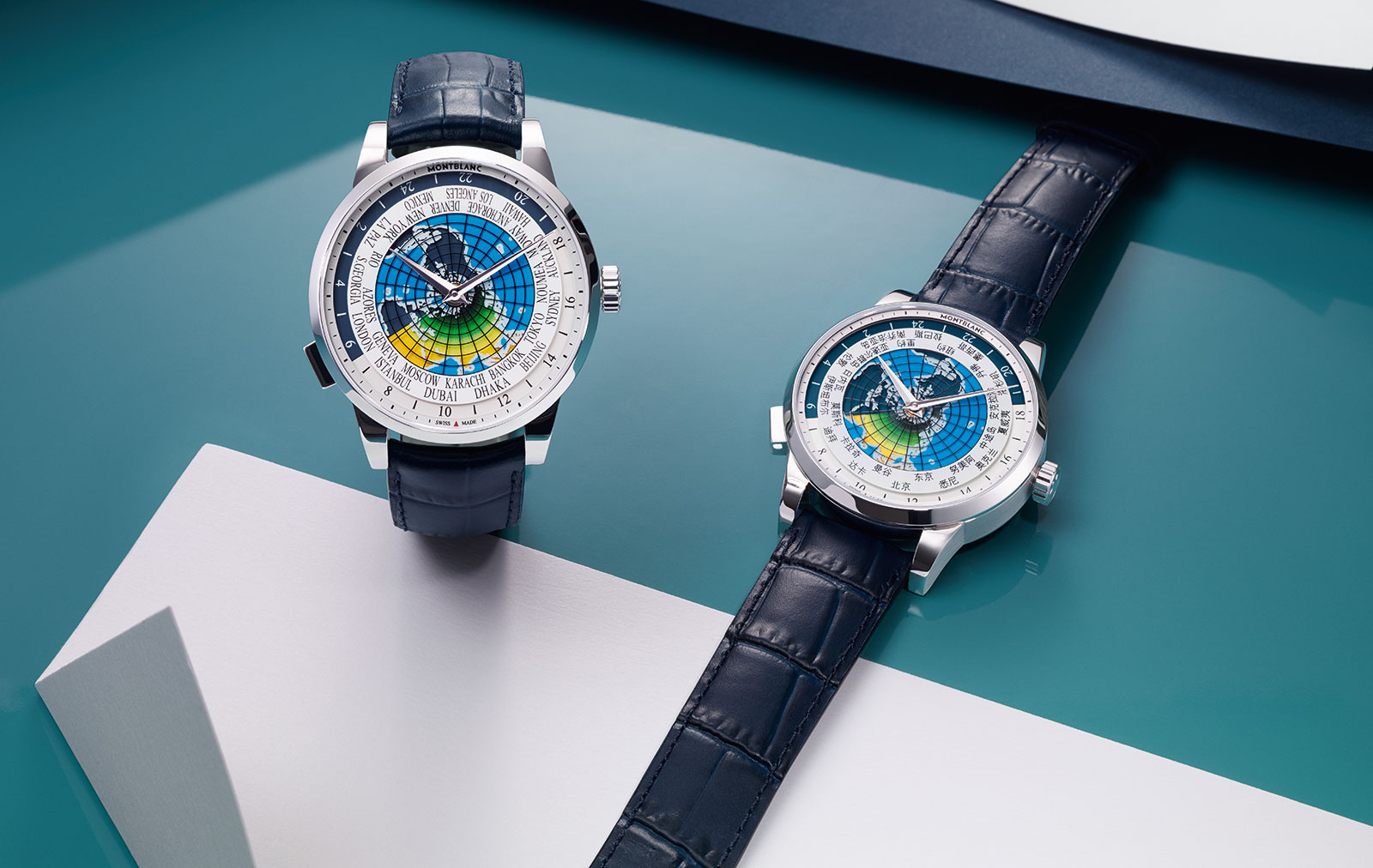
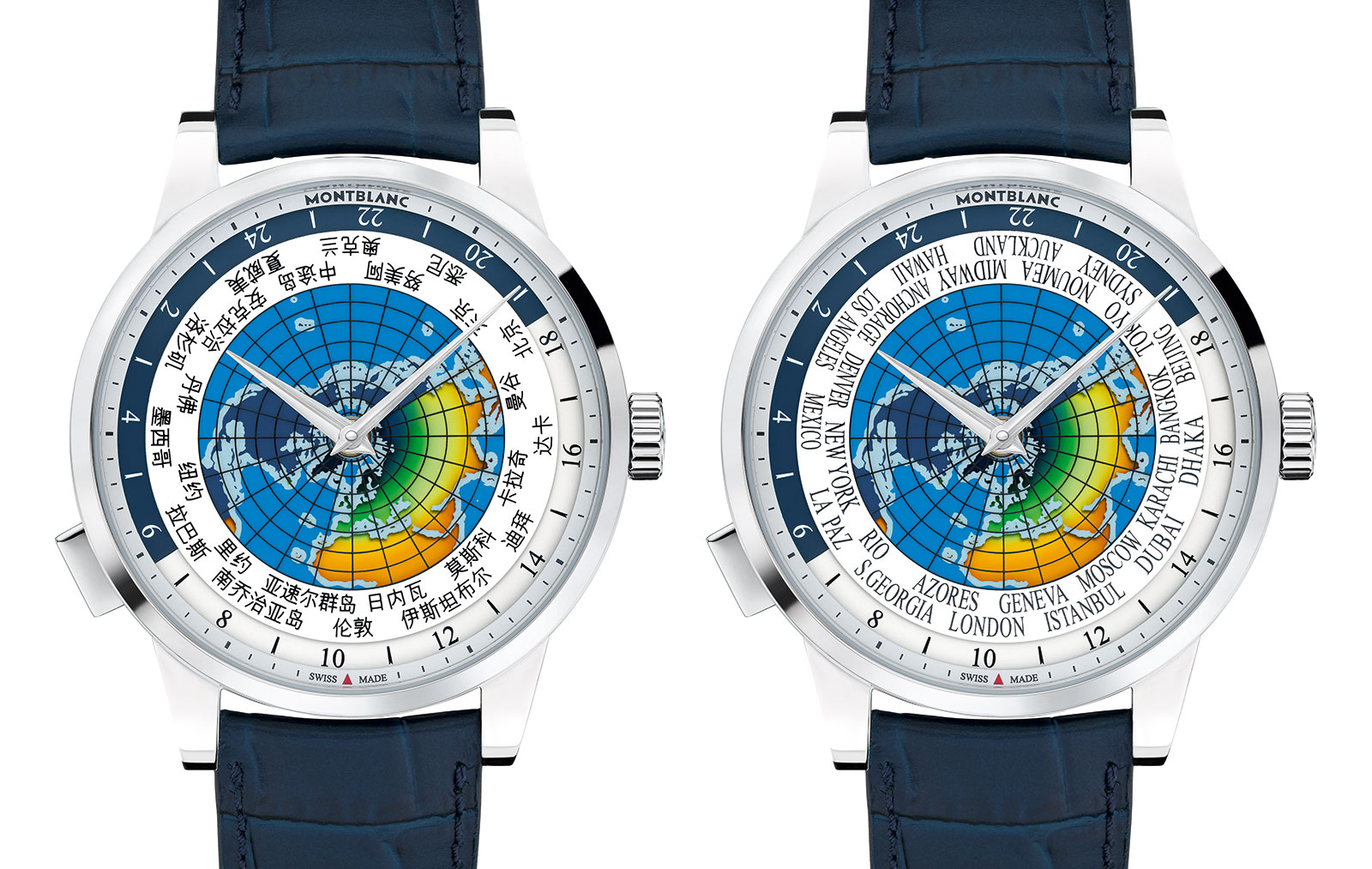
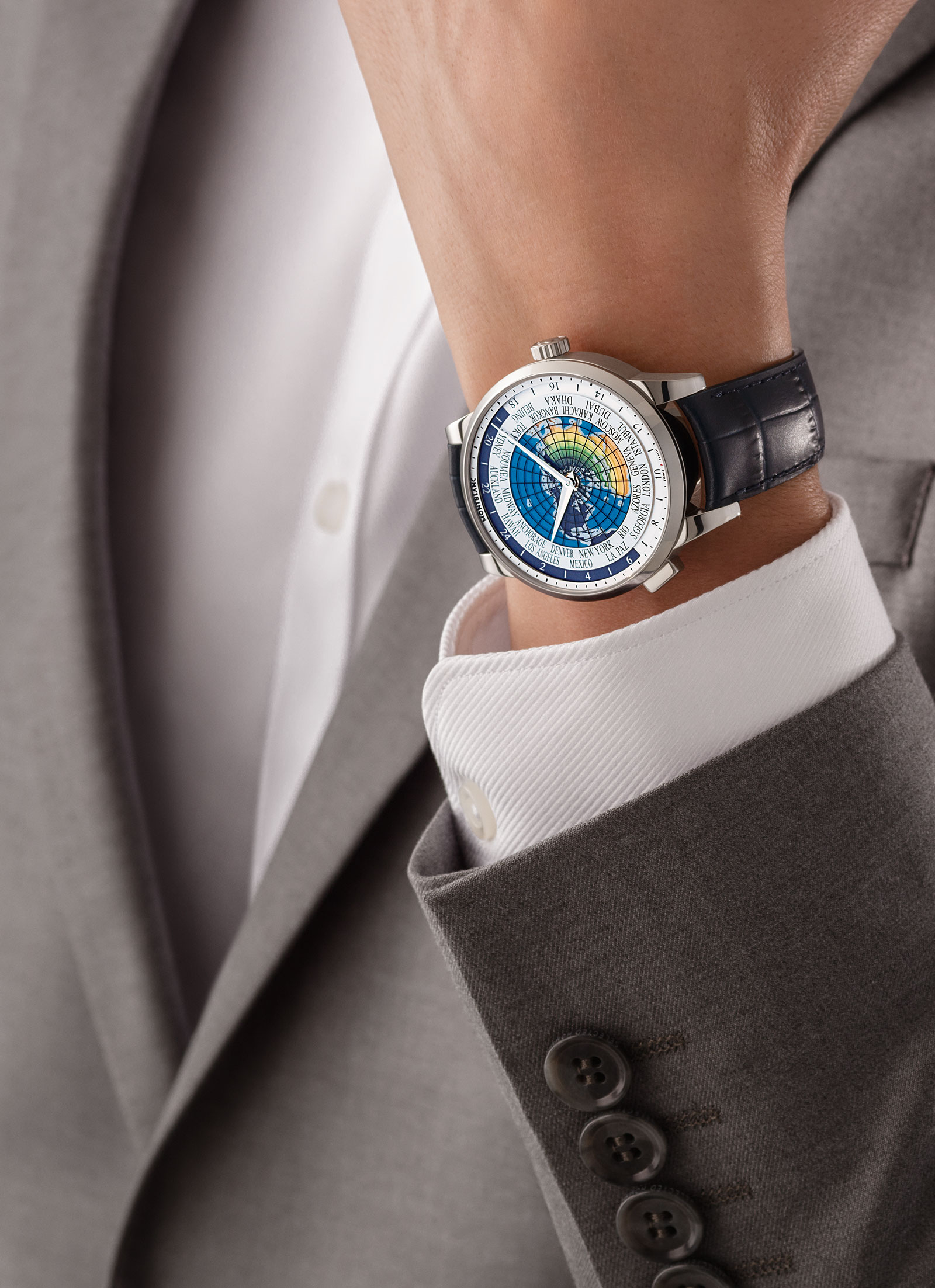
Introduced as part of a collection of watches and pens to raise funds for UNICEF, the Heritage Spirit Orbis Terrarum UNICEF is a variation on Montblanc‘s affordably priced world time wristwatch. Having donated over US$10m since its partnership with the United Nation’s children’s charity began in 2004, Montblanc will contribute another US$1.5m to the organisation at end March 2018, when production of the UNICEF collection comes to an end.

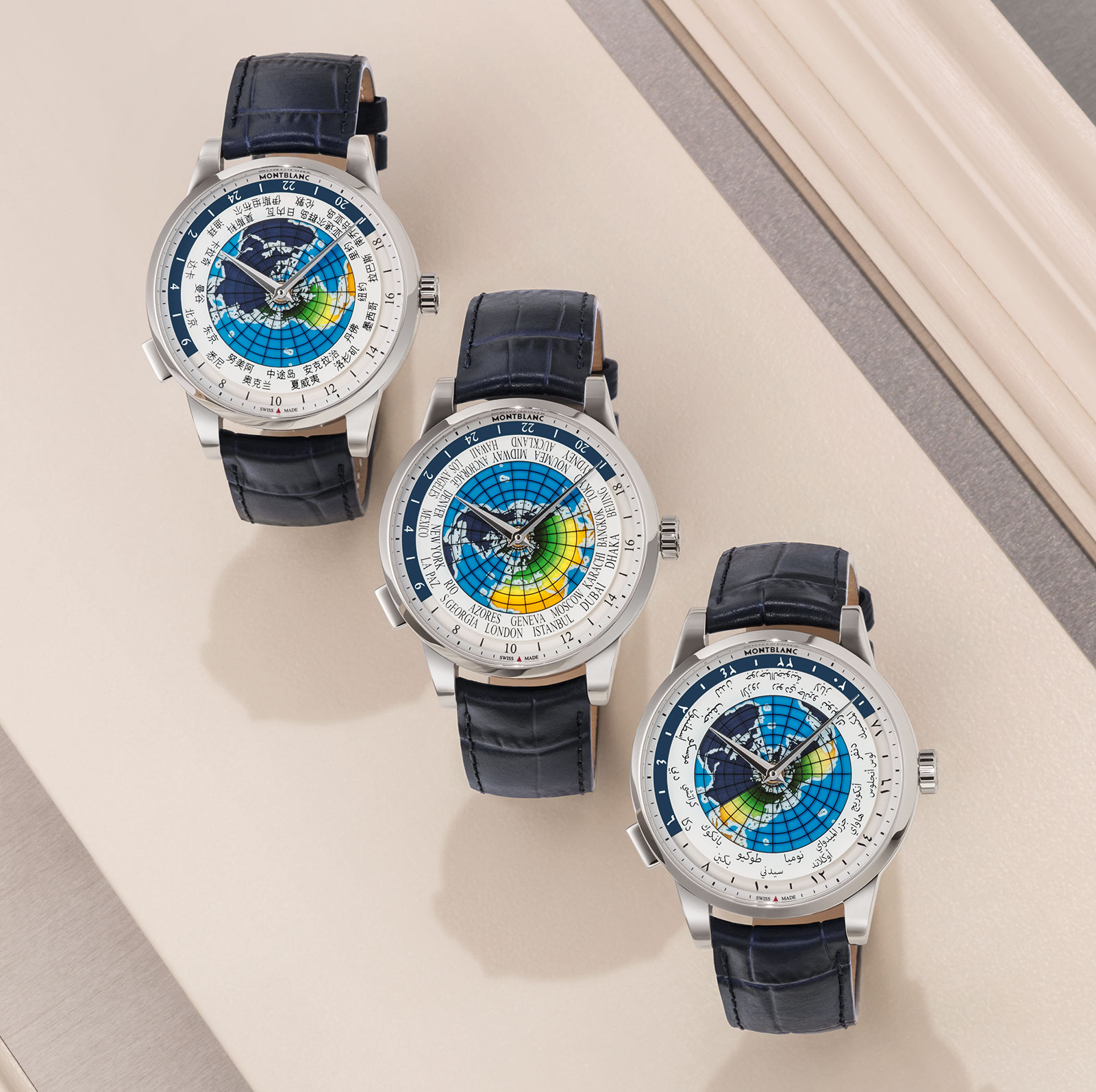
The UNICEF world time is available in three versions, each with a dial designed for key regions. The Heritage Spirit Orbis Terrarum Latin UNICEF has the cities on the world time disc in English, while Asian edition is Chinese and the Arabic edition is, well, Arabic. While the names are somewhat inaccurate in relation to the script, the labelling is convenient, with the languages representing key geographical markets for Montblanc.

From left: Asian, Latin and Arabic UNICEF editions

While the regular production world time has “Paris” to represent the time zone of GMT +1, the UNICEF edition has Geneva in its place, since the Swiss city is where UNICEF headquarters are sited.

Heritage Spirit Orbis Terrarum Asian UNICEF

Each version is limited to 500 pieces, and aside from the lettering on the dial, identical. It’s powered by the MB 29.20, an automatic movement based on the ETA 2892 with a world time module on top.

The button at eight o’clock advances the cities disc in one hour intervals, allowing the watch to show the 24 conventional time zones of the world. A coloured sapphire disc over the continents functions as a day and night indicator, showing which regions of the world are under cover of dark.

Heritage Spirit Orbis Terrarum Latin UNICEF

The steel case is 41mm in diameter and 11.99mm high. The sapphire back has the UNICEF logo printed on its underside.

Price and availability 

All three versions of the Heritage Spirit Orbis Terrarum UNICEF are priced at US$5600 or S$8900, less than 10% more than the retail of the ordinary version. The UNICEF edition references are as follows:

Heritage Spirit Orbis Terrarum Asian UNICEF – ref. 116534
Heritage Spirit Orbis Terrarum Latin UNICEF – ref. 116533
Heritage Spirit Orbis Terrarum Arabic UNICEF – ref. 116532


Back to top.

You may also enjoy these.

Introducing the Hautlence Moebius, Inside a Wraparound Sapphire Crystal Case (with Original Photos & Price)

Featuring a chain-link time display and double-axis tourbillon.

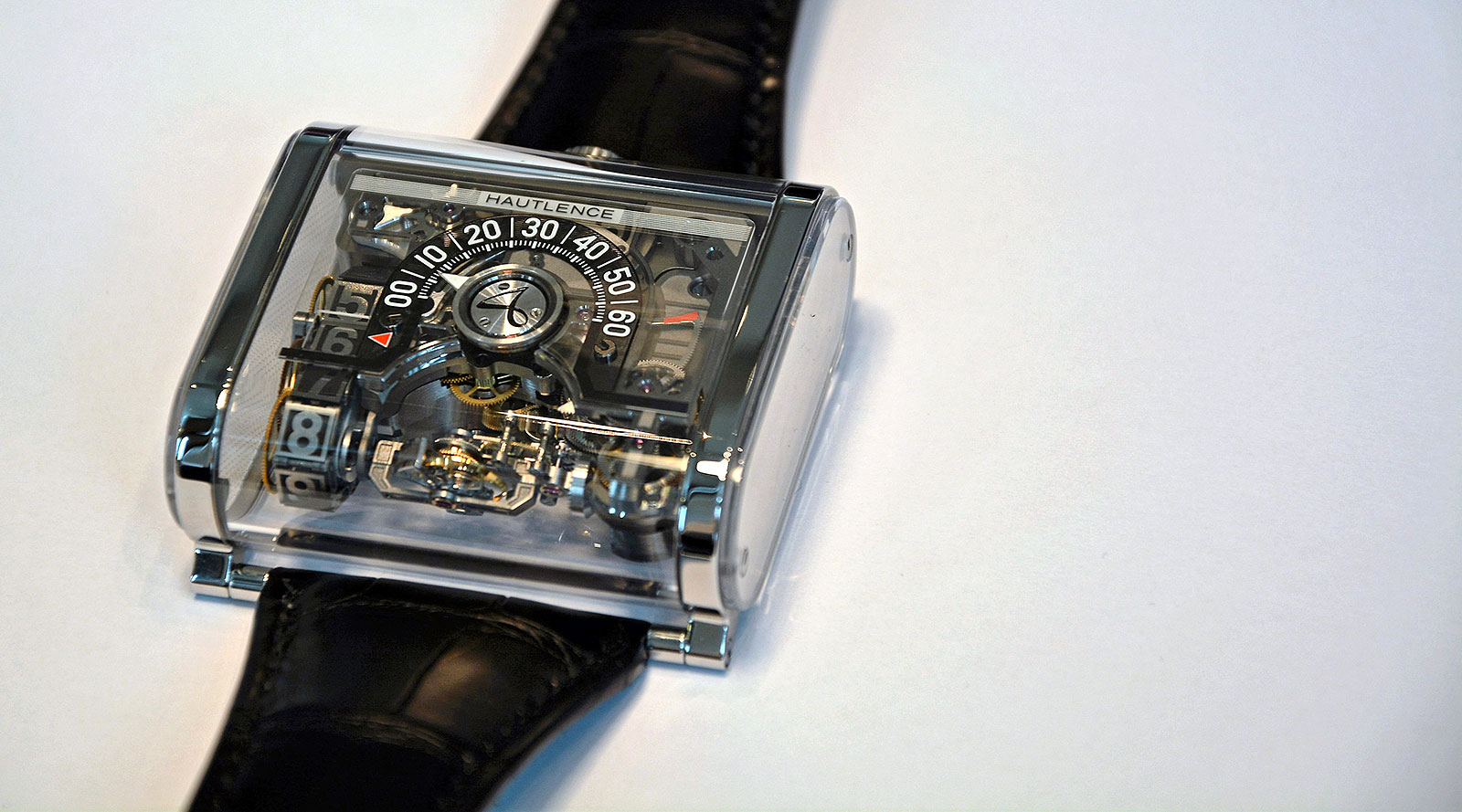
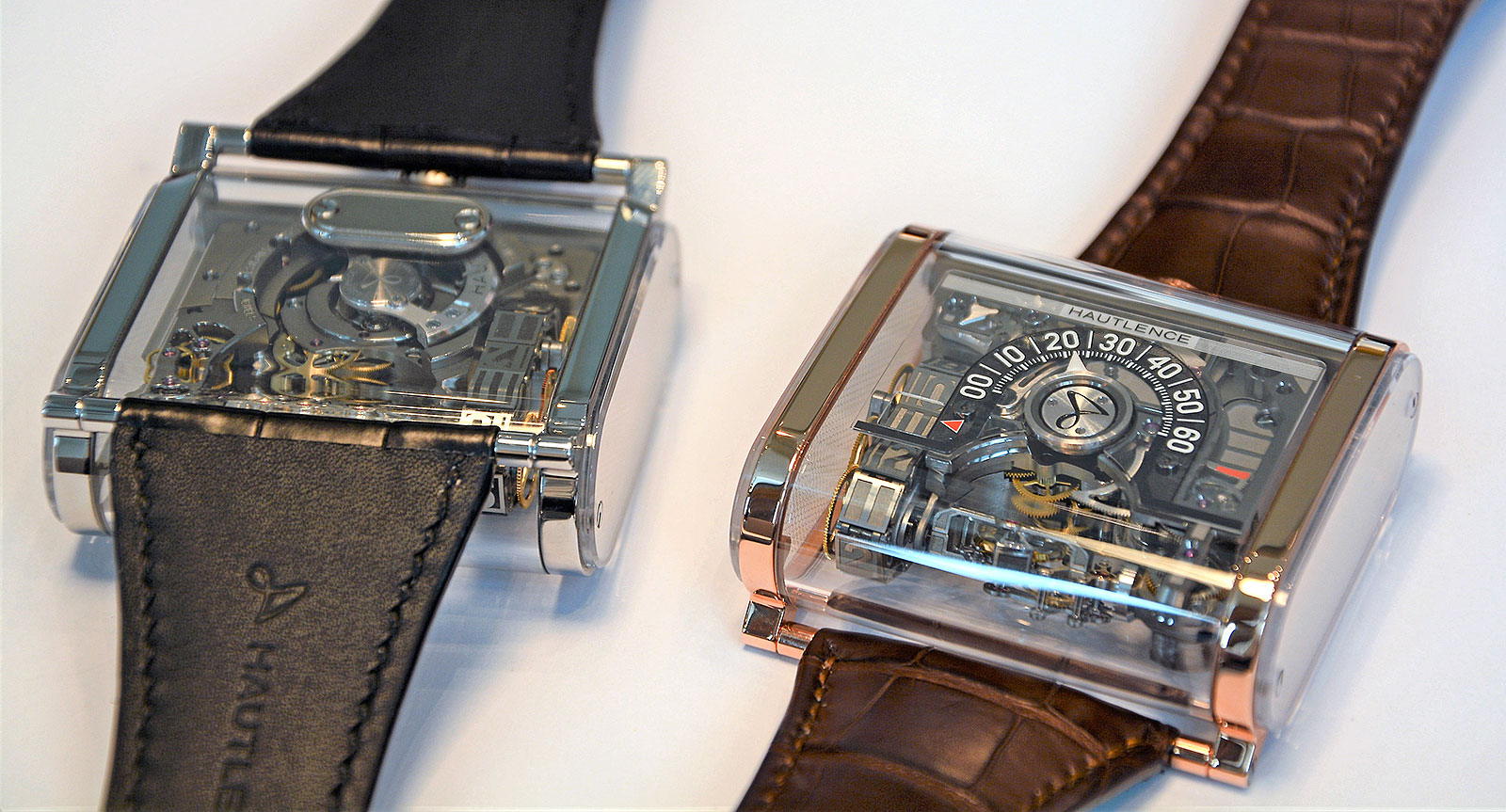
Part of the Concepts d’Exception collection of complications, the latest from Hautlence has a rather unusual name as well as with unusual features, namely a bi-axial tourbillon and an almost panoramic sapphire crystal case.

The Moebius is equipped with a tweaked version of the familiar HL2.0 movement that was already incorporated inside various Hautlence watches such as the Vortex. The movement consists of 482 components and boasts several technically interesting characteristics.

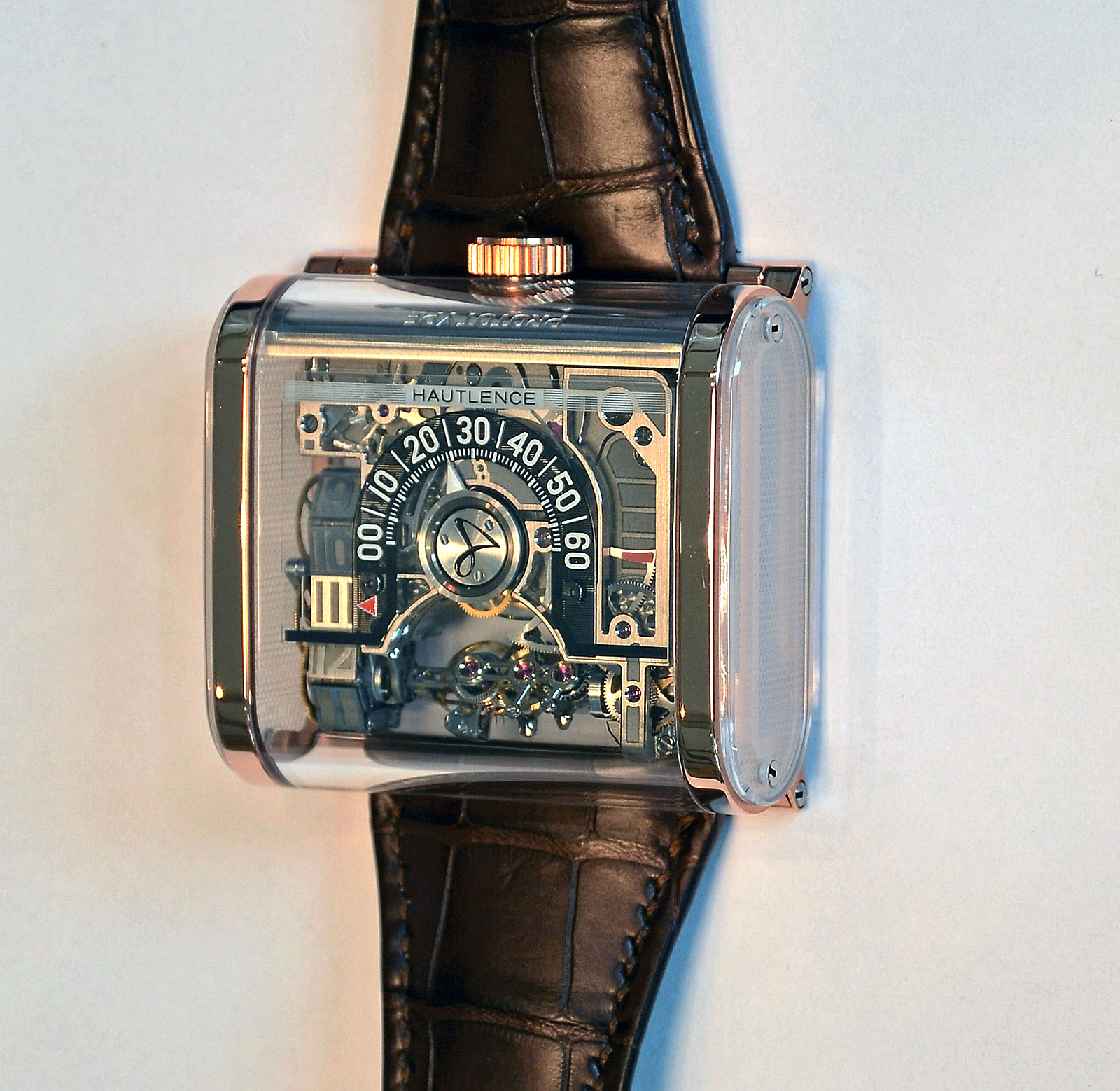
It has a large retrograde minutes display in the centre, power reserve on the right of the dial and the chain-link hours on the left. Just like the case, the minute sub-dial is made of sapphire crystal with markings for the minutes. The minute hand is rhodium-plated and painted with Super-Luminova to ensure night-time legibility.

Hautlence Moebius 3

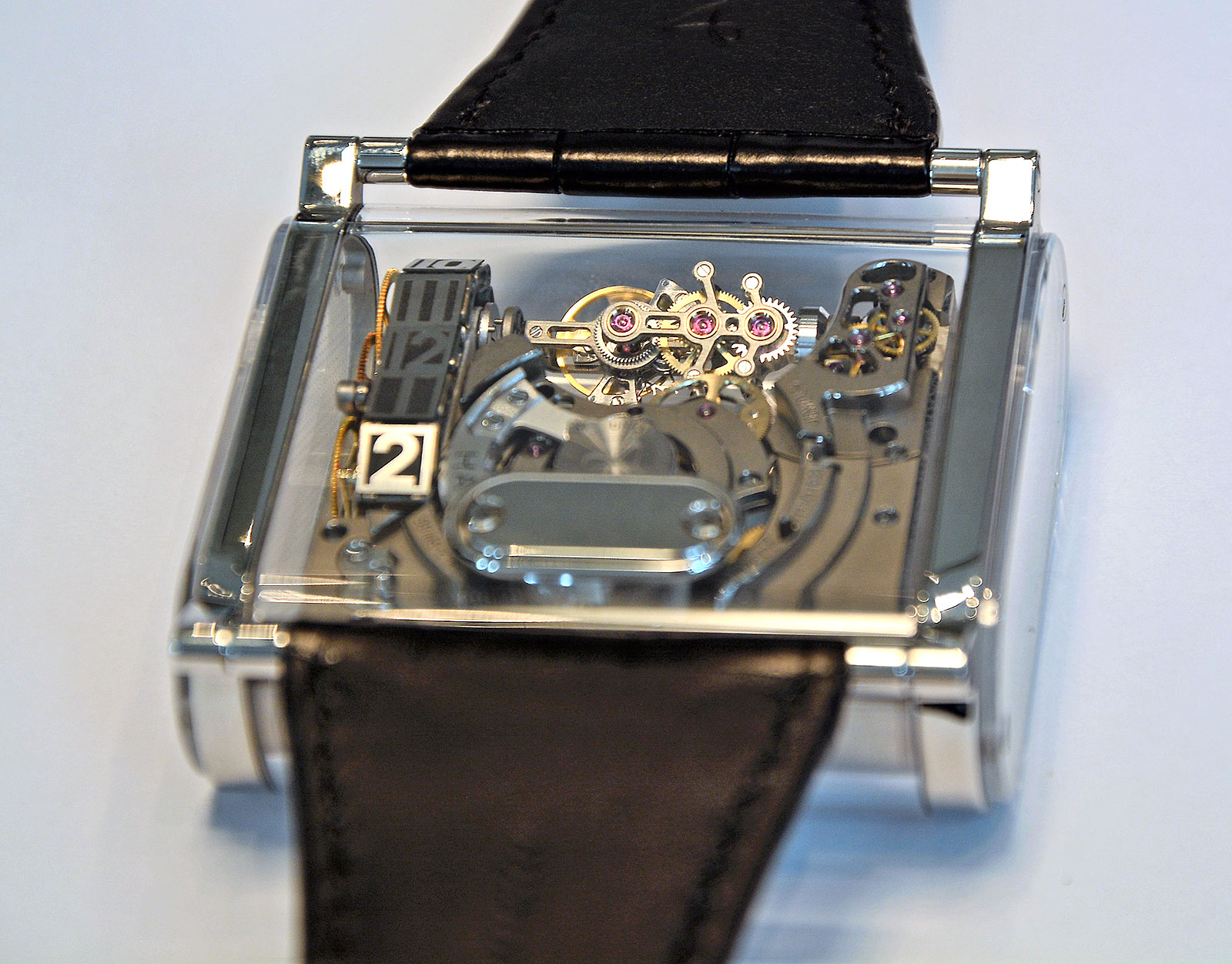
The first complication is the mechanism for displaying the hours with a 12-link chain on the left-hand side of the movement. At the top of every hour, the chain is pulled upwards and moves by one link, going from one hour to the next.

A regulator mechanism, which sits under a cap featuring the Hautlence logo in the centre of the retrograde minutes, ensures a flawless transition of the hours, which takes around three to four seconds. The regulator completes 48 high-speed rotations each time the chain transitions to the next hour.

Furthermore, the Moebius features a bi-axial tourbillon placed at six o’clock that is linked to the chain display. The tourbillon makes four complete revolutions every 24 hours, turning like a barbeque spit.

Hautlence Moebius 2

The movement is self-winding and has a power reserve of 40 hours, while running at 21,600 vibrations per hour. Two barrels each power the time and complications separately, allowing the complications to function without impairing the accuracy of timekeeping.

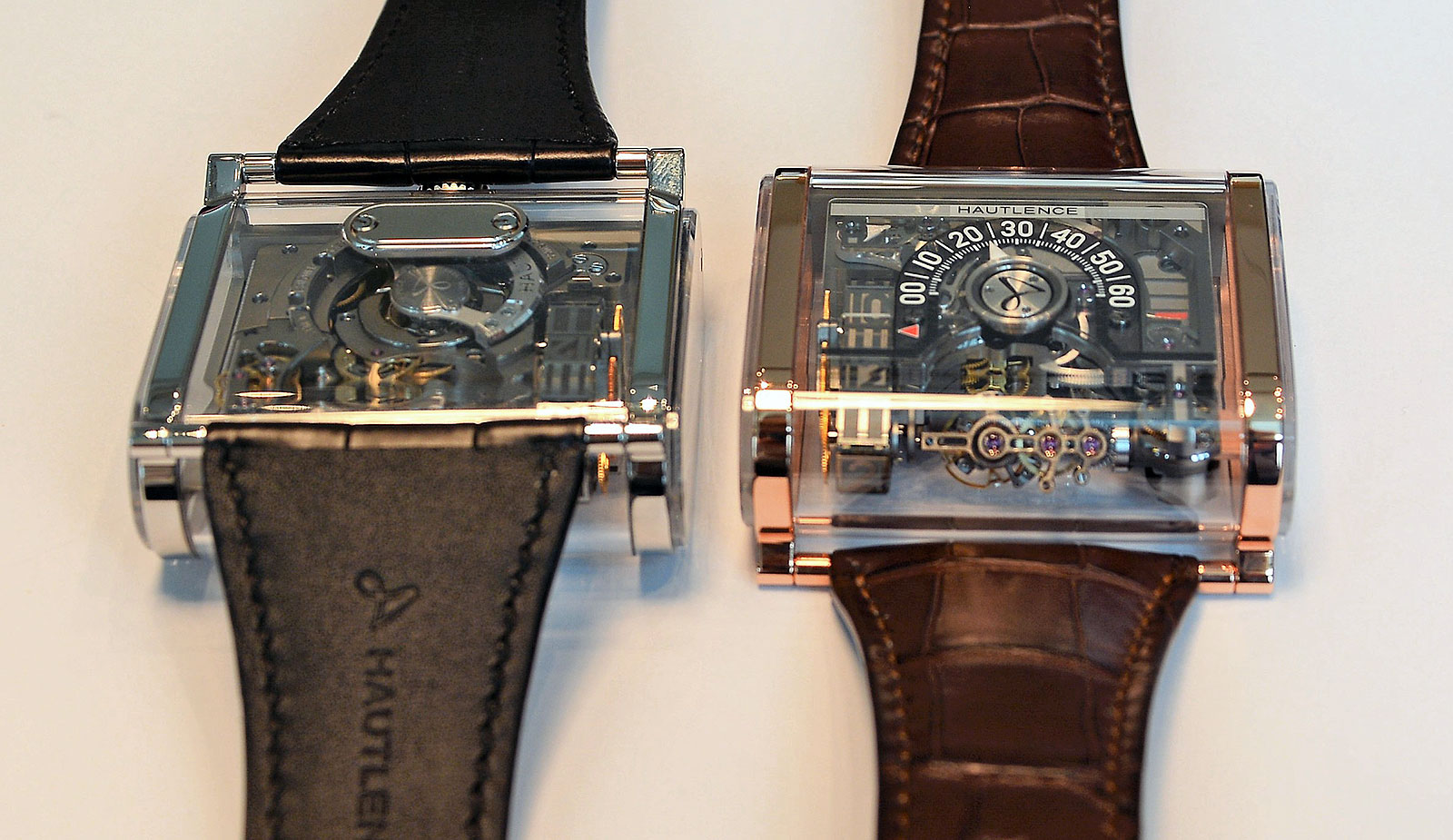
The complexity of the movement makes the sapphire case a necessity. The see-through case gives this watch a technical look and feel. The case, essentially a tube of sapphire crystal with sapphire caps on each side, allows the wearer a view of from various angles.

Hautlence Moebius 5

The Moebius is large, being 52mm wide, 50mm long, and 18mm high. These measurements may prevent the watch from fitting under any cuff, but then again, a watch like the Moebius is not meant to be hidden.

The polished case borders and lugs are available in either in 18k white or red gold. The side windows, also crafted from sapphire crystal, are finished with a honeycomb motif.

Hautlence Moebius 4

Pricing and availability

 The Moebius is fitted to a Louisiana alligator strap with a folding clasp made of titanium. It’s available in either white or 18k red gold, with each version limited to eight pieces and priced at SFr240,000.


Photos by Philipp Kneller

Back to top.

You may also enjoy these.

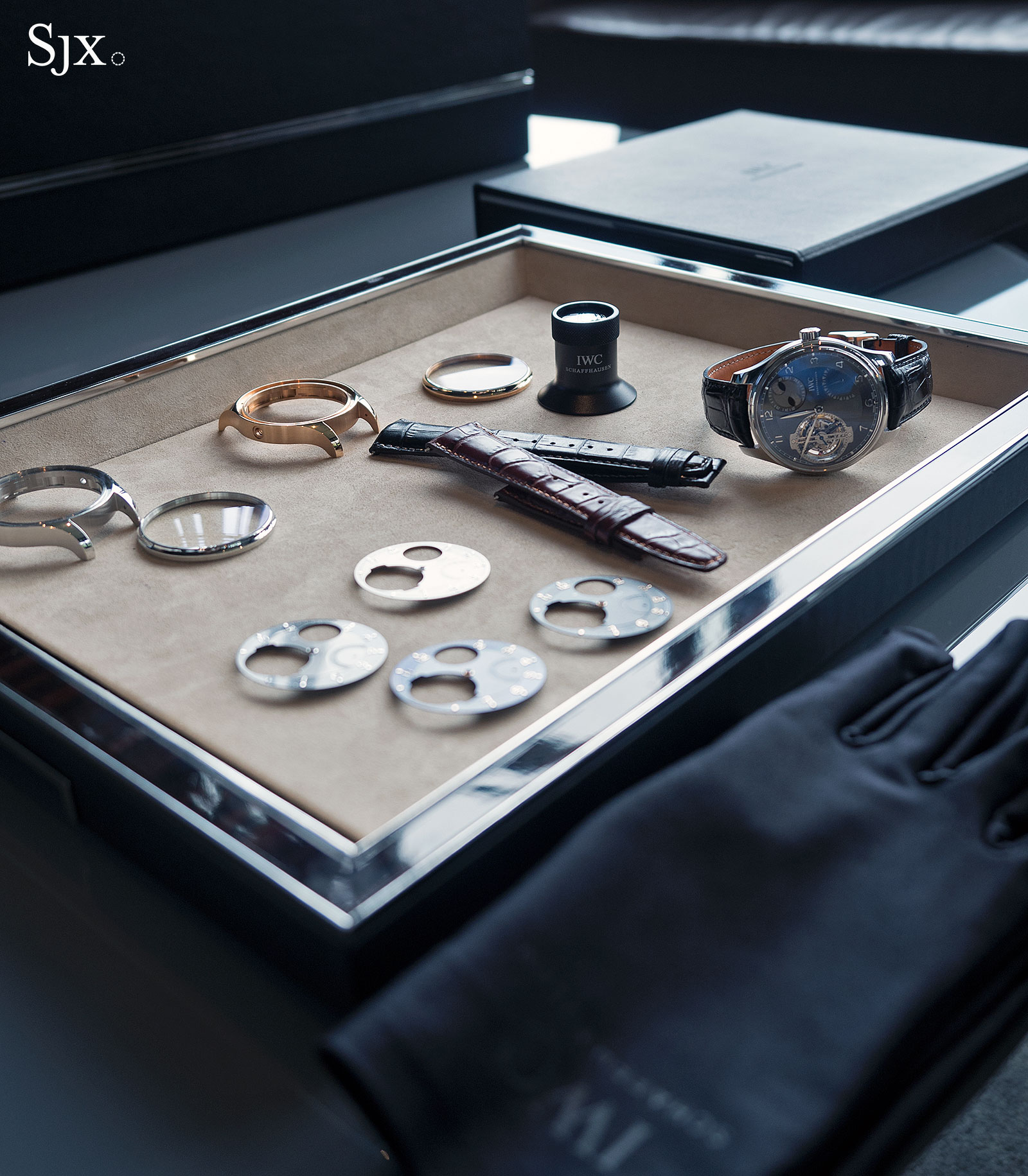
Hands-On with the IWC Portugieser Constant-Force Tourbillon

The compact and cleverly designed IWC tourbillon with integrated constant force returns.

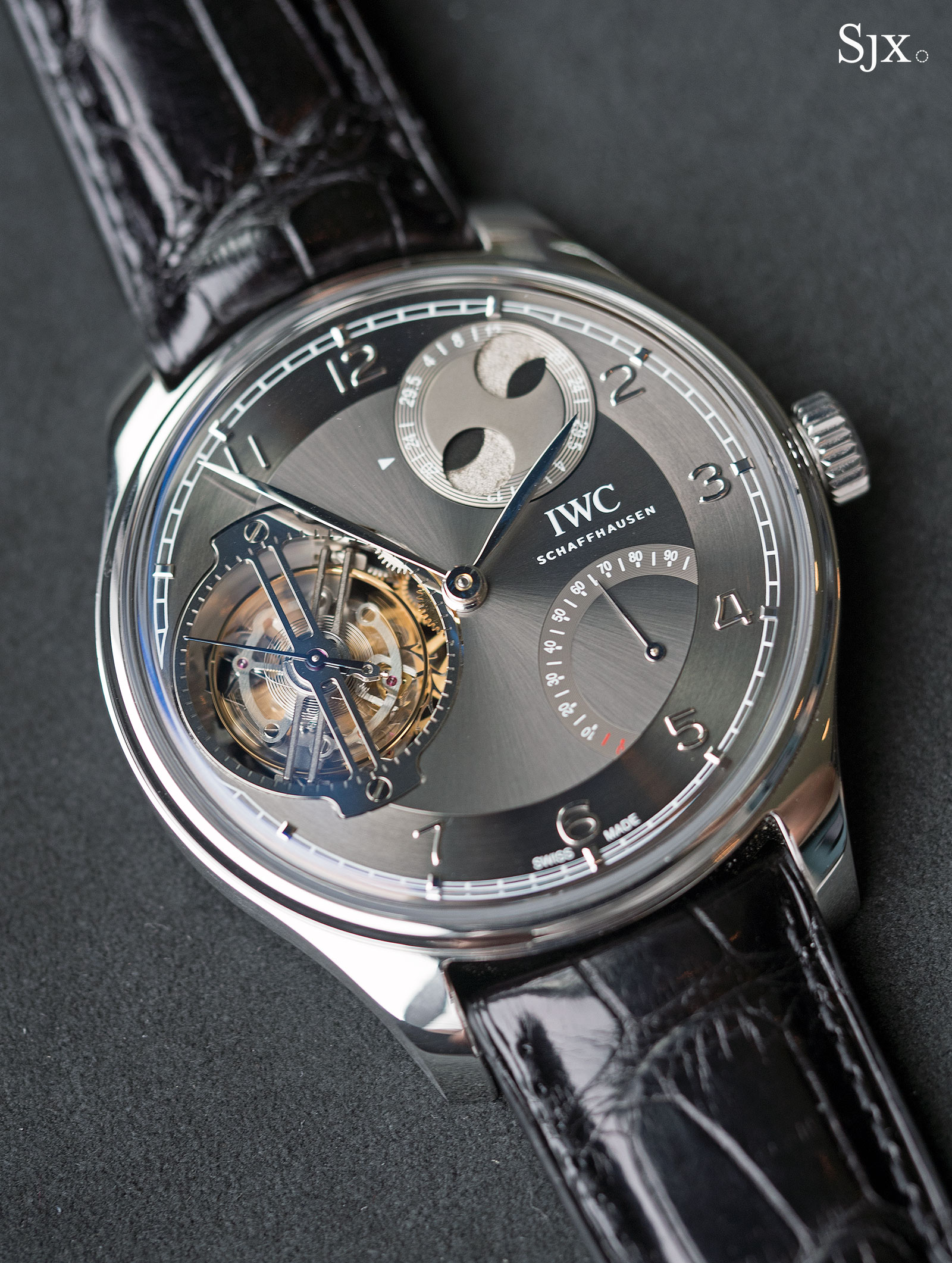
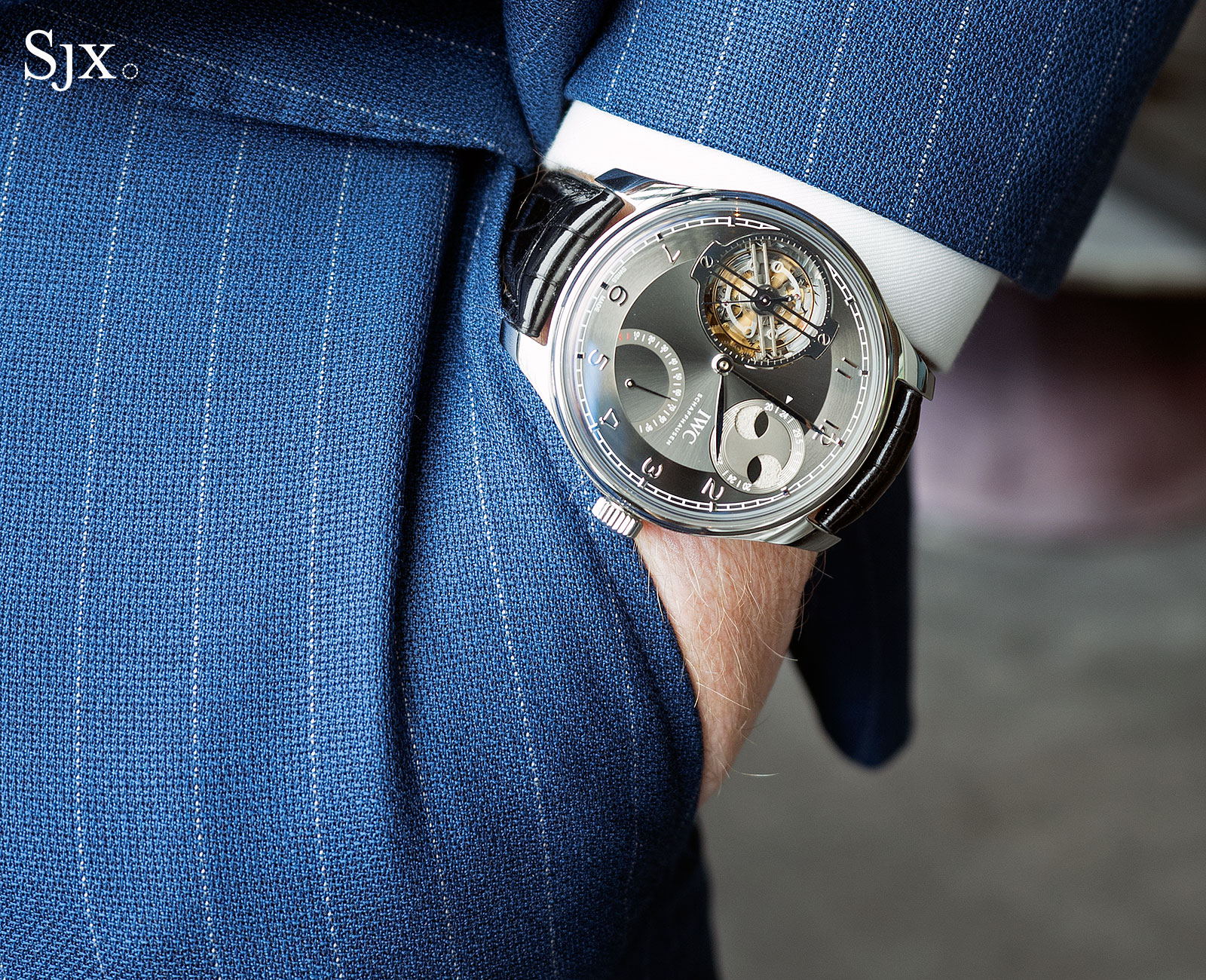
Although featuring a constant force tourbillon, moon phase and a four-day power reserve, the Portugieser Constant-Force Tourbillon is a dialled down version of the most complicated (and expensive) IWC wristwatch ever made, the Portuguese Sidérale Scafusia introduced in 2011.

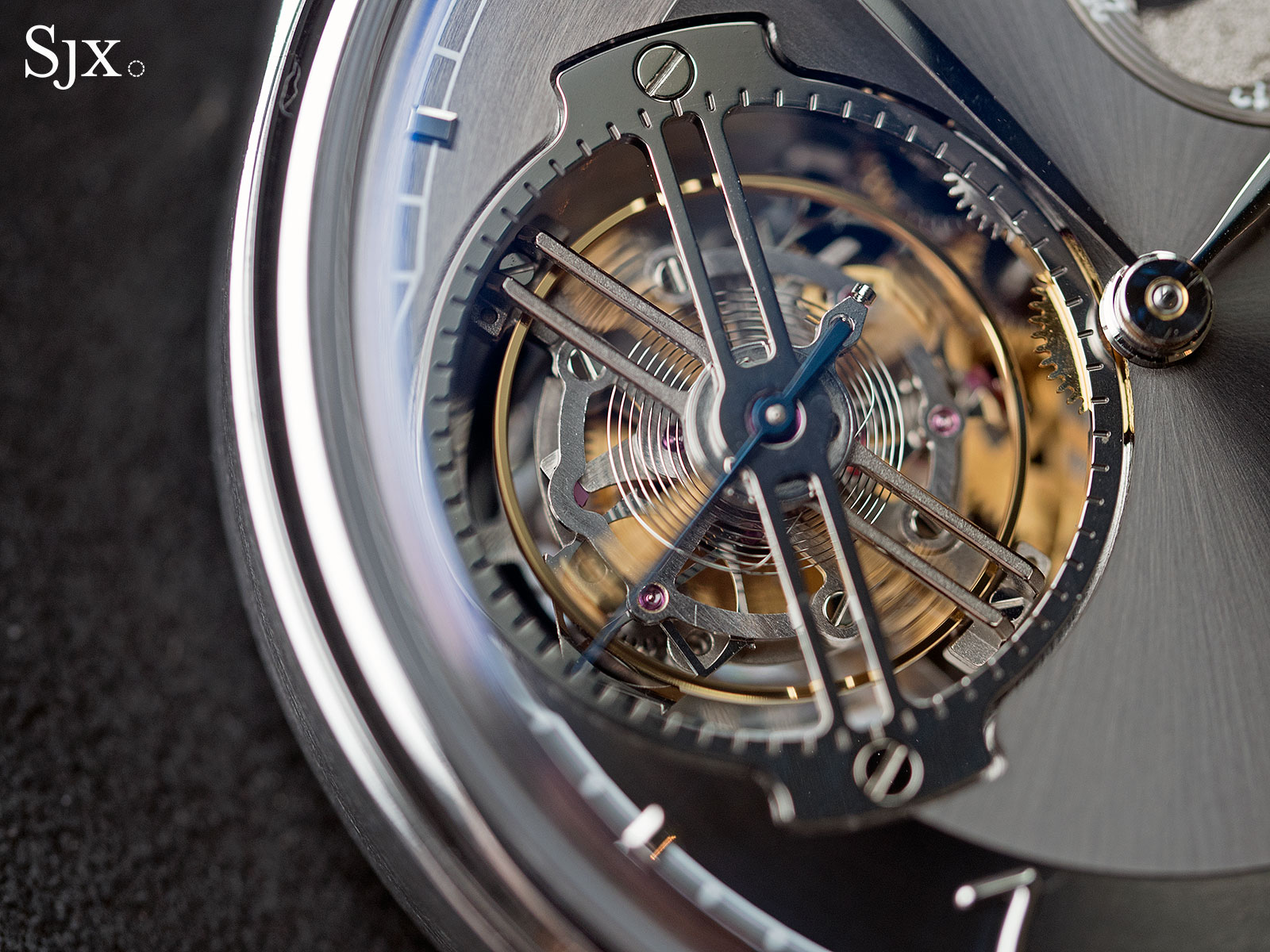
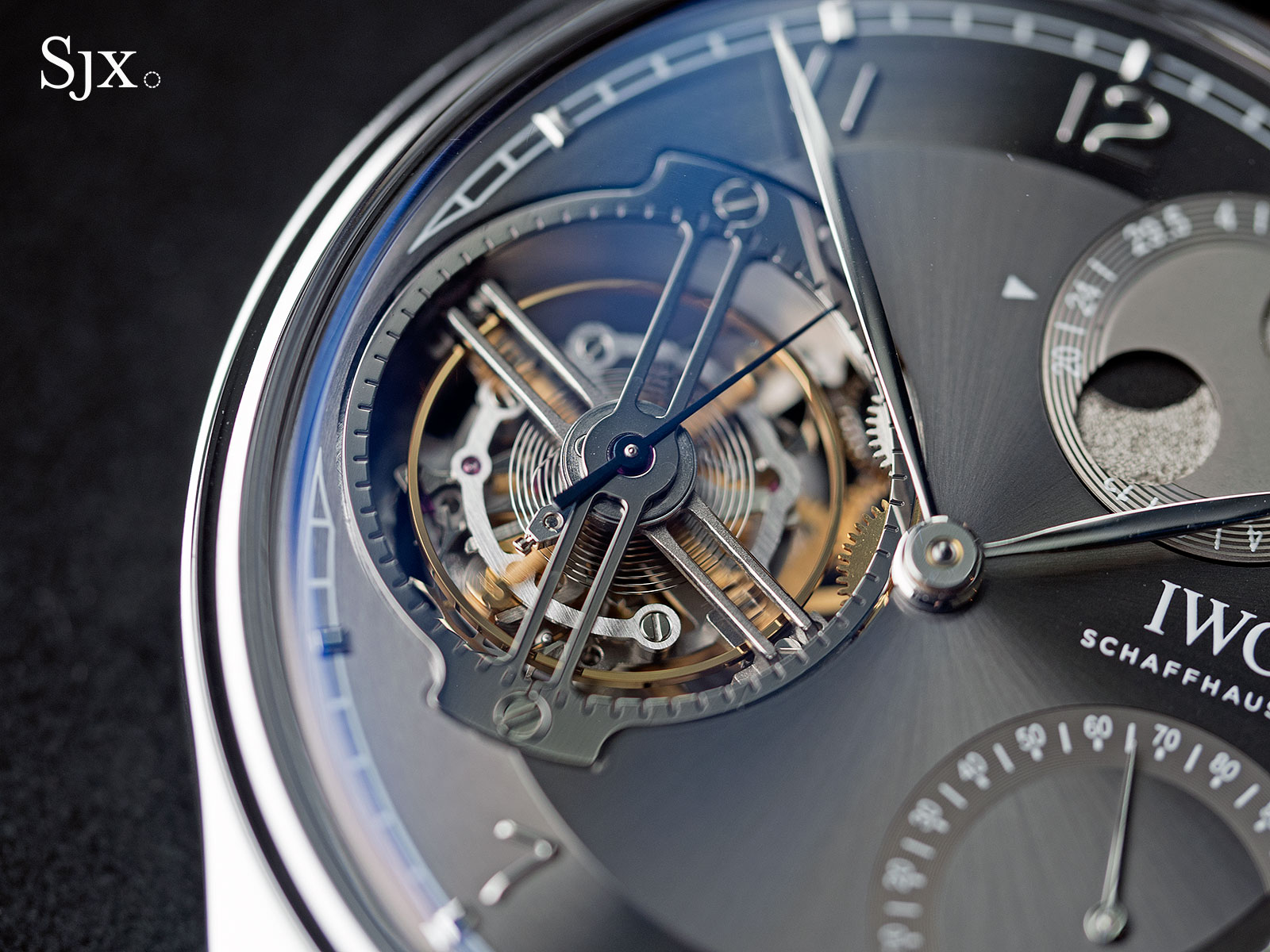
Powered by the same calibre 94800 found in the discontinued Ingenieur with the same features, the Portugieser Constant-Force Tourbillon has an aperture at nine o’clock that reveals the centrepiece of the movement, a large tourbillon regulator.

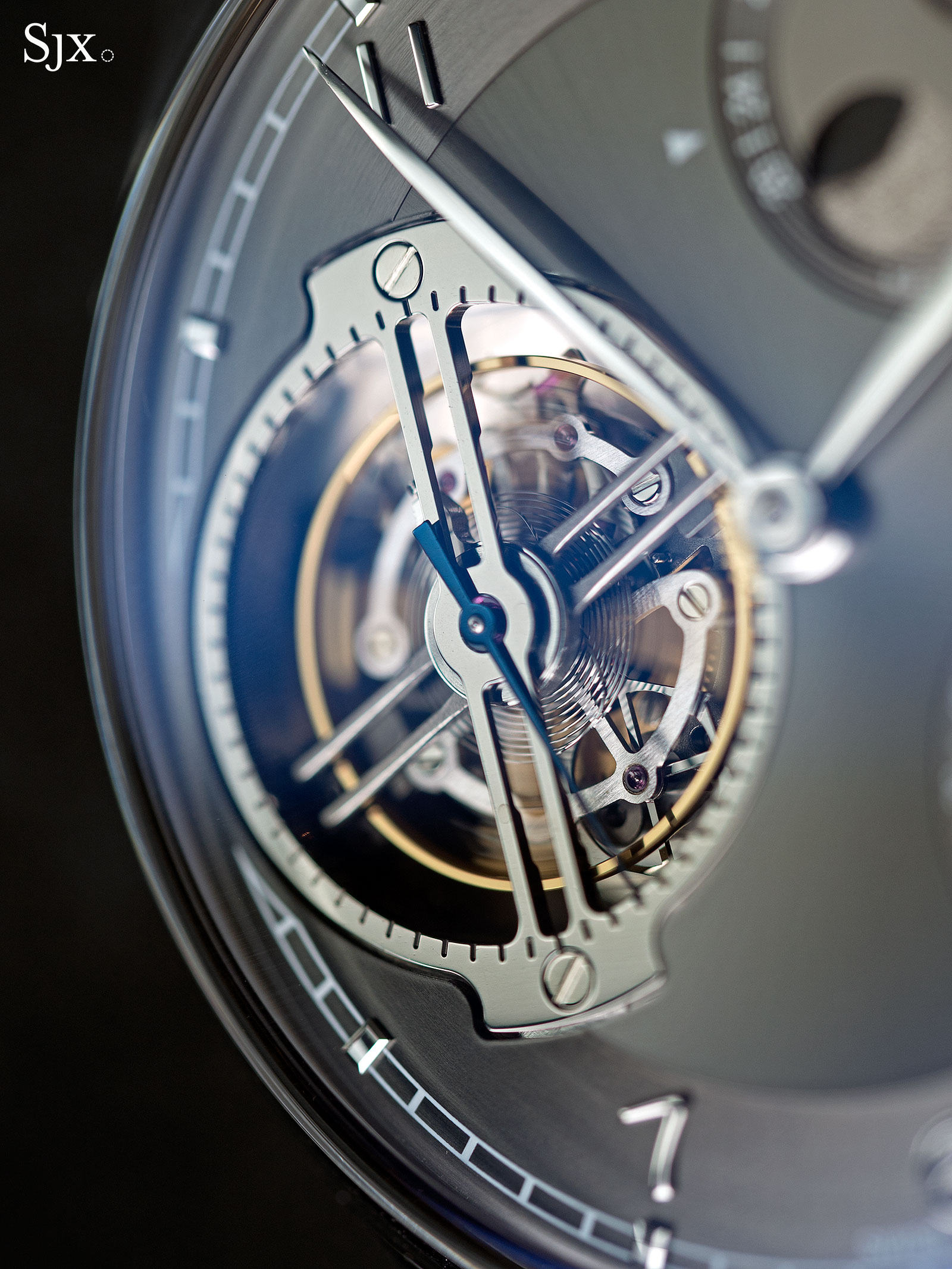
Though the tourbillon itself is large, the cage measures almost the radius of the dial and the balance wheel is only slightly smaller, the construction is compact, with the constant force mechanism integrated into the tourbillon.
IWC Portugieser Constant-Force Tourbillon 12

IWC Portugieser Constant-Force Tourbillon 1

Developed in collaboration with complications developer Chronode – founder Jean-Francois Mojon worked at IWC for a decade before starting Chronode – the tourbillon has a tiny spring mounted under the escape wheel.

Once a second this spring accumulates and releases power from the mainspring, ensuring that the escapement is driven by a small, steady supply of energy. This in turn keep the balance beating at a constant amplitude, and also gives the tourbillon cage a rotation that moves in one-second steps.
IWC Portugieser Constant-Force Tourbillon 6

IWC Portugieser Constant-Force Tourbillon 3

That only holds for the first two days of the 96-hour power reserve, when the mainspring is sufficiently wound to provide enough power to keep the constant force mechanism going at an optimal rate. Once the two-day mark is passed, the constant force disengages and the tourbillon functions like a conventional tourbillon.
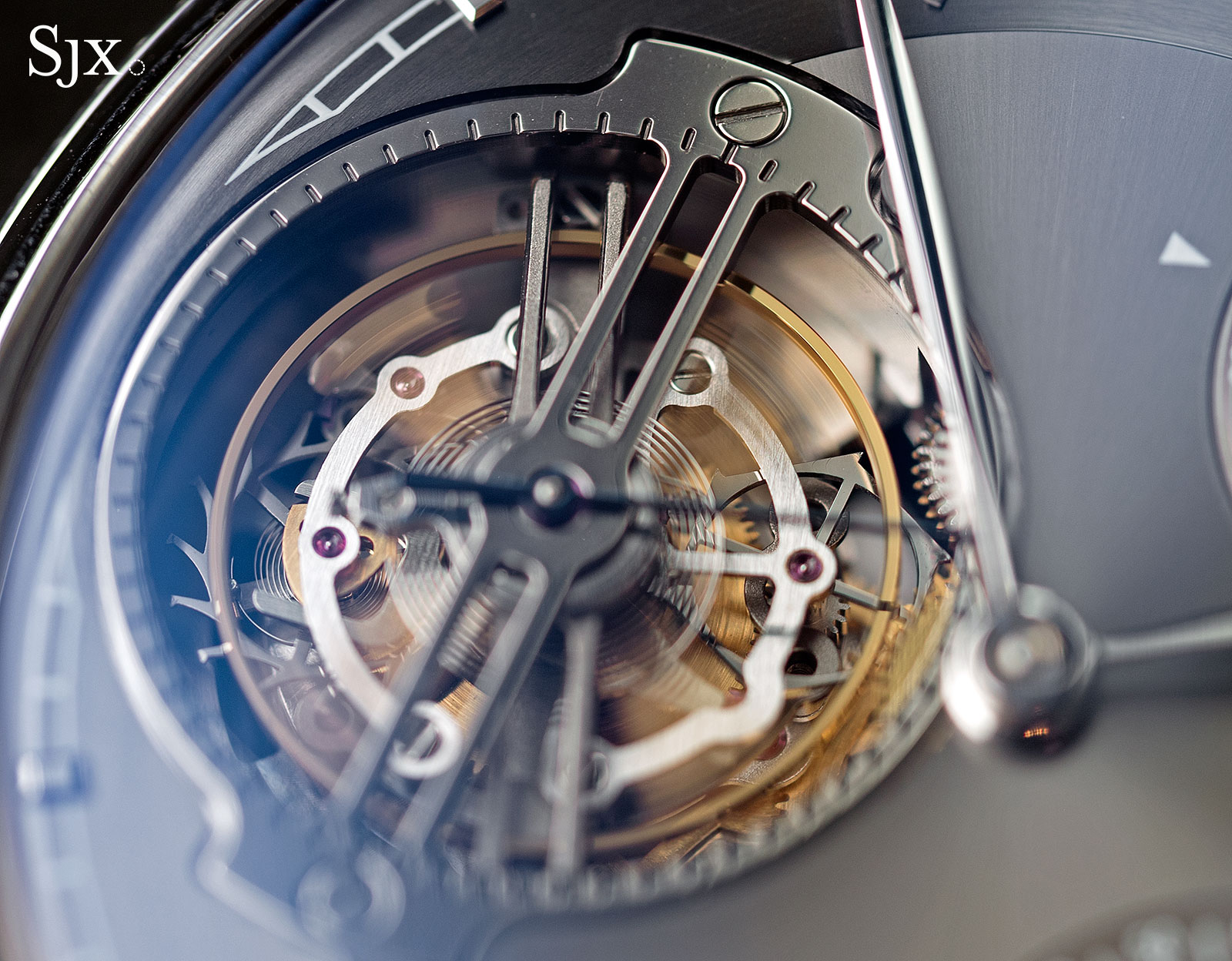
The constant force spring is visible on the left, under the escape wheel

At one o’clock is the double hemisphere moon phase, with the moon phase disc cast to resemble the cratered surface of the Moon. And just below that is the power reserve display.


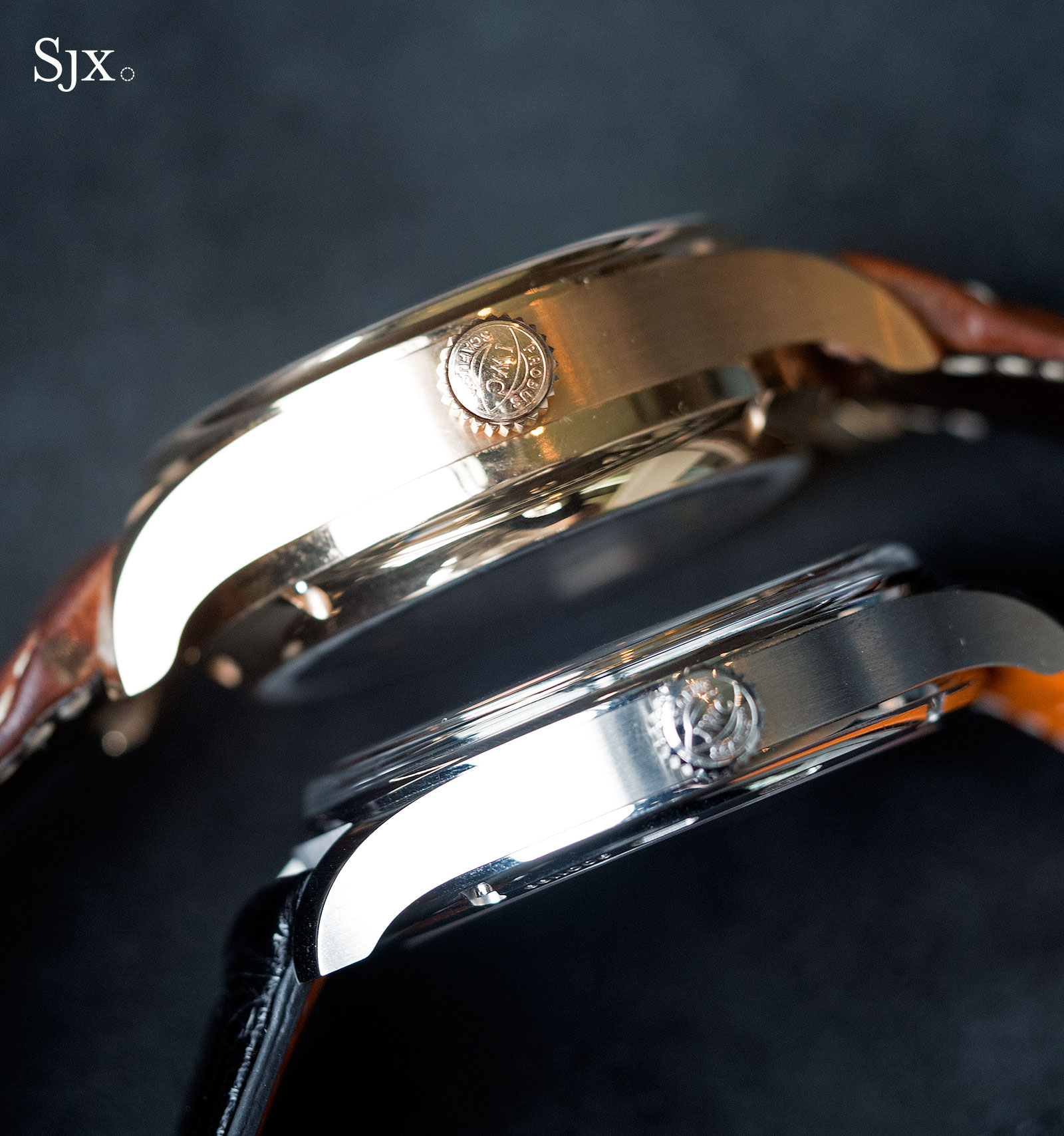
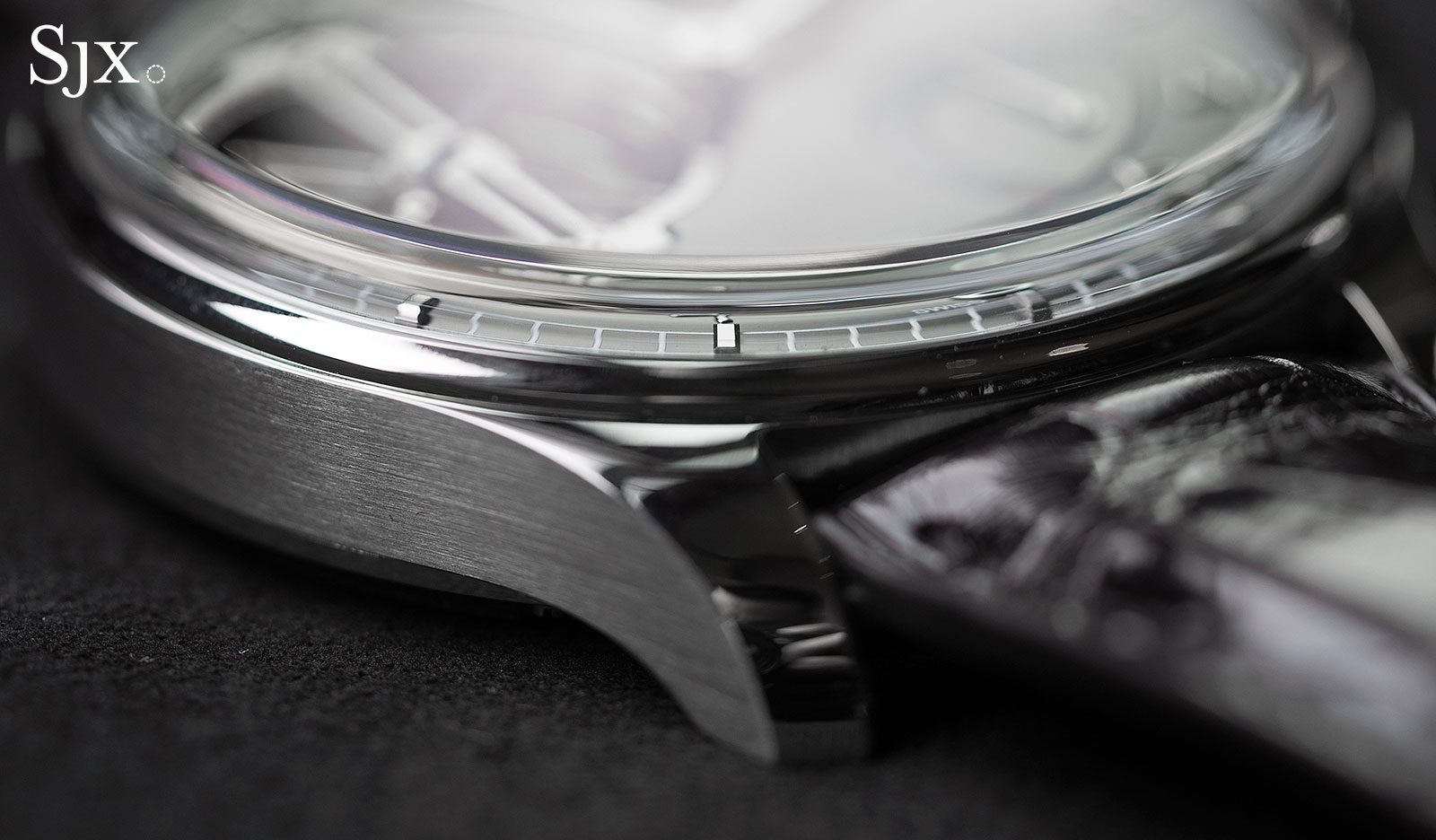
Unlike the Portuguese Sidérale Scafusia that incorporated a star chart on the back of the watch, which is why it is an enormous 17.5mm in height, the Portugieser Constant-Force Tourbillon is a relatively slim 13mm, even with the high domed sapphire crystal.
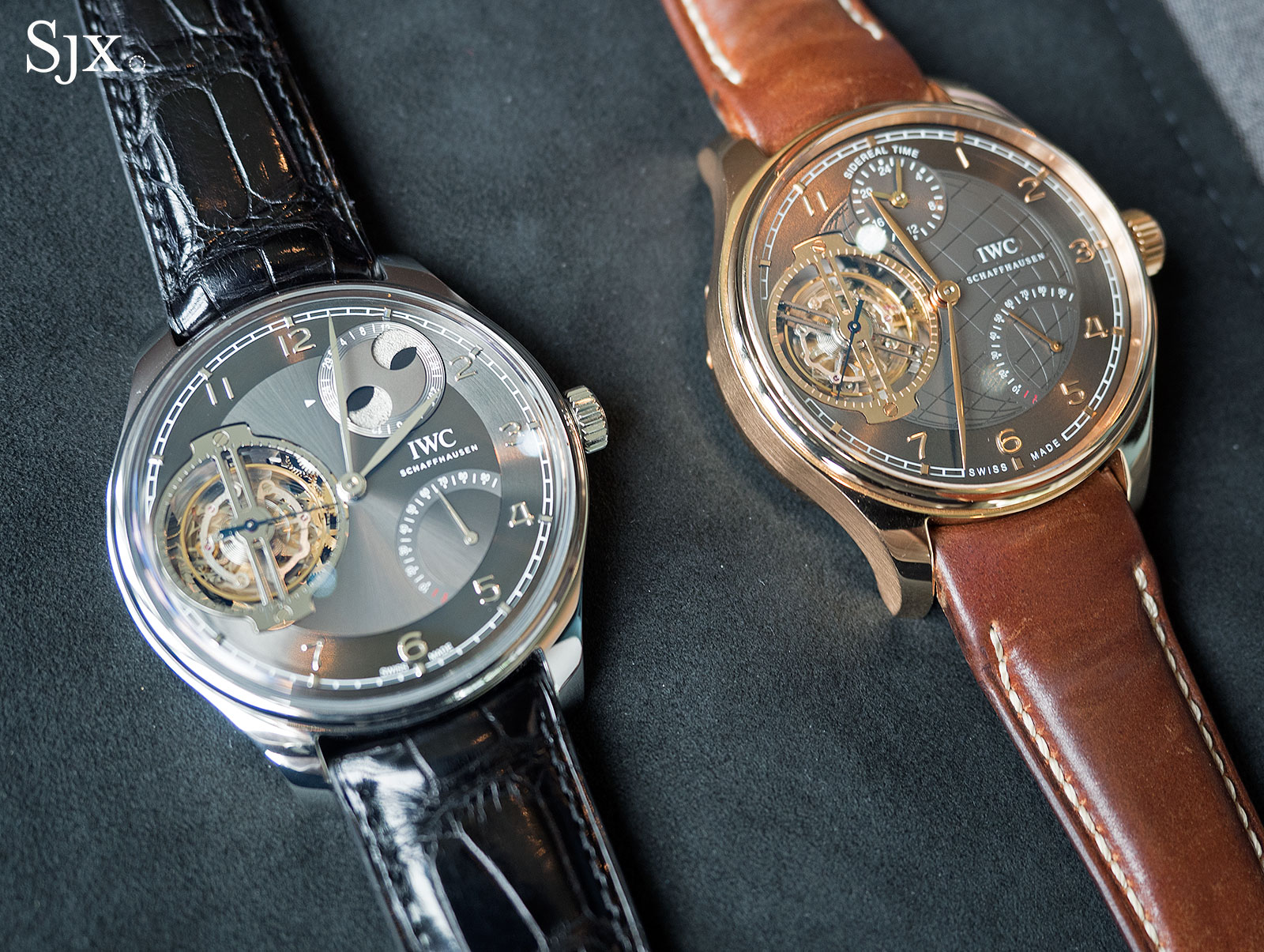
IWC Portugieser Constant-Force Tourbillon 7

The Sidérale Scafusia at right

17.5mm vs 13mm

The case is a large 46mm, which gives it relatively elegant proportions though it is still a large watch.
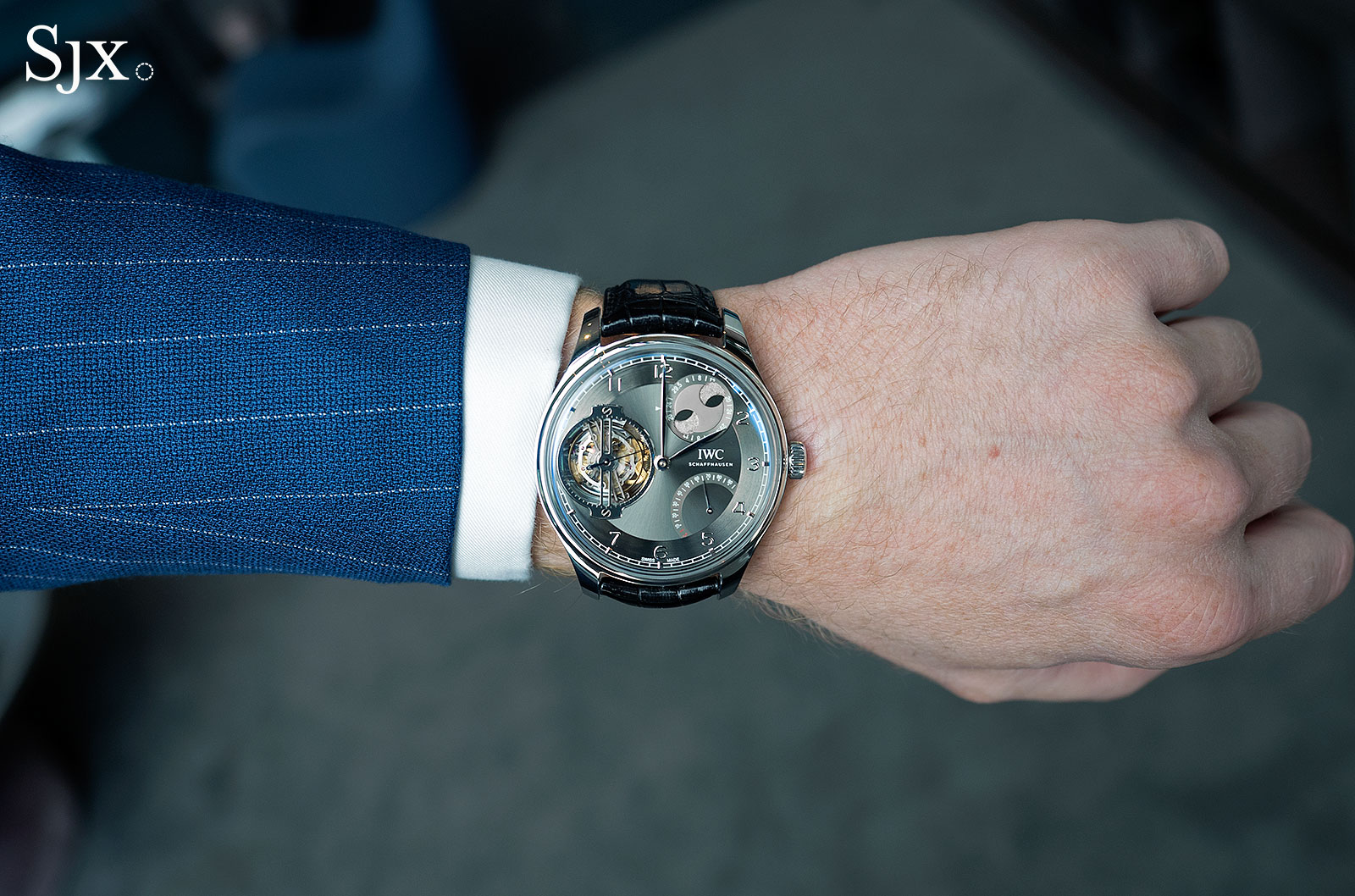
IWC Portugieser Constant-Force Tourbillon 11


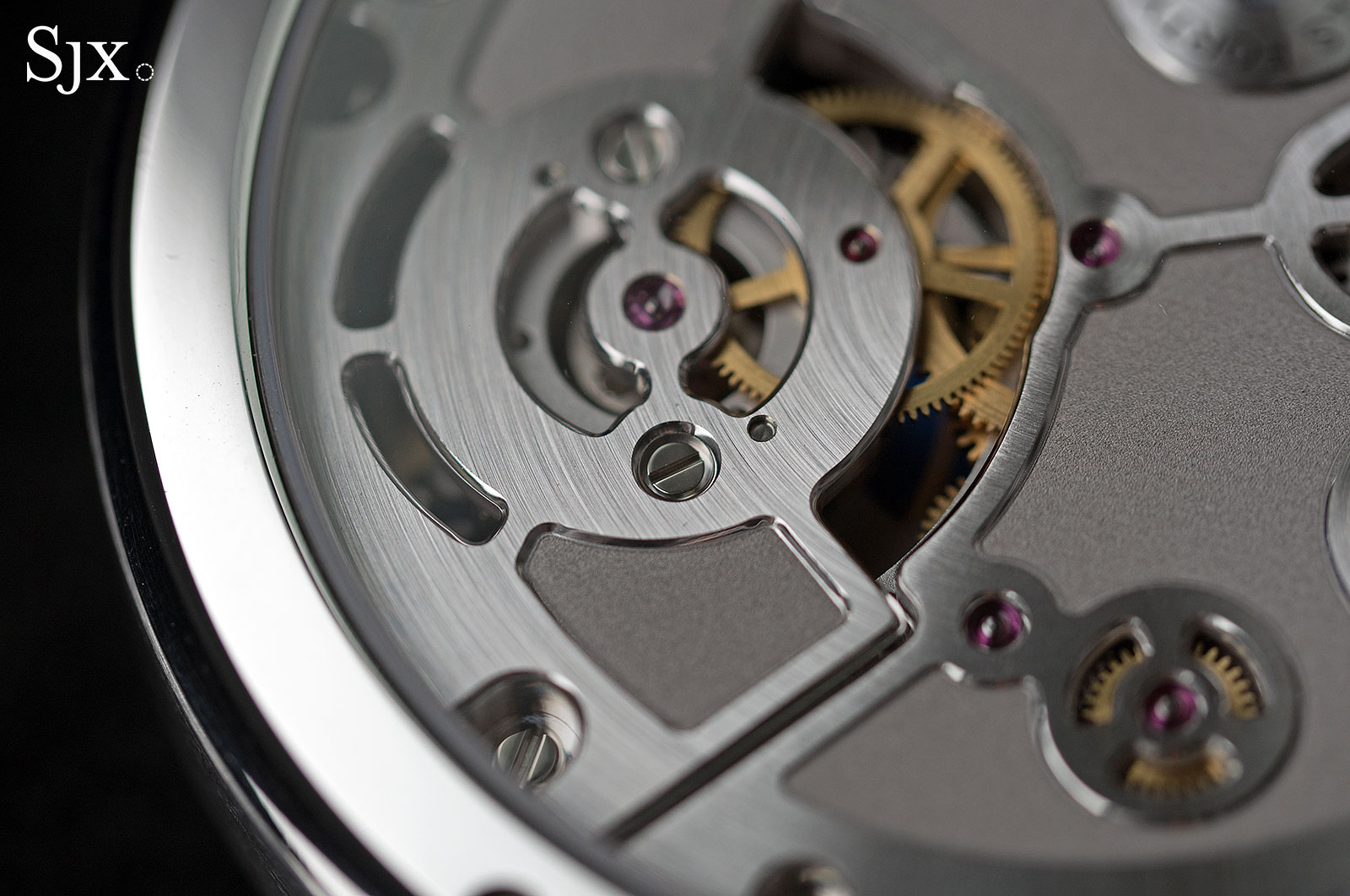
The back reveals the movement and its workmanlike finish. Historically IWC has never been associated with decorative finishing – clever and concise engineering was its thing – so the functional appearance of the movement is in keeping with the brand’s identity.
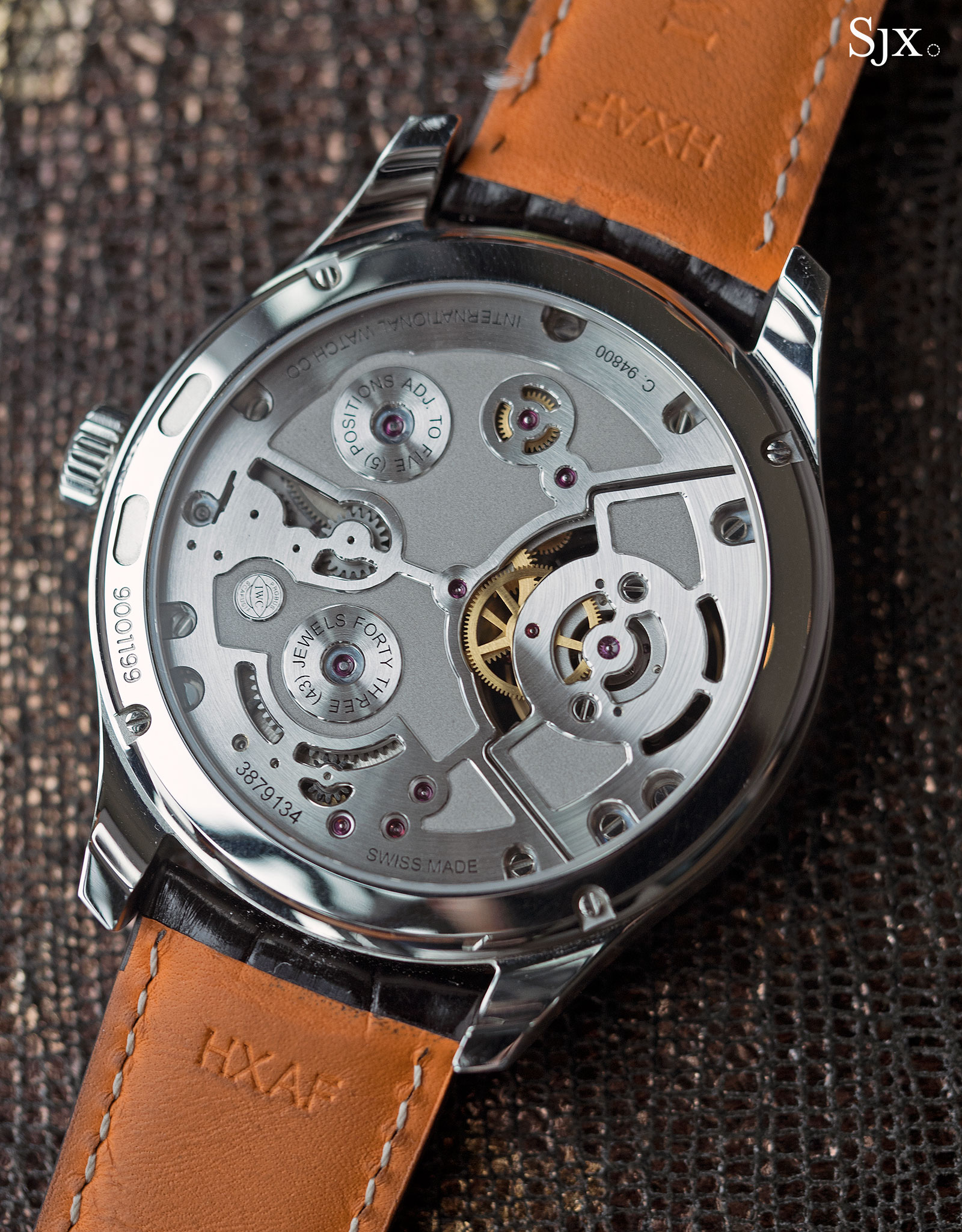
IWC Portugieser Constant-Force Tourbillon 8

Even if not fancy the movement is attractive, with variation of the surfaces finishes that create an appealing contrast. The overall finishing is careful, albeit applied by machine.
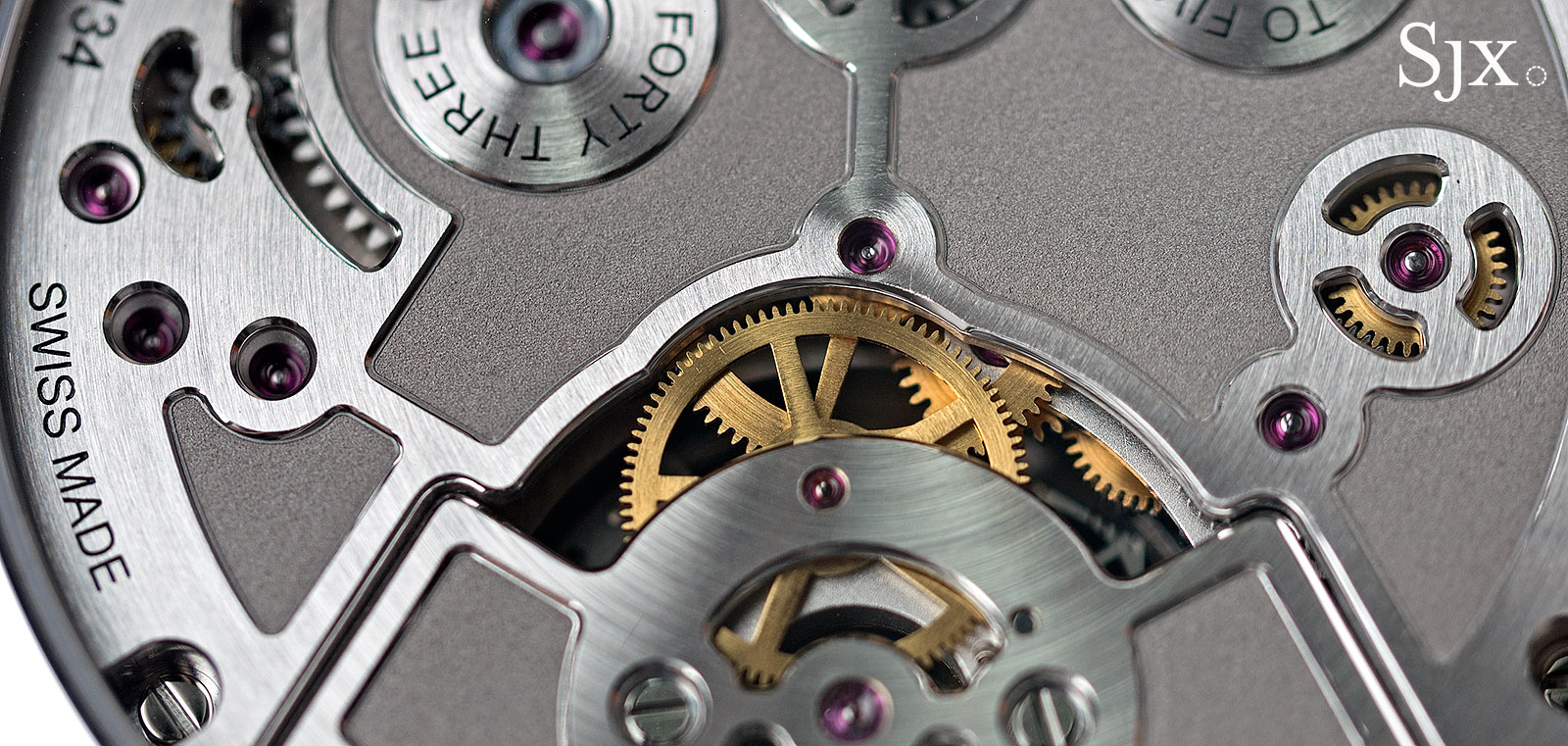
IWC Portugieser Constant-Force Tourbillon 9

IWC Portugieser Constant-Force Tourbillon 10

That being said, the styling of the movement, which is reminiscent of an automobile engine, doesn’t quite suit the classical design on the front. And that explanation for that is likely that the calibre 94800 was originally designed for the Ingenieur Constant-Force Tourbillon, a high octane-high complication.


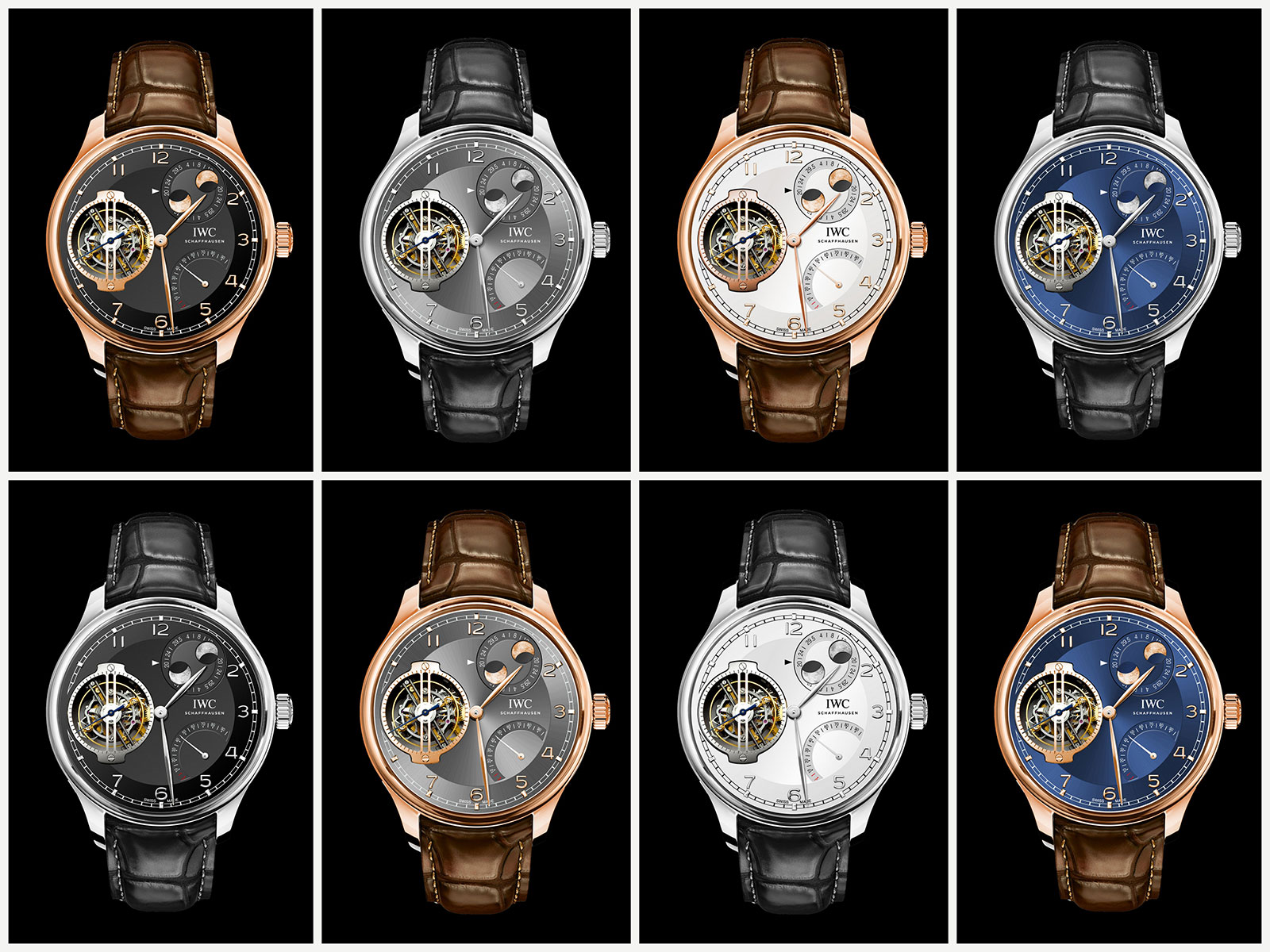
The Portugieser Constant-Force Tourbillon is customisable, with the client able to mix and match for the case, dial and strap. The case is available in red gold or platinum, with the choice of four metallic finish dial colours, as well as a wide range of straps. Further customisation beyond the options offered is possible, but likely at significant additional cost.
IWC Portugieser Constant-Force Tourbillon custom dial

The prototype of the Portugieser Constant-Force Tourbillon is in stainless steel, which unfortunately is not an option for the watch. The lightness of the steel case makes it more wearable than the precious metal versions.

Price and availability 

The Portugieser Constant-Force Tourbillon (ref. IW5901) is made to order, priced at S$325,000 in red gold and S$360,000 in platinum. Those are equivalent to US$230,000 and US$260,000 respectively.
IWC Portugieser Constant-Force Tourbillon 5


Back to top.

You may also enjoy these.

SevenFriday Introduces the S1/01, Clad in Clear, Recyclable Nylon

Sustainability and skeletonisation on SevenFriday's latest collection.

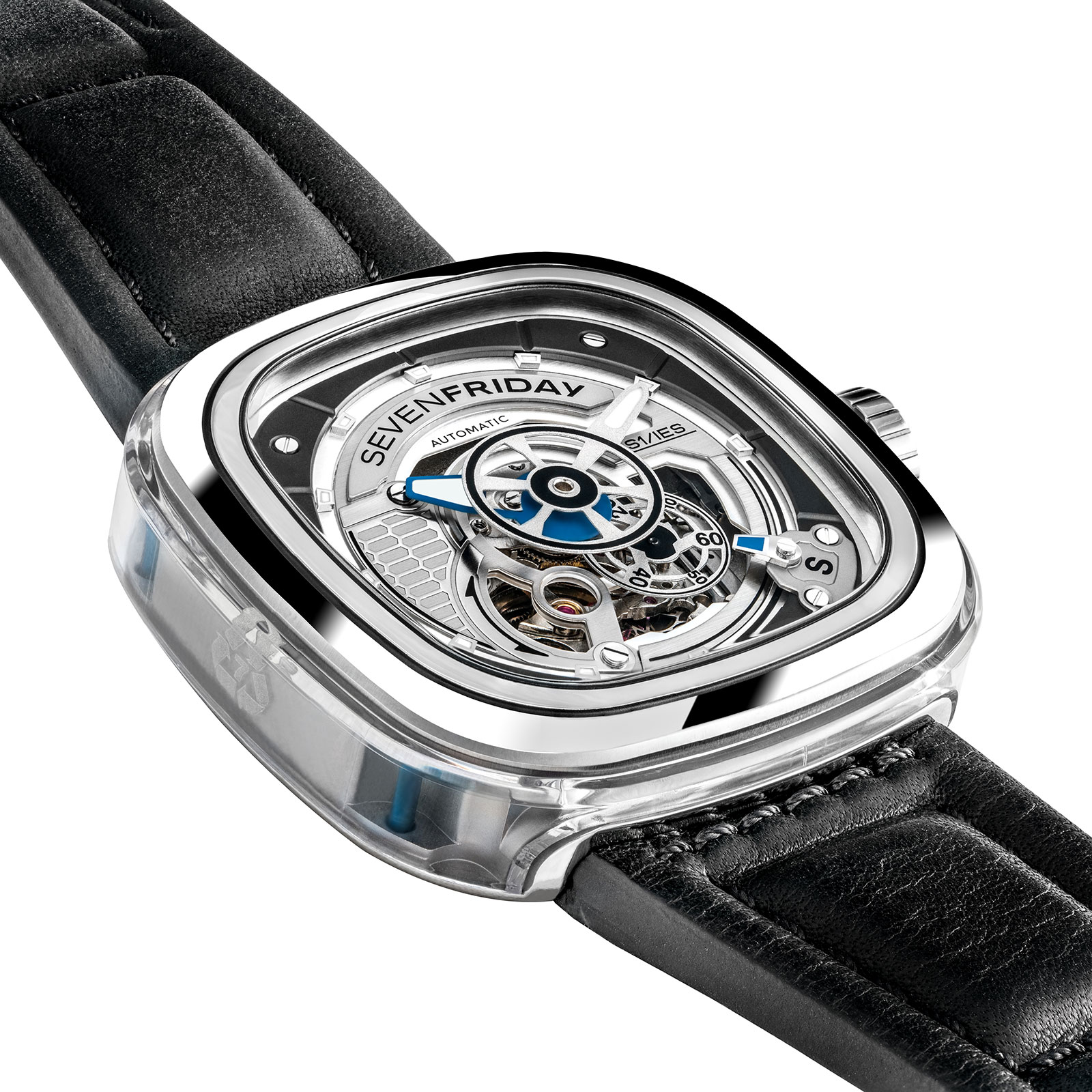
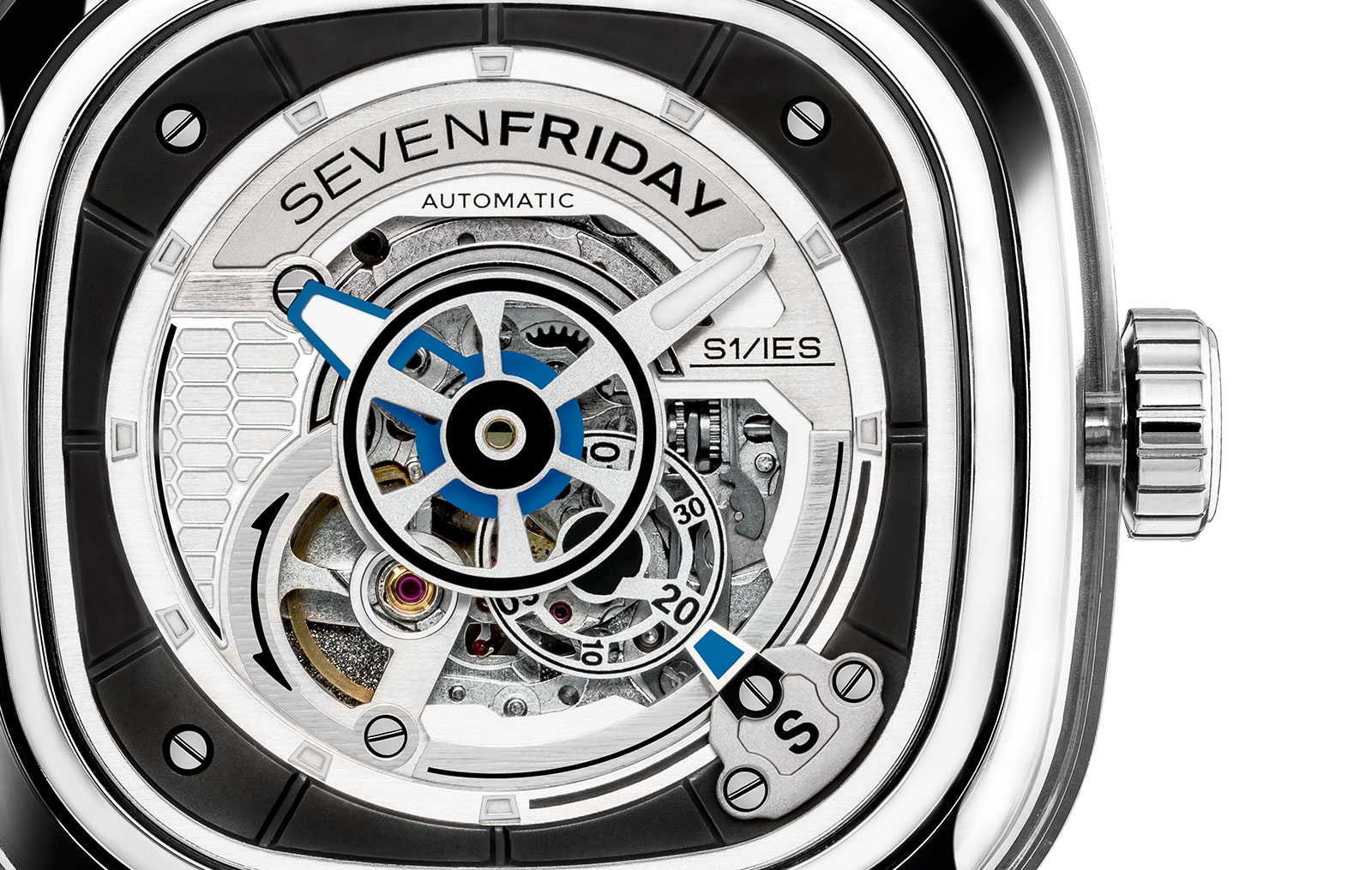
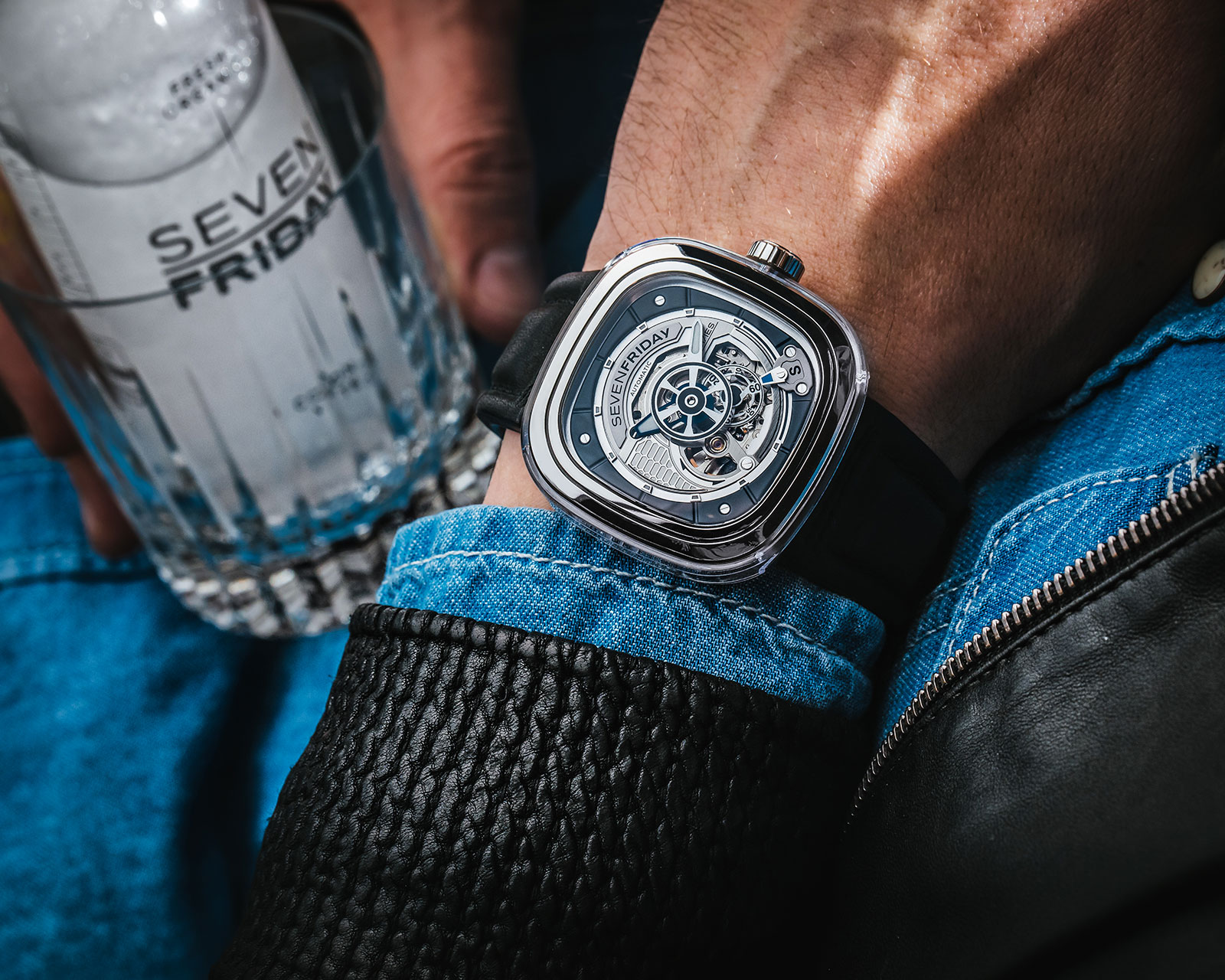
Returning to the original P-series watch case that’s still synonymous with the brand – technically known as a squircle – the SevenFriday S1/01 reveals more of the movement inside with an open-worked dial and seconds wheel.

The keyless works for winding and setting are visible, as is the balance wheel. But beyond the aesthetic tweaks the S1/01 was also conceived with better legibility in mind, becoming the first SevenFriday wristwatch with luminous hour markers and hands. And the hands are also wider than those on earlier models.

SevenFriday S1-01 watch 4

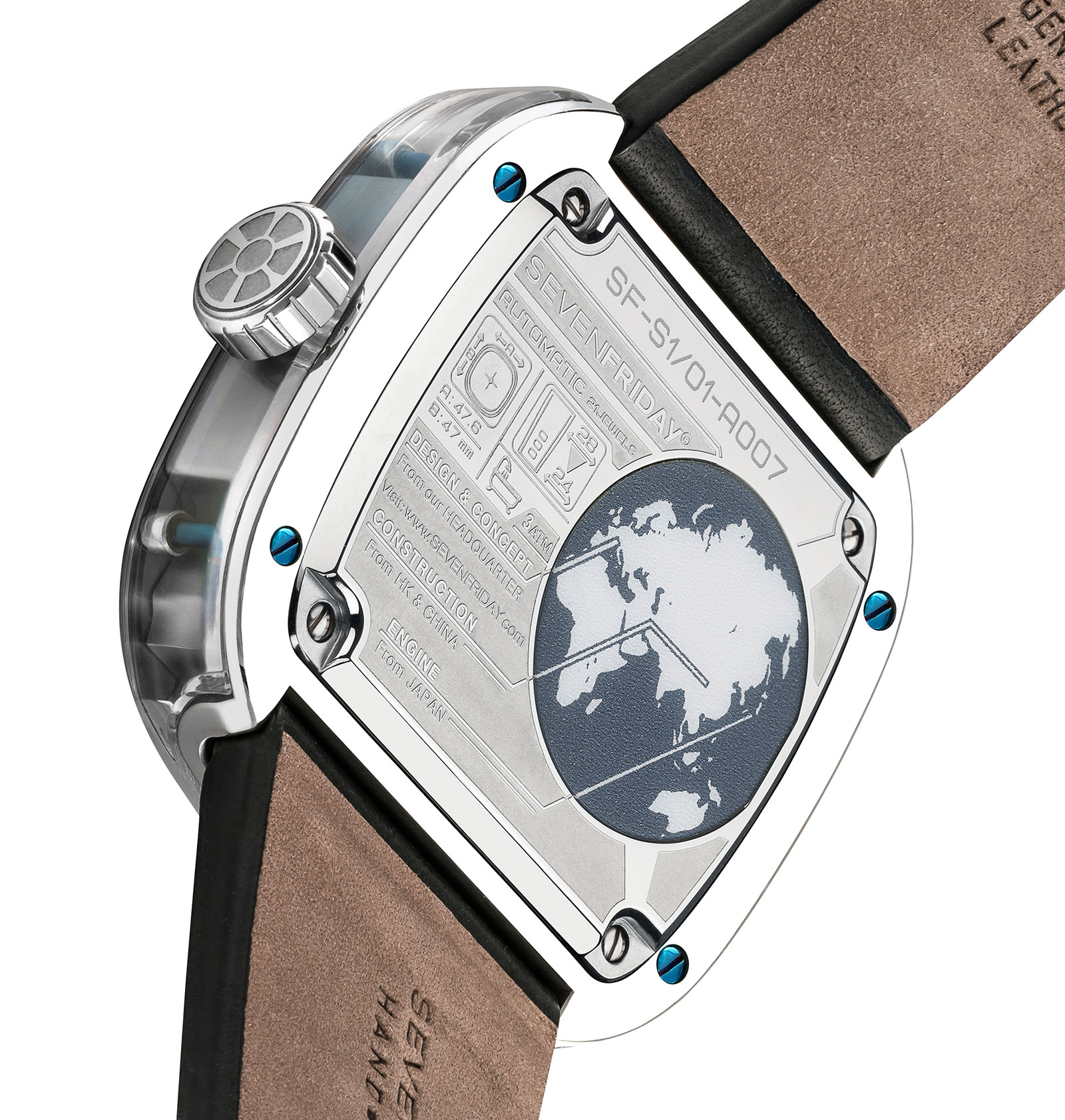
The “animation ring” that circles the sides of the case, which is usually steel but has even been made of laminated wood, is made of clear, hard nylon. Through the translucent plastic the four vertical screws that hold the steel case together are visible. The universal recycling symbol is moulded into the nylon ring at nine o’clock.

SevenFriday S1-01 watch 2

As is standard for SevenFriday watches, the S1/01 has a near-field communication (NFC) chip embedded into the case back. It can be read via a smartphone that has the SevenFriday app, allowing the owner of the watch to authenticate the watch and register ownership.

The case measures 47mm in diameter and 47.6mm long, exactly the same dimensions as the P-series.

SevenFriday S1-01 watch 1

Price and availability 

The S1/01 is priced at US$1450 or S$1850, and is already available at SevenFriday retailers.


Back to top.

You may also enjoy these.
Welcome to the new Watches By SJX.

Subscribe to get the latest articles and reviews delivered to your inbox.