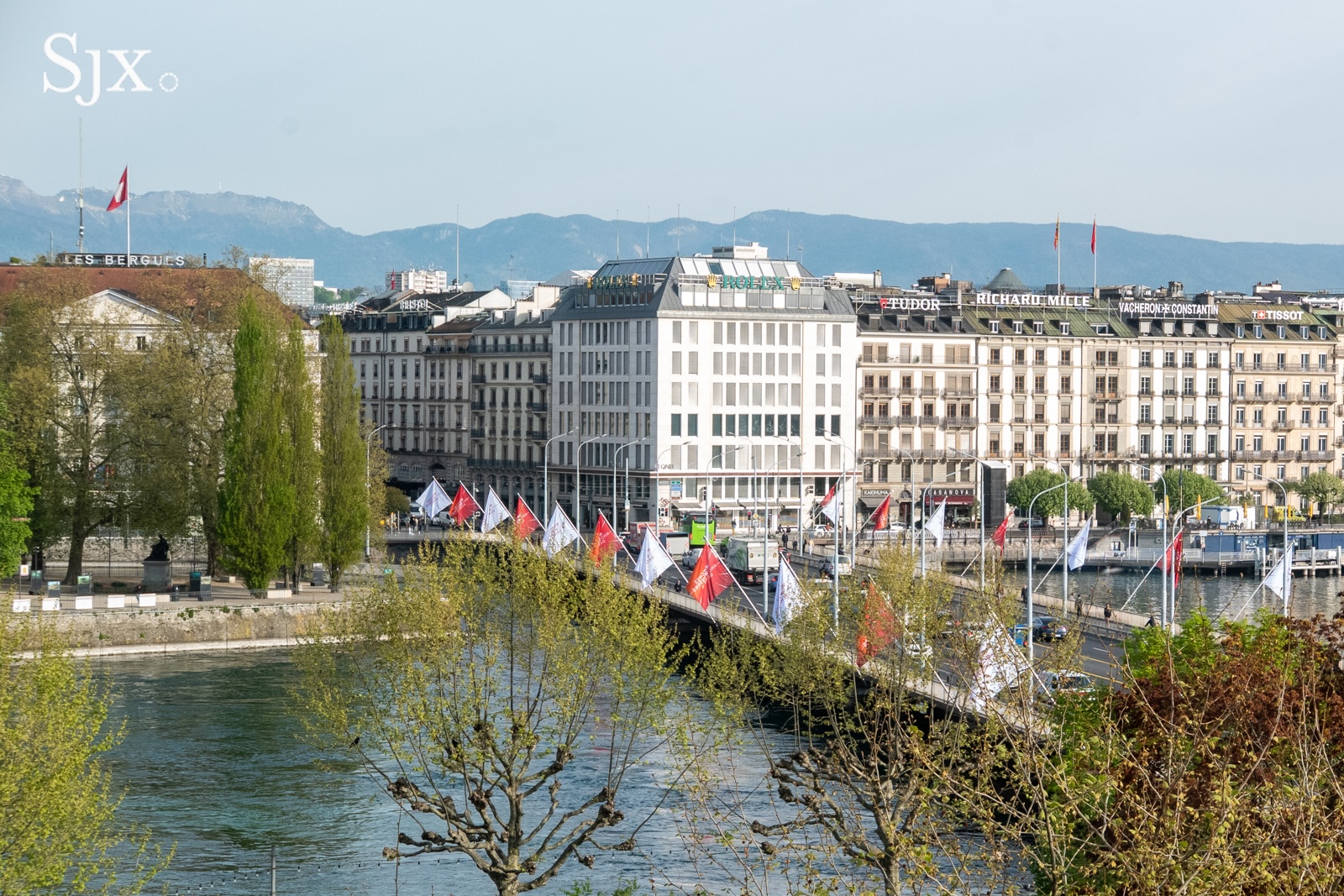
As Watches & Wonders drew to a close, Patek Philippe opened its annual exhibition of Rare Handcrafts at its salon on Rue du Rhône. It was a peaceful escape from the hustle of the Palexpo, and the perfect setting to view several dozen pieces from the new collection, ranging from Dome Clocks to wristwatches and pocket watches.
The exhibition is open to the public until May 9th. Attendance is free, but visitors must register in advance online.
Dome Clocks
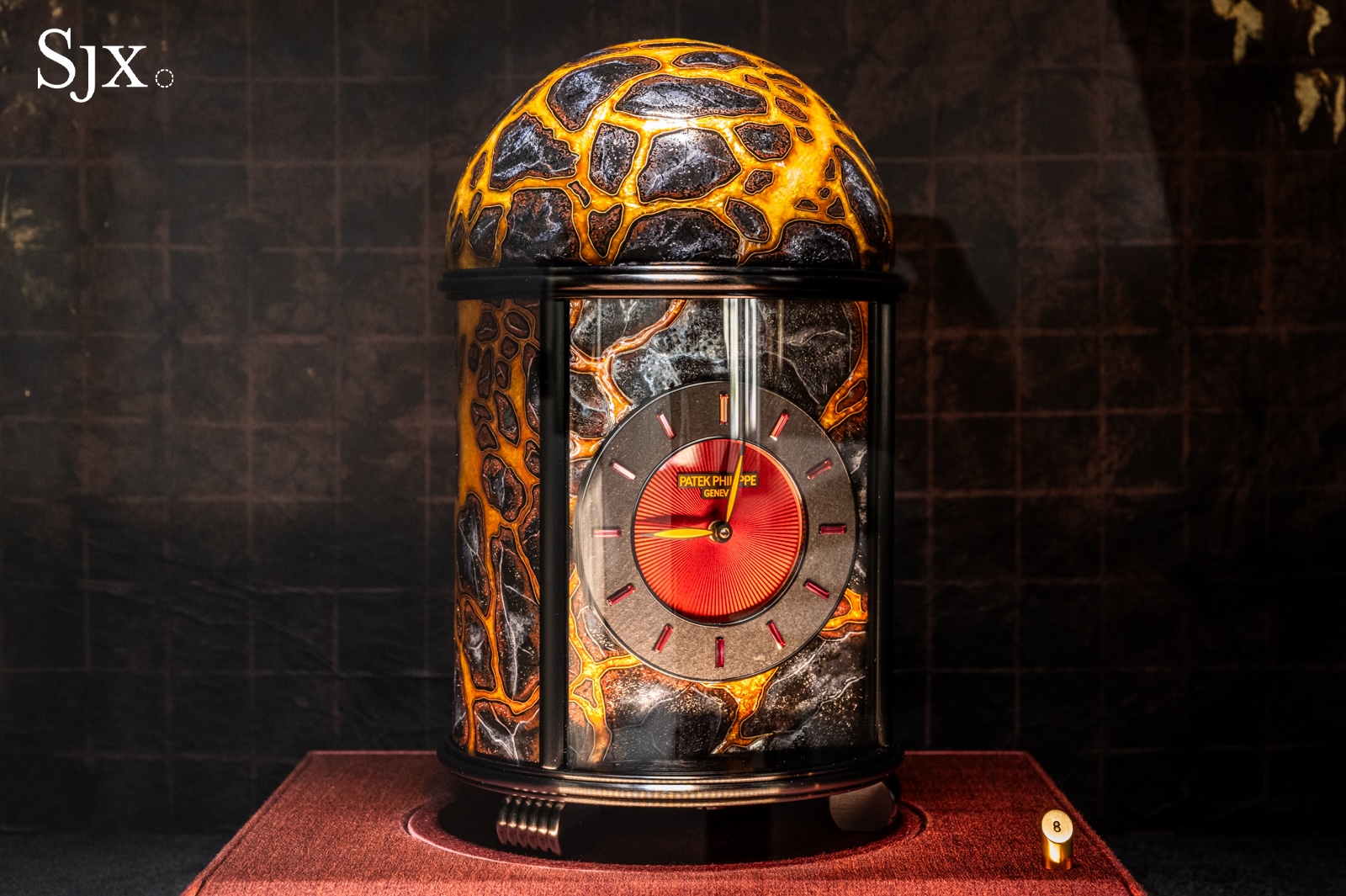
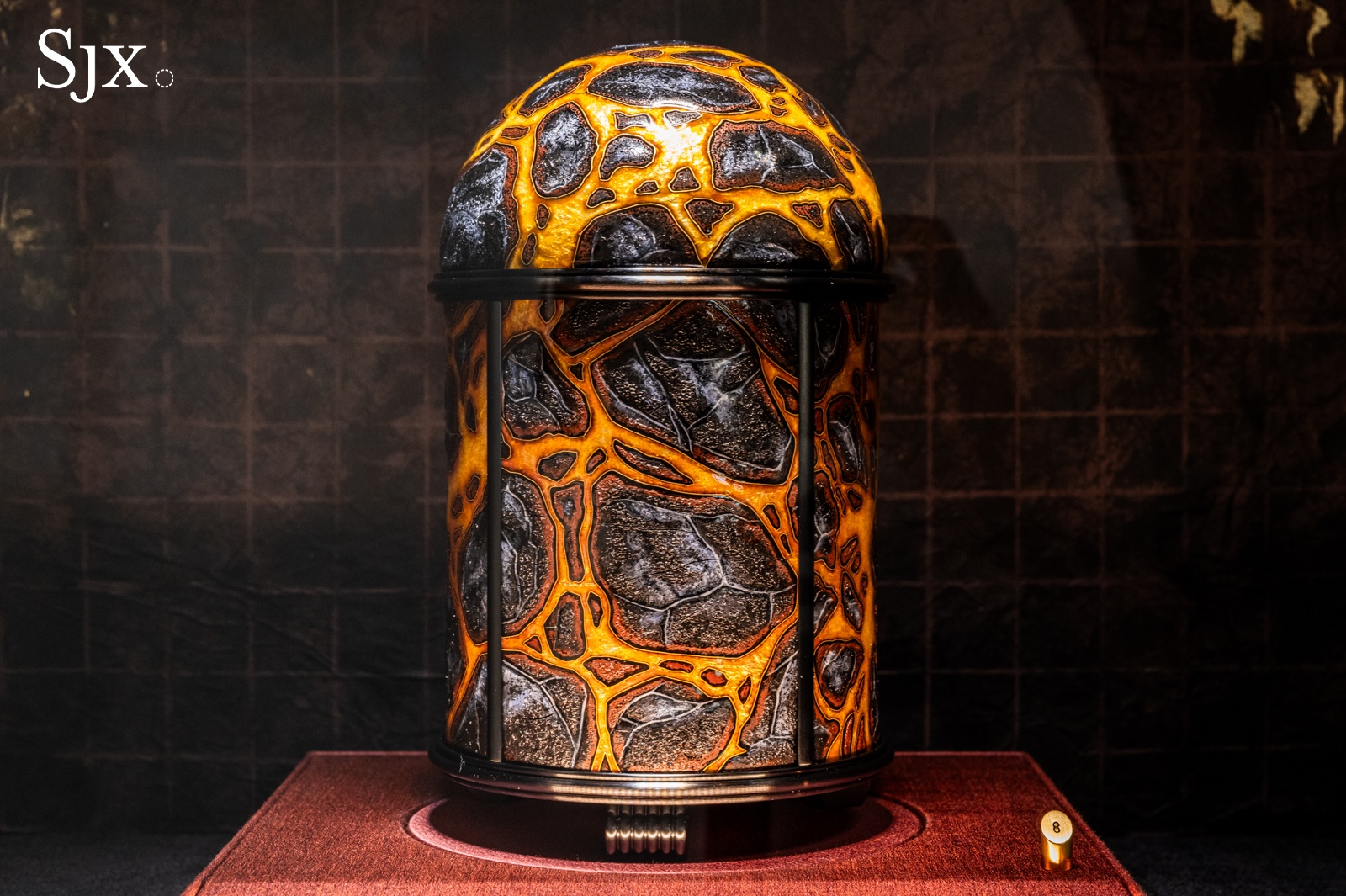
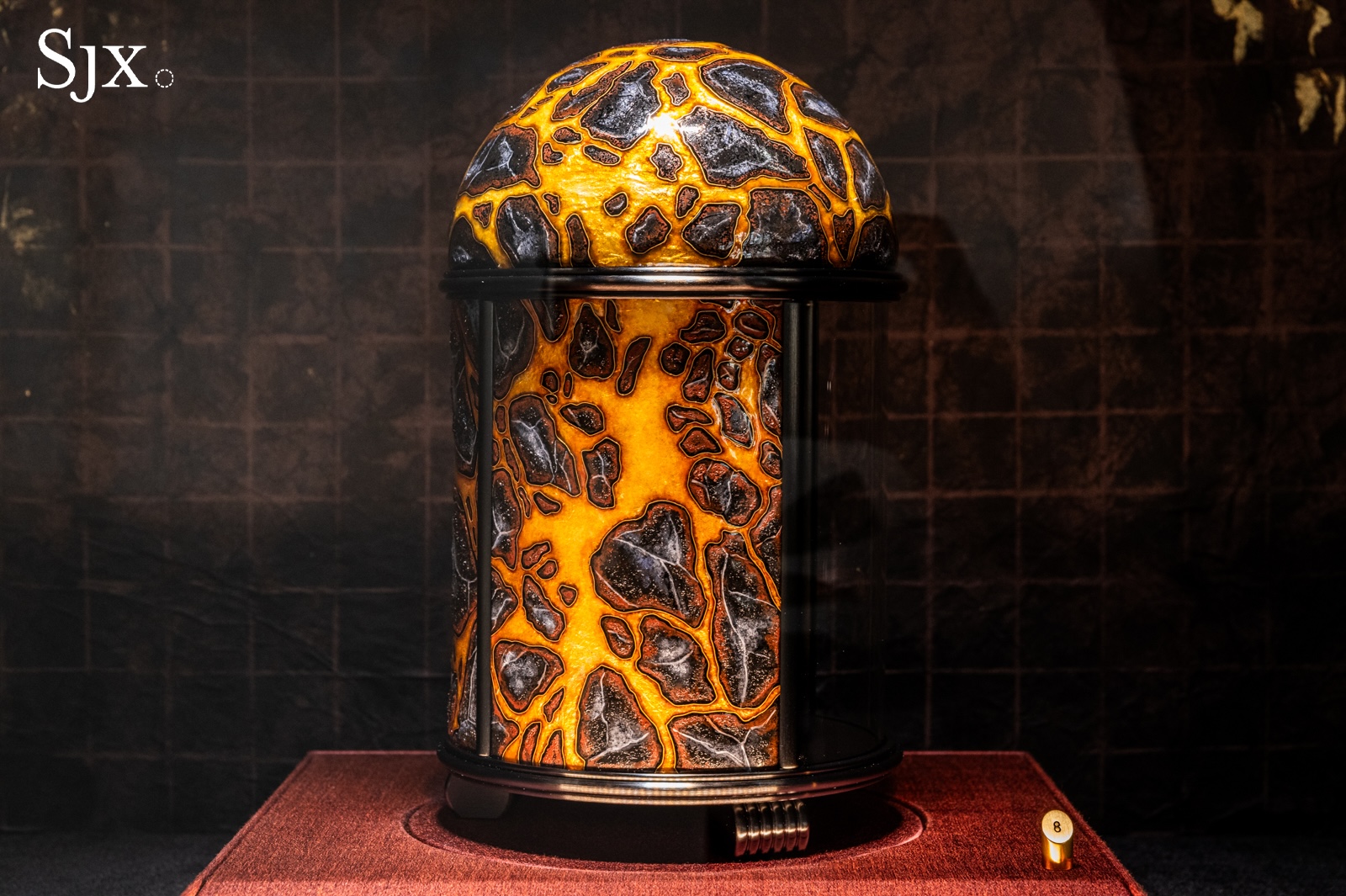
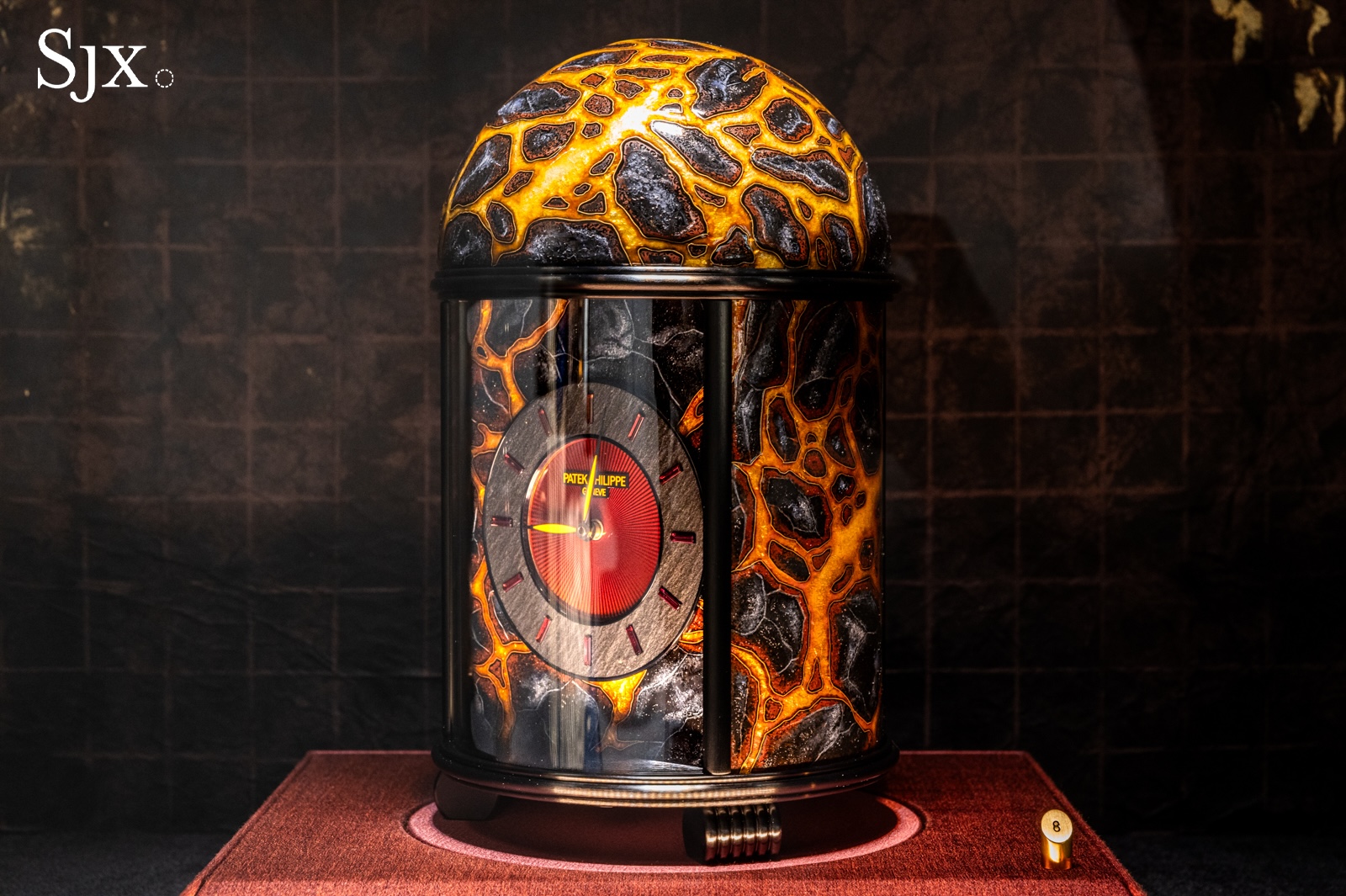
Among the prevailing themes of this year’s collection, the power of nature featured prominently. The Dome Clock ref. 20202N-001 “Magma” is the perfect example. The organic composition is almost shocking in its simplicity and minimal palette of just five colours of transparent enamel — and just seven more used for miniature painting.
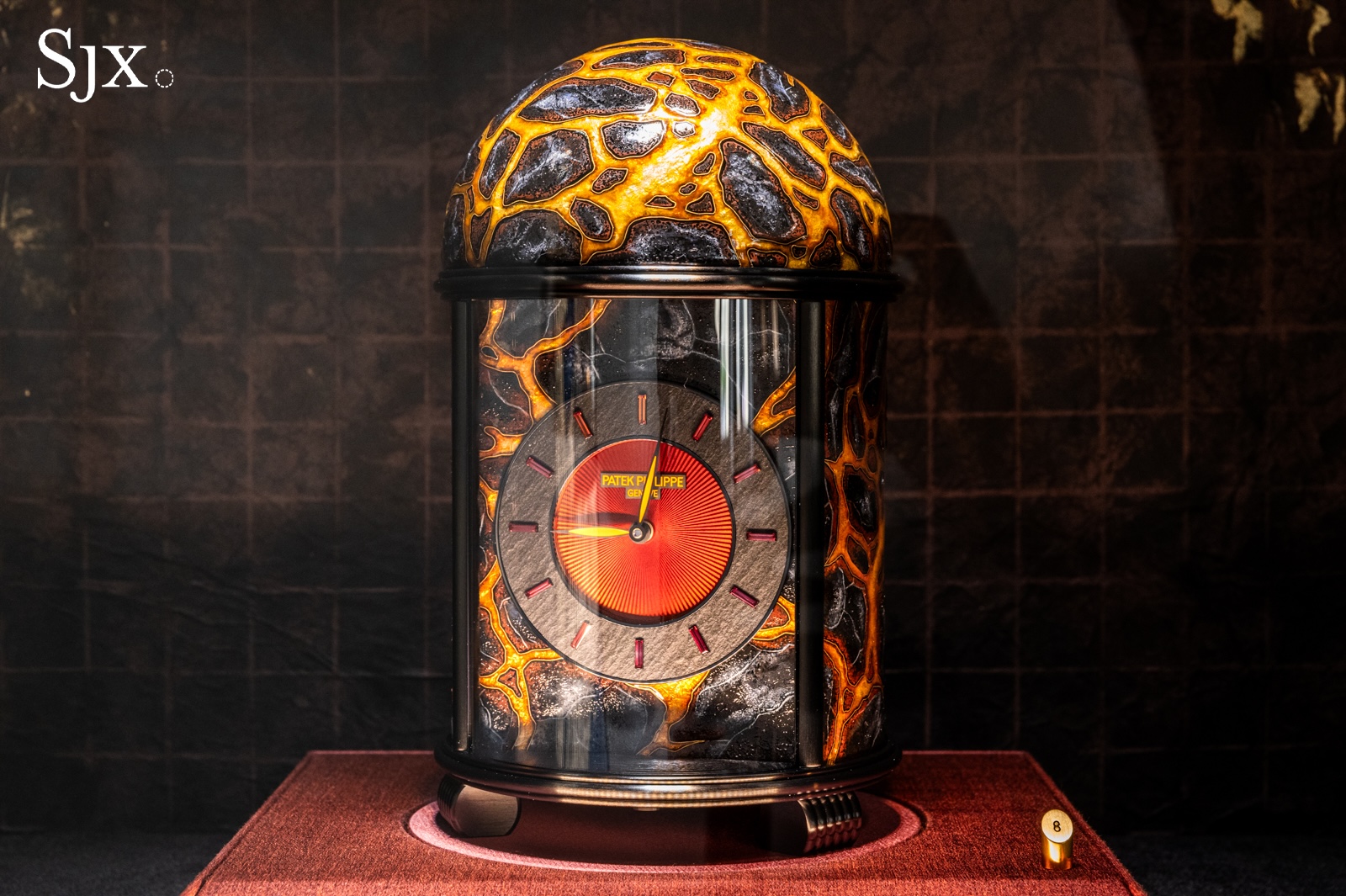
The volcanic depiction is undeniably violent in a way that creates a pleasing tension with the controlled techniques employed to create it, including silver leaf paillonné and a needle technique for creating the lifelike look of the volcanic rock, outlined with more than 23 g of gold wire.
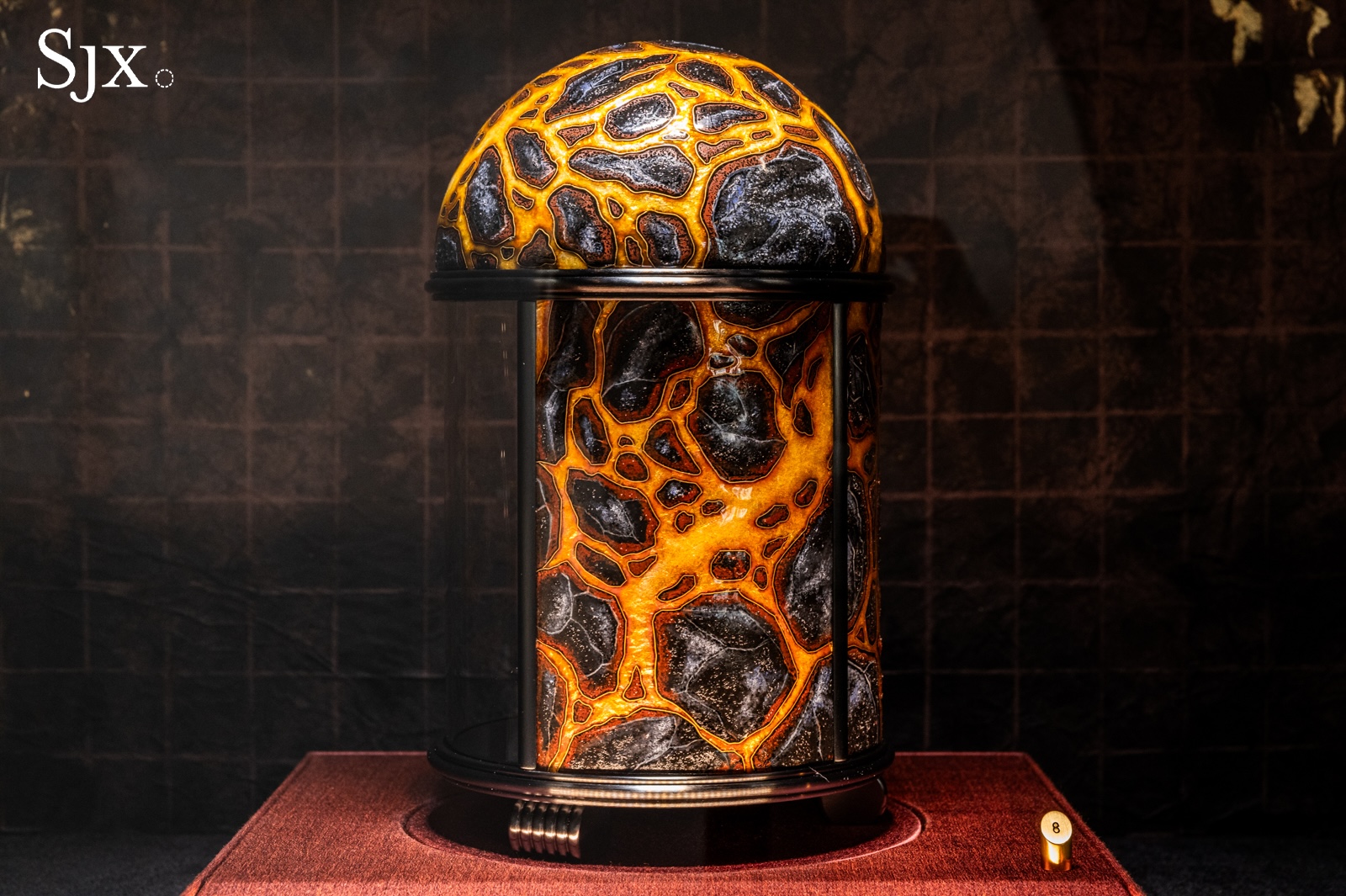
Of course, fired enamel has a lot in common with magma. In short, this choice of molten medium contributes to the authenticity of the work. The glowing lava is mirrored on the dial with 12 large baguette-cut sapphire hour markers totaling about 3 cts.
Like the other Dome Clocks featured, the Magma is powered by an electrically wound 17’’’ pocket watch movement that offers a look into the firm’s past with a hand-formed Breguet overcoil, snail regulator, and screw-poised balance.
The elegantly shaped bridges were once a trademark of the brand, the firm even acquired a design patent in its largest market, the United States, for its distinct center bridge. Today the forms have been simplified to remove two sharp interior angles, but it’s still recognizable as a Patek Philippe movement by design alone.
As the movement’s mere 50 hours of going isn’t enough for a clock — which should be expected to run for eight days — it is periodically rewound by a battery-powered electric motor, allowing it to run for at least a year.
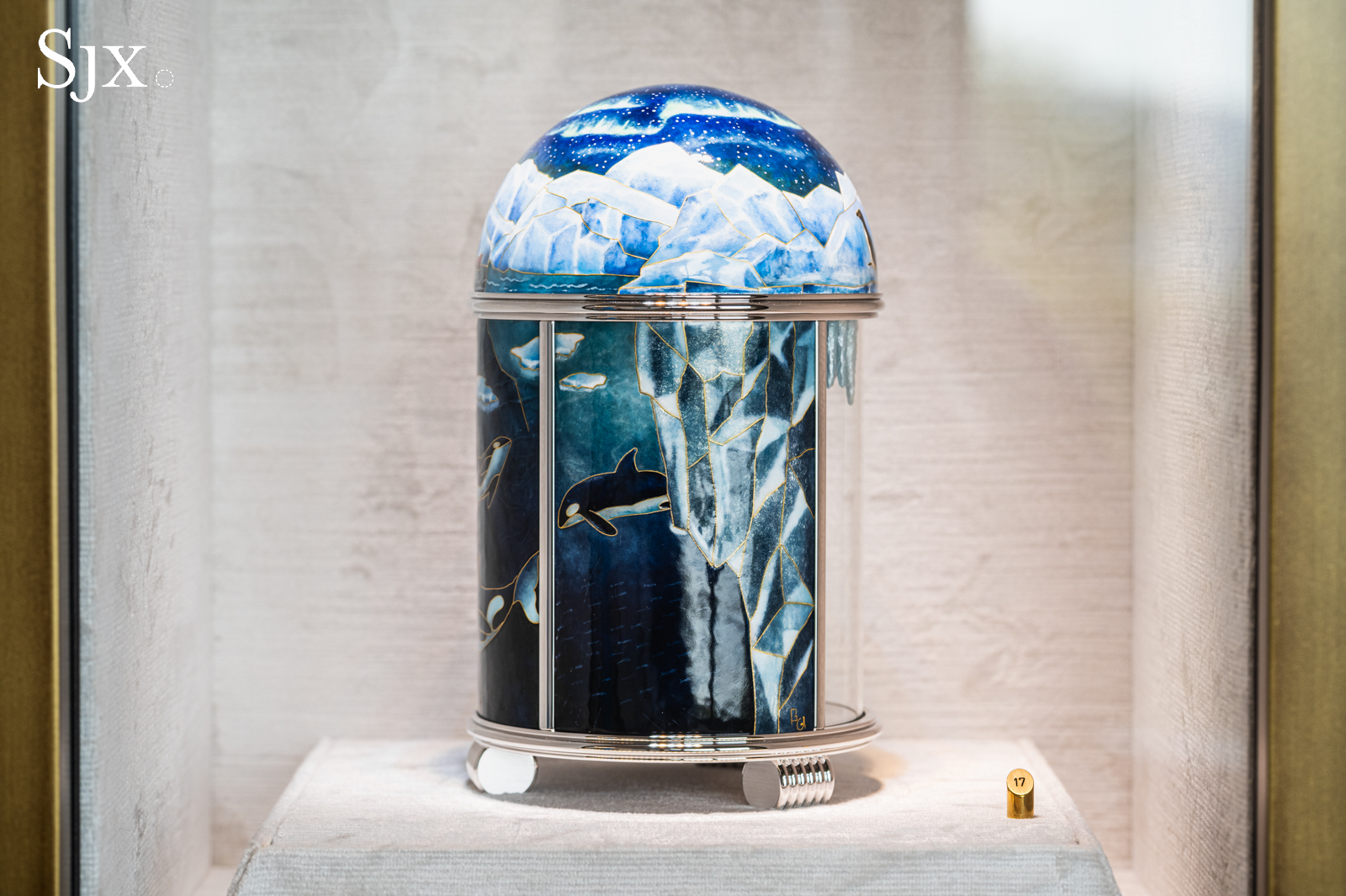
The Dome Clock ref. 20212M-001 “North Pole” cools things down, forming something of a ‘fire and ice’ motif within the broader 2026 Rare Handcrafts collection. Compared to the simple and striking Magma, the North Pole clock is more elaborate with 41 colours of enamel combining numerous techniques including cloisonné, paillonné, and miniature painting.
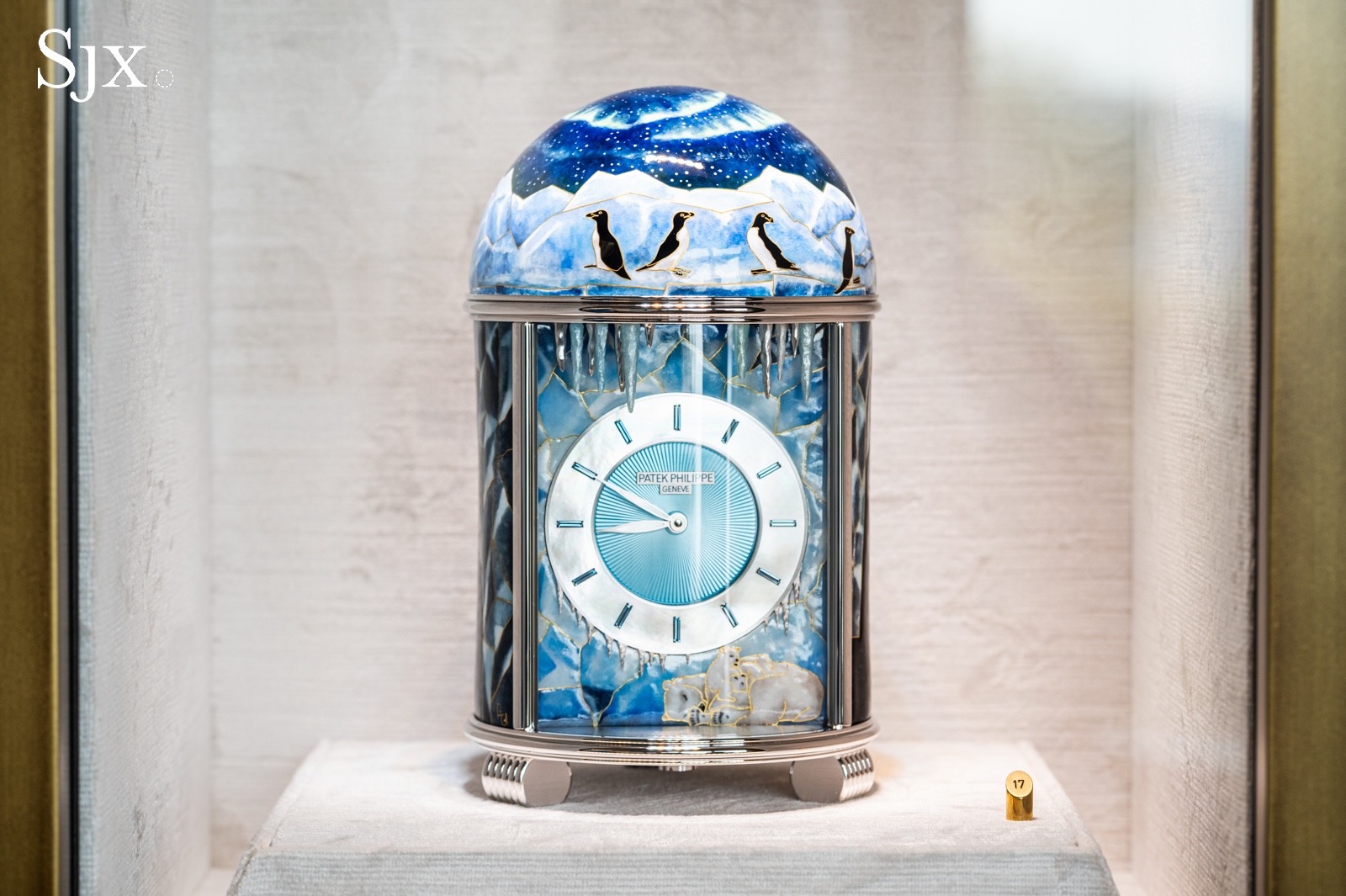
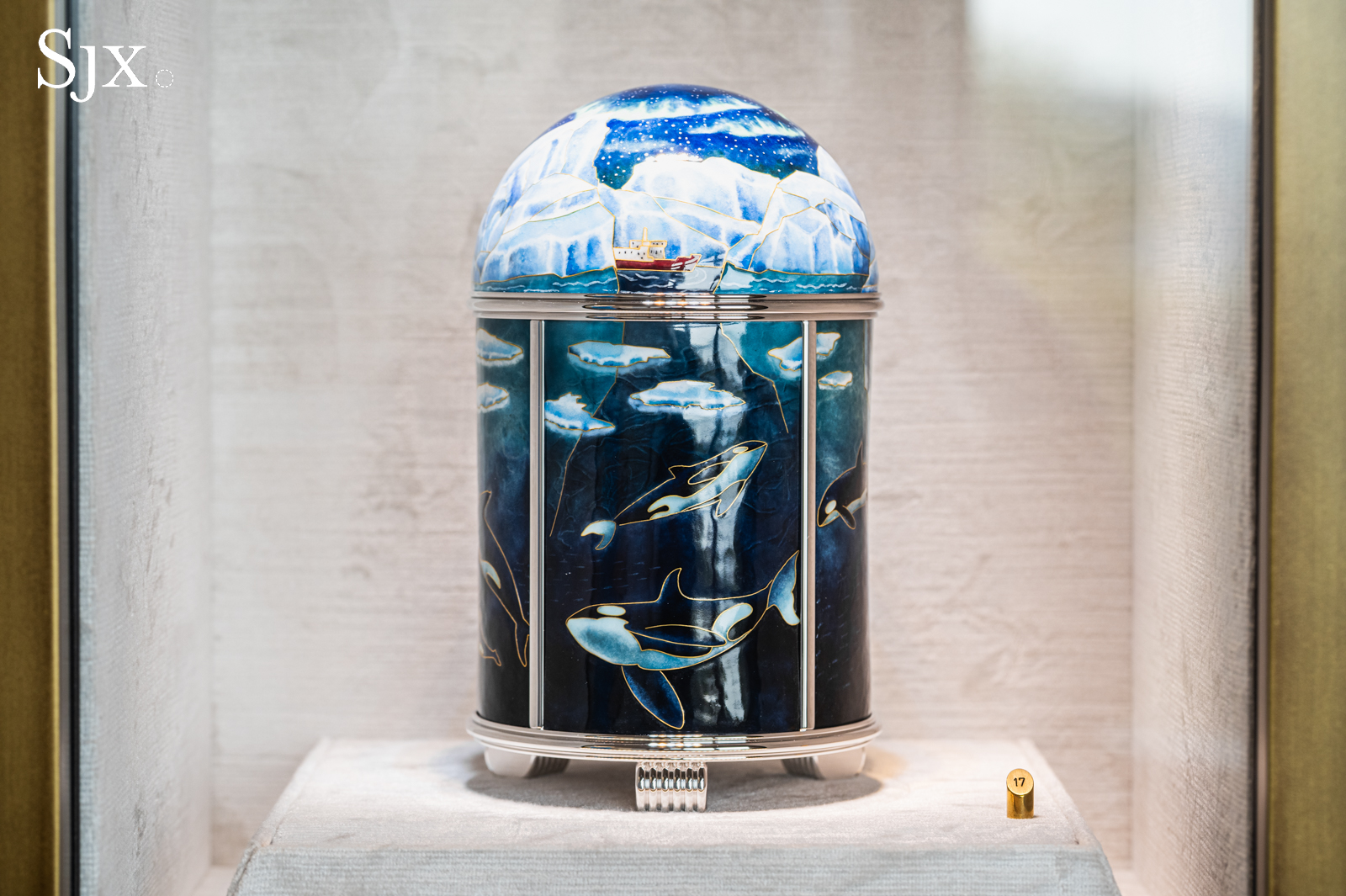
The North Pole Dome Clock was a personal favourite, as I’m headed that way later this year. Furthermore, the Orca whales — here rendered in cloisonné enamel — are a regular fixture near my home on Puget Sound.
But its most striking feature might be its rhodium-plated icicles that hang down above the dial. To some extent, this decorative embellishment feels like breaking the fourth wall — the design comes off the screen into reality.
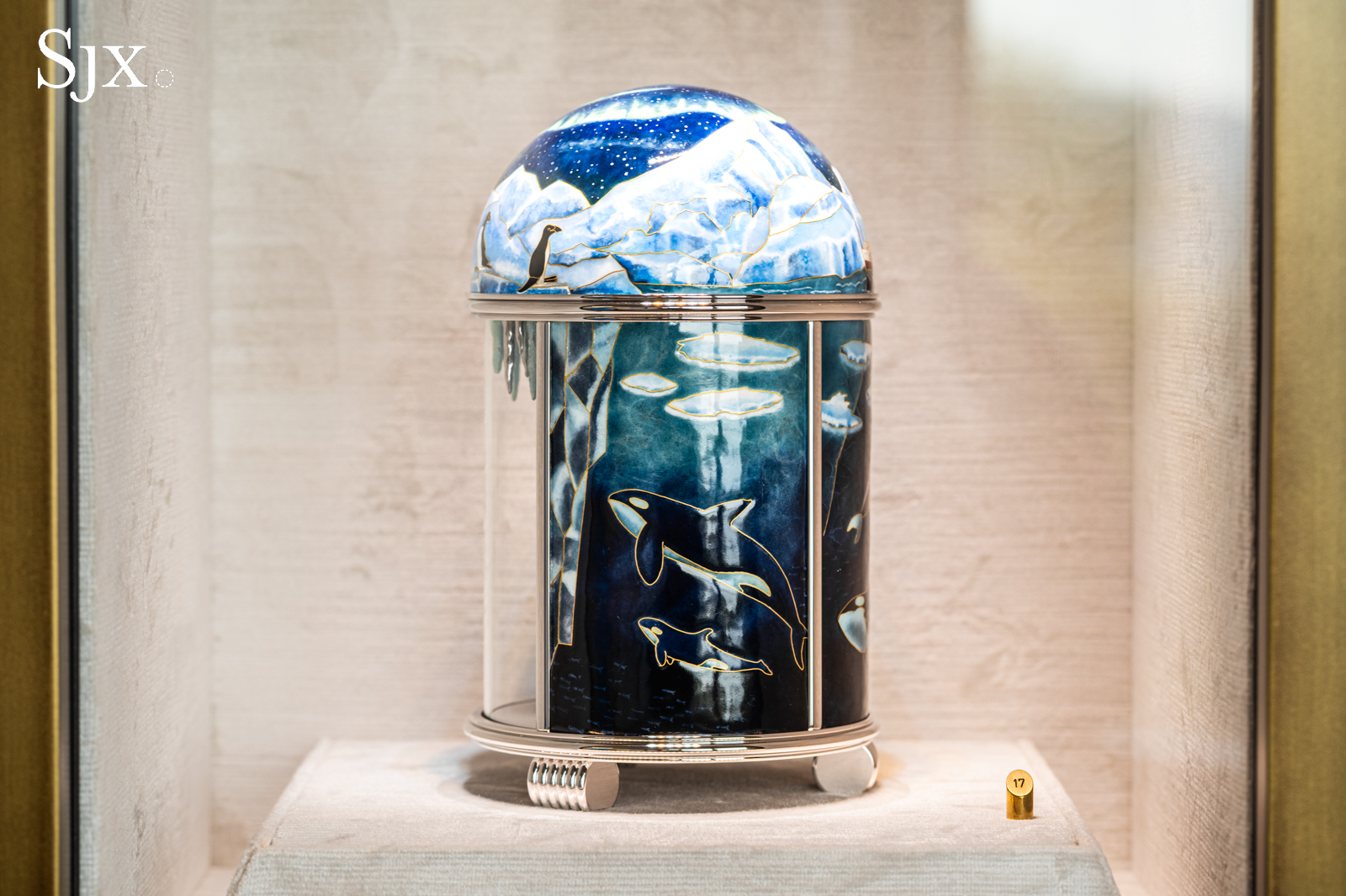
The other details, including the aurora borealis, polar bears, penguins, and a fishing boat, complete the richly detailed depiction of the arctic. The mother-of-pearl dial is set with blue topaz baton hour markers, which could almost pass for pieces of sea ice.
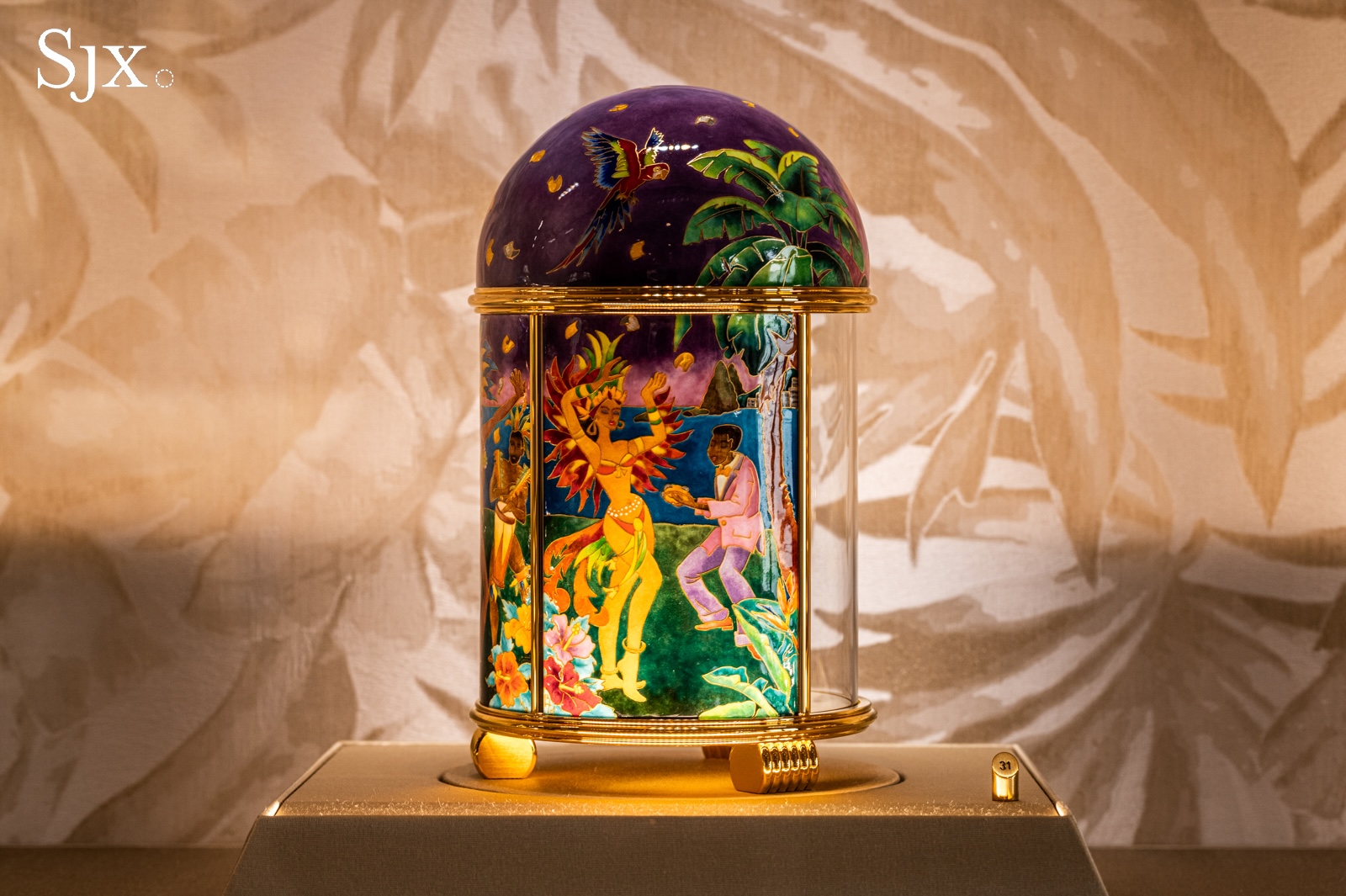
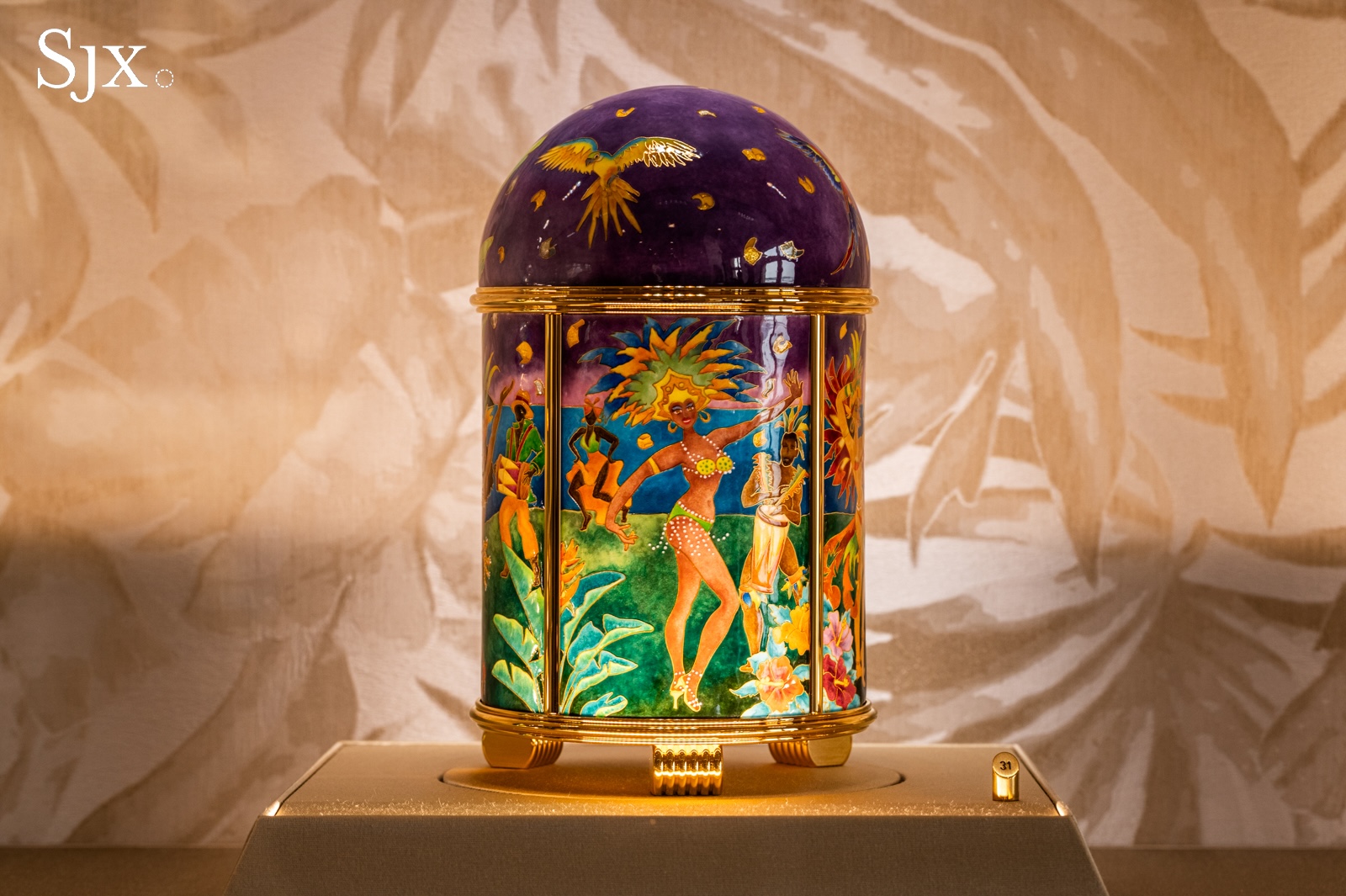
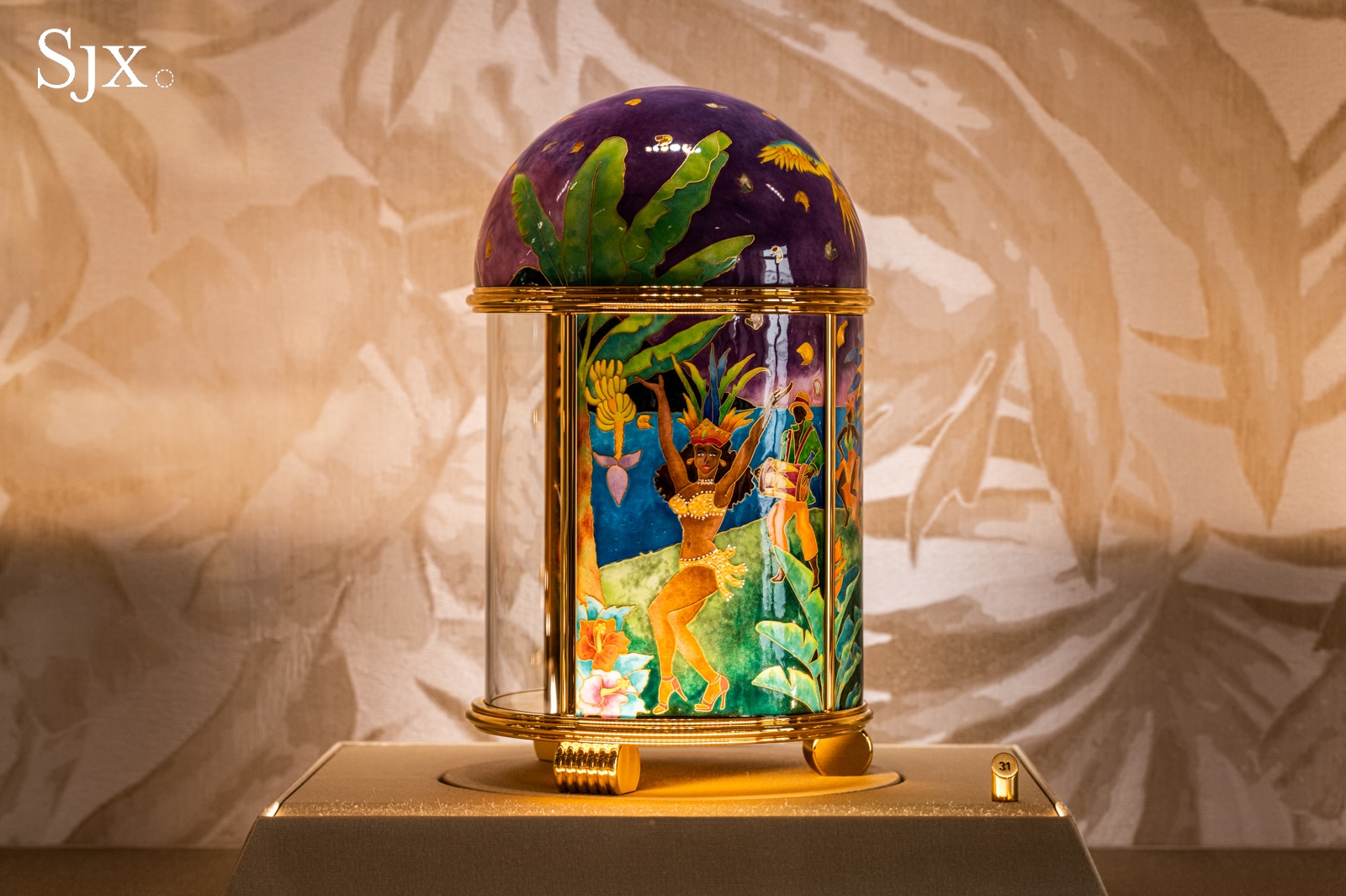
If the Magma and North Pole Dome Clocks represent the extremes of the natural world, the Dome Clock ref. 20201M-001 “Rio Carnival” is its human equivalent — exuberant, loud, and extreme in its own way.
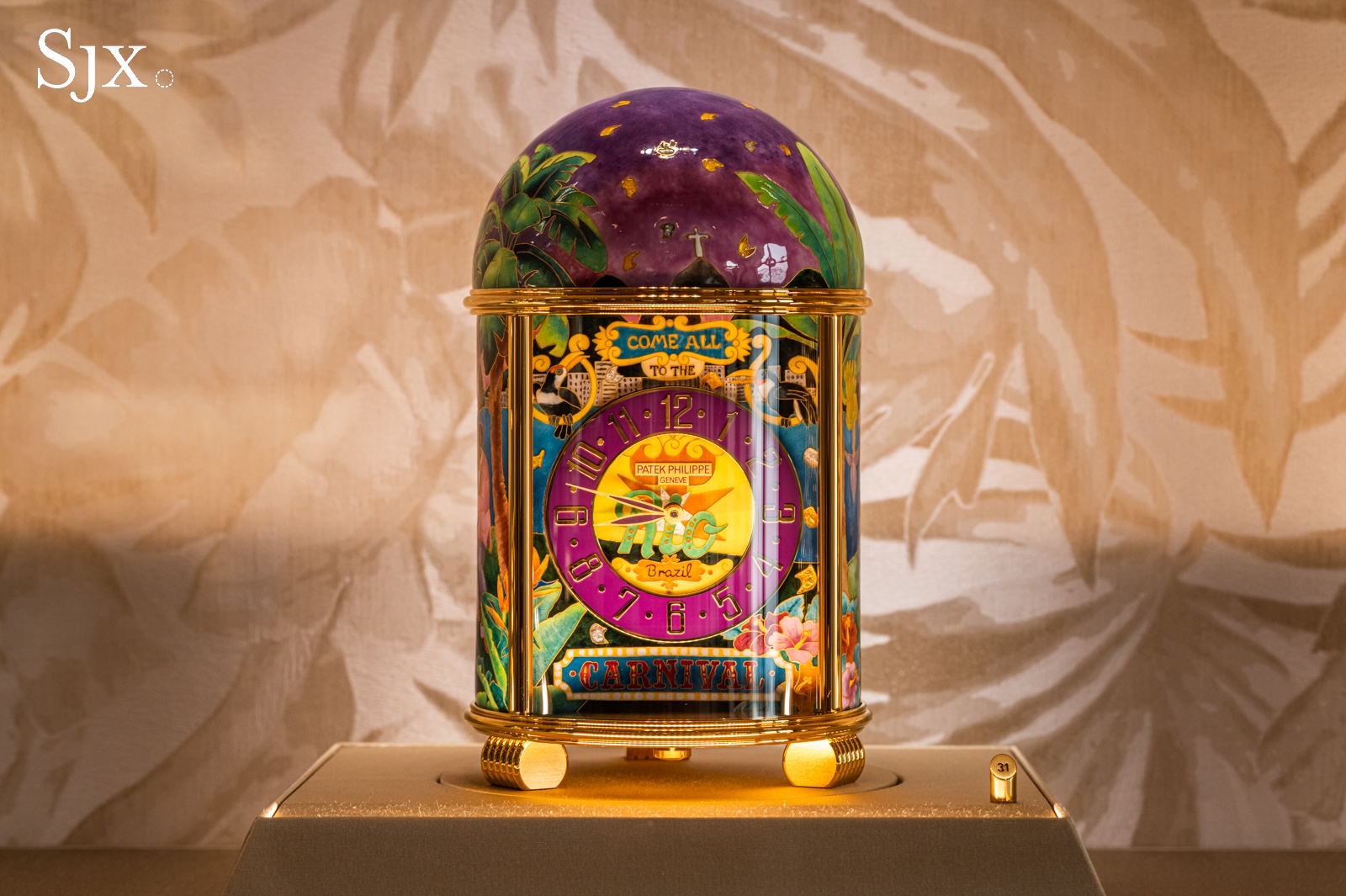
Compared to Magma and the North Pole, the Rio Carnival design feels more traditional — it could almost be a vintage design, with angular forms that remind me of mid-century cloisonné wristwatches dials from Patek Philippe and other brands supplied by Stern Frères.
The Rio Carnival Dome Clock features no fewer than 99 colours — some contained in cloisonné cells using more than 21 m of gold wire and 11 colours used specifically for the miniature paintings.
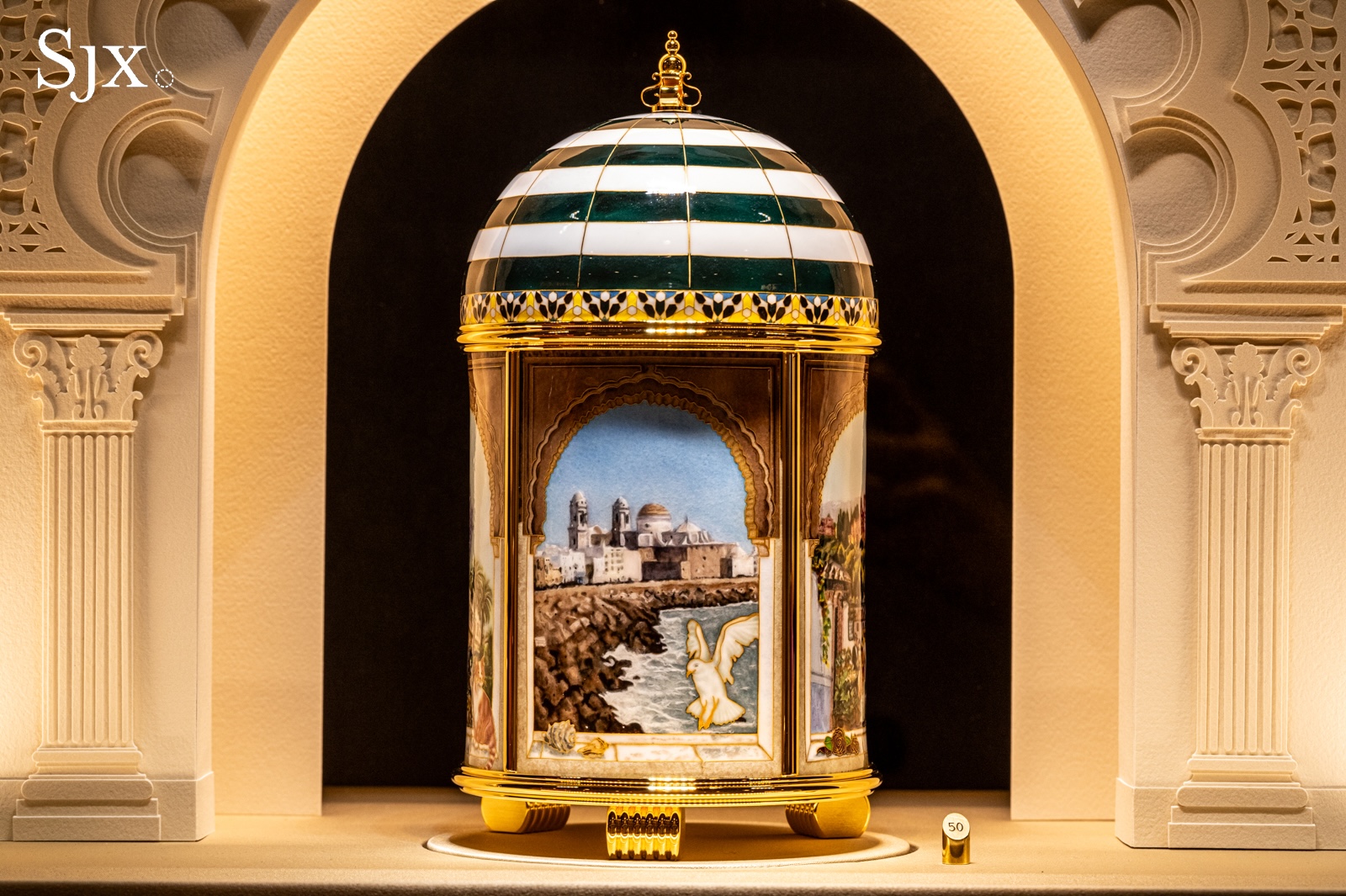
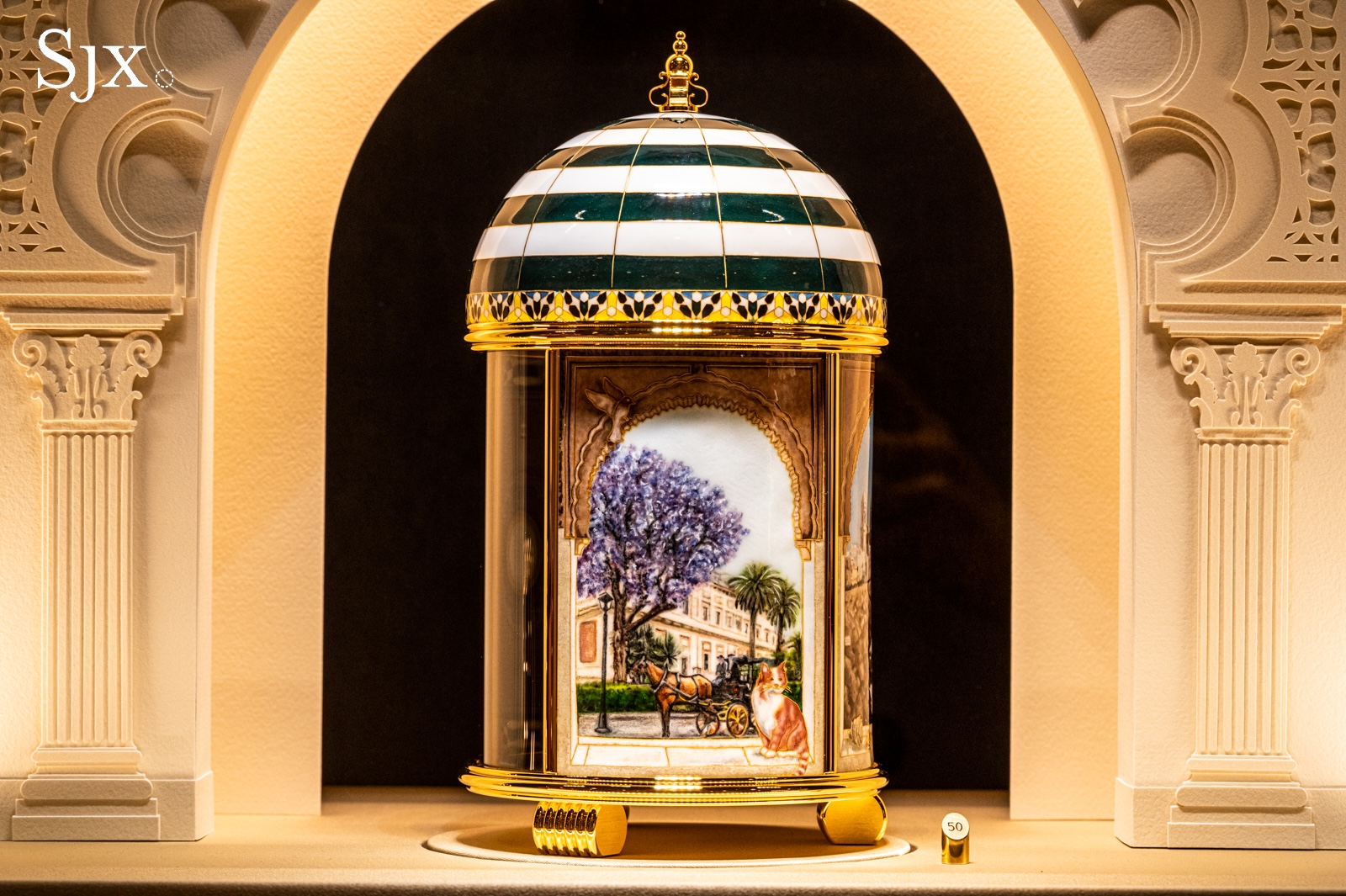
The Dome Clock ref. 19196M-001 “Andalusia” offers a peaceful respite from hectic tableau of the Rio Carnival. The panels of the clock feature 27 shades of enamel along with 20 colours used for miniature painting. In total, the variety of colours requires 14 firings at ~770°C.
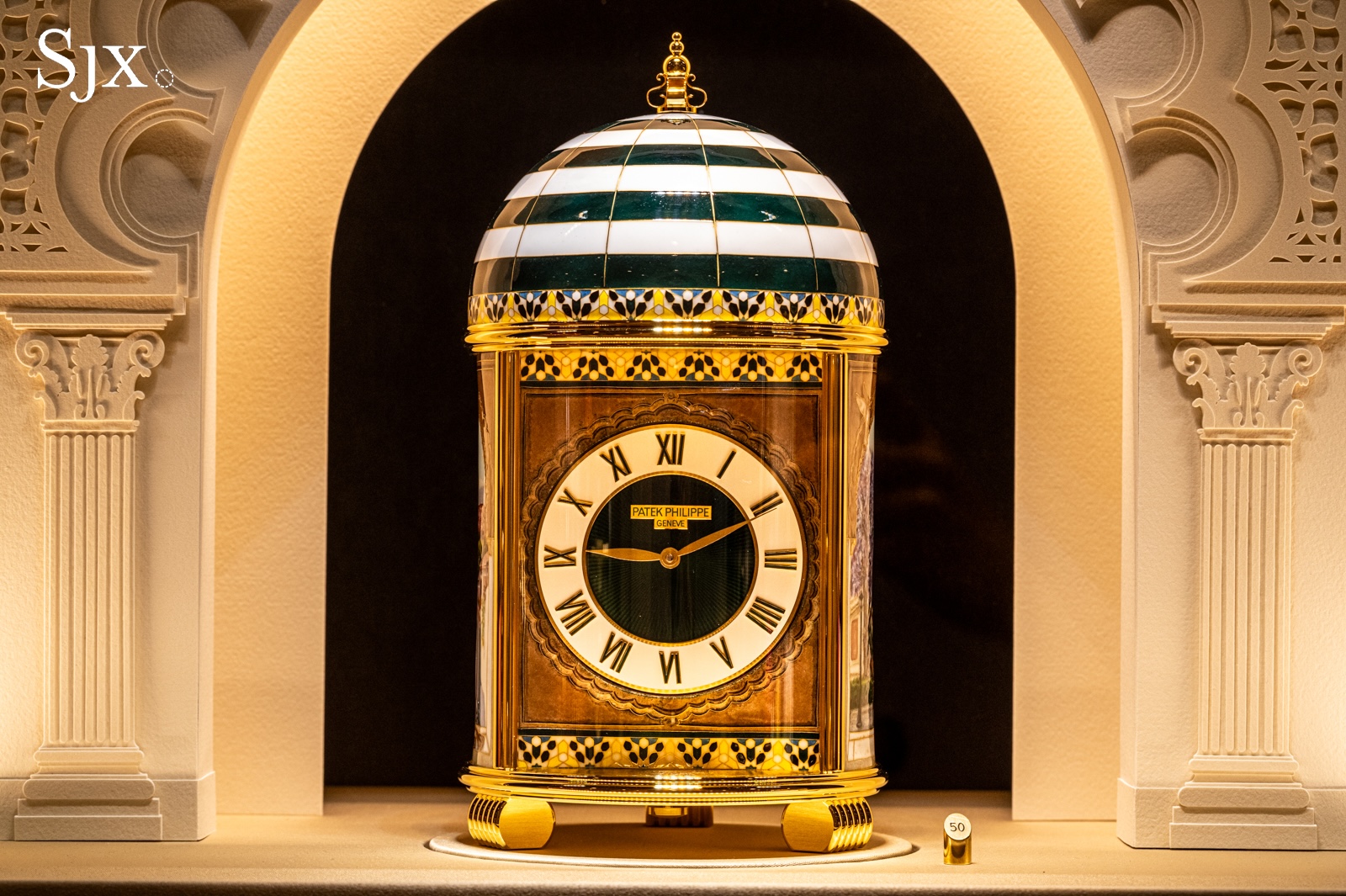
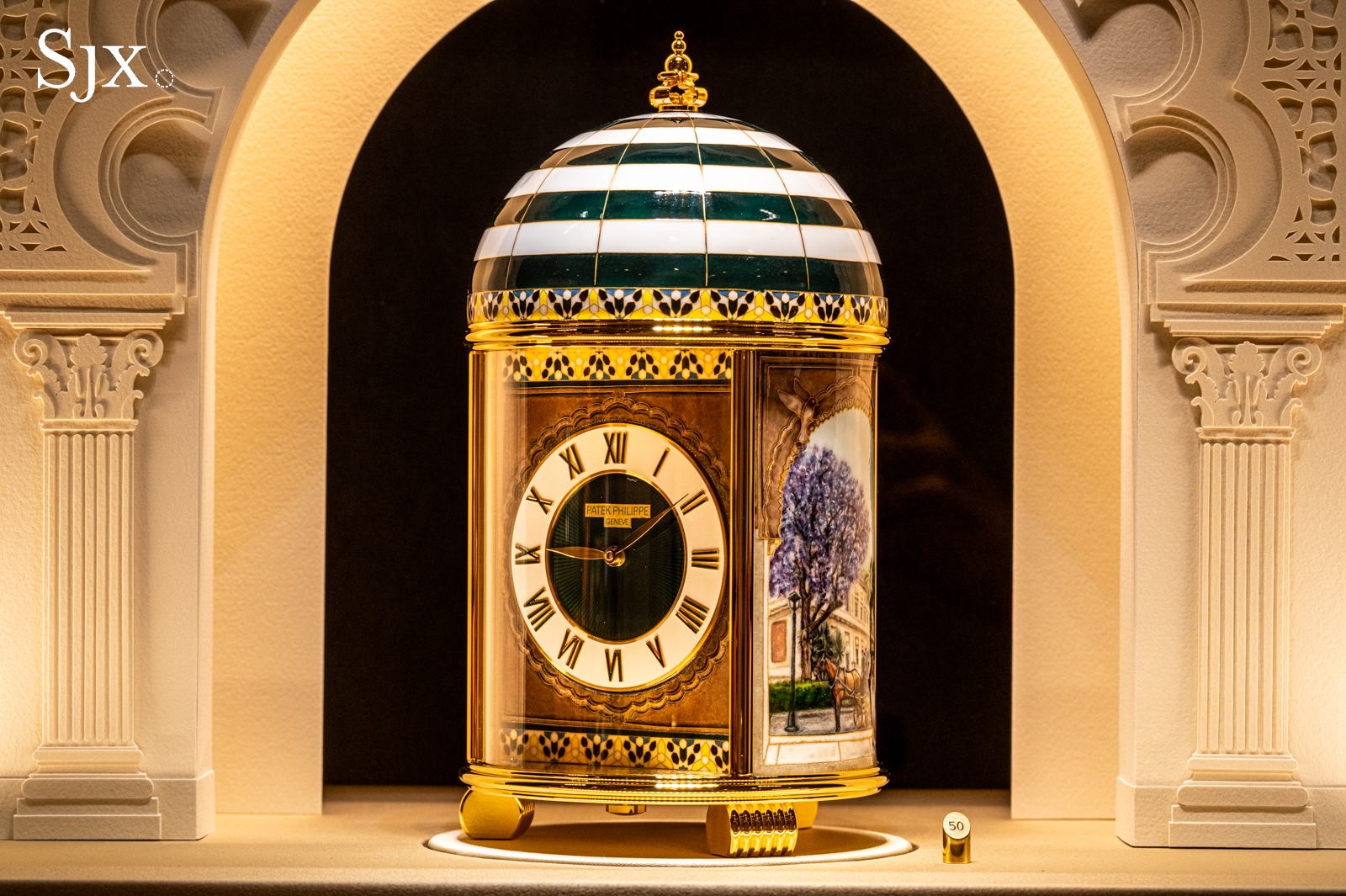
Andalusia in southern Spain is one of my favourite parts of Europe, and the artisans at Patek Philippe did a commendable job capturing the spirit of the Moorish architecture, with a ’tiled’ dome rendered in cloisonné enamel. The panels depict Seville, Cadiz and Granada, including a view of the iconic Alhambra.
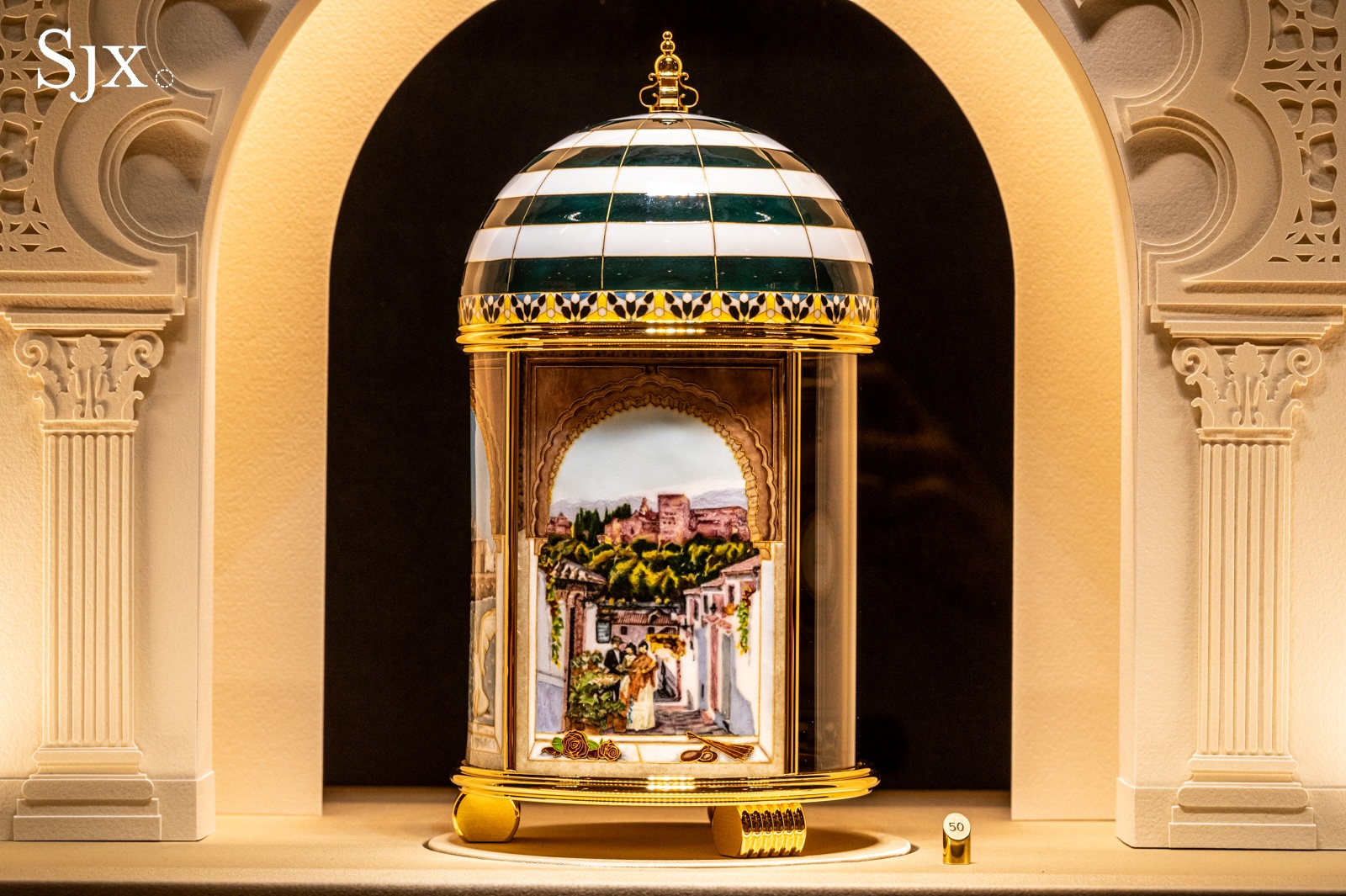
The Andalusia Dome Clock also features an ornamental spire, which distinguishes it from most other Dome Clocks and brings the design off the surface and into three-dimensional reality, similar to the effect provided by the stalactites of the North Pole clock.
Wristwatches
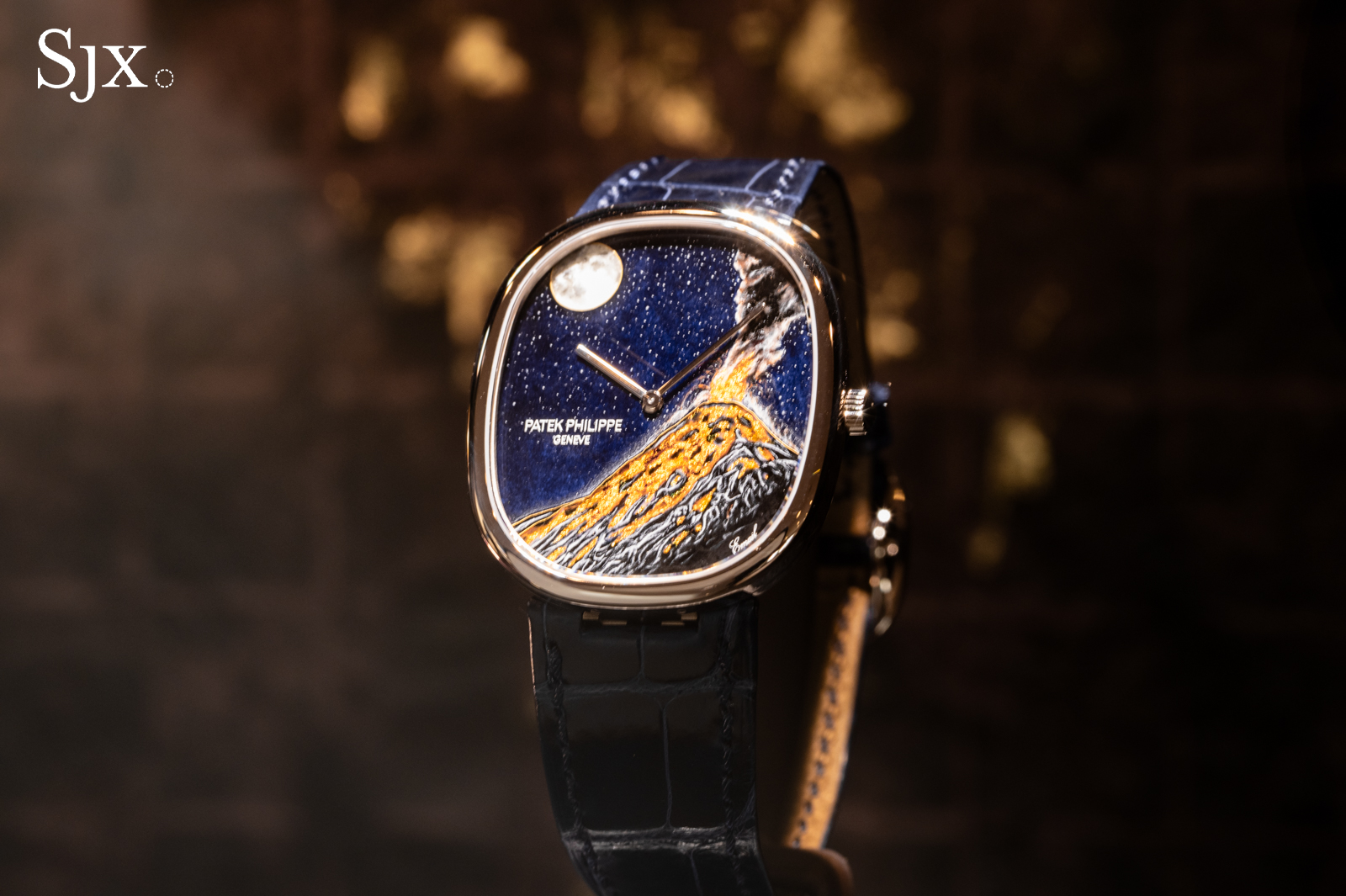
The Golden Ellipse ref. 5738/50G-044, 5738/50R-010 and 5738/50J-010 “Volcanoes of the World” revisit the theme of geological violence already explored in the Magma dome clock, but at wristwatch scale and with a more pictorial approach to the composition.
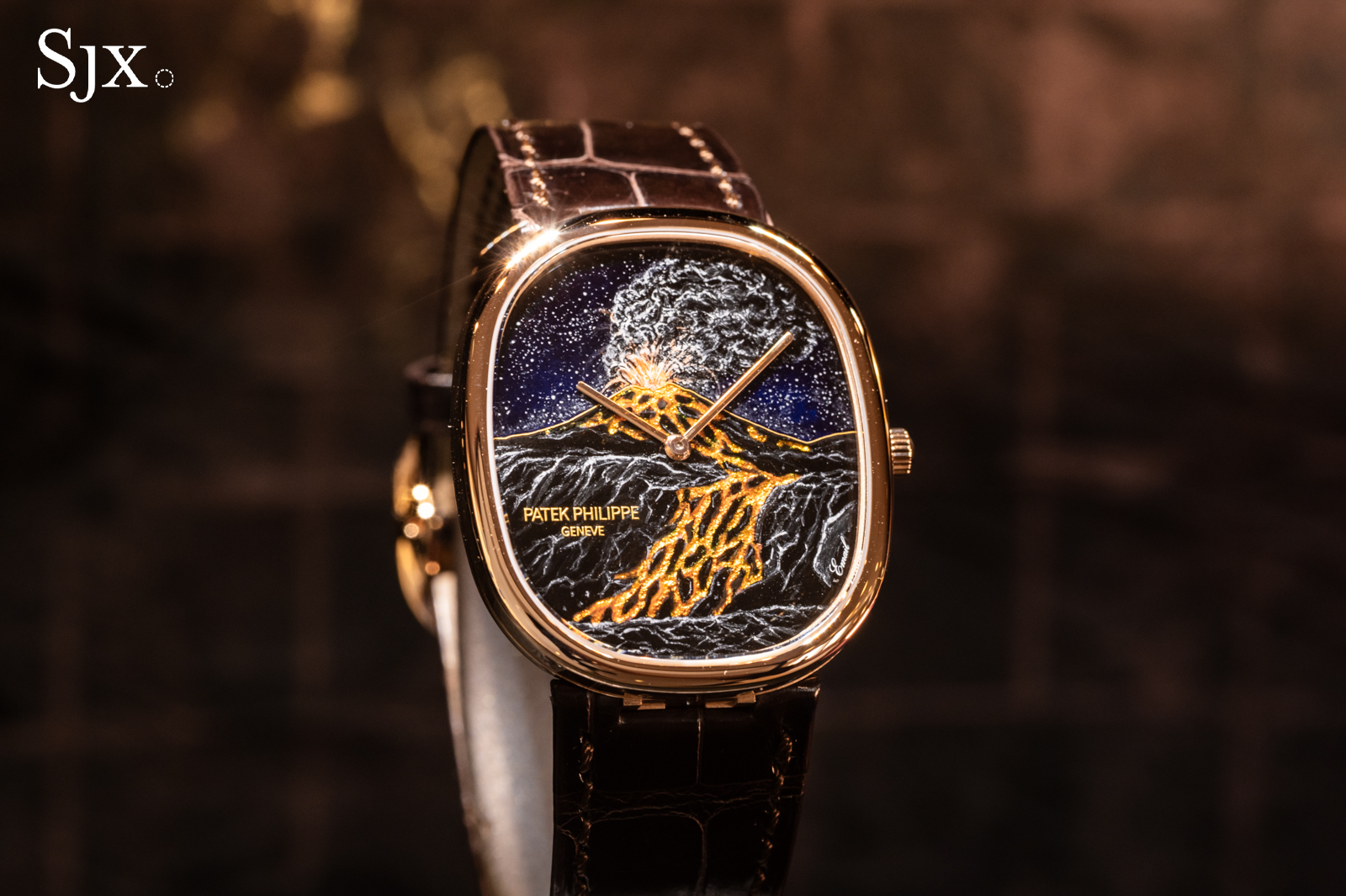
A limited edition of 15 pieces each, the enameled Volcanoes of the World trio is born from fire — 10 firings at 770°C, to be exact. Each of the three watches depicts a different volcano, with the name of the featured peak engraved on the case back.
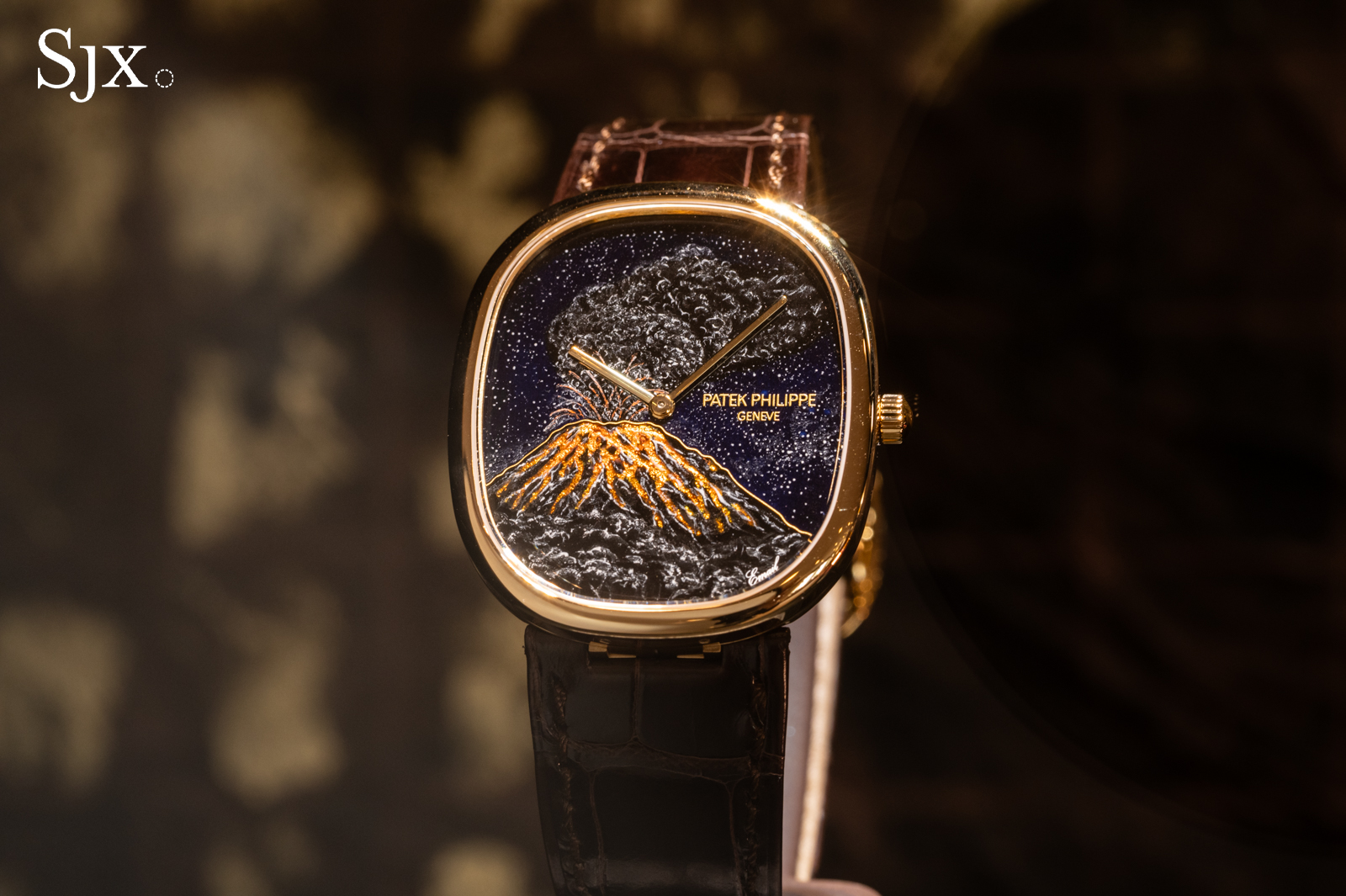
Like other Golden Ellipse watches in the Rare Handcrafts collection, the watches are powered by the ultra-thin micro-rotor cal. 240, which straddles history and modernity with its 1970s-era construction and advanced silicon hairspring.
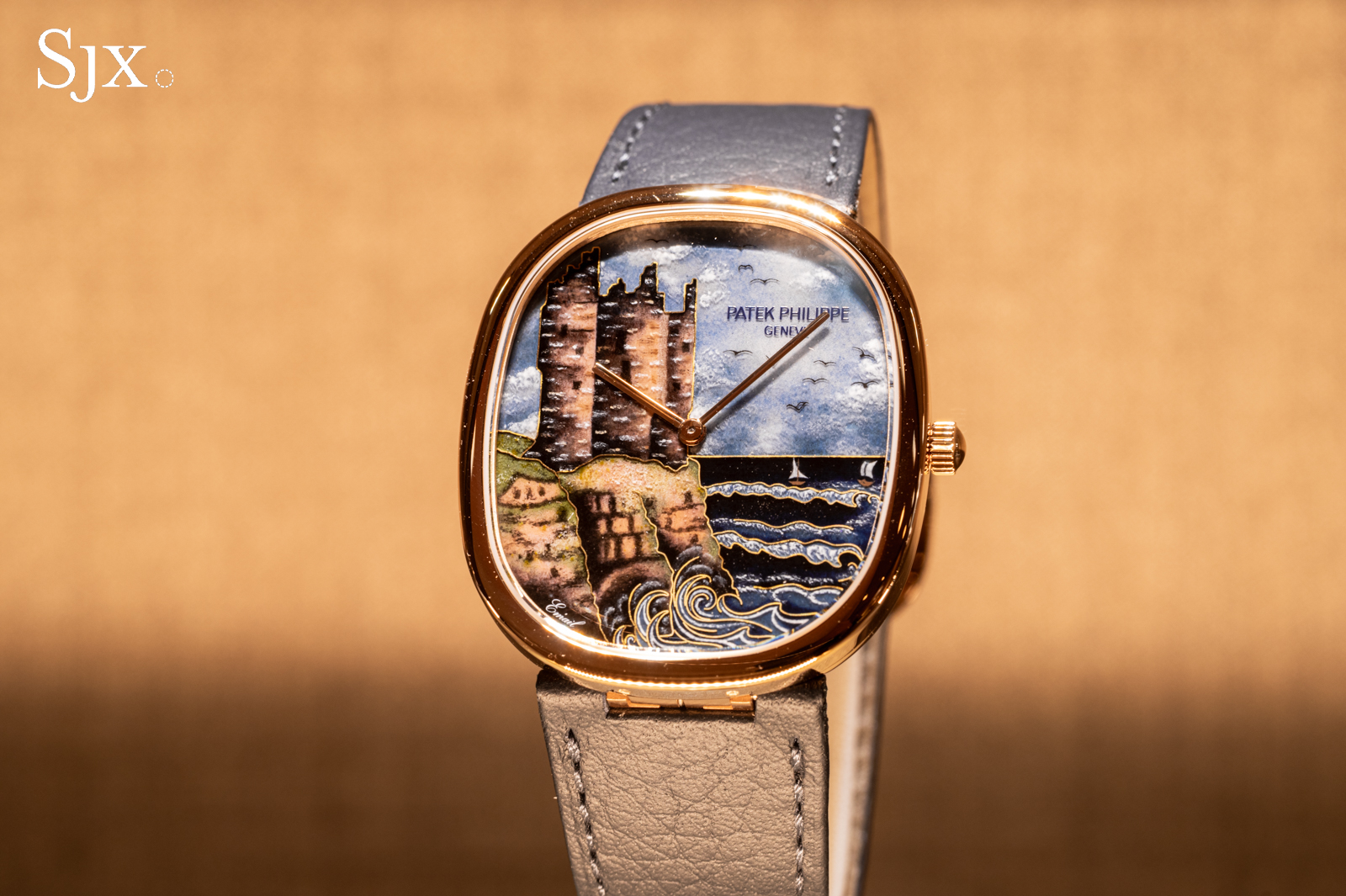
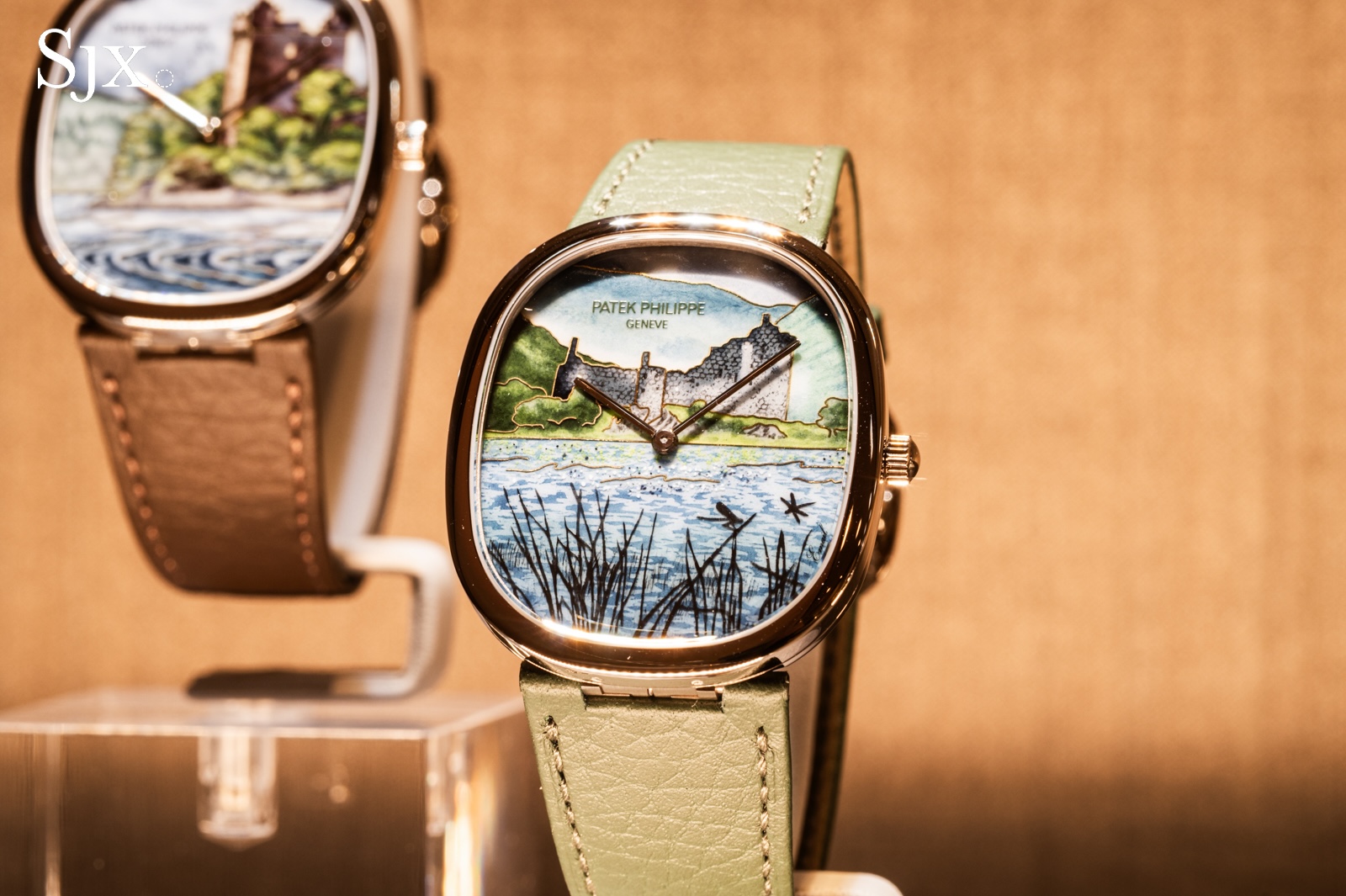
Another trio in the Golden Ellipse range spans references 5738/50R-021, 5738/50G-042 and 5738/50G-043 under the banner of “Scottish Castles”. The vaporous atmosphere of the Highland plains — mist, low clouds, the particular quality of northern light — is evoked through 18 to 41 colours of cloisonné enamel enriched with miniature painting, with 8 to 12 firings at temperatures ranging from 820°C to 830°C.
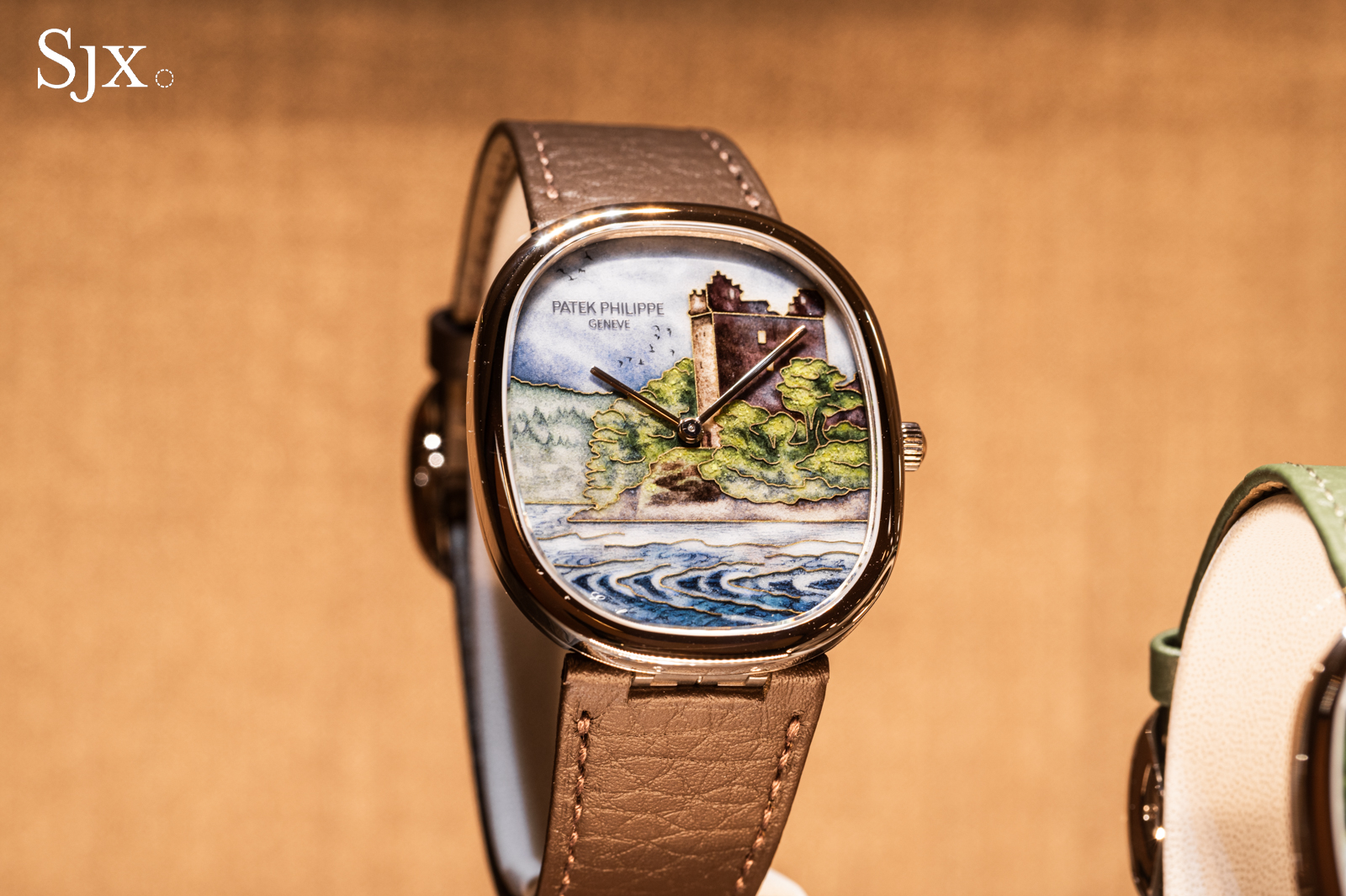
It’s worth noting the range of strap colours across the three references — navy-blue, earthy brown, and leaf-green — each of which picks up on a different element of the dial composition.
Continuing the Scottish theme, the Golden Ellipse ref. 5738/50J-012 “On the Rocks” features a whisky motif embellished with a hand-engraved sapphire crystal, perfectly evoking a cut crystal rocks glass.
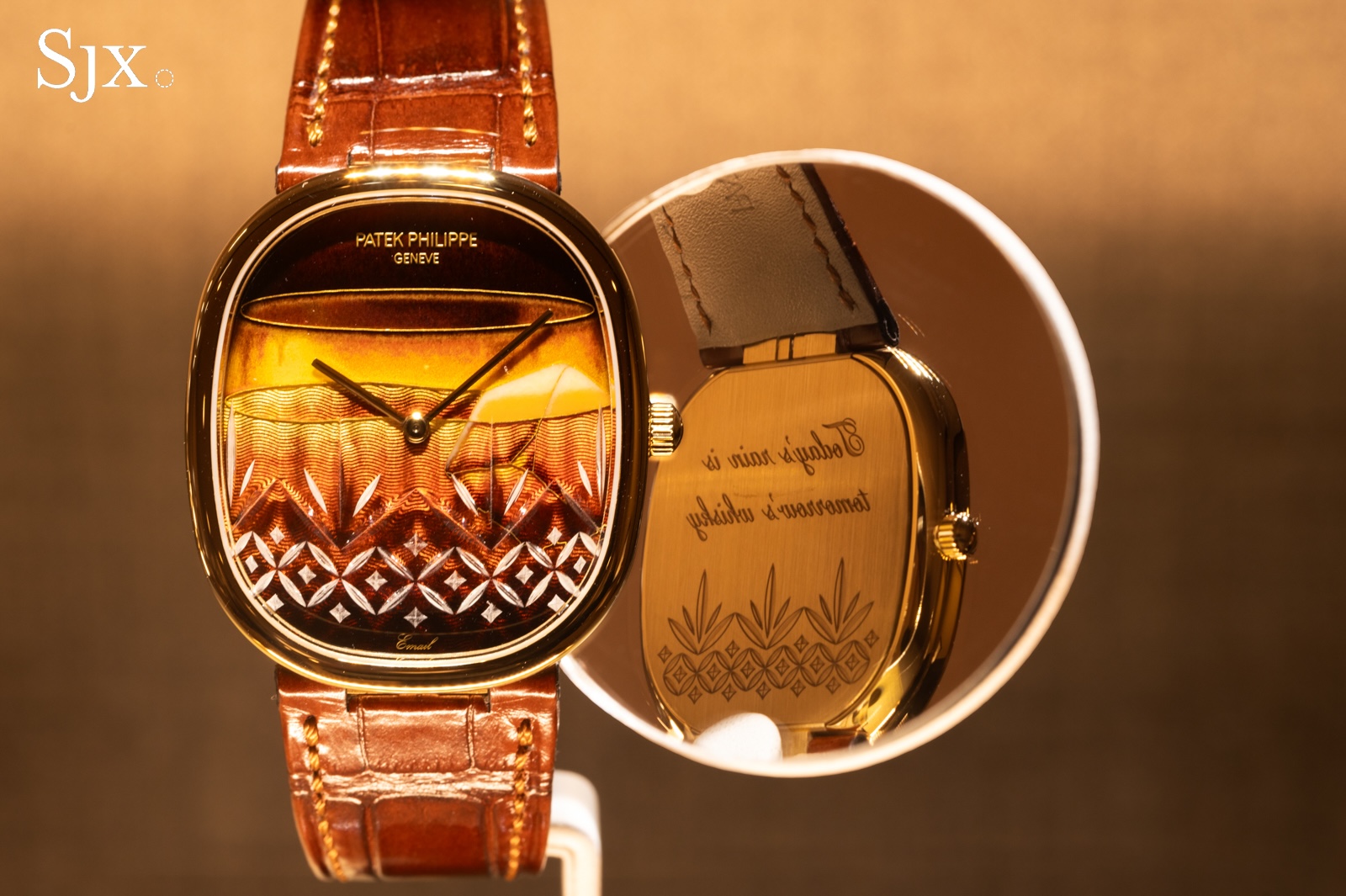
A limited edition of 10 pieces, On the Rocks features a hand-guilloché dial and 12 shades of enamel ranging from yellow to brown requiring 11 firings at ~765°C.
The Scottish theme concludes with a pair of Golden Ellipse Refs. 5738/50G-045 and 5738/50R-022 “Celtic Fabrics” which combine cloisonné and flinqué enamel over a guilloché dial base to create a realistic design of folded tartan.
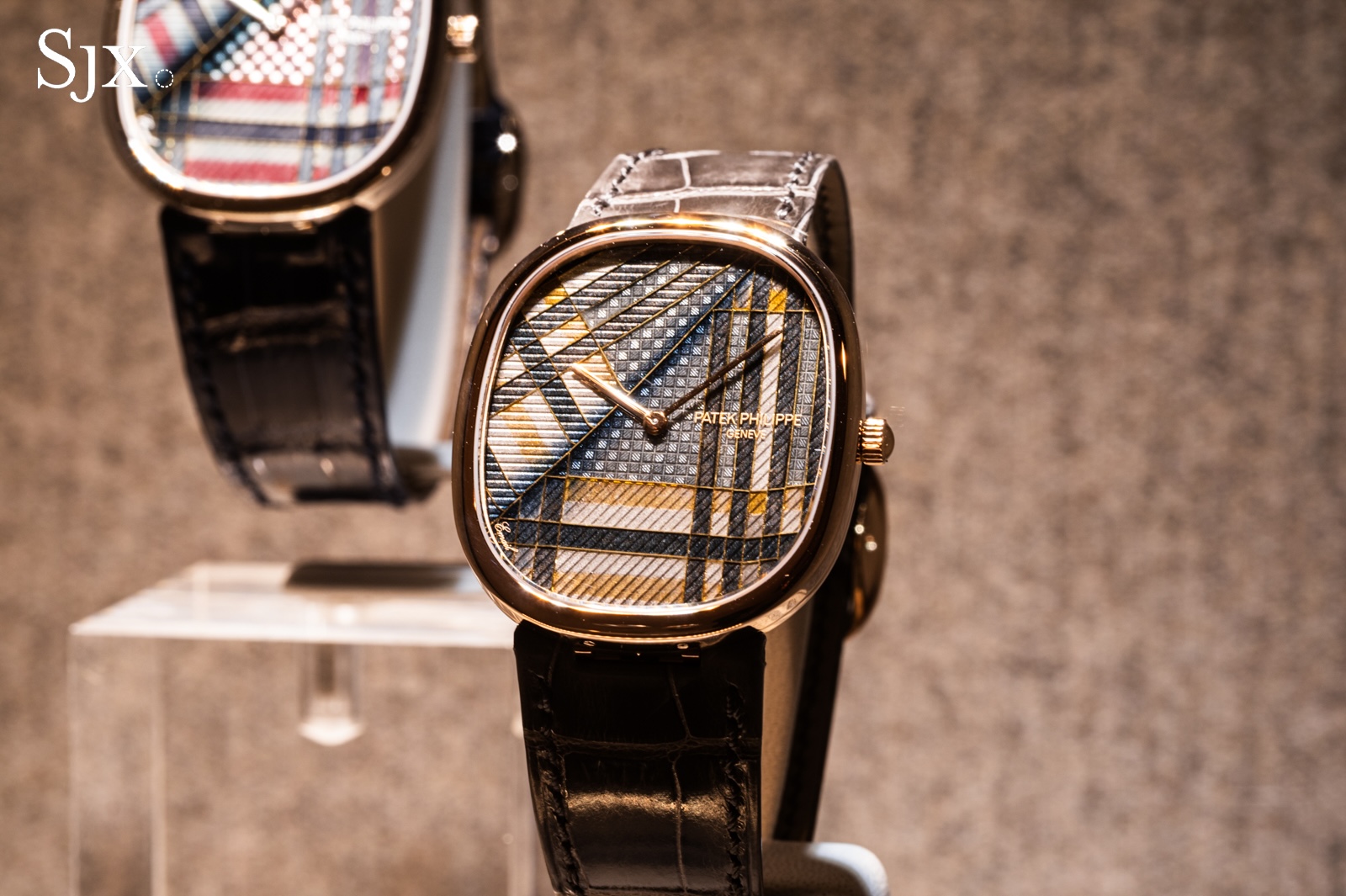
Limited to 10 pieces each, the design is impressive for both its sense of texture and shadow. The guilloché dial base makes sense to evoke the texture of woven fabric, and the delicate shading at the fold gives the two-dimensional composition a feeling of three-dimensionality.
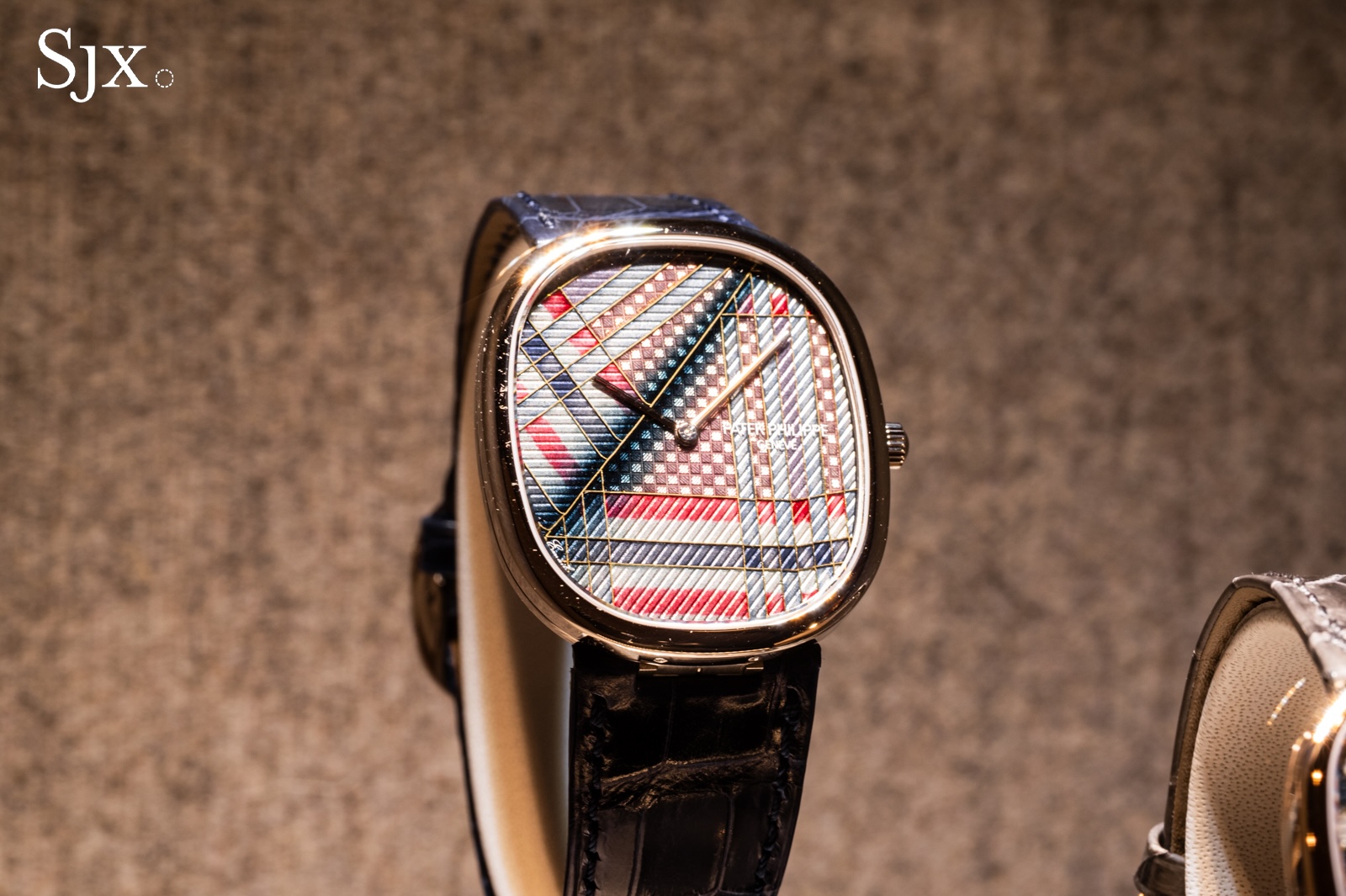
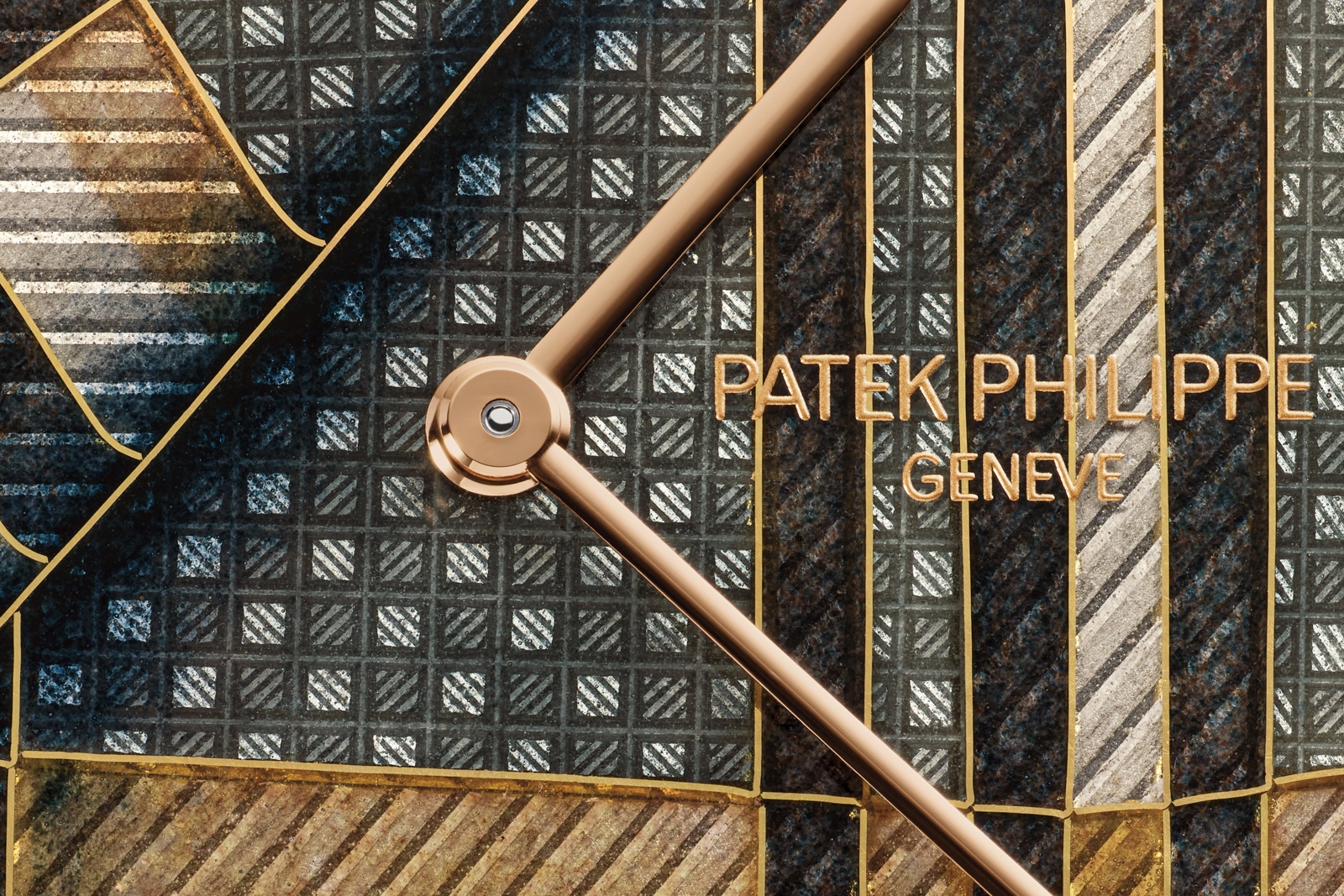
Dial detail of the Golden Ellipse Ref. 5738/50G-045. Image – Patek Philippe
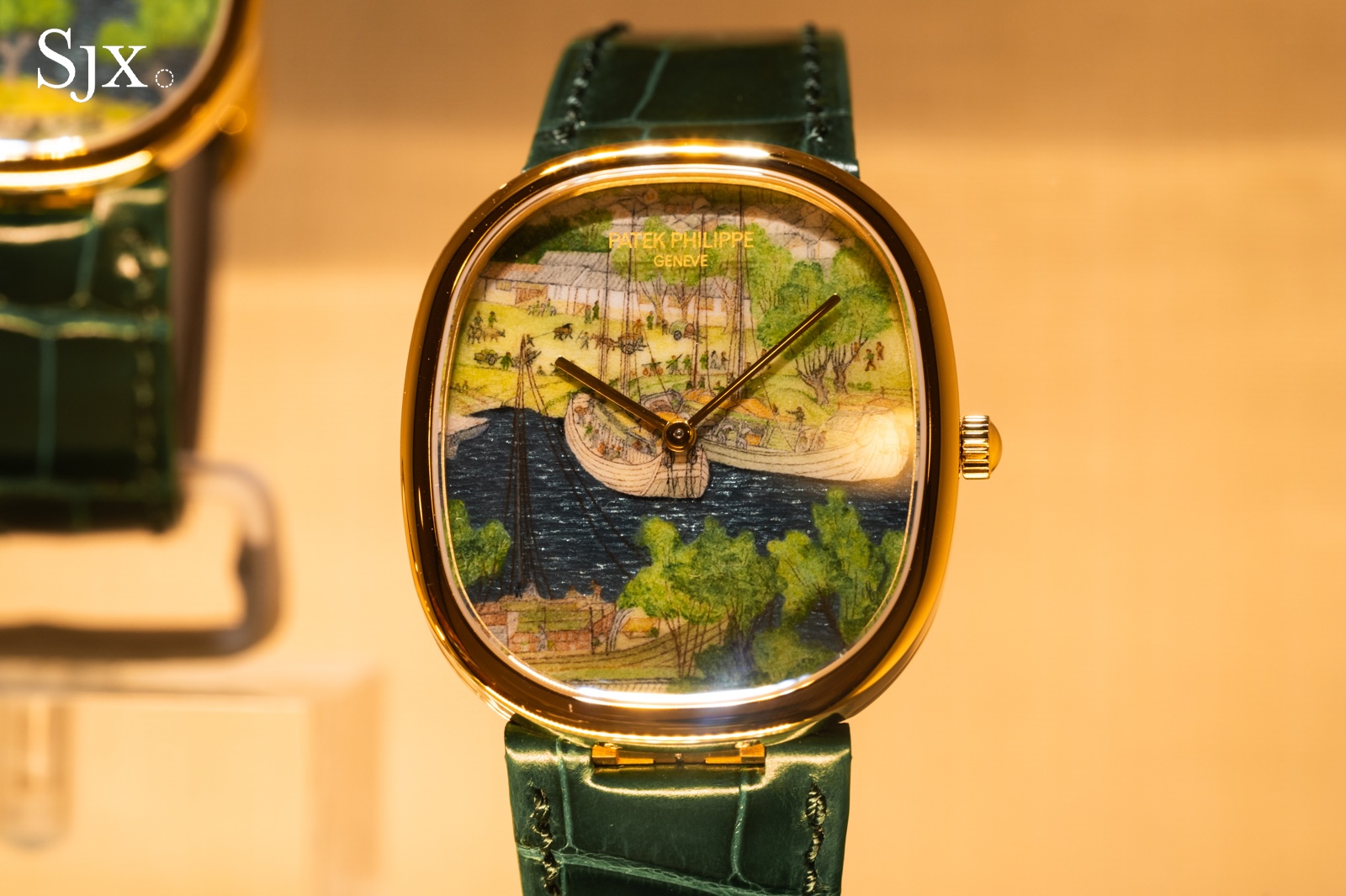
Taking a break from cloisonné, The Golden Ellipse ref. 5738/50J-014, 5738/50J-015 and 5738/50J-016 “Qingming Festival” are among the most ambitious undertakings in this year’s wristwatch collection — not one piece but a triptych, with each of the three dials depicting a different section of the famous 1736 painting “Qingming Festival on the Banks of the River.”
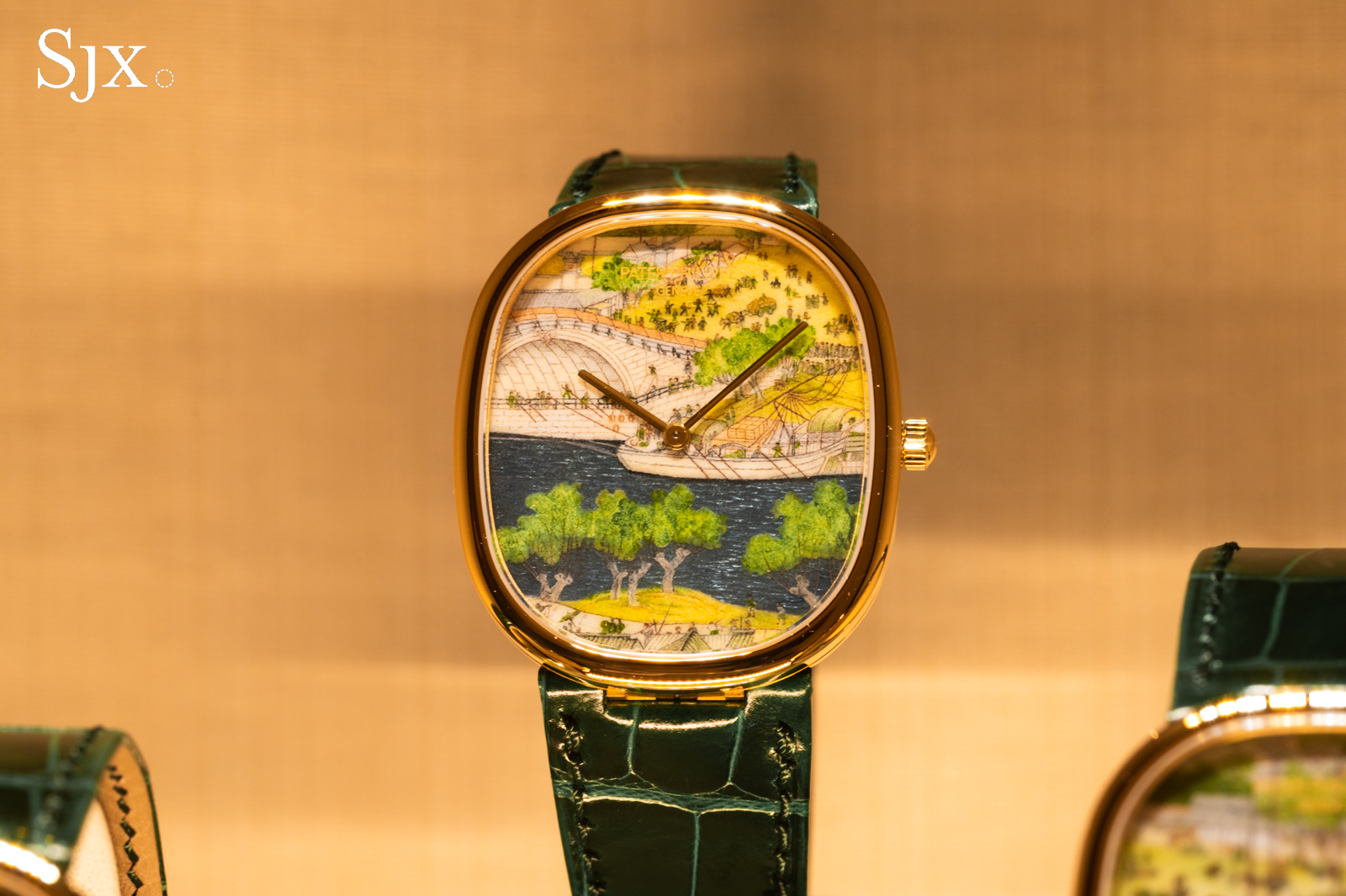
Known as ‘China’s Mona Lisa, the original work stretches 115 m in length, which makes the challenge of compressing it onto three watch dials all the more remarkable. Three sets in total will be produced.
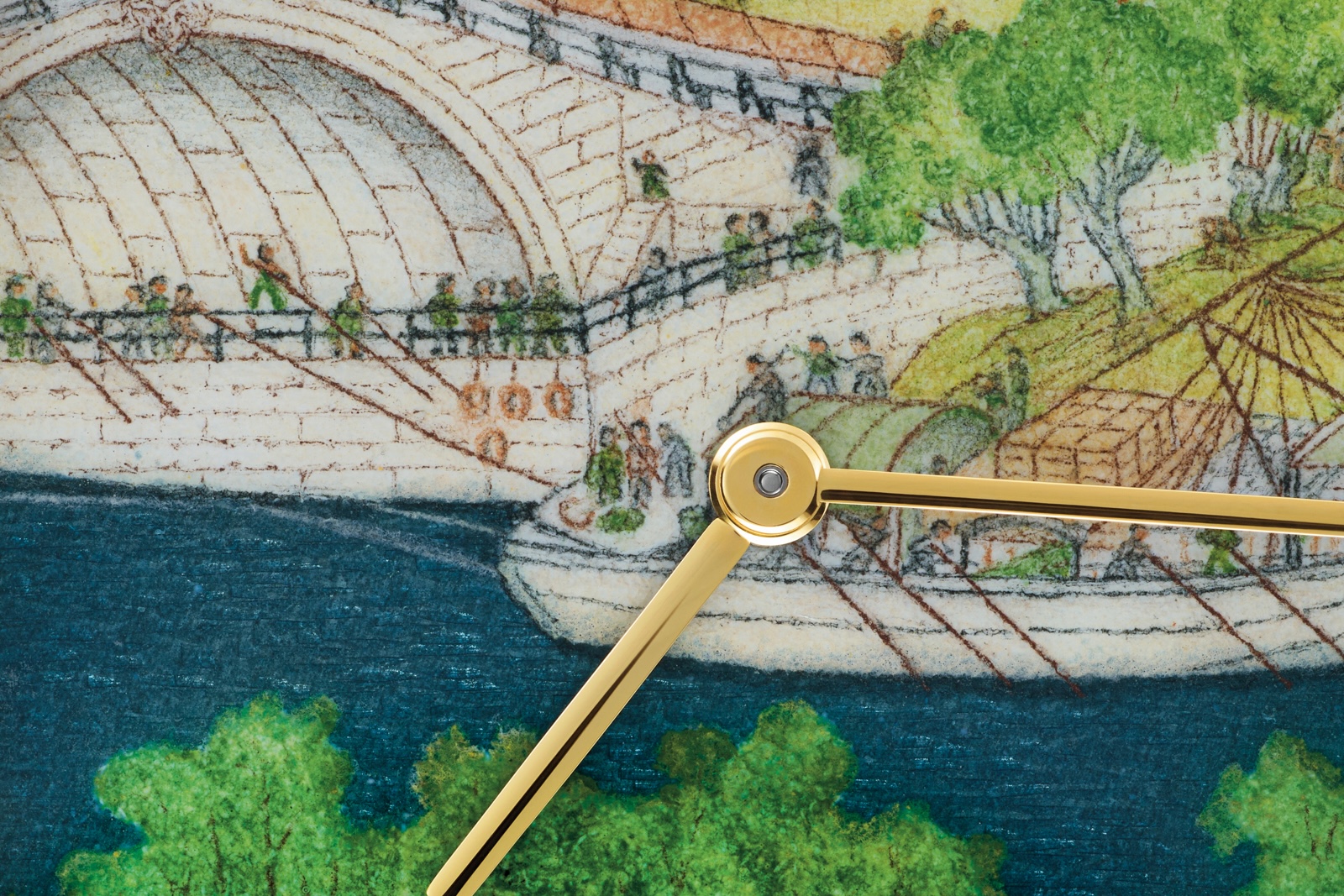
Dial detail of the Golden Ellipse Ref. 5738/50J-015. Image – Patek Philippe
The apparent motion of the river is the result of flinque enamel atop a hand-engraved surface. The numerous figures and architectural details are rendered in eight colours of miniature painting, fired an average of 15 times at temperatures ranging from 780°C to 830°C.
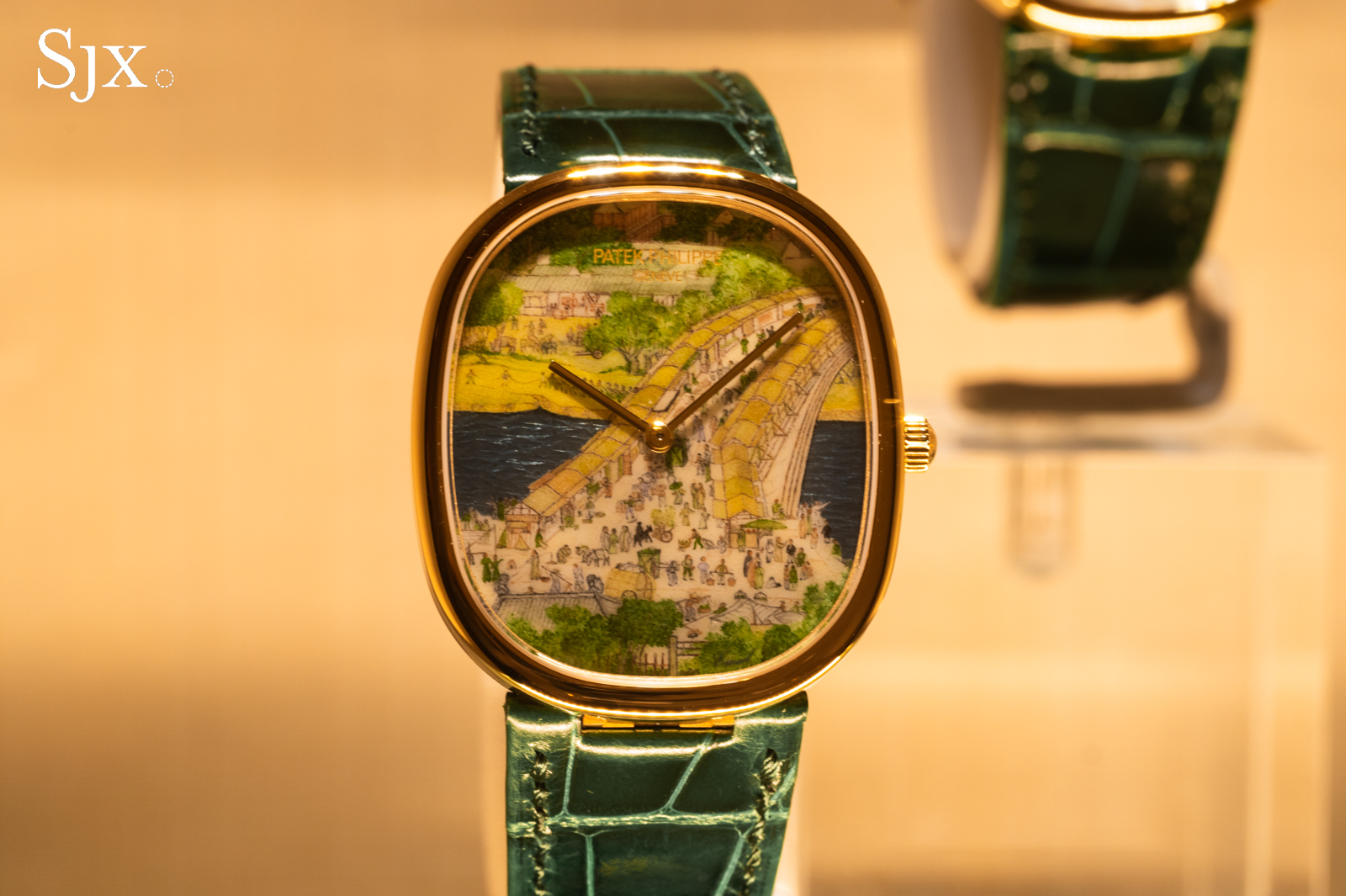
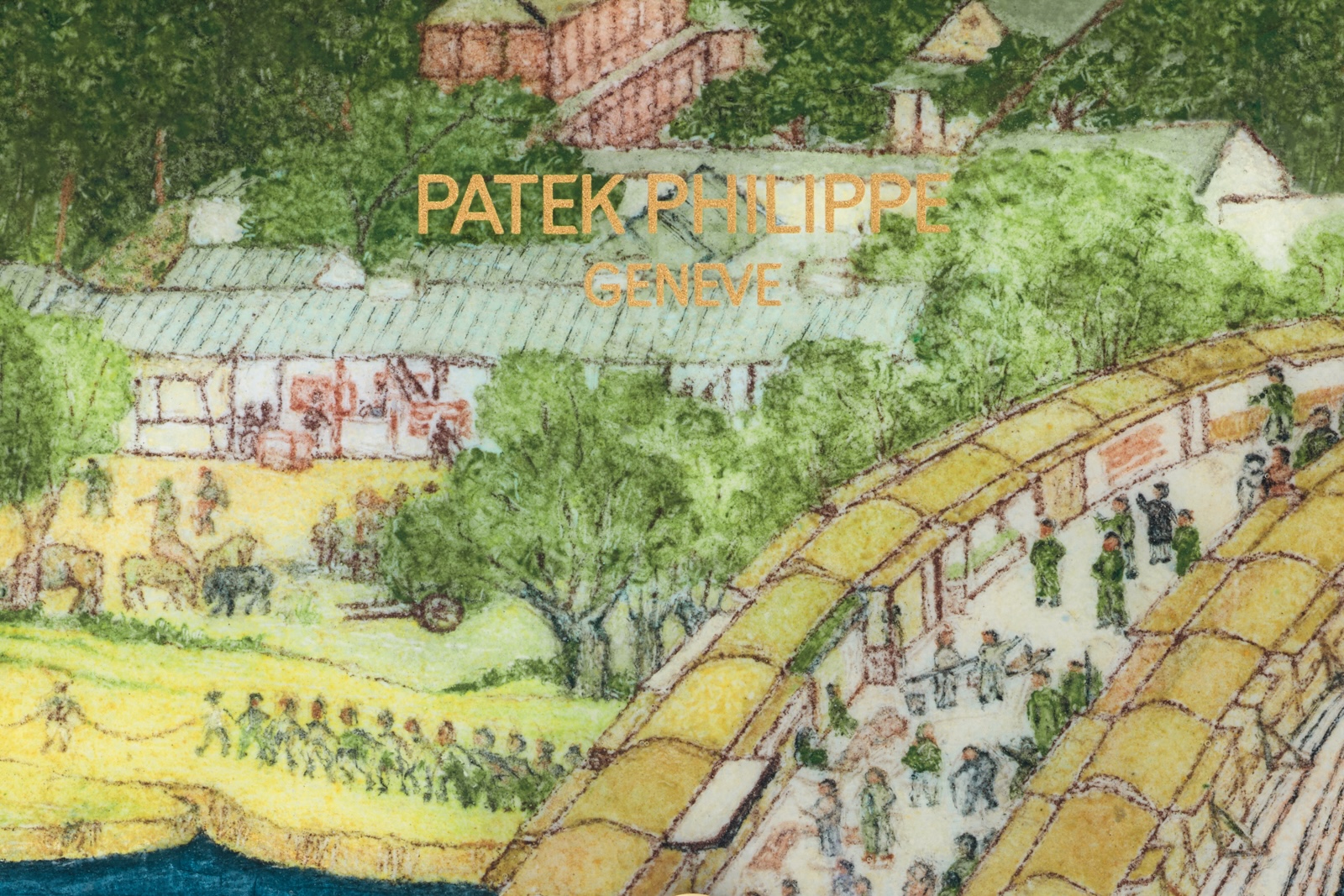
Dial detail of the Golden Ellipse Ref. 5738/50J-014. Image – Patek Philippe
Patek Philippe often explores avian themes with its Rare Handcrafts collections. The diversity of subject matter and the otherworldly grace common to many birds is an almost bottomless well of source material for the brand’s artisans.
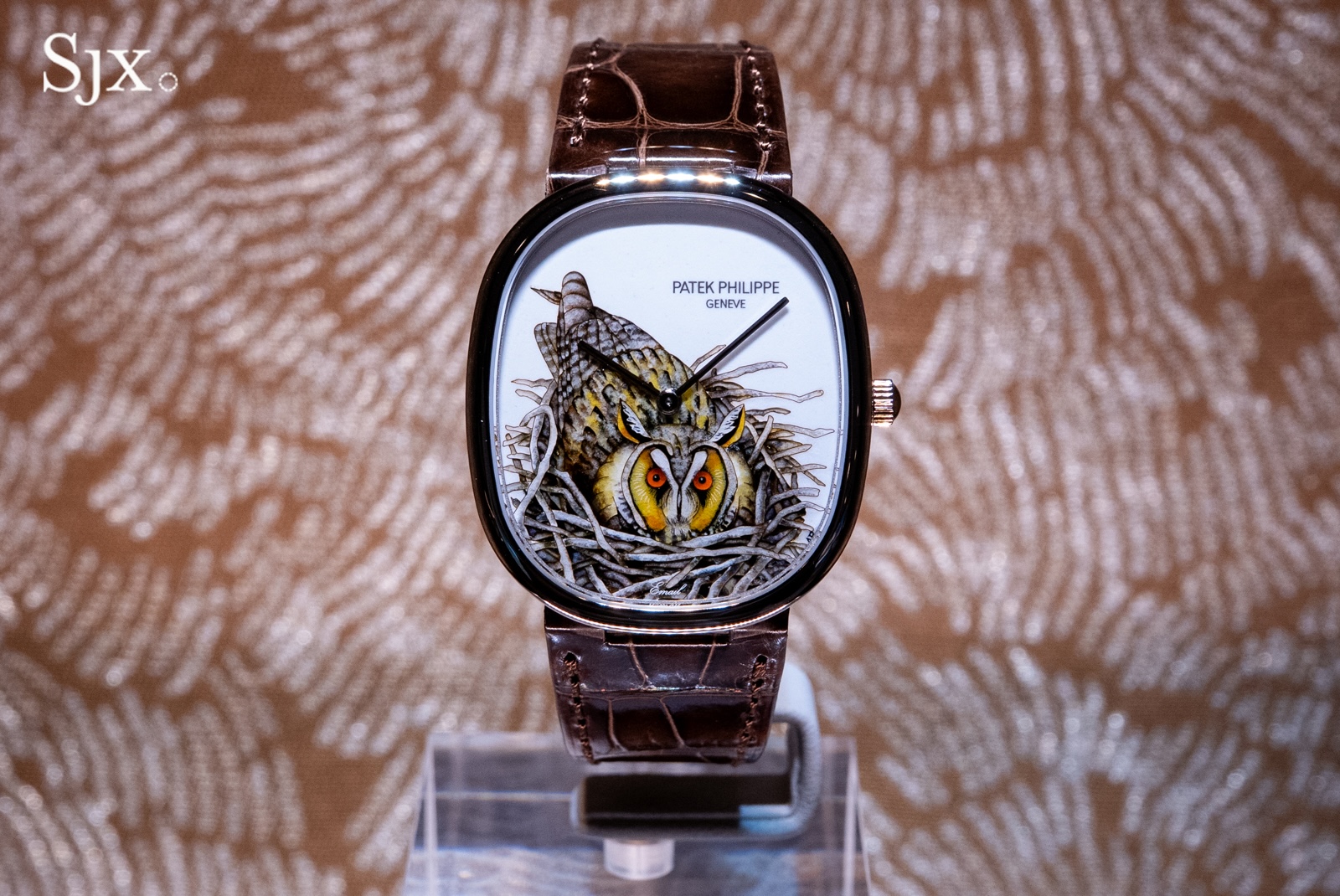
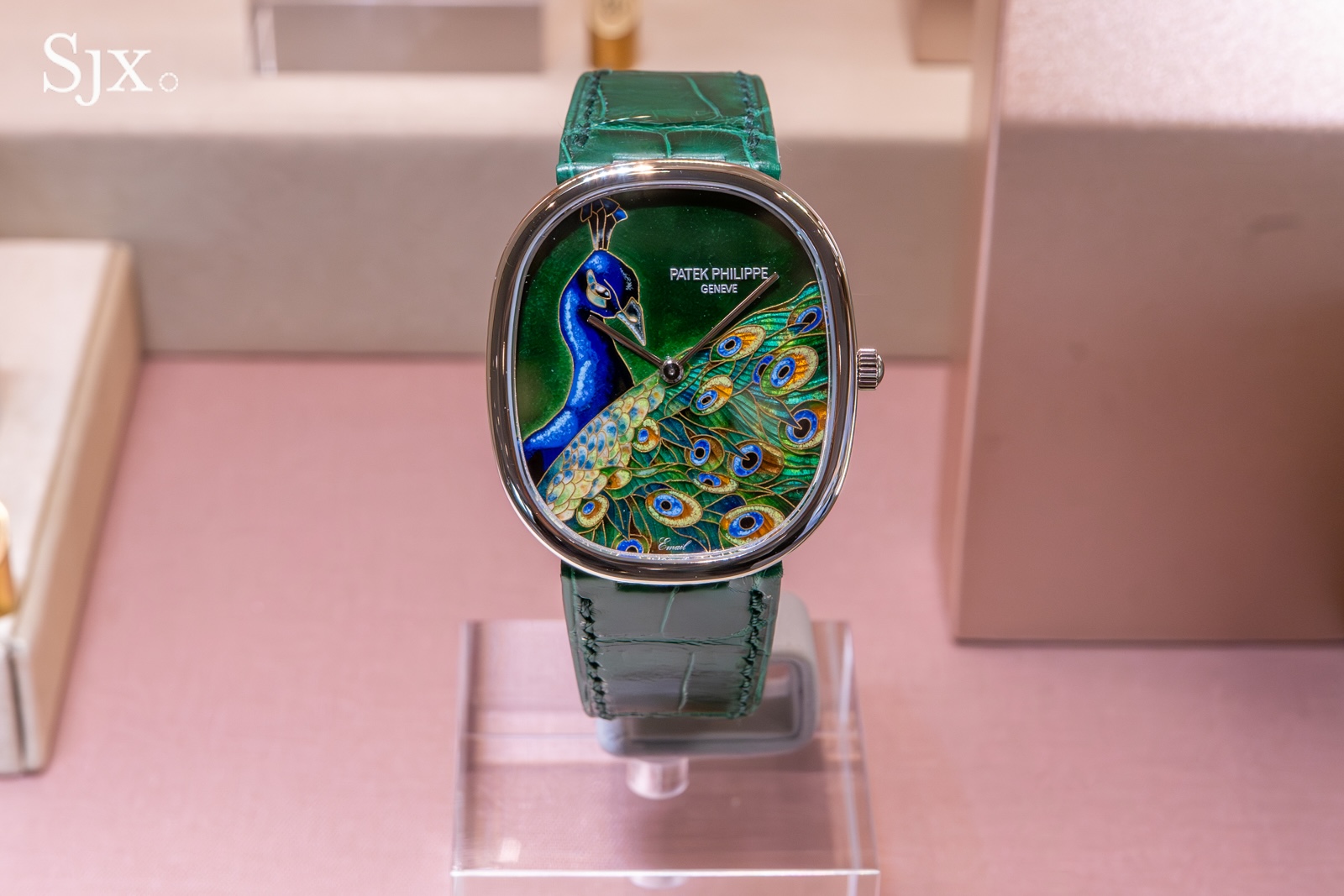
For 2026, Golden Ellipse refs. 5738/50G-048 and 5738/50G-049 “Birds of the Night” and refs. 5738/50G-041 and 5738/50R-023 “The Magic of the Peacock” are 10-piece limited editions with dials in cloisonné enamel further elaborated with miniature painting.
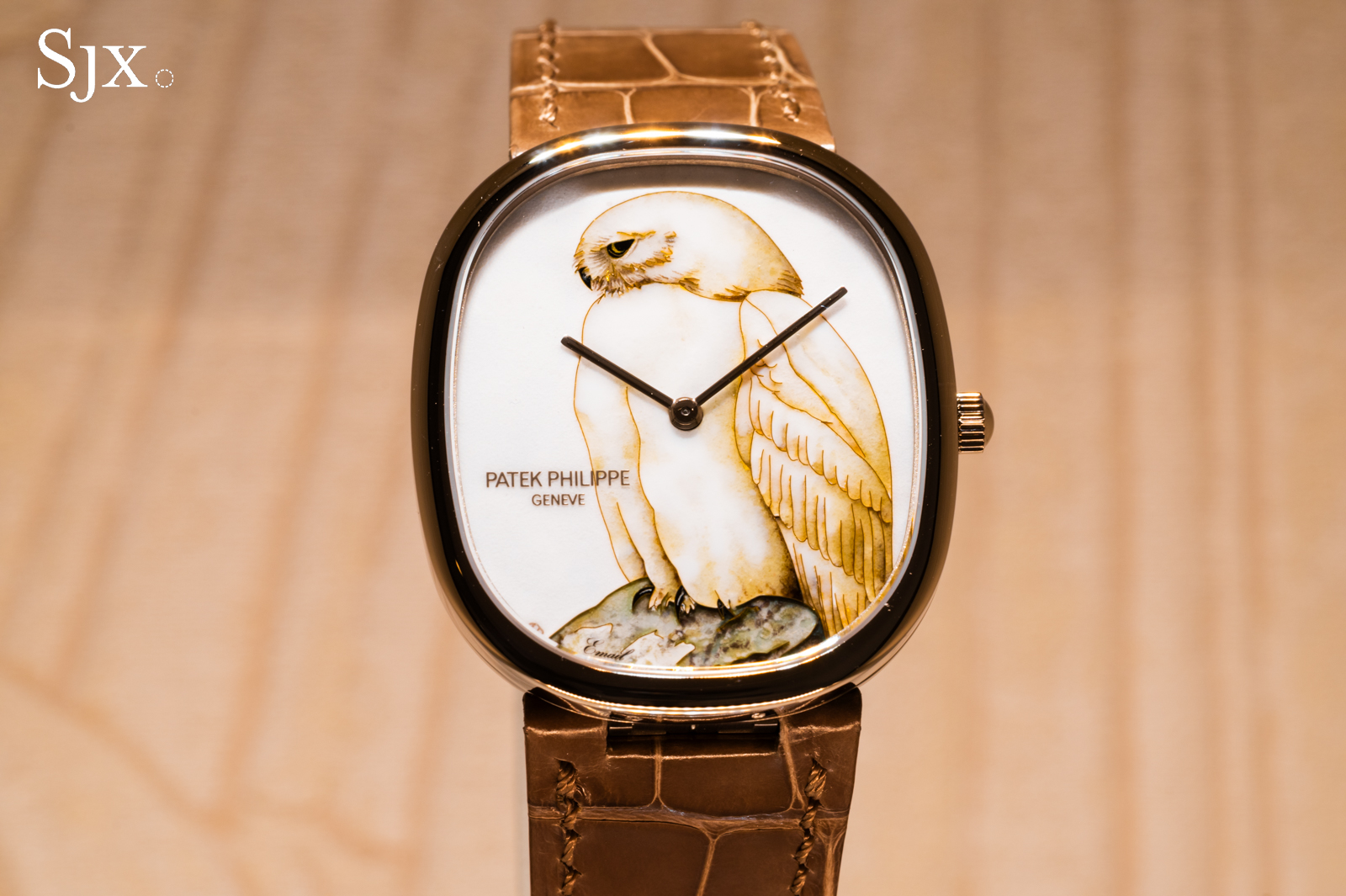
The dials of the Birds of the Night duo require 40–80 cm of gold wire and about a dozen firings to bring life to works inspired by the watercolour paintings of an unnamed French naturalist.
The Magic of the Peacock demands similar effort, with the addition of delicate hand-engraving an flinque enamel for iridescent feather effect
While the vertical orientation of the Golden Ellipse case makes it arguably better suited to replication of extant works, Patek Philippe has not forgotten the Calatrava.
The Calatrava ref. 5077/100R-068 and 5177G-056 “Typography” is one of the more conceptually interesting pieces in the 2026 collection. The design draws inspiration from the case back of a triple-complication hunter pocket watch exhibited at the 1867 Paris Exposition — at the time, the most complicated watch the brand had ever produced.
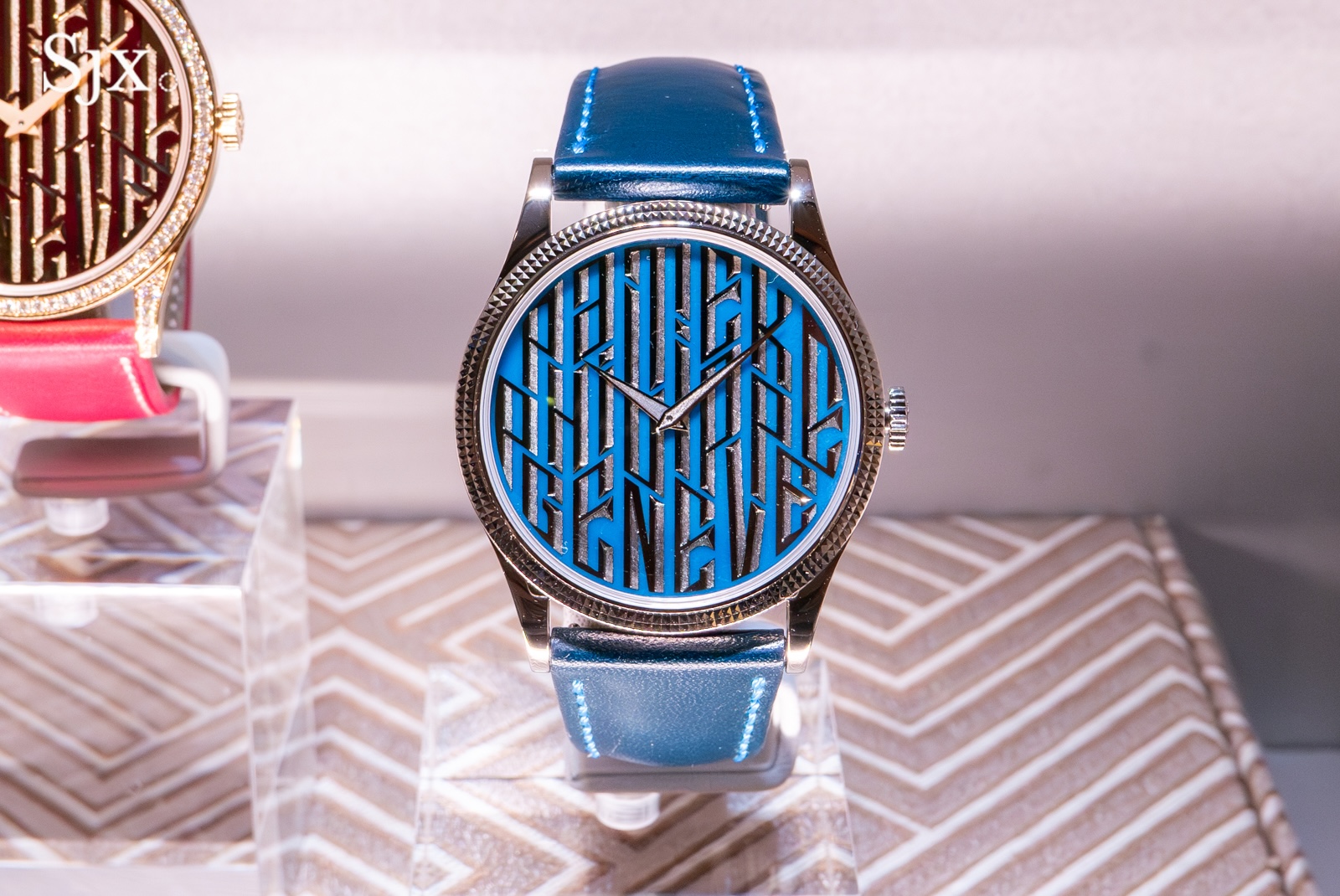
The words “Patek Philippe Genève” are engraved into the dial using a typography inspired by the stylised letters found on its historical inspiration, before the dial is coated in two colours of fired champleve enamel.
On its own, the Typography is simply an artistic exercise in graphic design. With the context of the 1867 pocket watch, it feels more like something that only Patek Philippe could make. Ten pieces of each reference will be made.
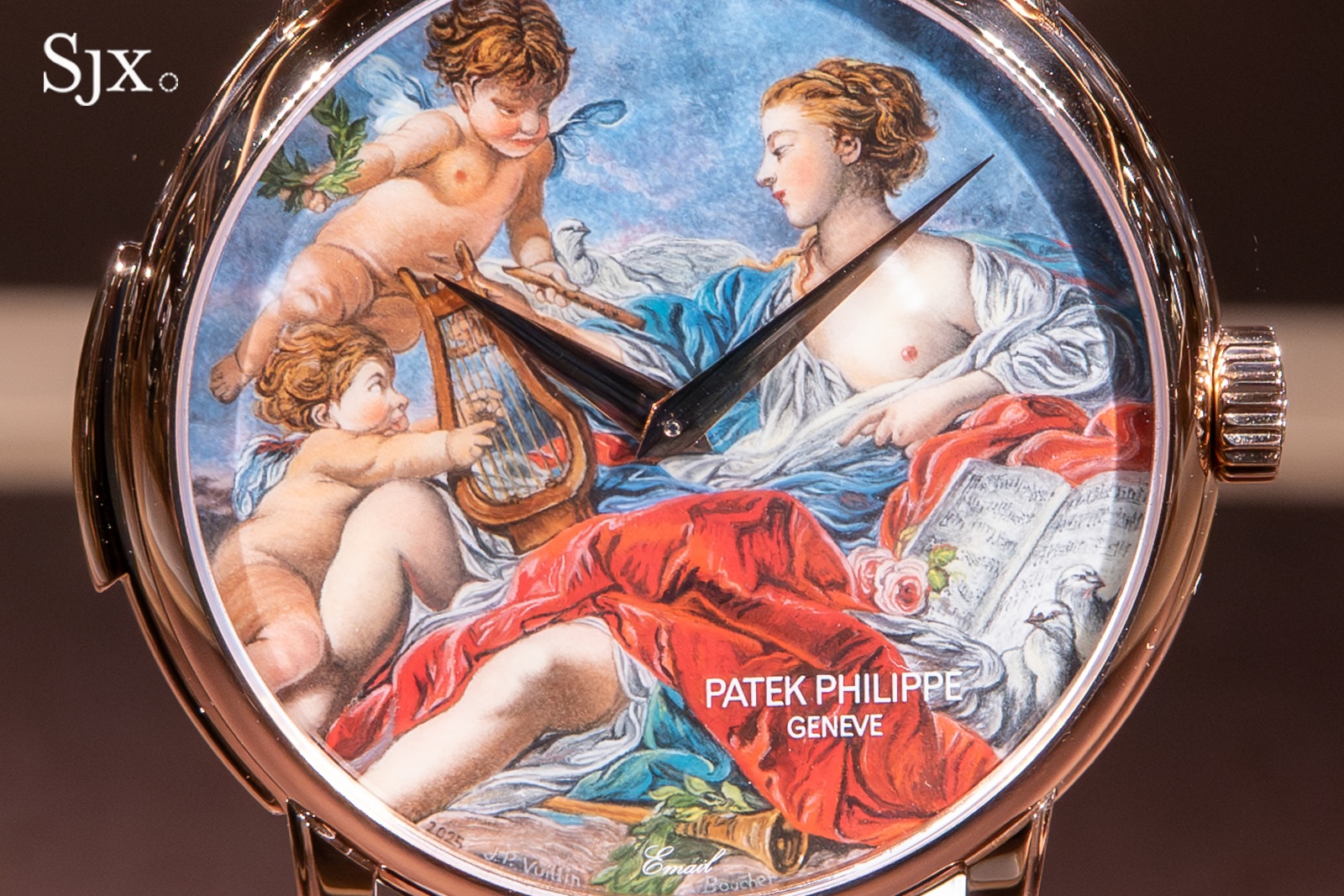
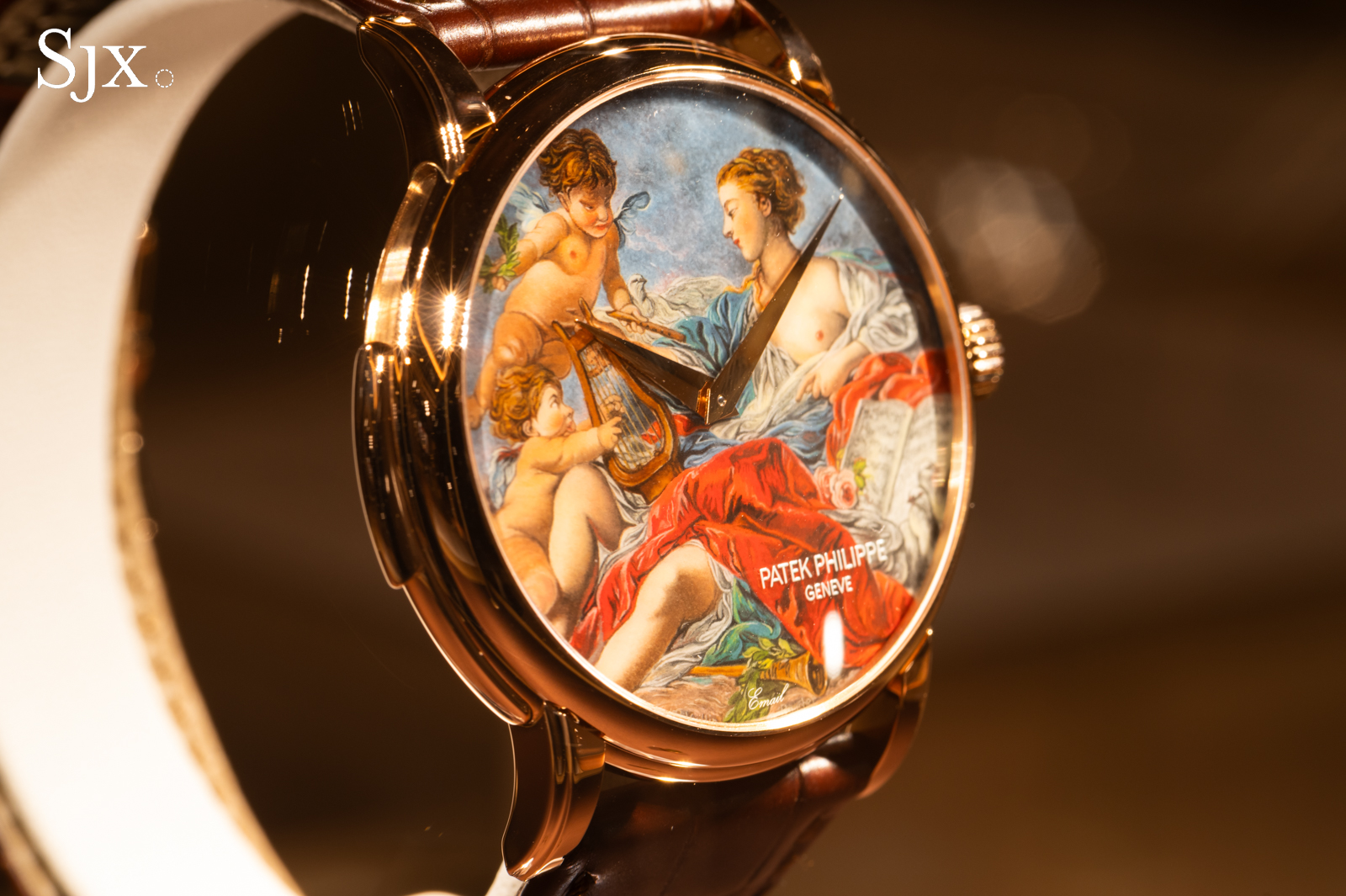
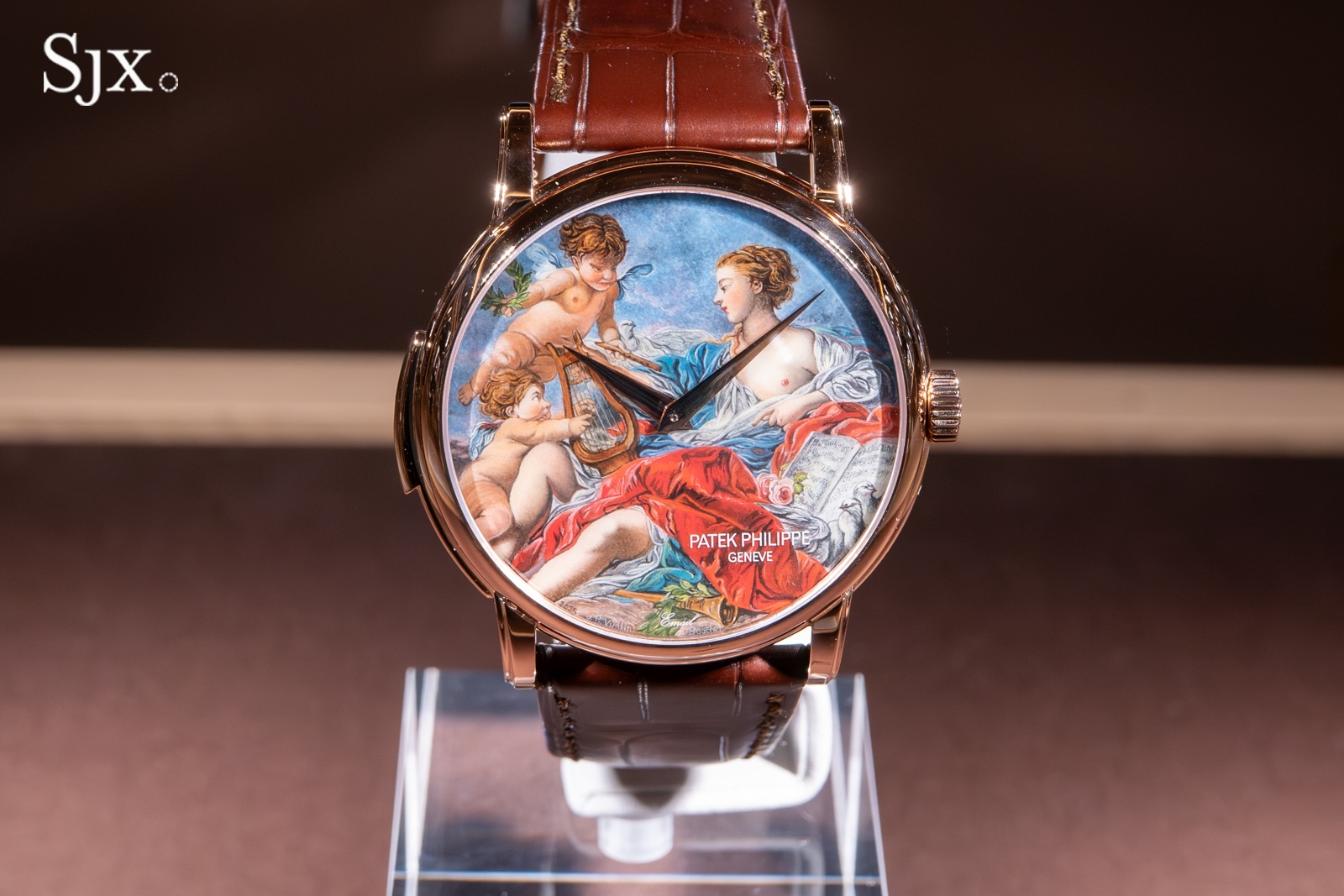
Now things get a little more complicated. The Calatrava ref. 5278/50R-010 “Allegory of Music” is a unique piece that reproduces François Boucher’s 1764 oil painting “The Allegory of Music” in miniature painting on enamel, built up from 19 base colours and 7 blended shades.
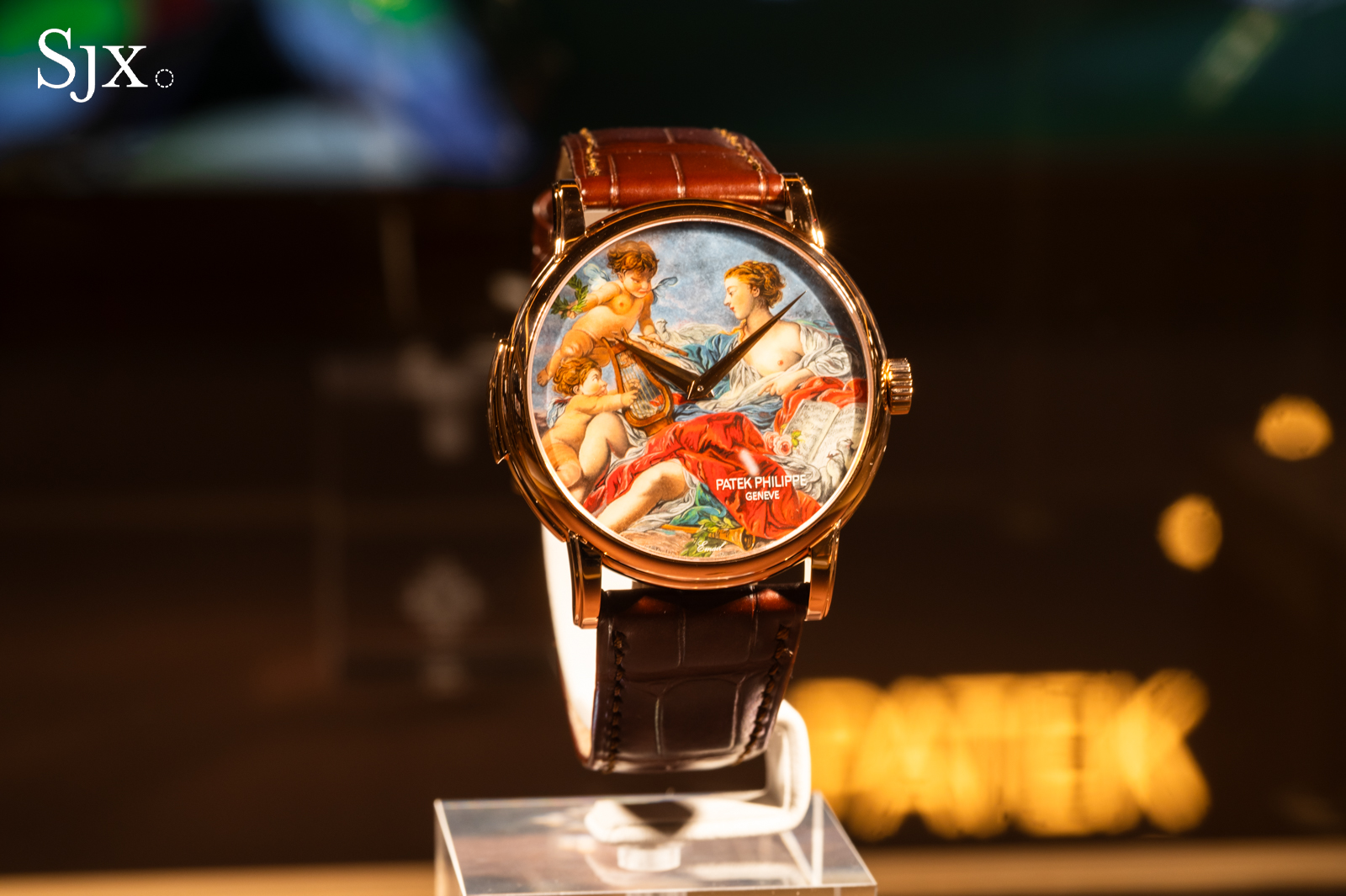
The enameller — the work is co-signed J.P. Vuillin — used the Geneva method, protecting the decoration with several layers of transparent enamel after 17 firings at temperatures ranging from 800°C to 830°C.
While the other wristwatches featured so far have used the simple cal. 240, the Allegory of Music uses the brand’s automatic minute repeater cal. R 27 — one of the most esteemed movements in Patek Philippe’s current portfolio.
The Calatrava ref. 5278/50R-011 “Electric Guitar” is the counterpart to the Allegory of Music — same movement, entirely different decorative philosophy. While the Allegory of Music uses enamel to reproduce a painting, the Electric Guitar uses wood marquetry to reproduce the look and feel of the instrument itself.

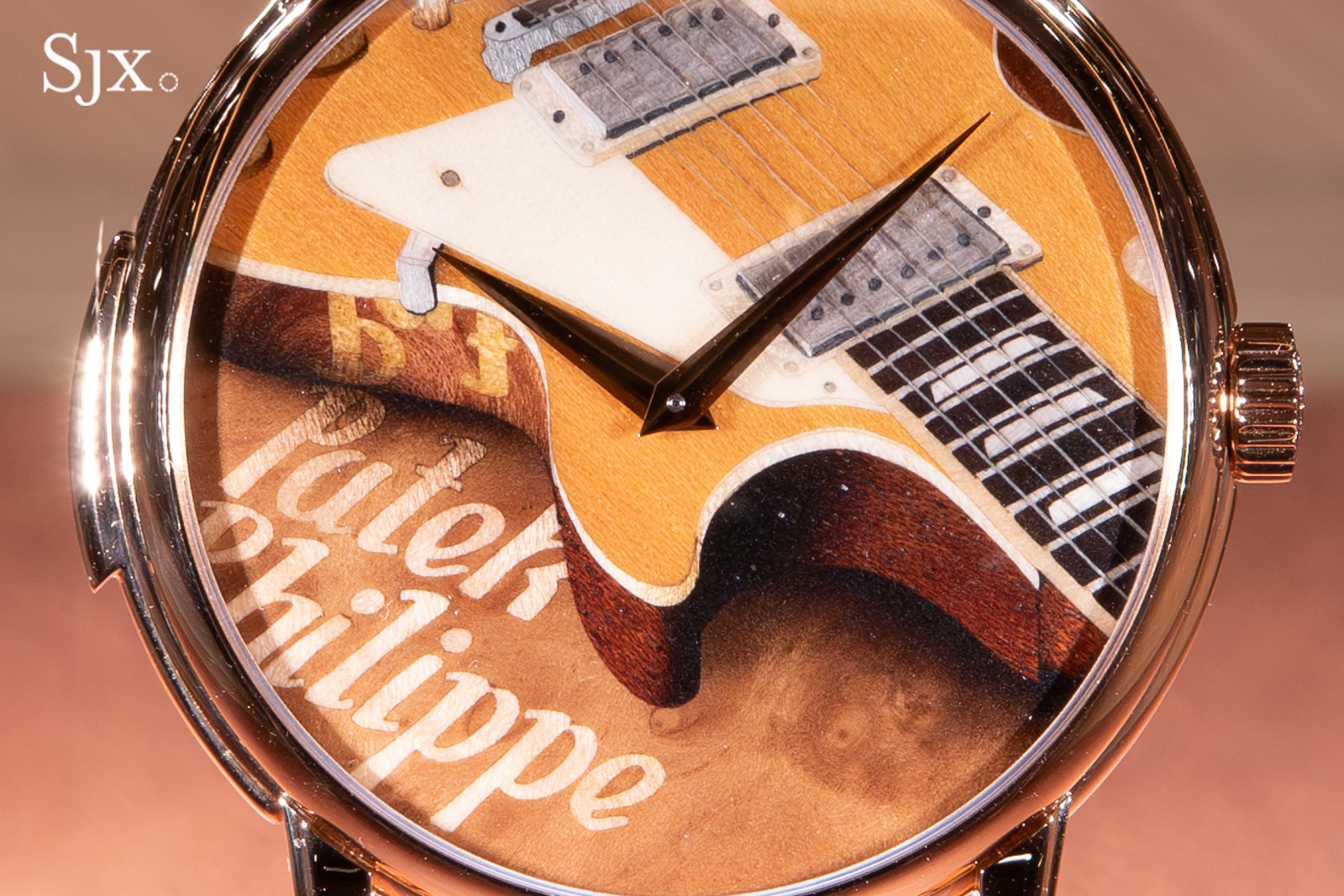
The marquetry maker assembled 336 tiny veneer parts and 18 inlays from 17 species of wood to recreate all the defining elements of a 1950s electric guitar. One of the most impressive elements is the name “Patek Philippe” reflected in the guitar’s glossy polished flanks.
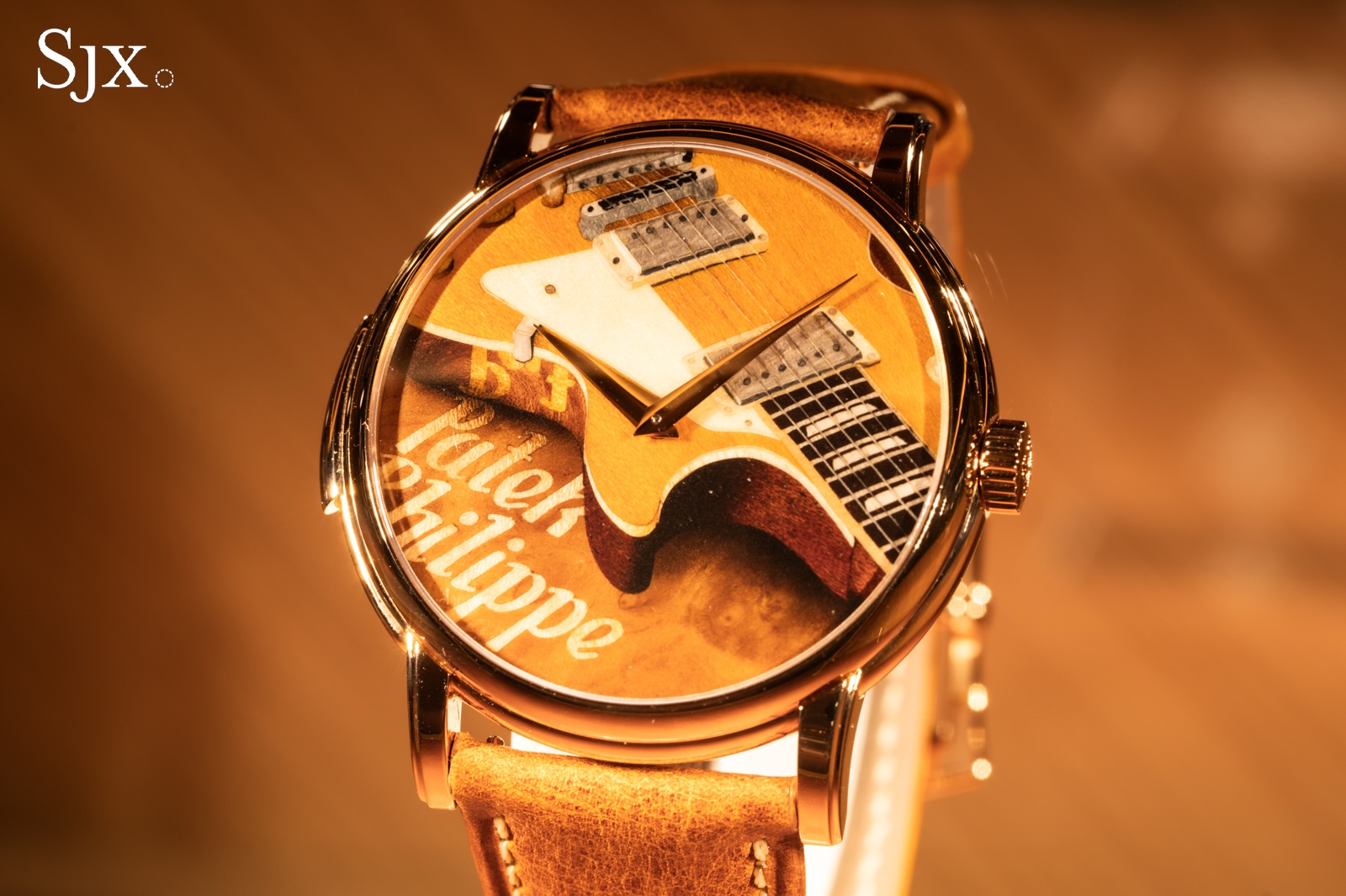
The choice of wood marquetry for a guitar dial seems obvious in retrospect. Wood is the material of the instrument, and the grain and texture of the veneer adds an authenticity that paint or enamel simply could not achieve.
Perhaps more impressively, Patek Philippe will make 10 examples, proving the practiced hand of the marquetry artist.
The most mechanically complex wristwatch in this year’s Rare Handcrafts collection is the Calatrava ref. 5531G-010 “Planisphere”, combining a minute repeater and world time mechanism in a single calibre — the cal. R 27 HU.
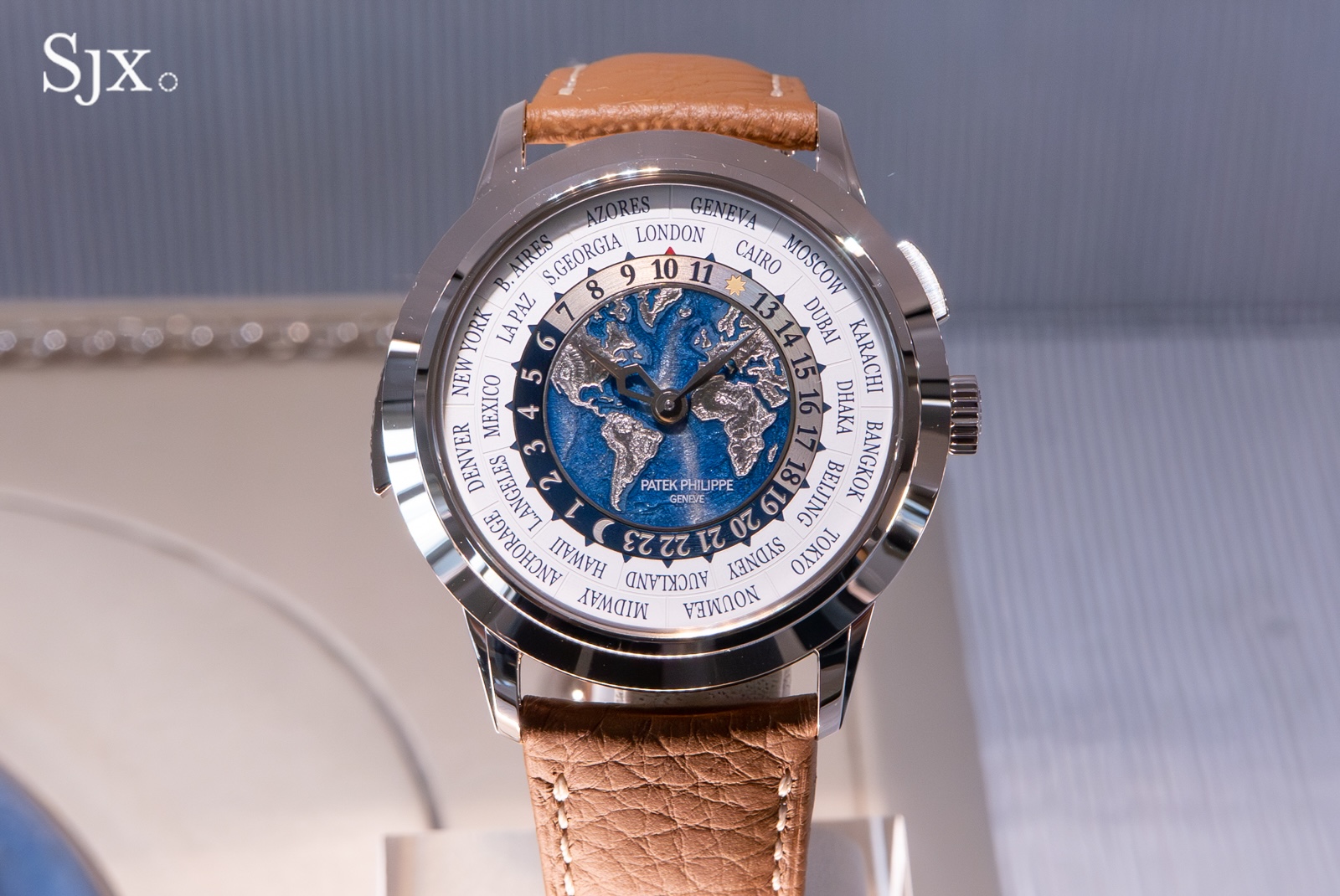
Another limited edition of 10 pieces, the Planisphere’s dial is hand-engraved before being enameled with three shades of blue. To achieve the nuance for the ocean ridges, the seemingly simple dial actually requires 10 to 15 firings to achieve the desired depth.
Pocket watches
Patek Philippe is one of the few contemporary brands that continues to make pocket watches, and the format makes for an impressive show every year at the Rare Handcrafts exhibition.
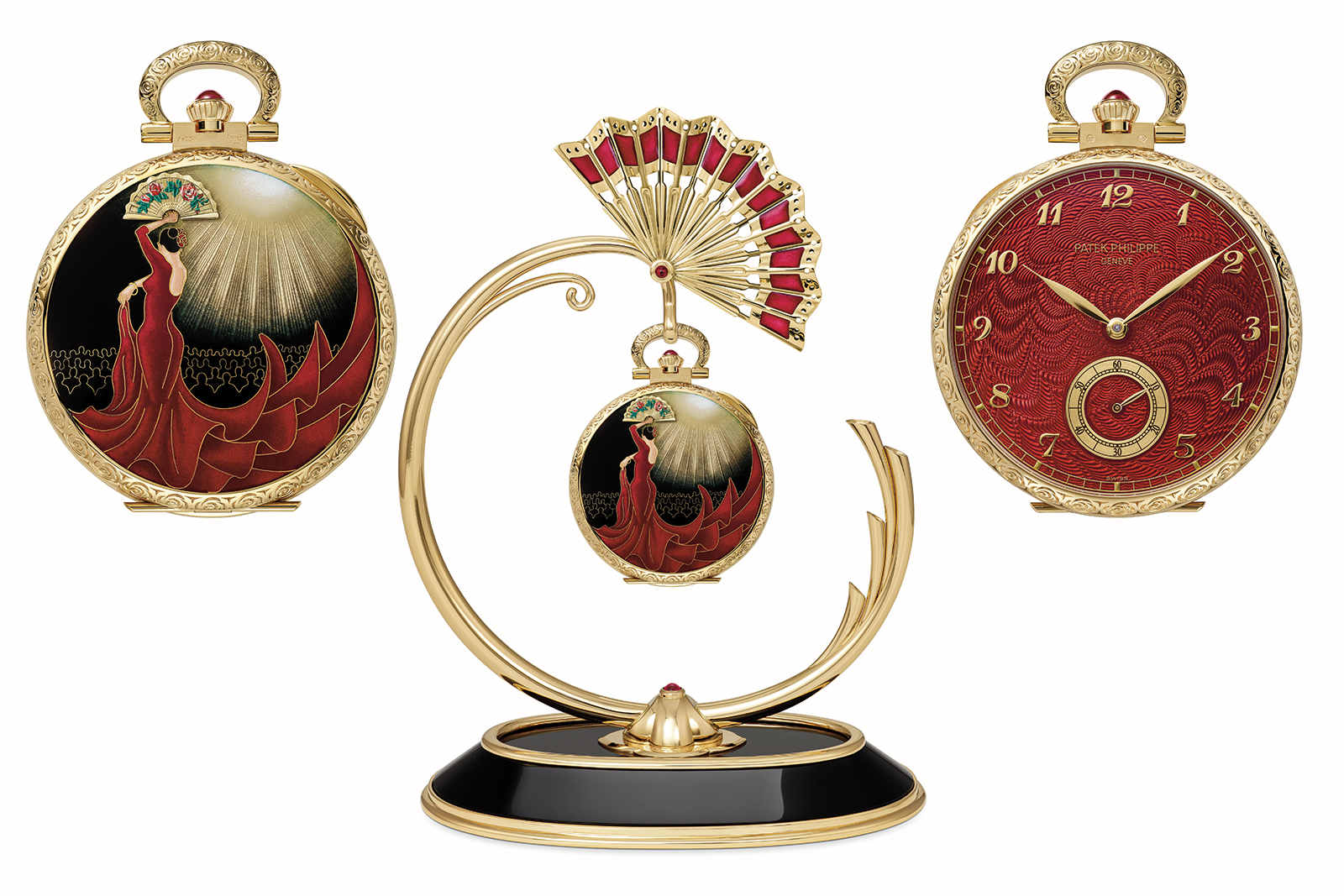
The Pocket Watch ref. 992/198J-001 “Flamenco” captures a bailaora — a flamenco dancer — mid-performance. The composition of this unique piece is unusual and original, focusing on the dancer’s back and the rapt audience beyond her.
Pocket Watch ref. 992/198J-001 “Flamenco”. Image – Patek Philippe
The audience’s view would have been more predictable, but in retrospect it would have probably been boring by comparison. The way the folds of the dress fill the lower third of the composition feels especially well-judged.
The spotlight is rendered in sunburst guilloché, and the dancer’s dress is sculpted with 50 cm of gold wire. Thirteen colours of cloisonné enamel establish the scene, with five further colours of miniature painting refining the detail of the fan. In total, 20 firings were required — a figure that reflects the ambition of the layering rather than the size of the canvas.

Case back detail of ref. 992/198J-001 “Flamenco”. Image – Patek Philippe
The stand is worth equal attention. The fan in pliqué à jour enamel suspended above the watch is among the most elaborate accompaniments in this year’s pocket watch selection.
Interestingly, the pocket watches are powered by the same 17’’’ movement that powers the Dome Clocks, sans electric winder. Patek Philippe manufactures both open-faced and hunter versions of the movement, with the former being most common in rare handcrafts watches, with the option of an up/down hand at 12 o’clock.
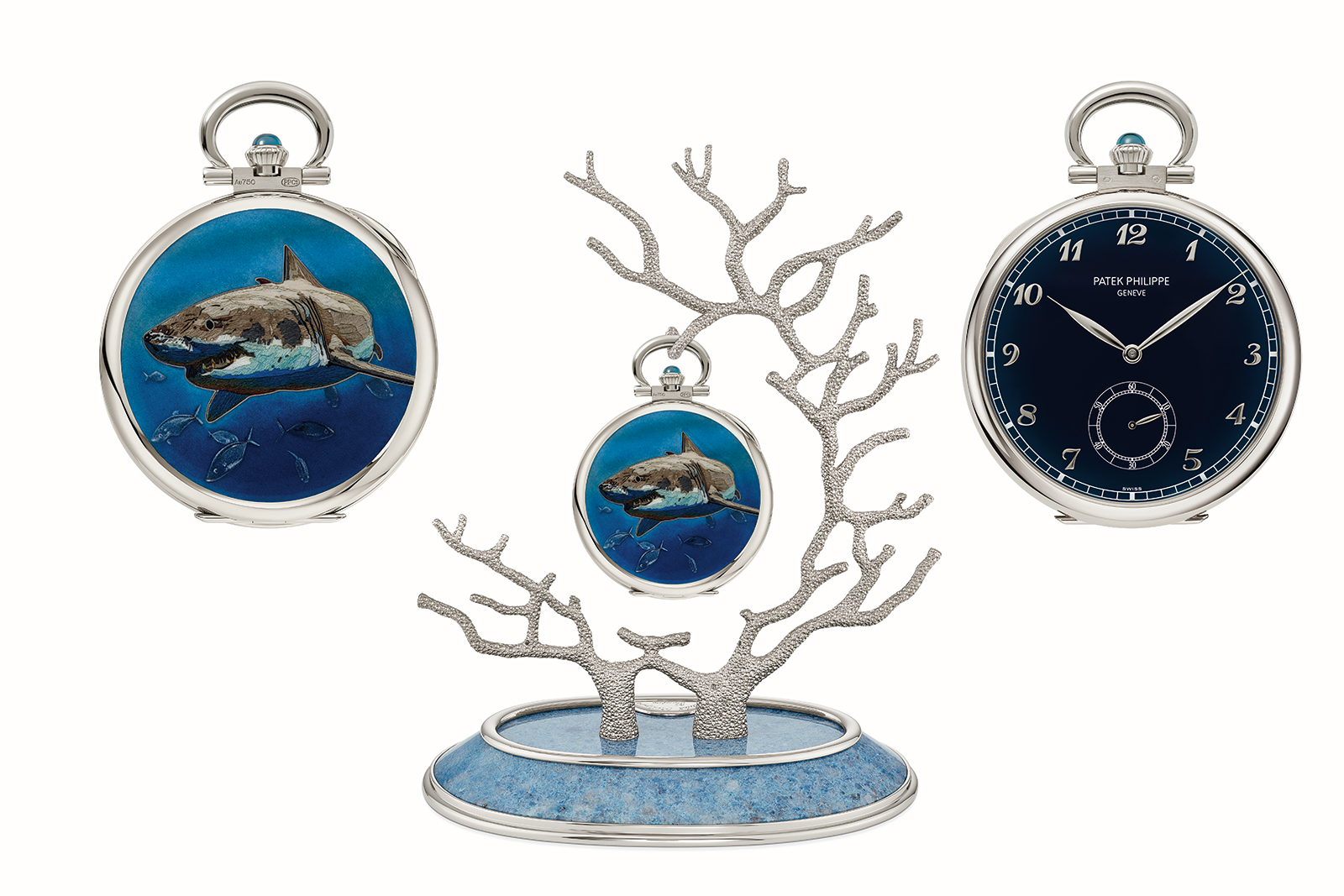
The Pocket Watch ref. 995/141G-001 “Great White Shark” is one of the most technically hybrid pieces in this year’s pocket watch selection, combining wood marquetry and miniature painting on enamel — two of Patek Philippe’s most demanding decorative disciplines.
Pocket Watch ref. 995/141G-001 “Great White Shark”. Image – Patek Philippe
Another unique piece, case back required 161 veneer parts and 25 inlays from 18 species of wood, while the enamelled background demanded 16 colours of opaque and transparent enamel to render the ocean depths with enough conviction to place the shark in its environment.
The coral-like stand is made of solid 18k white gold, set on a base of blue trolleite.
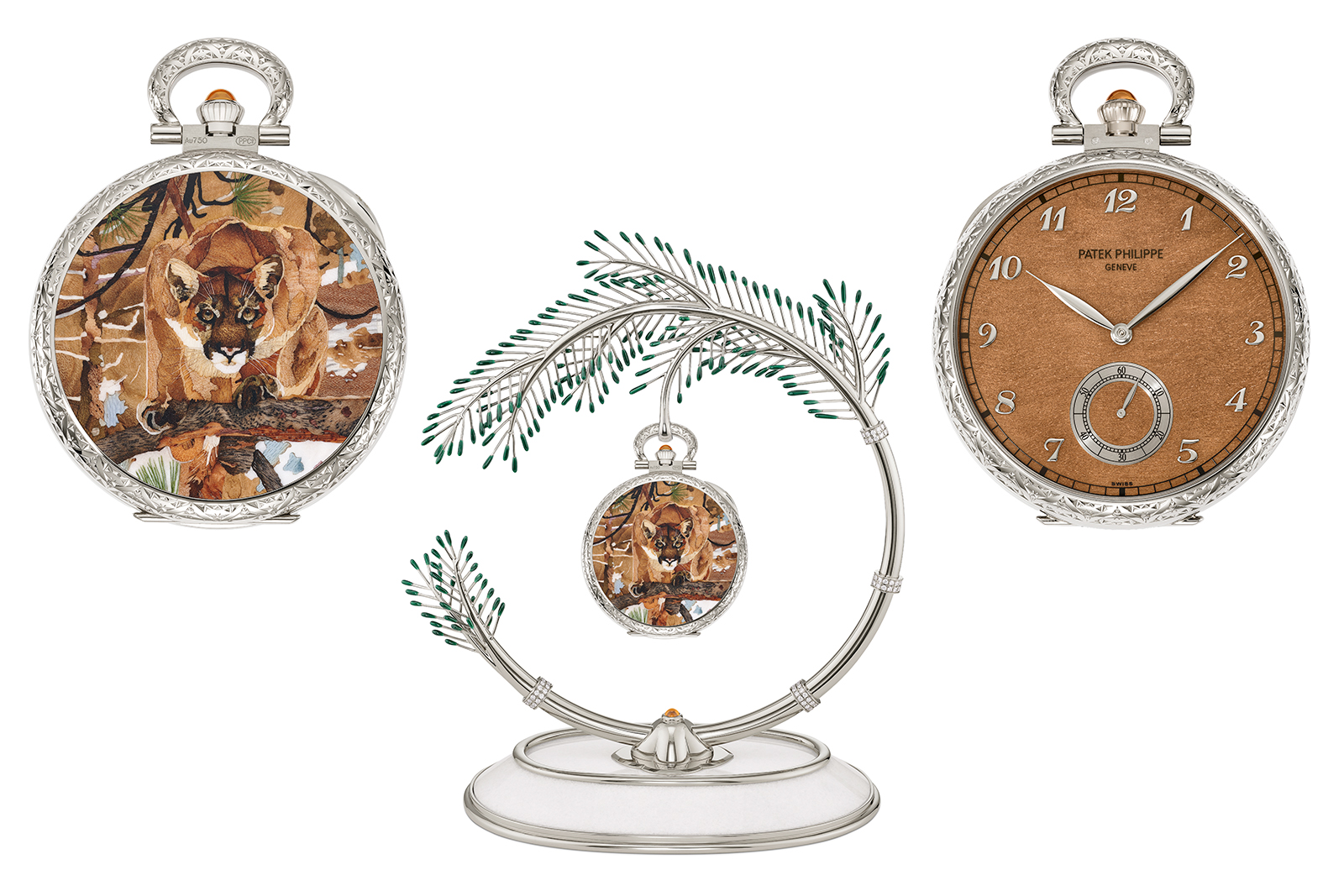
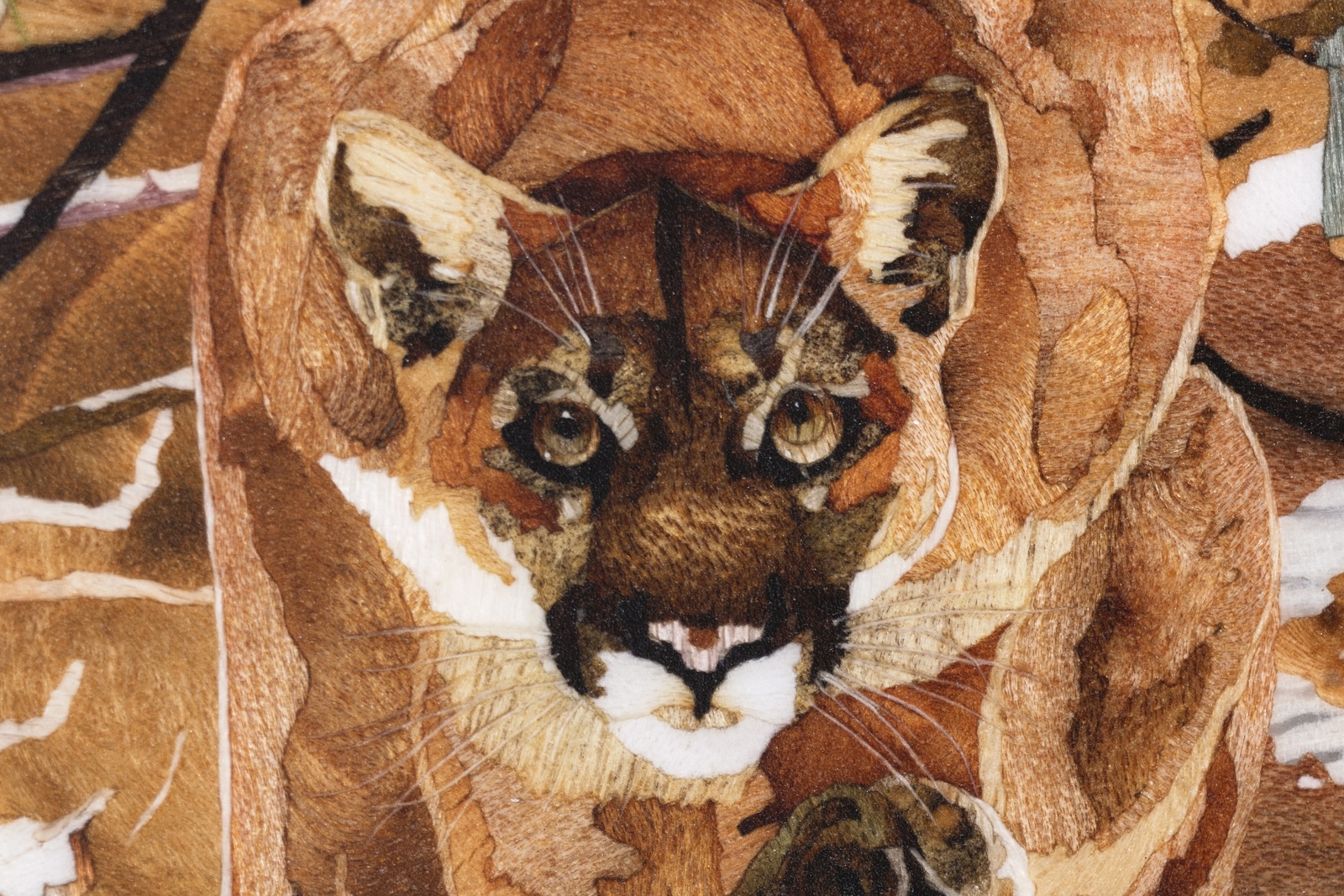
The Pocket Watch ref. 995/150G-001 “Puma” is another example of Patek Philippe’s mastery of marquetry, with 276 veneer parts and 80 tiny inlays from 35 species of wood to render a large cat poised to spring — a subject that requires the marquetry to convey both texture and tension simultaneously.
Pocket Watch ref. 995/150G-001 “Puma”. Image – Patek Philippe
The hand-engraved bezel and bow add a further layer of craft, with a geometric frieze presenting a stylised version of the big cat’s face. The white gold stand echoes the mountain habitat of the puma, set with 112 brilliant-cut diamonds and resting on a white marble base.
Marquetry detail of ref. 995/150G-001 “Puma”. Image – Patek Philippe
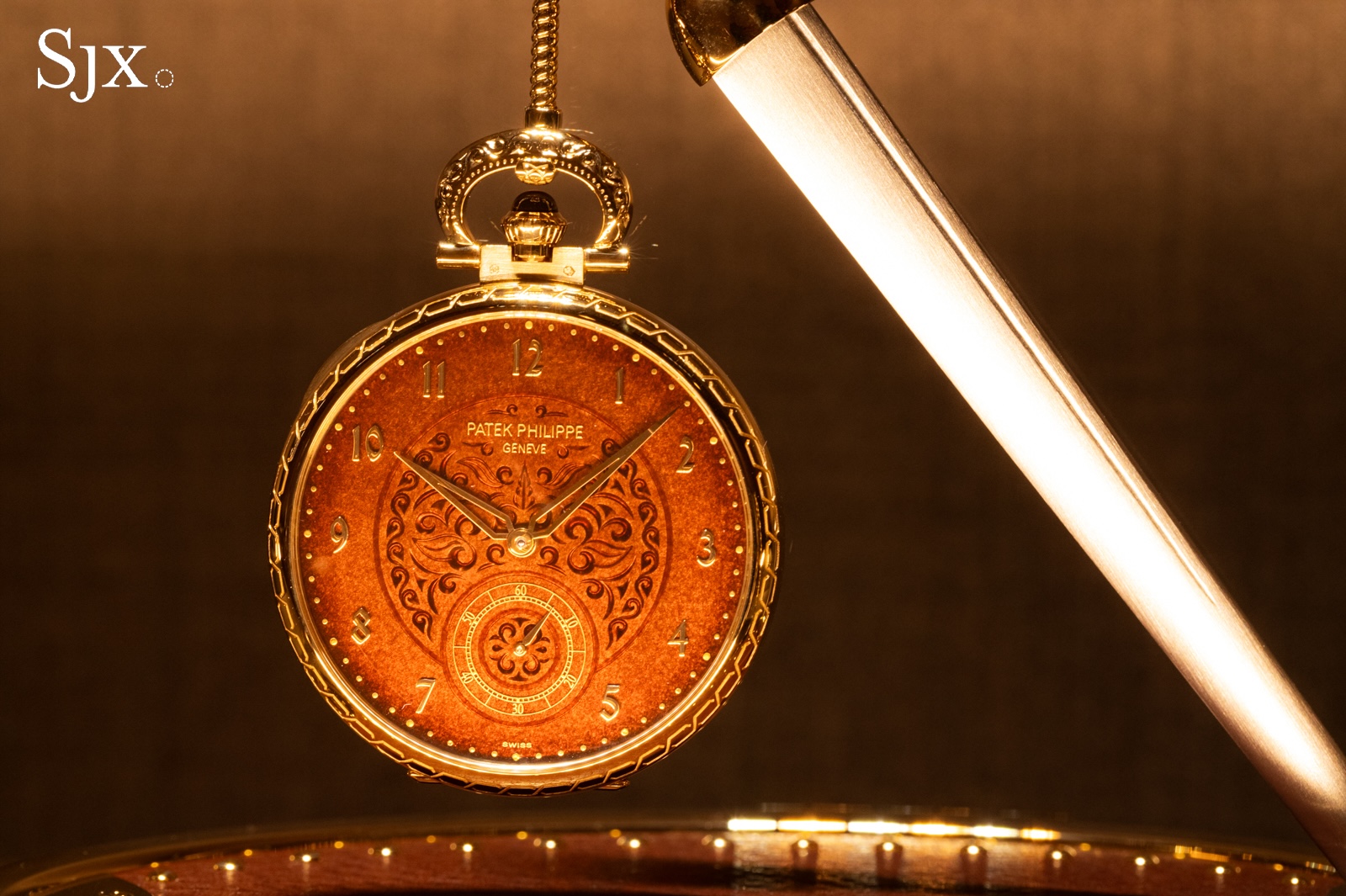
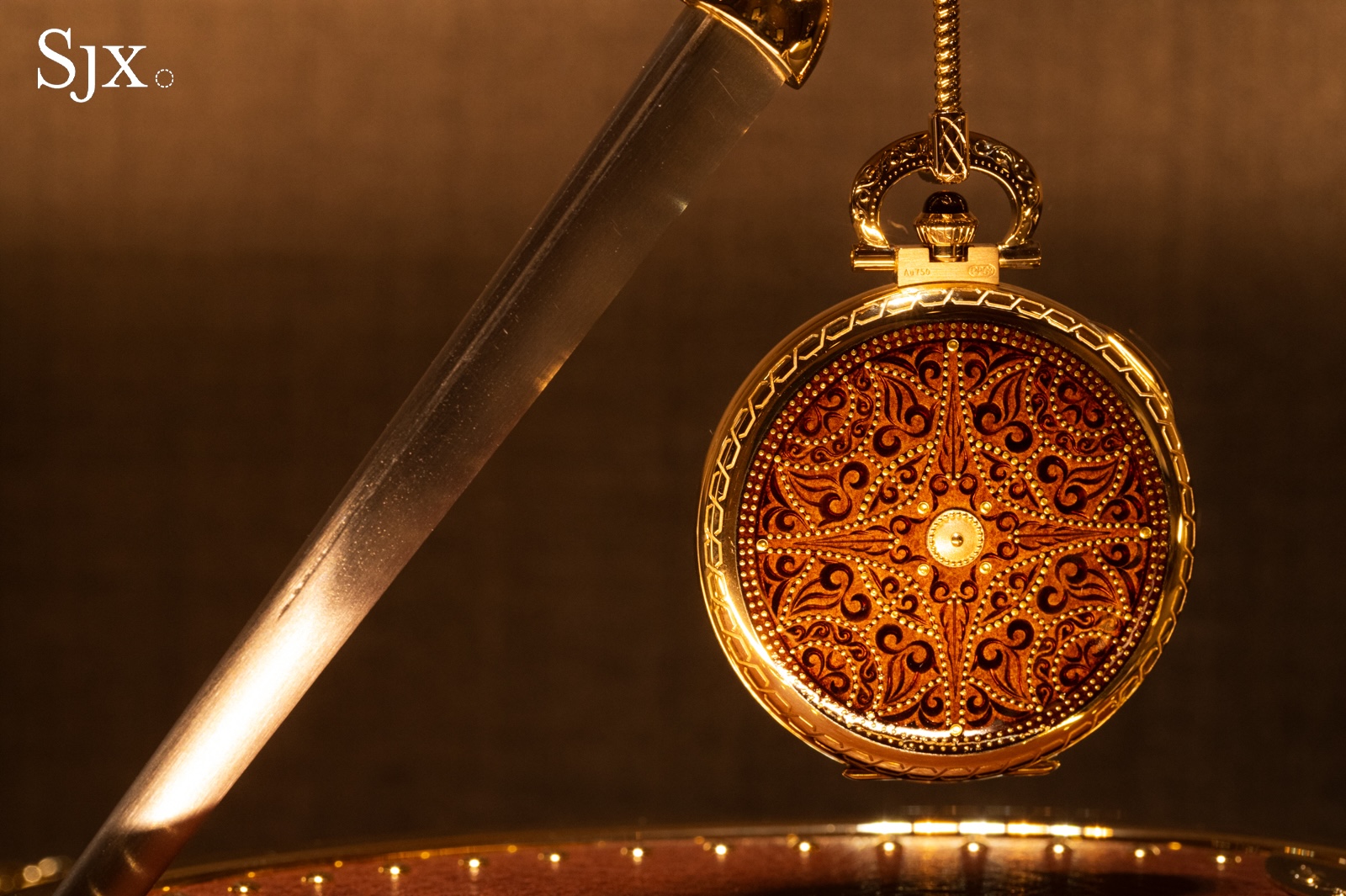
The Pocket Watch ref. 995/153J-001 “Targe” takes after the Scottish Highland shield of the same name. The design is rendered in paillonné, a technique in which individual gold spangles are set into the surface of the enamel to simulate the brass studs that stud a traditional targe. Here, a remarkable 680 paillons were applied — a figure that conveys the obsessive patience the technique requires.
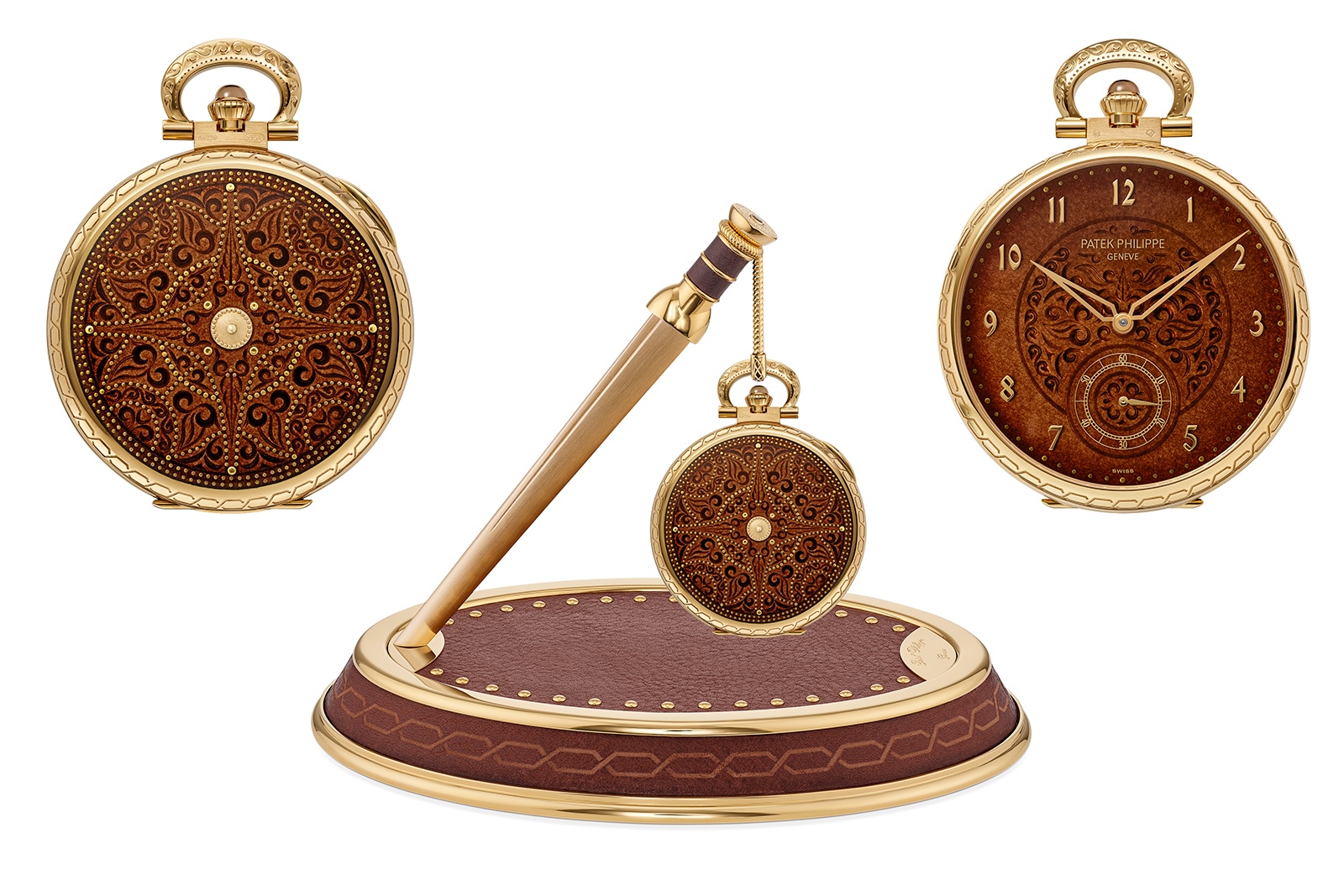
Pocket Watch ref. 995/153J-001 “Targe”. Image – Patek Philippe
The stand is the most literal in this year’s pocket watch selection — a Scottish dirk in yellow gold, its hilt hand-engraved and set with a Cairngorm stone, resting on a granulated brown leather base that echoes the leather of the shield itself.
Rare Handcrafts 2026 is open daily to the public from April 18 to May 9, except on Sundays.
Patek Philippe Salons
Rue du Rhône 41
1204 Genève
Switzerland
Admission is free but registration is required on Patek.com.
Back to top.