
Insight: F.P. Journe Répétition Souveraine Smoked Sapphire
A beautifully quirky minute repeater.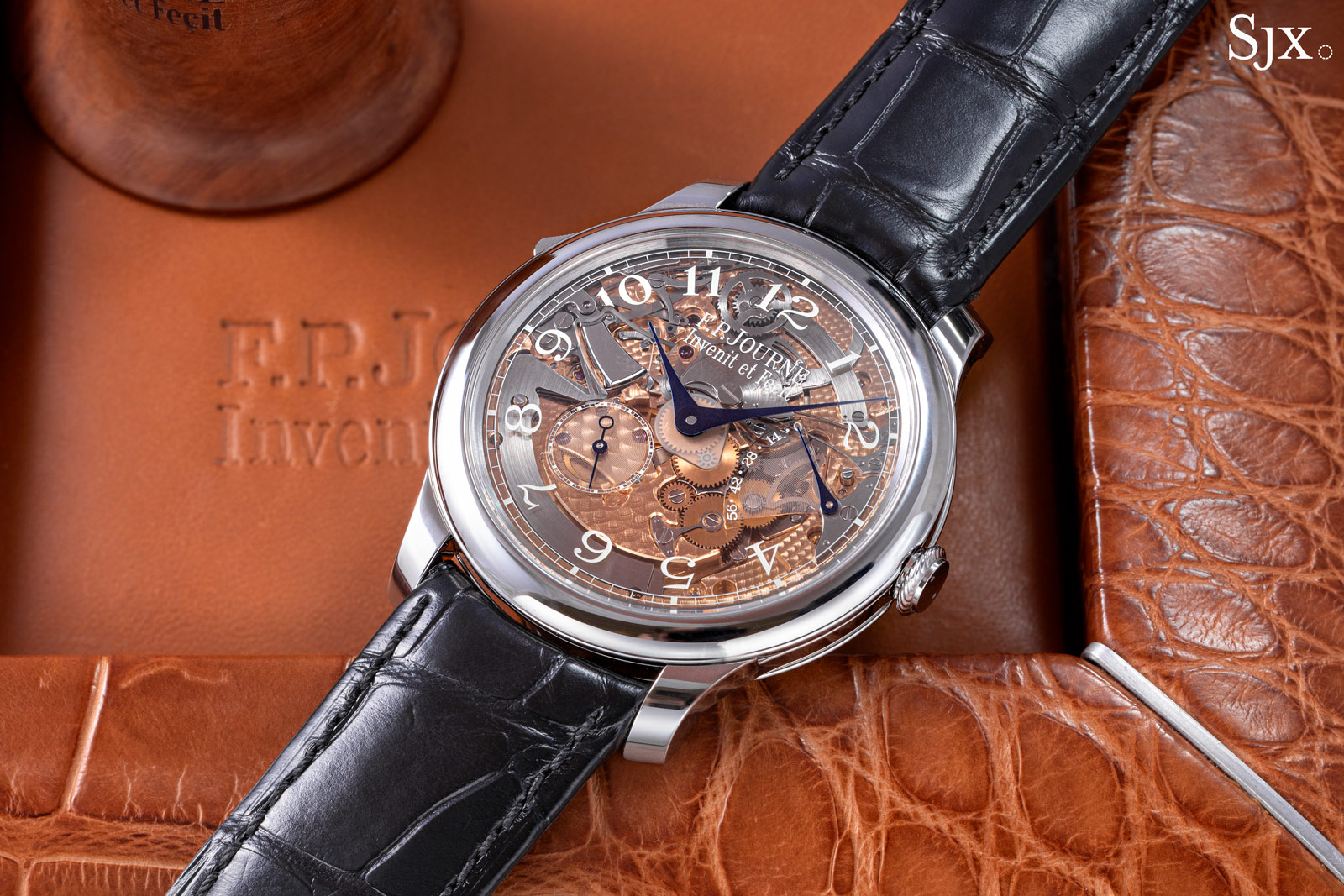
The Répétition Souveraine is one of the more unusual minute repeaters on the market, combining classical inspiration with an idiosyncratic technical approach that is unmistakably F.P. Journe. Based on the familiar architecture of the Chronomètre Souverain yet fundamentally reworked to accommodate a striking mechanism, it is neither a conventional integrated repeater nor a simple modular add-on.
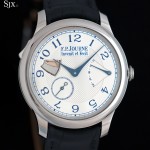
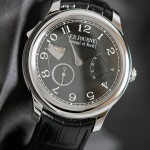
Launched in 2008 with a conventional dial and briefly the thinnest contemporary minute repeater on the market, the latest iteration of the Répétition Souveraine reveals its workings through a smoked sapphire dial, offering a direct view of its flat gongs and strike train while underscoring François-Paul Journe’s distinctive philosophy of clarity, compactness, and mechanical logic. This is our third encounter with the Répétition Souveraine, having already covered the silver-dial variant and the elusive “Black Label” edition.
Almost modular
Most independents – and many large brands – rely on a handful of external specialists like Le Cercle des Horlogers or decades-old ebauche stocks for their repeaters. As a result, most repeaters take the same, time-tested, approach with only a few exceptions. Most are integrated designs that put the repeater train, hammers, and gongs on the same level as the rest of the movement.
The rejuvenation of mechanical matchmaking during the 1980s and 1990s brought with it demand for systems that brands could add to existing movements. Among the most famous of these is the IWC minute repeater, which took a modular approach (and is another unusual design) allowing the same system to be used on both the Valjoux 7750 and IWC cal. 98 bases without significant changes.
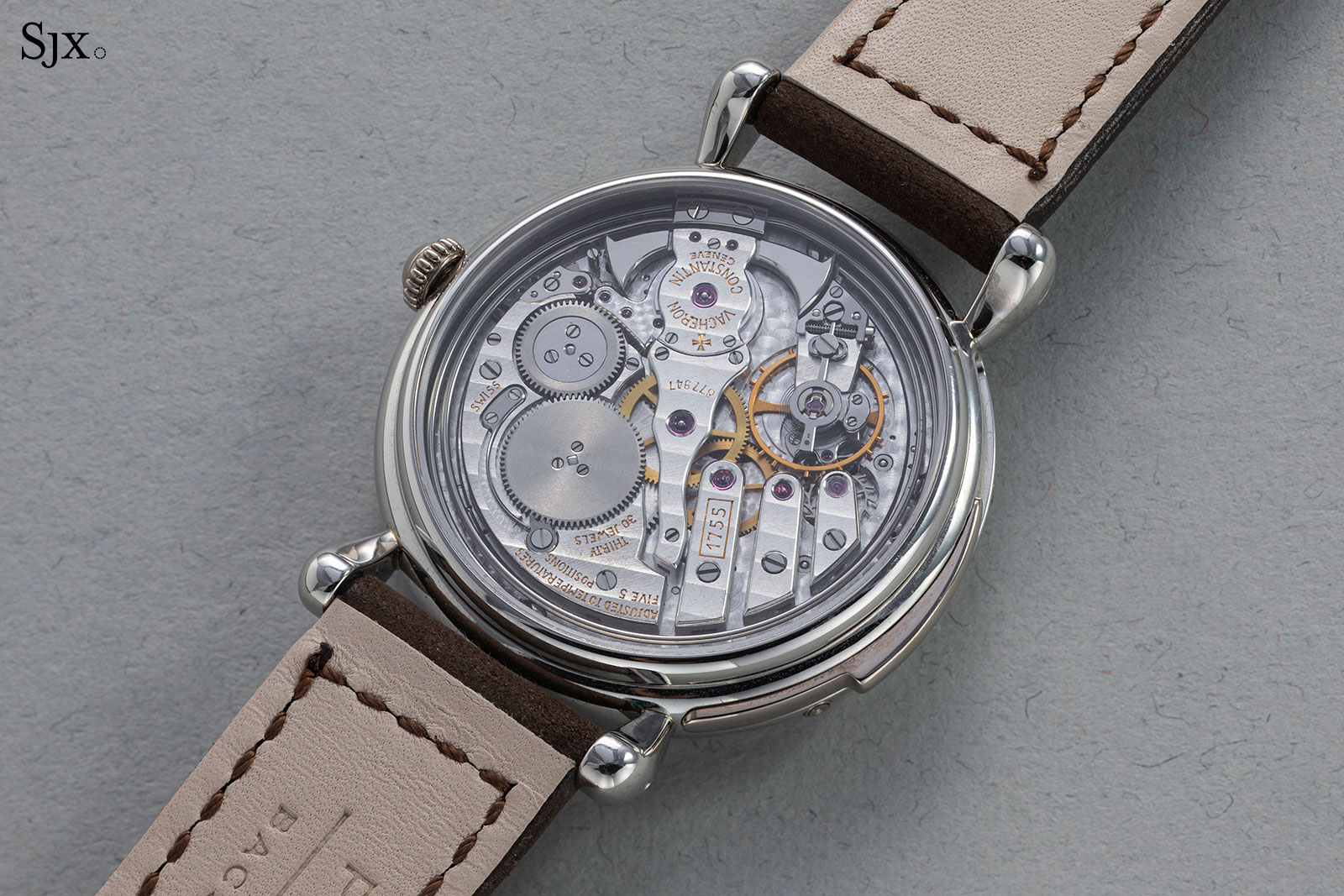
The movement of a Vacheron Constantin ref. 30020, representative of minute repeaters made from the late 19th-century onward.
In a similar vein, F.P. Journe turned to the Chronomètre Souverain’s cal. 1304 as the base for the brand’s first stand-alone minute repeater, increasing the height and width of the rose gold main plate to accommodate the repeating works of the Répétition Souveraine. From the outside, the Répétition Souveraine is essentially a minute repeating version of the much-loved Chronomètre Souverain, in this case with a smoked sapphire dial that reveals the normally hidden repeater works beneath.

But it’s not simply a cal. 1304 with a repeater module. Viewed through the case back, the less airy bridge design and missing barley corn pattern give the movement a different feel from that of the Chronomètre Souverain, setting aside the obvious presence of the strike governor.
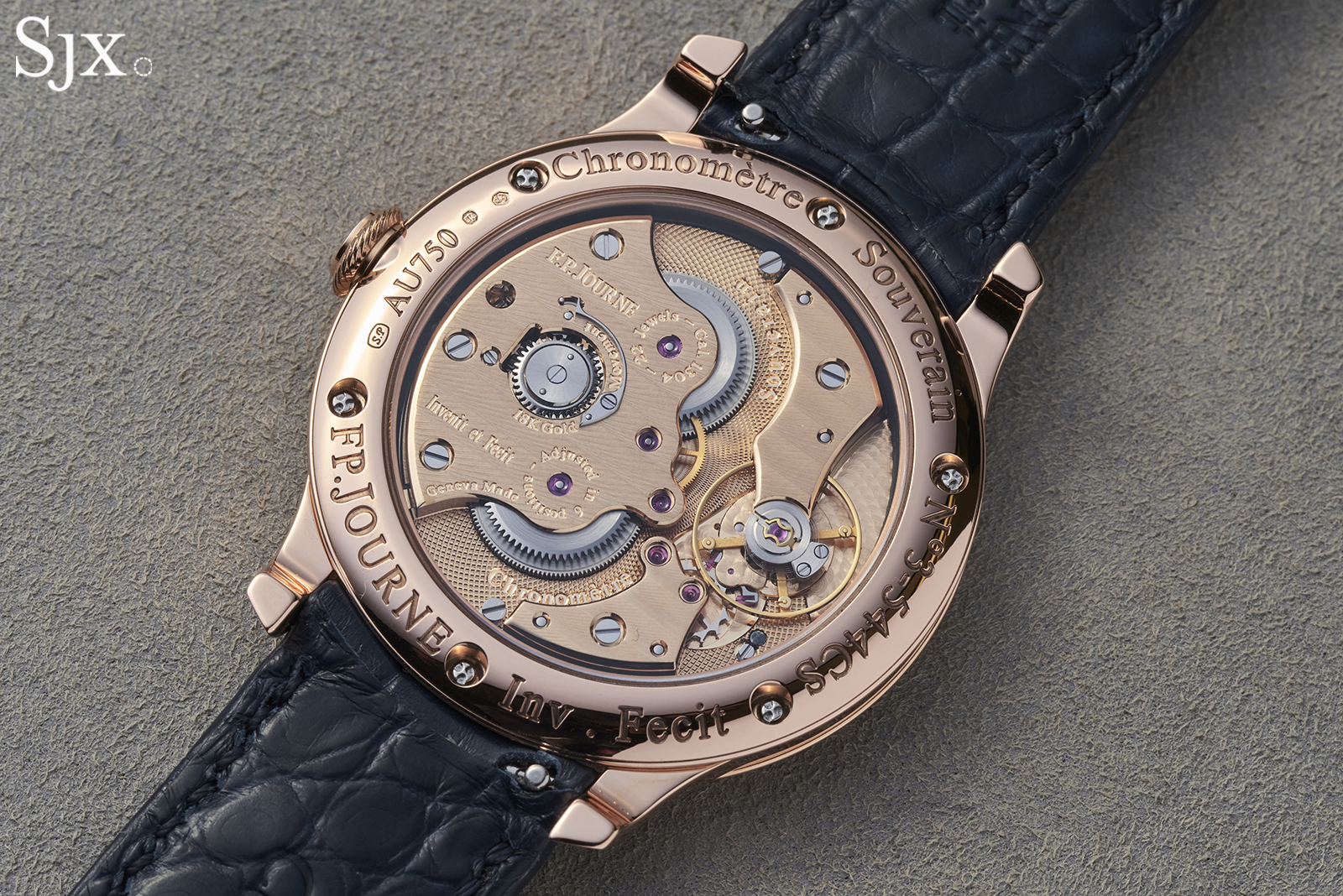
The Chronomètre Souverain.
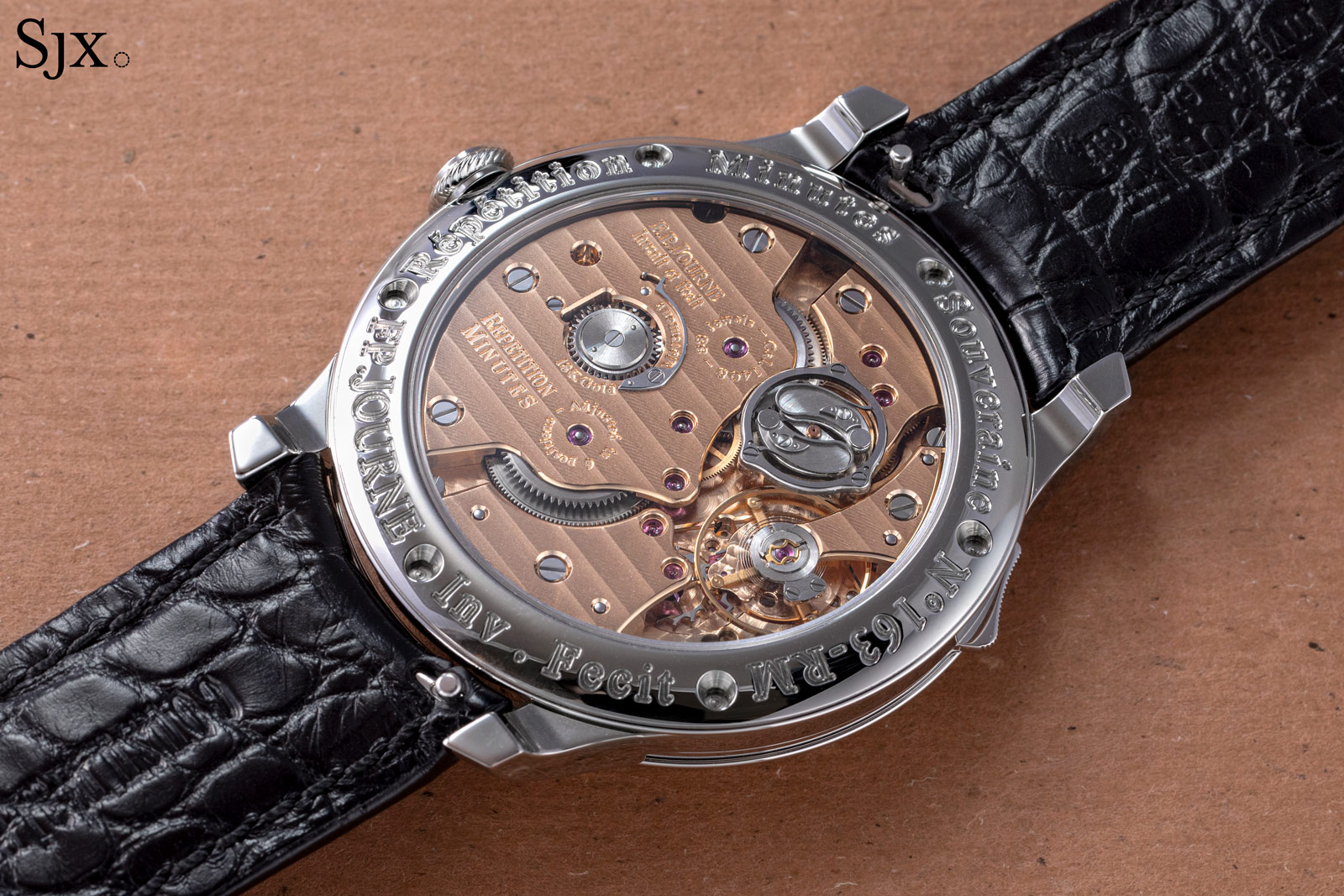
The Répétition Souveraine.
Aesthetic differences aside, the cal. 1408 features the same twin-barrel architecture, up/down indicator, eccentric small seconds and partially hidden train. F.P. Journe used the Répétition Souveraine as a base for the Astronomic Souveraine several years later, adding an astronomical annual calendar, tourbillon, constant-force device, and slightly larger balance; a slate of significant changes that leaves the underlying calibre barely recognisable.
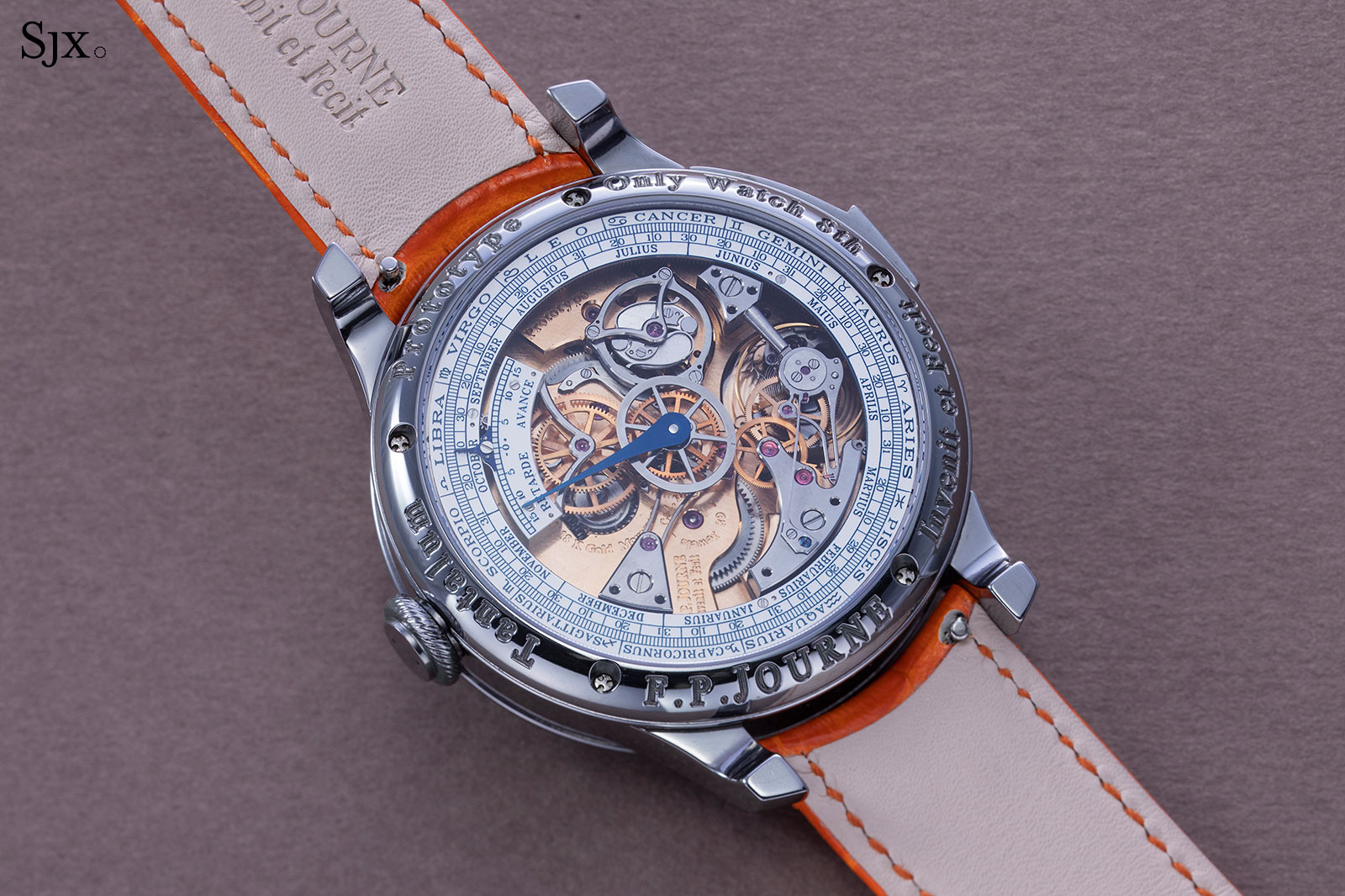
The Astronomic Souveraine.
In truth, the Chronomètre and Astronomic Souveraine share few parts directly, but it is both ironic and elegant that the brand’s most and least complicated (and expensive) models are so closely related, bringing the catalogue full circle.
The characteristic twin barrels, inspired by early French marine chronometers, contain springs that are weaker than the average mainspring, but the arrangement helps provide more consistent torque. Together they have the power of a normal mainspring, with the benefit of a flatter torque curve as it winds down.
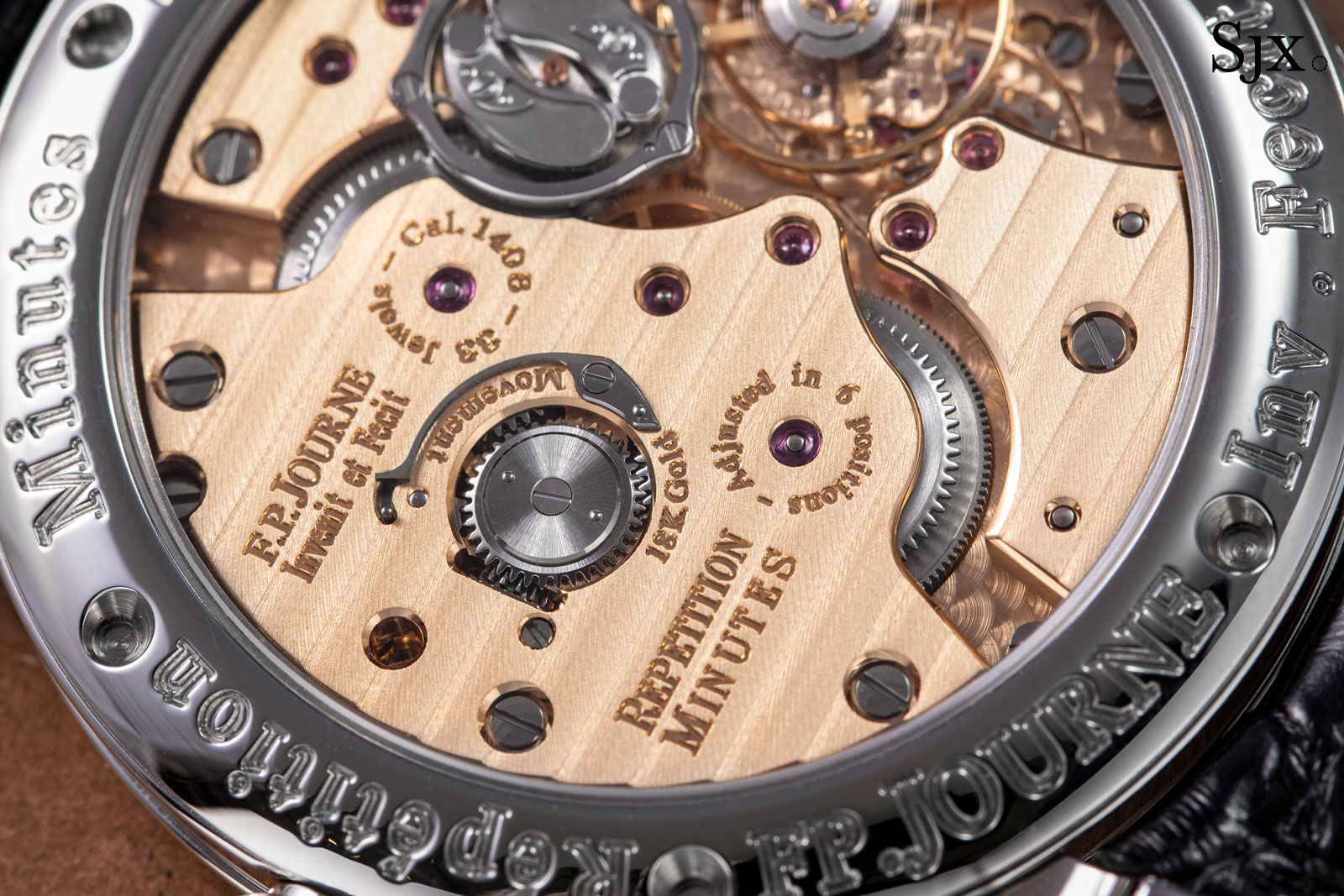
The twin barrels.
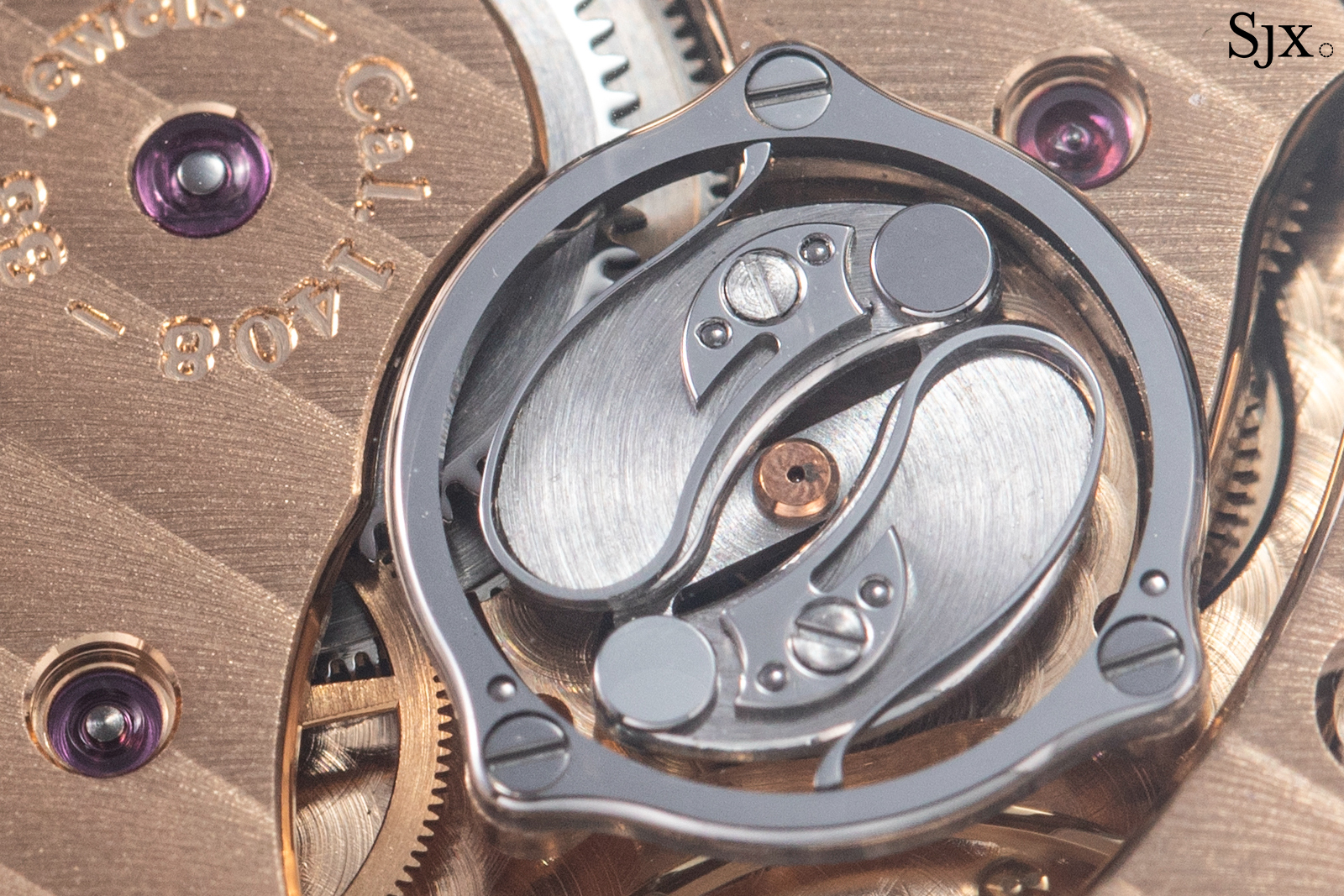
Unlike the self-contained minute repeater modules from IWC and Jaeger-LeCoultre, F.P. Journe took advantage of the generous empty real estate in the cal. 1304 to move the strike train and governor to the back, which saves space but means the system can’t be easily transposed to other base movements, like the Octa automatics for example.
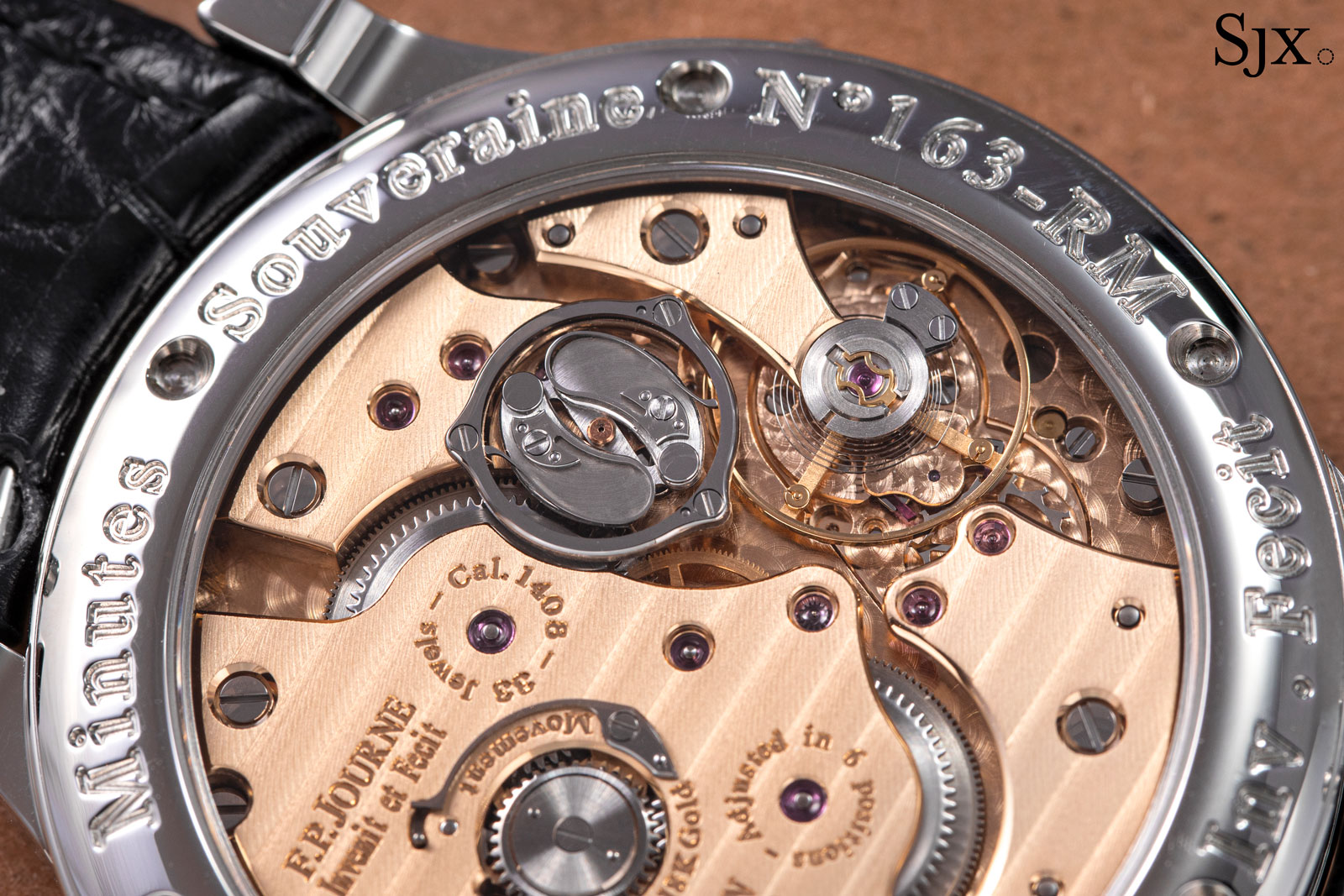
The governor carries a pair of springs mounted on articulated arms, which rub against the steel frame to regulate the striking speed. Centrifugal force (inertia) causes the arms unfurl as the governor speeds up, pushing the springs against the frame, slowing its rotation with increasing friction. This solution is quieter than traditional anchor governors, but not as whisper-quiet as Swatch Group’s magnetic governor or Seiko’s air-friction only governors.
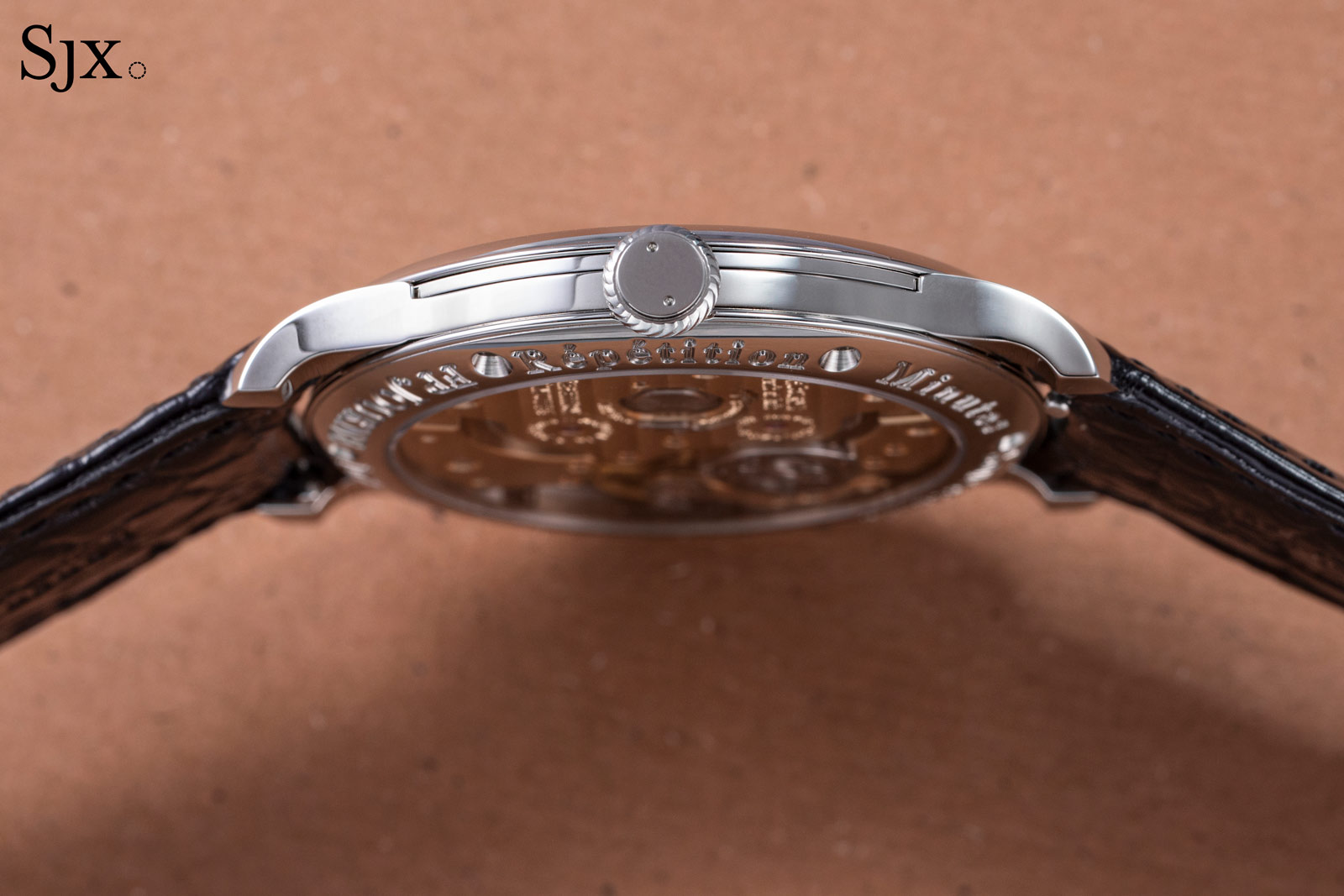
Despite its not-quite-modular construction, the 8.5 mm-tall Répétition Souveraine was briefly the thinnest minute repeater on the market when launched in 2008. It’s important to clarify significantly thinner minute repeating wristwatches existed during the 1980s and 1990s – and the flattest minute repeating pocket watches were only around 5 mm – but the Répétition Souveraine was the slimmest repeater one could buy new.
Sounding off
As with the Sonnerie Souveraine, the Répétition Souveraine uses the brand’s signature flat gongs, visible through the sapphire dial, which emit a clear, crisp note without the resonance of wire gongs. Journe claims his flat gongs are louder than traditional wire gongs, but the many confounding factors affecting sound make that claim difficult to evaluate.
Like the Sonnerie and Astronomic Souveraine, the Répétition Souveraine is only officially available in stainless steel rather than the brand’s usual choices of rose gold and platinum, as denser metals would dampen the sound. A matching steel bracelet is available at a modest premium, making it a minute repeater that is arguably well-suited to daily wear, especially given the 30 m water resistance rating, which remains unusual for a chiming watch even 18 years after its launch. While steel is a sensible choice for a chiming watch, part of the appeal of independent brands like F.P. Journe is the ability to have one’s dreams realised, and a precious metal case (and matching bracelet) is not off the table.
Ups and downs
The dial also reveals the wind indicator mechanism, in addition to the repeater works. Nearly all of F.P. Journe’s creations bearing the name Chronomètre have an indicator that tracks hours since the last full wind, which is the historical approach. Today, however, power reserve indicators, which display the hours remaining, such as on F.P. Journe’s own Octa models, are more common. This leads to confusion as most modern watches omit the customary “up/down” markings, but for this watch “0” represents the fully wound state.
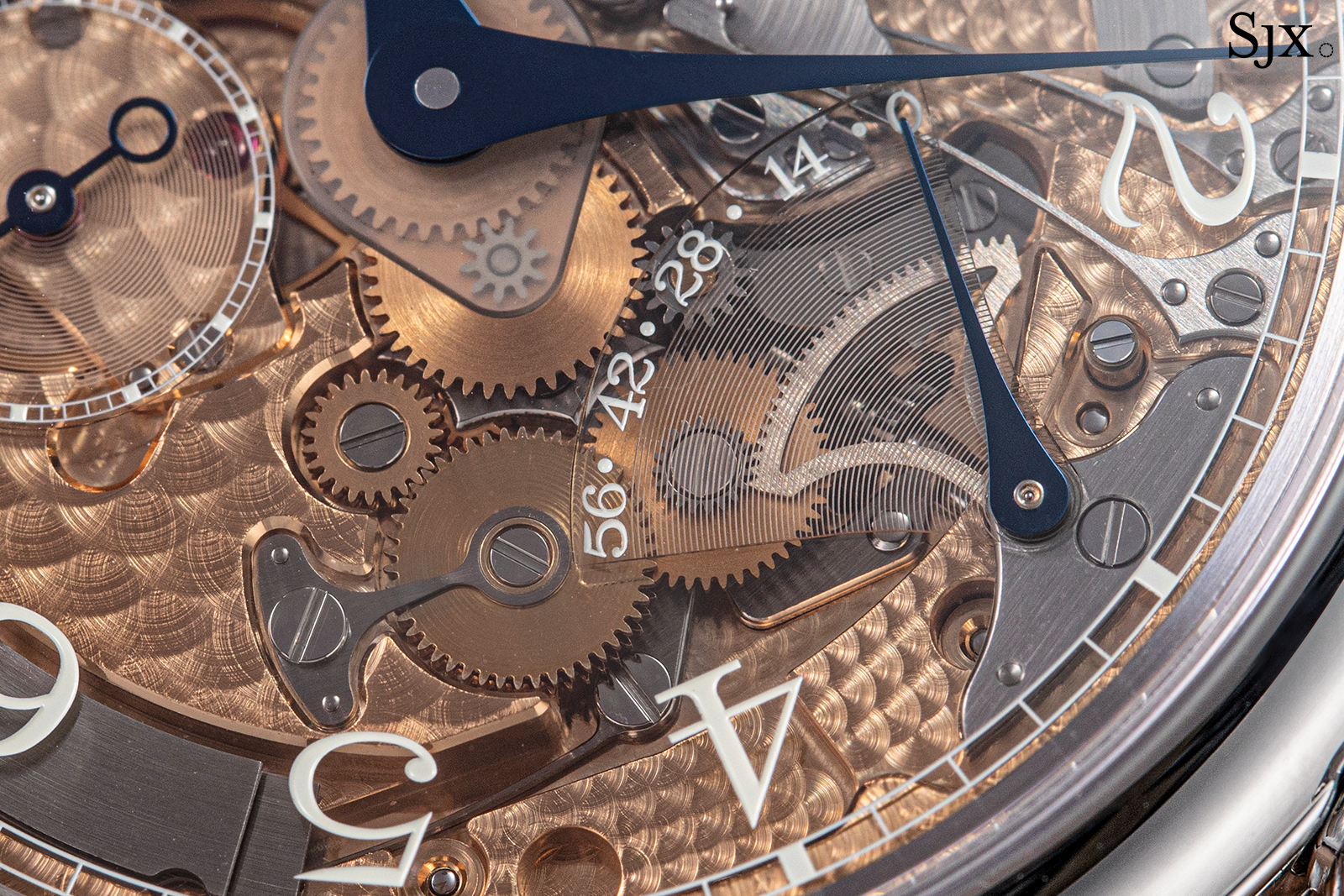
A planetary gear differential is the most well known approach, constantly driving the hand to the down position as the watch runs, but allowing it to rise as the watch is wound. Journe instead uses a ball differential, most commonly used in small remote control cars. It comprises a (blue) free wheel geared to the up/down hand, with (red) ceramic ball bearings sandwiched between two coaxial wheels. The upper wheel (green) is geared to the barrel arbour and turns while winding the watch, the lower (orange) is geared to the barrel and turns very slowly in the opposite direction as the watch runs.
The rotation of the free-wheel (blue) is the sum of the rotation of the two inputs (green and orange), slowly driving the up/down hand to the “down” position after 56 hours as the watch runs down, and raising it back to the “up” position when wound.
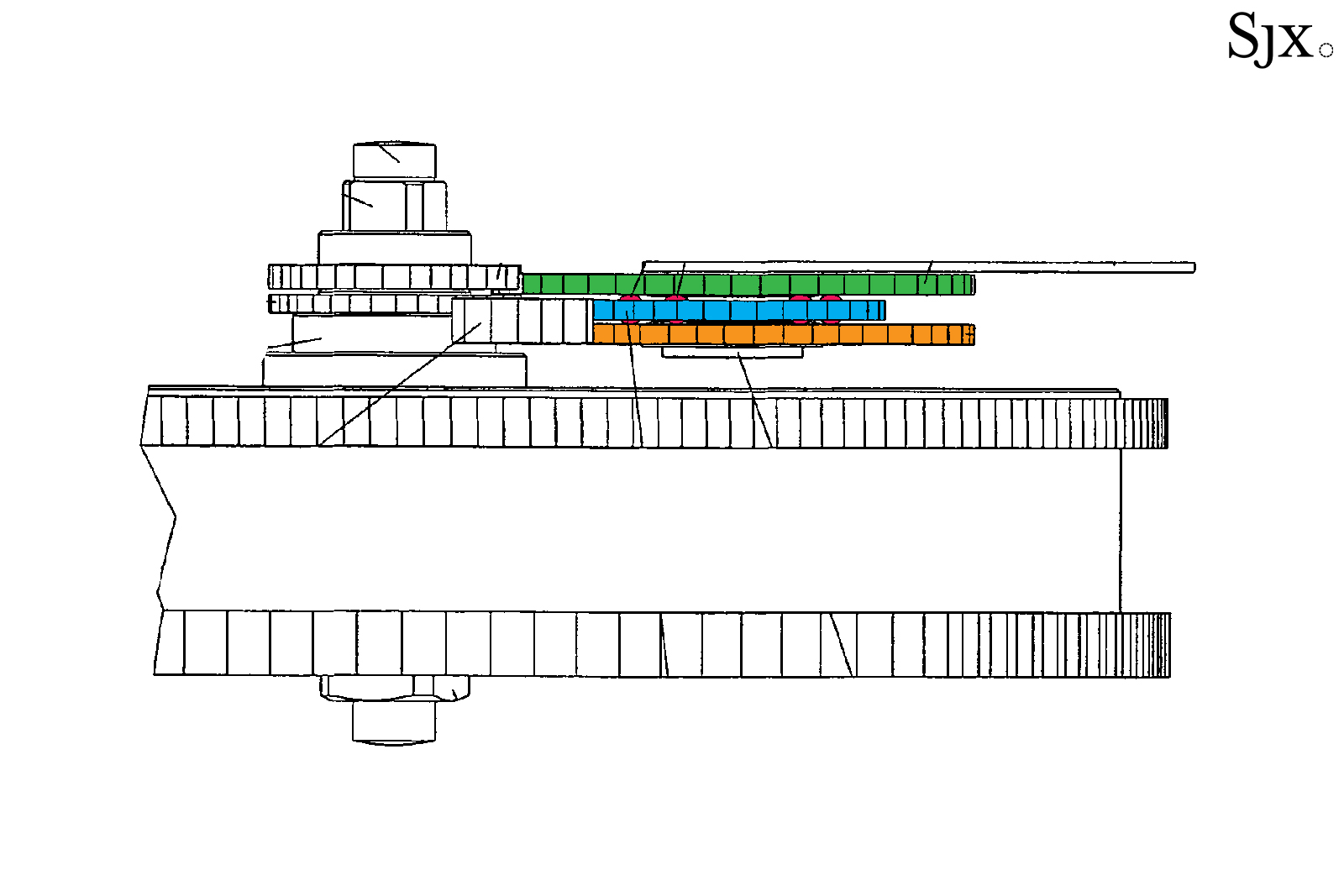
Diagram of F.P. Journe’s up/down system. Image – Application EP1760544A1
Usefully, since the connections within a ball differential are frictional, the three wheels can slip past each other as needed, allowing the watch to continue running even after the up/down indicator reaches the down position and the free wheel can no longer move. This also makes it well suited to automatic movements, such as in the ETA 2897.
A striking anachronism
Despite the visual similarity of the dial-side flat gongs, the Répétition Souveraine is unrelated to the Sonnerie Souveraine. The former is inspired by the repeaters of A.-L. Breguet, while Cesar Racine’s simplified grande sonnerie design likely influenced the Sonnerie Souveraine. Repeaters were the most common complication in Breguet’s time. With limited daylight in cities like London, Paris, and Amsterdam, and gas lighting still in its infancy, chiming clocks made telling the time by ear both practical and intuitive.
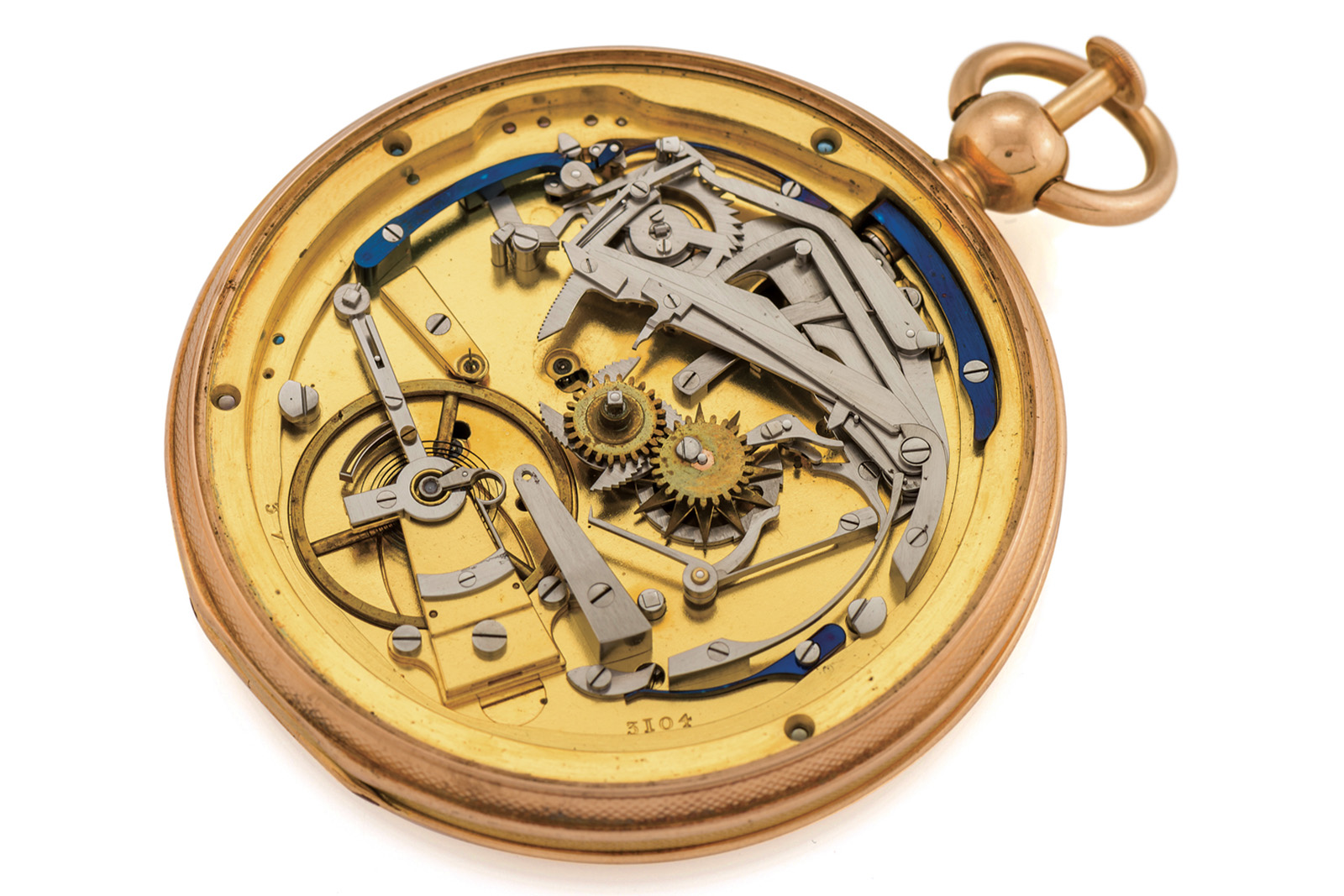
Breguet No. 3104 with minute repeater. Image – Breguet Museum
While Breguet made many repeating watches, and Francois-Paul Journe was no doubt inspired by his work, the system was not exclusive to or invented by Breguet, and is generally credited to a London watchmaker named Matthew Stogden (see The Repeater by Richard Watkins). Much like the work of Breguet, the repeater works are very compact, leaving room on the dial side for additional complications, like the up/down indicator.
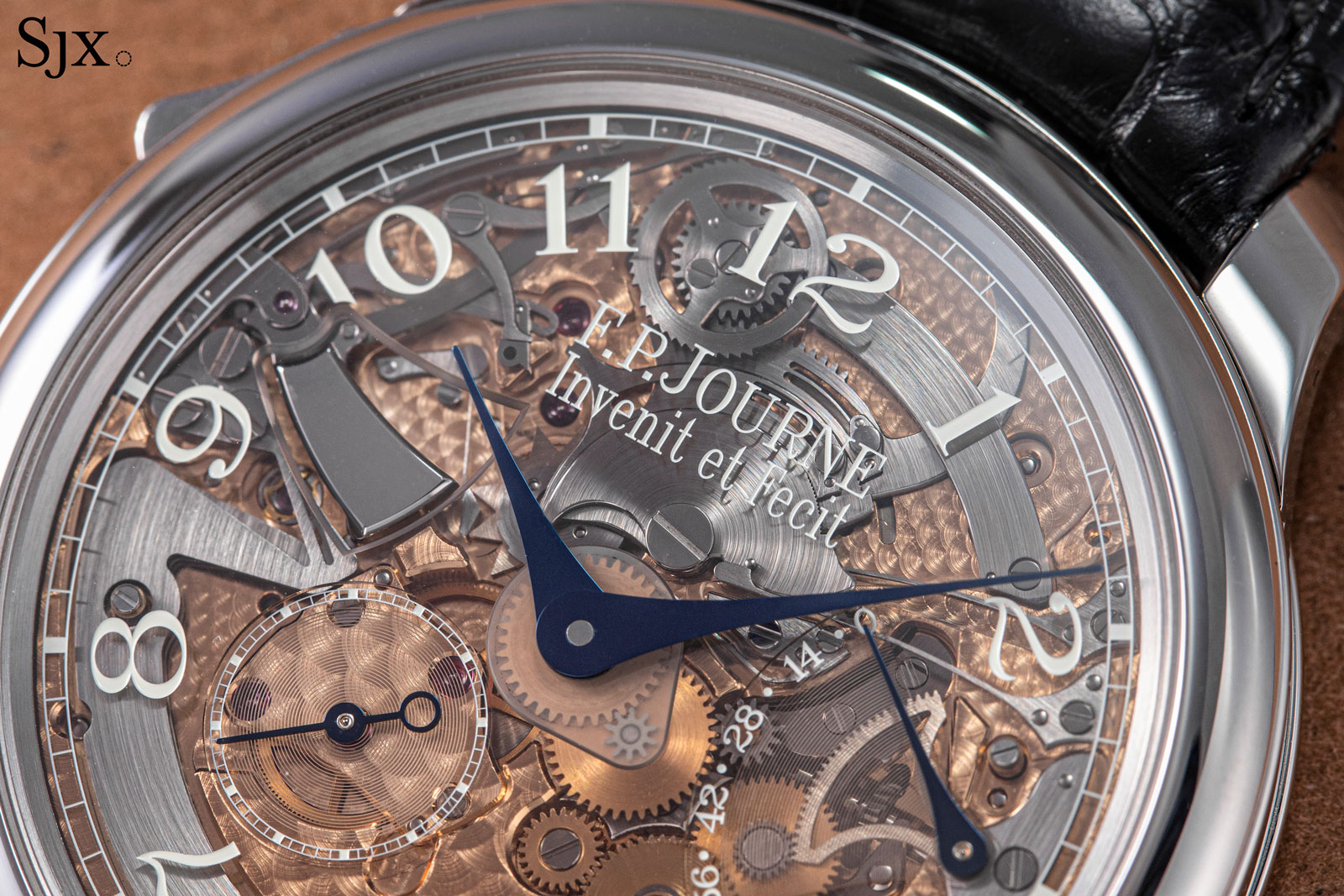
Notice that the springs for each beak are integral to the racks, which is possible thanks to EDM technology, something A.-L. Breguet lacked.
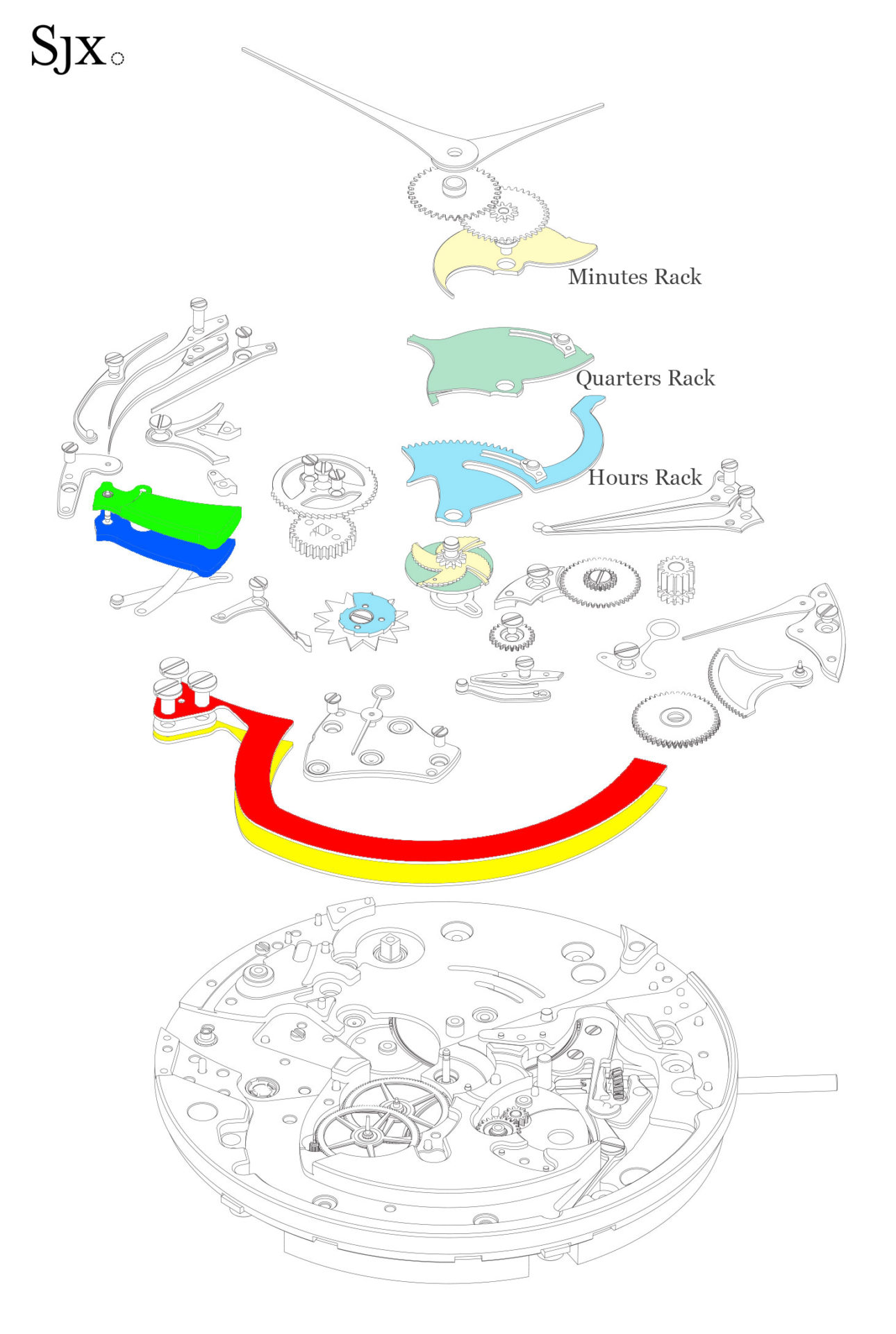
Minute repeater mechanism
Breguet’s minute repeaters chimed the hours and quarters on the same gong, and the minutes get their own. F.P. Journe’s approach is slightly different: the hours, minutes and the second of the two notes for the quarters use the same gong, while the first quarter note is on the second gong.
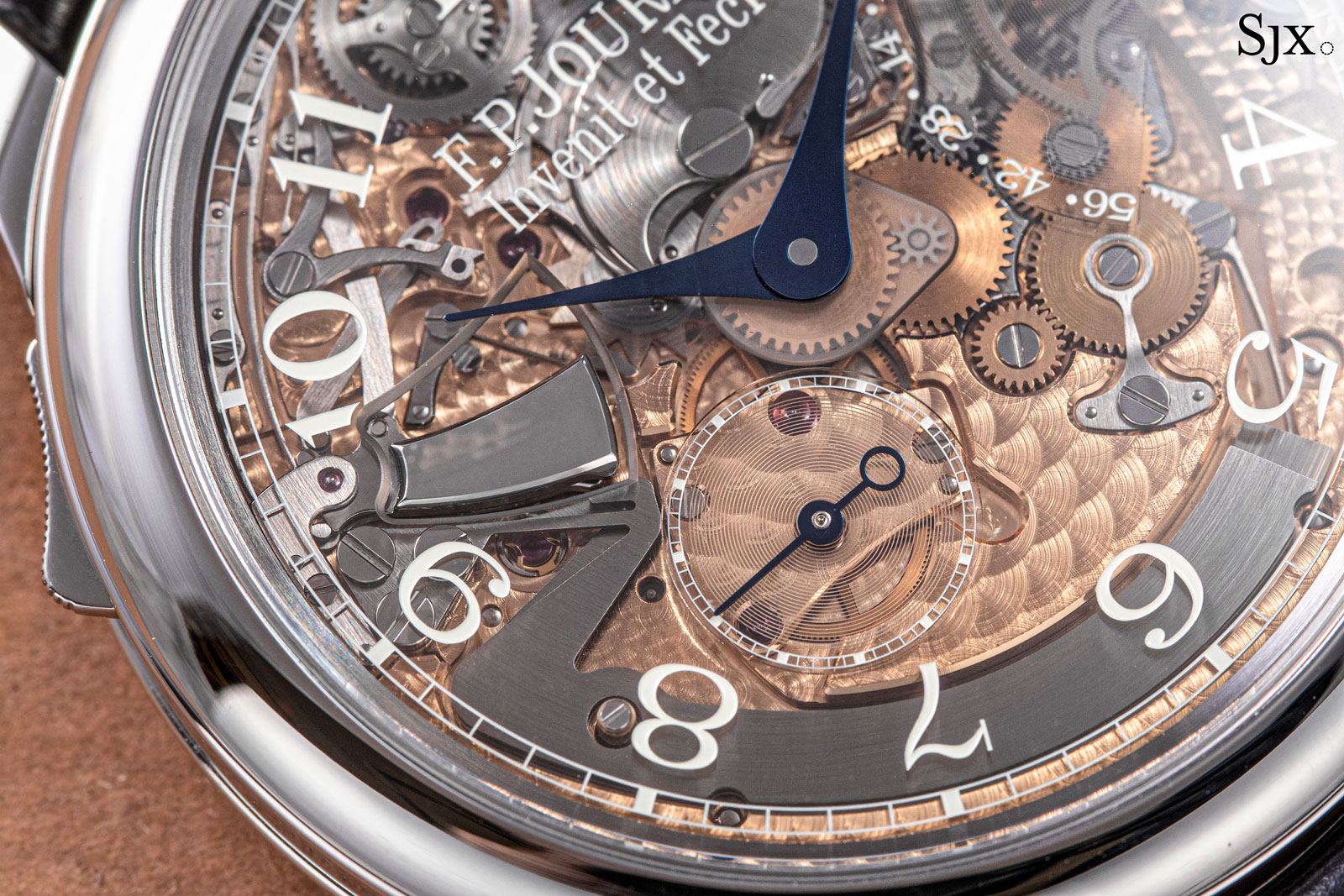
The slide connects to the hours rack, which is geared to the strike train. Pulling the slide brings the hours rack down onto the hour snail, while winding the striking train and releasing the quarters and minutes racks. The hour rack drives the quarters rack using a beak that bites in after all hours strike. The quarters rack drives the minutes rack in turn through another beak that engages after quarter striking completes.
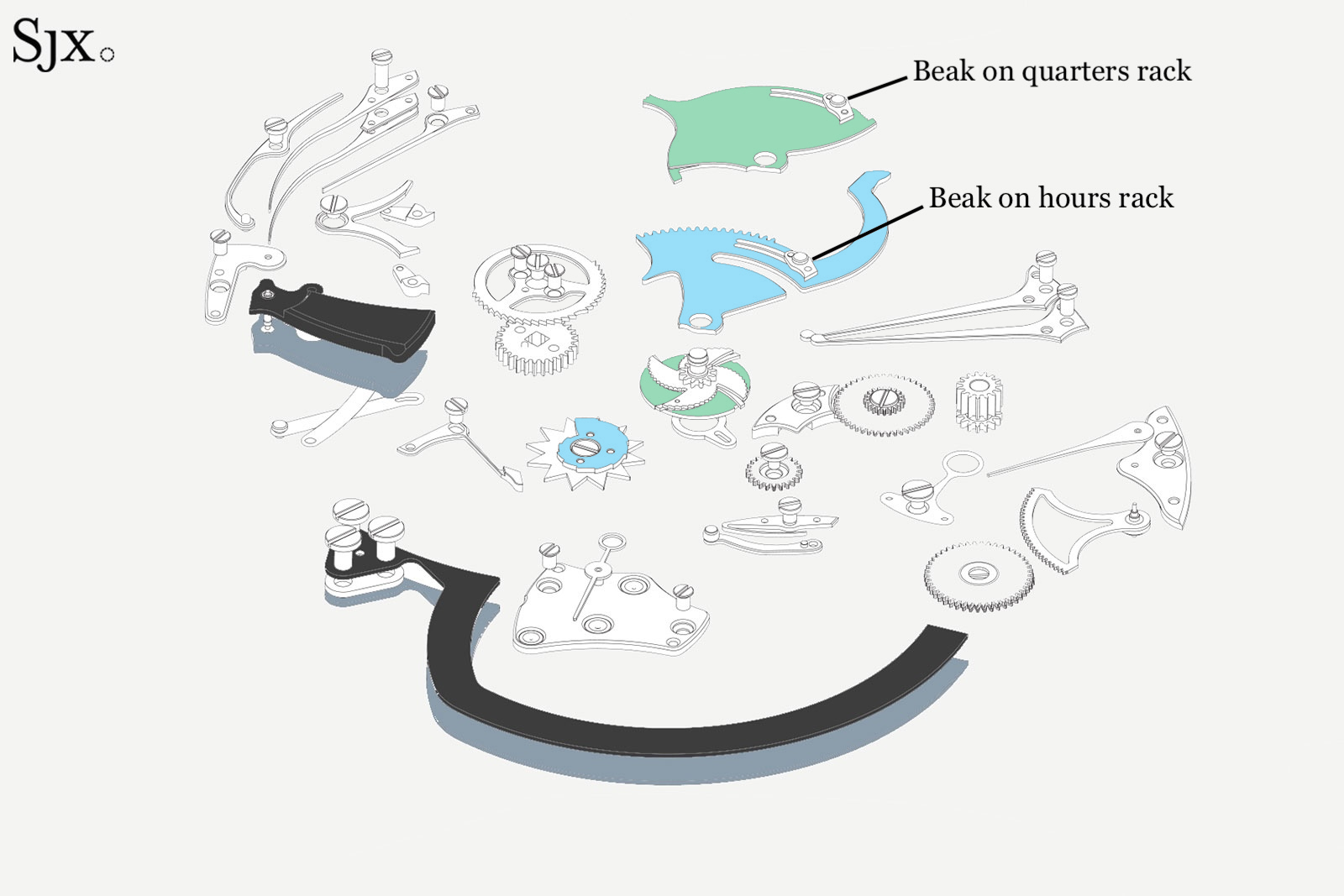
Normally in repeaters, the hours rack indirectly trips the hammer though an intermediate wheel, while the minutes and quarters racks directly trip their hammers. However, the hours rack in the Répétition Souveraine drives an intermediate wheel, which trips the first hammer, while the quarters rack trips the second hammer directly.
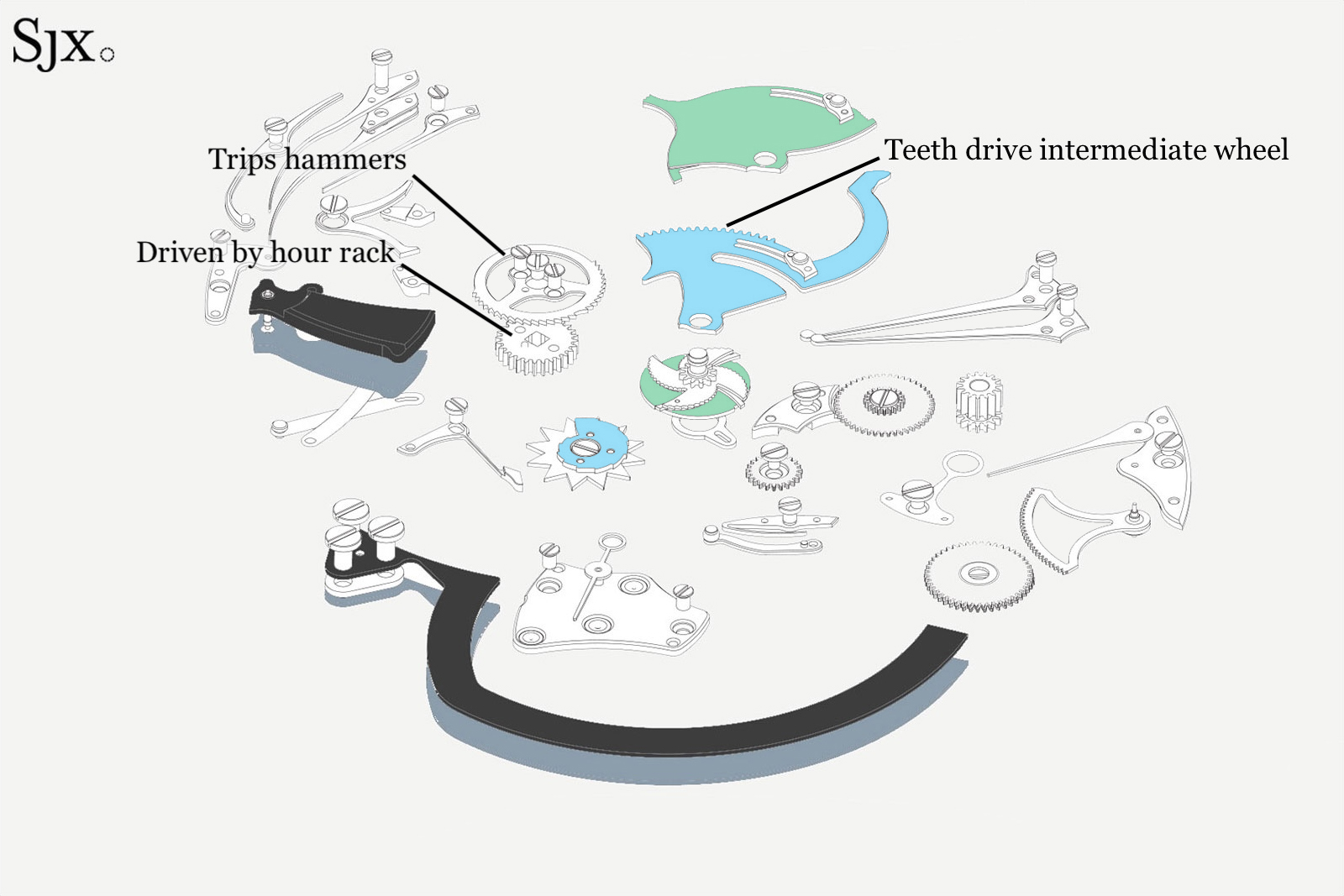
This means that it is actually the hour rack that strikes the hours, second quarter note, and the minutes. In fact, the minutes rack isn’t really a rack as it has no teeth, except the ones grabbed by the quarters rack beak. Instead, the minutes rack limits the travel of the hour rack. Notably, Le Phare, perhaps the largest single producer of repeating watch movements ever, used a similar approach in its economical minute repeaters, using the quarters rack to trip the minutes.
The image below highlights a wheel with two groups of teeth. The first group of 12 teeth is for the 12 hours, while the second ground of 17 is for 3 quarters and 14 minutes. The gap highlighted between the two groups creates a pause; without this gap it would be impossible to tell when the hour strikes end and the minutes begin during the first 14 minutes of every hour, since both strike on the same gong.

Gap in intermediate wheel.
As a consequence of the open dial, it is possible to tell which quarters and minutes the were last struck by examining the position of the racks, while the minutes rack will always end up in the same place, pressed against an eccentric screw. For example, the hour rack will be noticeably closer to the wind indicator after striking 1:14 than after 1:01.
Simple surprise
Since the snails continuously advance with the hands during striking, it is possible for the snails to bind against the beaks of the racks during striking, stopping the watch and possibly trapping the racks. For this reason, the highest steps on the minutes snail (corresponding to zero minutes) are cut short or removed altogether, and instead replaced by a mobile step called the surprise piece, to which the quarter snail is attached.
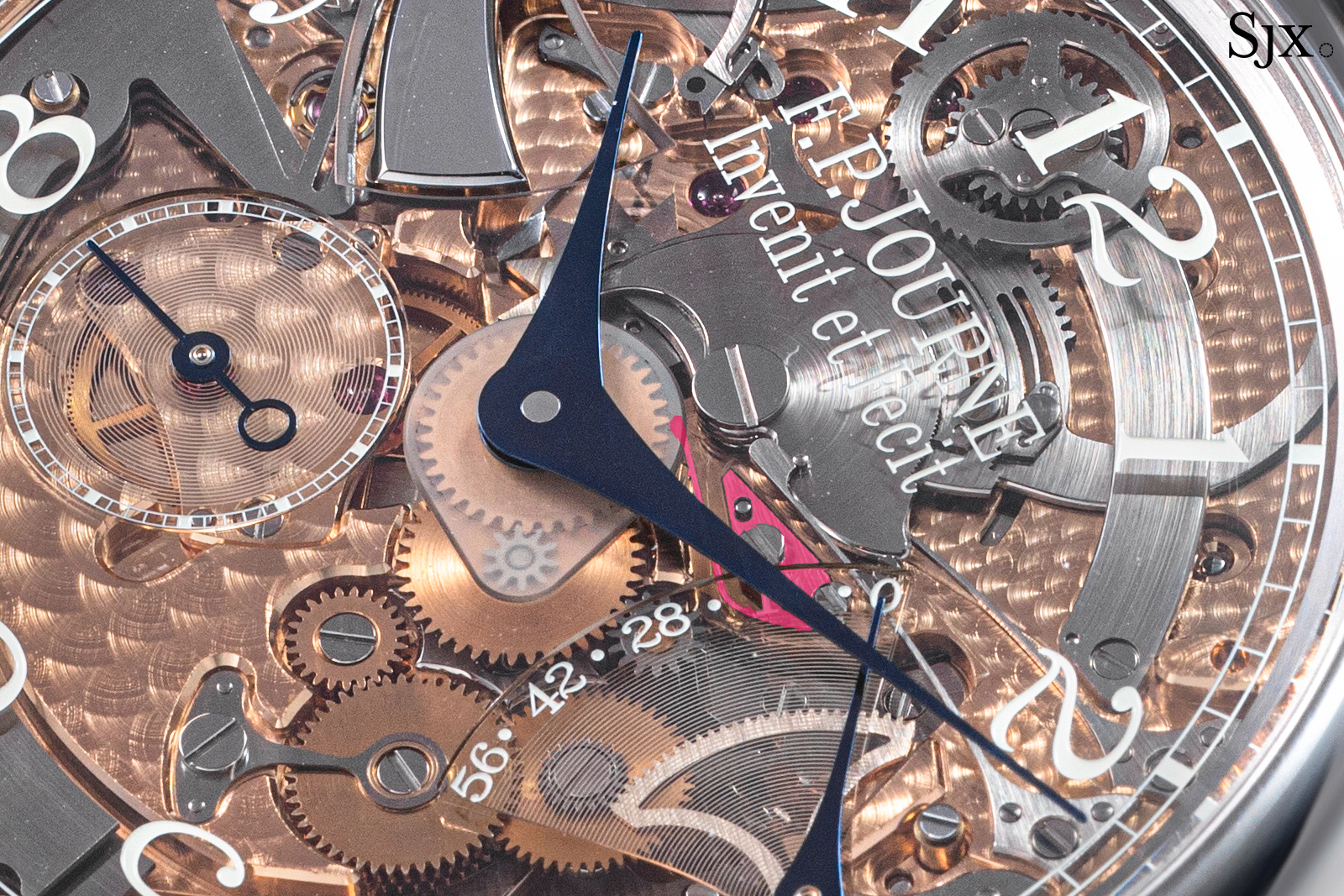
A jumper spring (highlighted in red) snaps the surprise piece forward on each new quarter to ensure accurate striking, but the jumping spring is light enough to yield if the racks block the surprise piece, preventing the system from jamming.
Typically, high-grade minute repeater movements use an isolator system that only engages the jumper when needed. F.P. Journe has instead opted to use a dragging surprise piece jumper, which is simple and compact – a benefit often sought by F.P. Journe, even for the brand’s most complicated creations.
Back to top.