
Hands On: Breguet Expérimentale 1
It's magnetic – but is it magic?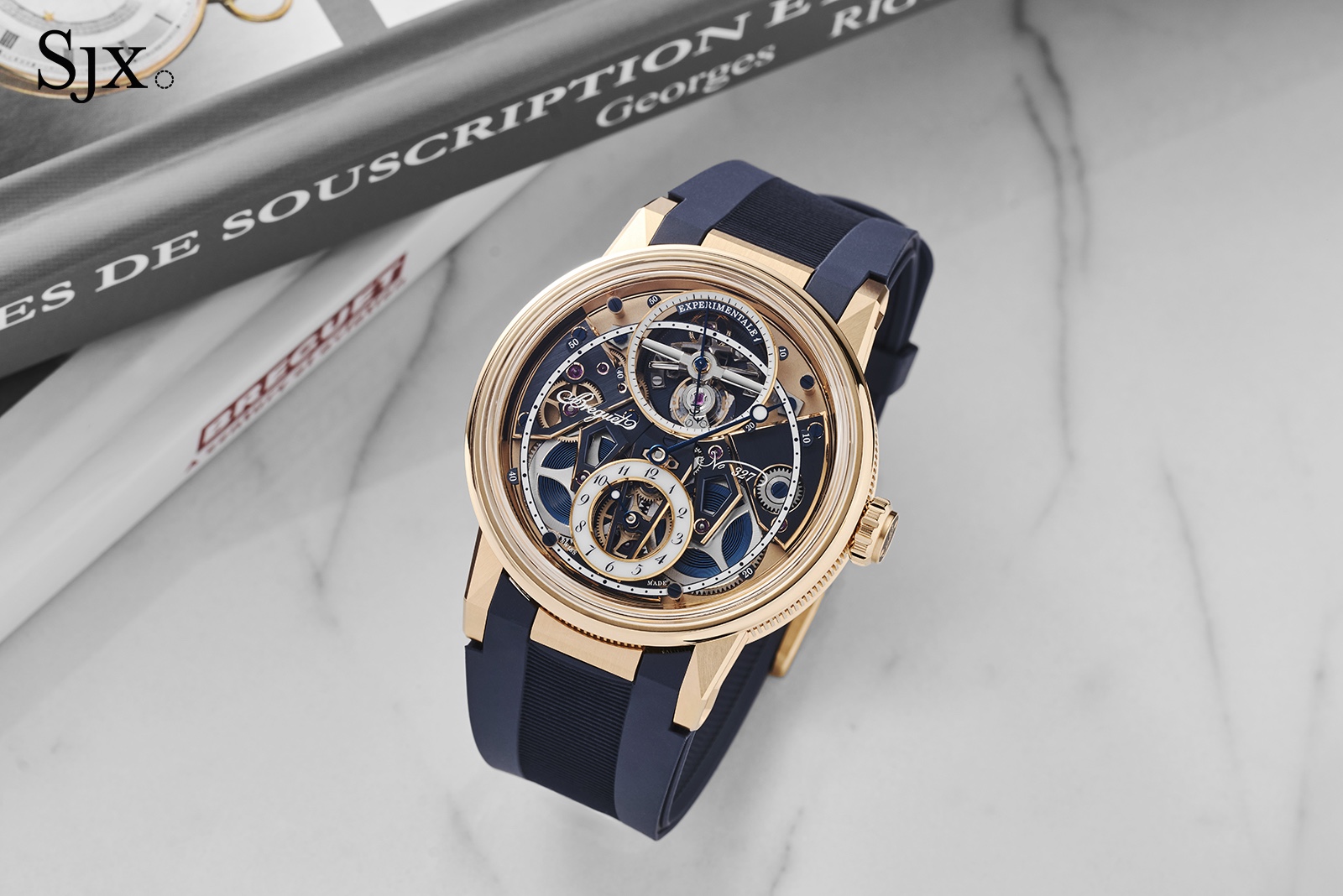
The Expérimentale 1 debuted last year as the capstone to the first quarter-millennium of the house of Breguet. We attended the launch event and shared immediate hands-on impressions, but watches like this don’t come along every day, or even every year, so it’s worth a fresh look now that some time has passed and the dust has settled.
On paper, the Expérimentale 1 arguably represents the highest form of the mechanical watch. To understand the technical details of what makes the watch so groundbreaking, this in-depth analysis should be considered required reading.
In short, the cal. 7250 housed within introduces the first-ever contactless mechanical escapement that simultaneously achieves two feats that Abraham-Louis Breguet himself toiled to accomplish throughout his entire career, namely, an oil-free escapement and stable amplitude. The Expérimentale 1 delivers both, and more.
That said, as a wristwatch the Expérimentale 1 is tantalisingly imperfect owing to its polarising design. In fairness, this arguably says more about the difficultly of communicating technical breakthroughs to a non-technical public than it does about the design process at Breguet. It could also be the result of Breguet learning lessons from its own past.
A modern (Marine) chronometer
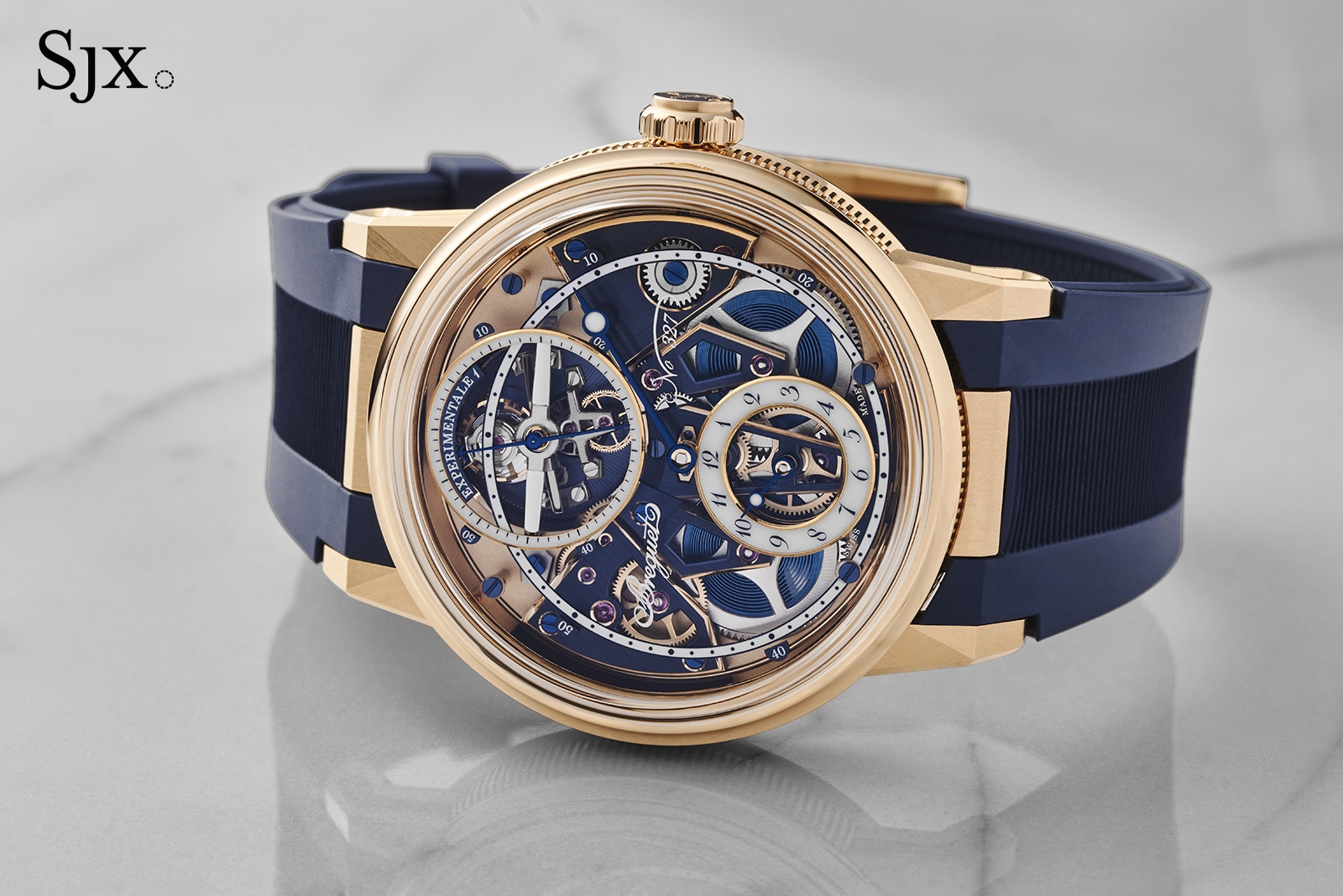
The Expérimentale 1 is most notable for its novel escapement and what it signals about the future direction of the brand, but it’s also worth analysing the updated Marine-style case, which is the most challenging aspect of its design.
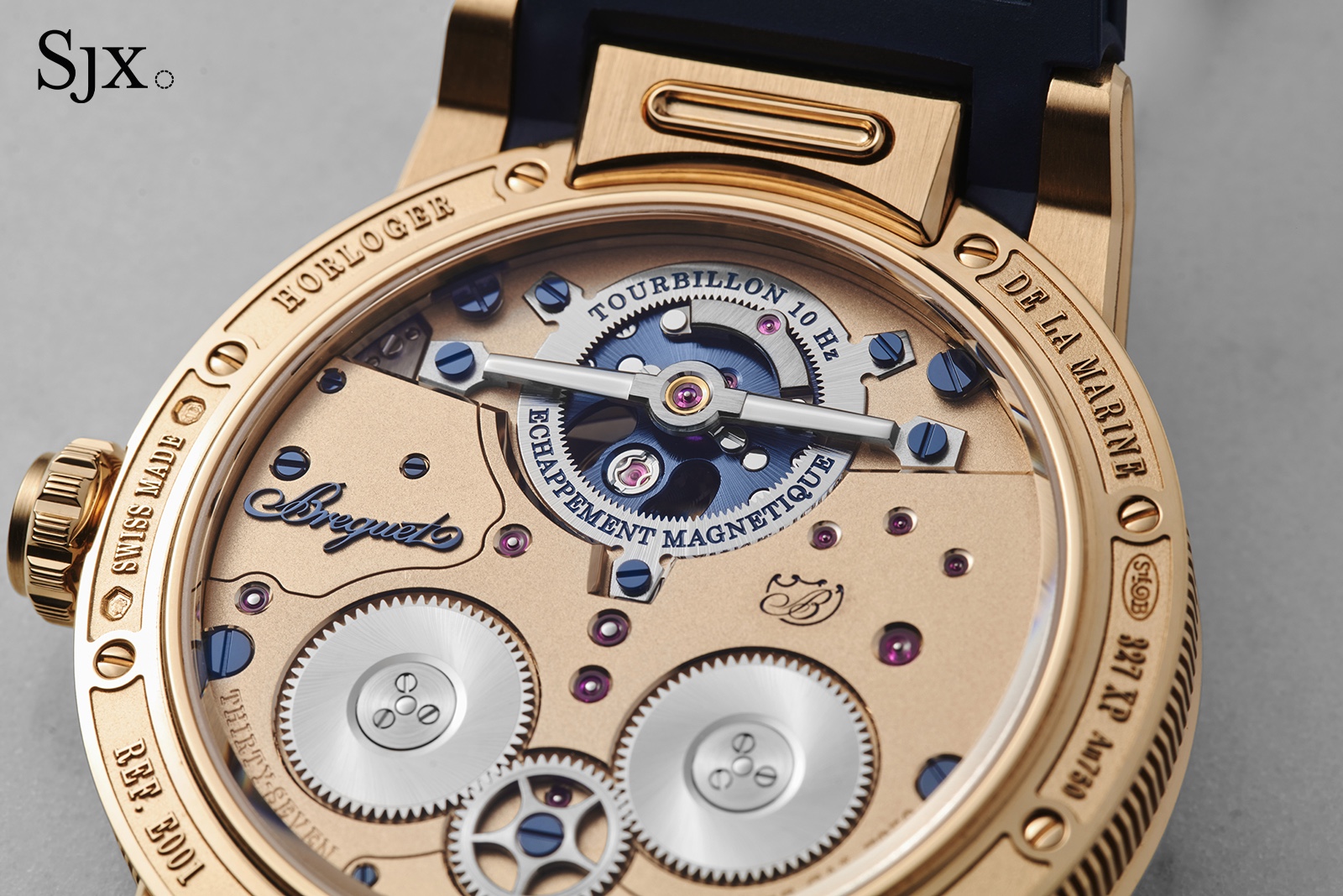
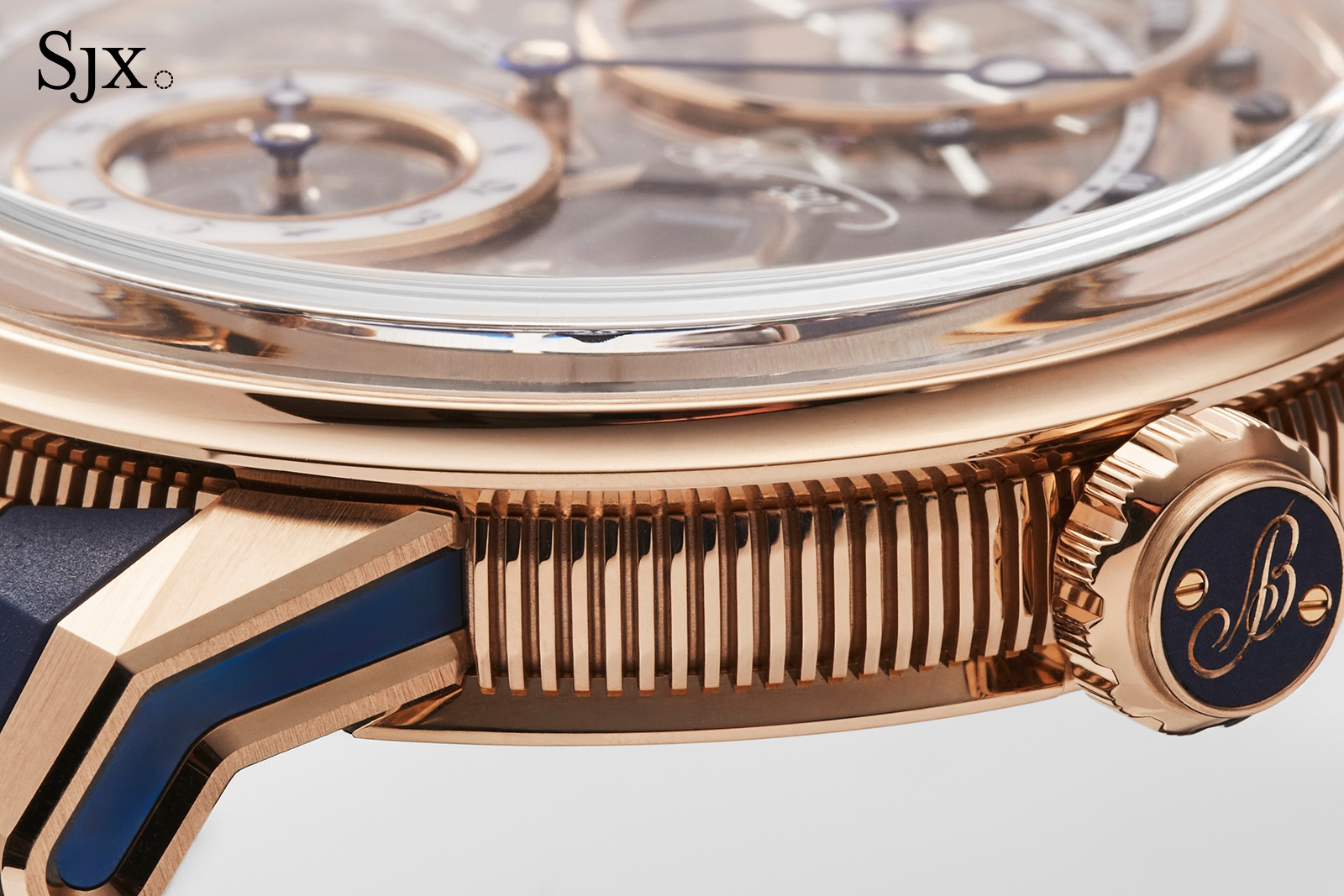
Starting with what works, the Marine format makes plenty of sense as the debut vehicle for such an ambitious timekeeper, owing to A-L Breguet’s investiture as Horloger de la Marine to King Louis XVIII of France, an esteemed title he was granted in 1815 after the death of Louis Berthoud. This title is engraved on the rear bezel of the case to emphasise the connection.
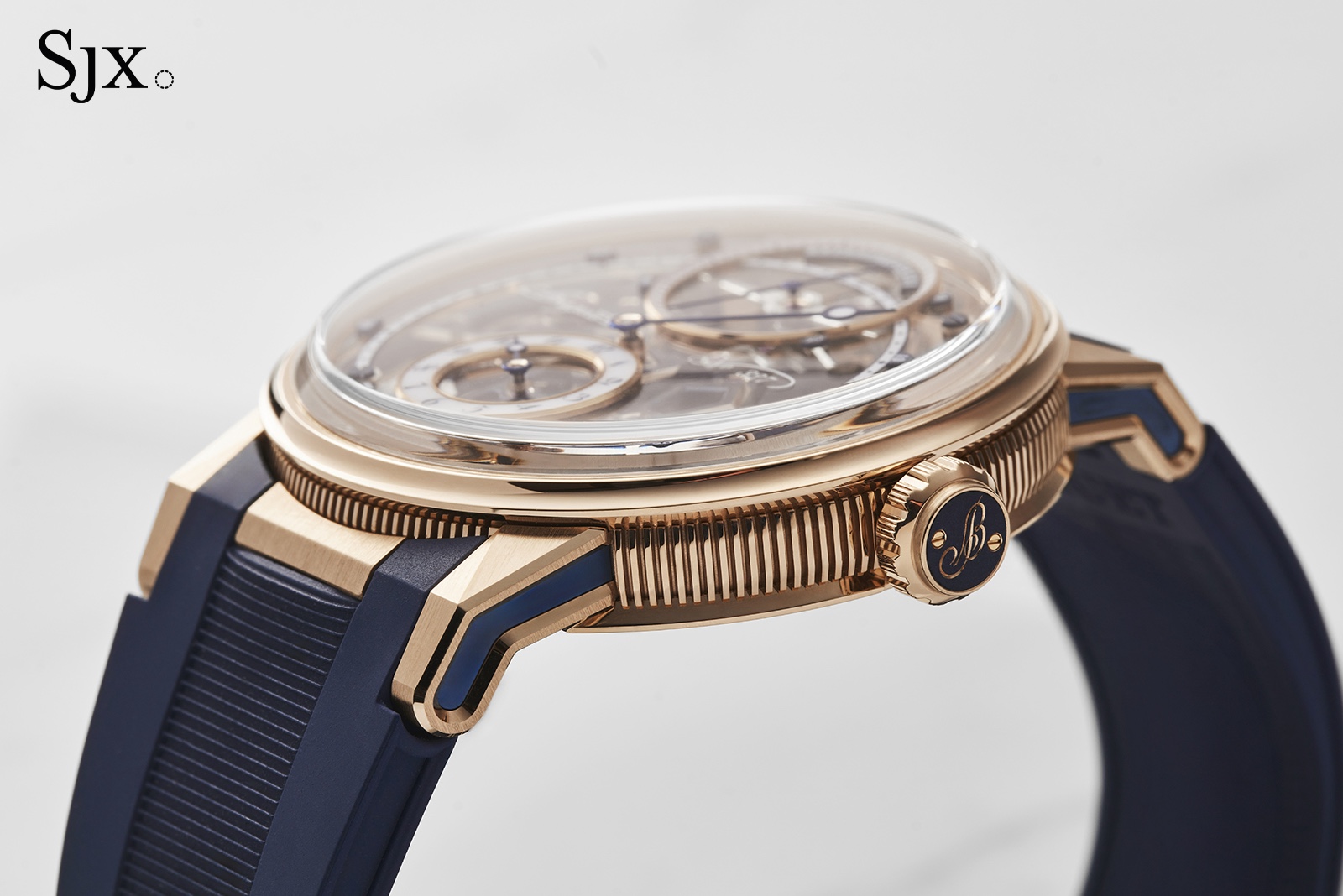
But the design is not identical to that of watches in the Marine collection, though it features many of the same traits including the coin-edge case band and anchor motif, seen here on the balance end of the seconds hand. Similarities aside, the design of the faceted lugs is different, with blue-coated gold inlays that match the strap. This details feels extraneous, but is suggestive of an open-worked design.
The lugs differ from previous Marine models functionally as well, with a proprietary push-button strap release. Since it would be pointless to develop a proprietary strap system for a single limited edition reference, we might see this new lug design diffuse throughout the Marine collection in the future. It would not surprise me to see new bracelet variant emerge that’s compatible with this attachment system, and a leather strap would complete the picture, a la Vacheron Constantin Overseas.
Interestingly, the coin-edge case band, long a Breguet hallmark, was absent on several other anniversary releases. It’s use here might signal how Breguet intends to keep this design element alive were it to fully disappear from the rest of the lineup.
The watch is substantial on the wrist thanks to its 43.5 mm case in 18k gold of Breguet’s own formulation, but at just 13.3 mm thick it’s easily wearable by the standards of technological showpieces. Similar exercises in oil-free, high-frequency chronometry from the likes of Audemars Piguet and Richard Mille, for example, are much larger. The Jules Audemars Chronometer AP Escapement is 46 mm, and the related RM 031 measures 50 mm.
The visual language of innovation
That Breguet opted for such an extreme design is telling about the nature of luxury watch marketing. Breguet is not alone in harbouring the belief that technical innovation must translate visually. As a result, the most ambitious innovations often debut in extreme packages. The perfect example is probably the Ulysse Nardin Freak, which introduced silicon to watchmaking in a shocking, aggressive design. The Jaeger-LeCoultre Master Compressor Extreme Lab One and Chopard LUC 8HF, which introduced the brand’s 8 Hz oscillator, are other illustrative examples of this principle.
This view is understandable and probably correct. These kinds of innovative products often command a substantial premium over mainline products, compelling brands to do something to visually differentiate them in the display case to justify the up-charge. That said, one might hope that Breguet, a brand rooted in the very idea of innovation, might eventually evolve its product mix to the point that such gimmicks become unnecessary.
Ironically, Breguet’s own Classique Chronometrie 7727, which introduced magnetic pivots and a 10 Hz oscillator, almost avoided this trap, but for a discordant ’10 Hz’ label that stayed with it throughout its production run. In fairness to Breguet, it’s worth noting this reference was chronically under-appreciated, so perhaps there’s substance to the idea that an innovative watch needs to look the part to be taken seriously.
Fortunately, some of what the Expérimentale 1 lacks in elegance it earns back in practical wearability with a properly seaworthy 100 m water resistance rating and versatile rubber strap. In other words, it’s a rare piece of experimental fine watchmaking that could actually be someone’s daily wear, though I expect few will do so given the collectible nature of such a groundbreaking, low-volume product.
Party in the front
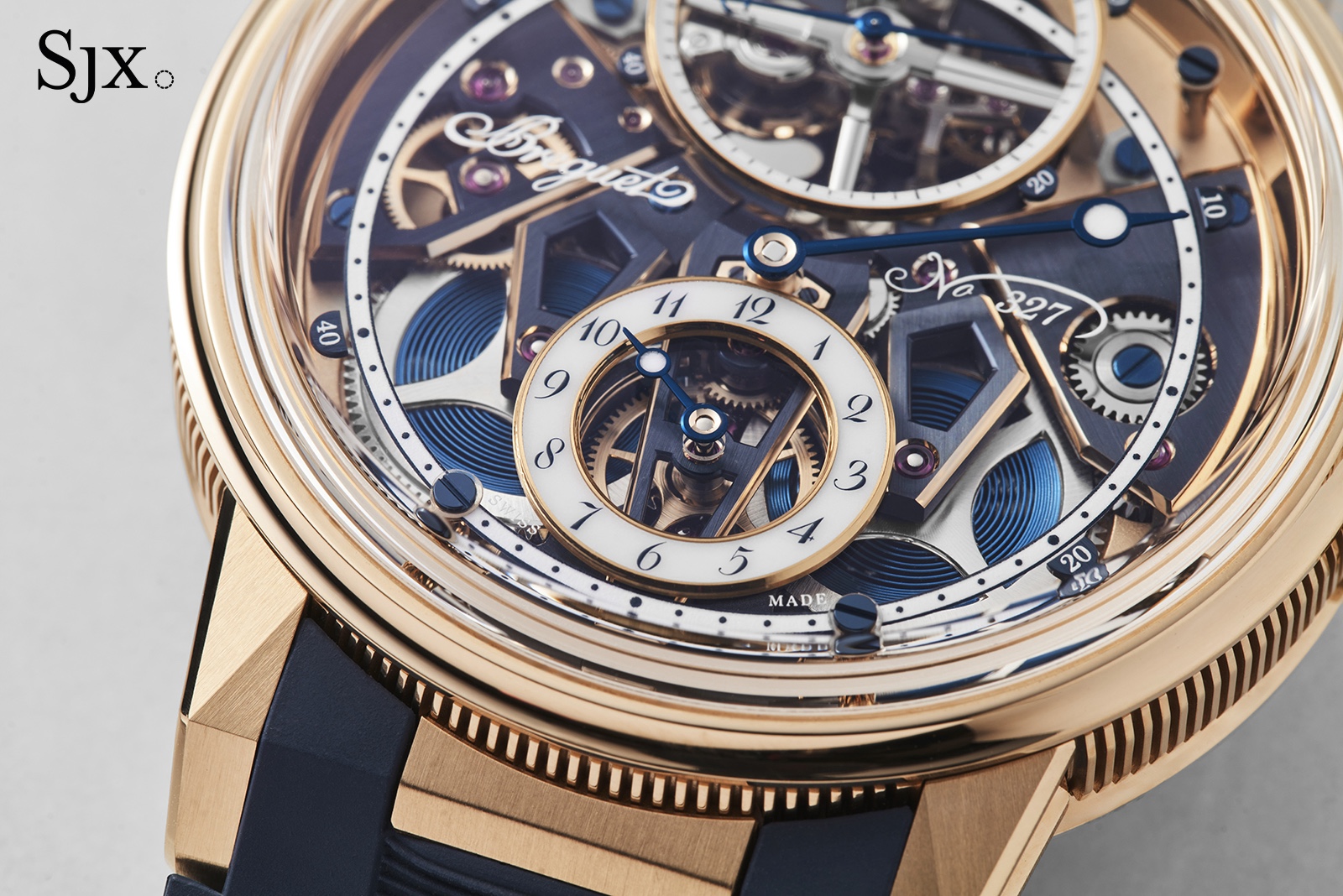
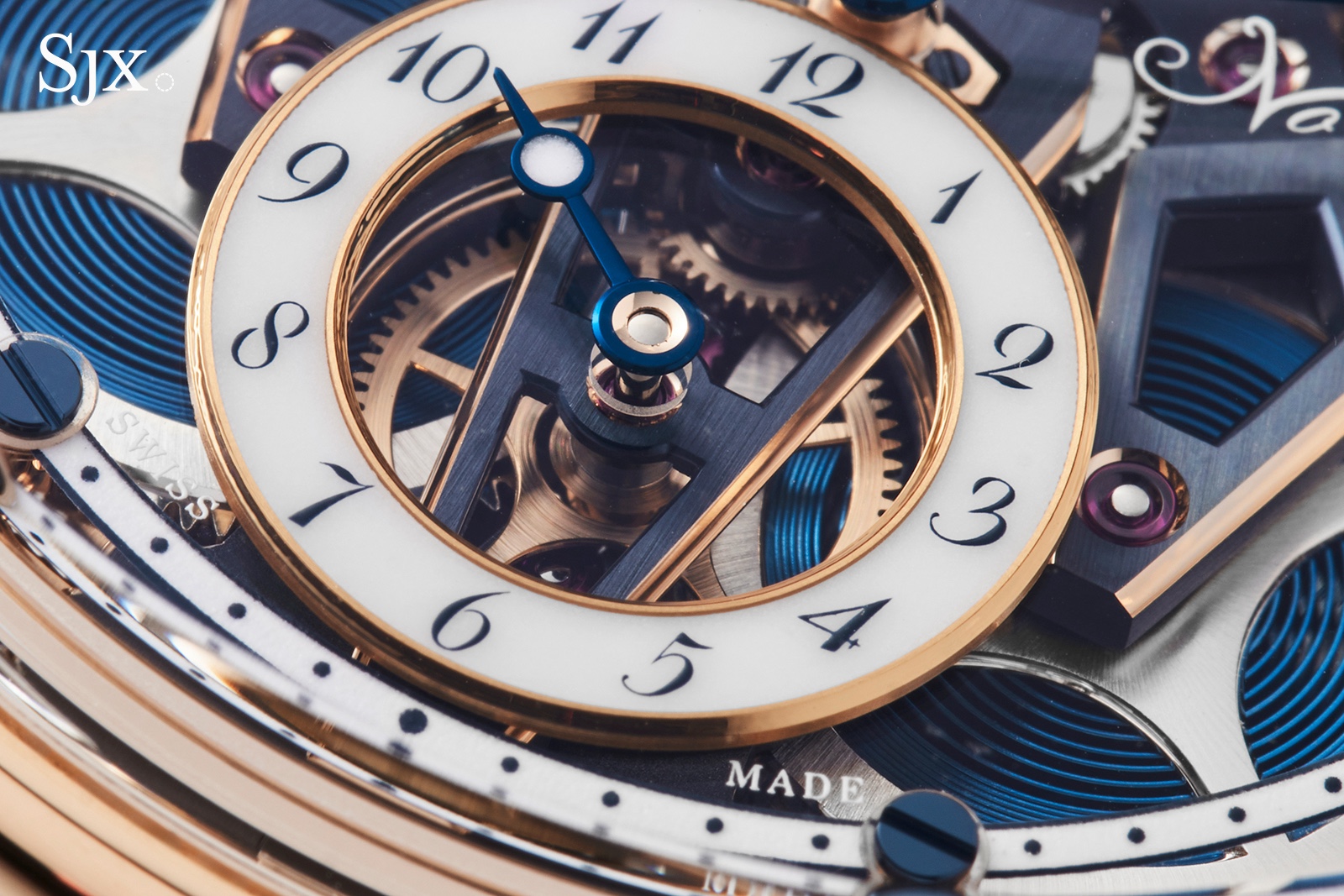
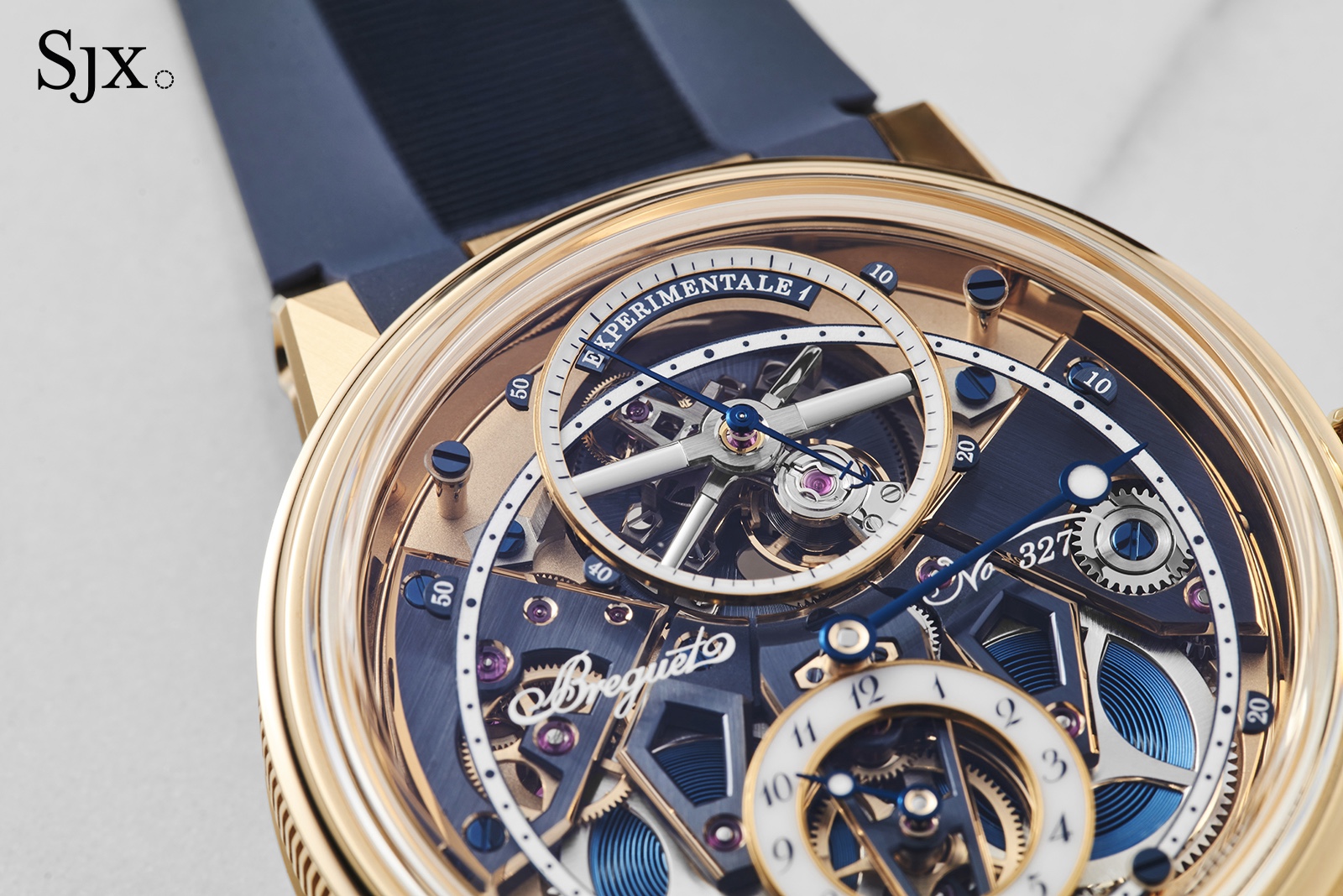
The need for visual differentiation carries over to the regulator-style dial, inspired by a pocket watch (no. 3448) that was sold to French astronomer Alexis Bouvard in 1820, shortly after A-L Breguet’s appointment as Horloger de la Marine. The layout retains the most charming elements of the original, including its offset layout and tab-style markers for the minutes and seconds.
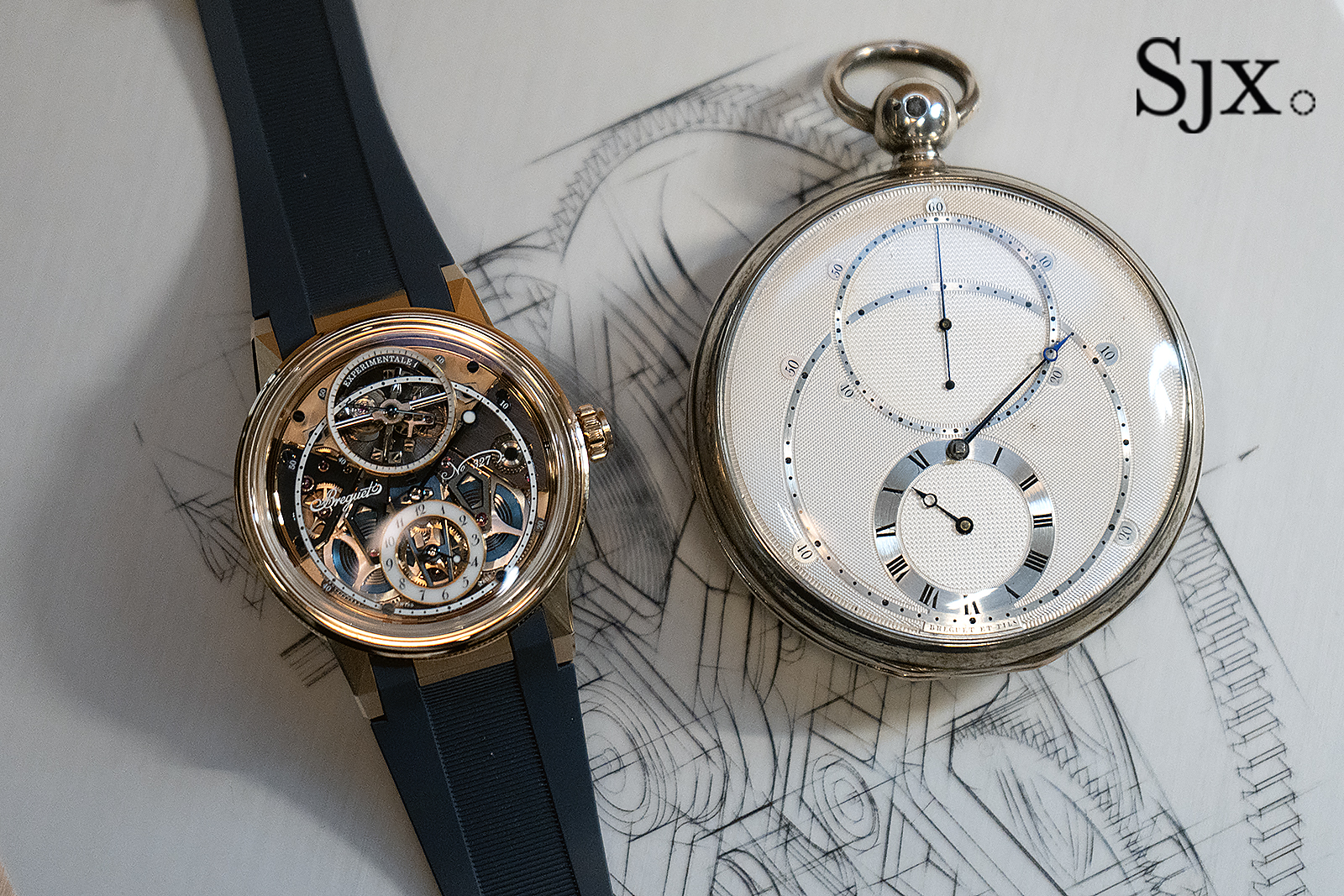
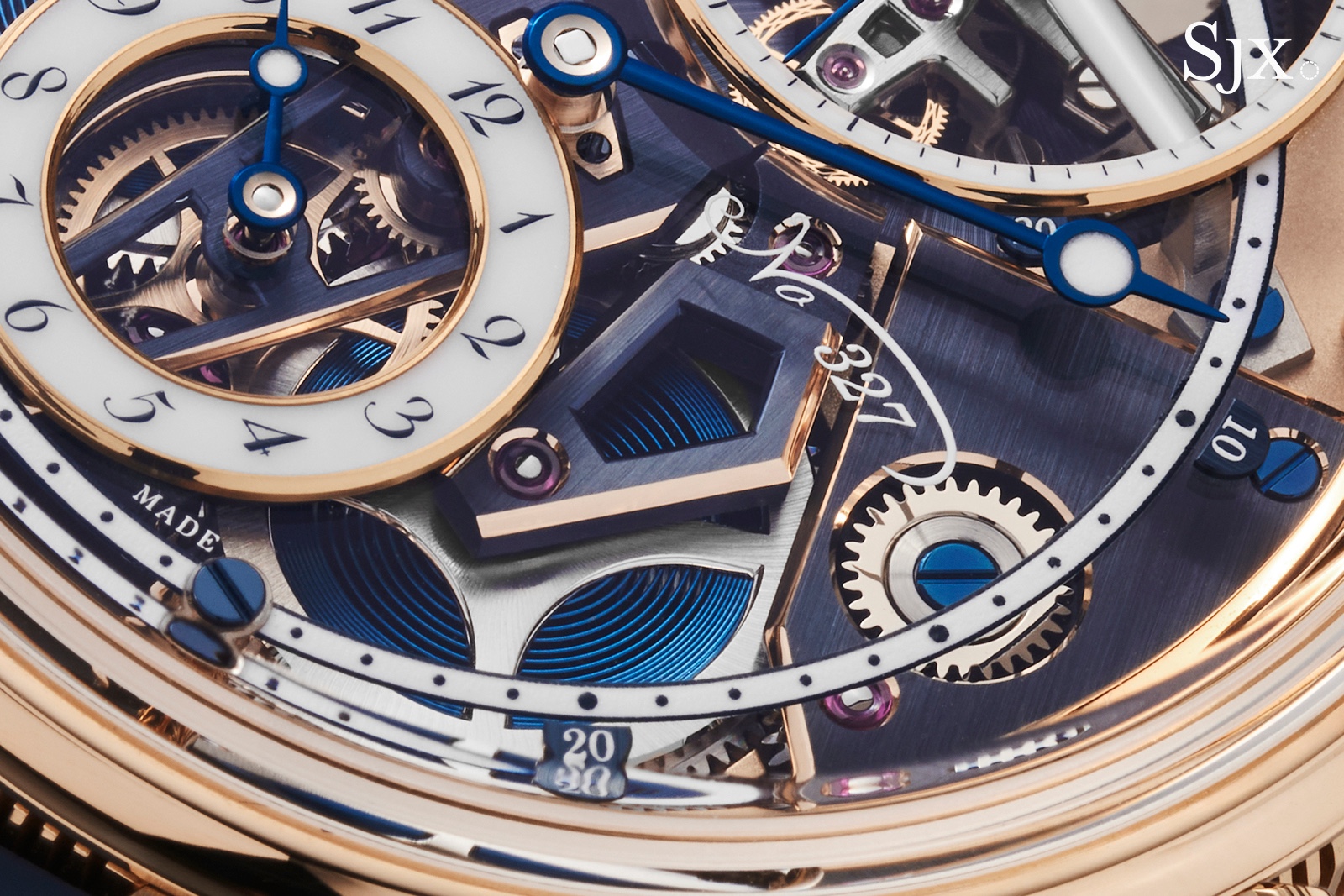
But the high-tech Expérimentale 1 ditches traditional guilloche in favour of sapphire crystal, revealing a frosted mainplate and industrially open-worked bridges for the twin mainspring barrels and the blued springs within. The architecture of the cal. 7250 is clearly designed to be admired from the front, which reveals an engaging mix of traditional haute horlogerie finishes and more austere industrial treatments.
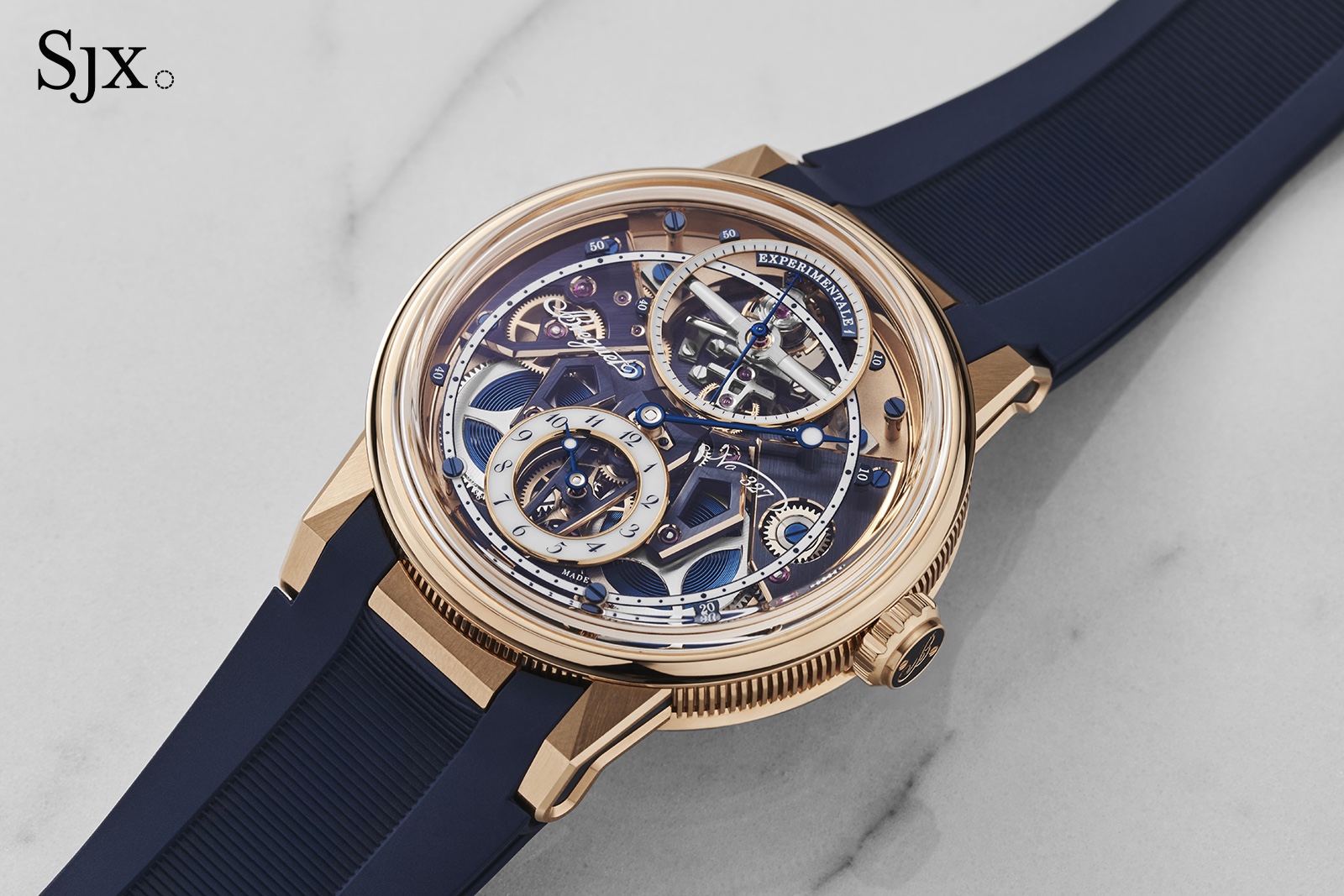
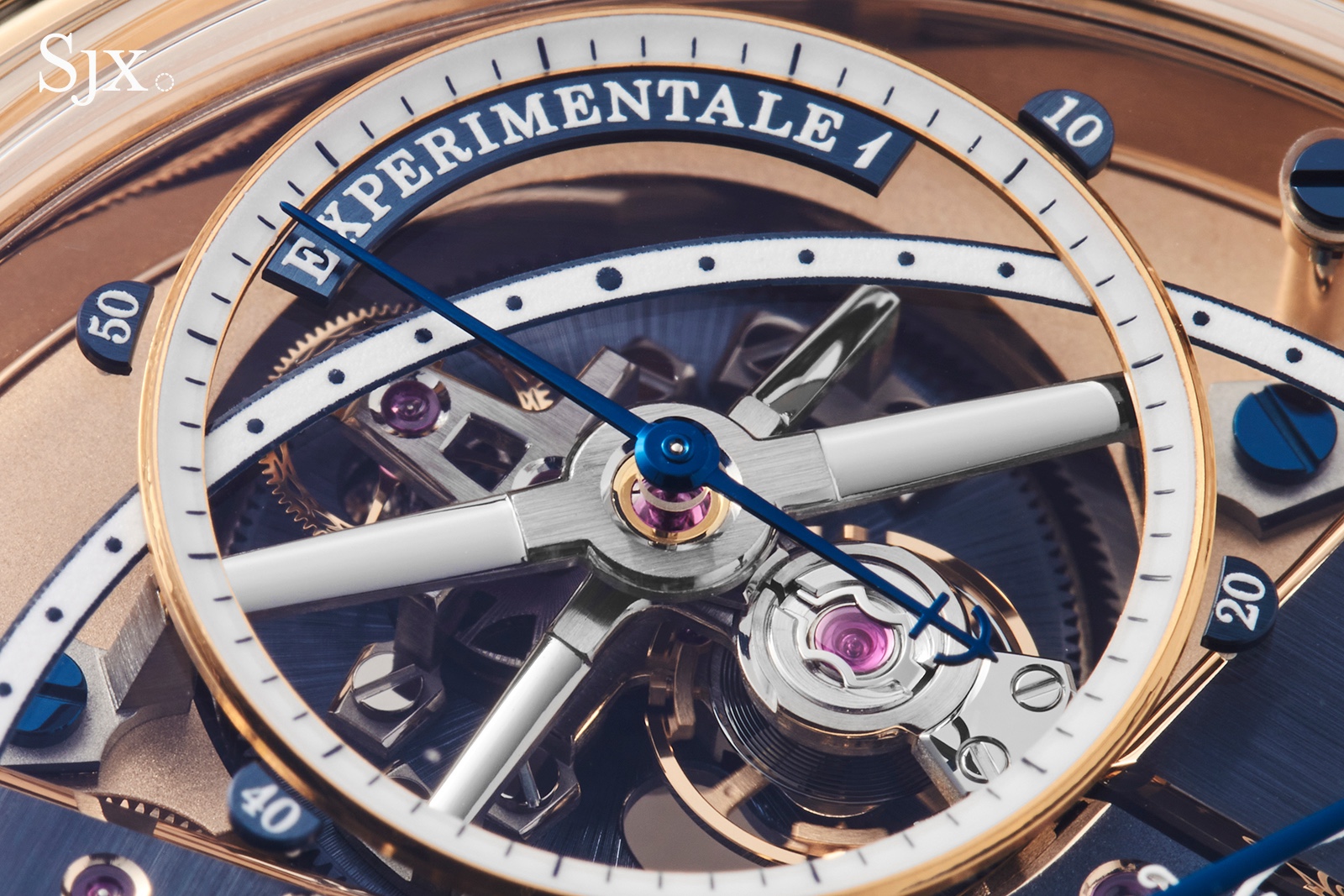
The former includes broad bevels with crisp transitions, and rounded mirror-polished arms for both the tourbillon cage itself and its support bridge; a similar bridge secures the tourbillon carriage on the reverse side. As evidence of the finishing quality, the anchor-shaped balance on the seconds hand can be seen reflected in the mirror-polished Geneva-style stud carrier used to mount the silicon hairspring.
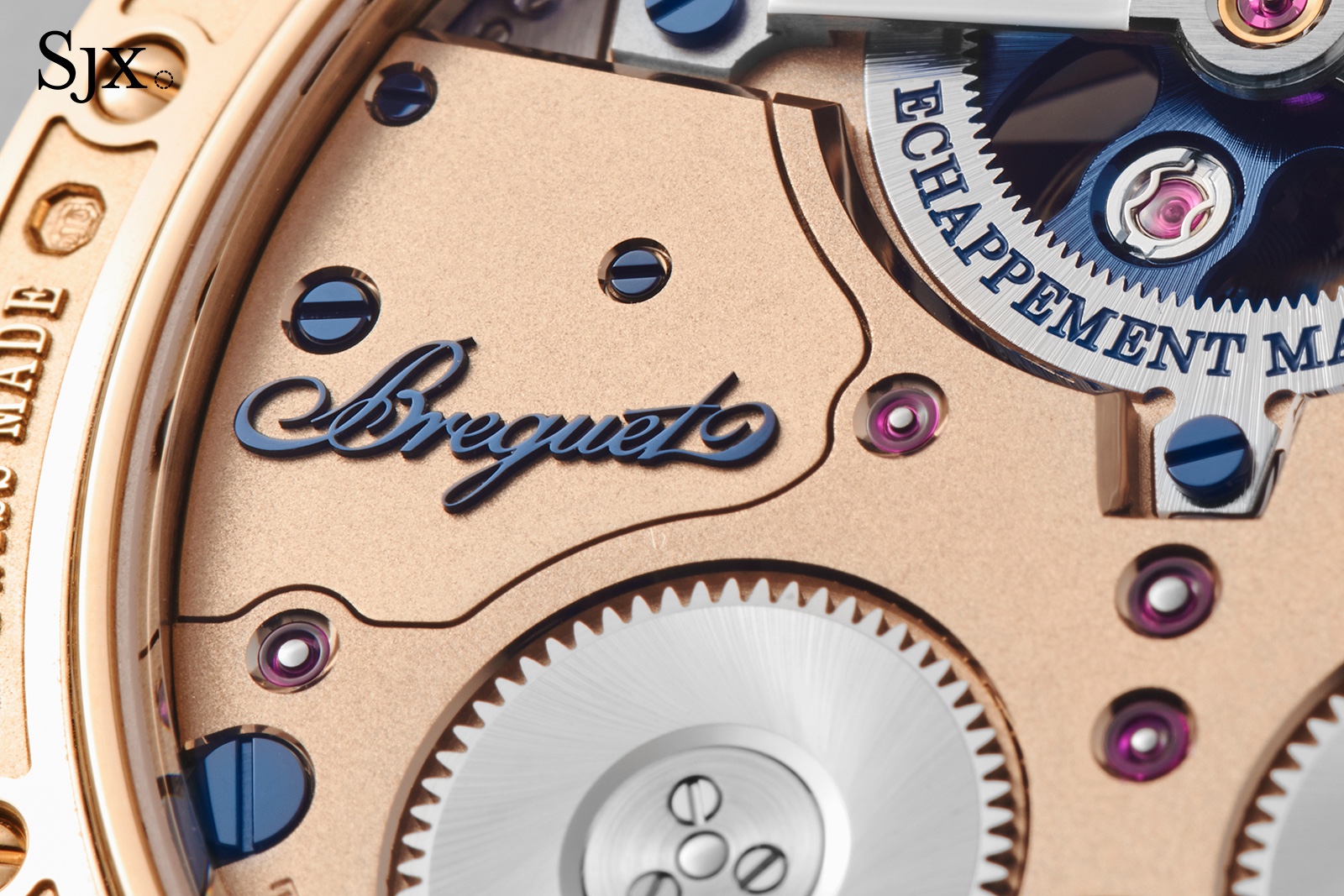
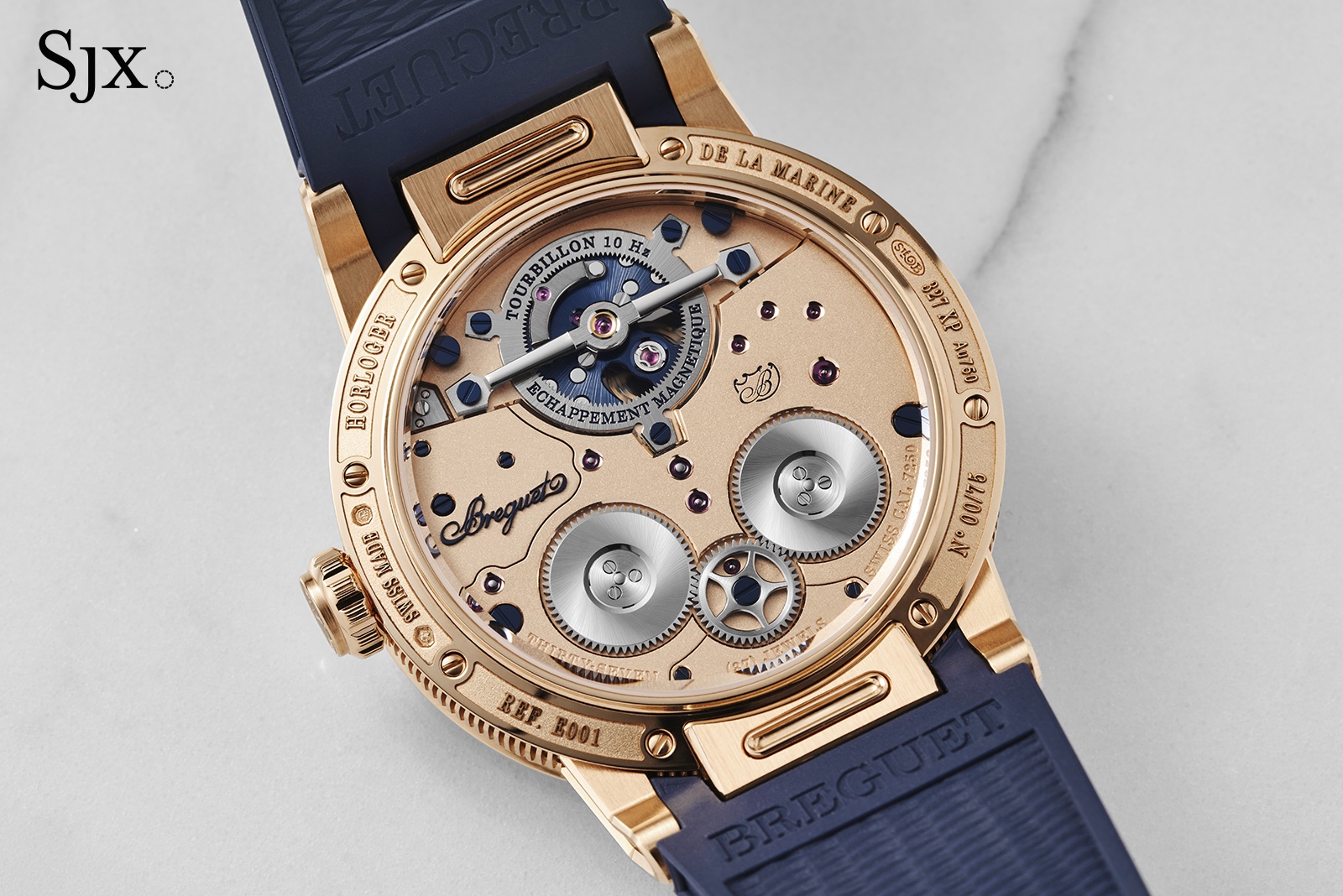
Meanwhile, the straight grained surface treatment of the major bridges, which are coated blue to contrast with the sandblasted gold-coated mainplate, feel more contemporary. Around back, the view is comparatively minimal, with more gold-coloured frosting and a somewhat odd applied logo.
Of course, the star of the show is the smoothly gliding tourbillon cage at 12 o’clock. Thanks to the 10 Hz frequency of the balance, the rotation of the cage, and its attached seconds hand, is nearly as stutter-free as the seconds hand of a Spring Drive calibre, an effect never-before-seen in a tourbillon format.
In fact, the discreet steps of the intermediate wheel that powers the escape wheel are almost imperceptible, giving it a look similar to a Spring Drive calibre’s glide wheel.
The tourbillon platform is massive and features an offset balance axis similar to sister brand Blancpain’s signature tourbillon design. But the similarity is purely coincidental, since the construction of the tourbillon in the cal. 7250 is entirely different owing to the intermediate wheel and central position of the magnetic escape wheel.
Masters of magnetism
The magnetic escapement should not be confused with the magnetic pivots developed for the Classique 7727 that were dusted off for duty in the Classique 7225 that debuted last year. That platform features a traditional lever escapement with an escape wheel in lightweight silicon, and half-floating balance pivots secured by permanent magnets.
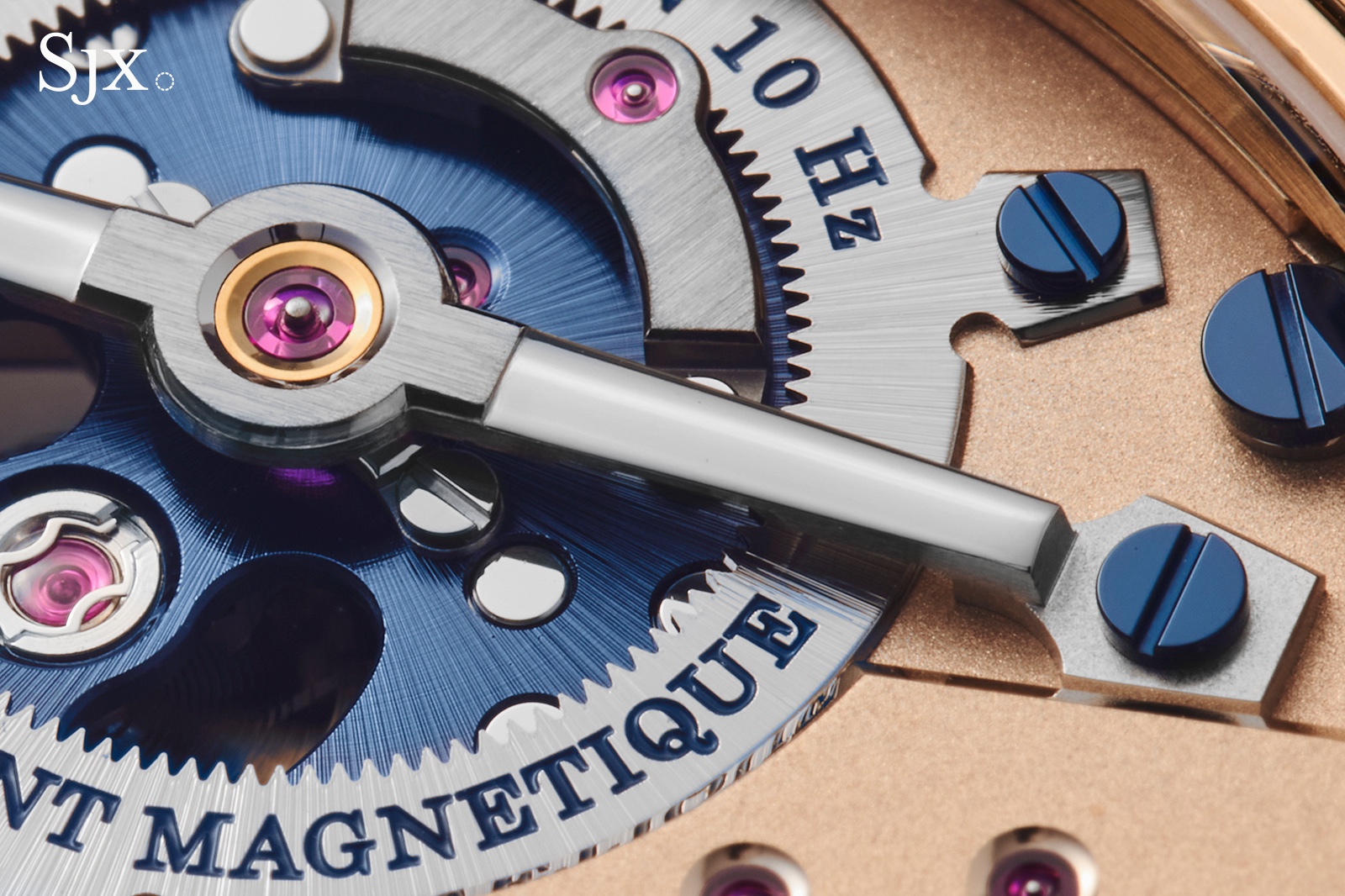
In contrast, the innovation in the cal. 7250 is the other way around, with a traditional Incabloc setting for the balance staff, and a groundbreaking magnetic lever-style escapement. Though a tertiary feat, this represents the highest-frequency oscillator ever suspended in a traditional jewelled setting.
The magnetic pivots of the 7727 and 7225 represent a significant achievement, but their absence here can be forgiven because the magnetic escapement itself is so interesting. Of course, it would be fascinating to see these innovations combined in a future model, but such a design would probably be too heavy for use in a tourbillon. And for a milestone anniversary for the brand that invented the tourbillon, the need for a tourbillon was a foregone conclusion.
Regardless, it’s impressive that Breguet has managed to commercialise two completely different 10 Hz architectures with two different novel uses of permanent magnets while no other brand has managed to do anything similar.
Oil-free where it matters
The Expérimentale 1 is not billed as completely oil-free watch — there are many jewelled bearings in the movement that are clearly lubricated, including the balance staff. But the contactless magnetic escapement so fully (and inventively) addresses one of the most persistent challenges in watchmaking that it represents a breakthrough in this context.
On the challenges of lubrication, A-L Breguet is said to have quipped, “Give me the perfect oil, and I will give you the perfect watch.” And while the performance and longevity of the kinds of lubricants used in watchmaking have improved substantially since the 19th century, they are not perfect.
It was already obvious in A-L Breguet’s time that the perfect oil is no oil at all, and a so-called ‘dry’ escapement — one that works without lubrication — will perform best over the long term. Until the launch of the Expérimentale 1, there were two paths to this outcome.
The first involves tweaking the escapement geometry to avoid sliding friction. A-L Breguet himself took this path — frankly the only one available to him at the time — and the result was the natural escapement. But designing new escapements is tricky, especially given the technological limitations of the time, and Breguet was never satisfied with the performance of his design, resorting instead to finely made (lubricated) lever escapements later in his career.
The other option, which emerged more recently, is the use of alternative materials with lower coefficients of friction than steel and stone. Silicon is the most common alternative material, used by brands like Rolex, Patek Philippe, Orient Star, and most famously Ulysse Nardin. In general, however, some degree of lubrication is used to enhance the acceleration of the balance wheel.
That said, a few brands have pushed these (and similar) materials to their limits in truly ‘dry’ setups. The Jaeger-LeCoultre Master Compressor Extreme Lab One, the Panerai LAB-ID, and the Cartier ID One, are examples, though the latter was a concept watch that was never commercialised.
The Expérimentale 1 heralds a never-before-seen third option, which avoids the need for lubrication at the escapement by avoiding physical contact altogether. Instead, the escape wheel imparts its energy to the lever solely by magnetic repulsion. Amazingly, this aspect of the cal. 7250 is almost incidental to another even more impressive benefit: true constant force.
Use the (constant) force
One issue that has troubled watchmakers since the beginning of timekeeping is the fact that the energy from the mainspring decreases as it unwinds. This issue was especially acute in early watches that featured non-detached escapement designs like the verge. As a result, sophisticated constant force mechanisms like the stackfreed and chain and fusée, designed to equalise the mainspring’s force throughout the power reserve, were developed quite early in the history of watchmaking.
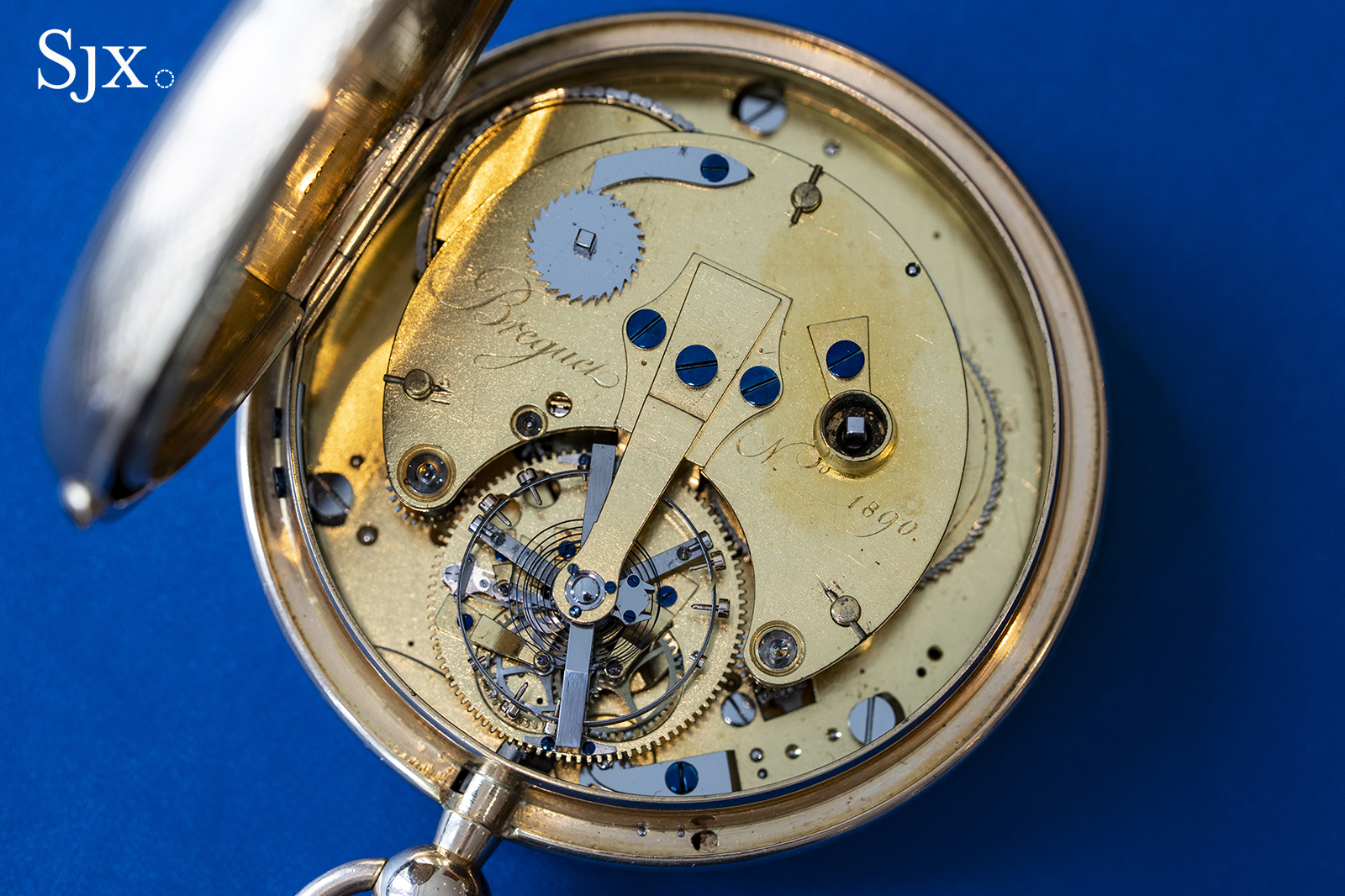
Breguet no. 1890 features both a chain and fusee and a detached escapement.
Eventually, however, technology improved to the point that sophisticated constant force mechanisms like the chain and fusée and remontoire proved to be more trouble than they were worth given the additional complexity of manufacturing, assembly, and adjustment.
But all else being equal, stable power is still better for performance than variable power, even for detached escapements. As a result, watchmakers have come up with various ways to ensure that each impulse carries with it an equal amount of force.
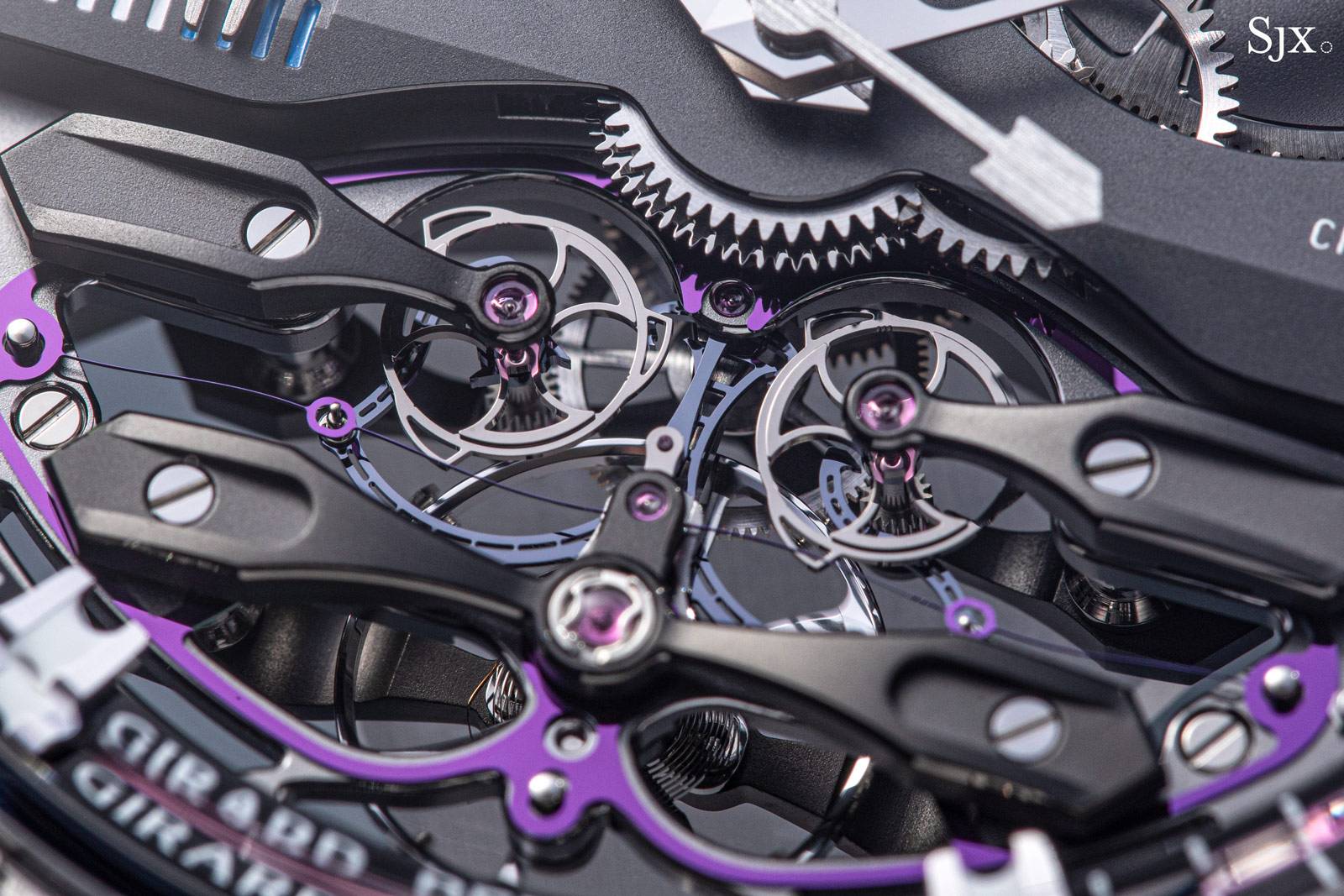
The Girard-Perregaux Neo Constant Escapement uses the consistent force imparted by buckling silicon blades to deliver constant force to the escapement.
These methods include the use of multiple barrels, stop-work mechanisms that limit the movement’s operation to the flattest part of the mainspring’s torque curve, and compliant silicon blades that isolate the oscillator from the gear train. Indeed, the Expérimentale 1 features a multi-barrel arrangement of its own in addition to its other merits.
But the Expérimentale 1 features an entirely different route to constant force. Instead of trying to even-out the uneven force provided by an unwinding mainspring, the brand created an escapement that transmits energy using only the stable repellent force of permanent magnets. In other words, the stable rotational force of the escape wheel, which to-date has been the ultimate goal of most constant force mechanisms, has been made irrelevant.
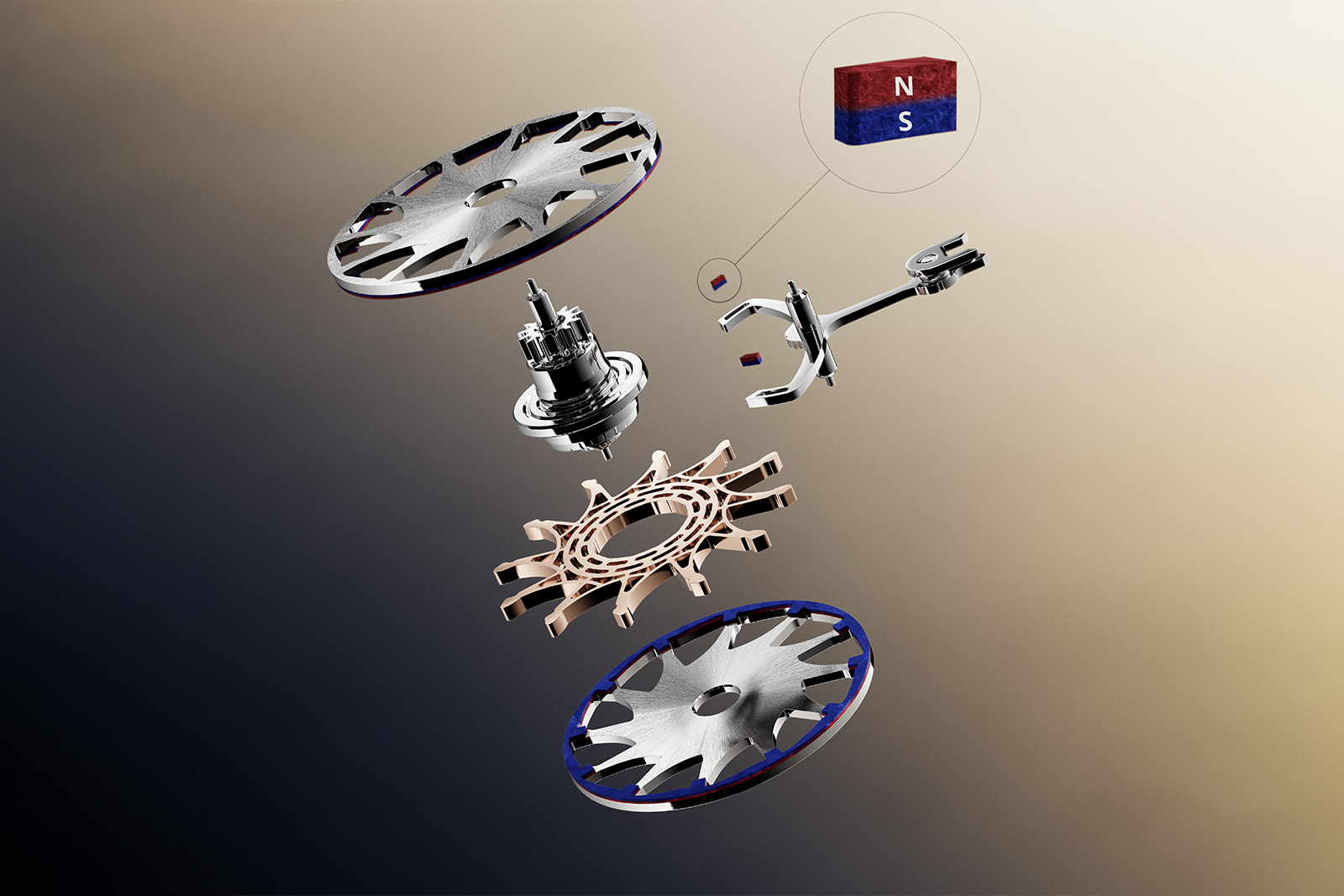
The Breguet magnetic constant-force escapement.
The escapement takes the rough form of a lever escapement, with indirect impulse in both directions, but the escape wheel, with a tri-level sandwich-style construction, is designed to never come into physical contact with the lever, except in the case of extreme shock. Instead, the design relies on a carefully calculated magnetic field to eject opposing magnets built into the entry and exit pallets of the lever.
Because the repulsive energy of the magnets is the same for every impulse, regardless of the movement’s state of wind, the balance amplitude is the same throughout the entire power reserve — a stunning achievement that would have made A-L Breguet proud.
The proof is in the performance
The chain and fusée is a good example of Stephen Forsey’s maxim that’s it’s difficult to gain more than you lose when trying to improve chronometric performance through additional complexity. Many watches with remontoires and the like are usually positioned as intellectual statement pieces, and as such they are rarely subjected to stringent performance requirements.
In this context it’s meaningful that the Expérimentale 1 is rated run within to +/- 1 second per day, the highest standard in the industry. In other words, it works in theory, and Breguet’s engineers have proven it works in practice.
Closing thoughts — what it means for the future
The Expérimentale 1 is an almost perfect chronometer, if an imperfect watch. It represents the beginning of a new collection for Breguet, signalling a renewed emphasis on meaningful innovation. I applaud this direction, which strengthens the link between the modern brand and its visionary founder. This link is critical for the brand’s credibility in an increasingly competitive marketplace.
It also helps build a modern-day competitive moat – given the brand’s unique expertise and intellectual property related to magnets and silicon, not to mention the backing of the well-resourced Swatch Group, Breguet is in a unique position to commercialise breakthroughs like the magnetic escapement. But unlike silicon, which had a clear path to industrialisation and widespread use, it’s harder to see the path to broader impact with this technology.
Thus it remains to be seen whether the Expérimentale 1 will become an icon or a footnote. Looking at past moonshot efforts from similar brands, results have been mixed. Audemars Piguet abandoned its AP Escapement after just a few years, and today the technology seems like a tantalisingly short-lived detour from the brand’s overall trajectory.
In contrast, the Freak completely changed perception of Ulysse Nardin and today forms the basis of the brand’s technical credibility and aesthetic differentiation. The true legacy of the Expérimentale 1 might only come into focus once we see the extent to which this technology diffuses throughout Breguet’s collections. But in the short term, the outlook is promising.
Key facts and price
Breguet Expérimentale 1
Ref. E001BH/S9/5ZV
Diameter: 43.5 mm
Height: 13.3 mm
Material: 18k “Breguet” gold
Crystal: Sapphire
Water resistance: 100 m
Movement: Cal. 7250
Functions: Regulator Hours, minutes, seconds, tourbillon with magnetic escapement
Winding: Manual wind
Frequency: 72,000 beats per hour (10 Hz)
Power reserve: 72 hours
Strap: Blue rubber with proprietary interchangeability system
Limited edition: 75 pieces, produced over more than two years
Availability: At Breguet boutiques and retailers
Price: CHF320,000 including tax
For more information, visit Breguet.com.
Back to top.