
Hands-On: Audemars Piguet Royal Oak “Jumbo” Extra-Thin Openworked
Radical openness in action.
The Audemars Piguet (AP) Royal Oak “Jumbo” Extra-Thin Openworked 39 mm is an appealing new variant of a watch that’s already in short supply, famous as much for its scarcity as its octagonal bezel. Seen previously in white gold, the Jumbo Openworked returns at the top of its class with a case made from lightweight titanium and palladium bulk metallic glass (BMG), a material that gives the bezel its almost ethereal mirror finish.
The Jumbo Openworked is not a limited edition, but its undeniable appeal will make it hard to come by, even by Royal Oak standards.

Ideal configuration
The Royal Oak is one of the most sought-after watches in the industry, and one of the few collections that consistently trades at a premium to retail, according to WatchCharts. With its iconic Genta design, slim form factor, and high-end calibre, it’s easy to see why.
That said, some configurations are more appealing than others, and this titanium and palladium version of the Jumbo Openworked ranks highly in the Royal Oak pantheon. It’s worth exploring why it works.

Starting with the sizing. In 1972, the Royal Oak was broad and flat by industry standards, but the “Jumbo” moniker now feels misleading for a 39 mm watch. Ironically, the “Extra-Thin” designation also feels misleading for the opposite reason — 8.1 mm is plenty thin, but there are now so many thinner watches that the terminology feels out of date.
Setting aside AP’s historical naming conventions, the Jumbo Openworked is almost perfectly sized by the standards of an elegant sport watch, large enough to have presence and thin enough to disappear up one’s sleeve. It’s apparently the smallest size that accommodates AP’s latest-generation slimline automatic calibre, and, perhaps as a consequence of that technical rationale, the sizing feels right.
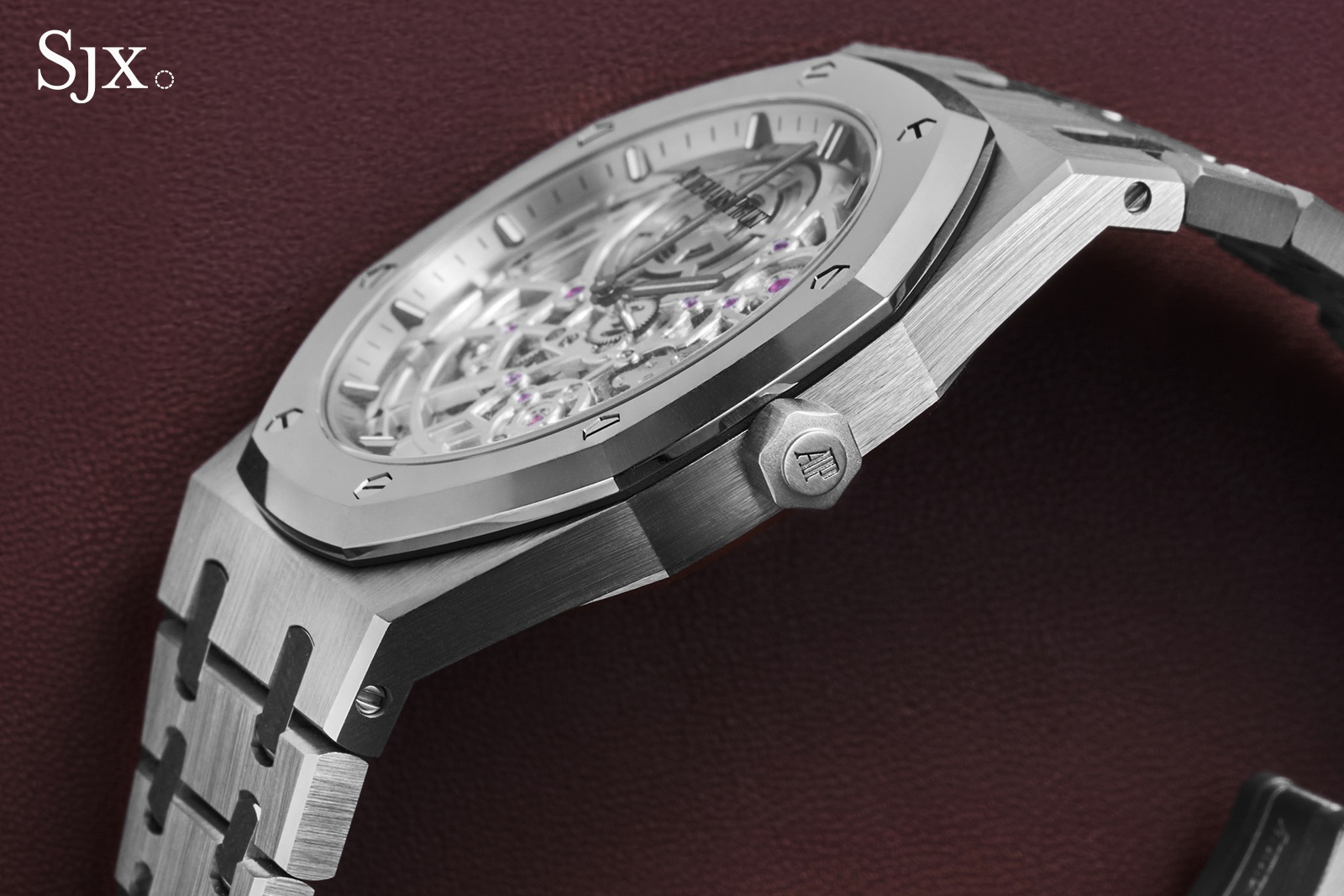
The Royal Oak made a splash originally because stainless steel represented a provocative choice at the time, when gold watches still dominated the high-end segment. Today, no one bats an eye at stainless steel luxury watches, but AP has continued to push the envelope when it comes to shocking, exotic materials.
One of the brand’s latest material developments is BMG, which in this case is an alloy made from 50% palladium. Despite the confusing name, the material is metal, not glass, though it undergoes a special heat treatment process that results in an amorphous glass-like structure with greater scratch resistance — 500 Vickers, according to AP.
The only real downside of BMG, as far as I can tell, is that it’s a magnet for finger prints in a way that I haven’t experienced with other metals. This is a worthwhile trade-off for its brilliant look and enhanced scratch-resistance, but it’s worth keeping a cleaning cloth close at hand.

The BMG bezel and intermediate bracelet links are highly polished, devoid of the rich straight graining that the Royal Oak is known for. On the other hand, the case and primary bracelet links are made of lightweight titanium, which gives the watch an effortless feel on the wrist and creates a pleasing contrast between the brushed and polished surfaces, which practically glow.
Unsurprisingly, there’s not much to the dial of the Jumbo Openworked. Traditionalists may regret that absence of the iconic petite tapisserie dial, but the cal. 7124 is well-suited to its starring role and the excellent finishing puts a lot of eye candy front and centre. What little dial remains is confined to the perimeter flange, which is set with applied (lumed) lozenge-shaped 18k white gold hour markers.
Another desirable trait of the ‘Jumbo’ compared to other Royal Oak models is it retains the printed Audemars Piguet wordmark, rather than an appliqué. The applied wordmarks on most other Royal Oak models are undoubtedly more costly to pull off, but to my eye the design cheapens the look. In the case of the Jumbo Openworked, the wordmark is printed on the underside of the crystal to keep the bridges uncluttered.
Industrial quality
AP’s industrial strategy intends to strike a balance between industrial quality and hand craftsmanship. These priorities converge in several areas, including the numerous inward angles found in the movement — a hot topic among collectors of late.

The cal. 7124 features hundreds of polished inward angles, and their regularity is suggestive of the processes used to create them. Take the barrel cover, a component produced by one of AP’s suppliers. In most watches, the barrel cover is a cheap, forgettable, functional component. In the cal. 7124, AP has dressed it up with 48 inner angles on each side — more than most haute horlogerie calibres offer in the entire movement.
The size and uniformity of the cutouts, which are but few among many, offer a clue about how this is done. The cutouts are first machined using a technique like Electrical Discharge Machining (EDM), which is capable of cutting precise corners. This preparation simplifies the finishing process, increasing the speed with which hand-polished inward angles can be finished. It’s hard to argue with the results.
Radical openness
During the model’s launch event in the chic mountain village of Andermatt, AP CEO Ilaria Resta presented three key pillars intended to guide the brand for its next 150 years. The first is manufacturing excellence, with an emphasis on hand craftsmanship, and the second is inclusivity — specifically, connecting with collectors across generational and gender divides to build the customer base of the future.
The third pillar is radical openness, and while the intent refers to making the brand intellectually accessible, the Jumbo Openworked does a pretty good job of embodying this objective in a tangible form. The cal. 7124 leaves little to the imagination, revealing remarkable finishing inside and out.
The simplified design has a technical benefit as well — without a date mechanism, the movement gains an extra two hours of power reserve relative to the cal. 7121, up to 57 hours. That’s a big number for a thin calibre, especially one that beats at a robust 4 Hz.
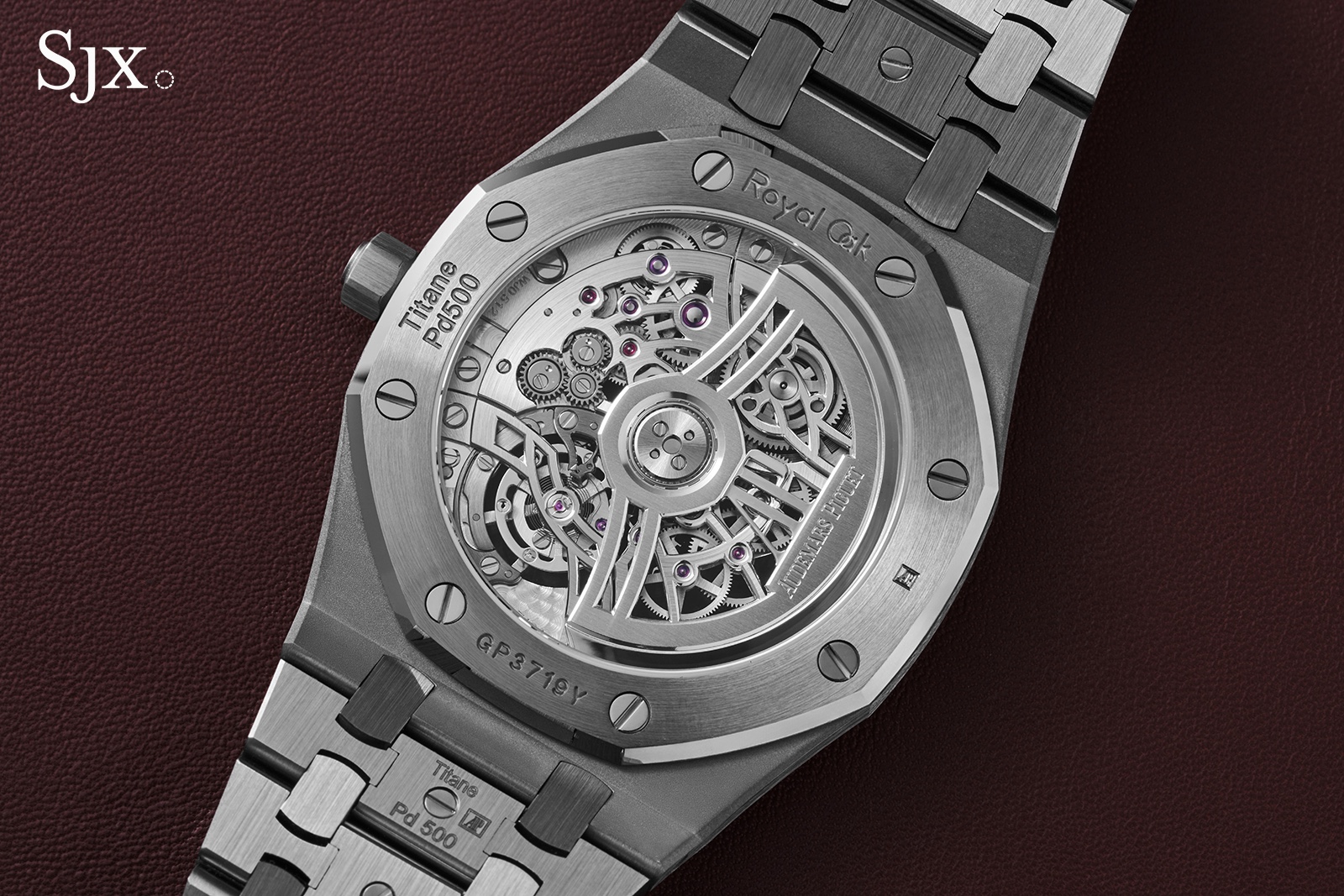
Having gotten used to the look of the cal. 7121 with its solid bridges and contrasting colours, the monochromatic palette of the cal. 7124 is almost shocking in its austerity. Traditional Cotes de Geneve give way to large-diameter circular graining on the little surface area that remains, while tidy (almost geometric) openings reveal the movement’s inner workings, including the going train, the keyless works, and the bidirectional winding system.
Regarding the latter, there remains disagreement within the industry about the relative technical superiority of bidirectional winding, but in an upscale, refined watch like this, utmost efficiency is arguably beside the point. The slower-moving rotation of the rotor, which is partly visible through the openworked dial, offers a more graceful experience on the wrist.
Key facts and price
Audemars Piguet Royal Oak “Jumbo” Extra-Thin Openworked 39 mm
Ref. 16204XT.OO.1240XT.01
Diameter: 39 mm
Height: 8.1 mm
Material: Titanium and palladium 500 BMG
Crystal: Sapphire
Water-resistance: 50 m
Movement: Cal. 7124
Functions: Hours and minutes
Winding: Automatic
Frequency: 28,800 beats per hour (4 Hz)
Power reserve: 57 hours
Strap: Titanium bracelet with palladium 500 BMG intermediary links
Limited edition: No
Availability: At AP boutiques and AP Houses
Price: Upon request
For more, visit audemarspiguet.com.
Back to top.