
Hands On: Haute-Rive Honoris Meccanica
A peek inside the 41-day movement.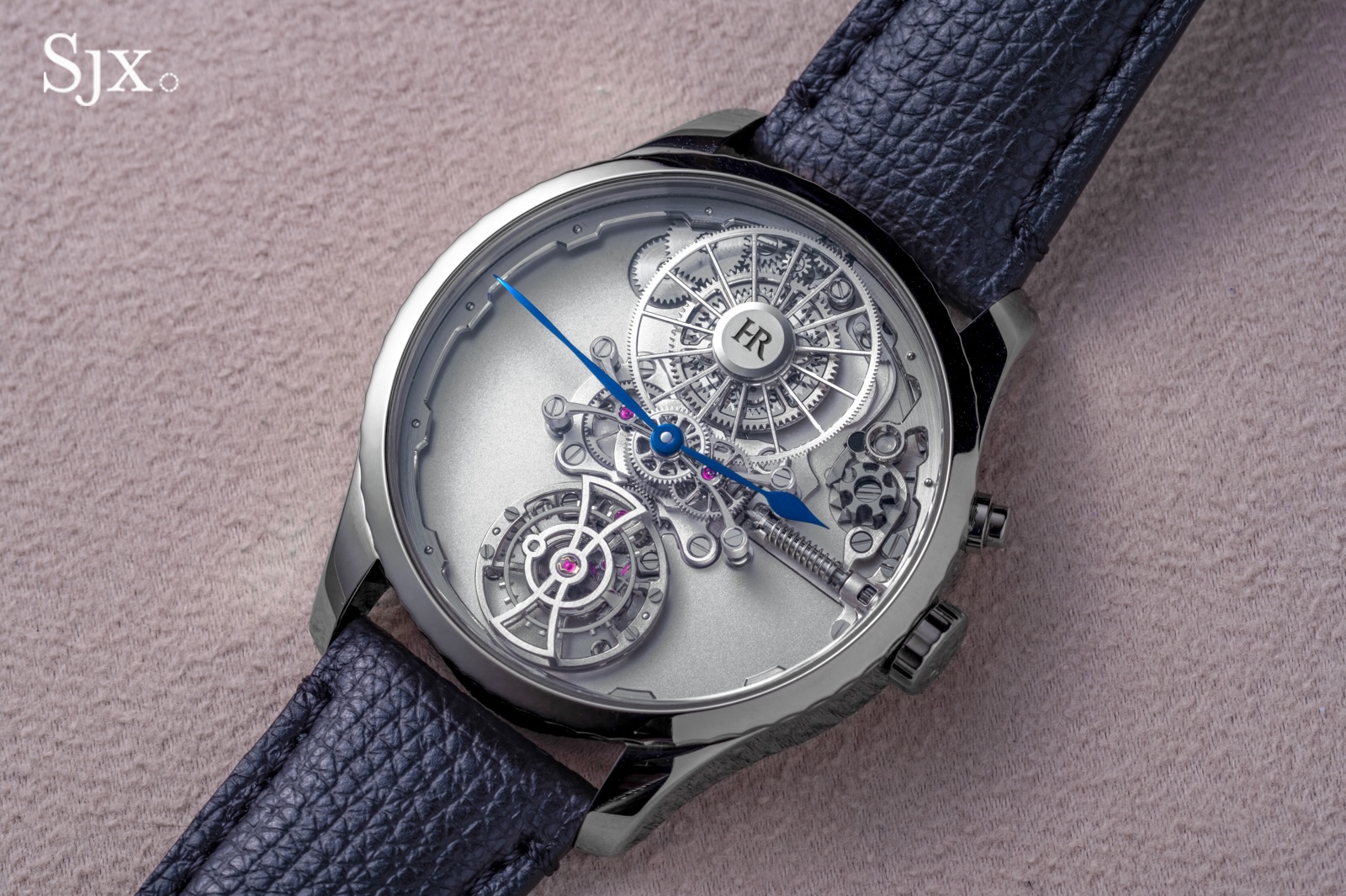
Taking place right next door to Watches & Wonders, Time to Watches is an annual fair dedicated to independent watchmaking. Among the exhibitors this year was Stéphane von Gunten, the watchmaker behind the Haute-Rive brand.
Arguably the most technically impressive watch on display was the Honoris Meccanica, the most mechanical looking of Haute-Rive’s Honoris line. The timepiece houses a three meter-long mainspring which allows it to achieve a power reserve of 41 days — more specifically 1,000 hours.
Unlike some other watches with ultra-long power reserves, the Honoris Meccanica remains a properly sized and wearable timepiece that doesn’t feel like a wrist-worn experiment.
Initial thoughts
Stéphane von Gunten is part of a new generation of independent watchmakers with a strong engineering background, rather than a career spent doing restoration work. Before launching Haute-Rive, Mr von Gunten worked as a Research and Innovation Director at the Sowind group, which owns Girard-Perregaux and Ulysse Nardin.
His most notable work happened while at Ulysse Nardin, where Mr von Gunten filed a number of important patents, ranging from the oval-shaped hairspring still used by Ulysse Nardin today to constant force escapements and compliant flexure oscillators.
As fate would have it, one of Mr von Gunten’s ancestors is Irénée Aubry, the watchmaker behind the “Hebdomas” eight-day pocket watch of 1888. Commercialised under many names, the movement only required winding once every eight days and was powered by a large mainspring turning on the underside of the base plate.
The same construction trick helped power Ulysse Nardin’s Freak platform in 2001. Appearing once again in the Honoris, this unusual construction feels right at home.
The Honoris Meccanica is definitely among the more unique time-only independent watches, as it truly brings some new innovations to the table. Although its refined appearance doesn’t suggest it at first, the Honoris Meccanica is among the most accomplished independent creations from a micro-mechanical point of view.
The Honoris line includes one of the more abstract uses of a differential gear set I have seen in modern watchmaking. In this case, the solution to a larger power reserve was not simply a larger barrel or a stack of them, but a complete rethinking of the mainspring system, winding works and going train.
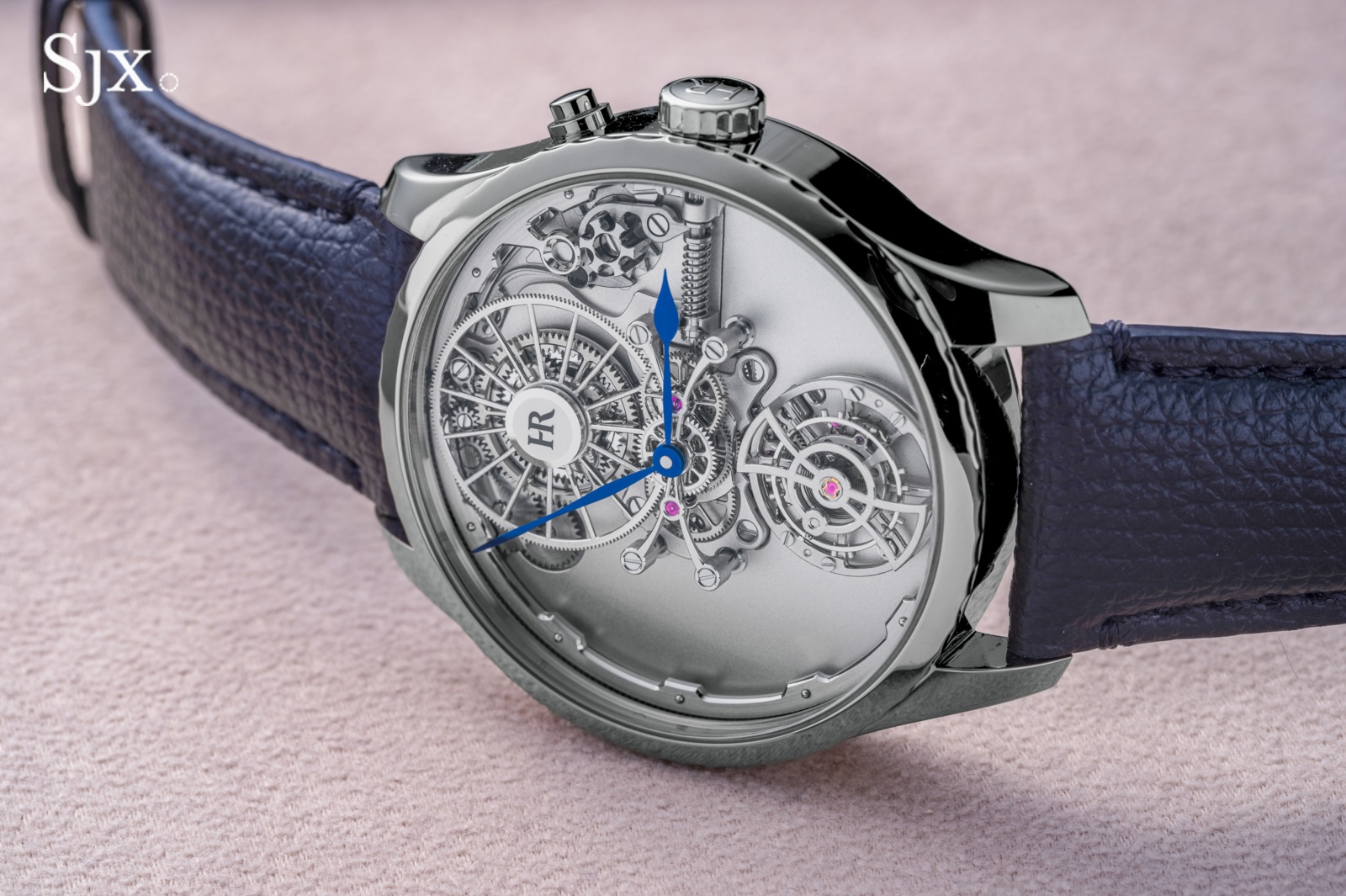
The Honoris Meccanica in particular strikes me as the most appealing reference in the current collection, as it really allows the mechanical beauty of the HR01 movement to shine. Thanks to its more open construction, the wearer can better enjoy the watch’s mechanics by matching the tactical feel of winding, setting the time, or actuating the function selector with the visual snaps happening under the sapphire.
Haute-Rive produces about 10 watches per year, and the Honoris Meccanica comes in three versions: Rhodium, Ruthenium and the 8-piece limited edition Rosso. The latter features a red theme, but all three pieces are functionally the same.
The Honoris Meccanica’s price point of CHF158,000 is probably justified by the brand’s small scale production and its founder’s technical ingenuity. There are a lot of six-figure tourbillons from independent watchmakers, but few that demonstrate such fundamental differentiation.
Modern architecture, old finishes
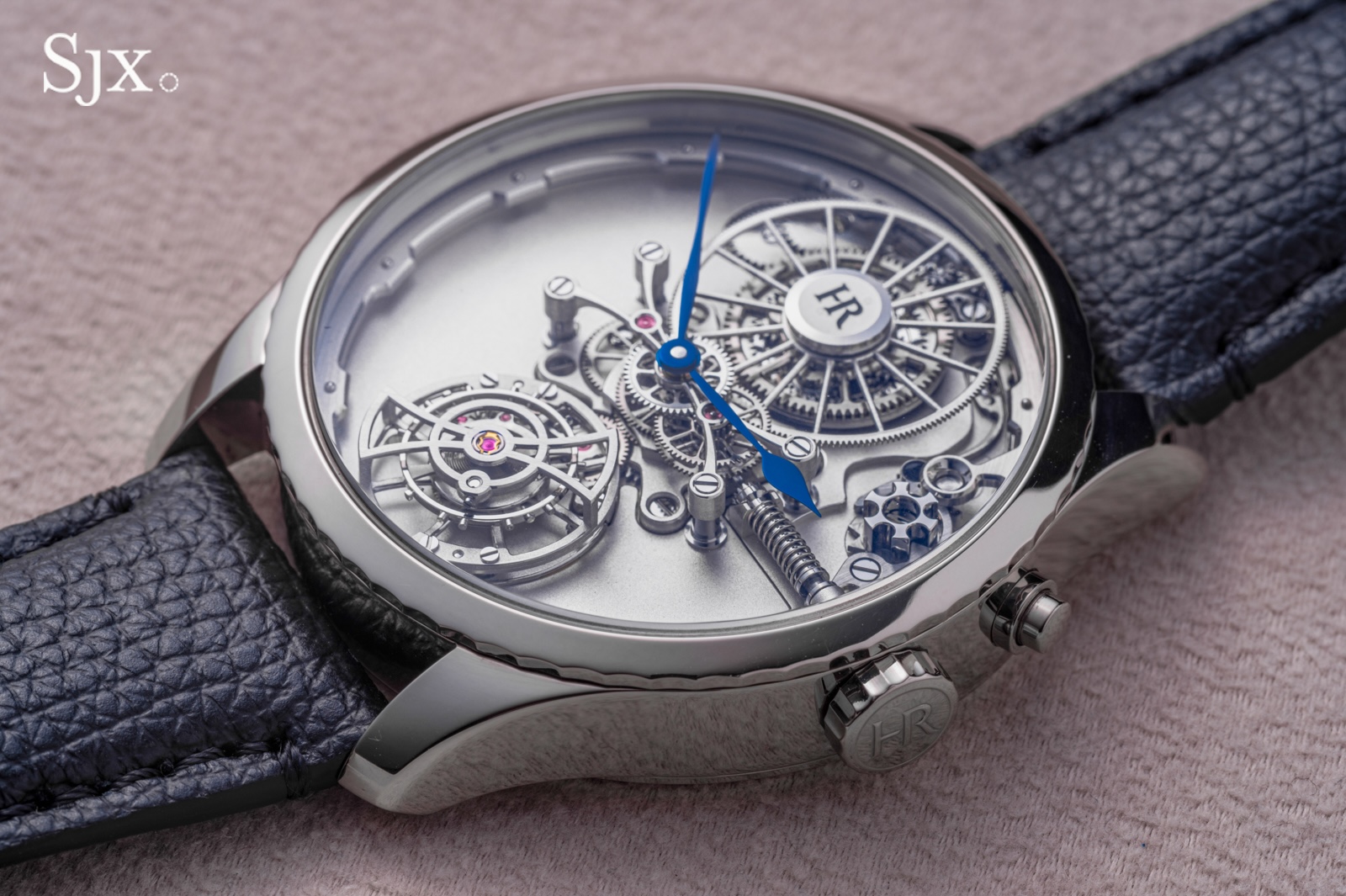
The 18K white gold case measures 42.5 mm in diameter and a very reasonable 11.95 mm in height. Given that the watch houses a mainspring that keeps it running for 41 days, the size achievement is laudable.
The timepiece feels properly hefty on the wrist, despite the airy construction. The movement is substantial, but having the grained mainplate sunken down relative to the other components gives the parts a floating look.
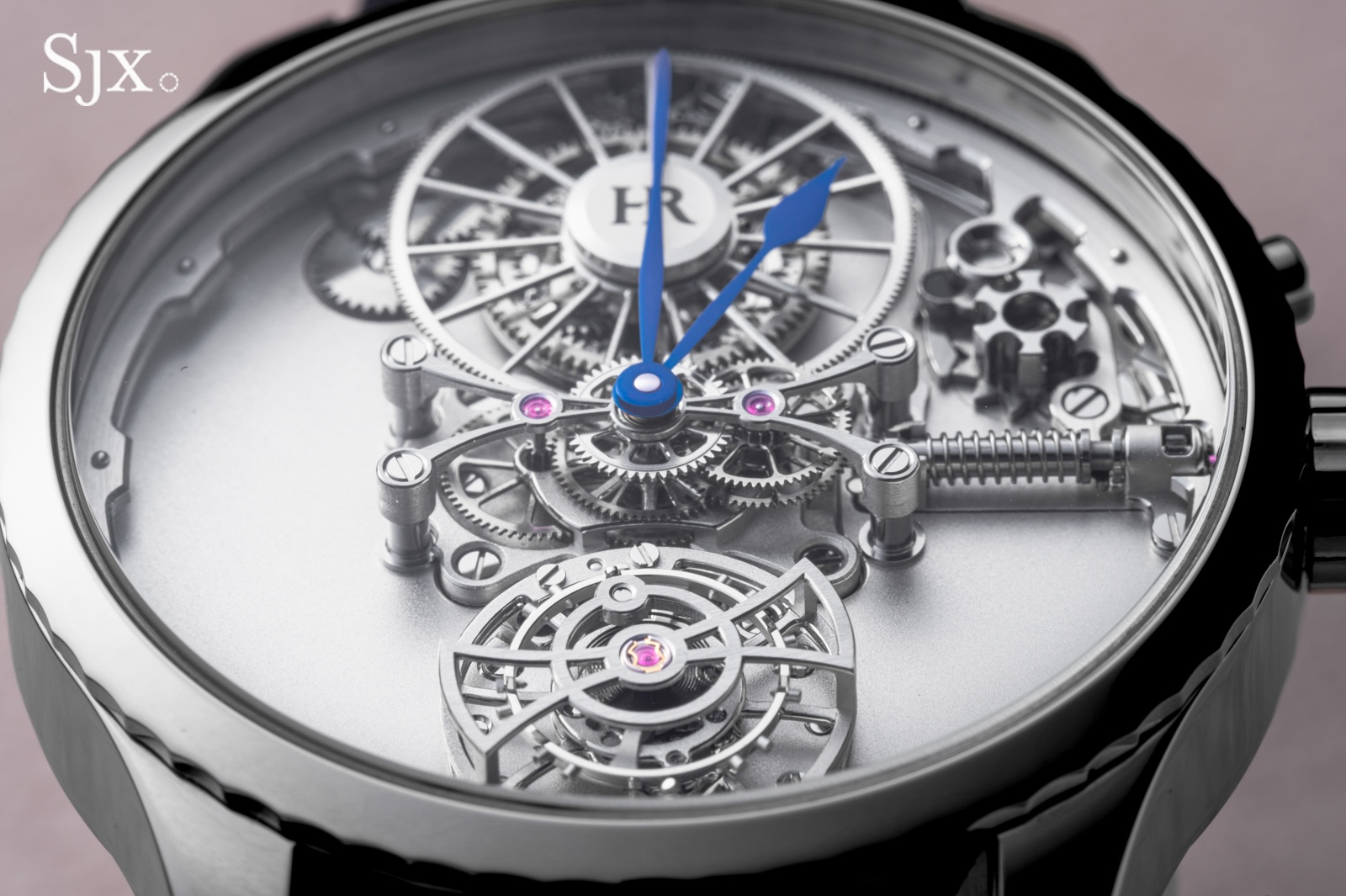
The bezel is slightly ridged, since it is used for winding the mainspring. The small facets are functional in nature but also complement the overall aesthetic well. The Honoris’ case has rather simple lines and the bezel motif lends it some more identity.
Winding the Honoris is a rewarding tactile experience. At first I suspected the slim bezel would be hard to grip properly, but that is not the case and winding feels smooth. This bezel-based user interface for winding gives the entire product a cohesive feel. In fact this type of solution tends to be the domain of larger brands like Ulysse Nardin and Rolex, rather than small independents making fewer than a dozen watches per year.
Because the crown isn’t used for winding, there is a function selector for making sure there exists a neutral position for the crown. The selector is a pusher placed at two o’clock on the case, which actuates the over-engineered selector mechanism.
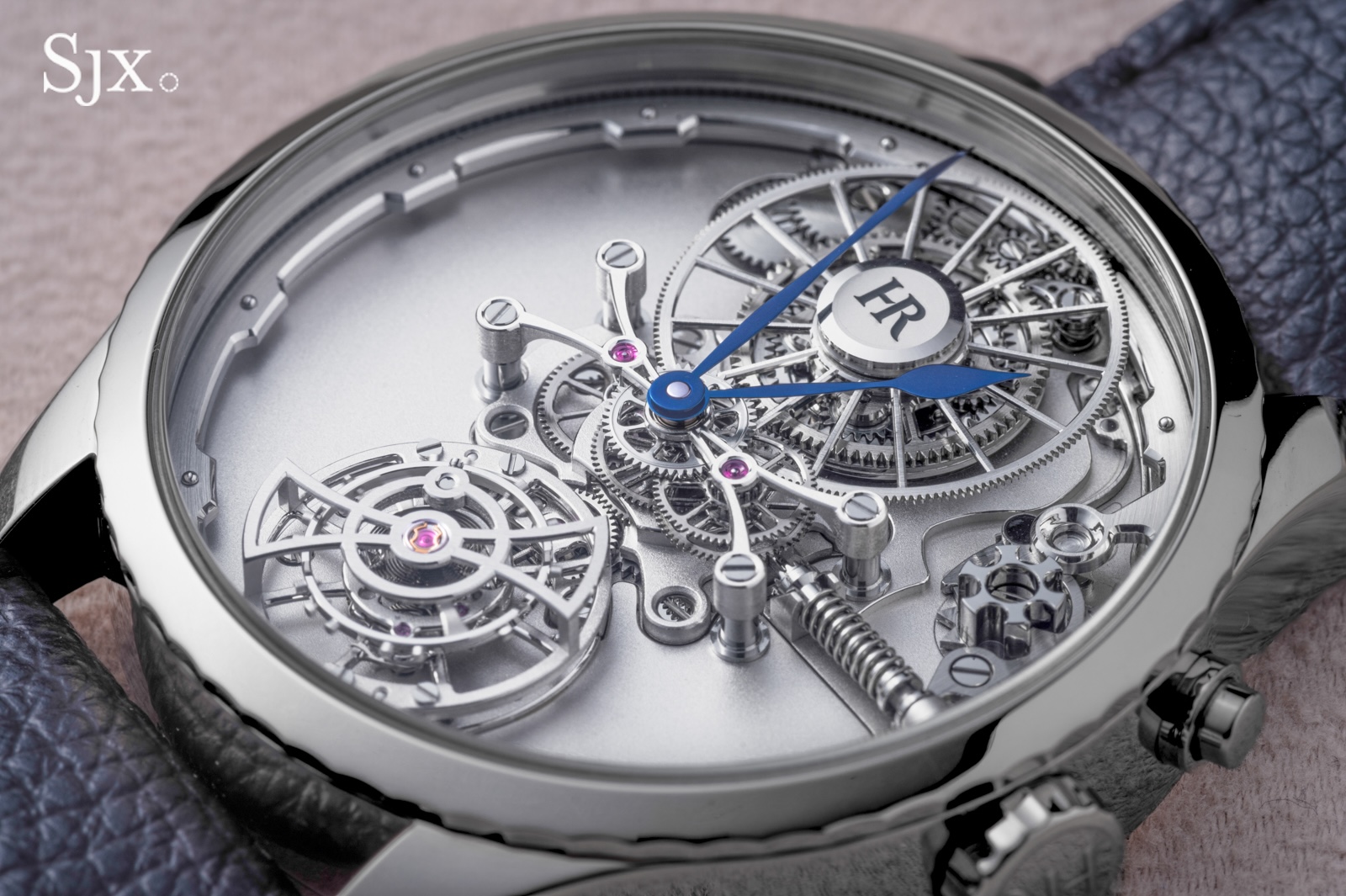
There is a tall column wheel that works in conjunction with the pusher and crown stem, effectively clutching in the stem for setting the time. After the watch is set, the selector is actuated again, de-clutching the stem; the crown simply free-wheels in this neutral position.
The system also includes a discreet but useful aperture for showing whether the crown is in the active or neutral position. The entire time-setting works are really a show of mechanics, since there was no particular need for such an overbuilt system.
Actuating the pusher actually feels better than some chronographs on the market and perhaps this is a hint that Haute-Rive’s next creation might indeed be a chronograph.
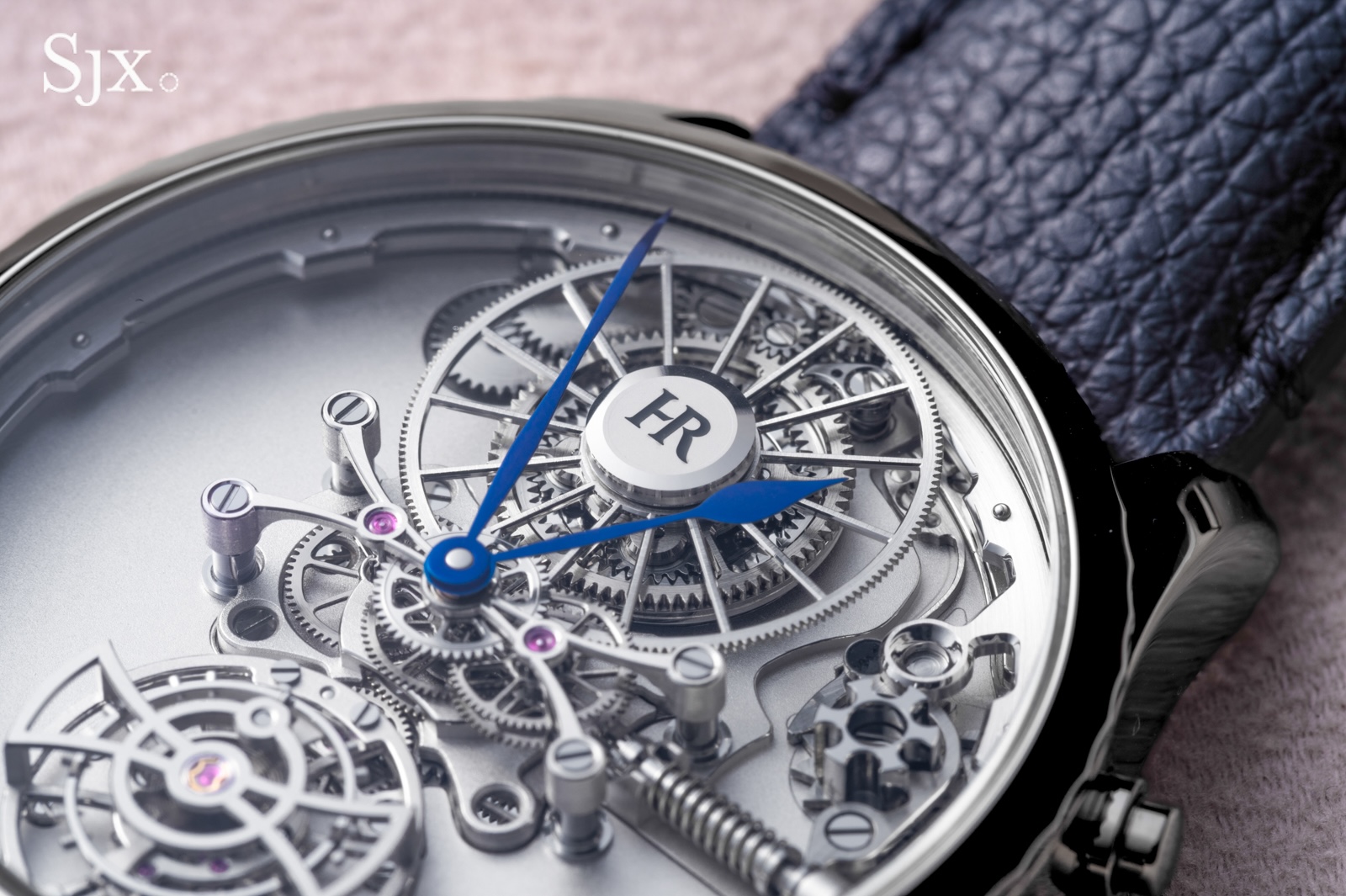
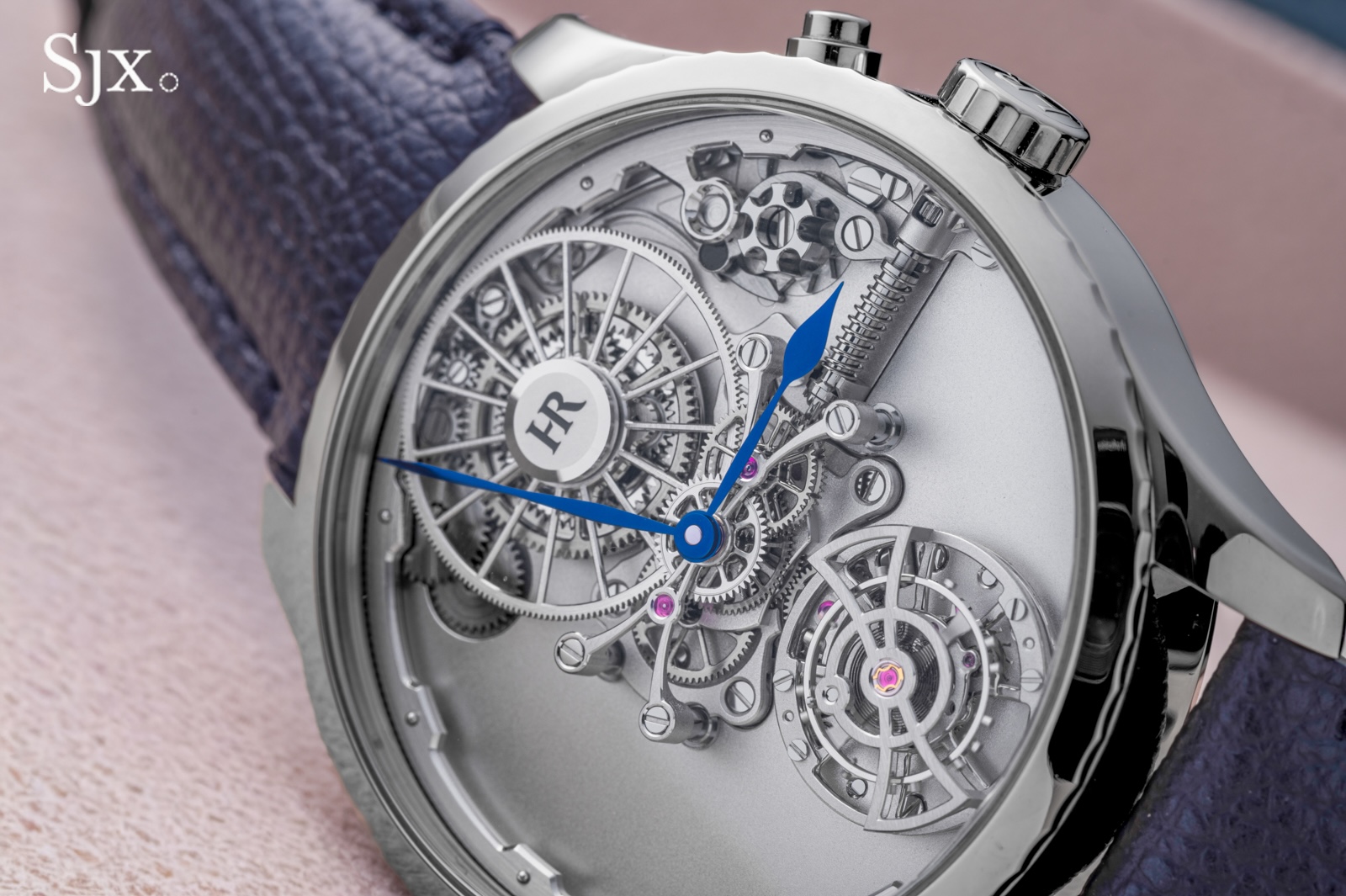
The entire gear train is on show on the dial side. It is, however difficult to make out all the individual components — especially due to the large and strange-looking planetary gear hub affectionately called the “Wheel of Time”.
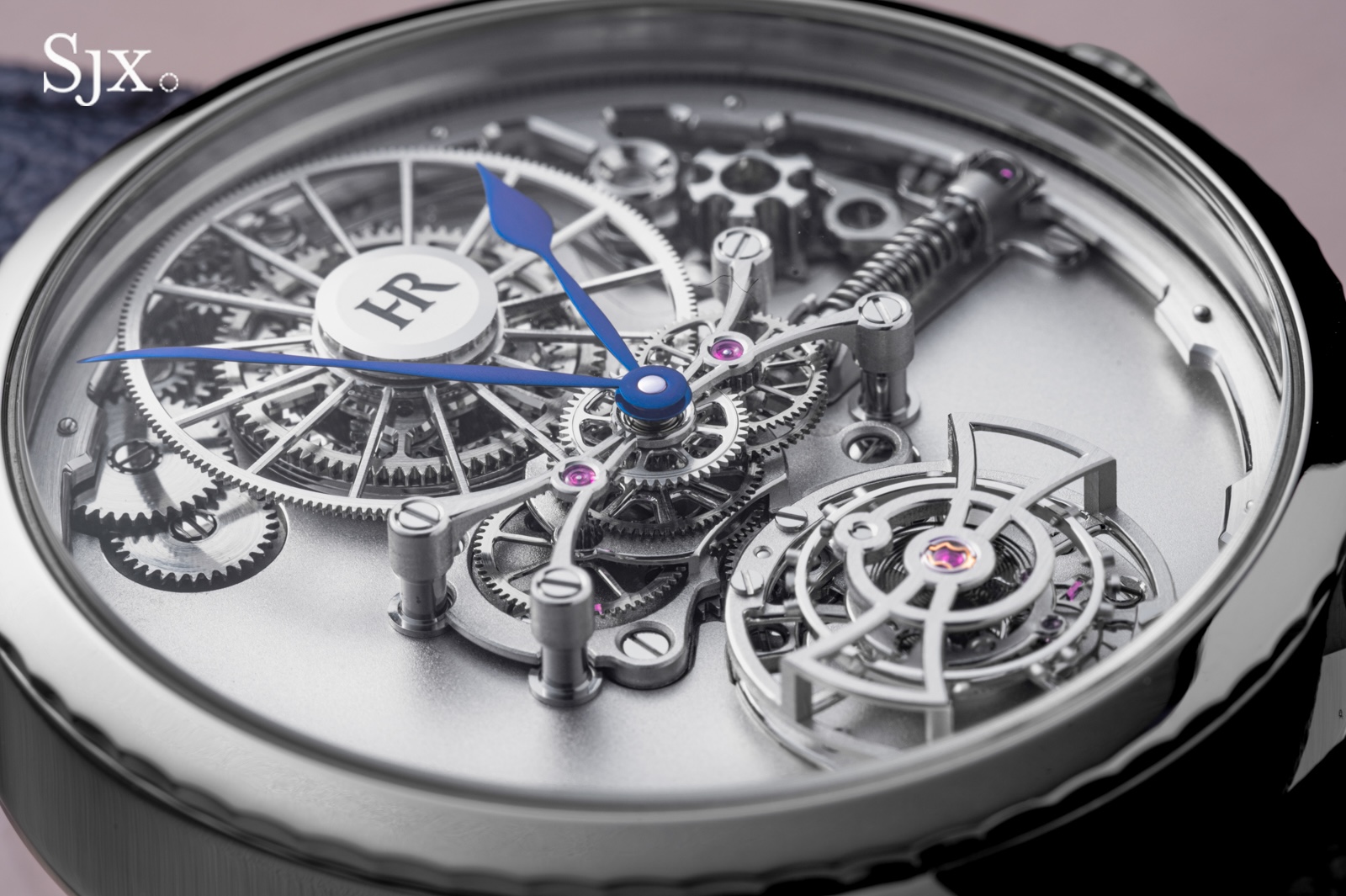
There is also a flying tourbillon at six o’clock that adds a good measure of dynamism to the dial side. The construction makes it look mysteriously removed from the rest of the going train — a point that will be expanded upon later in this story.
There is a good amount of hand-applied finishing on all the movement parts, although the focus of the Honoris Meccanica remains on the mechanics. All steel parts are polished — which looks a bit monochromatic against the dull rhodium graining on the mainplate. The hands are thankfully blued and perhaps some matching blued screws would have enlivened the view.
The real treat in terms of finishing is the fine bevelling running across many surfaces. Best admired with a loupe, the “Wheel of Time” has beveled spokes and interior angles — which are more demanding to apply on thin spokes that are structurally important.
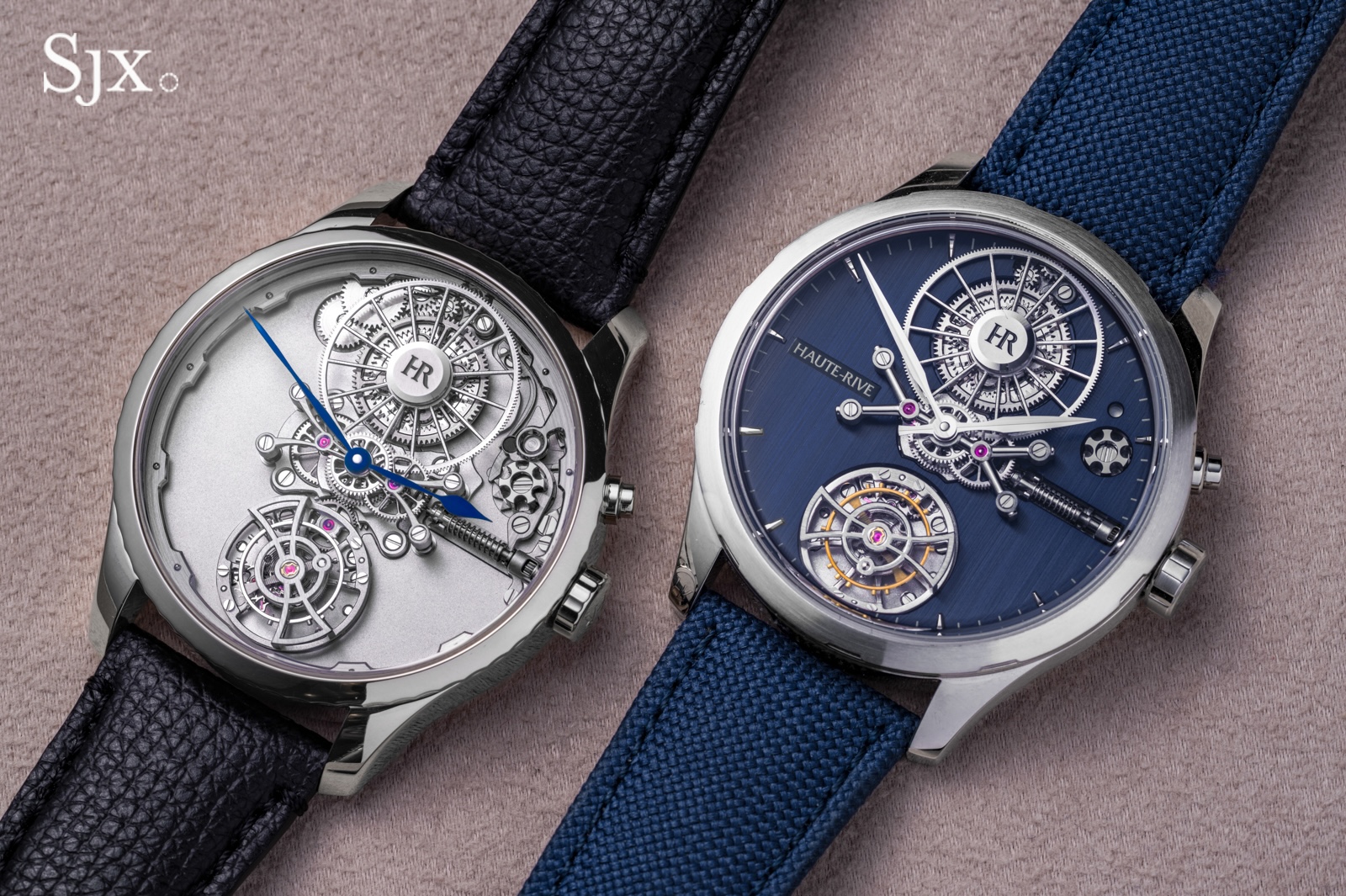
The Honoris Meccanica next to the Honoris Strato Blu. Notice the difference in the amount of mechanics on show.
A similar bevel runs along the central four-legged bridge supporting the going train. The bridge is a beautiful piece of steelwork and also best appreciated under magnification. The widest bevel runs along a raised rim, which serves as a sort of dial ring, using small studs as hour markers. Legibility is not really the main point of the Honoris Meccanica, as it often is the case with the majority of open-worked watches.
Exploring the HR01
The mainspring assembly is reminiscent of the Ulysse Nardin Freak in some sense, but in function the systems are vastly different. In the Freak, the barrel’s turning is integrated with the time-telling function. As the whole movement is in motion, some clever gearing ratios were found to make everything turn at the right pace (once per hour).
Inside the Honoris Meccanica, the mainspring’s cradle occupies about the same area as the movement’s mainplate but unlike the Freak, this movement is very much stationary. So a way of advantageously connecting the large spring underneath with the fairly conventional going train exposed on the dial side needed to be found.
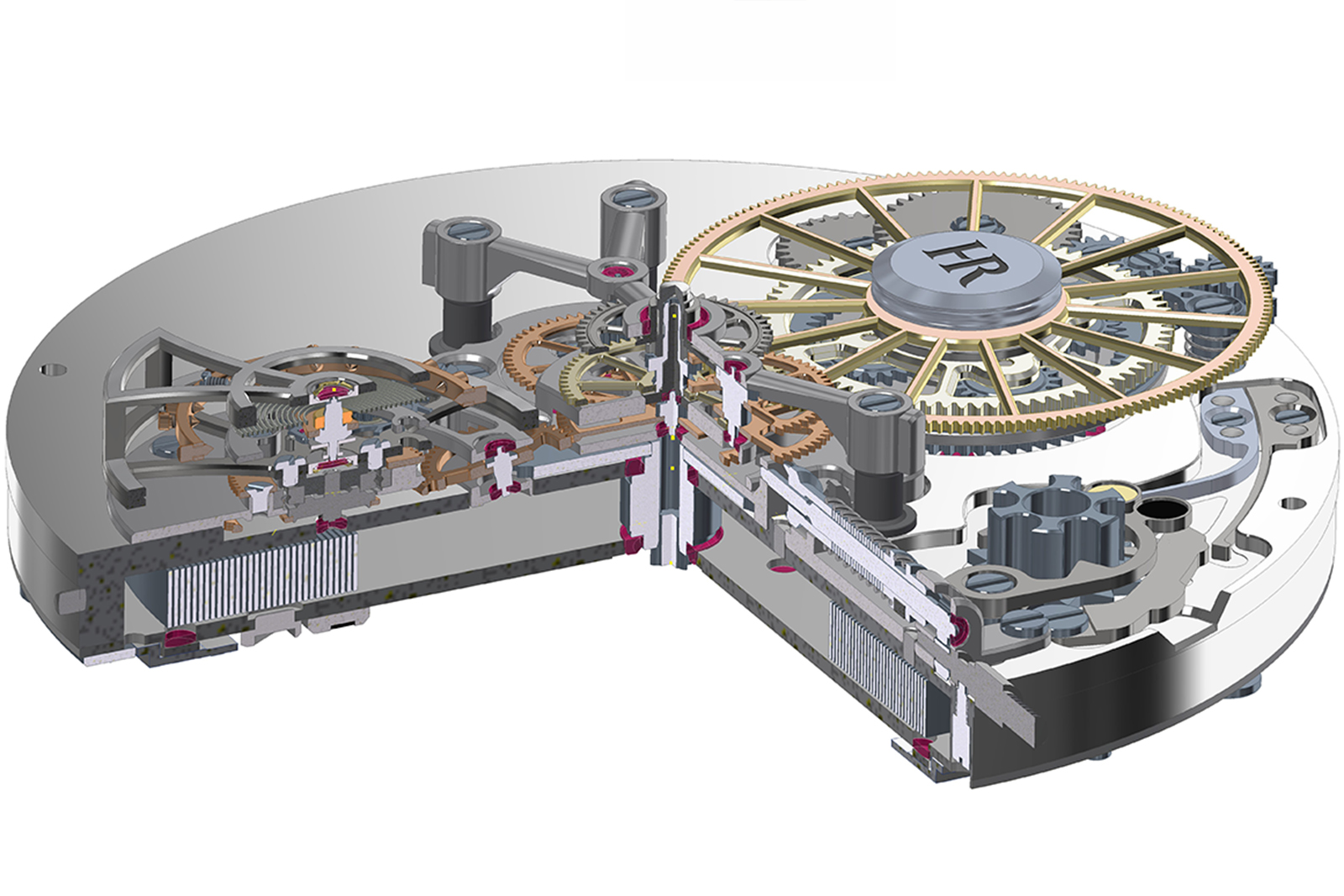
Sectional view of the HR01 movement. Image — Haute-Rive.
The trick used is not instantly apparent. The keen reader might have noticed I didn’t refer to any actual “barrel” so far. That is because there is no barrel in the traditional sense — the mainspring’s sturdy central arbour performs double-duty, both winding the spring and discharging its power into the going train.
The outer end of the spring is connected to the casing with a slipping bridle to prevent overwinding, but the casing itself is stationary — the coiling and uncoiling of the three meter-long spring happens on the inside. The idea makes sense in this context, since having such a large drum turn could prove problematic on many levels.
The issue with such a construction is that the arbour has to handle both the power input and output, which are very different in a watch. The input is a fast and forceful winding action by the wearer, while the discharge is slow and controlled over a longer period of time.
In fact, the input and output trains are required to be separated — like they are in a classic barrel execution. In an ordinary movement, the click wheel winds the arbour then locks it in place, so that the stored tension turns the free end, namely the barrel drum.
So while separation of functions is necessary, it is tricky to do when working with only one active end — the arbour. The easy solution would be to physically decouple the arbour from the going train when winding, then coupling it back again. Inconveniently this would also mean stoppage of the movement itself.
This issue with the arbour inside the Honoris Meccanica actually mirrors a similar one with old weight-driven clocks. Say a pulley wheel is linked to a weight; as the weight descends, the wheel turns in one direction, powering the rest of the going train. When the weight has reached the ground, the same pulley wheel would need to be turned in the opposite direction for rewinding — thus upsetting the clock and disrupting time telling.
A solution was found by Christiaan Huygens, who used a compound pulley assembly which allowed removing the ratchet from the going train and ensured the clock would still run undisturbed during winding.
Another solution was found by John Harrison and featured an auxiliary spring mounted on the ratchet wheel. Known as the “Harrison maintaining power” the system is used today in the F. P. Journe Centigraphe — solving a similar problem as the one faced by the Honoris Meccanica.
Later clocks then started using differential gear sets — which is the solution used by Mr von Gunten as well. The elegant and intricate planetary assembly at 12 o’clock is the key to the Honoris Meccanica movement.
Differential gear sets are well known to those interested in automobiles or just mechanics in general. They are found quite a lot in watchmaking, most commonly for power reserve indicators. Some watches use differentials to average the rate of two oscillators — as is the case with the recent Super Freak from Ulysse Nardin.
Without going into too much detail on differentials, it is important to understand that such devices are three-way nodes. That refers to the way they can link together and transform movement between three transmission lines. Depending on the particular setup, they can split one input into two outputs, or they can be locked in certain instances to reduce the number of degrees of freedom.
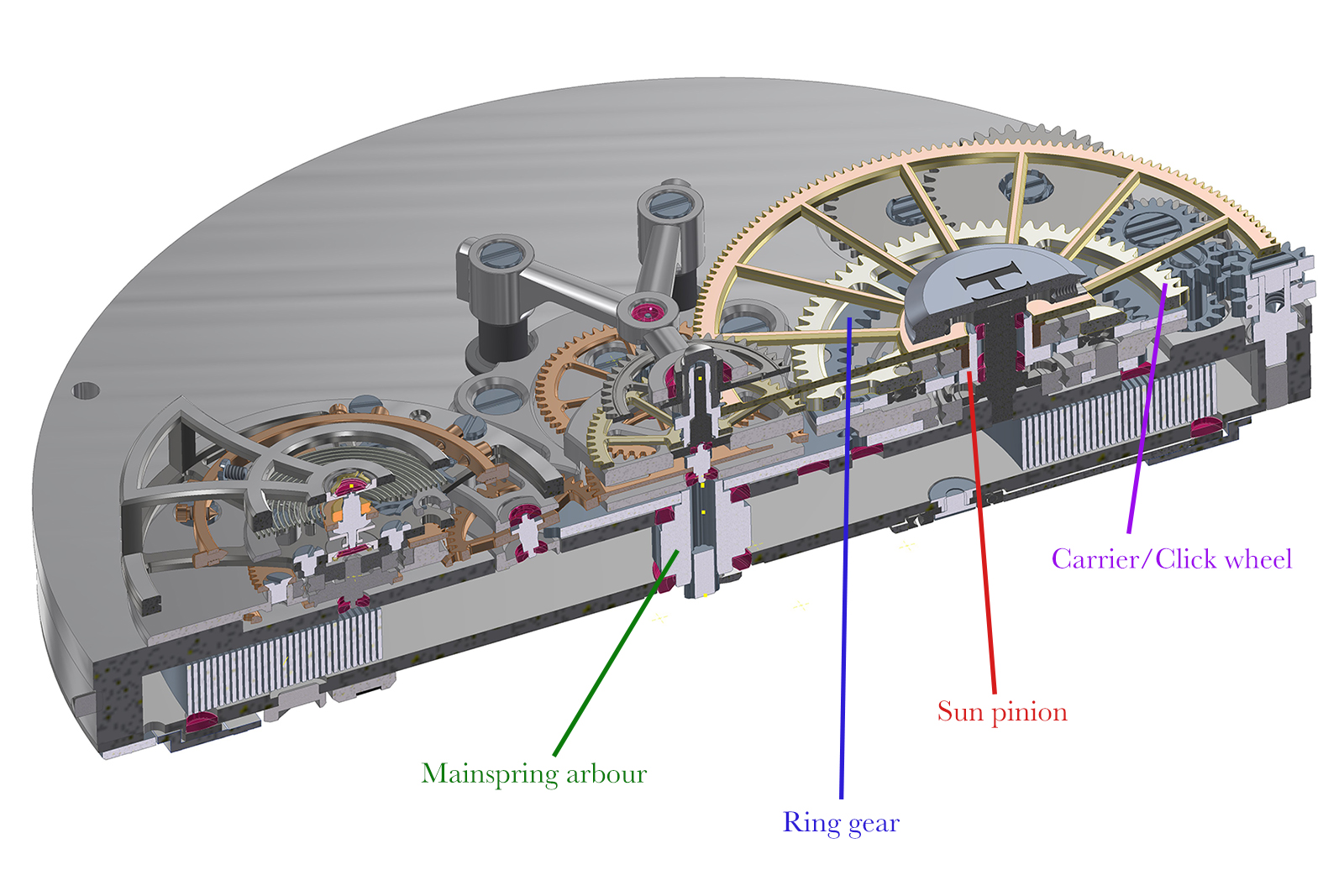
Cross-sectional view of the HR01 movement in perspective. Image – Haute-Rive, annotated by the author.
A flat differential usually is composed of one ring gear, satellites fixed on a carrier and lastly a sun gear. The satellites link the sun gear to the ring gear. The ring, carrier and sun gears can all act as inputs or outputs. The whole assembly is visible under the large wheel at 12 o’clock.
The winding system inside the Honoris Meccanica works by having the carrier component locked by a click when the watch is running — thus turning the differential into a simple planetary gear. The ring gear sits on a large hub and is journaled to a crown wheel on the underside. The setup is better visible in the cross section in the annotated diagram above.
This crown gear engages with another wheel, rigidly connected to the mainspring arbour. This is the only direct link between the large mainspring and the movement’s going train.
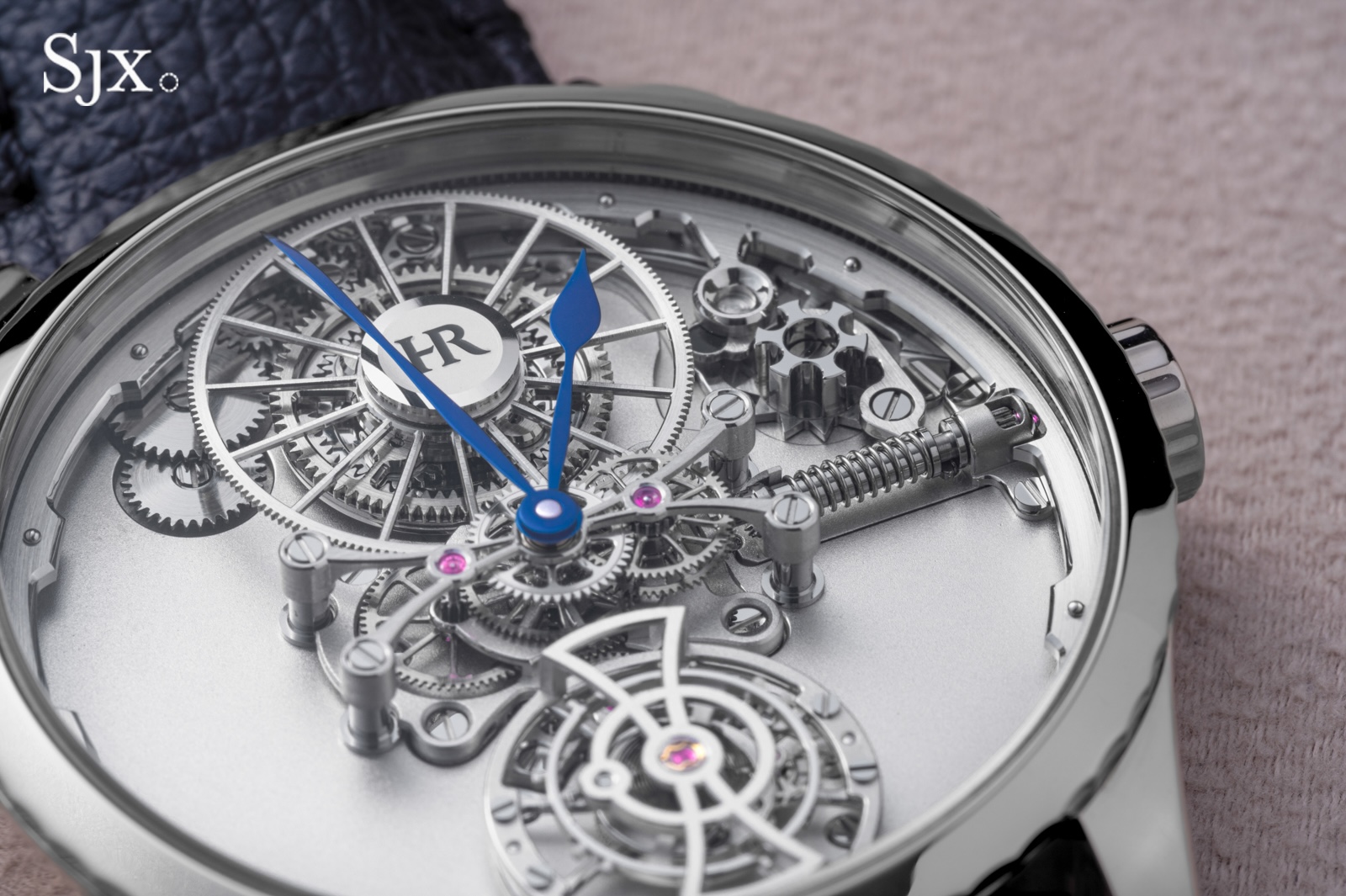
Assuming the watch is wound and running, the arbour turns under the action of the mainspring thus causing the ring gear hub to rotate. As the carrier is locked by the click, the satellite wheels simply transmit the motion to a jewelled pinion placed placed on the hub’s central rod.
The pinion itself is rigidly attached to the large spoked gear that has become a staple of the model line. This gear acts as the de facto first wheel of the going train, since it powers all the gears down to the tourbillon.
When the timepiece is wound, the carrier isn’t immobile anymore and the mainspring arbour is forcibly turned in the other direction, opposing the action of the mainspring. What happens is the carrier forces the ring gear to turn, thus winding the spring. The ring is turned because the satellite pinions meet resistance from both the the ring gear and the interior pinion, which can’t turn faster than the rate imposed by the escapement.
The watch continues to run since the differential’s pinion isn’t rigidly connected to the other components, so due to the resistance of the mainspring, power still flows in its direction through the tensioned satellite gears. This behaviour is facilitated by having a slight relative speed difference between all these components, which is compensated for by the satellite wheels.
Interesting constructional choices
Due to the movement’s unorthodox build even some of the more conservative elements required some imaginative tweaks. Such is the case with the dial-side going train, which is packed rather tightly. The layout is so unconventional that it is difficult to make out the individual gears in the classical sense (the first, second etc.). Since all the going gears — along with the hour wheel and cannon pinion assemblies — are packed around the movement’s centre, the construction builds up vertically.
In order to not thicken the movement any more, the flying tourbillon at six o’clock was brought down quite a bit, as the cage’s top is almost level with the hour wheel. The efficient connection between these levels is an angled intermediate gear, which connects the last wheel of the gear train with the tourbillon’s driving wheel. The angled gear is visible in the cross-sectional diagram below, on the upper lefthand-side of the mainspring arbour.
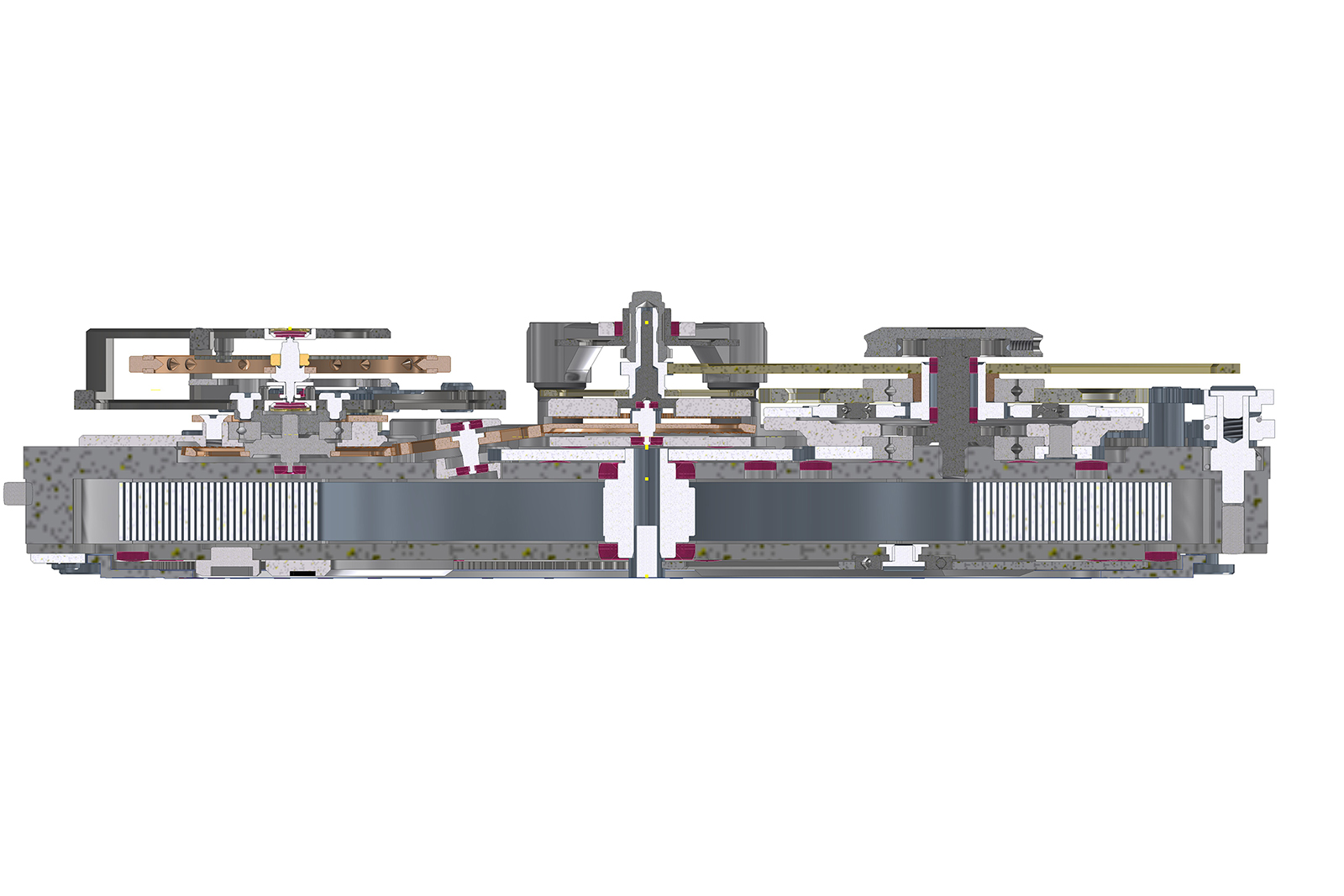
Cross-sectional view of the HR01 movement. Image – Haute-Rive.
Gears meshing at an angle have been used before in watchmaking (notably by Greubel Forsey) but mostly as a show of mechanical prowess. Inside the Honoris Meccanica the use of this angled meshing is actually justified since it keeps the overall movement thickness in check.
The tourbillon itself is an interesting affair. Whereas most watchmakers go for slender and light constructions, von Gunten went for a heavier structure, with a broad platform and wide cage.
Although the cage is hefty by any standard, visually it works well balancing the planetary gear set at 12 o’clock. The “Time Wheel” is very layered and complex, so having a less assertive tourbillon design would have thrown the symmetry out of balance.
Being a floating tourbillon there is no upper bridge anchoring the cage. Instead the entire structure is supported by a ball bearing set into the mainplate. Being connected to the going train by the hidden angled wheel, it creates the illusion of the tourbillon mysteriously rotating by itself.
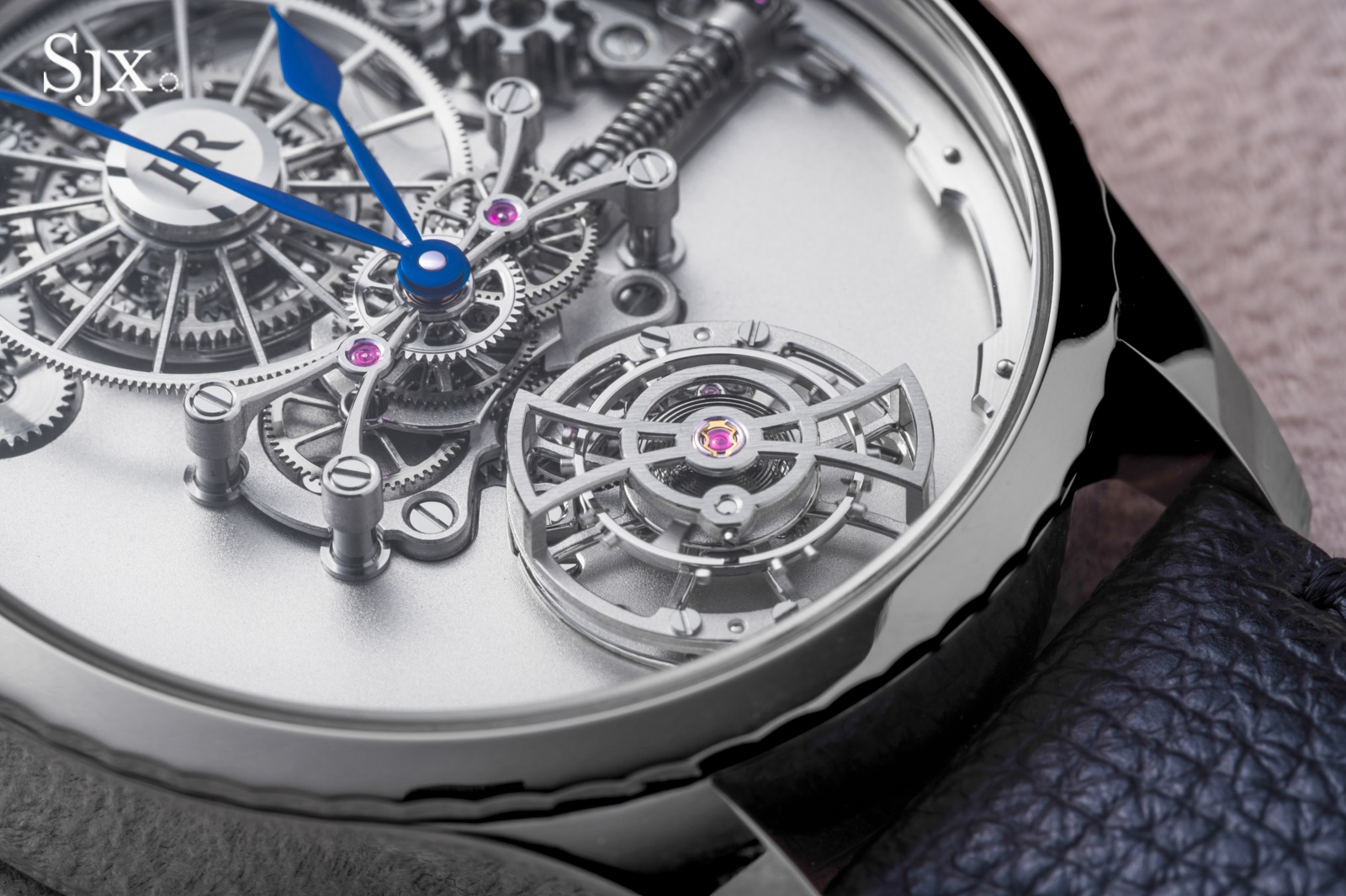
Inside the tourbillon beats a slow-paced 2.5 Hz screwed balance. The movement is torque intensive and the idea is to get the most usable mainspring turns, so the slower beat rate is understandable. Otherwise the regulator is of high quality, being free-sprung but lacking a Breguet overcoil. Given the vertical elevation of this movement, an overcoil could have fit inside the cage.
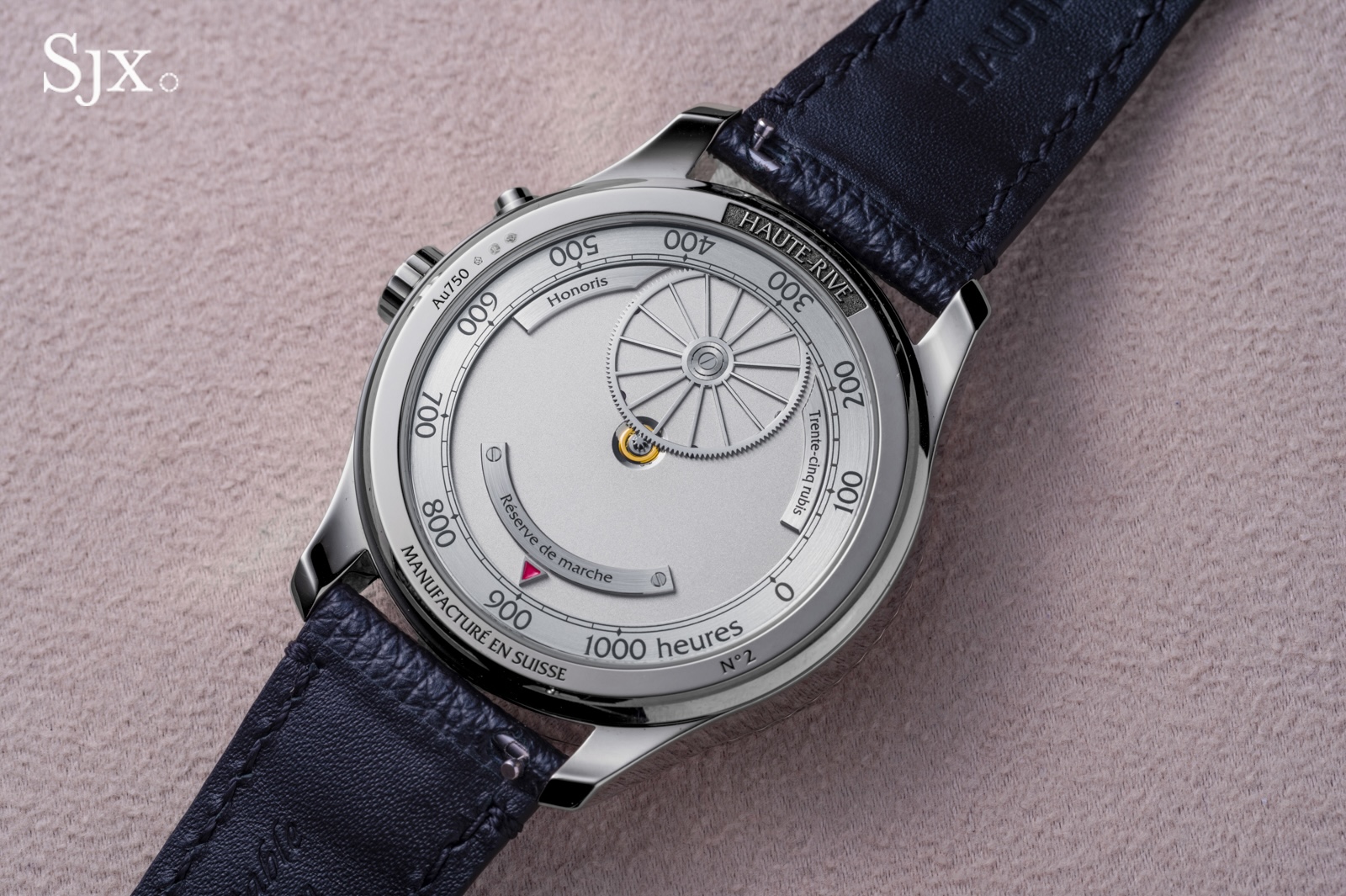
One last interesting technical solution can be found on the case back. The power reserve disk is perhaps one of the simplest power reserve indicators on the market — and that is due to the mainspring setup.
As explained, the only turning part of the spring assembly is the arbour. So in practice, the only component moving in accordance with the winding states is the arbour — thus making for an ideal “natural” power reserve indicator.
There is a small pinion visible on the caseback which engages with the ring indicator via a large spoked wheel. Due to the ratio between pinion and ring, the indicator makes one full turn as the arbour rotates between winding states.
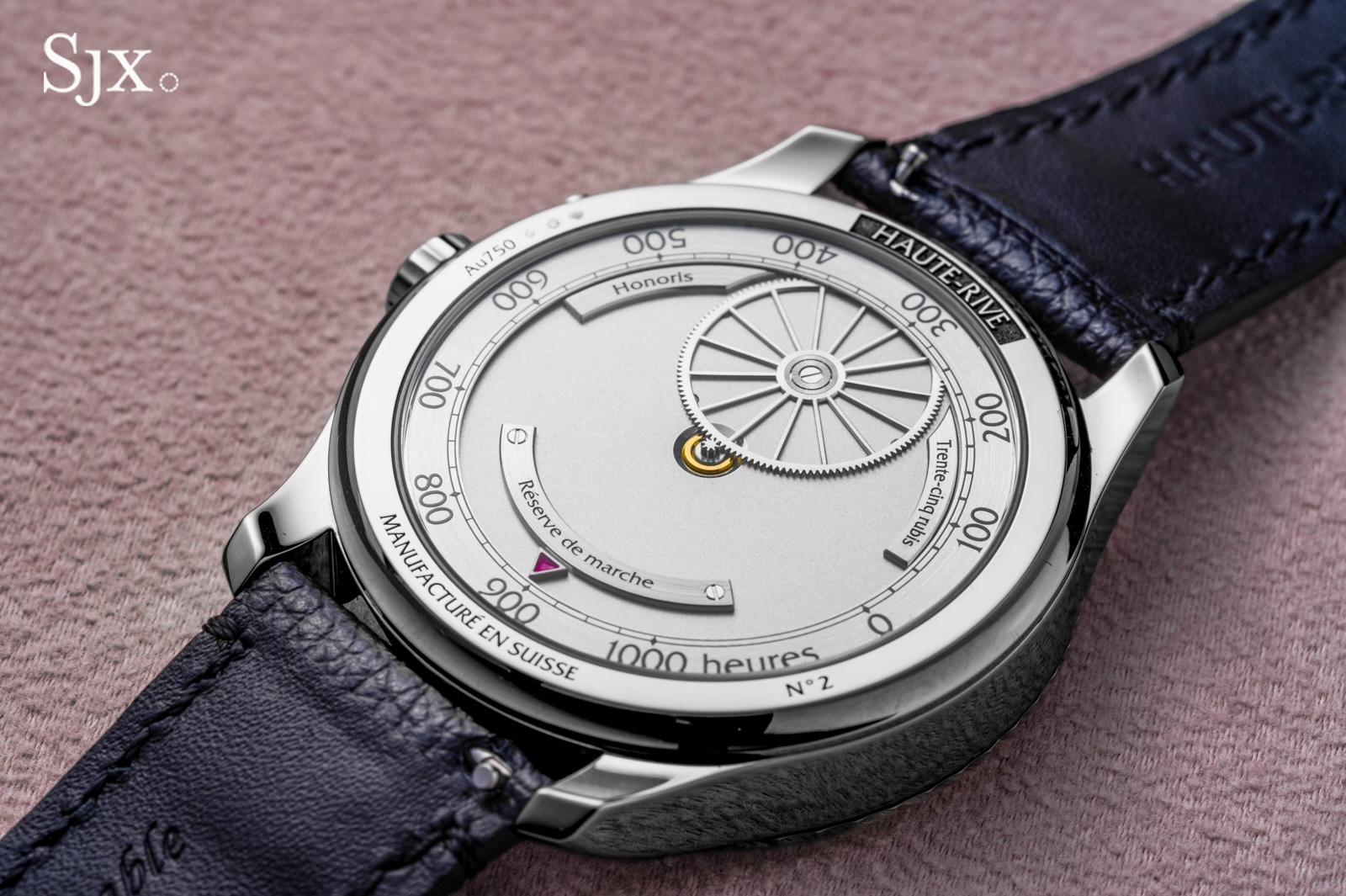
The only subtlety of this indicator relates to how the arbour can still be wound even past the maximum power reserve due to the slipping spring construction. Following the arbour’s continued motion, the power reserve indicator would overshoot, advancing past the “1000” mark towards zero.
To overcome that issue, there is a tensioner joining the ring gear and ring indicator together, so that the engraved indicator can be stopped while the arbour still turns. After winding stops, the indicator resumes its normal motion, counting down the hours.
Concluding thoughts
In summary, the Honoris Meccanica is less about its impressive 41-day power reserve and more about the manner in which it is achieved. By rethinking the conventional barrel architecture and leveraging a differential in such an unconventional way, Stéphane von Gunten has proven his technical acumen in a new context.
After his work with silicon and other advanced materials at Ulysse Nardin, going back to just steel and brass was surely limiting. Yet despite this constraint, the traditionally-crafted Honoris feels as advanced as pieces made by the bigger technical players in the industry.
Key Facts and Price
Haute-Rive Honoris Meccanica
Ref. HM-WG-RH
Diameter: 42.5 mm
Height: 11.95 mm
Material: 18K White gold
Crystal: Sapphire
Water resistance: 30 m
Movement: HR01
Functions: Hours, minutes, flying tourbillon, 41-day power reserve.
Winding: Manual
Frequency: 18,000 beats per hour (2.5 Hz)
Power reserve: 1,000 hours
Strap: Hand-stitched leather strap
Limited edition: No, but limited by production time.
Availability: Direct from Haute-Rive
Price: CHF158,000 excluding taxes
For more, visit Haute-rive-watches.ch.
Back to top.