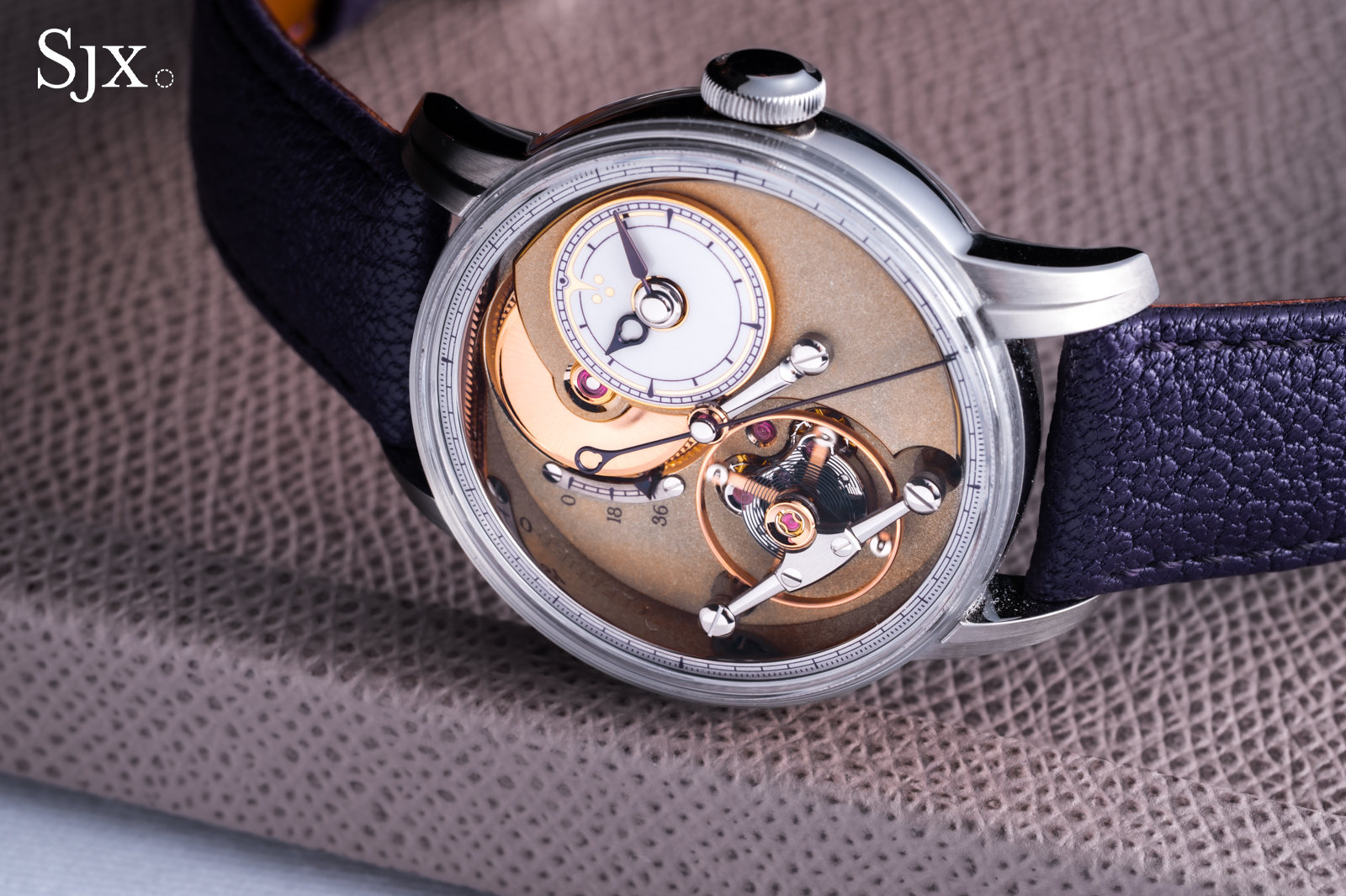
Mathieu Cleguer makes his debut under his own name, with the intricate Inspiration One. The relatively young movement constructor is well known in the industry but has not produced watches under his own name until now. Having worked for various movement specialists — including a stint at Akrivia — Mr Cleguer launches Cleguer Horology with a thoroughly impressive debut featuring a proprietary escapement.
Initial thoughts
Although the market for artisanal time-only watches has becoming increasingly crowded, sometimes a new creation comes along that genuinely stands apart. This is the case with Cleguer Horology’s Inspiration One — a watch that that is surprisingly refined and technically imaginative for a new maker’s debut.
Mathieu Cleguer is representative of a new class of independent watchmakers who are not ‘watchmakers’ in the traditional sense. Instead, he is an engineer, with the training and experience to bring fundamentally new concepts to life, so long as he can find the manufacturing partners and bench watchmakers to help realise his vision.
It’s a fundamentally different background than what we’re used to seeing — George Daniels, Kari Voutilainen, and François-Paul Journe started their careers doing hands-on restoration work long before they designed movements of their own. But times have changed, and the emergence of engineer-led brands is a new trend made possible by the depth of the supplier network in Switzerland.
For the visual design of the Inspiration One, Mr Cleguer worked with artist Lee Yuen-Rapati to create a strong visual identity for his first piece. Mr Yuen-Rapati is perhaps better known by his Instagram account One Hour Watch, and earns consistent praise for his designs. Some founders would have insisted on designing their first watch themselves, but such efforts rarely succeed — there’s no substitute for a real designer.
Mr Cleguer also focused on bringing something new to the table from a mechanical point of view, not merely dressing up a basic movement. He invented, prototyped and finally produced a working novel double-wheel escapement — the Innate escapement. Such endeavours are not easy, especially for an engineer working as a one-man research and development team.
Finally, Mr Cleguer opted for a limited inaugural run of souscription pieces. Housed in titanium and priced just below CHF60,000, all 12 pieces have already been sold. Future configurations will shift to precious metal cases, priced closer to the CHF100,000 mark.
This pricing might have felt ambitious a few years ago, but in today’s market it feels justified. And launching with a well-priced souscription series in titanium was an astute way to draw attention and reward early believers.
Style and finish
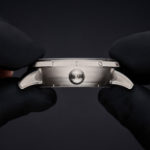
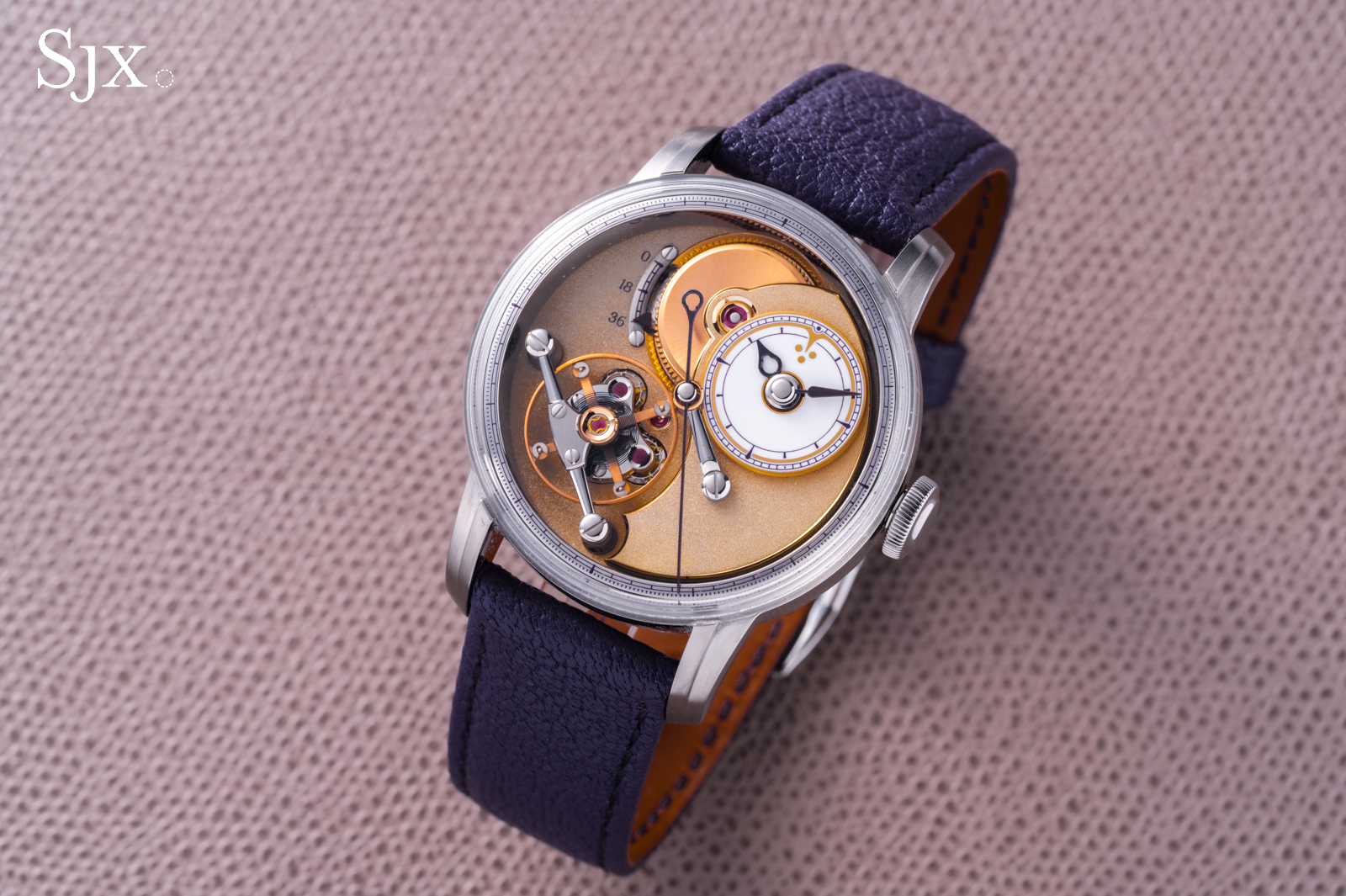
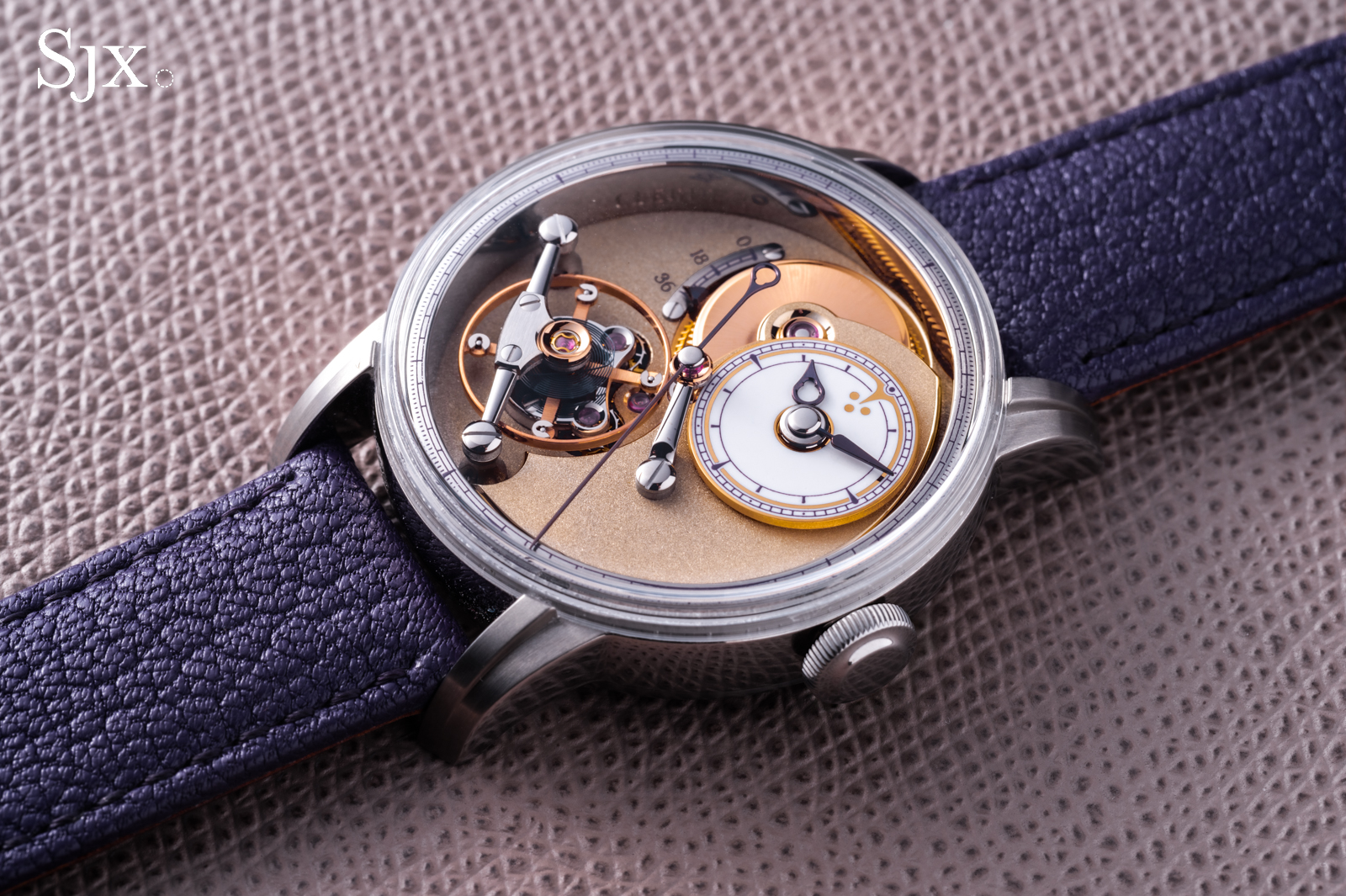
The Inspiration One souscription edition pictured is cased in a comfortably sized 38.5 mm titanium case that’s about 12 mm thick, defined by simple but resolute lines. There is no bezel, a trick often employed to guide the eye toward the dial.
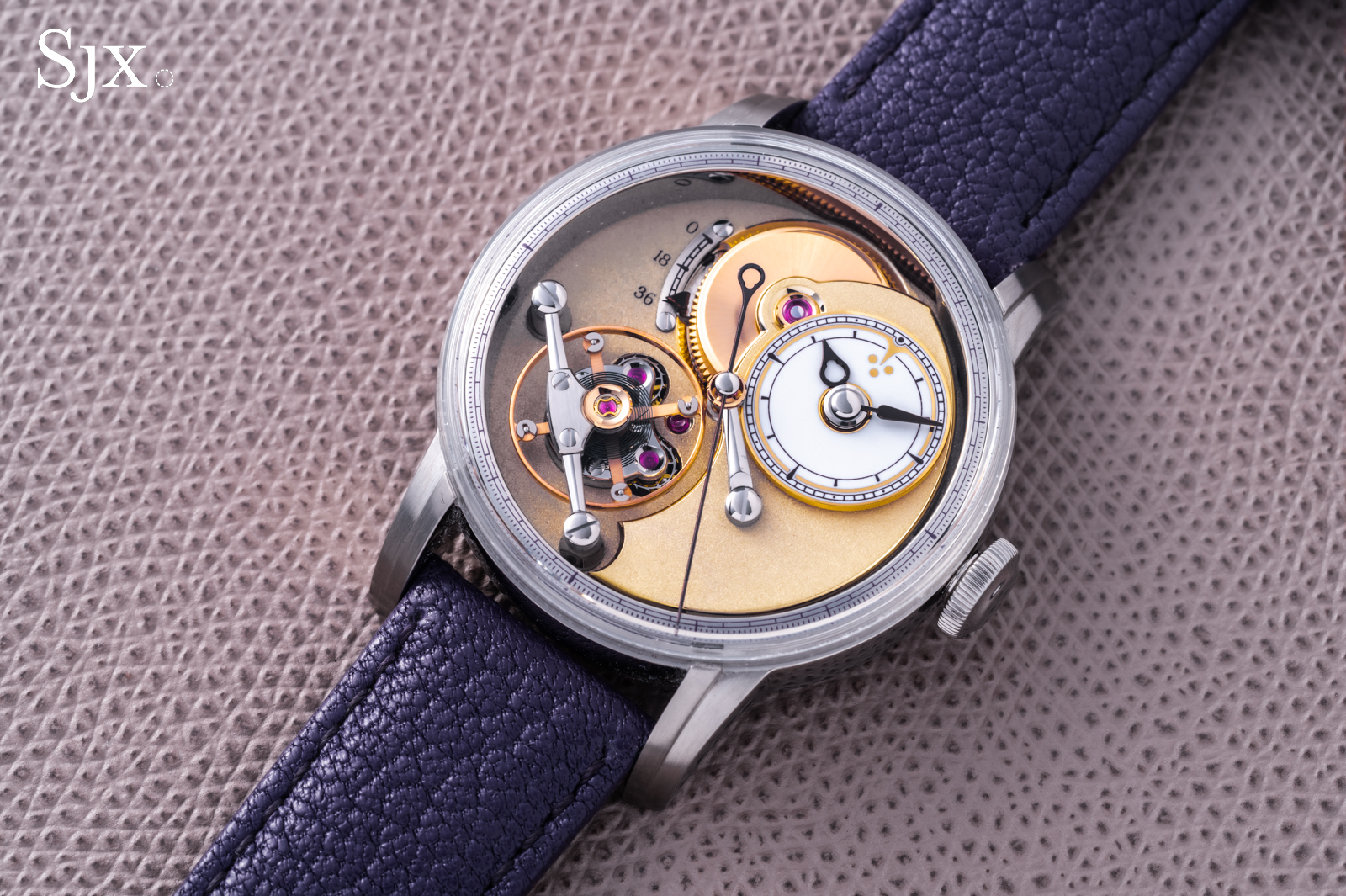
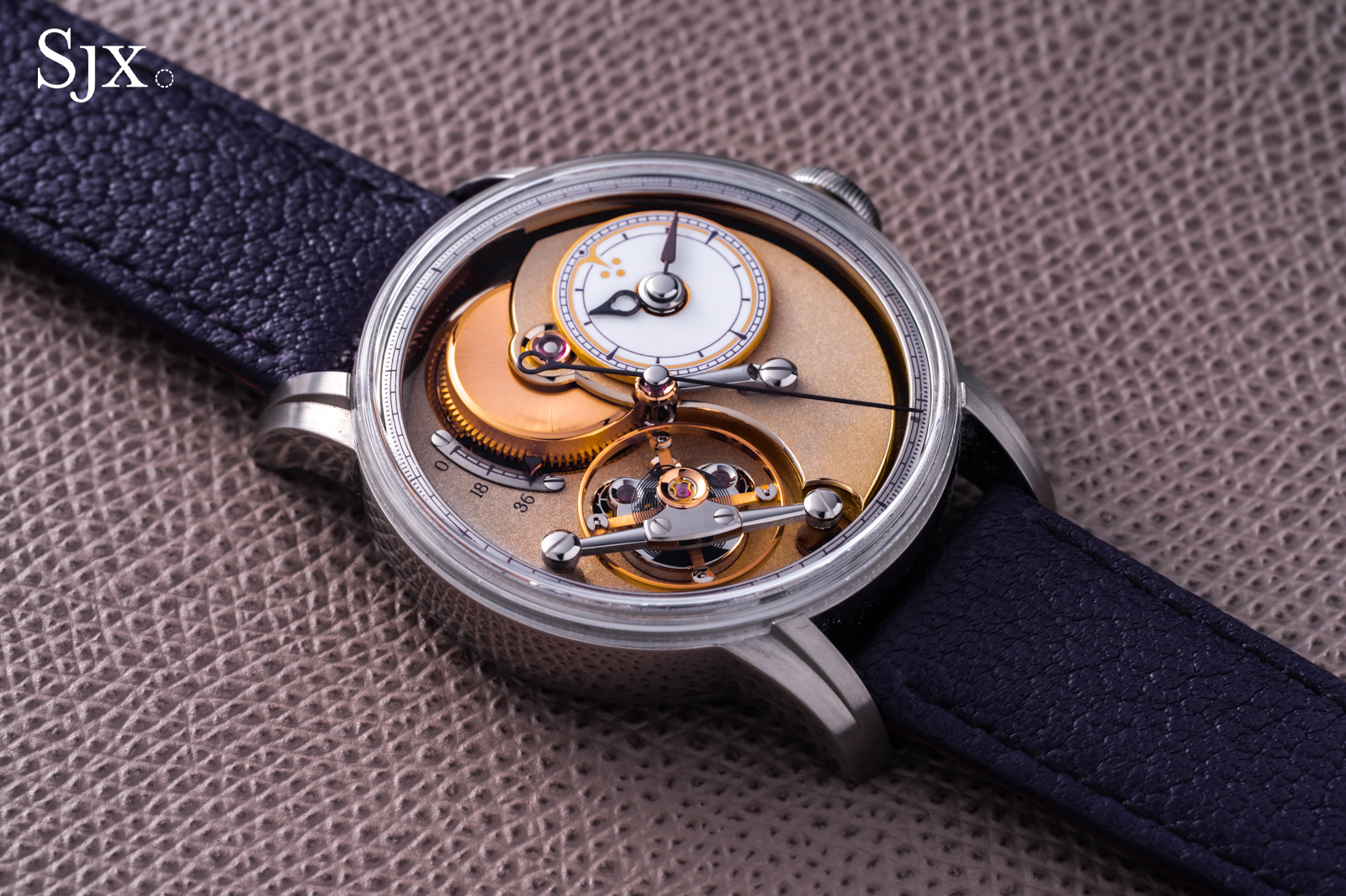
Of course, with the Inspiration One, there is a lot more to see than just the dial. The dial is actually a rather small champlevé Grand Feu affair placed off-centre. The design plays on both colour and shapes with blue and gold print and beefy (but elegant) blued hands.
The seconds hand is centrally mounted — suggestive of the focus on chronometry.
Right next to the dial, at the 12 o’clock position, sits the barrel. The visible drum is gently solarised and pivots in a gold jewel setting. The power reserve scale is positioned intuitively at the edge of the barrel itself.
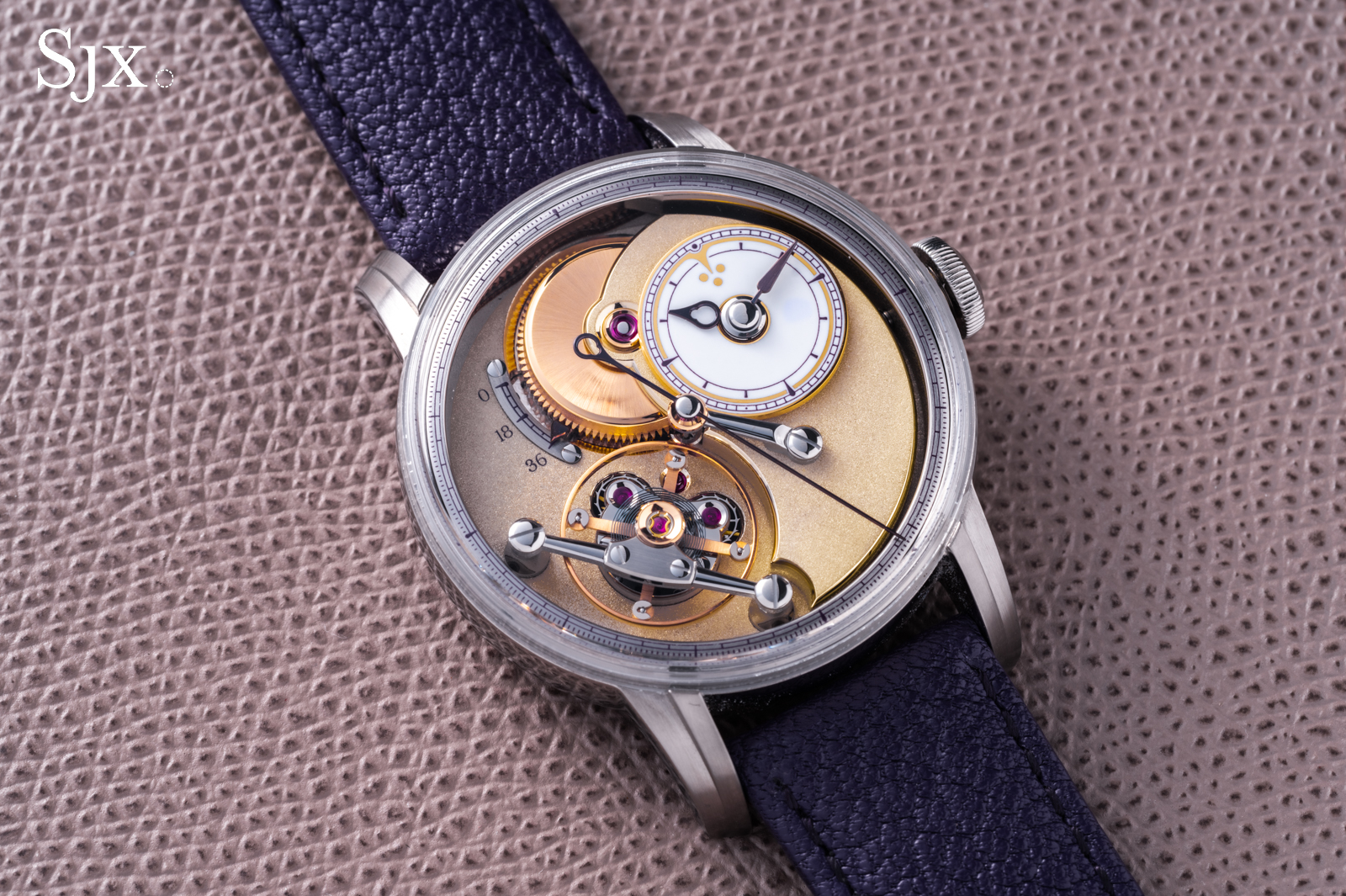
As indicated by the power reserve scale, the movement will only run for 36 hours on a full wind before it stops due to a Maltese cross stop-work. The idea is to use only the linearly decreasing torque stored inside the barrel — so the mainspring is never fully wound nor fully uncoiled.
The most dynamic part of the dial-side tableau is the large 2.5 Hz balance wheel. Featuring a free-sprung architecture, the balance is paired with a blued hairspring with a prominent overcoil. The weighted balance is supported by a polished steel bridge.
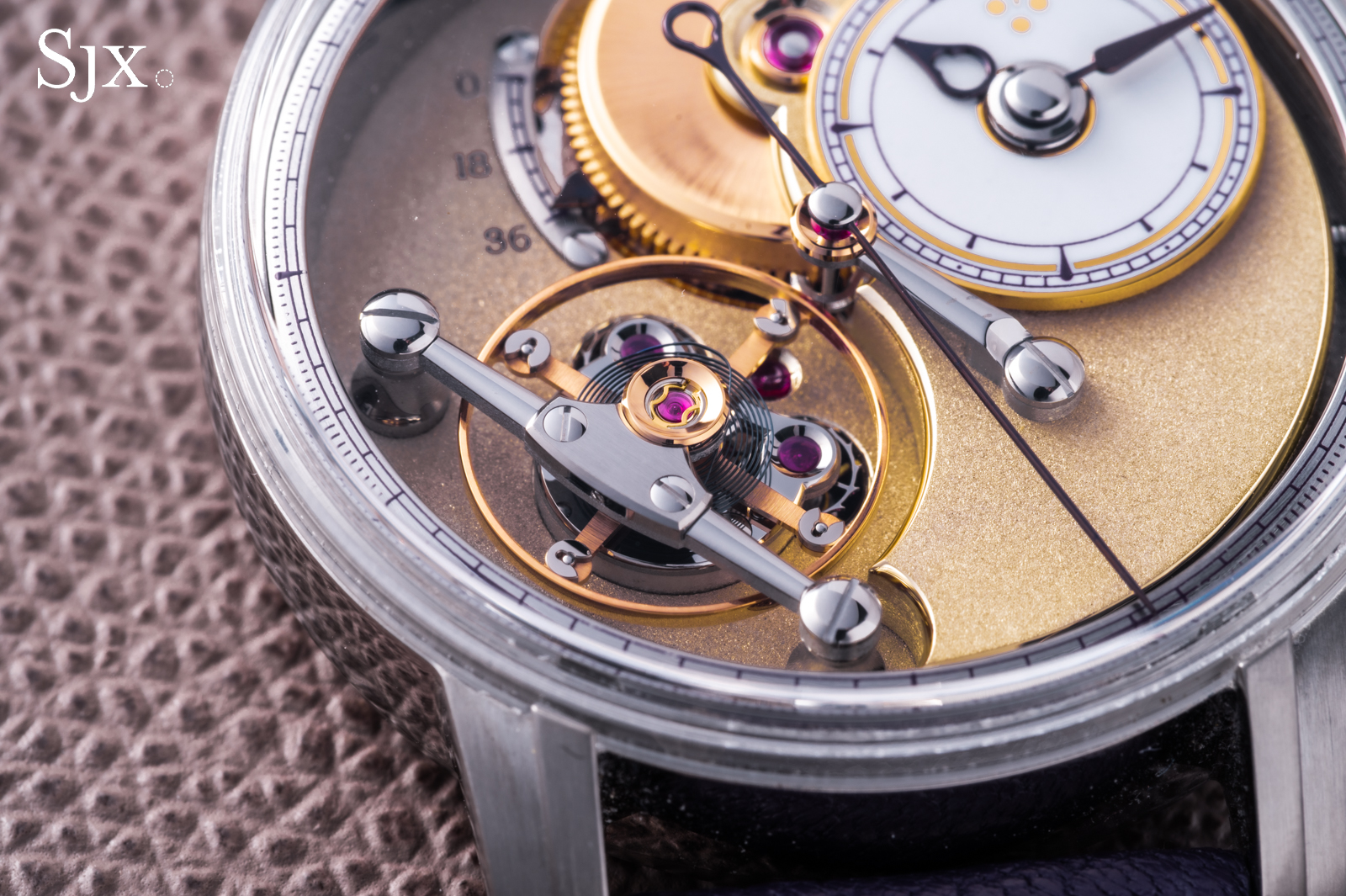
Charmingly, the pivot is anchored outside of the bridge’s axis. Apart from just being an eccentric design choice, the bridge shape allows a better view of the hairspring’s rhythmic breathing and a glimpse of the twin escape wheels underneath.
The plates are made from untreated German silver — hence the warm hue. The surface is grained, serving as a neutral background to the black polished steel components.
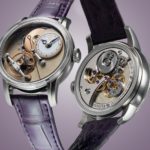
The same emphasis on layering is carried over on the case back, which is characterised by greater density in terms of components.
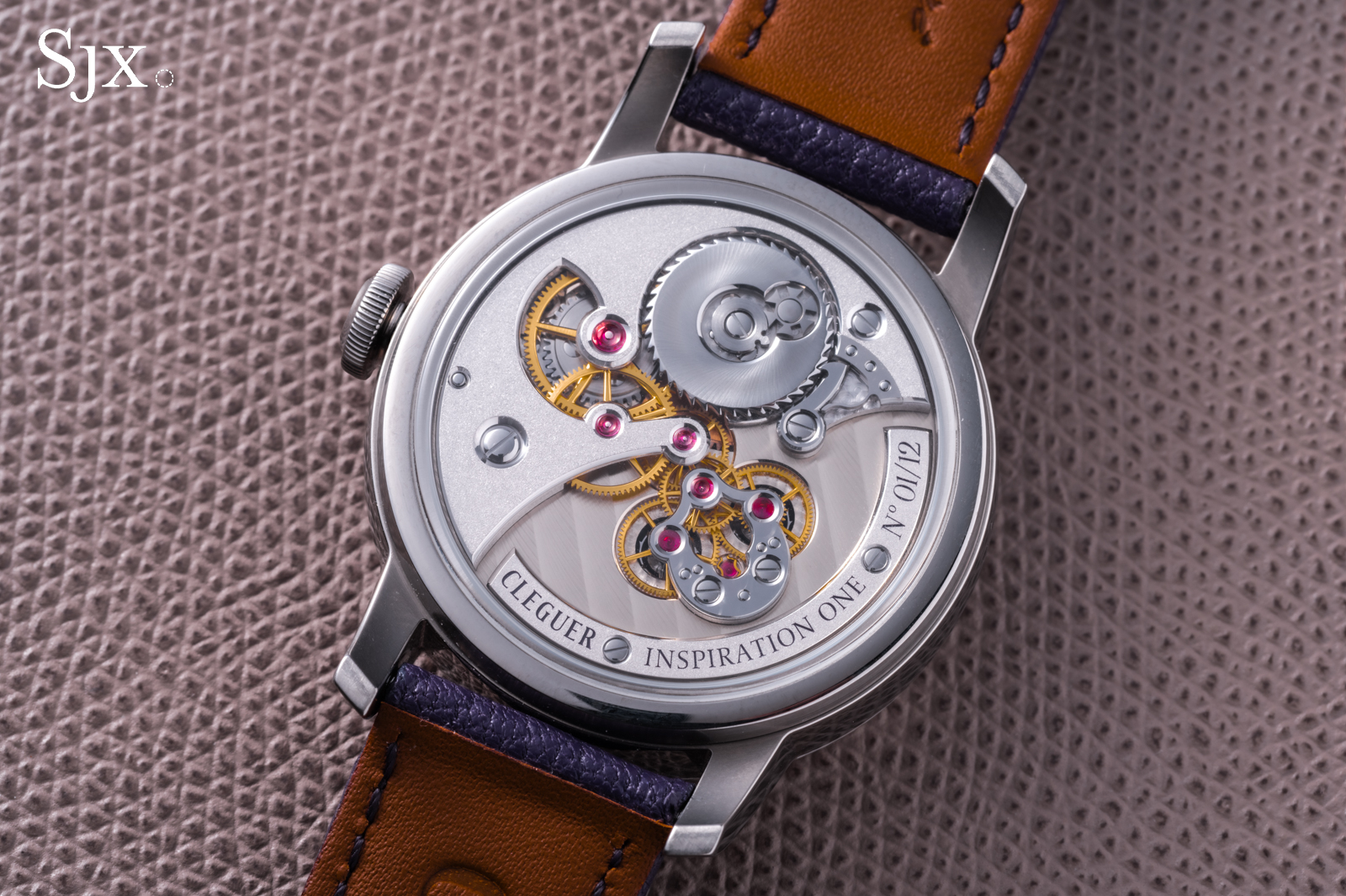
The entire going train is on full view, from barrel to the twin escape wheels. There is one raised bridge which anchors the barrel together with the first three mobiles of the going train. The bridge is still grained, but treated with a steely grey finish.
A second, smaller bridge holds the escapement components. Made from black-polished steel, the bridge vaguely resembles a lyre, although the shape was chosen to cater to the specific geometry of the Innate escapement.
The marks of a constructor
During winding, the click action is heavy and properly crunchy — winding the Inspiration One is both a tactile and visual treat. The ratchet wheel with its sharp wolf’s teeth looks disconnected from the winding train. This is a deliberate choice — the ratchet wheel conceals a smaller winding wheel fixed on the underside. The hidden gear connects with the crown wheel and completes the winding works.
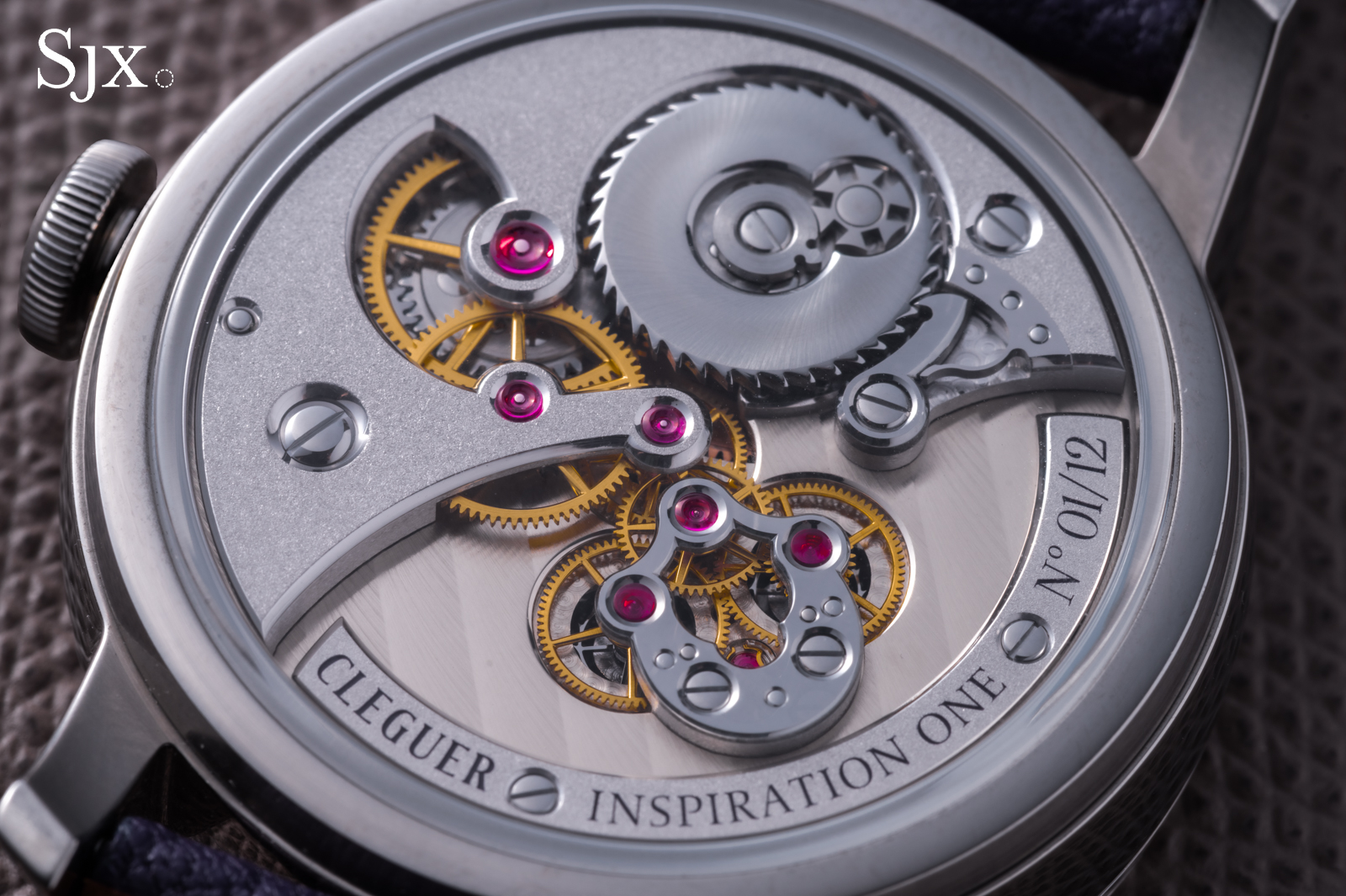
The dual-levelled ratchet wheel is journaled to a sleeve-like mainspring arbour component. The sleeve fits over a central pillar — which is fixed to the barrel drum. The fixing point of said pillar is on the dial side, but is concealed by the barrel bridge. This construction is characteristic of motor barrels.
The sleeve arbour is linked to the inner ends of the mainspring, while the outer ends are attached as usual to the inside of the barrel drum. The point of this elaborate construction is to allow the unusual sight of having the Maltese cross stop-work mounted directly on the ratchet wheel. The Maltese cross (Or Geneva stop-work) is the classic way of making sure the barrel torque is linearised over the running time of the timepiece.
In the classic construction of this system, the “finger” component is rigid with the arbour and the “cross” piece is affixed to the barrel drum. During winding, the finger would advance the cross in steps, until the latter’s geometry prevents further turns. As the barrel would then slowly unwind, the finger would remain still and the cross slowly turn against it until stoppage.
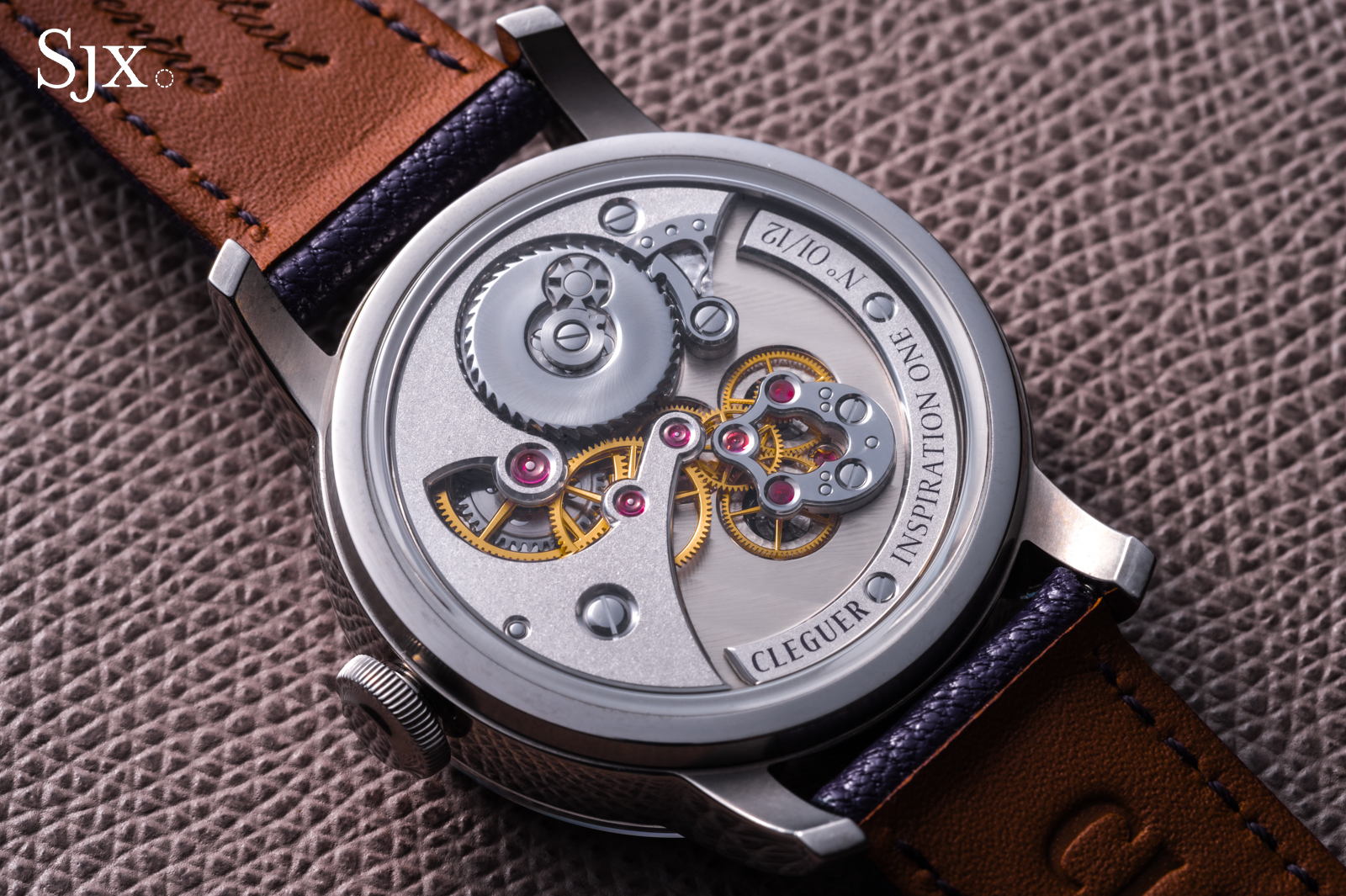
In Mr Cleguer’s design, the ratchet-mounted cross wheel revolves around the finger during winding. The finger piece is rigidly connected to the barrel drum via the central pillar, and the ratchet is free to pivot around it, arming the mainspring through the sleeve-arbour.
This makes for a more dynamic winding experience, but the construction remains otherwise functionally identical to the classic implementation. But the execution is more complex, showcasing Mr Cleguer’s skill as a movement constructor and willingness to devise elegant alternatives to commonplace mechanisms.
There is also a flat differential for the power reserve indicator hidden between the layers of the winding works. Relying on epicyclic gearing and a rather dense assortment of pinions, the power reserve indicator mysteriously sprouts from the underside of the inverted barrel. The wearer can easily read the remaining power reserve using the discreet blued hand and a small silvered sector.
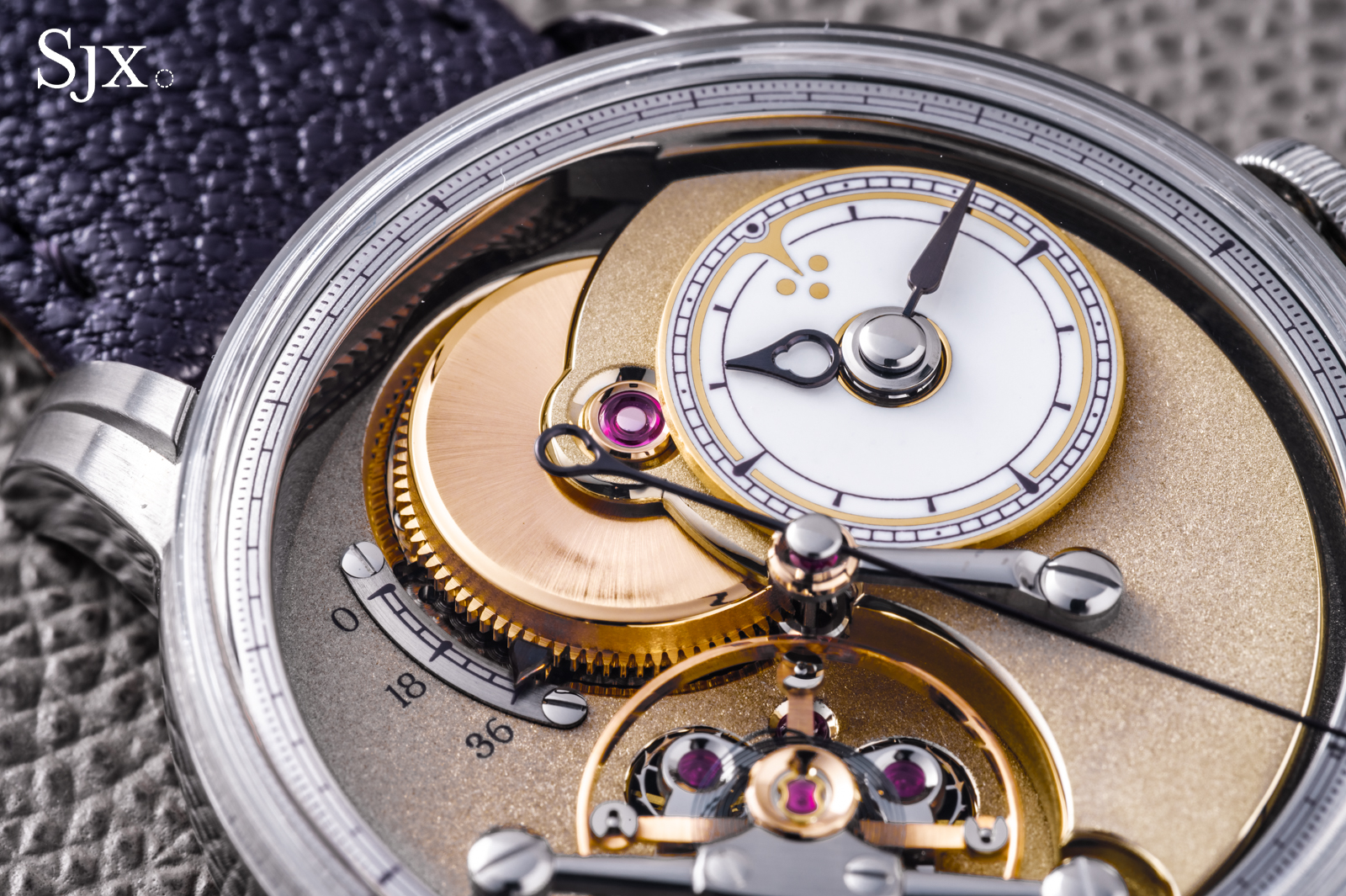
Another cleverly-constructed element is the hacking lever. Since the balance wheel is on full display and secluded visually from other components, a classic hacking lever tongue would have ruined the view.
Mr Cleguer hid the hacking lever within the layered construction. The lever sits flush under the raised dial plate and its tongue is rounded, as to fit around the the central seconds hand pivot. When the crown is pulled, the concealed tongue sprouts outward, gently pushing against the balance rim to halt its swing.
The Innate escapement
Although it cannot be filed under natural escapements, the so-called Innate escapement is an interesting blend of the Fasoldt chronometer, Robin escapement and Breguet’s infamous natural escapement. This new double wheel escapement of Mr Cleguer’s own design is arguably the main selling point of the Inspiration One so it warrants a closer look.
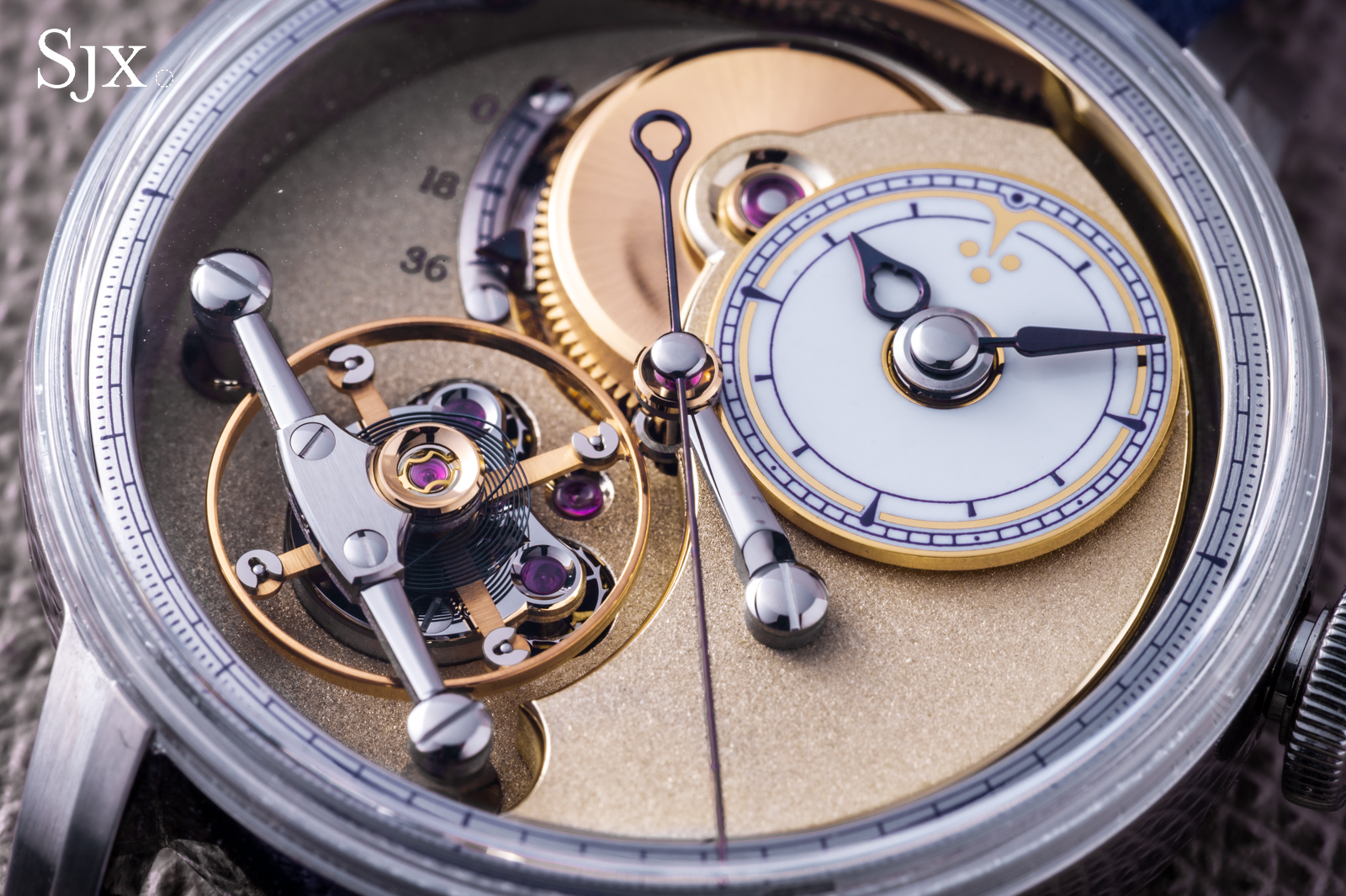
In many ways the Innate escapement is an original and well-executed attempt at ameliorating the weaknesses of the current pool of escapements — both mass-produced and artisanal. Developing new escapements is not a straightforward process and every sub-family of escapement comes with its own issues.
Escapements in which the balance roller has to interact with both a lever and directly with the escape wheel are inherently harder to set, due to tighter geometry constraints and overall tolerance of engagements. Examples include the Daniels co-axial, the Grand Seiko Dual Impulse escapement, and the various executions of the Double Independent Wheel escapement.
Due to the tolerances required, direct escape wheel-to-balance engagements are not always desirable. Direct tangential impulse to the balance may be considered the cleanest form of impulse but sometimes it is wise to find ways of working around it entirely.
Mr Cleguer’s take on the matter is rather smart as it combines the security of the balance roller and fork interaction found in the ubiquitous Swiss lever with a purely tangential escape wheel-to-lever impulse.
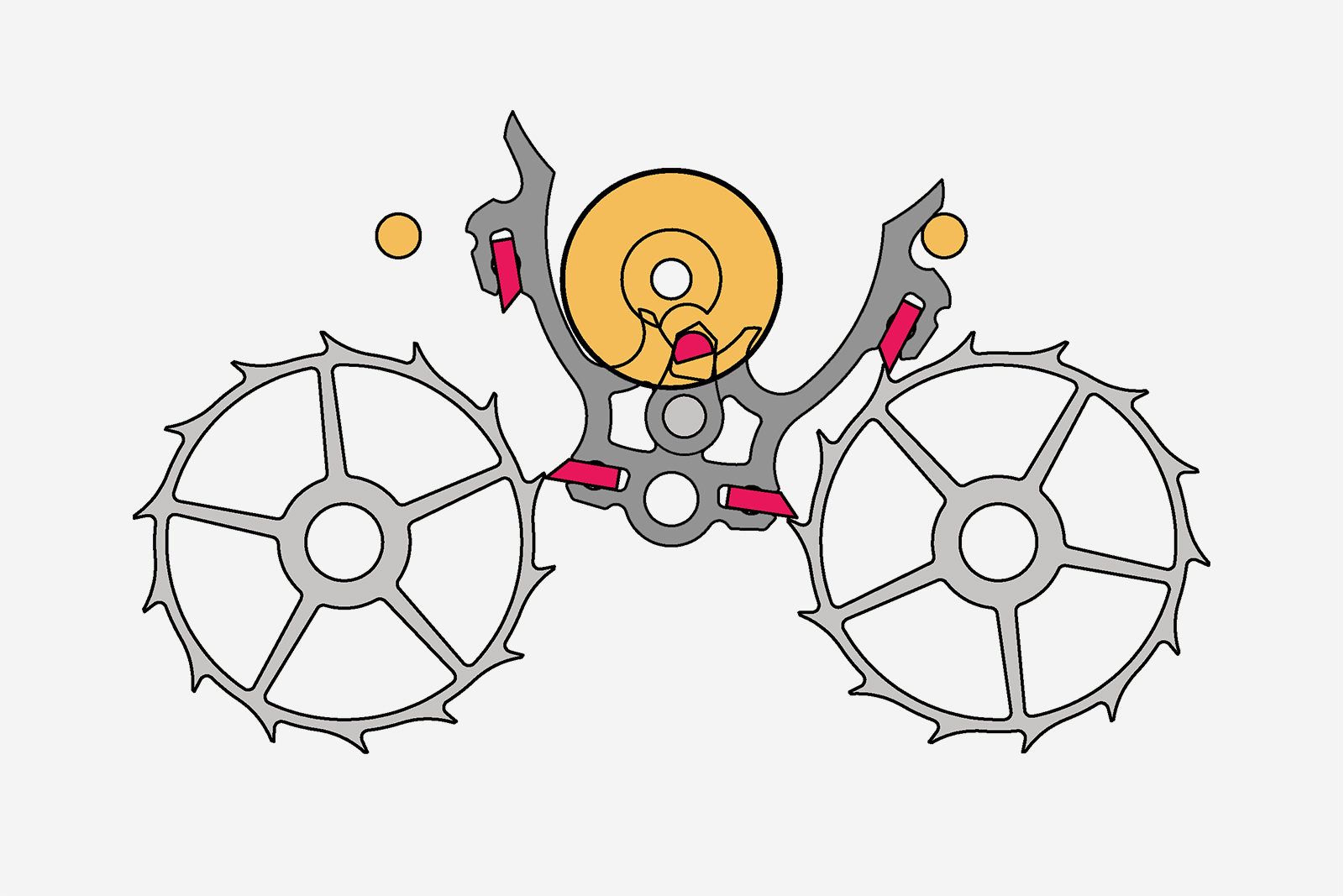
Figure I. Image – Mathieu Cleguer
There are two steel escape wheels, meshed together on the underside via large gears. The first “motor” escape mobile is directly powered by the going train, carrying the second “dead” mobile along.
The Innate escapement has a rather intuitive working cycle. Figure I shows the right escape wheel locked by one of the locking stones of the broad lever. The balance swings clockwise towards the anchor, initiating the unlocking.
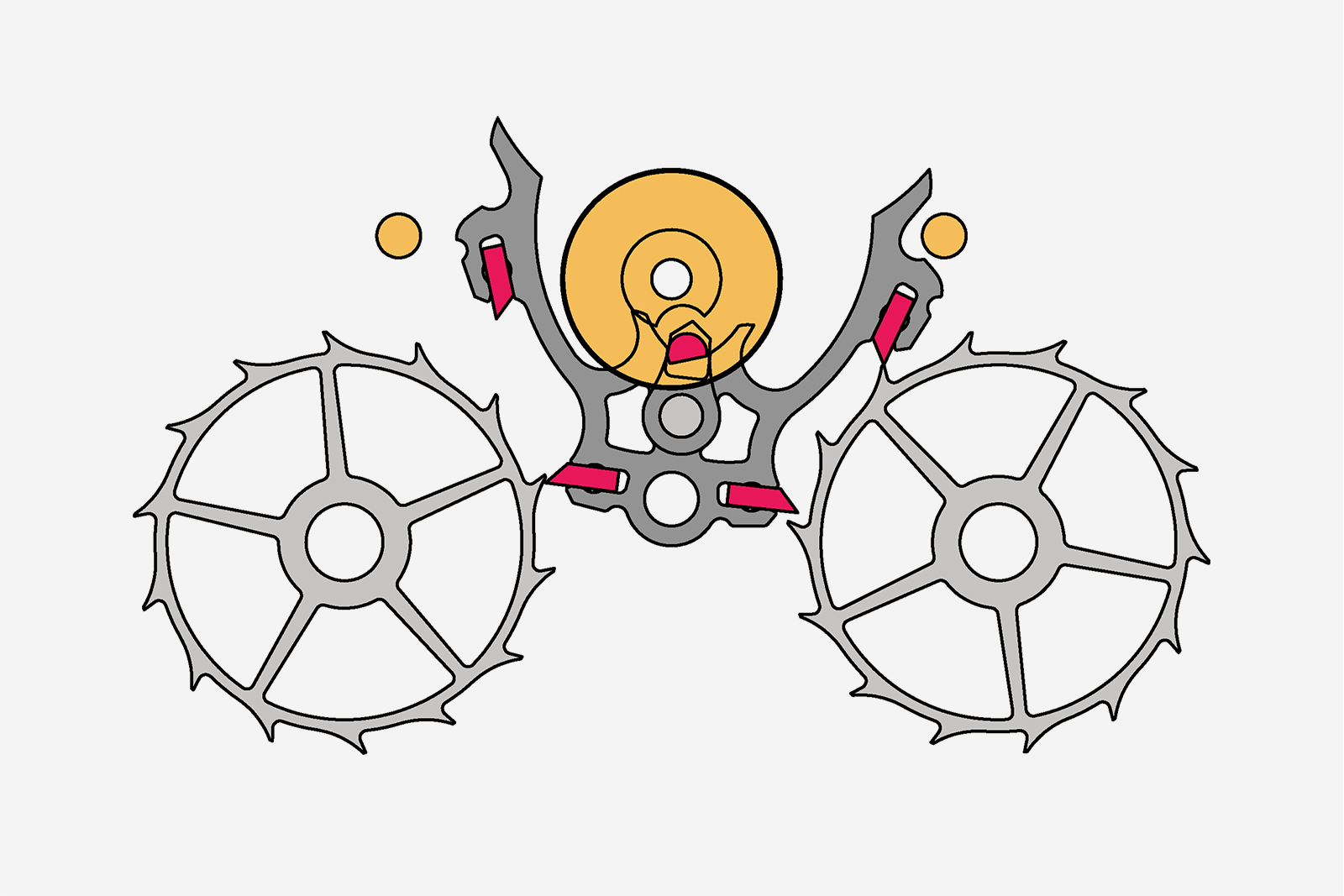
Figure II. Unlocking. Image – Mathieu Cleguer
Figure II shows the recoil of the escape wheels. There is a noticeable gap between the escape tooth and impulse pallet; the lever advances while the escape wheel is pushed backwards.
Figure III shows the escape wheel finally liberated and catching up with the impulse pallet, actively pushing it. The impulse phase resembles the detent’s tangential impulse.

Figure III. Impulse. Image – Mathieu Cleguer
Finally Figure IV shows the impulse phase coming to an end. The lever has reached the end of its travel and rests against the opposite banking pin. The escape wheels advance some more, making the run to the next locking. This is considered dead travel, much like the initial drop to the impulse pallet.
A strong draw effect on the locking stones ensures the lever is kept tightly against the banking pins, leaving sufficient clearance for the inactive escape wheel to advance past the impulse pallet.

Figure IV. End of lift. Image – Mathieu Cleguer
The escape wheels are offset by a half-tooth spacing and over one oscillation cycle (two vibrations, hence two unlockings, impulse delivered by both wheels) each wheel advances angularly by one escape tooth spacing.
Crucially, the wheel that is locked (thus under tension from the barrel torque) is also positioned to impart impulse after unlocking. As such, there is no “flutter” involved in the “dead” escape wheel, so impulse is consistent when coming from both wheels.
The same trick was used inside Rolex’s Dynapulse. Of course, the difference in construction is undeniable, but the core principle remains the same. Since Mr Cleguer has privately worked on this project for a long time and everyone knows how secretive Rolex is, there is no way the two systems are even remotely connected.

Rolex Dynapulse for comparison. Image – Rolex
Regardless, the Innate escapement and Rolex’s Dynapulse can both be reduced to the same functional schematic as per Dr. Oliver Laesser’s primitive escapement theory.
One notable difference however is that in the Dynapulse one escape tooth fulfills both locking and impulse functions. In the Innate escapement one tooth is locked and another delivers the impulse. While the first design makes the lever more ergonomic, the latter may help with diminishing surface wear over time.
Efficiency considerations
While the Innate escapement has all the signs of a chronometrically-potent escapement, there are a few elements that might lower its global efficiency. An escapement’s efficiency is determined by its frictional, inertial and geometric losses; while the frictional losses might be considered almost negligible, the other two criteria likely reduce the Innate escapement’s global performance.
Probably the Innate escapement’s greatest weakness can be found in the broad and heavy driving wheels, which look disproportionately large compared to the escape wheels themselves. This means the system must overcome a lot of inertia to accelerate from standstill.
Newer escapement designs often use titanium and/or hollow geometries to keep their mass (thus inertia) in check. In contrast, the Innate escapement relies on large brass meshing gears that are visually appealing but comparatively heavy. Add to that the large lever, and the inertial loss of the Innate escapement is likely substantial relative to most designs in use today.
Secondly — and this might be a stretch — the multi-purpose lever is unbalanced. Judging by the shape, position of the jewels and the elongated balance surfaces, the lever’s center of mass sits far away from the pivot point — meaning gravity can induce a bias to the system.
In other words, depending on the position of the timepiece, the consistency of impulse might vary. A true measure of the how real this effect is would be to measure the average torque at the escape wheel and compare it with the gravity-generated defect.
In terms of geometric efficiency, the Innate escapement also loses a little. Based on angle measurements taken on the escapement figures, the geometric efficiency of the Innate escapement was computed to be 66.1%. As a short reminder, this metric is the ratio of the useful travel of one escape wheel (when it is in full engagement with the impulse pallet) over the entire angular step.
Over one oscillation, each of the mirrored escape wheels travels 360/14 degrees. However, only 8.5° of useful impulse was measured. This is in part due to the heavy recoil of the escape wheels, which allows the impulse pallets to accelerate away from the escape tooth during unlocking. The angles of impulsion are visually shown in Figure V.
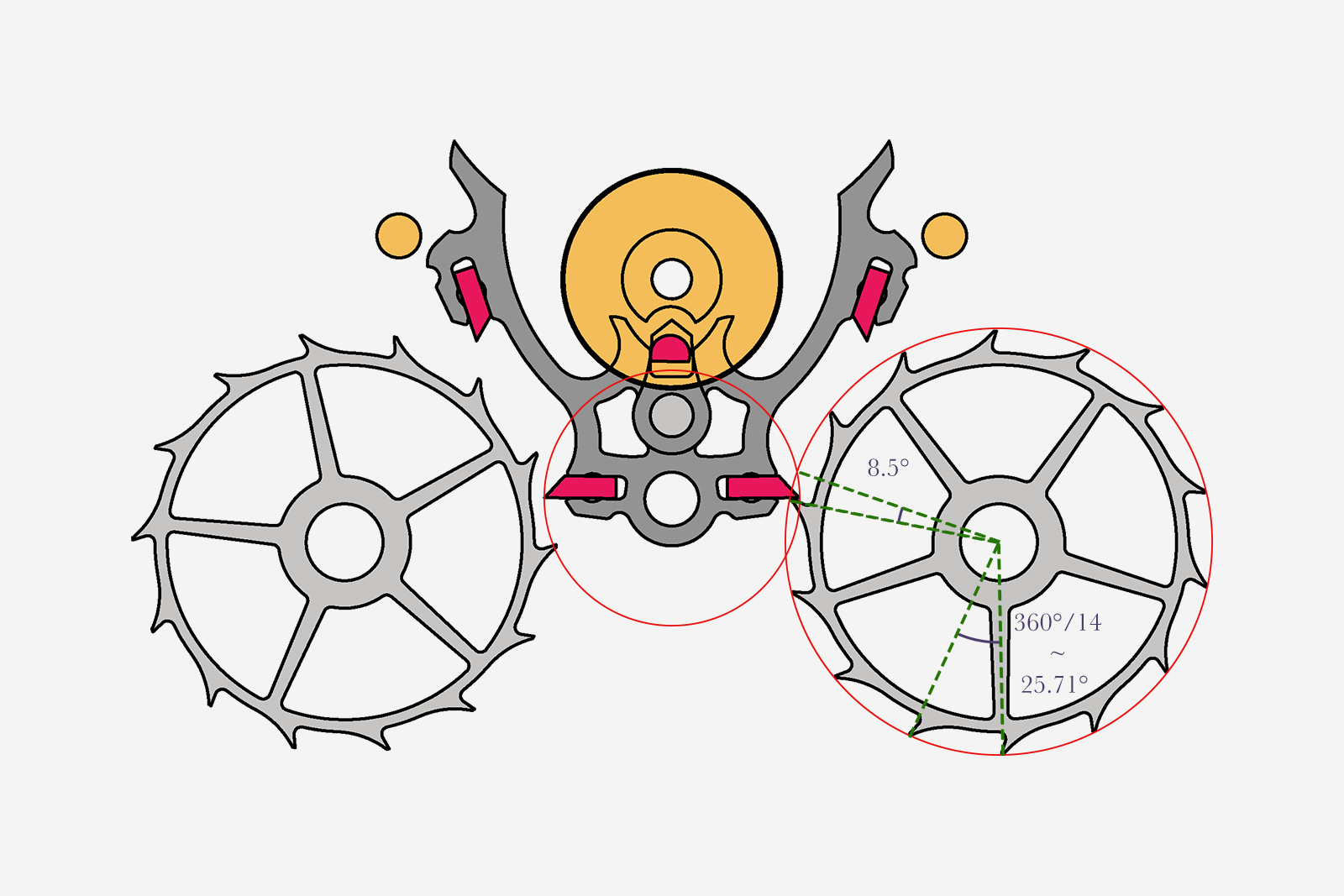
Figure V. Impulse angles. Image – Mathieu Cleguer, annotated by the author
The Innate escapement is said to be self-starting — a feature that is generally lacking from traditional natural escapements. The claim seems to be supported by the overall geometry of the system. When the watch is unwound, the large balance should be centred by the hairspring, keeping the lever in a relaxed, neutral position. Given the half-tooth offset between the escape wheels, as soon as some torque reaches the escapement, one escape tooth is bound to strike one of the pallets — thus initiating oscillation.
While the theoretical efficiency of the Innate escapement may be limited, that’s not to say it offers no chronometric potential — real-life experience will reveal how well the system will behave.
It’s also important to note that efficiency was not the key priority of the design and Mr Cleguer hasn’t made any bold claims about improving the efficiency over the standard Swiss lever. Instead, the benefit of the Innate escapement is that it runs cleaner than a Swiss lever and doesn’t require much lubrication — sound claims based on the escapement’s geometry.
Closing thoughts
Ultimately, the Inspiration One stands as a compelling debut from Mathieu Cleguer. From construction to finishing, the Inspiration One is the result of what has clearly been a long-time passion project for Mr Cleguer.
While the Innate escapement’s real efficiency might be debatable, it undeniably showcases an increasingly rare willingness to take risks and stray away from the beaten path. Reinventing something as fundamental as the escapement is always a commendable — if ambitious — undertaking.
From construction to finishing and style, the Inspiration One delivers in almost every respect. Perhaps most importantly, it manages to convey a distinct voice and style in a crowded field.
Key facts and price
Cleguer Horology Inspiration One
Ref. I1
Diameter: 38.5 mm
Height: 12 mm
Material: Souscription in titanium; choice of precious metals available for future series
Crystal: Sapphire
Water resistance: 30 m
Movement: I1
Functions: Hours, minutes, seconds, power reserve and innate escapement
Winding: Manual
Frequency: 18,000 beats per hour (2.5 Hz)
Power reserve: 36 hours
Strap: Leather strap with matching buckle
Limited edition: Yes, 12-piece souscription sold-out; total production of 80 pieces in four distinct precious metals.
Availability: Directly from Cleguer.
Price: CHF95,300 excluding taxes
For more information, visit Cleguer.com.
Back to top.