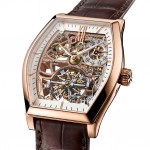
Hands On: Vacheron Constantin’s Overseas Tourbillon Titanium Red Dial

A new take on the premium sports tourbillon.
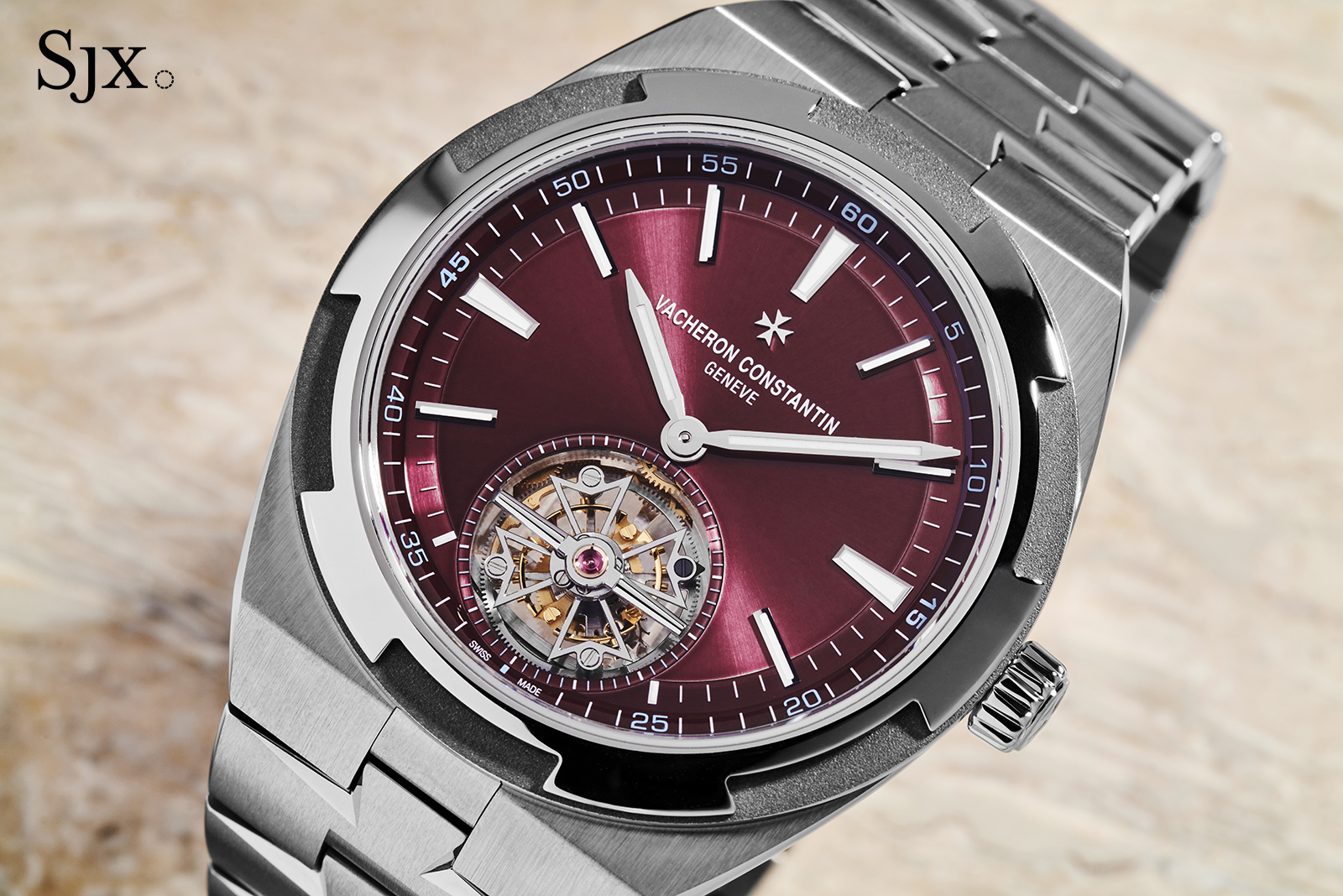
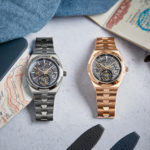
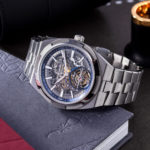
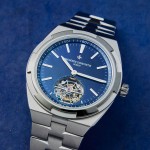
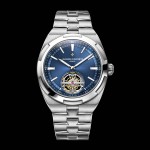
Vacheron Constantin’s latest Overseas Tourbillon pairs a titanium case with a deep red dial, recalling last year’s perpetual calendar, showcasing the cal. 2160 with peripheral rotor, refined finishing, and a slow beating one minute tourbillon. It represents the finest of industrial fine watchmaking with high-end construction inside and out.
Initial Thoughts

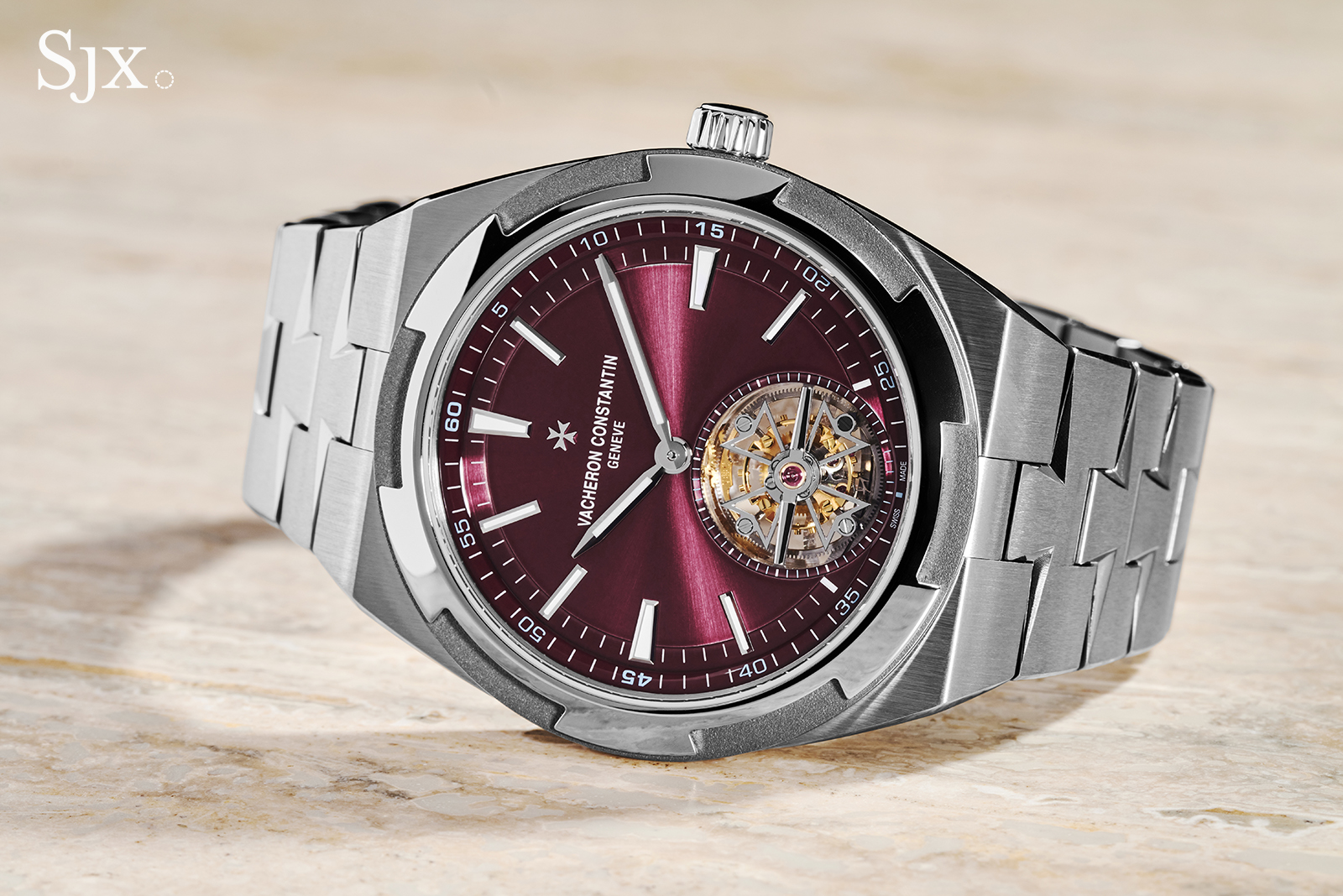
Last August Vacheron Constantin launched a pair of new Overseas Perpetual Calendars, one in burgundy and the other pink-on-pink. I felt the “deep red” dial – as Vacheron Constantin calls it – works particularly well against the white gold case, and the light blue accents were a nice touch.

Nothing has changed on that front, the colour pallette looks just as good now as it did then, but is now lighter, thanks to the titanium case, and equipped more impressive movement.
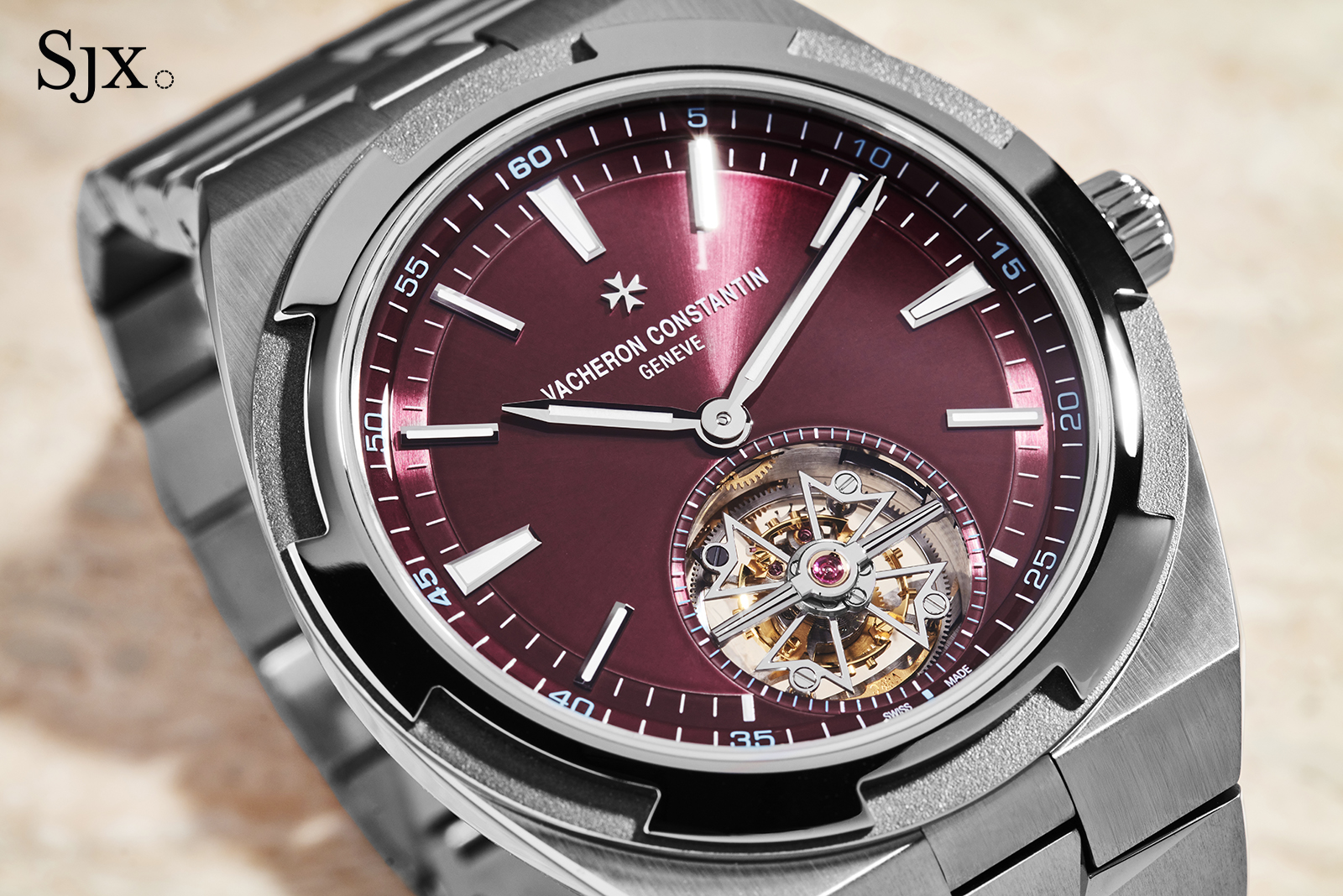
While the Overseas Perpetual’s movement somewhat lags behind its competition, the Overseas Tourbillon has a more competitive calibre, which holds its own against the Royal Oak Tourbillons, and wins by default against the non-existent Nautilus Tourbillon. That said, it is hardly a value within its segment, with estimated pricing comparable to Audemars Piguet’s blue-chip Royal Oak Tourbillons, though that is more than fair when you put aside brand caché and focus purely on the product.

Case and Bracelet

The Overseas case is well made and well finished by any standard, though not quite as complex as its counterparts from Audemars Piguet and Patek Philippe. However, the bracelet impresses more than the case itself in that regard, with the crisp, high-polished interior creases of the bracelet that form the Maltese cross motif no doubt being difficult to execute, especially in titanium.
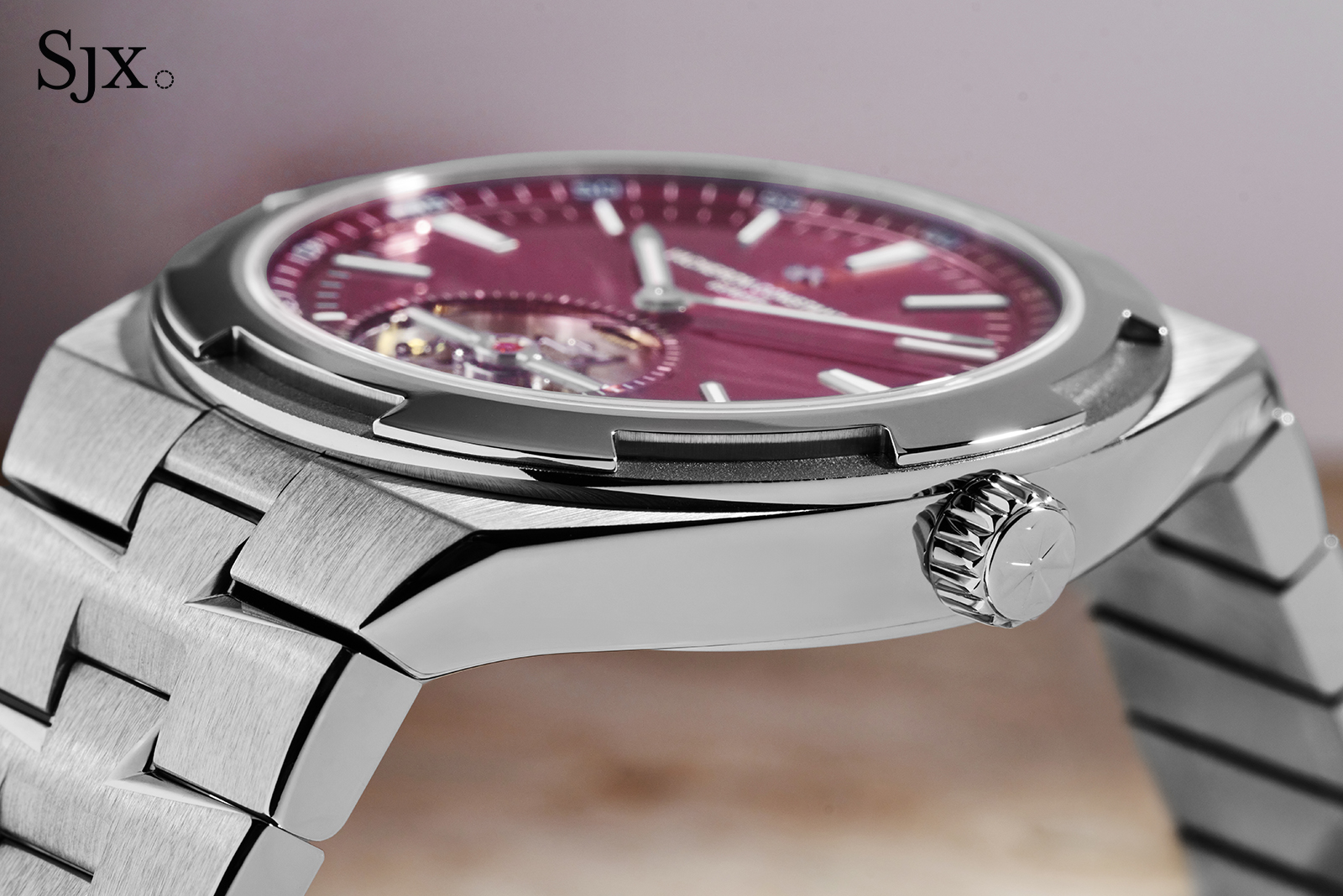
The case is otherwise appointed with a screw-down bezel (the functional purpose of the bezel’s Maltese cross motif), case back and crown to ensure its modest 50 m depth rating – which now surpasses that of the Nautilus. The movement is further protected by a soft iron ring, a defence against magnetism that doesn’t obscure the movement.
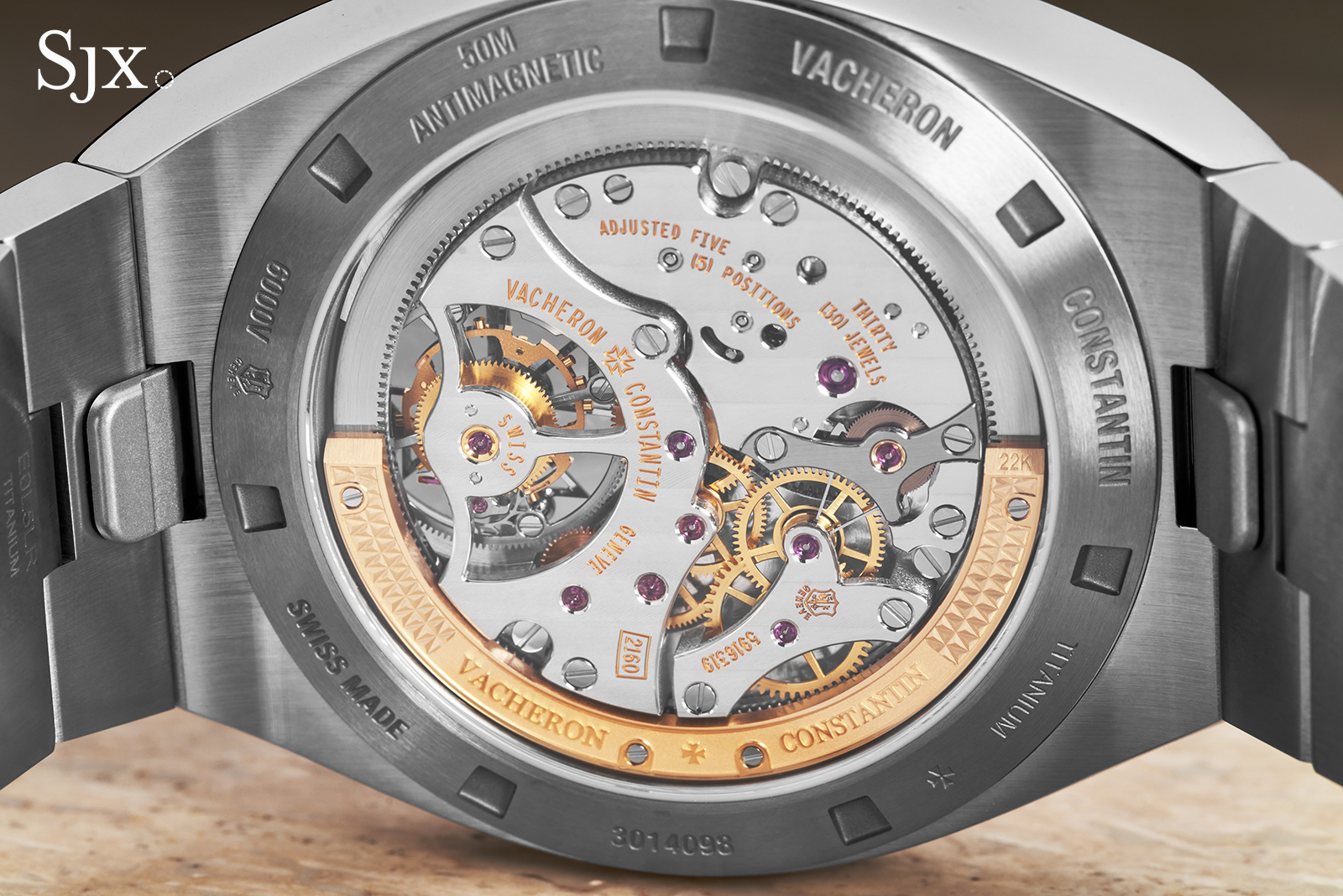
Pressing pressing the tabs where the bracelet meets the case releases it. Such systems are a staple of modern Richemont products at every price point. The bracelet also includes a tool-less comfort extension in the clasp.

A defining feature of this generation of Overseas models is the quick-release mechanism, allowing overs to exchange the strap in seconds without risk of marring the case with a spring bar tool. To this end, Vacheron Constantin delivers this model and many of its siblings with a bracelet and two additional straps. In this case, those straps red and white rubber and share a single titanium deployment clasp.
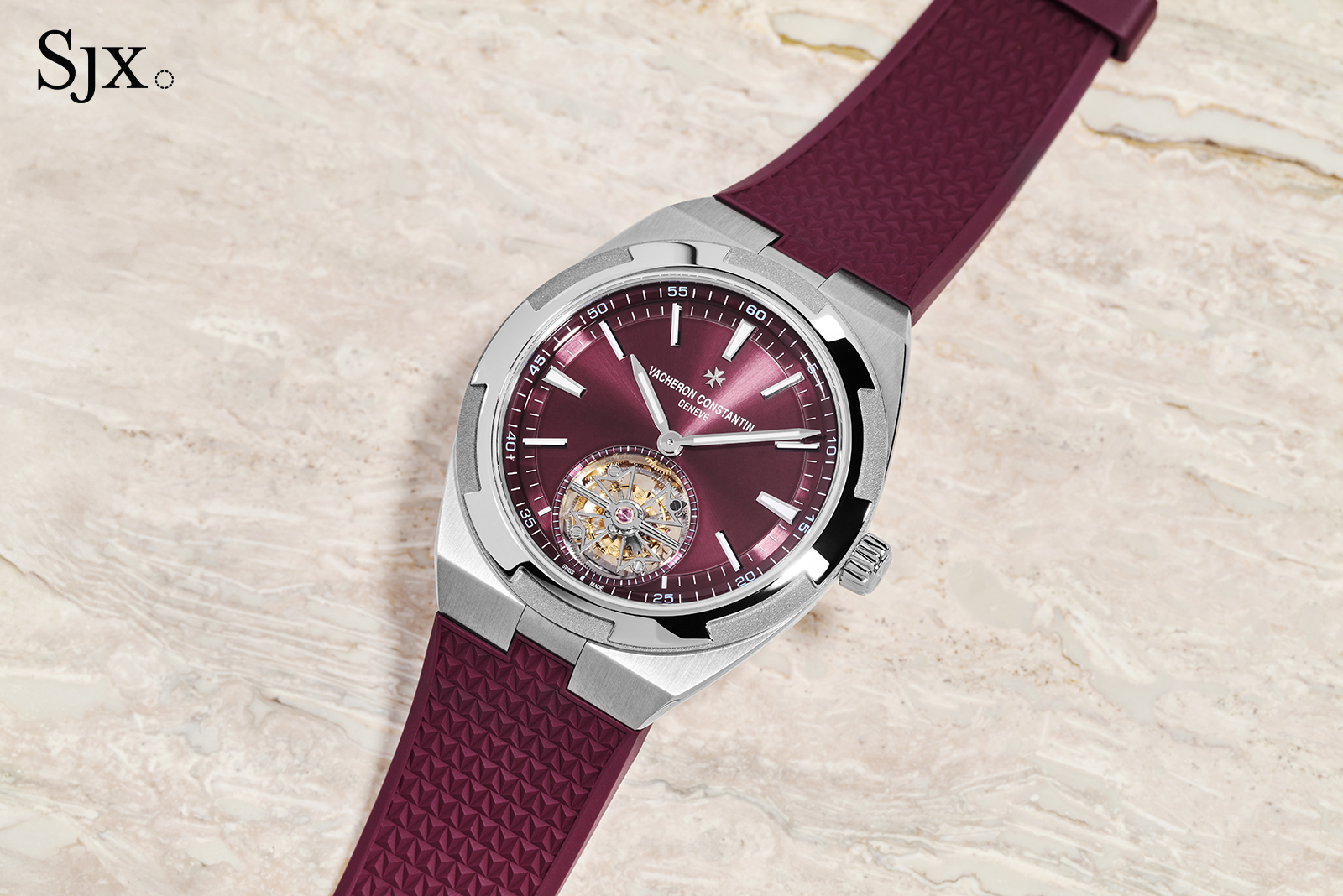
However, systems like this are somewhat wasted on the Overseas, as the bracelets are excellent and such an important part of the watch’s design that there is little incentive to remove it.

Calibre

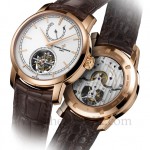
Inside is the familiar cal. 2160, which has become Vacheron Constantin’s go-to tourbillon movement, either on its own or as a base for other complications. The large 31mm calibre fills the case back well and is both finely decorated and visually interesting.

Its most notable trait is the 22k gold peripheral rotor, which winds the 80-hour mainspring bidirectionally using a magic lever, a solution first pioneered by Suwa Seikosha but now widely adopted across the watch industry, especially by Richemont.
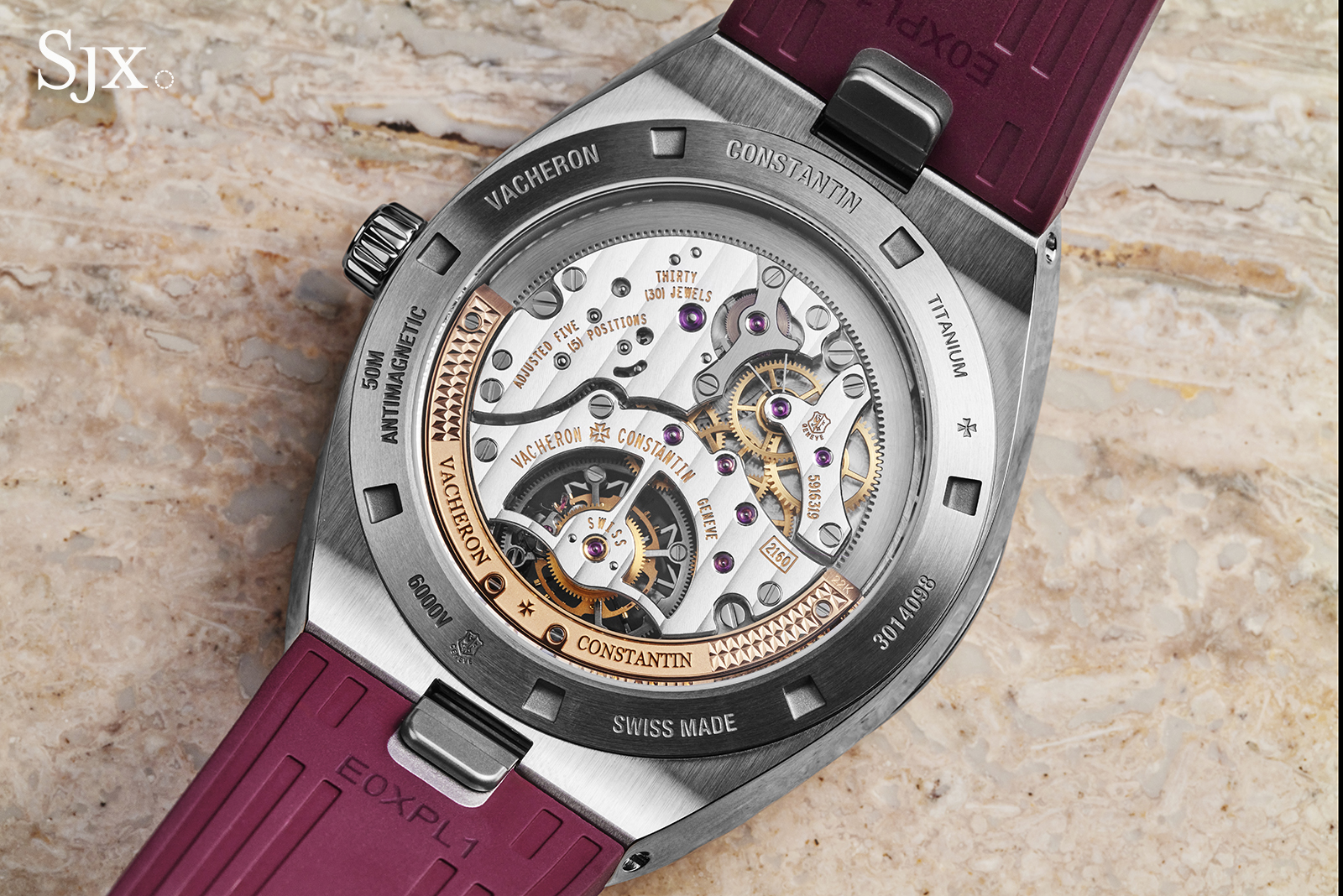
It bears the Poinçon de Genève, meaning it meets certain standards for construction, decoration, and performance as assessed by Timelab. While still a modern movement made by modern machines, a non-trivial amount of hand work goes into each of these movements, such as the specular polishing of the rounded tourbillon bridge.

The barely visible Breguet overcoil is formed by hand, and given the presence of posing screws along the balance rim, the balance is likely manually poised by a skill watchmaker rather than a laser.
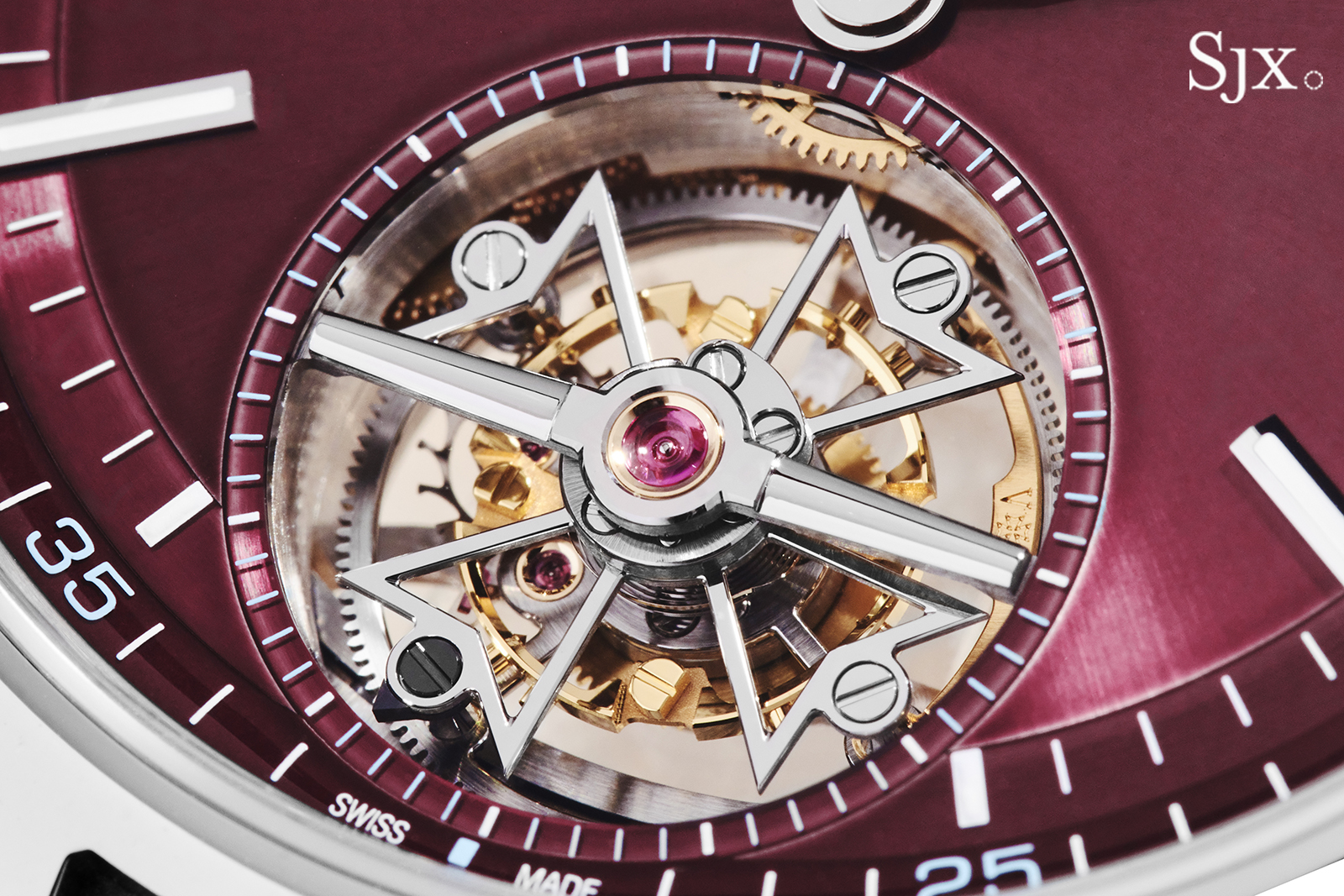
The heat blackened screw acts as a seconds hand.


Key Facts and Price

Vacheron Constantin Overseas Tourbillon
Ref. 6000V/210T-H179

Diameter: 42.5 mm
Height: 10.39 mm
Material: Titanium
Crystal: Sapphire
Water resistance:
 50 m

Movement: Cal. 2160
Functions: Hours, minutes, and tourbillon
Winding: Automatic
Frequency:
18,000 beats per hour (2.5 Hz)
Power reserve:
 80 hours

Strap: Matching bracelet and additional strap in rubber and leather with folding clasp

Limited edition: No
Availability:
Exclusive to Vacheron Constantin boutiques
Price: On request, estimated to be about US$160,000

For more, visit vacheronconstantin.com.


Back to top.
You may also enjoy these.

Off-Catalogue No More: Patek Philippe Reveals Gem-Set Nautilus Collection

More baguettes than a bakery.

Today, Patek Philippe updated its website to include a slew of formerly off-catalogue haute joaillerie models. While none are revelations, all being well known, their presence in the catalogue reinforces the brand’s commitment to this segment, and reflects how mainstream, relatively speaking, this once-niche genre has become.

This move can probably be traced back to Patek Philippe’s 2022 investment in Salanitro, the gemstone giant behind many high jewellery watches from Hublot to Audemars Piguet. Since then, the brand has placed increased emphasis on gem-set watches across its catalogue, such as the “Rainbow” Aquanaut minute repeaters the following year. In other words, it would seem the brand’s gem-setting capacity has matured enough to advertise these models.

Long live the ref. 5711

Patek Philippe nominally discontinued the ref. 5711 in 2022, though its many off-catalogue variants escaped that fate. Since 2013, Patek Philippe has offered the platinum ref. 5711/1P-010 to its most important clients, while keeping it out of the official catalogue, but the model’s gem-set siblings are now officially part of the Patek Philippe lineup.

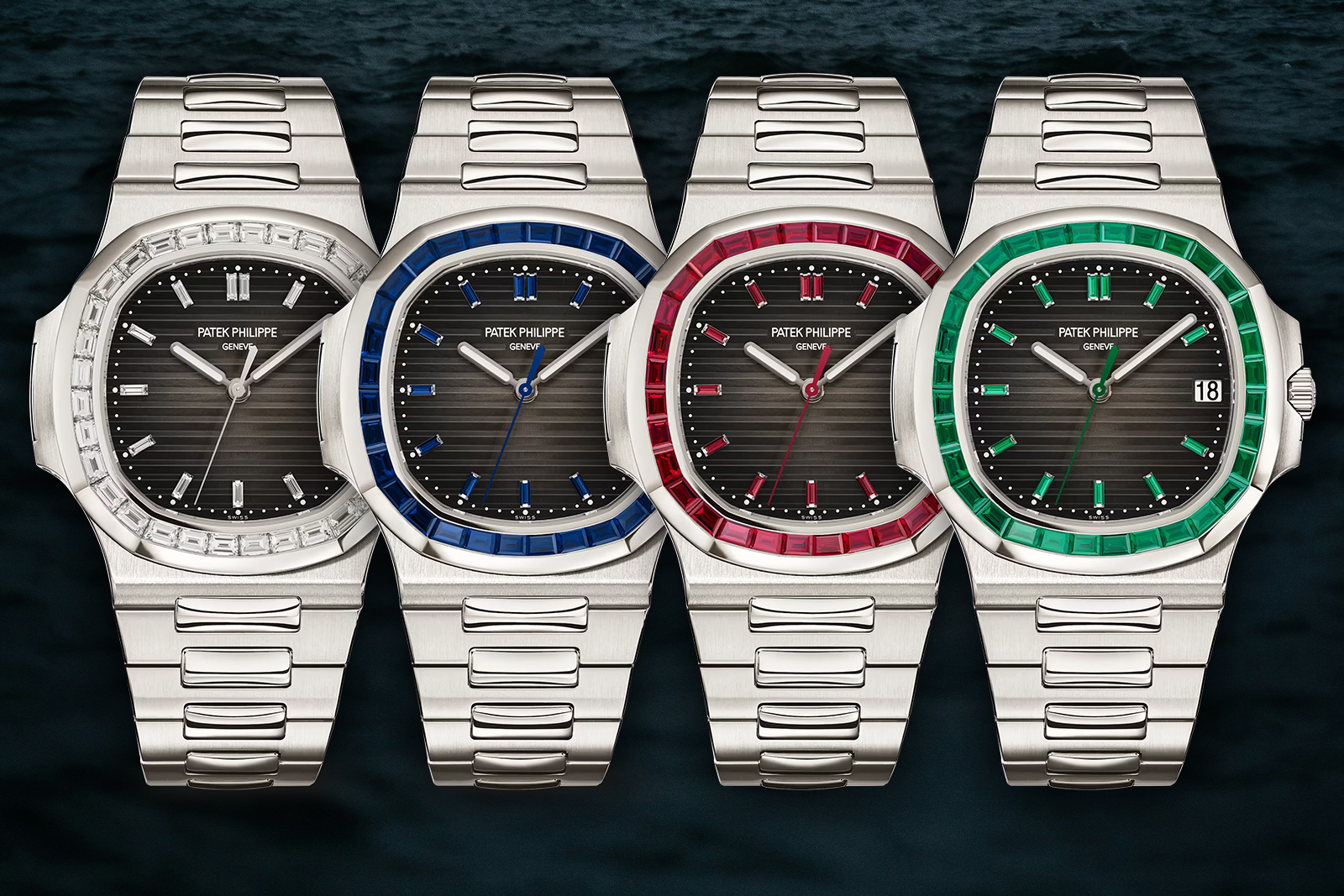
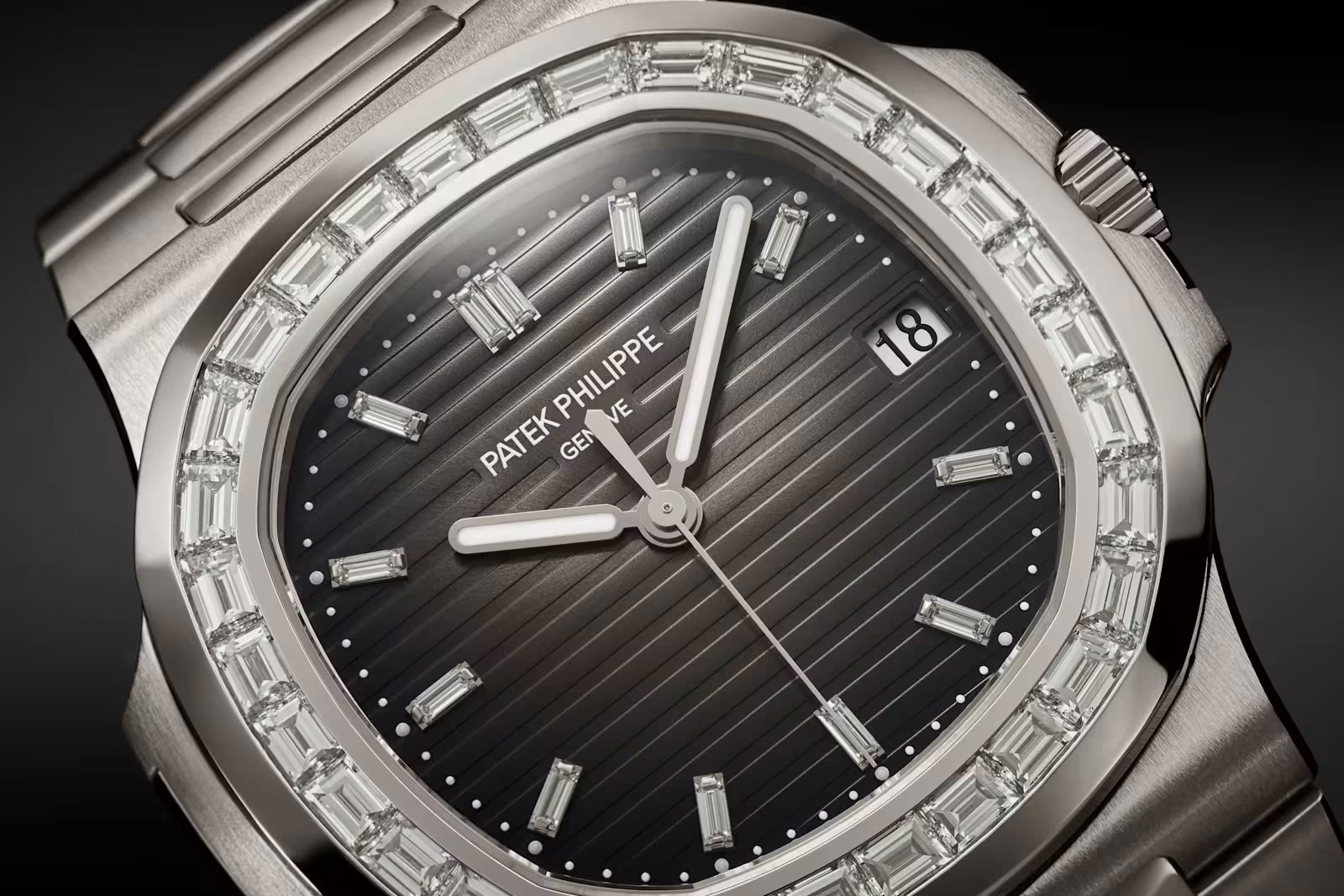
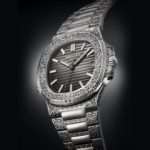
The configuration of each of the four references is identical, with a gem-set bezel, baguette-cut hour markers, and a stone-matched centre seconds hand. The stones are approximately the same size across all four models, but the carat weight differs because of the density of the stones.

As a result, the ref. 5711/110P-001 features 4.03 ct of white diamonds, while the ref. 5711/113P-001 is set with just 3.16 ct of emeralds. The refs. 5711/111P-001 and 5711/112P-001, however, are identical, with 4.24 carats of blue sapphires and rubies, respectively.

Note the seconds hands are colour matched to the stones.

Interestingly, the diamond-set variant is the least expensive at just over US$250,000, followed by blue sapphire (~US$269,000) and ruby (~US$288,000). The emerald reference is priced at a significant premium, around US$433,000, reflecting anecdotal evidence that it is the least common of the quartet, rarely coming to market while there are usually several credible sales listings for the other three at any given time.

It is worth mentioning the white-dialled ancestors of this current crop, launched around 2015, which are probably no longer in production but essentially the same other than the dial colour.

Rose and ruby

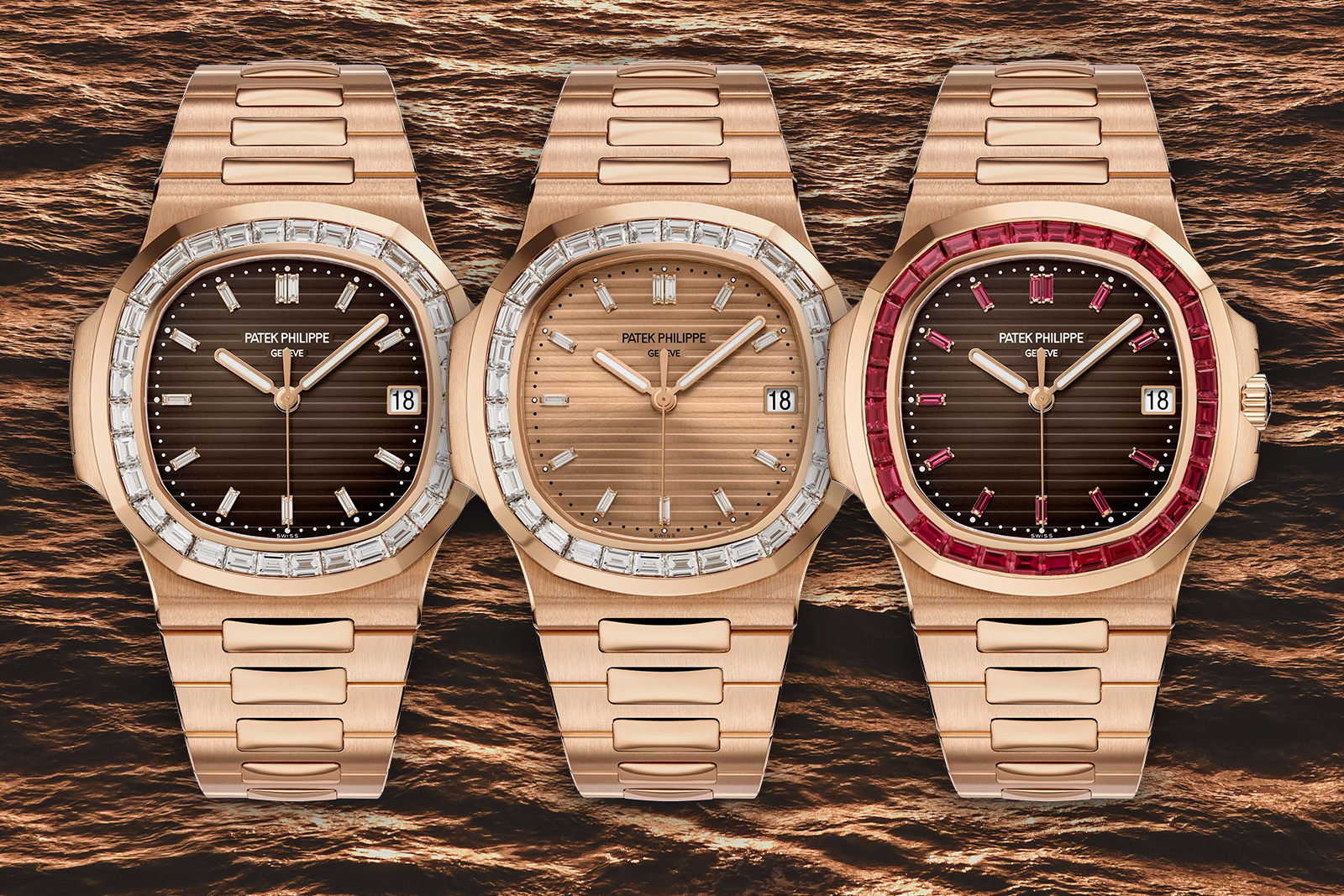
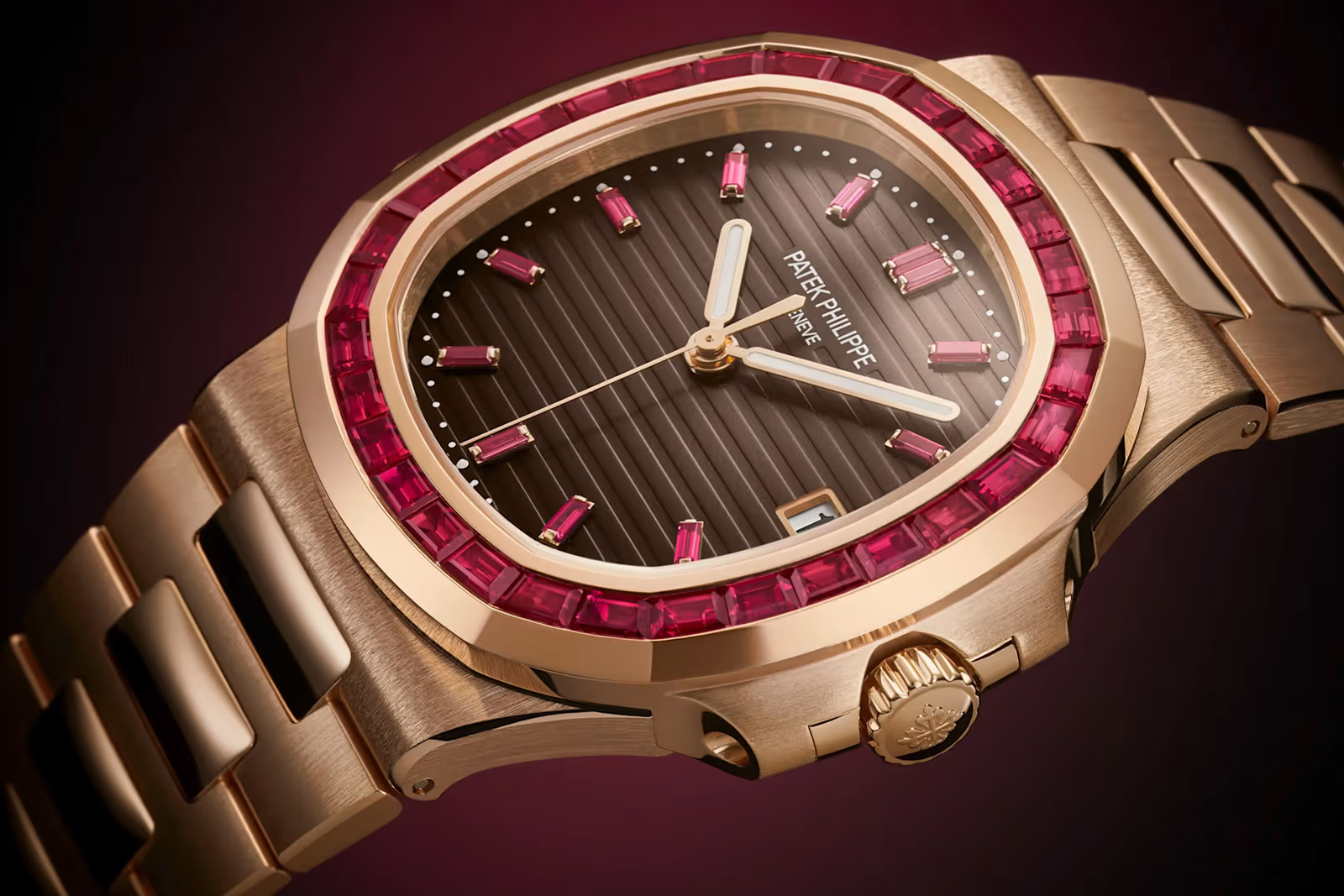
The Nautilus ref. 5723 is unusual in that it only exists in rose gold, and has never been in the brand’s catalogue until now. It’s only subtly different from the iconic ref. 5711, though it’s slightly thicker and has a flatter bezel. This reference is offered in three variants, with the choice of diamonds or rubies with a sunburst brown dial (refs. 5723/1R-010 and 5723/112R-001, respectively), or a case-matching rose gold dial set with diamonds (ref. 5723/1R-001).

Despite the slight case differences, each ref. 5723 has the same carat weight as its 5711 equivalent (4.03 ct of diamonds, and 4.24 ct of rubies). They are, however, significantly less expensive, starting at about US$200,000 with diamonds, and just under US$230,000 with rubies. All three variants are uncommon, but not as uncommon as the emerald-set ref. 5711.

The maximalist ref. 5990

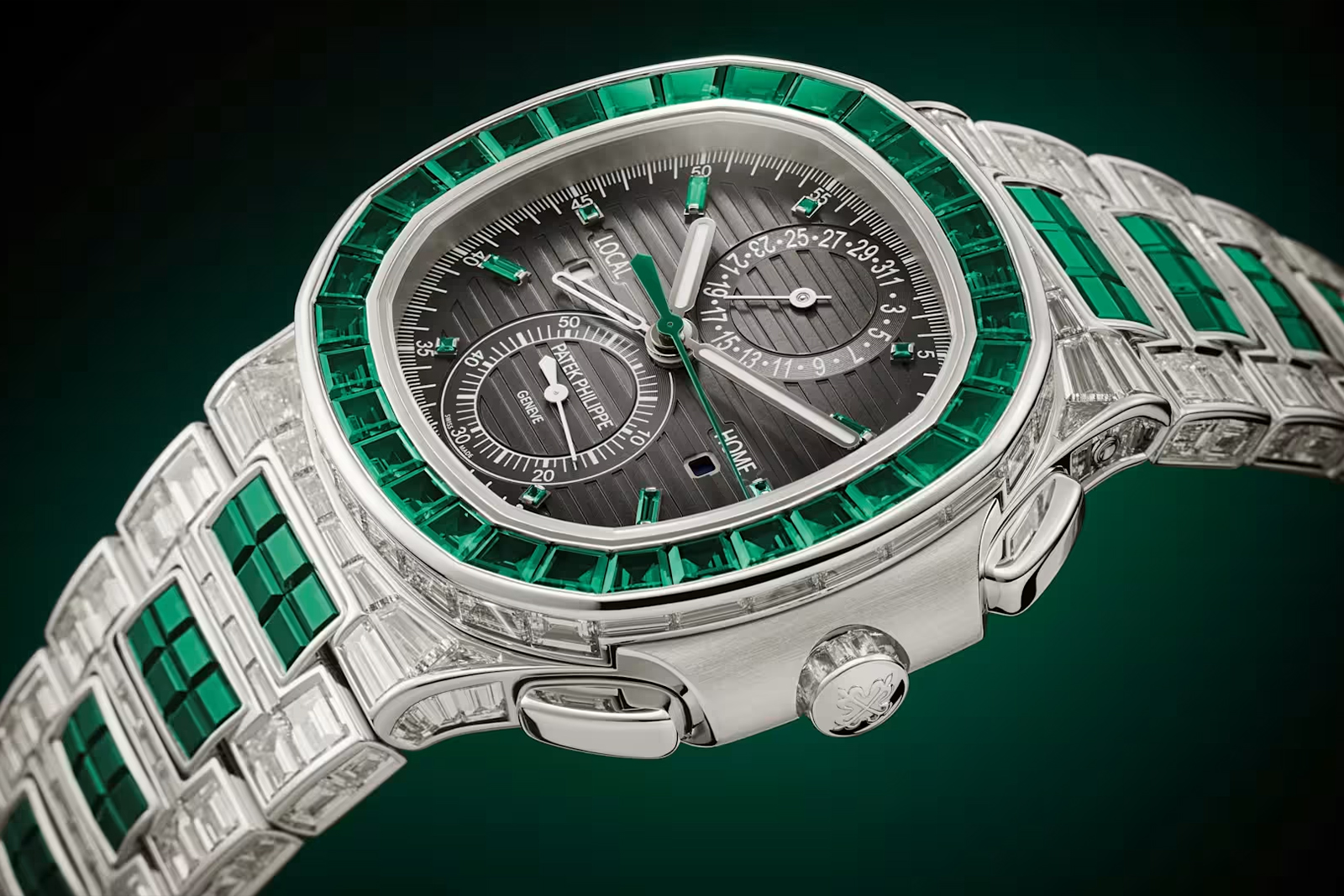
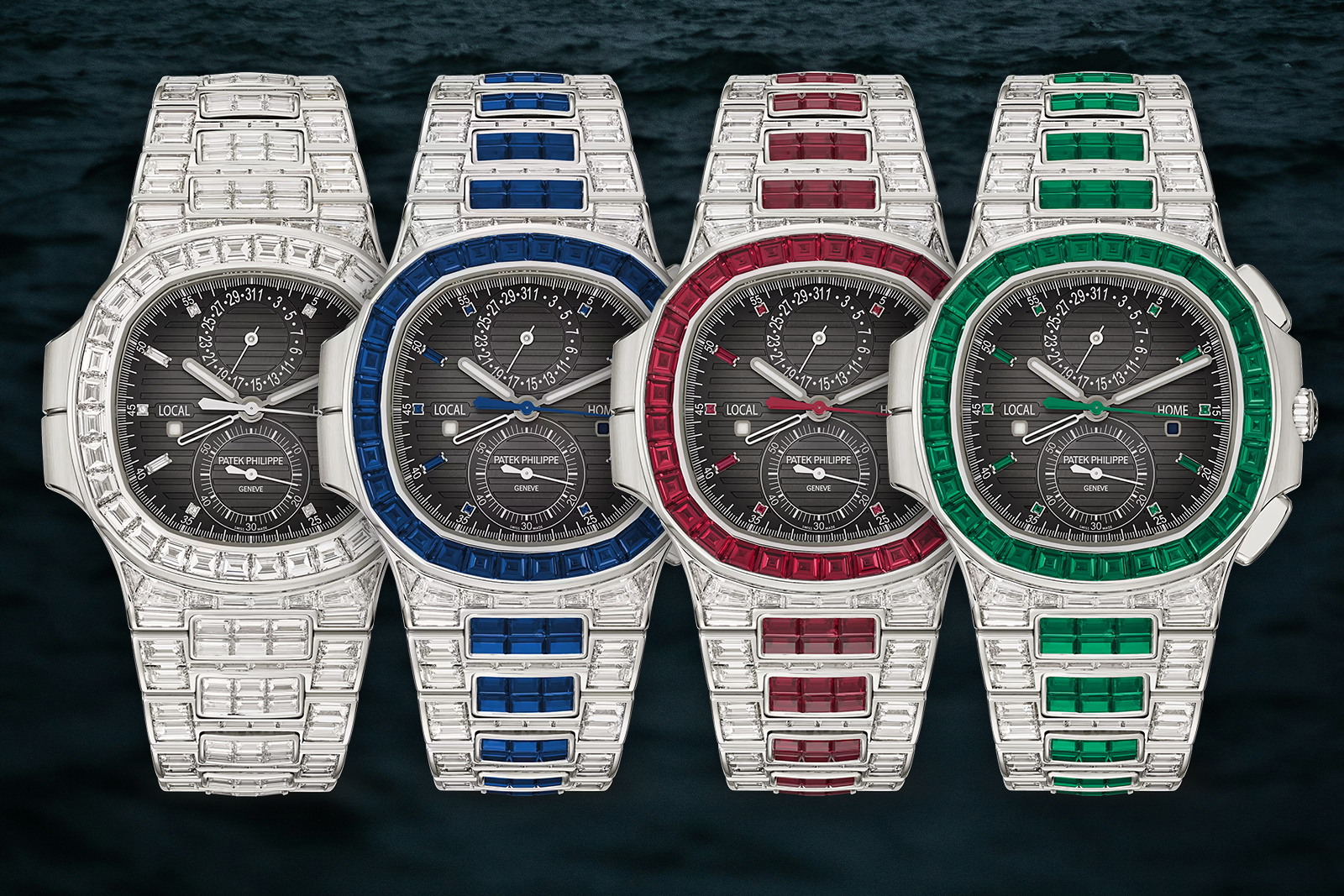
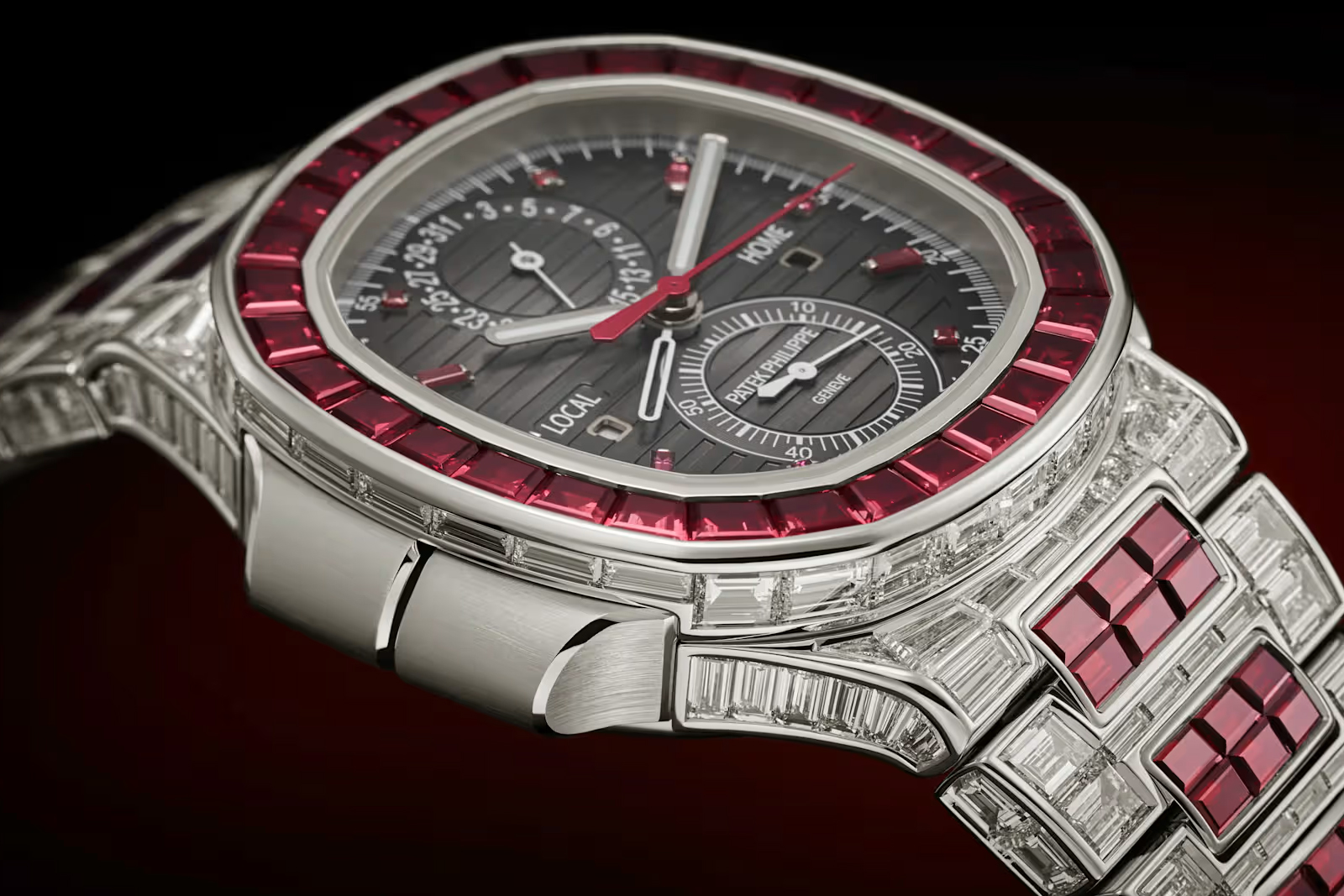
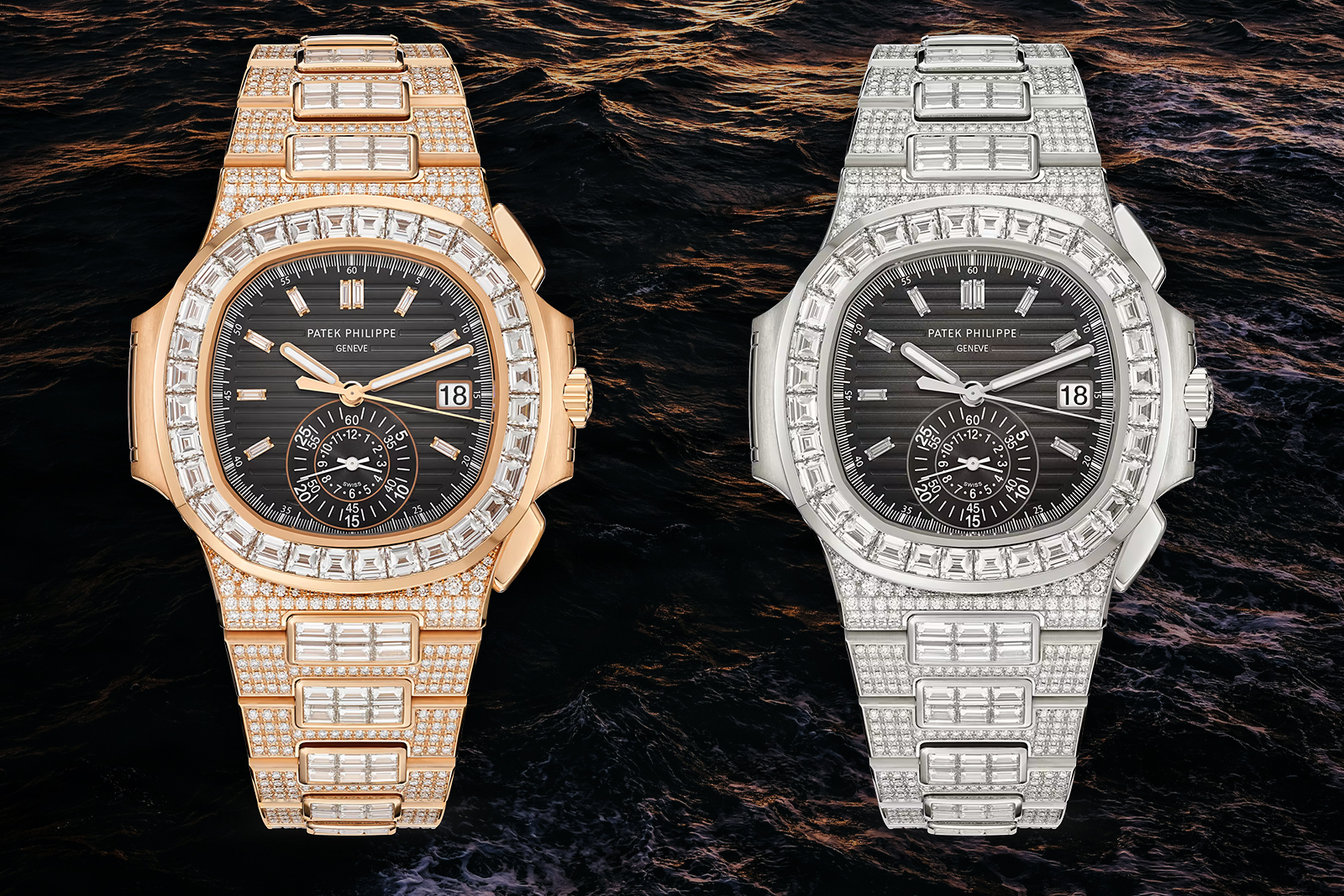
The most complicated Nautilus, combining the brand’s travel time system, date, and a chronograph with minutes counter, fittingly has the most decadent gem-set counterpart. The case and bracelet are fully paved with 406 baguette-cut diamonds, weighing in at 33.11 carats. Furthermore, the bezel, dial and bracelet centre links are set with another 192 baguette-cut stones.

Again, the diamond variant, ref. 5990/1400G-001, is the entry point, if that term can reasonably be applied to a watch set with nearly 50 carats of diamonds and that costs about US$1.8 million. This format is repeated across the ref. 5990/1421G-001 and ref. 5990/1422G-001, which cost a little over US$2 million each, that add about 17 carats of additional blue sapphires or rubies, respectively.

The priciest option is the emerald variant, ref. 5990/1423G-001, (11.94 ct), which costs in excess of US$2.75 million. Of these, only the diamond variant is seen with any regularity, likely due to the relative ease of sourcing large amounts of white diamonds compared to coloured stones of equivalent quality.

Less complicated, fewer stones

There are two more accessible, relatively speaking options on gem-set bracelets. Both are variants of the ref. 5980 flyback chronograph, ref. 5980/1400G-010 in white gold and ref. 5980/1400R-011 in rose gold. Despite the greater cost of Patek Philippe’s white gold alloy, due to its palladium content, the two are priced identically at ~US$788,000. For reference, that isn’t far from the ref. 5811/1460G-001’s ~US$722,000 price tag.

Both carry 20.08 carats of diamonds in total, comprised of 893 brilliant-cut diamonds (4.44 ct) and 191 baguette cut diamonds (15.64 ct), with no links removed. While great in number, the brilliant-cut melee diamonds weigh only 0.005 carats each on average, and can be bought off-the-shelf for only a few dollars apiece.

The baguette-cut stones, on the other hand, are exponentially more expensive and must be specially cut to fit the watch, which is why the these cost US$1 million less than the aforementioned ref. 5990/1400G-001.

Celestial carats

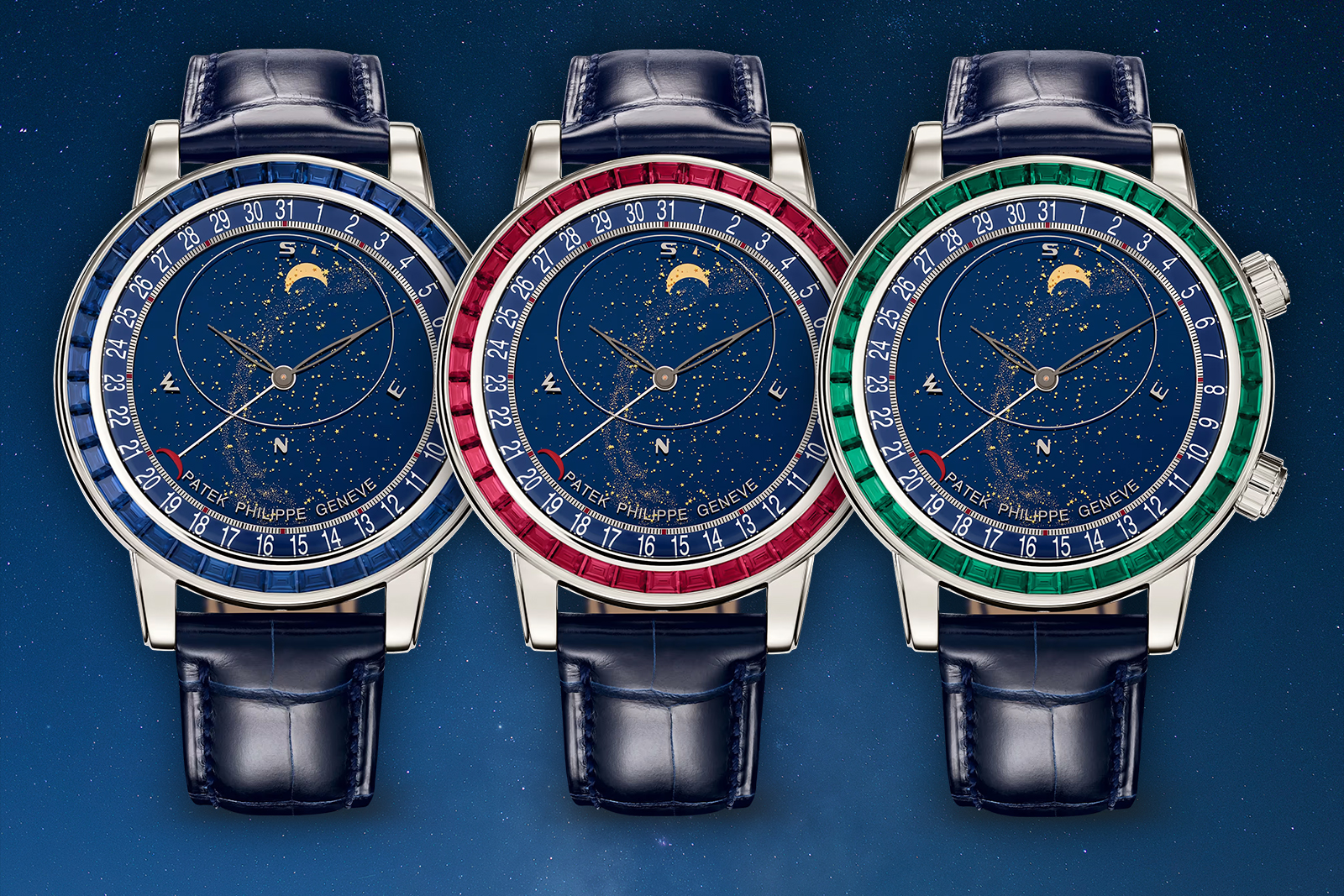
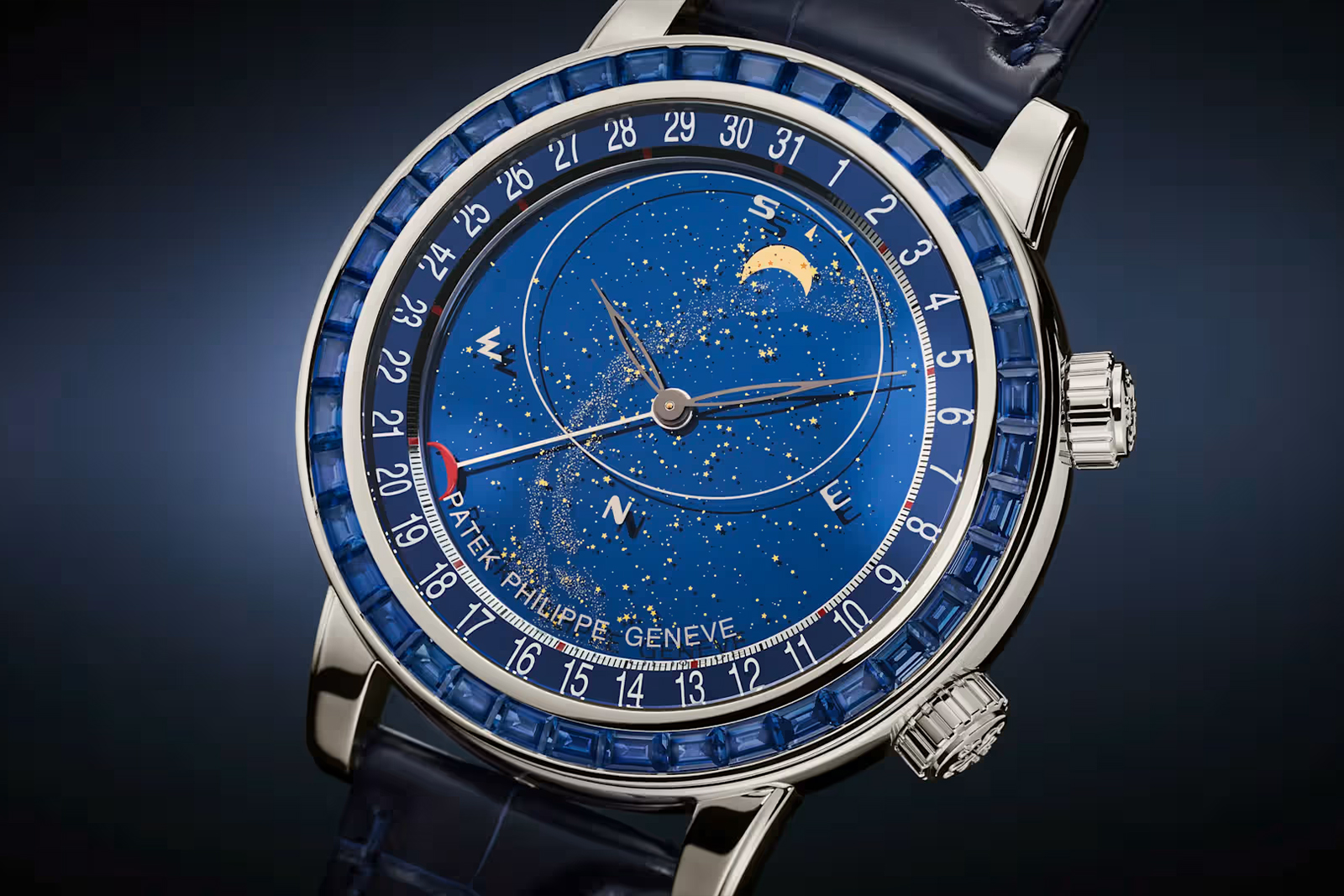
While most of Patek Philippe’s gem-set Grand Complications have been in the catalogue since day one, including the flagship bejewelled variants of the Grand Master Chime, several Celestial variants were oddly absent until now. The diamond-set refs. 6104P-010 and 6104R-001 are now joined by a trio set with 38 blue sapphires (ref. 6104/11P-010), rubies (ref. 6104/12P-010), and emeralds (ref. 6104/13P-010).

Oddly, despite the nearly identical densities of blue sapphires and rubies, the carat weights diverge significantly — 4.94 carats of sapphires against 4.56 carats of rubies, implying the bezel stones are not identical in size between the two, though the stones on the deployant clasp add up to an identical 1.1 carats for both. They are priced at ~US$630,000 , and ~US$655,000, respectively.

As usual, the emerald variant is the most expensive, most exclusive, and most elusive, coming in at just under US$875,000 for a total of 3.92 carats of emeralds on the bezel and clasp. It’s worth mentioning that emeralds are not hard-wearing stones like diamonds and sapphires. In fact, their hardness is closer to that of tempered glass, with even worse tenacity. In other words, the most expensive choice isn’t always the best one for those who wear their watches frequently.

For more, visit Patek.com.


Back to top.

You may also enjoy these.

Welcome to the new Watches By SJX.

Subscribe to get the latest articles and reviews delivered to your inbox.