
Hands On: Urwerk UR-10 Spacemeter Blue Final Edition
The final voyage for the astronomical odometer.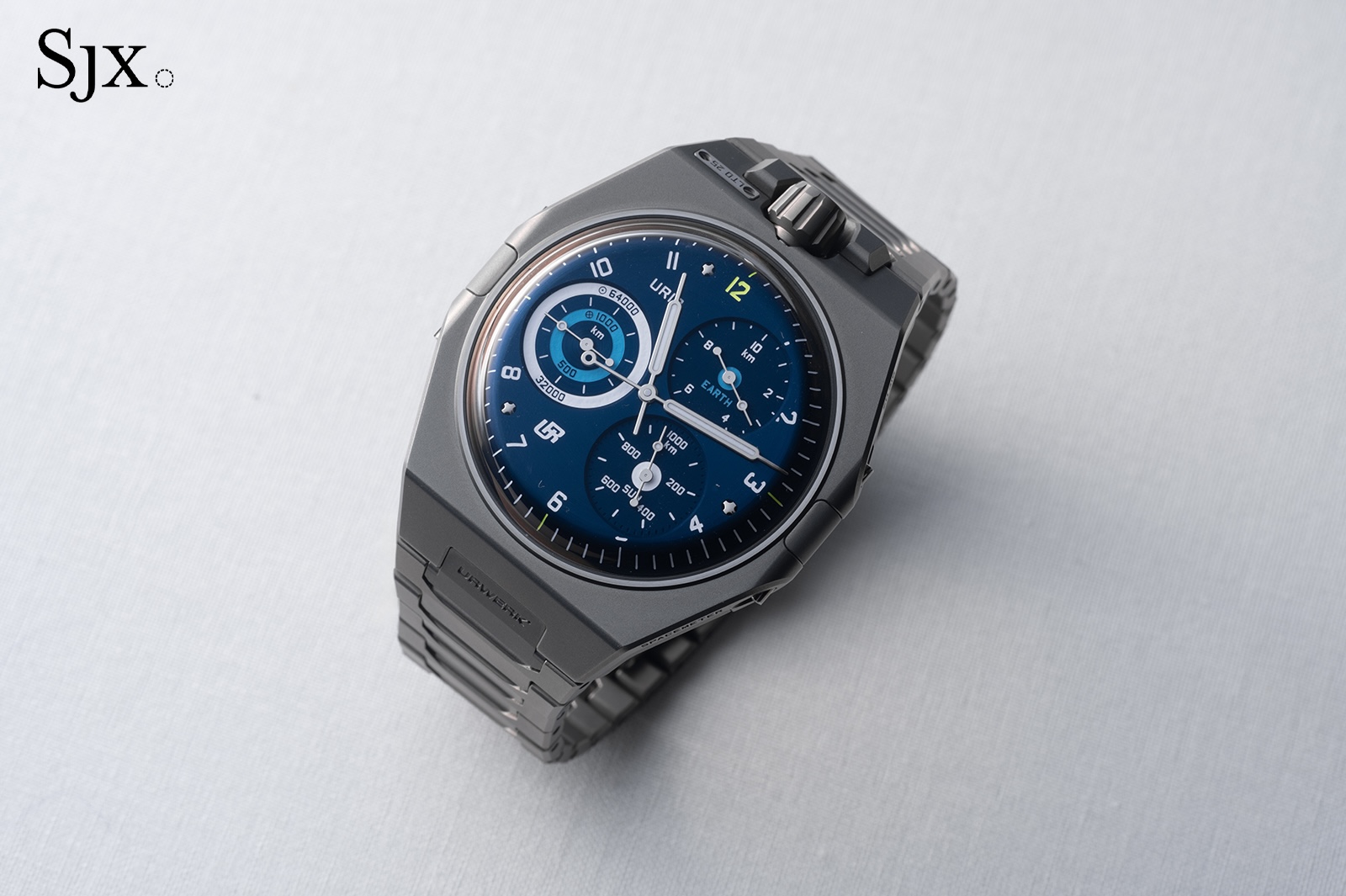
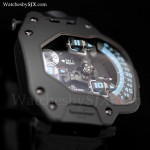
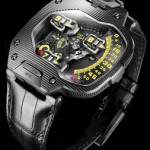
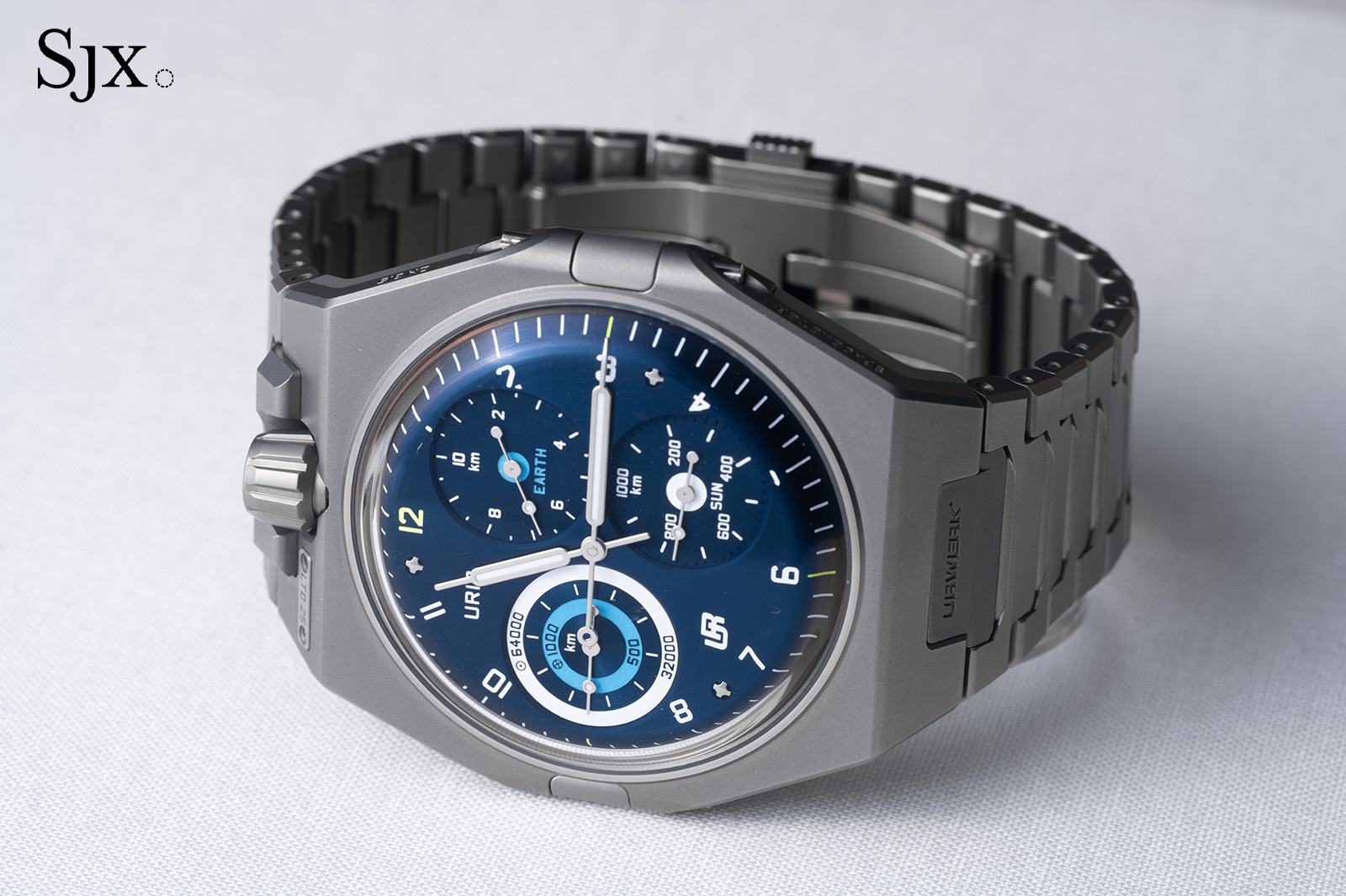
Urwerk bids farewell to the Spacemeter with UR-10 Spacemeter Blue Final Edition. As the final series of the UR-10, the 25-piece limited edition features a dark blue dial that differentiates it from the black and silver editions released previously. The watch is otherwise identical to its predecessors, and features an instrument panel-like display that tracks the progress of the Earth around both the sun and its own axis.
Initial thoughts
The ‘almost conventional’ display of the UR-10 represents a departure for Urwerk, which made its name in satellite wandering hours complications. Like the quirky and impressive EMC, the UR-10 proves Urwerk’s space-age aesthetic works in a variety of formats.
But the Spacemeter’s time on Earth was relatively short, having been launched less than a year ago. The limited production of just 75 pieces (25 in each of three colours) should reward collectors, but I’m hopeful the ergonomic case and bracelet will come out of retirement to house different complications in the future.
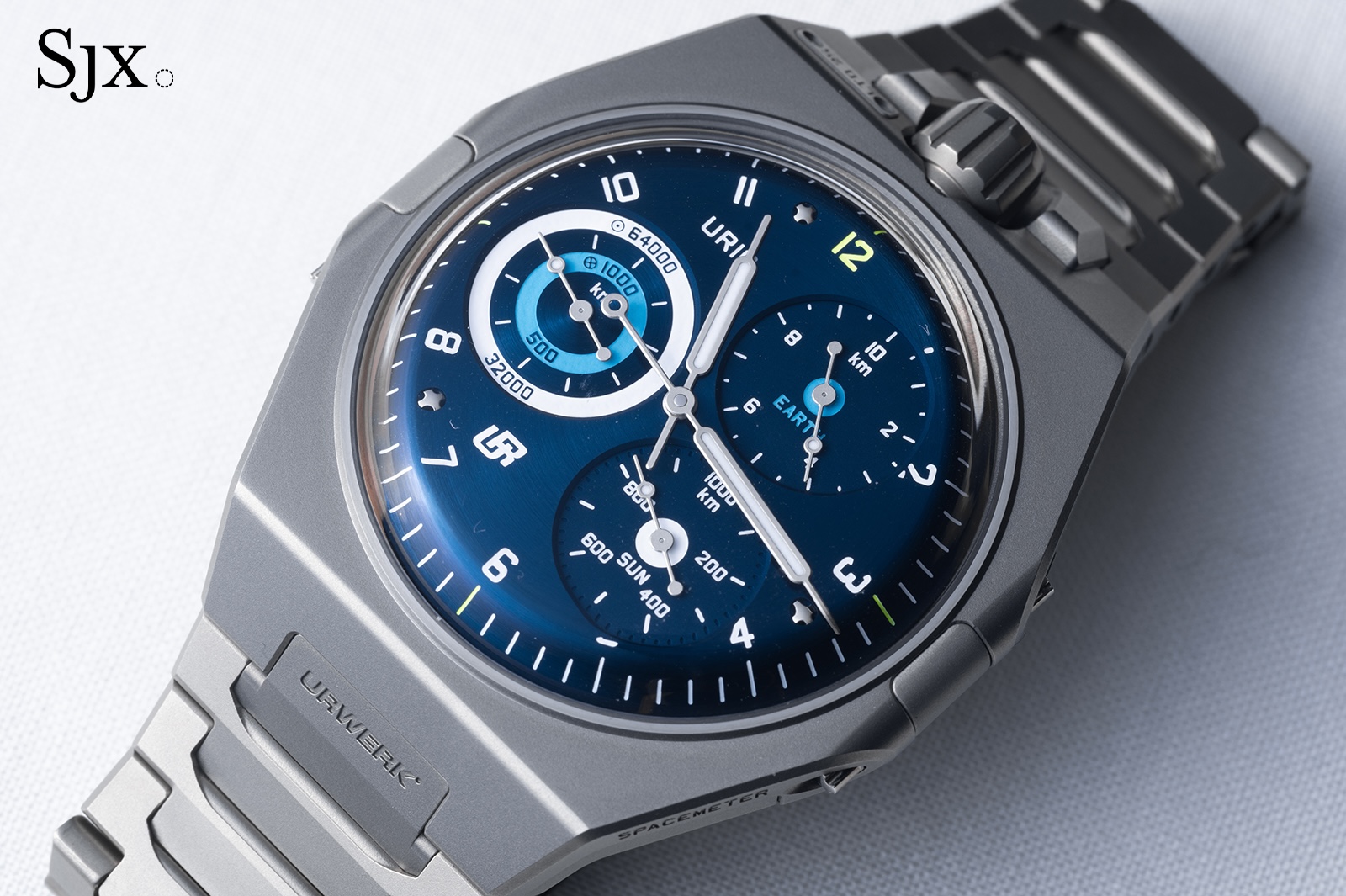
The UR-10 borrows a number of stylistic cues from the UR-100, but the case construction is entirely novel. The 45.4 mm case is essentially a bi-level construction — stainless steel on the bottom for a stable weight balance, and titanium on top for a continuous look from case to bracelet.
The two materials contrast slightly on the winglets on either side of the case, where they are fastened with bolts. This construction is similar to that of the original Patek Philippe Nautilus, but the implementation of the design feels more extraterrestrial than nautical.
Urwerk co-founders Felix Baumgartner and Martin Frei were seminal figures in the emerging field of independent watchmaking at the end of the 1990s, and the Urwerk brand commands a degree of pricing power as a result.
The UR-10’s retail price of CHF70,000 positions it squarely against more complicated models from more mainstream brands, but the premium is arguably justified by its distinctive feature set, high quality construction, low-volume unit economics, and a design language that is still unlike anything else even after more than a quarter century.
An astronomical odometer
Compared to most Urwerk models, the UR-10’s time indication is straightforward. The hour and minutes hands are entirely conventional, which is a rare concession to normalcy for a brand that prides itself on novel displays of the wandering and rotating variety.
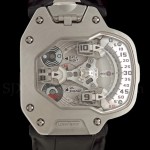
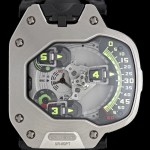
That’s probably for the better, since the UR-10’s raison d’être is found in its four sub-dials, which measure the distance travelled by Earth through the cosmos. The colour-coded sub-dials are easy to parse, with blue indications representing the Earth’s rotation, and white indications denoting its passage around the sun.
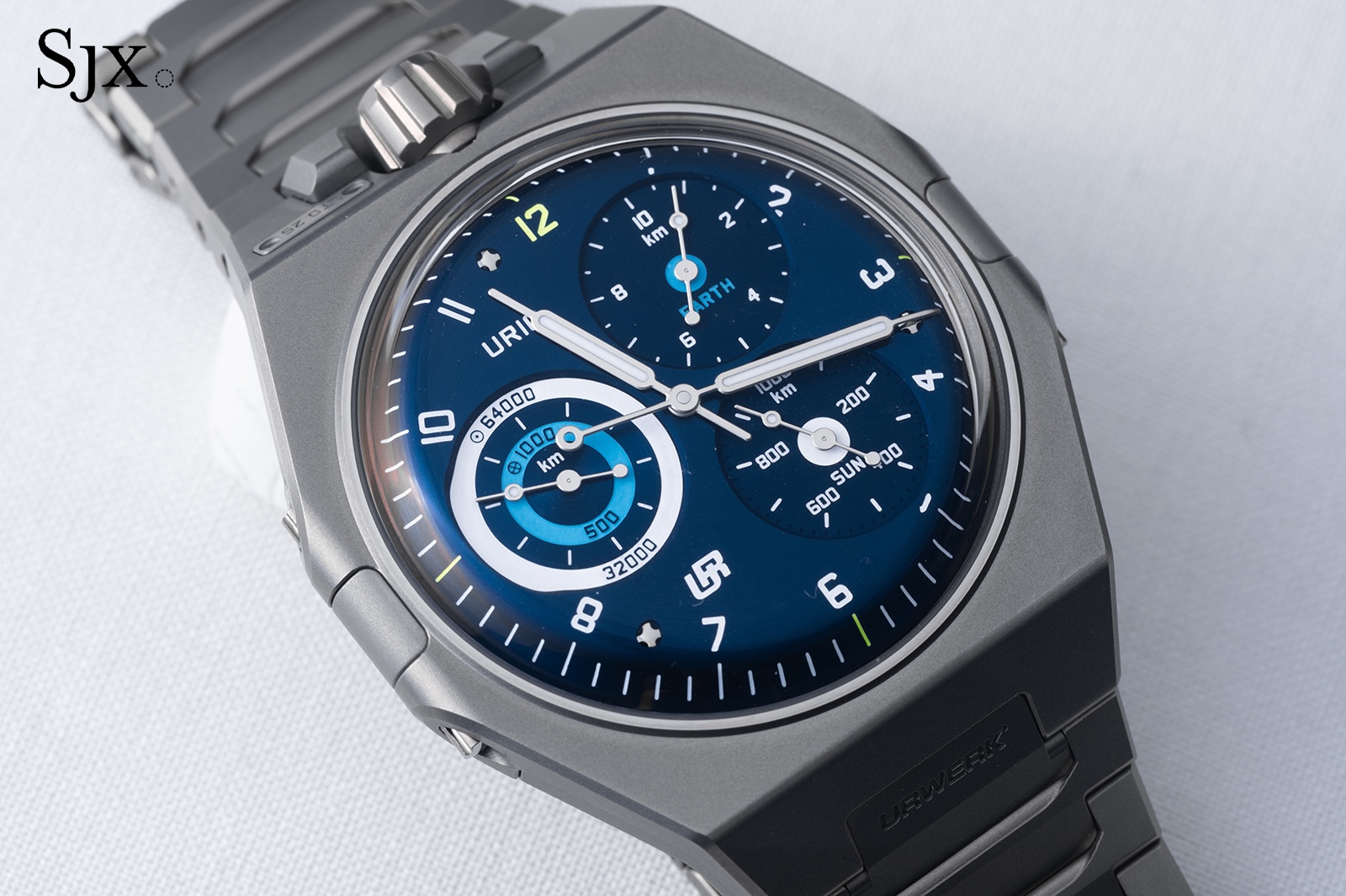
The sub-dial at one o’clock features what is effectively a high-speed running seconds hand, accelerated to make one revolution every 22 seconds. This interval corresponds roughly to the time it takes for a fixed point at the equator to rotate through 10 km. The actual interval is closer to 21.56 seconds, but since the errors don’t accumulate the difference is largely irrelevant.
The sub-dial at five o’clock is similar, completing one rotation every 34 seconds. This approximates the time it takes for the Earth to travel 1,000 km through space in its orbit around the sun. Of course, the Earth’s orbit is elliptical and its speed is variable, but the UR-10’s simplified display does its job — namely, giving the wearer a way to perceive cosmic speed and motion.
The third — and seemingly final — sub-dial indicates the time it takes for the Earth to travel 64,000 km on its solar orbit. This happens in about 36 minutes , which is about the time it takes for the upper right sub-dial to make 100 rotations — hence the 1,000 km indication in blue.
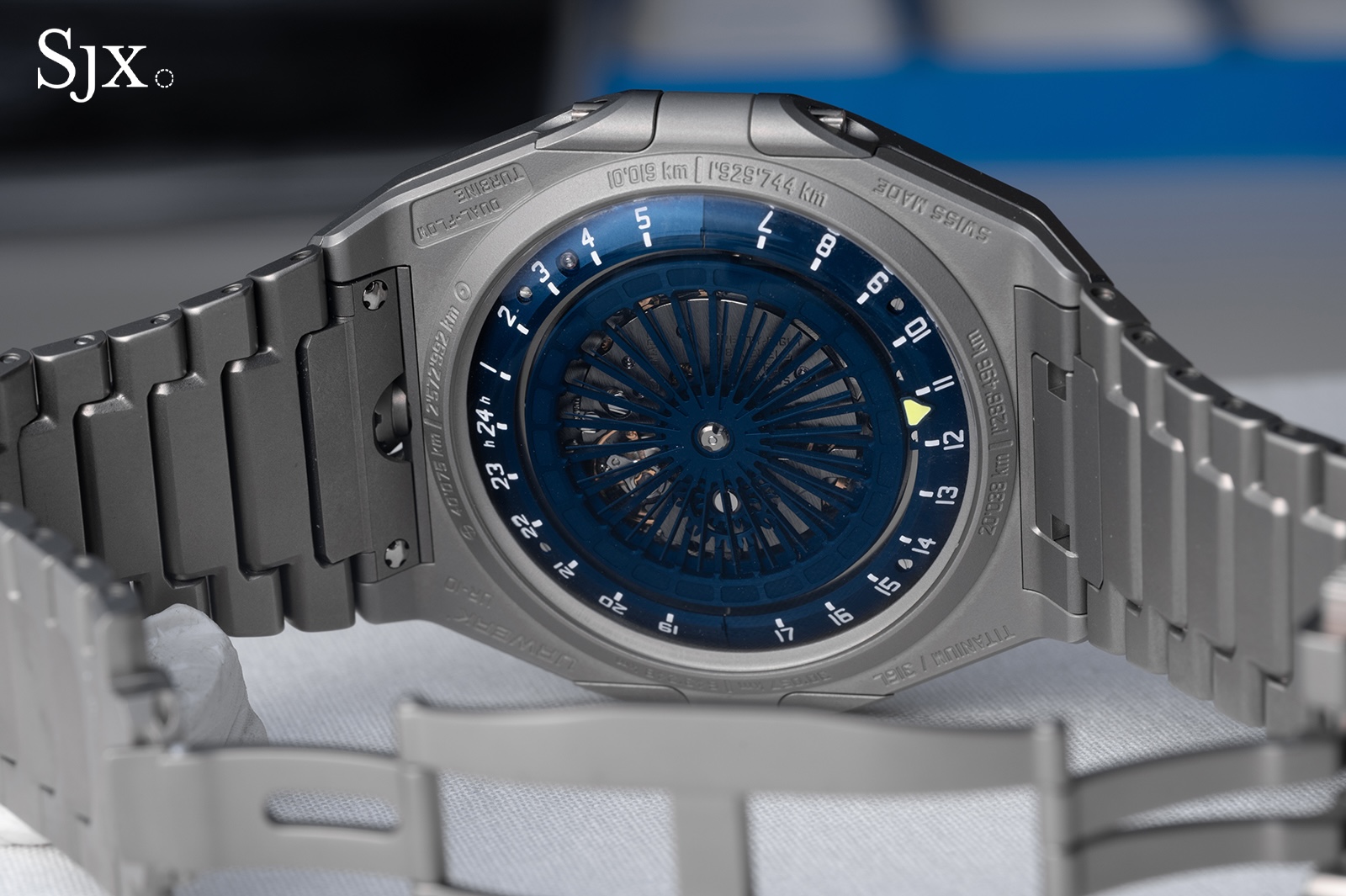
The fourth and final indication is a discreet 24-hour hand tucked away on the back of the watch, which naturally denotes one full rotation of the Earth relative to the sun. Fittingly, the rear bezel is engraved with distances for both its rotational and orbital travel over the course of a full day. It’s worth noting the implementation tracks civil time, rather than sidereal time which would be slightly more correct thematically.
Wearing experience
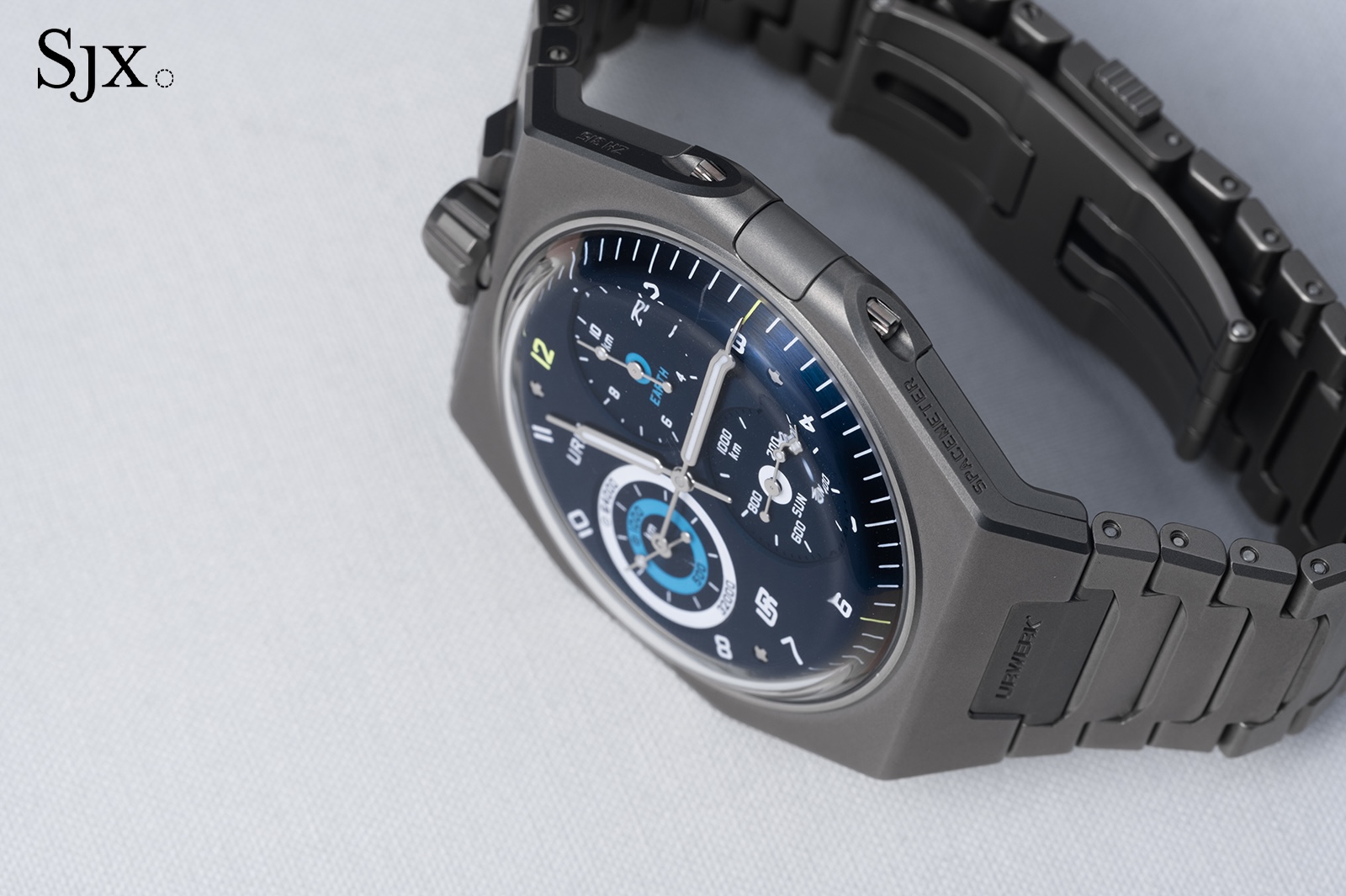
The bracelet is similar to that used for the UR-100. But while the UR-100 features a slightly odd front-facing end link, the UR-10 was clearly designed from the ground up to feature this bracelet. As such, the front-facing end link feels more cohesive with the rest of the design.
The similarity extends to both the sandblasted texture and the design of the titanium links. I’d argue the bracelet is one of the industry’s best, despite its lack of one of the most talked-about features in recent memory: tool-less micro-adjustment. I’m usually a vocal proponent of such features, but in Urwerk’s case there are two main factors that contribute to its exceptional wearing comfort.
The first is the weight. Heavy watches — those is steel but especially those in precious metal — require a more precise fit to avoid sliding around too much when the wrist is contracted or being too tight when the wrist expands, such as during physical exertion or in warm weather. Titanium watches can be worn slightly looser in general — the natural friction of the watch against the wrist is often enough to keep a lightweight watch planted.
The second thing working for the UR-10’s bracelet is the short pitch of each link, which enables a good fit to be established from the initial sizing. This design also gives the bracelet an especially soft and supple feel than enhances the wearing comfort. The supple bracelet cascades easily over the wrist, which helps the somewhat large watch wear smaller than its dimension would suggest.
Turbine-powered
As is the norm for Urwerk, the UR-10’s in-house module is powered by a third-party base calibre. In this case it’s a Vaucher movement, which means its smartly engineered and finely made, even if some specs — namely the 43-hour power reserve — may fall short of some expectations.
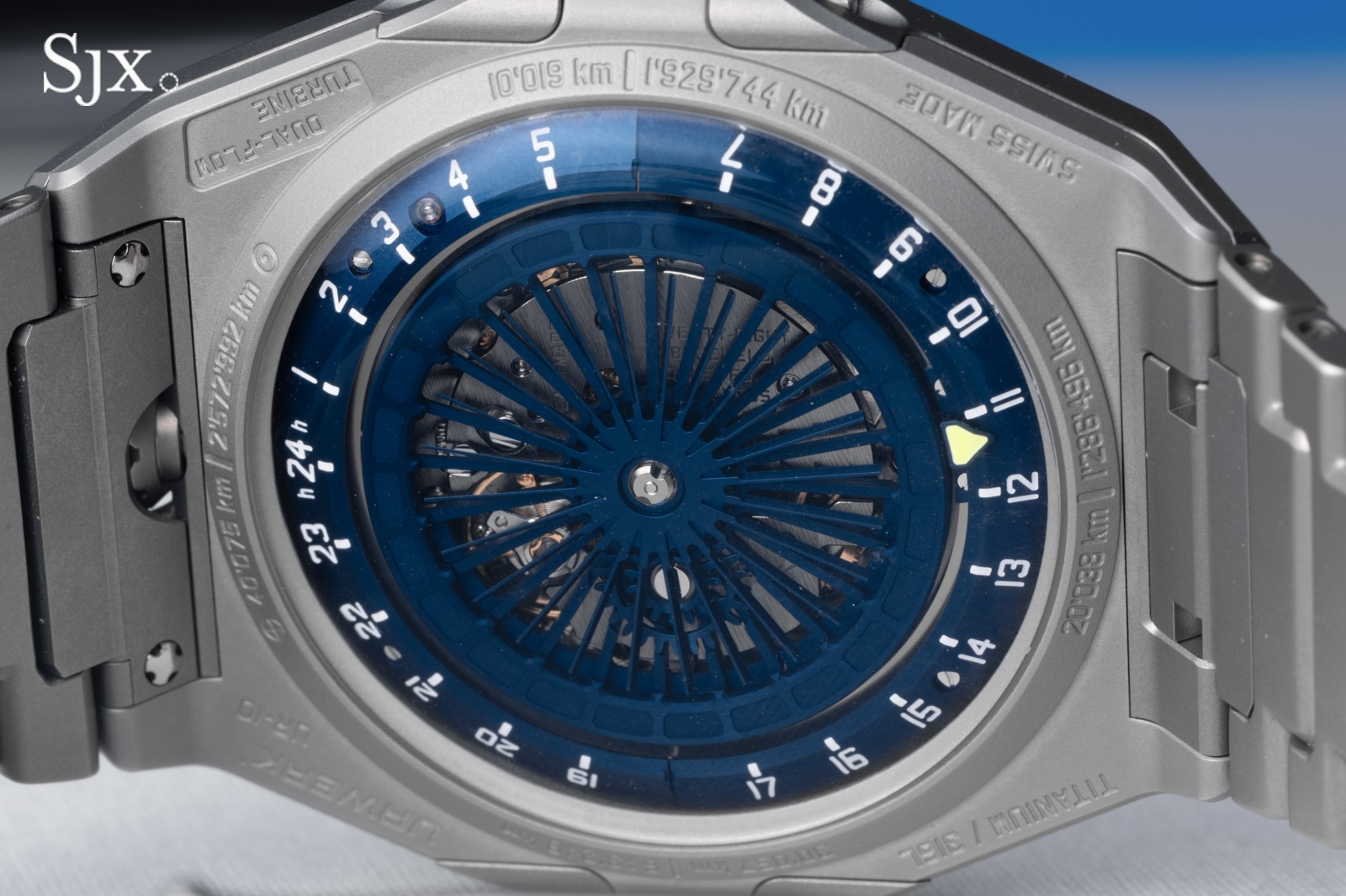
It’s rare to glimpse Urwerk’s base calibres, but the free-sprung balance of the Vaucher platform can be seen through the ‘blades’ of the winding mass. This unusual design is partly stylistic, and partly functional, with two superimposed turbines that create an air cushion to slow the rotational speed of the rotor.
This system is designed to take some of the strain off the winding system during rigorous activity. While modern movements are more than a match for these forces, Urwerk and Richard Mille continue to develop novel solutions to these perceived risks, often with intriguing results.
Key Facts and Price
Urwerk UR-10 Spacemeter Blue Final Edition
Diameter: 45.4 mm
Height: 7.12 mm (without crystals)
Material: Titanium with steel case back
Crystal: Sapphire
Water resistance: 30 m
Movement: UR-10.01
Functions: Hours, minutes.
Winding: Automatic
Frequency: 28,800 beats per hour (4 Hz)
Power reserve: 43 hours
Strap: Titanium bracelet
Limited edition: 25 pieces
Availability: At Urwerk retailers
Price: CHF70,000 excluding taxes
For more, visit Urwerk.com.
Back to top.