
Hands On: Patek Philippe’s Celestial Goes to Space
The weird-but-cool ref. 6105G Celestial Sunrise and Sunset.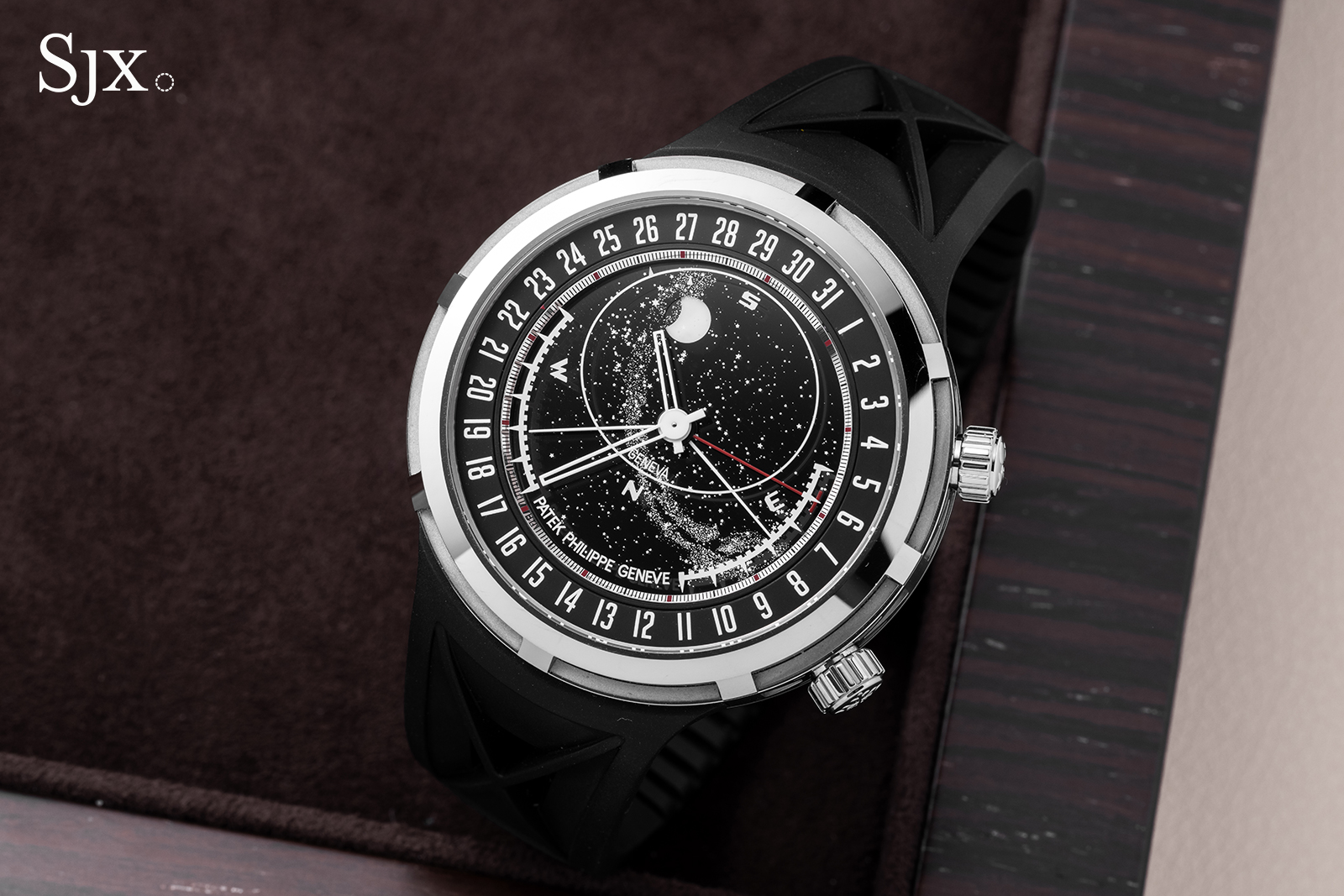
Perhaps the most surprising launch from Patek Philippe at Watches & Wonders 2026 was the Celestial Sunrise and Sunset Ref. 6105G-001. The ref. 6105G arrives over a decade after its predecessor, the ref. 6102 (2012), which in turn replaced the ref. 5102 (2002). While the prior model was an incremental evolution over the original, the ref. 6105G is a drastic redesign with its spaceship-inspired aesthetic and 47 mm (!) white gold case that wears unexpectedly well.
The ref. 6105G is also an upgrade in mechanical terms with the addition of an elegant and simple sunrise and sunrise display that’s smartly implemented on the date ring and driven by a clever compliant mechanism that enhances its precision. And the ref. 6105G has another trick up its sleeve, a mechanism that accounts for summer and winter time (also known as daylight saving time), which shifts the time display as well as the date ring backwards or forwards as the seasons change.
Initial thoughts
Put simply, the ref. 6105G is weird but cool. Some of Patek Philippe’s recent experiments with design have been so-so in attractiveness, but the ref. 6105G scores well, maybe even the best amongst the brand’s adventurous designs.
It’s unlike any other Patek Philippe ever with its huge case and integrated rubber strap, but it is appealing. Even though the star chart complication is a historical one descended from the Henry Graves Jr. “Supercomplication” and Star Calibre 2000, it feels like a perfect match for the sci-fi case.
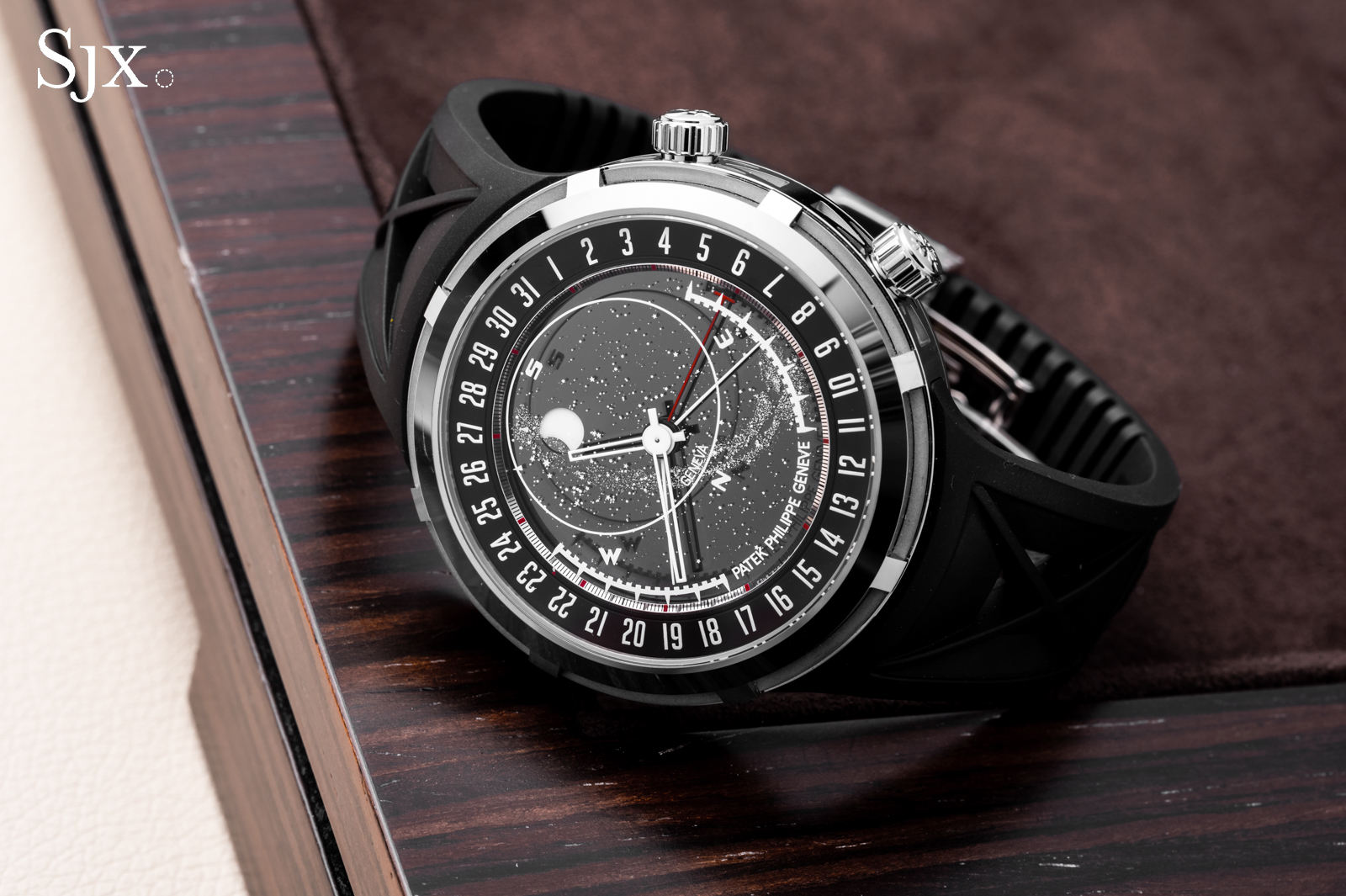
The case is huge at 47 mm, but the lack of lugs give it a smaller effective footprint. This, combined with the integrated rubber strap, means the ref. 6105G wears well though it is a bit heavy. The ref. 6105G is being launched only in white gold; a titanium version would be awesome.
In terms of the movement, the ref. 6105G is typical for Patek Philippe, meaning finely engineered to be thin and sophisticated. The calibre is descended from the earlier generation, but upgraded in several ways, including with the clever mechanisms for sunrise and sunset as well as daylight saving time. The compliant mechanism also stands out for its elegant approach to an age-old concept, resulting in superior precision and less play”.
But as is often the case for Patek Philippe, the user interface is old school, which means a trio of recessed pushers on the case that require a stylus to operate. This is less-than-convenient but not a deal killer.
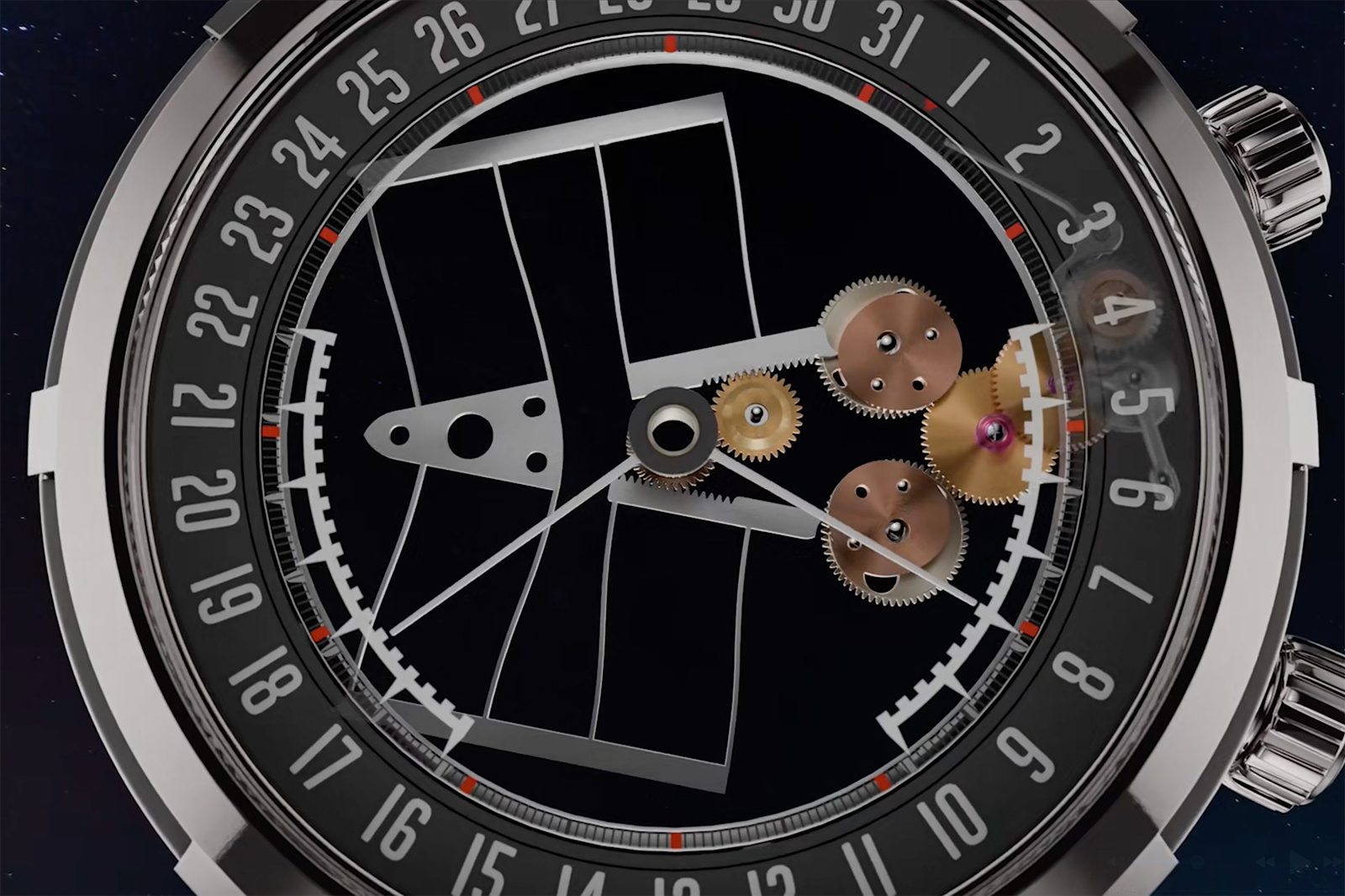
The compliant mechanism comprising of linear racks for the sunrise and sunset. Image – Patek Philippe
More broadly, the new look of the ref. 6105G actually puts this in a different category of watch, making it an easy substitute for high-end complicated watches with modern styling, think Richard Mille or Hublot, except that the ref. 6105G has the advantage of Patek Philippe’s gravitas and technical know-how. In fact, the ref. 6105G is the only sport(y) watch in the Patek Philippe line-up that’s not an Aquanaut, Nautilus, or Cubitus.
With that comparison in mind, the high price tag seems reasonable because the ref. 6105G is probably a better buy in terms of horological credentials than a similarly priced Richard Mille.
A celestial lineage
The Celestial debuted in 2002 as the ref. 5102. It essentially extracted the star chart display found on the reverse of the Sky Moon Tourbillon launched a year before, and relocated the astronomical display to the front of the watch. Since then it’s been a fixture in the Patek Philippe catalogue, and arguably one of the brand’s best known “Grand Complication” models thanks to its distinctive night-sky dial.
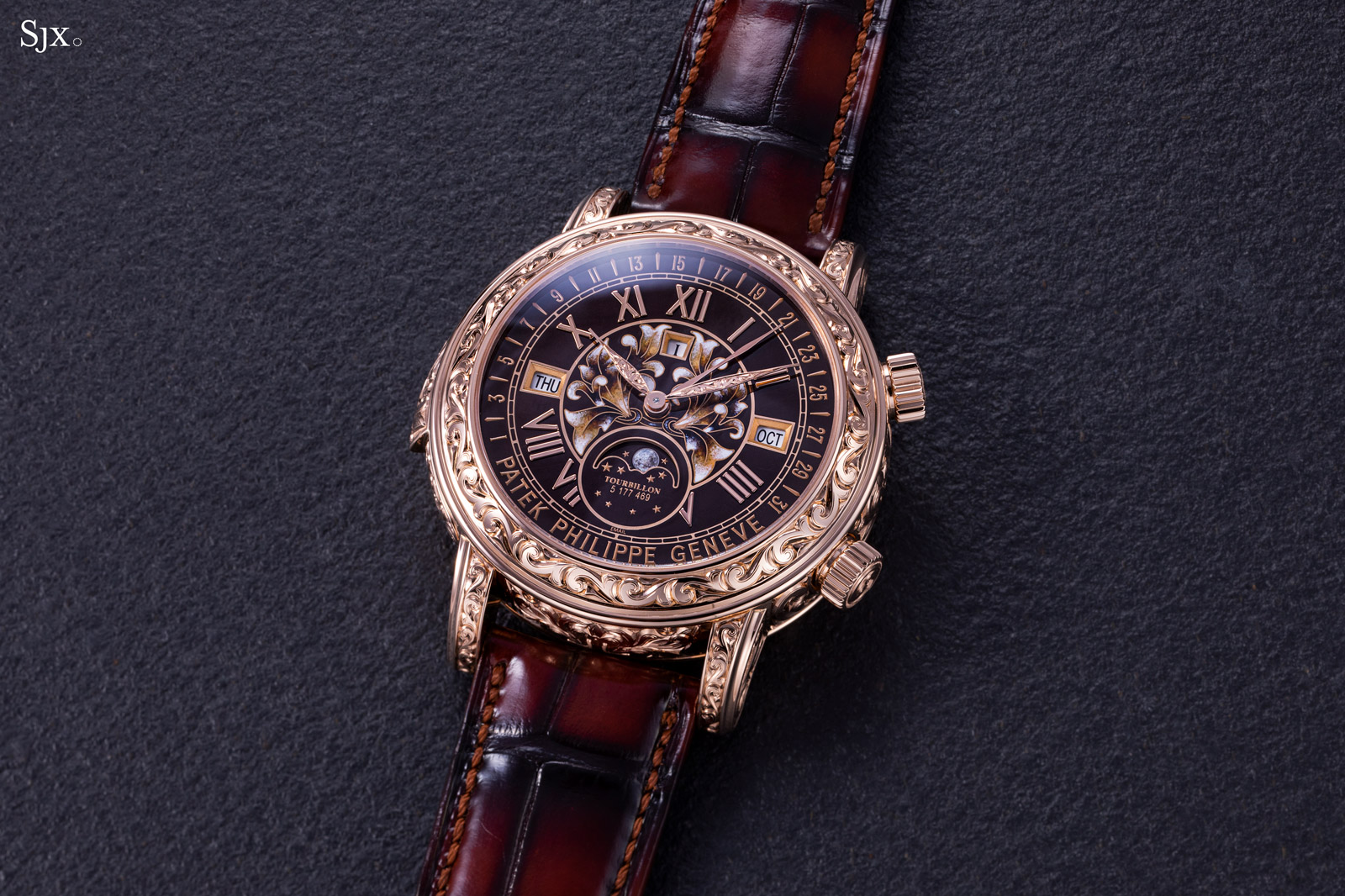
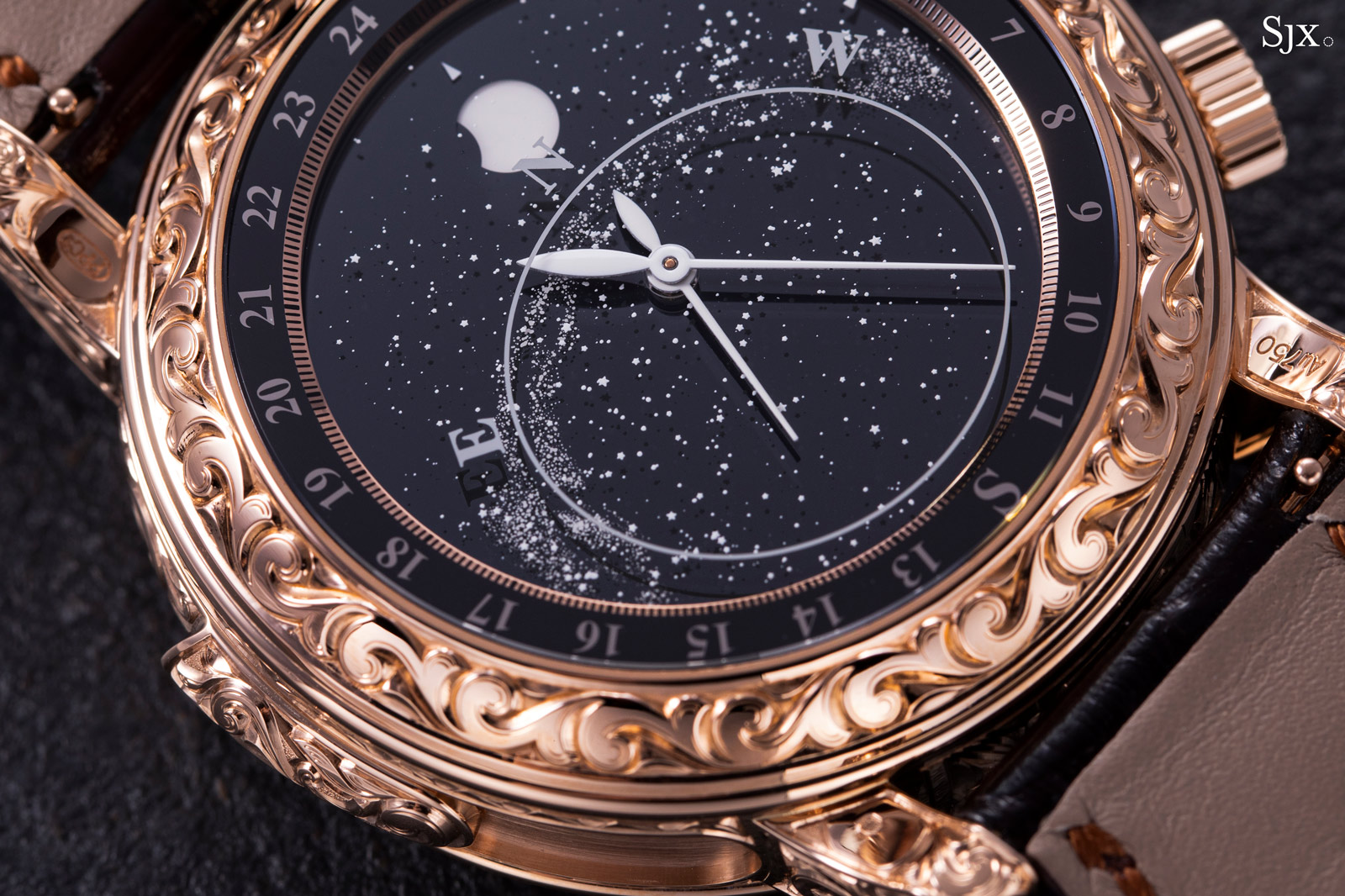
The star chart on the reverse of the Sky Moon Tourbillon ref. 6002R
The ref. 6105G is the third generation Celestial. While it has the familiar star chart on the front, it looks nothing like its predecessors.
While the earlier versions had conventional cases, the ref. 6105 has an oversized, 47 mm case in white gold with no lugs – the integrated rubber straps goes straight into the case middle. As a result, despite the seeming large size, the watch sits well on the wrist. It almost feels like an ergonomic sports watch with an integrated strap, but the weight of the white gold case makes it a little top heavy.
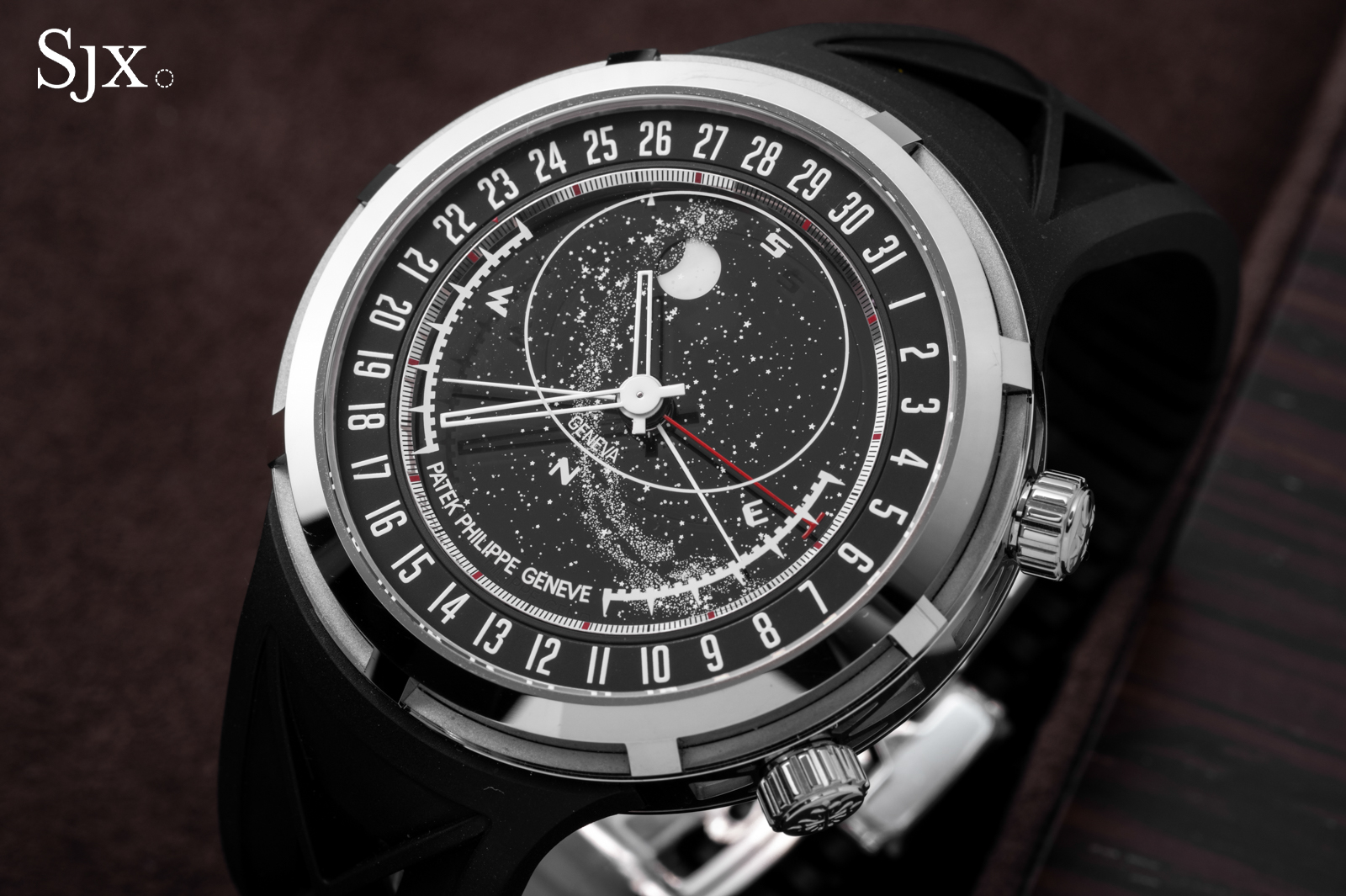
Not only is the case large, it is also adopts an entirely new design language. The flanks of the case has an “X” shaped relief pattern that continues onto the strap and case back. According to Patek Philippe, this was the brainchild of Thierry Stern and inspired by lunar modules and satellites. The look is atypical for Patek Philippe and almost shocking at first sight, but it works – the ref. 6105G looks good.
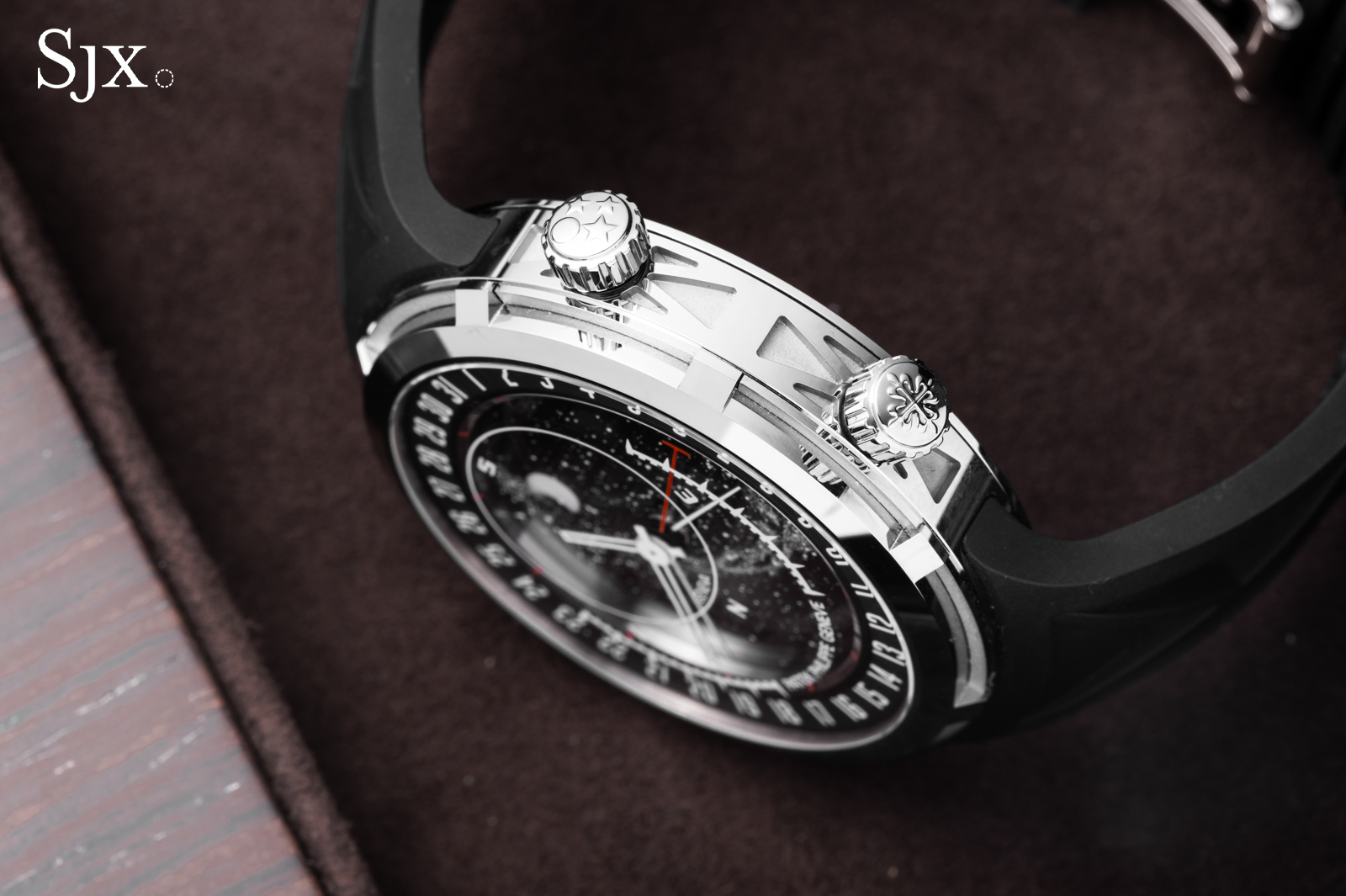
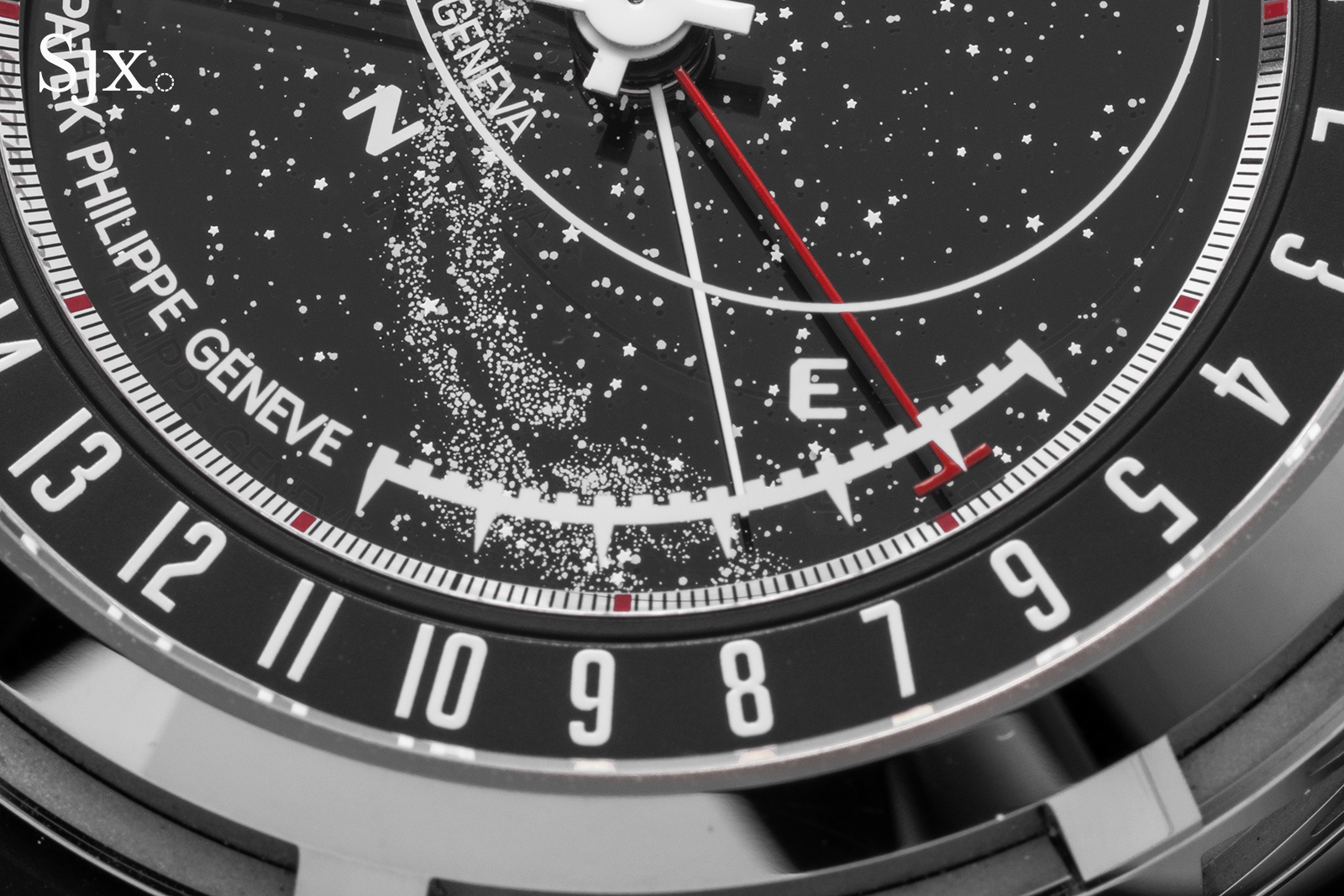
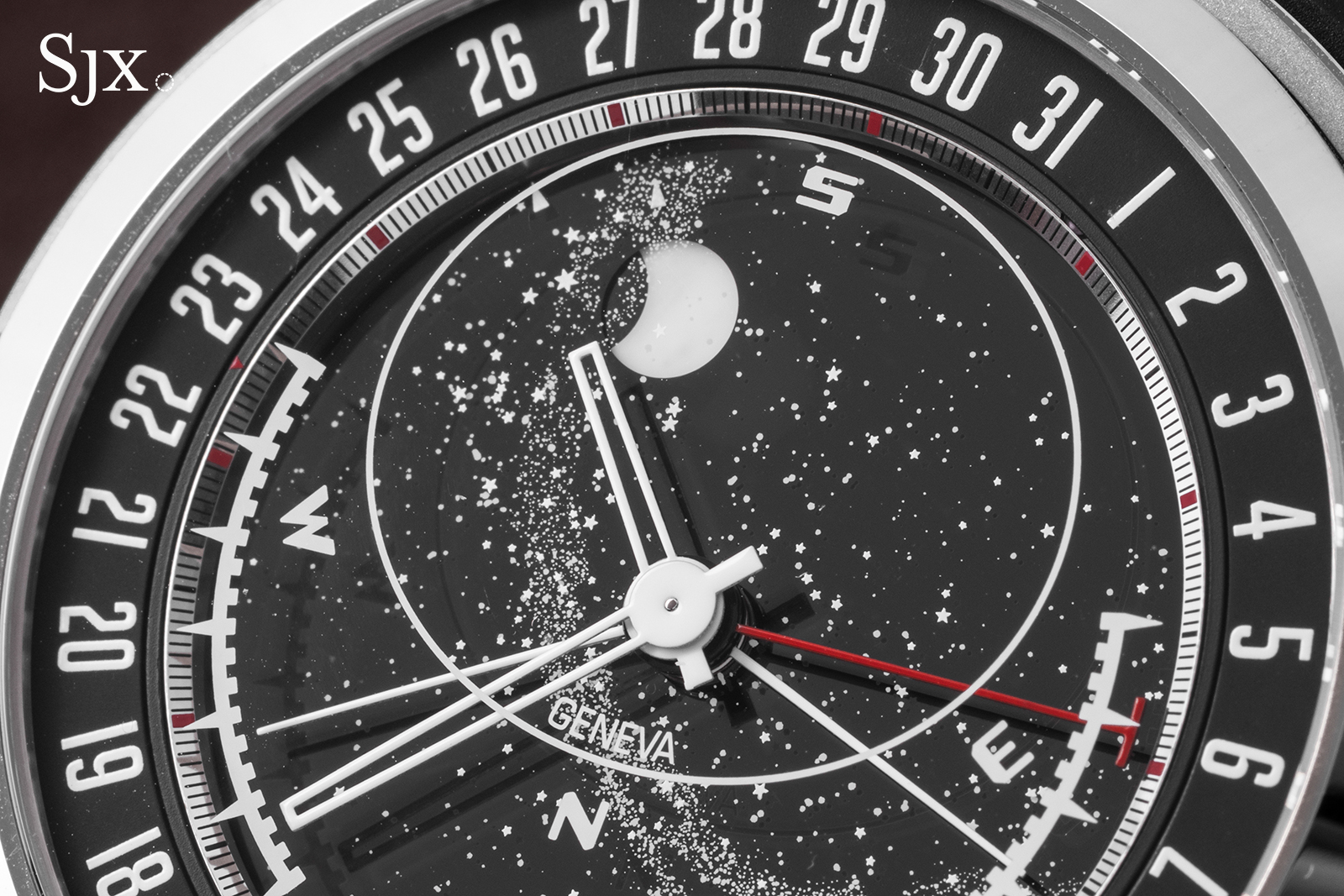
Fundamentally the ref. 6105G functions just like its predecessors. Time and date are indicated by hands on the front, while the dial itself is a planisphere, in other words a star chart. The planisphere is a typical two-disc construction that has a clear disc with stars over an opaque disc; the rotation of the discs reveal the stars in the night sky through the oval aperture on the upper half of the dial.
The star chart display is calibrated for Geneva, and the official word from Patek Philippe is that this is fixed – there can be no customisation of location for the star chart. Changing the gearing for another location is fairly easy, however, so customisation is possible within reason and Patek Philippe may presumably do it for some (very) important clients.
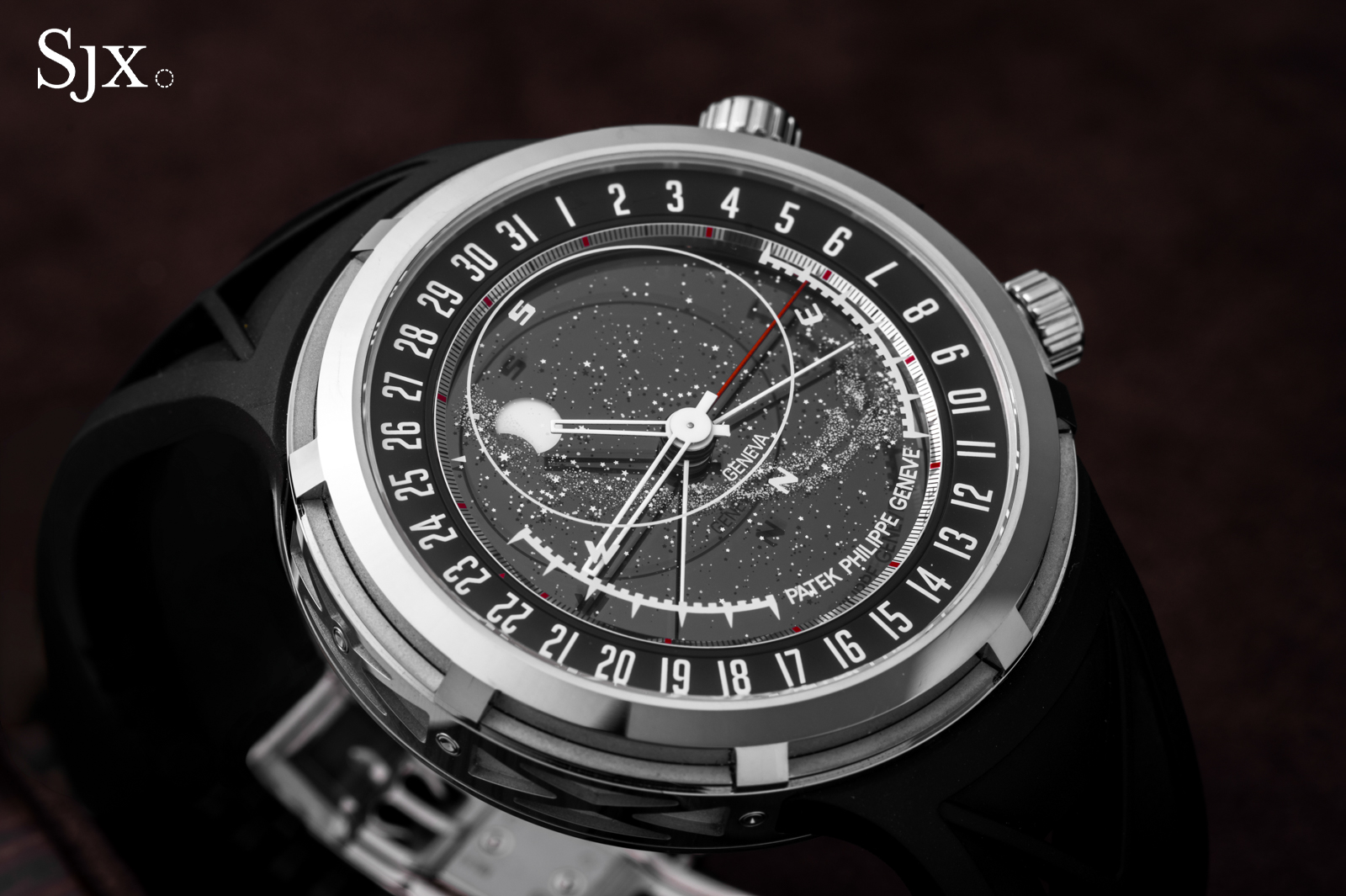
While I like the design of the case, it feels like more effort could have been out into the hands. All of the hands are basic, with the hour and minute hands being skeletonised batons. Legibility is decent, and the hour and minute hands are solid gold, but they could be a little bit more cohesive with the sci-fi case design.
Sunrise, sunset, and daylight savings
At a glance, the dial of the ref. 6105G looks almost identical to its predecessors. But it differs in a crucial respect: the date scale on the periphery is rotated clockwise such that “31” is no longer located at 12 o’clock as it was on the ref. 6102.
This twist is to accommodate the sunrise and sunset indicators that are both read against the date. The ref. 6105G intelligently uses the date scale to indicate sunrise and sunset, so “5” to “11” is for sunrise while “17” to “23” is for sunset. Sunrise and sunset are indicated by a pair of white pointers, while the date pointer is in red.
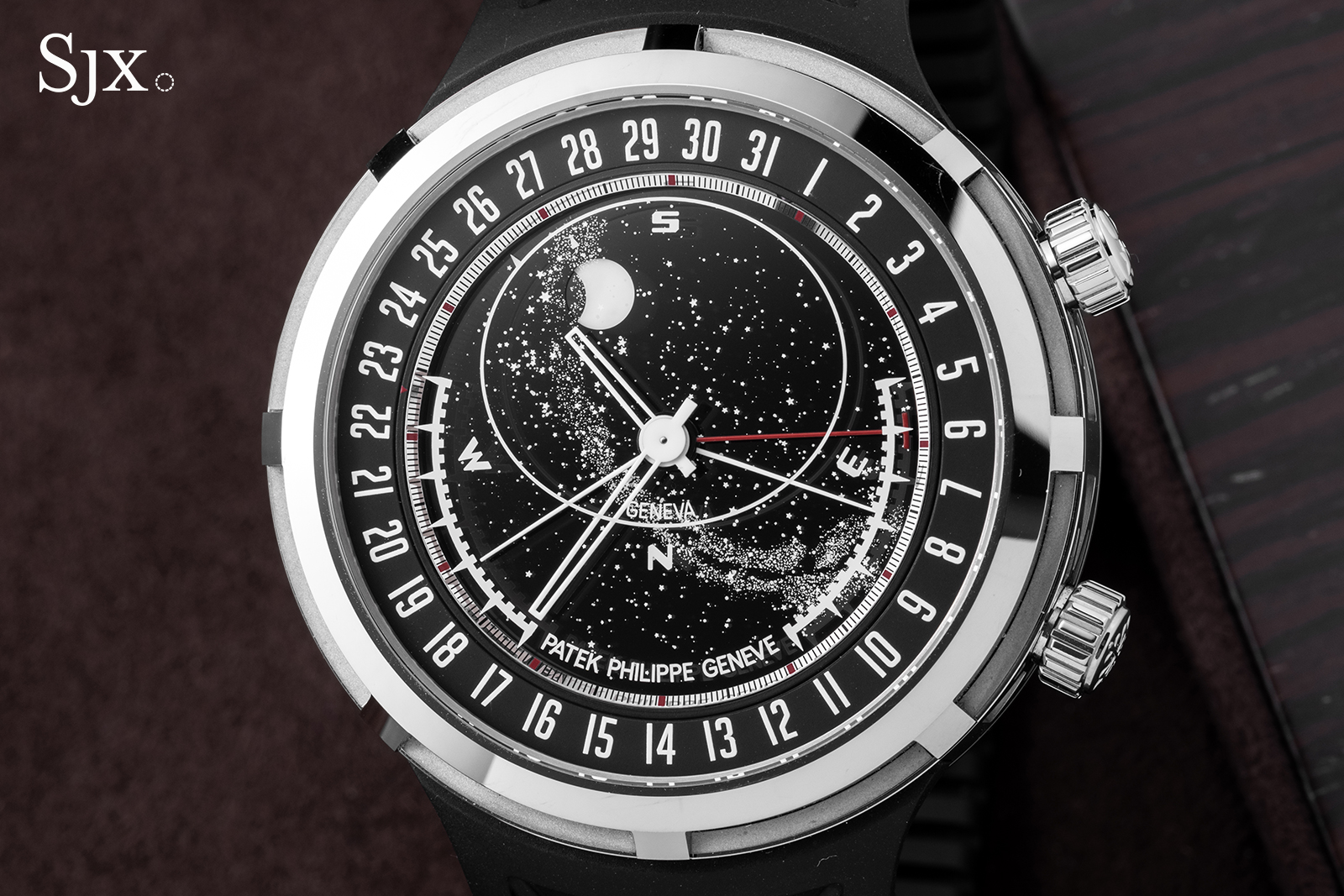
The dial above indicates 6th of the current month, sunrise at about 7:50 am, and sunset at about 6:55 pm
The clever twist behind the display is the summer and winter time function. Pushers in the case flank move the hour hand, date scale, and date pointer simultaneously, either backwards or forwards by one step each as daylight saving time starts and ends. The white pointers for sunrise and sunset remain static during this adjustment, since the date ring has moved to account for the change in time.
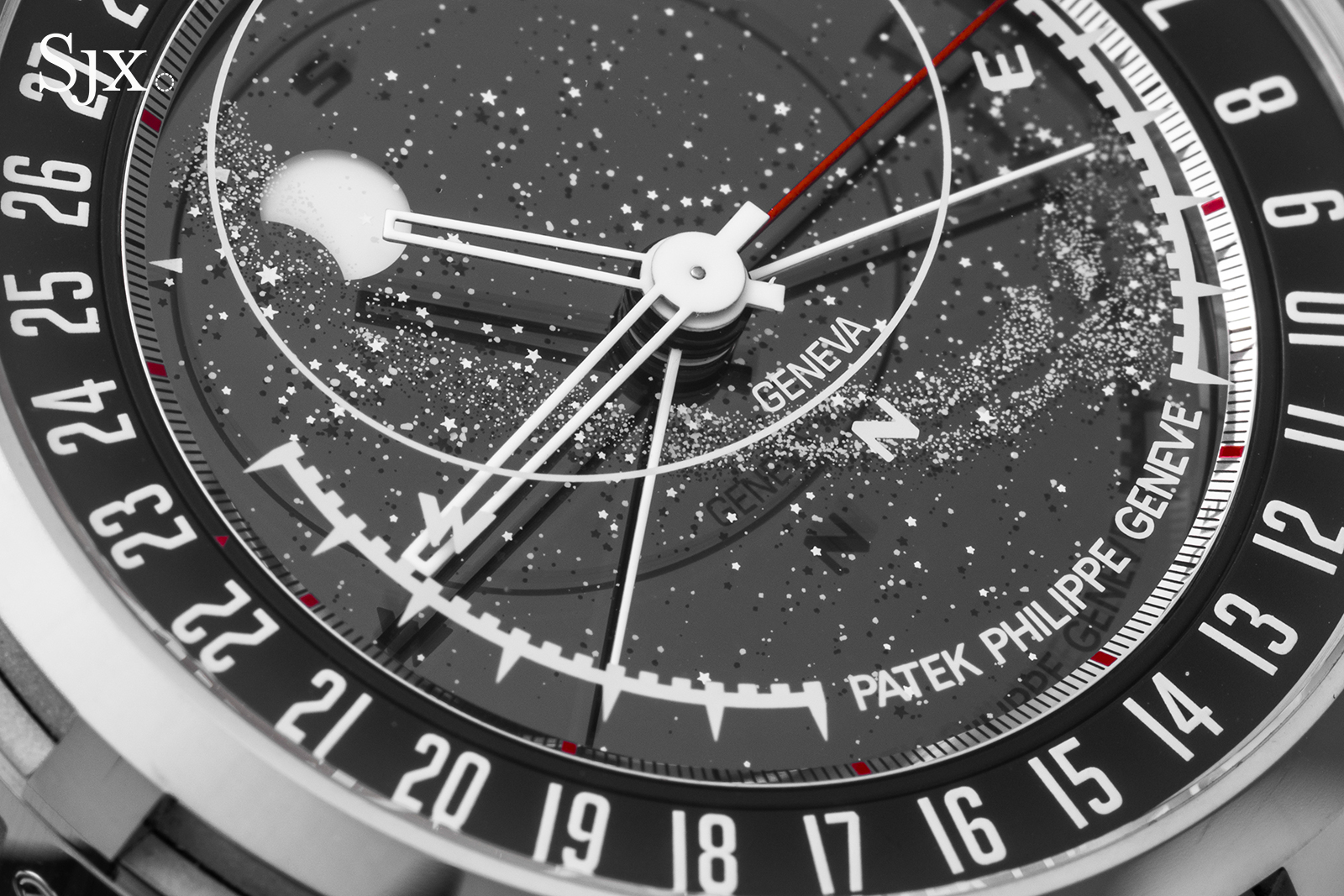
The ref. 6105G continues to use twin crowns: the upper crown at two o’clock sets the star chart while the lower crown at four winds the movement and sets the time.
The upper crown incorporates a bayonet-lock mechanism to prevent accidental adjustment – the wearer must push down and twist the crown to release it. Pulled out the first position, the crown sets the sunrise and sunset indicators. And in the second, final position, the crown advances the star chart in one direction, and then the moon phase in the other direction.
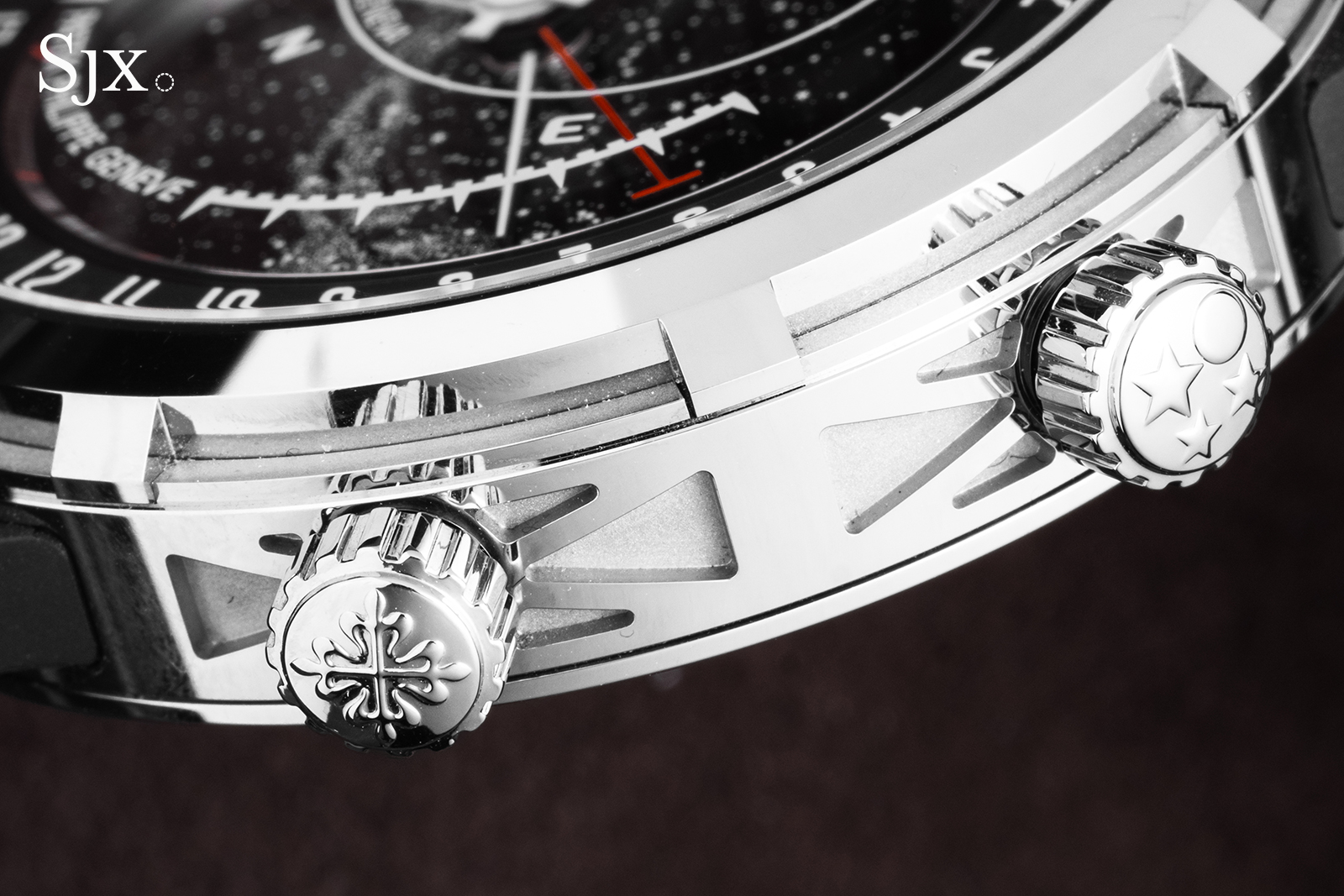
The right flank of the case features three recessed pushers. The pusher at seven o’clock sets the date, while the nine o’clock pusher advances the sunrise and sunset displays by an hour for summer time, and the pusher at ten o’clock does the opposite for winter time.
Patek Philippe is still a traditionalist when it comes to setting, hence the multiple pushers in the case. This requires a stylus for adjustment, and is less convenient than more advanced crown-based systems. This is arguably one of the weaknesses of the watch, though strictly speaking the pushers only need to be accessed twice a year during daylight saving time, while the date does not need setting since the watch is on a winder.
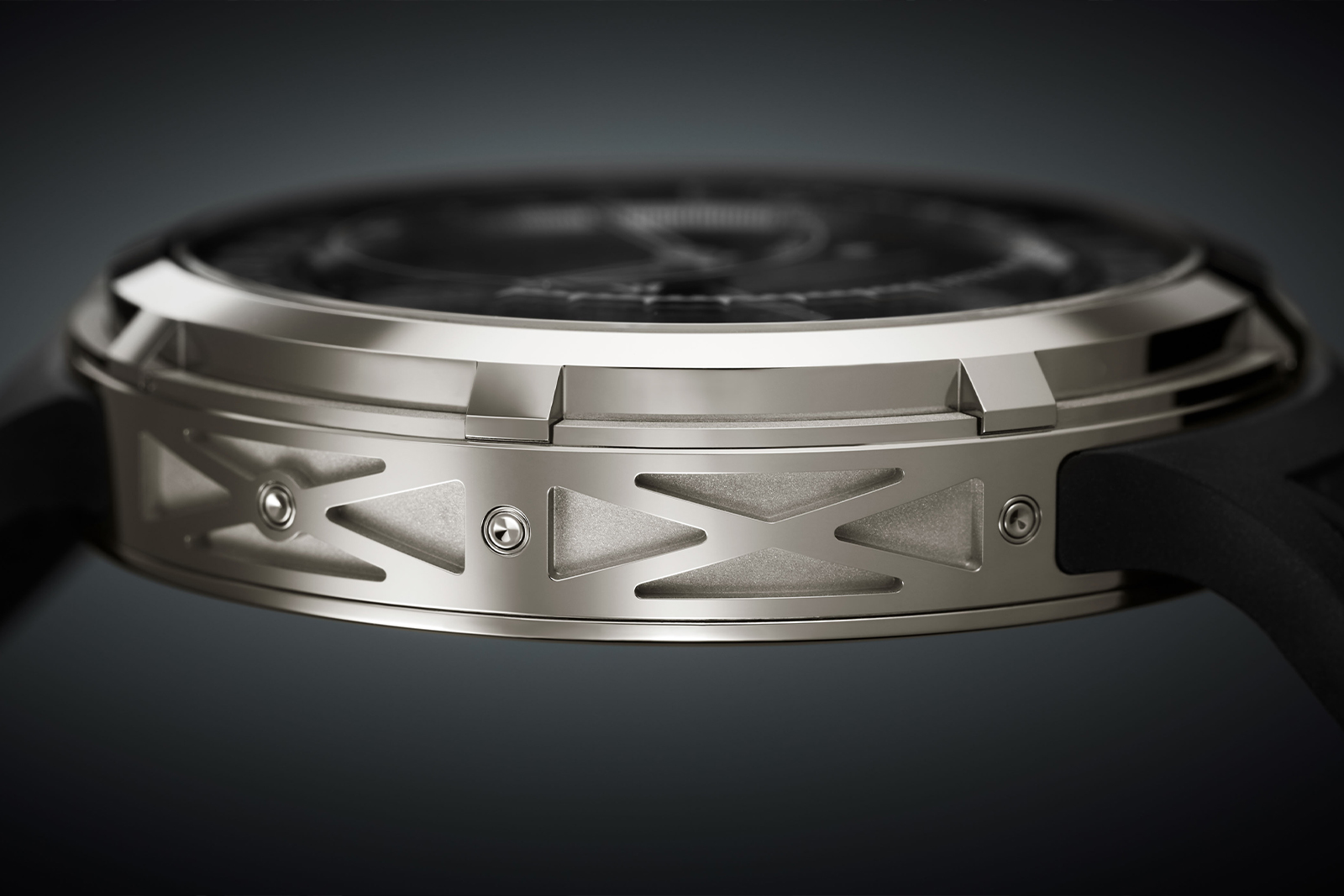
The trio of pushers. Image – Patek Philippe
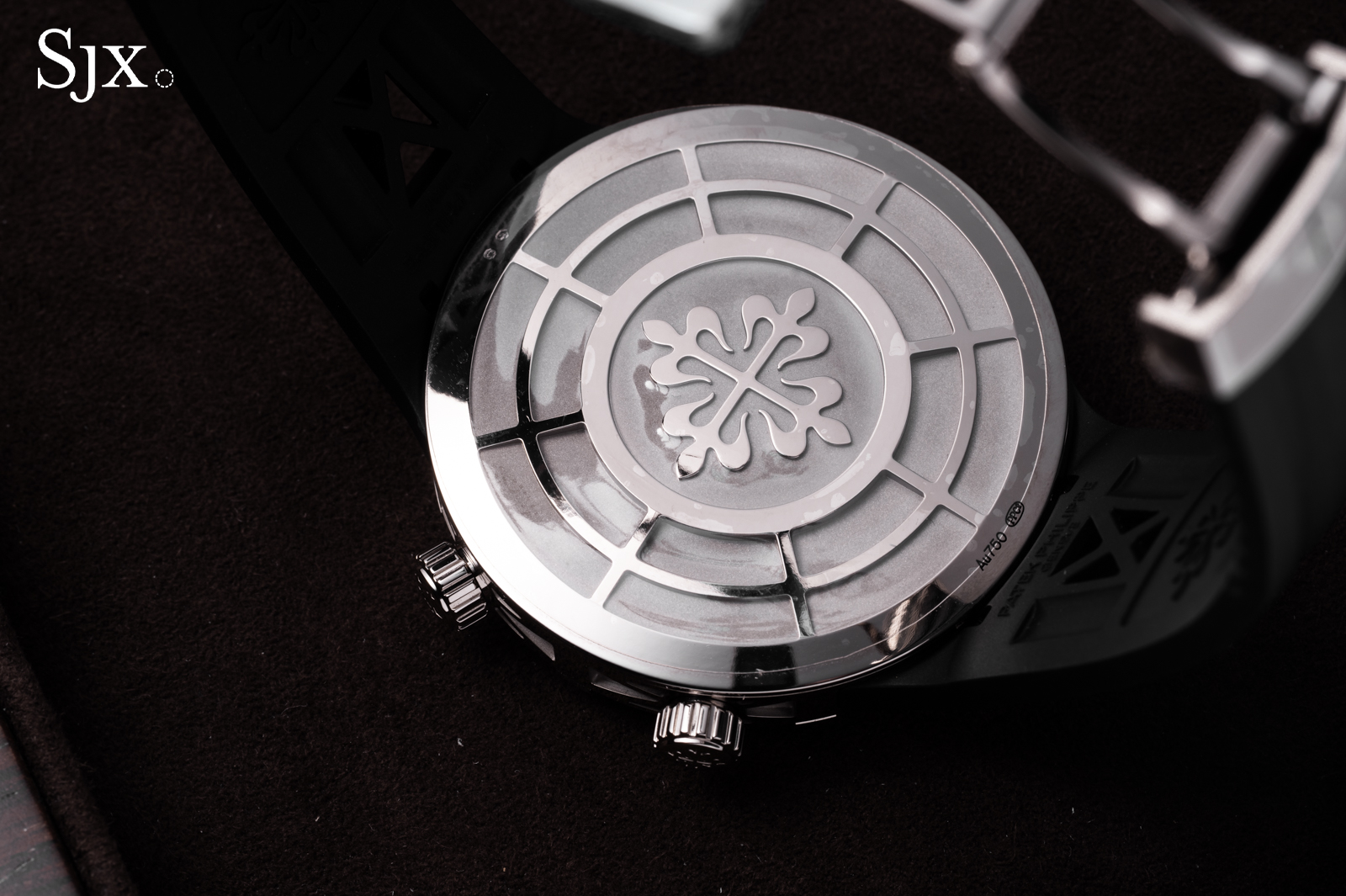
The ref. 6105G is one of the few Patek Philippe watches with a solid case back. Instead of a sapphire window the back has a relied pattern that continues the lunar module style of the case. This creates aesthetic continuity; moreover a clear back is probably not necessary since the cal. 240 inside is well known and anyone who owns a ref. 6105G likely owns another Patek Philippe with a visible cal. 240.
Compliant Celestial
The cal. 240 C LU CL LCSO is evolved from the original Celestial calibre, but has an additional 121 parts resulting in an extra 1.12 mm in thickness. This is primarily due to the addition of the sunrise and sunset indicators.
Now several decades old but continually upgraded over the years, the cal. 240 includes a silicon hairspring amongst other upgrades. Most of the upgrades are invisible, possibly including details like optimised teeth profiles and LIGA components. Most notably, the cal. 240 now runs within -1/+2 seconds a day, which is impressive for a movement of this size and age, underlining the modernisation it has enjoyed.
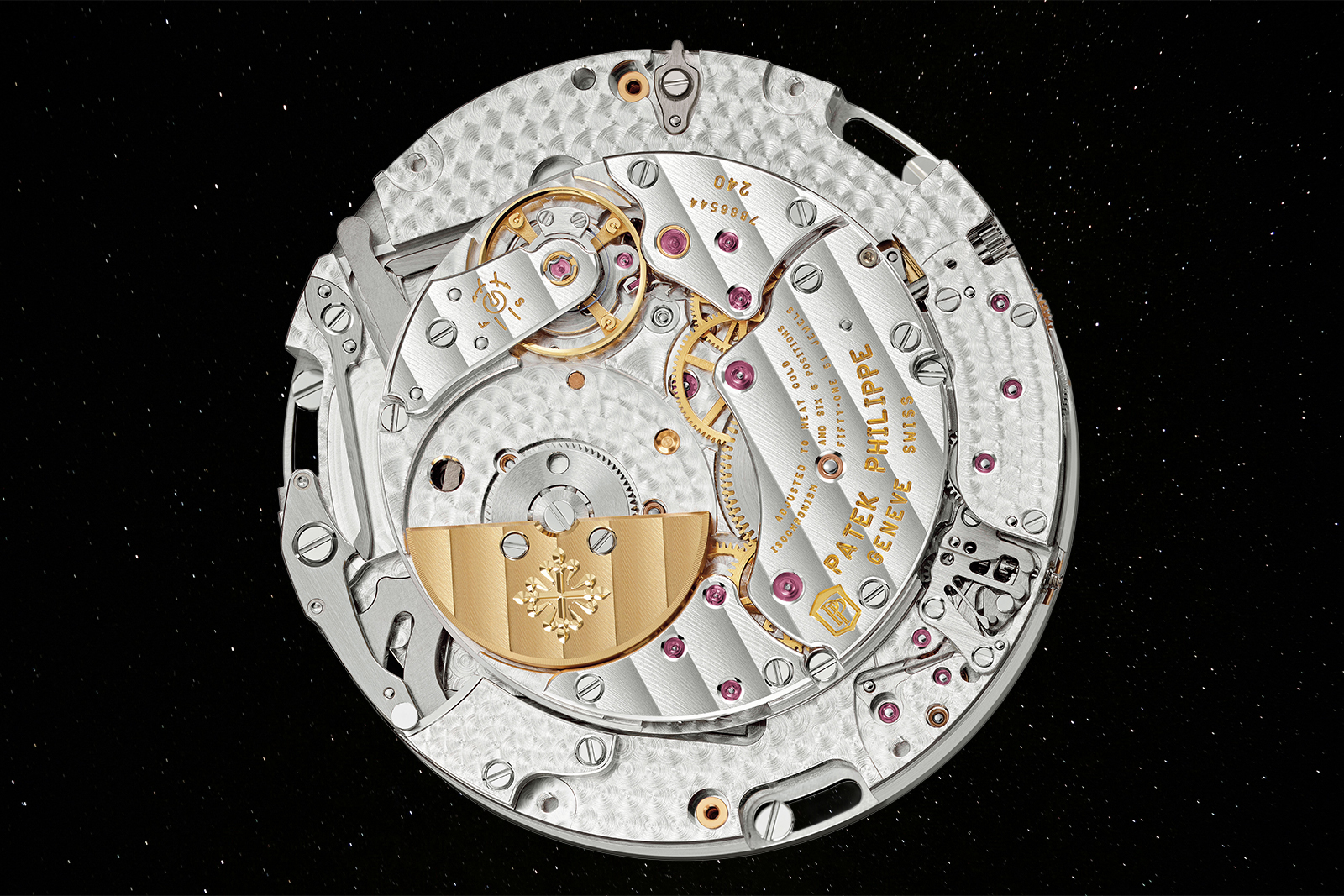
The cal. 240 is a small movement at just 27.5 mm in diameter, while the celestial module is a much larger 38 mm. Image – Patek Philippe
The sunrise and sunset displays are driven by a mechanism with several patents. The core concept is traditional: a pair of kidney-shaped cams control each indicator, with each cam making one full rotation over the course of a year. Each cam has a feeler that “reads” the edge of the cam, translating the position of the cam into sunrise or sunset. The cams are both kidney shaped to account for the different length of days as the seasons change.
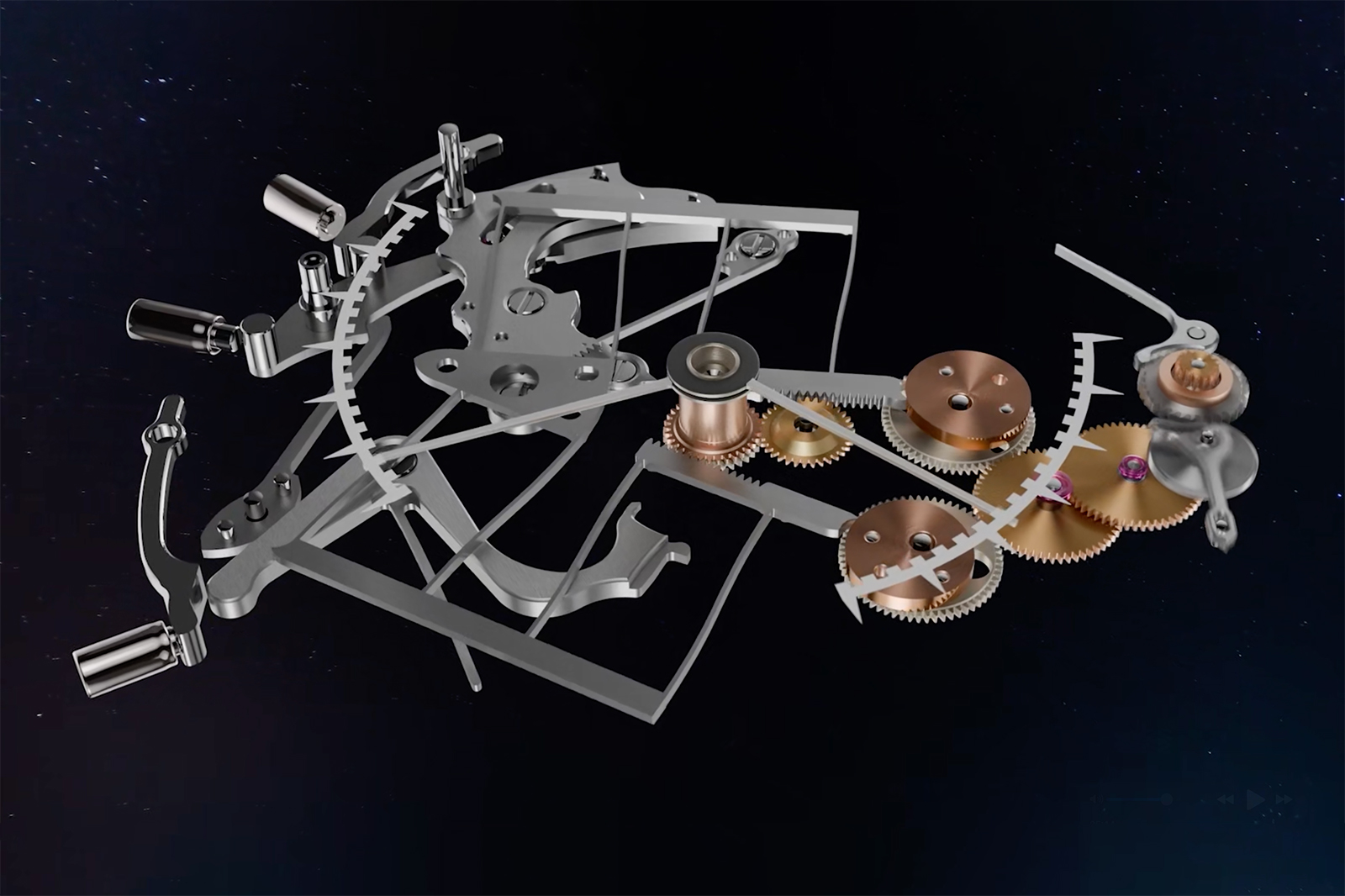
The sunrise and sunset mechanism. Image – Patek Philippe
The novel aspect is the patented double feeler-spindle (in red) linked to the feelers, which is a compliant mechanism of a type that might be a first in watchmaking. Interestingly, Patek Philippe was not the only brand to roll out an innovation centred on a compliant mechanism at W&W 2026; TAG Heuer also did so but with a different type of mechanism for the Evergraph. And going even further back, Patek Philippe already experimented with compliant mechanism (of a different type) with the Aquanaut Advanced Research ref. 5650G of 2017.
Most likely produced via LIGA, a lithography technique, this component incorporates twin linear racks, each guided by a two pairs of exceptionally slim springs that are just 0.48 mm wide, enabling for precise, gradual movement. Because the racks are linked by flexible springs, the mechanism is more precise than a conventional set-up; the linkage eliminates play and parasitic shift.
On the other hand, the summer and winter time adjustment function relies on traditional levers (in blue below) that shift the hands and date ring forwards or backwards as necessary.
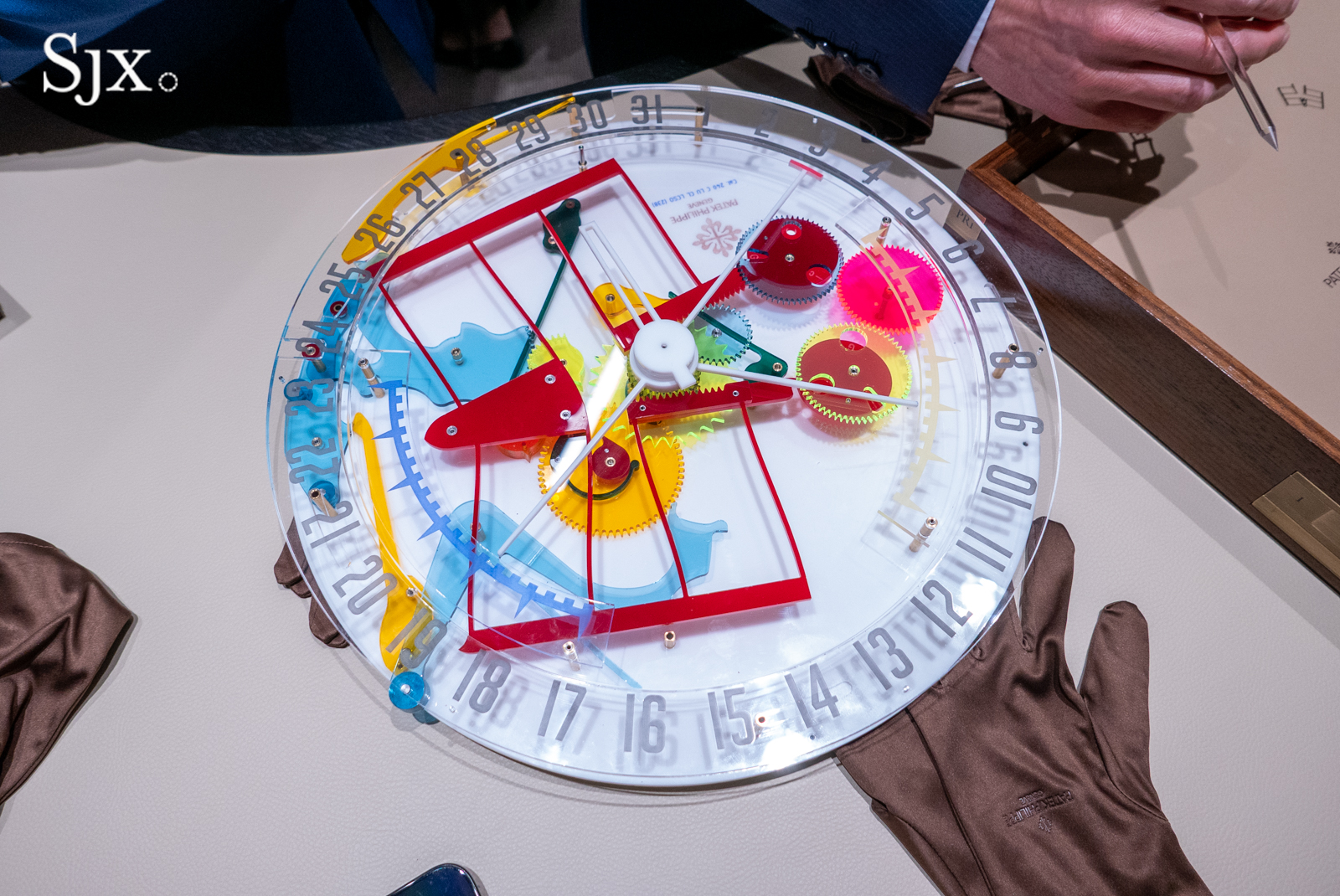
An oversized model of the sunrise and sunset mechanism
Key facts and price
Patek Philippe Celestial Sunrise and Sunset
Ref. 6105G-001
Diameter: 47 mm
Height: 12.39 mm
Material: 18k white gold
Crystal: Sapphire
Water resistance: 30 m
Movement: Cal. 240 C LU CL LCSO
Functions: Hours, minutes, date, planisphere, time of sunrise and sunset, date
Frequency: 28,800 beats per hour (4 Hz)
Winding: Automatic
Power reserve: 45 hours
Strap: Rubber with triple-blade clasp
Limited edition: No
Availability: At Patek Philippe retailers and salons.
Price: US$437,610 excluding taxes
For more, visit Patek.com.
Back to top.