
Hands On: Dominique Renaud Pulse 60
A slow-beating watch that carries momentum.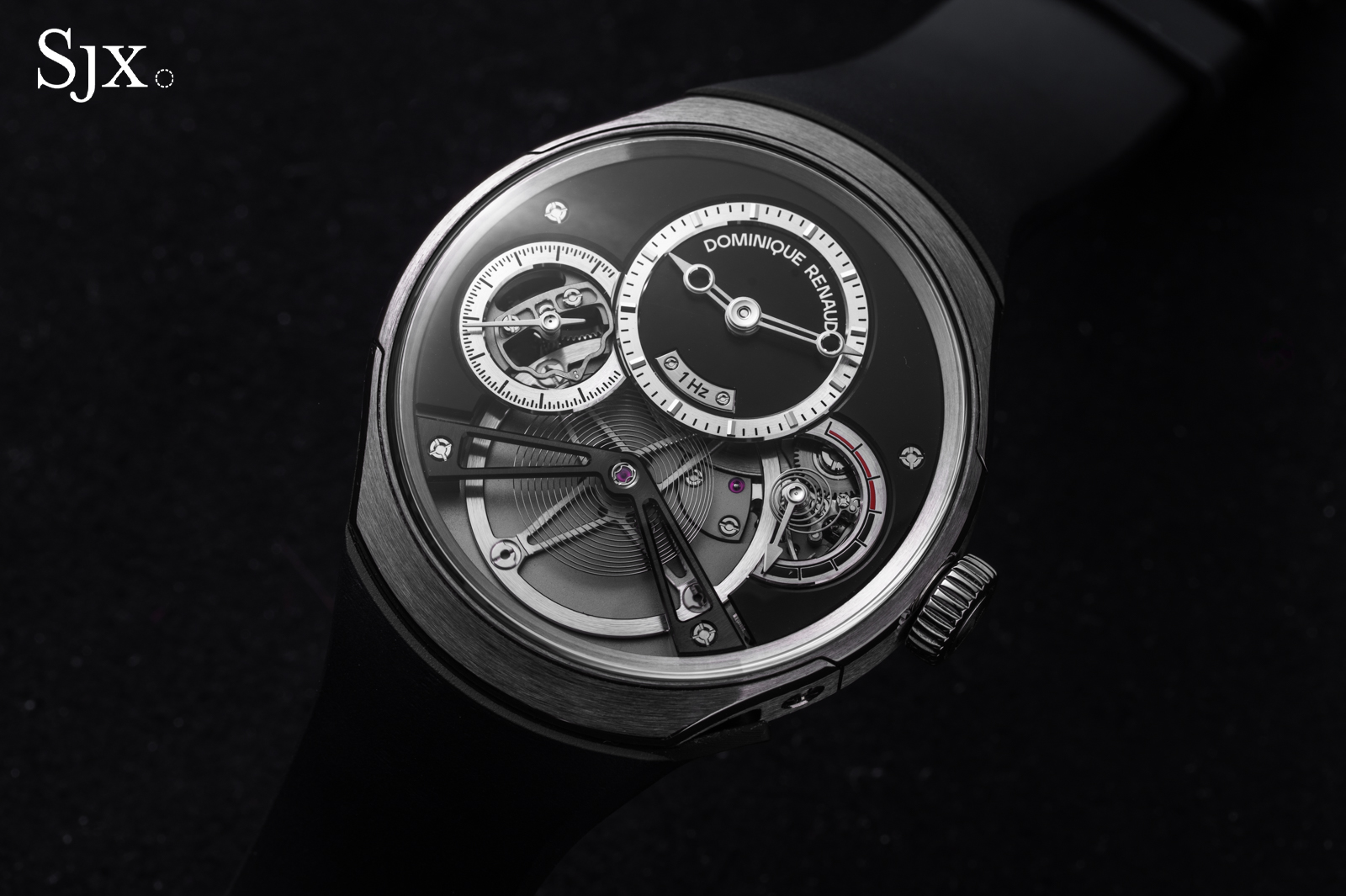
Accomplished movement constructor Dominique Renaud makes a compelling return with the Pulse 60, a slow-beating timepiece featuring a 1 Hz oscillator. An important name in the post-quartz era, Mr Renaud has recently re-emerged alongside Julien Tixier under the Renaud Tixier brand. The Pulse 60 marks his first signed watch in nearly a decade — following the million-dollar DR01 Twelve First, which resulted in a single unique piece.
Initial thoughts
When speaking today of advancing the theory and practice of horology, the conversation usually centres around cutting-edge materials, novel tribology research or reimagined complications. The Dominique Renaud (DR) Pulse 60 contradicts this trend and instead goes back in time to put a new spin on an old idea.
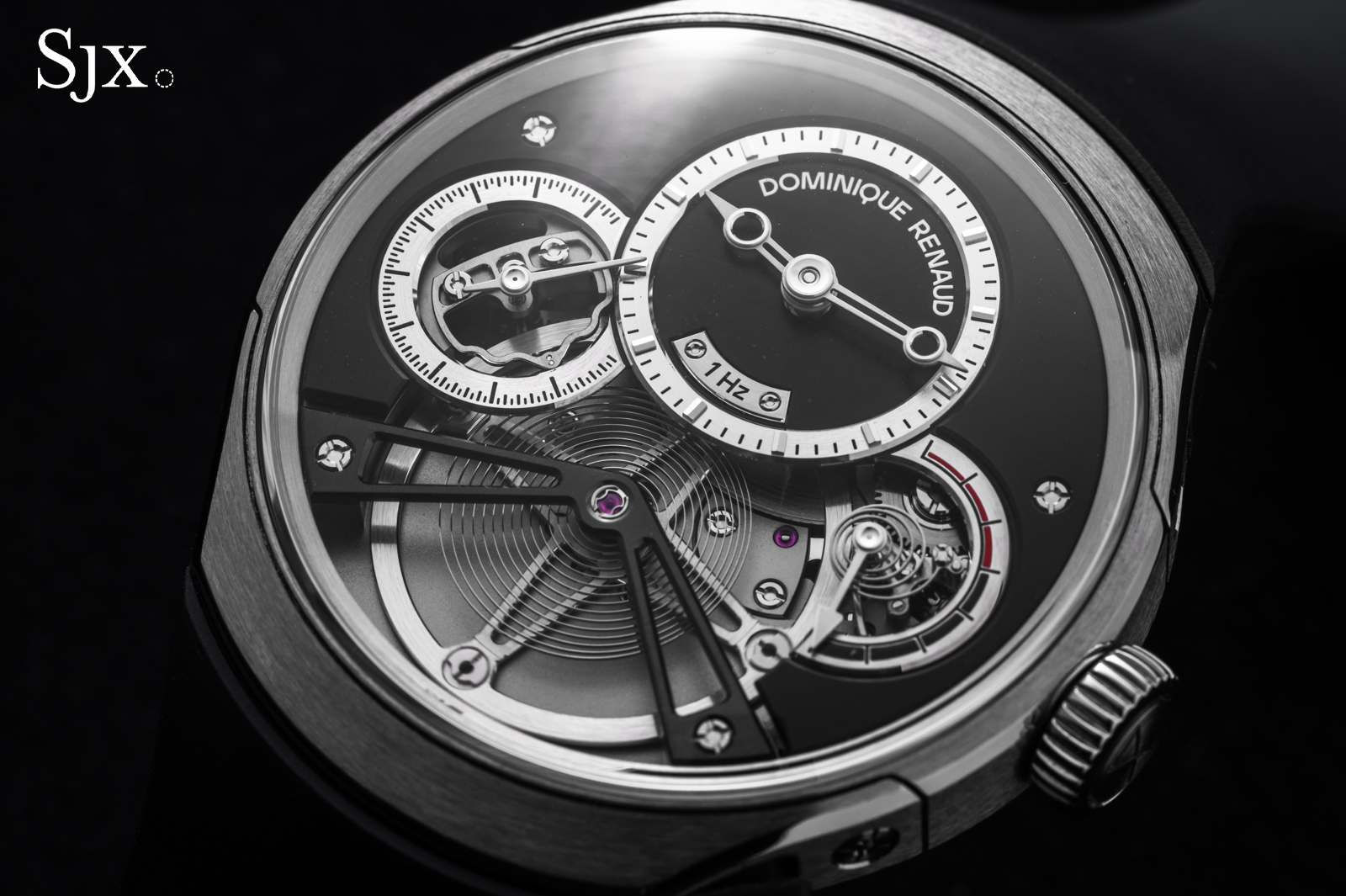
The slow beating 1 Hz Pulse 60 bets on classic chronometry, when heavy balances paired to slow and steady running rates were the champions of precision. Going one step further, DR slowed the oscillator to 1 Hz — or just one oscillation per second. In the era of ever-higher frequencies, the counterintuitive choice seems at first like a deliberate act of self-sabotage.
But after analysing the novel movement in the Pulse 60, it’s my opinion that it should prove to be a reliable timekeeper, and more than just a proof of concept. After Antoine Martin’s ill-fated Slow Runner, DR has produced a fully functioning 1 Hz timepiece by employing a smaller balance and — crucially — raising the amplitude ceiling to over 360°.
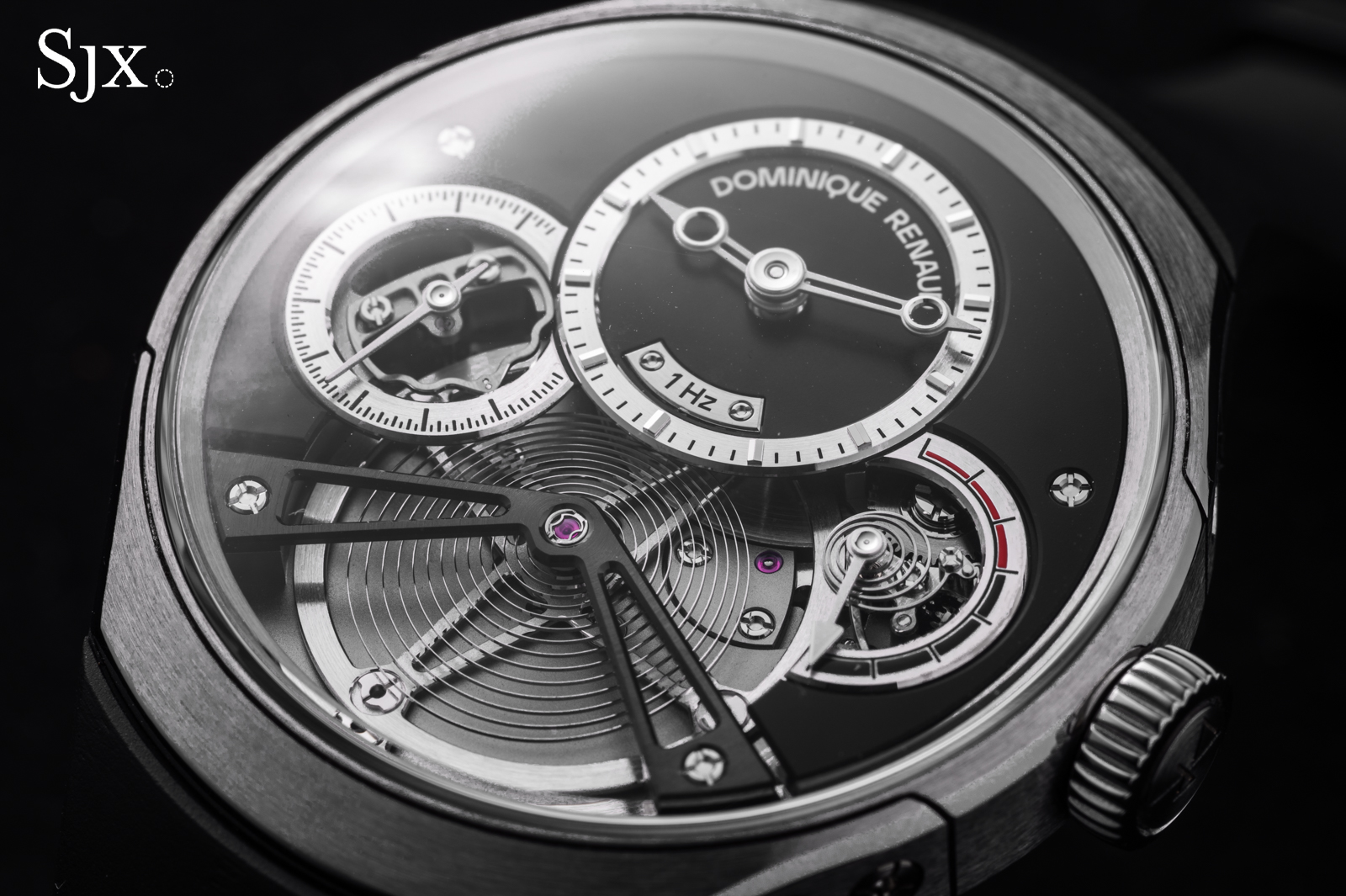
As a timepiece, the Pulse 60 is a successful exercise in avant-garde design. Proper sizing and light construction make the Pulse 60 a wearable watch. Surely it won’t slide too easily under the metaphorical cuff, but thankfully it won’t look excessive either. Although not as visually engaging as a lightning seconds hand or a fast-turning tourbillon, the large 1 Hz balance still holds lots of hypnotising charm.
Priced at just under CHF50,000 in its basic configuration, the Pulse 60 is priced reasonably by the standards of low-volume watches with novel escapements. The visual effect of the massive balance is unique, and distinguishes the watch from a field crowded with simple, well-finished time-only watches.
A humble hyper watch
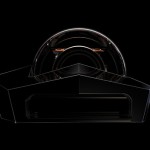
The Pulse 60 is fashioned with a certain industrial-futuristic look in mind. The case doesn’t follow the usual format and instead has a pod-like structure, with the integrated shrouded lugs screwed laterally. The lug connectors are a proprietary design, and are both easy to use and feel quite sturdy. That said, when small independents opt for integrated bracelets or proprietary straps, there is always the fear of a lack of strap options should the product be discontinued.
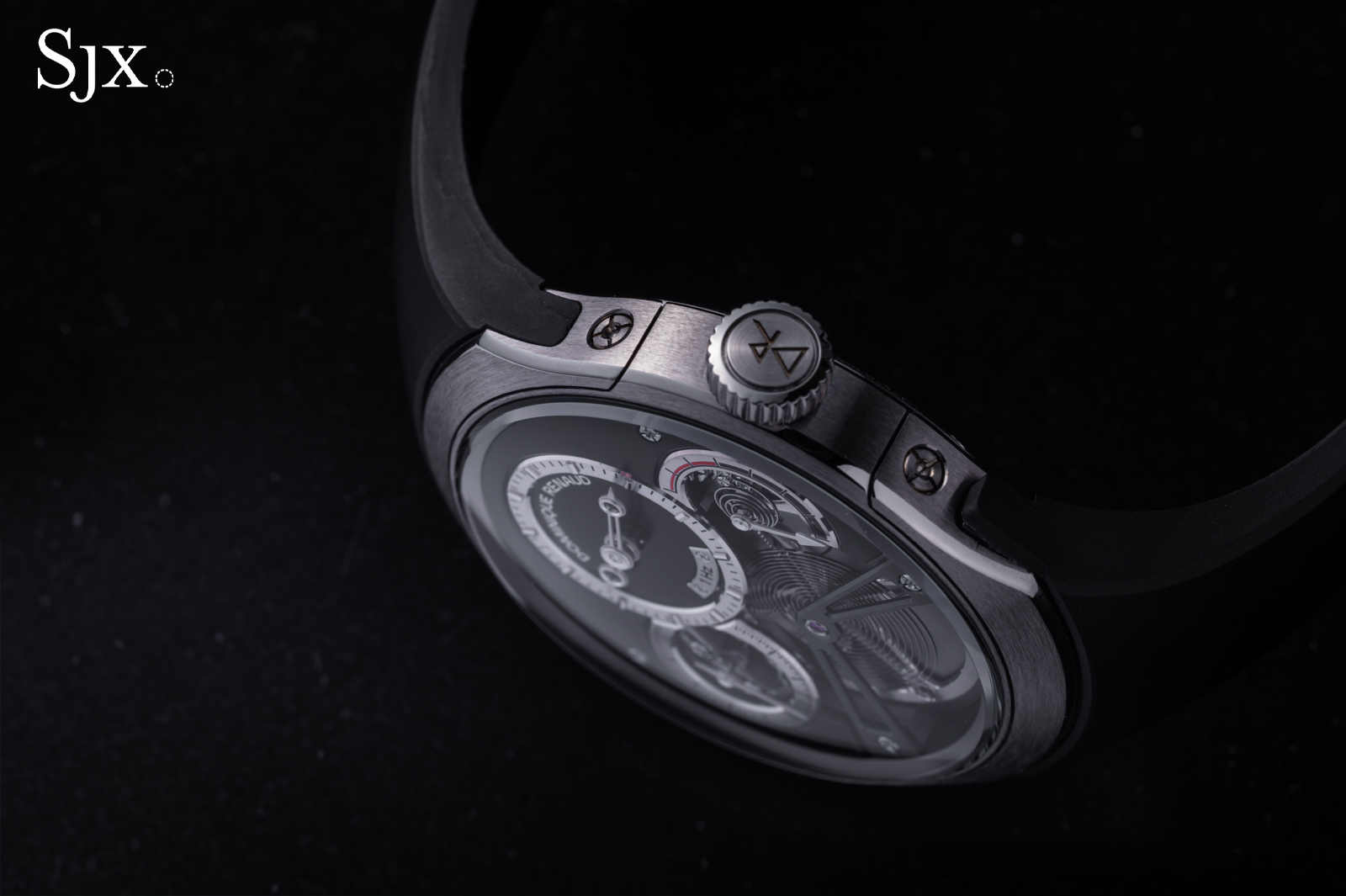
The Pulse 60 comes with an assortment of colourful high-quality rubber straps — the ability to easily swap between them should appeal to a wide range of tastes. The soft, supple feel of the rubber straps and the sturdy, click-heavy action of the strap connector reminds me of the Apple Watch — which is a compliment.
The case is made from brushed titanium, but can also be delivered in a bi-colour configuration with 18K rose gold lugs. At 40 mm in diameter, the Pulse 60 wears well, in part due to its lugless design.
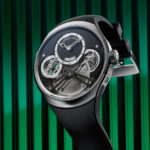
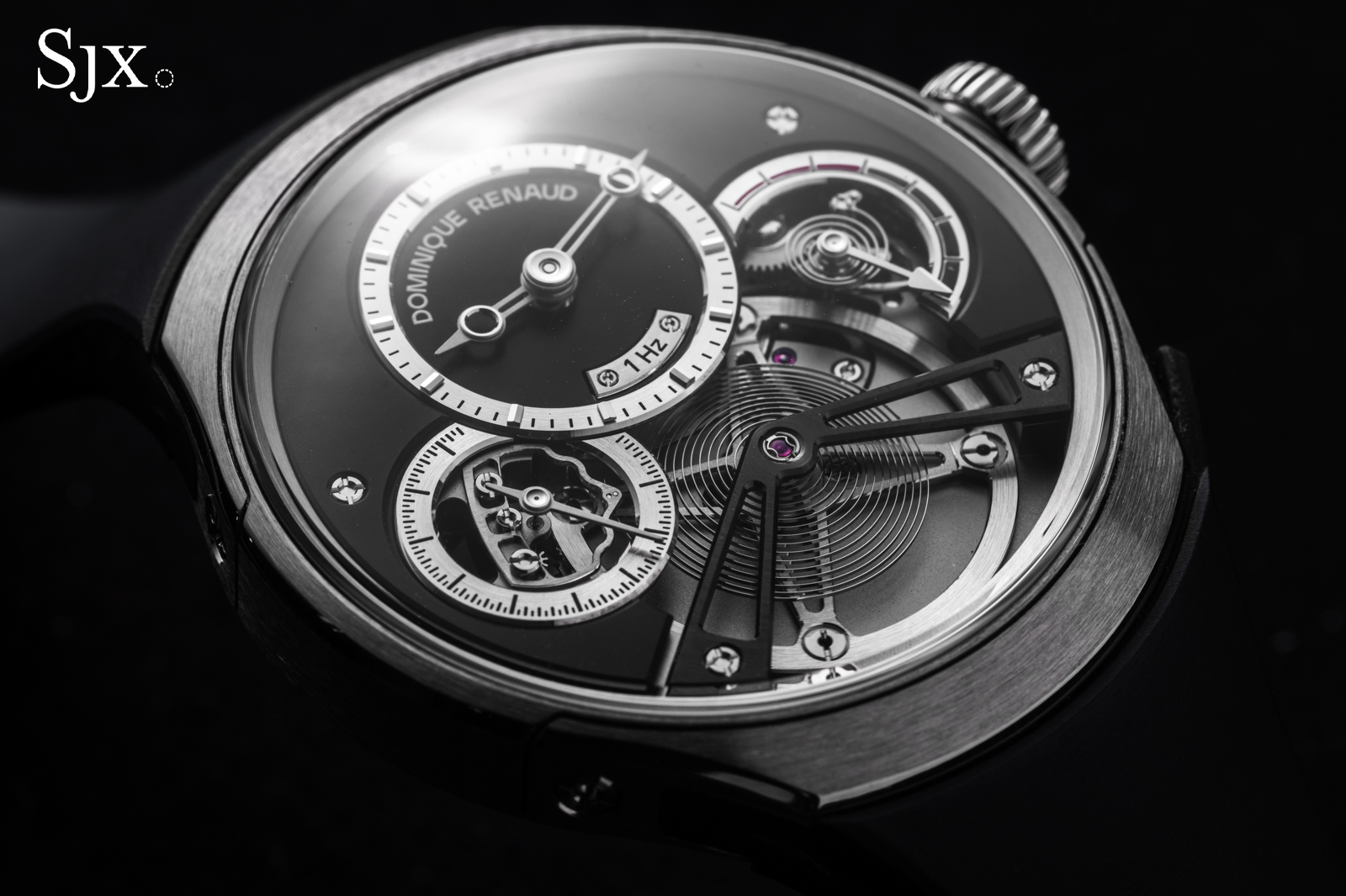
The unpretentious case and the lack of a proper bezel effectively guide the eye toward the broad dial. The 1 Hz balance feels slow by contemporary standards, but the decelerated motion allows the onlooker to follow the full swing of the oscillator, lending it a more human scale and an intimate sense of dynamism.
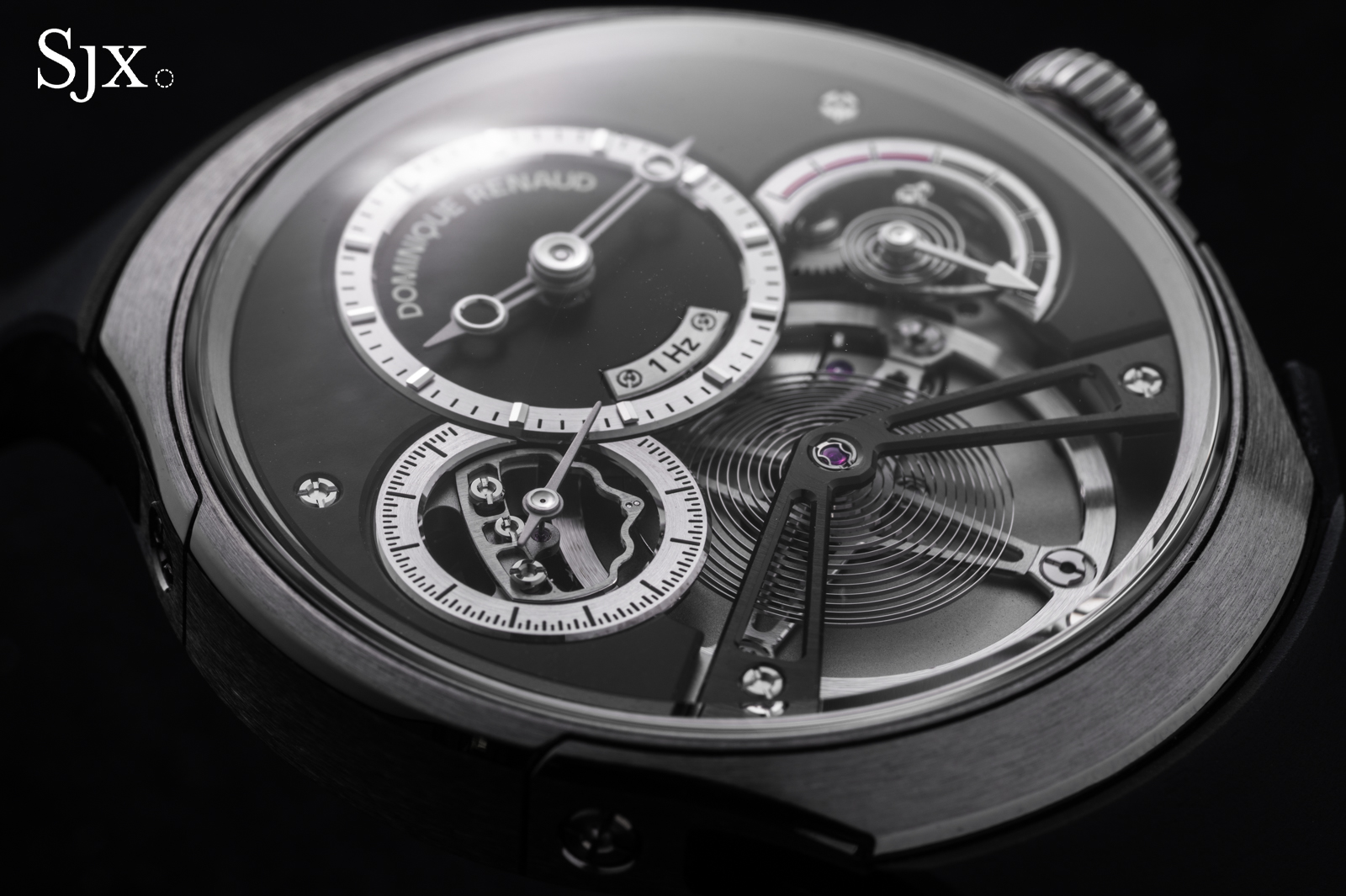
The large balance measures 20 mm in diameter — exactly half of diameter of the cased watch. The entire movement is just 33 mm in diameter, so the balance is positioned on the dial side of the mainplate, free from typical constraints on size — namely the position of the centre wheel pinion.
The hours and minutes can be read on a sub dial at 12 o’clock, which is flanked by two other indications. The balance is so large that it extends and oscillates under each of these dials, which display the running seconds and the level of remaining torque.
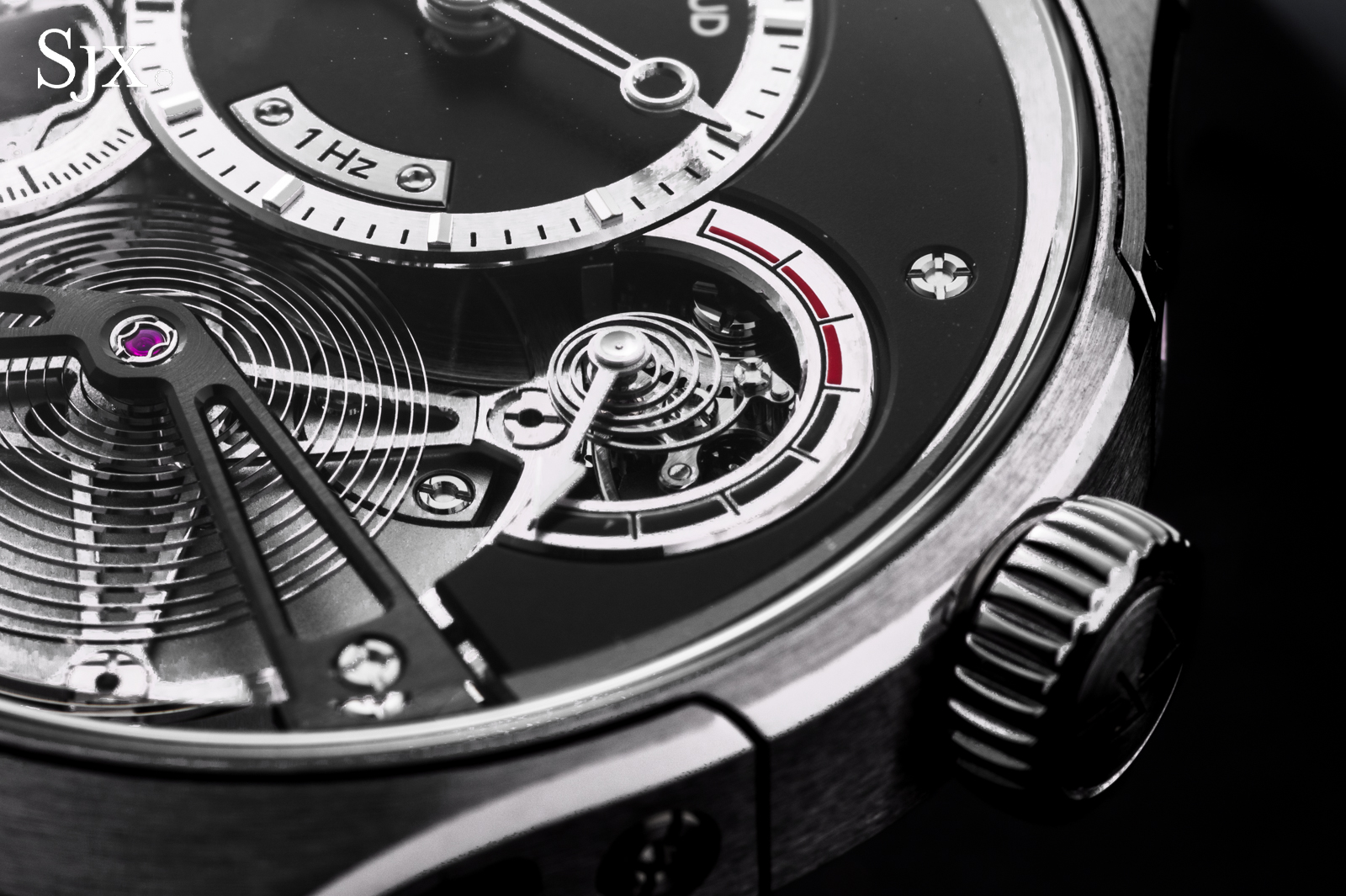
The torque indicator is an unusual choice compared to the more-common power reserve indicator. A normal power reserve indicator only displays the number of developing turns left in the mainspring barrel; a torque indicator actively measures and shows the available torque strength. This is why when the Pulse 60 is wound, the torque indicator instantly shoots towards the maximum position, then settles back for the true reading.
Although they are uncommon, we’ve seen these sort of “dynamographs” before, notably in the Audemars Piguet Concept Watch 1 and some early watches from Richard Mille. Given the rarity of the complication, it’s not surprising that in both of these cases the movements were developed by Renaud & Papi. The choice of a torque gauge is a deliberate nod to Mr Renaud’s storied career.
The movement is rated to run at 96 hours from a single barrel. By having a real-time gauge of the available torque, the wearer will probably be tempted to wind the Pulse 60 more often, as to always keep the torque level in the green.
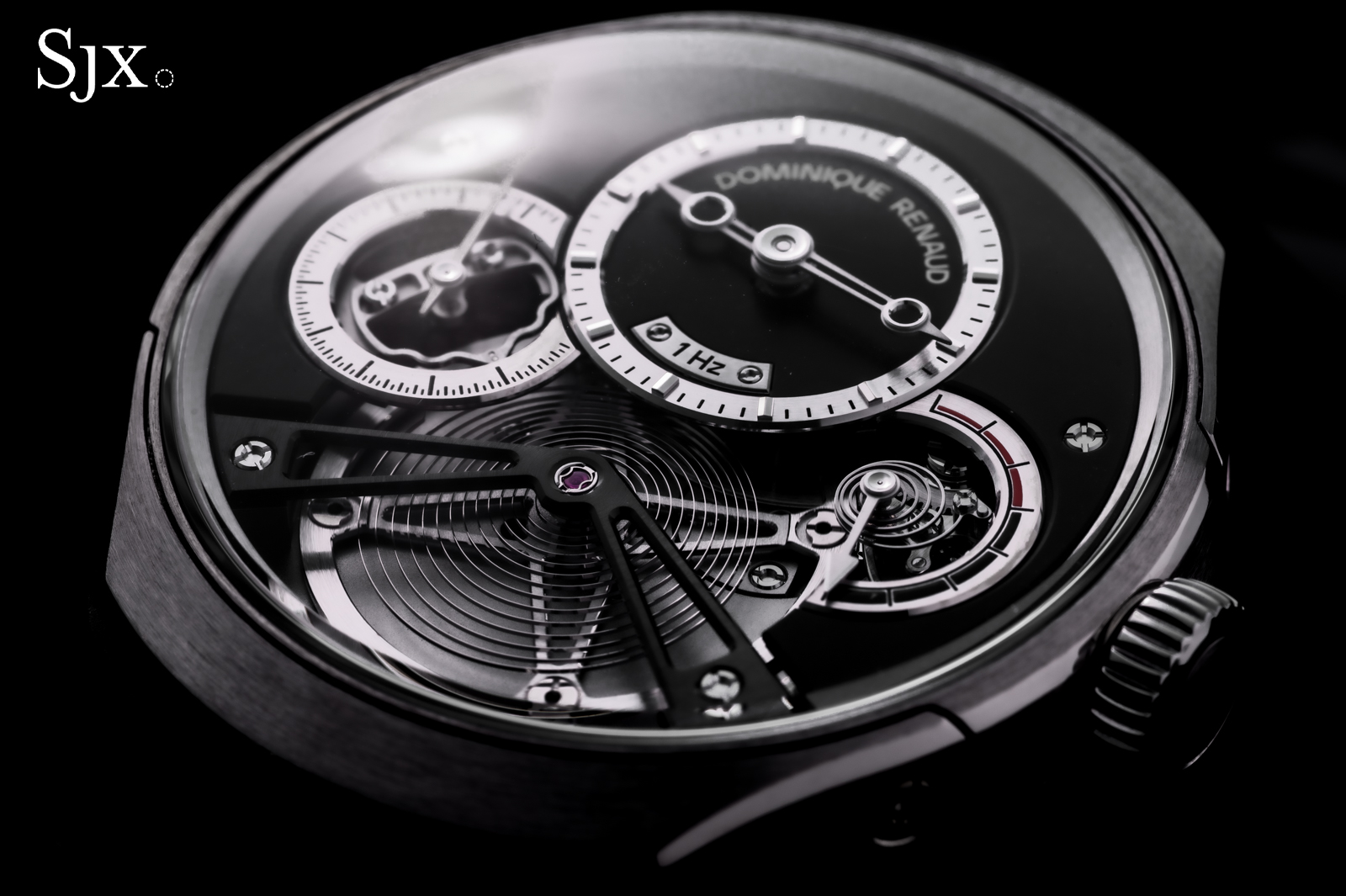
The seconds hand is an unusual sight as well, since it jumps just twice per second. A 1 Hz balance completes two vibrations every second, or 7,200 beats per hour. With every vibration, the escapement is unlocked and advances, thus making the seconds hand jump twice every second. Visually, the look is similar to that of a deadbeat seconds, just with smaller, quicker steps.
Inside the small seconds sub-dial sits the pin curb regulator for the long hairspring. Although it looks like a pinning point at first, the long hairspring is pinned somewhere under the main dial. The regulator can move laterally, with its radius of gyration centred on the balance staff — so it behaves like a classic pin regulator affixed to the balance bridge.
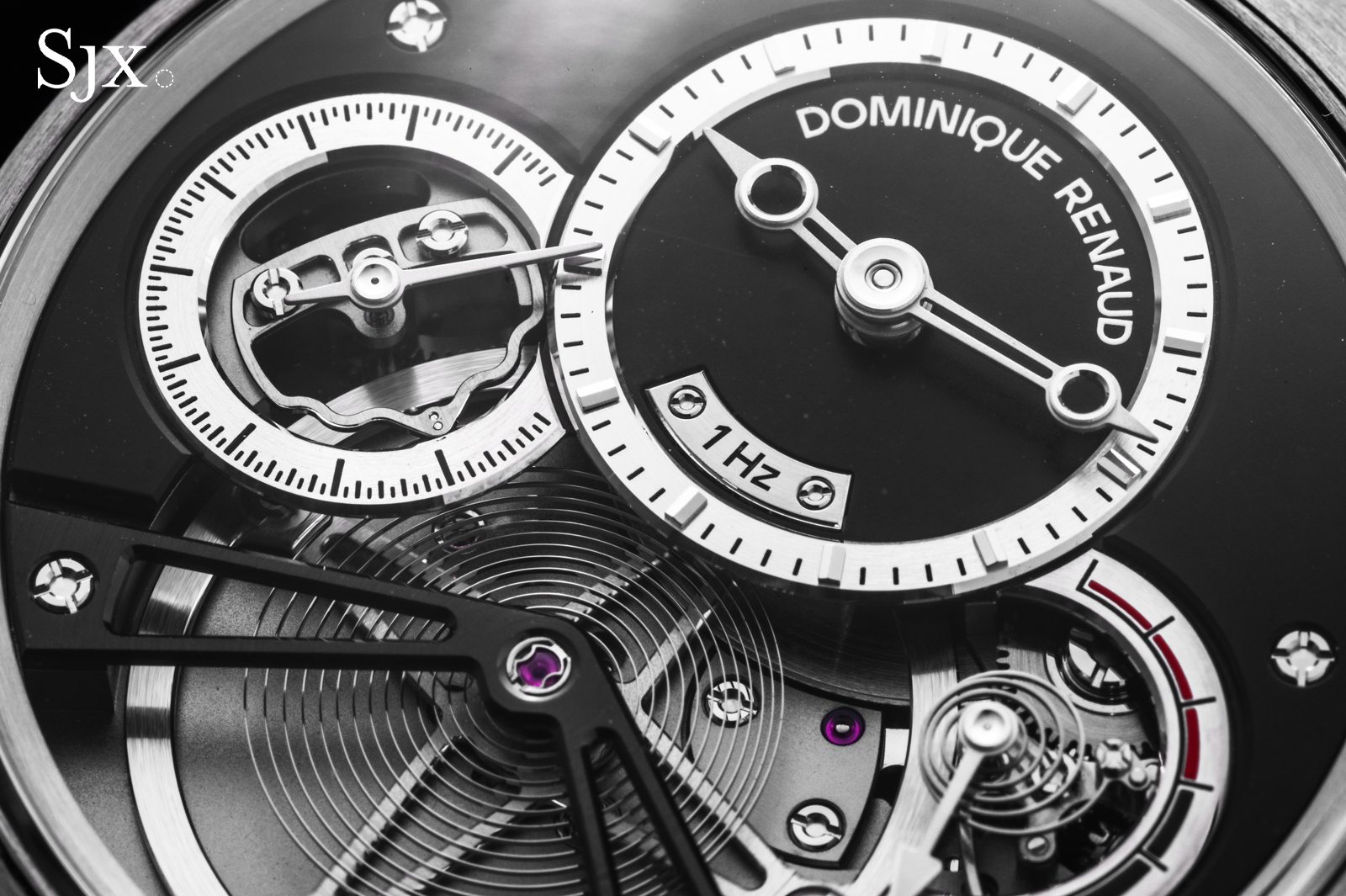
The component is well-thought, with an eccentric screw fine adjustment system and two large clamping screws to keep it securely in place. The small seconds hand peers through the regulator, another creative construction choice made to accommodate the particular size of the balance wheel.
Though the balance is not fully free-sprung, it features four timing weights on its rim. Their purpose is presumably for poising and gross regulation, while the curb-pin regulator is likely used for the final adjustments after the movement is assembled. DR is still perfecting the rate-testing protocols for the Pulse 60, since regular sound-based timing machines are as-yet incompatible with this construction.
Proper finishings
Turning the watch over, the caseback offers a good view of the movement itself. Apart from the openworked escapement region, most of the movement is concealed under two large straight-grained bridges.
The crown wheel assembly is on full display, along with a sector of the barrel click wheel. Compared to the revealing front of the Pulse 60, the back is relatively dull. Brushed surfaces dominate the view, complemented by a few highly polished steel parts.
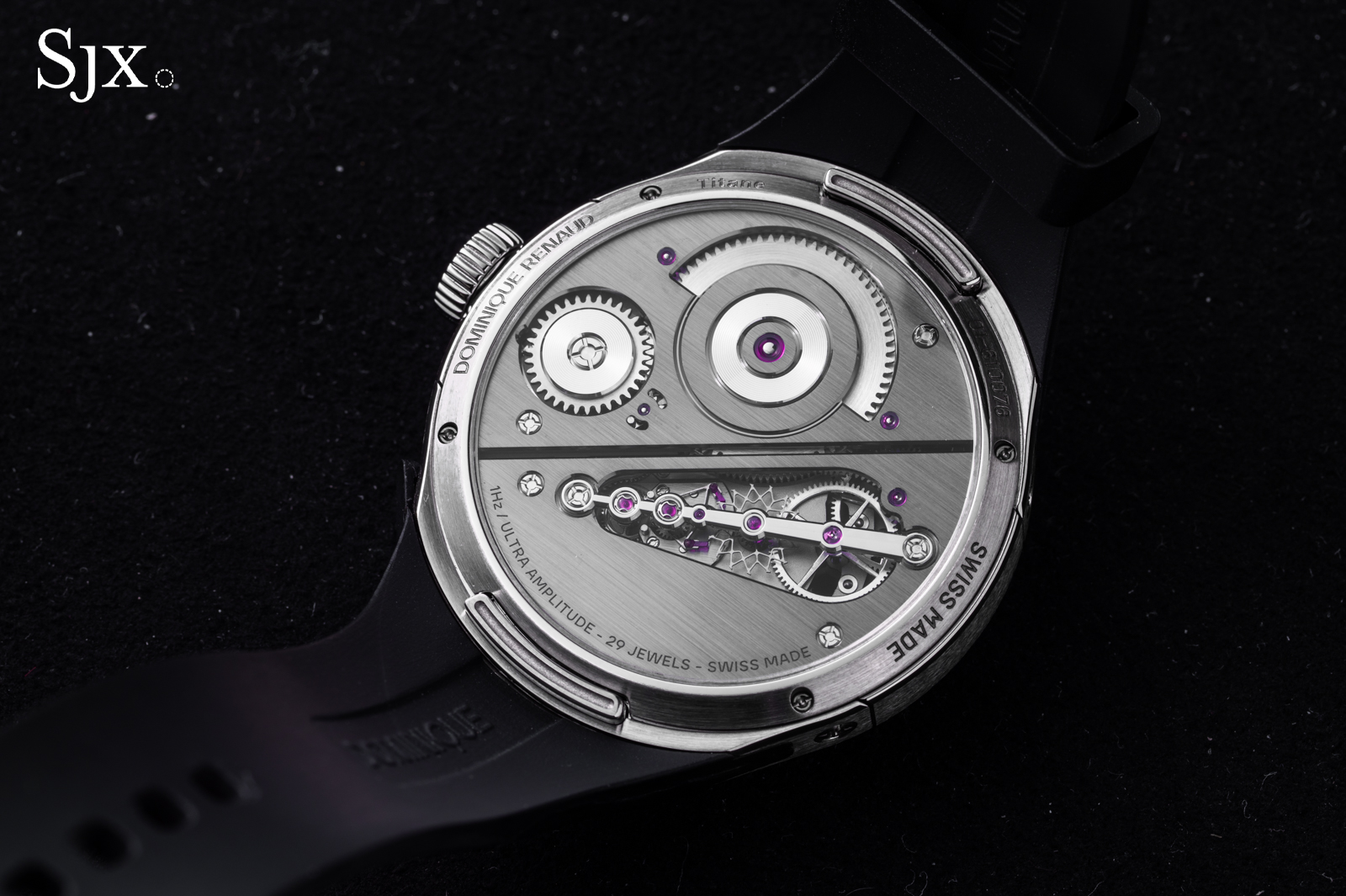
Notably, the escapement bridge is a long piece of polished and beveled steel, which anchors the balance assembly, escapement and seconds wheel. The bridge design has drawn some comparison with a similar remontoir bridge used in the Lange Zeitwerk’s cal. L043.6 . In truth, both architectures allow a generous view of the mechanics underneath.
The Pulse 60 movement also uses proprietary screw-heads — which is no small feat coming from a small independent like DR. There are two types of screw heads employed — one with two slots and another with four slots.
A question of stability
Having considered the design of the watch, it’s worth a detailed look at its starring attraction — the 1 Hz oscillator. In terms of mechanism design balancing taxonomy, the hairspring-balance model is filed under force-balanced assemblies. This means the system’s linear momentum is null and the center of mass of the system remains stationary. A propriety of forced balanced mechanisms is that they remain insensitive to linear accelerations in any direction.
In more practical watch-related terms it means that a watch balance will beat the same, regardless of how fast and in which direction the watch is linearly accelerated — considering changes in pivot point friction negligible. The sprung balance model (Figure I) is however not inertially balanced, which makes it sensitive to certain outside angular accelerations.
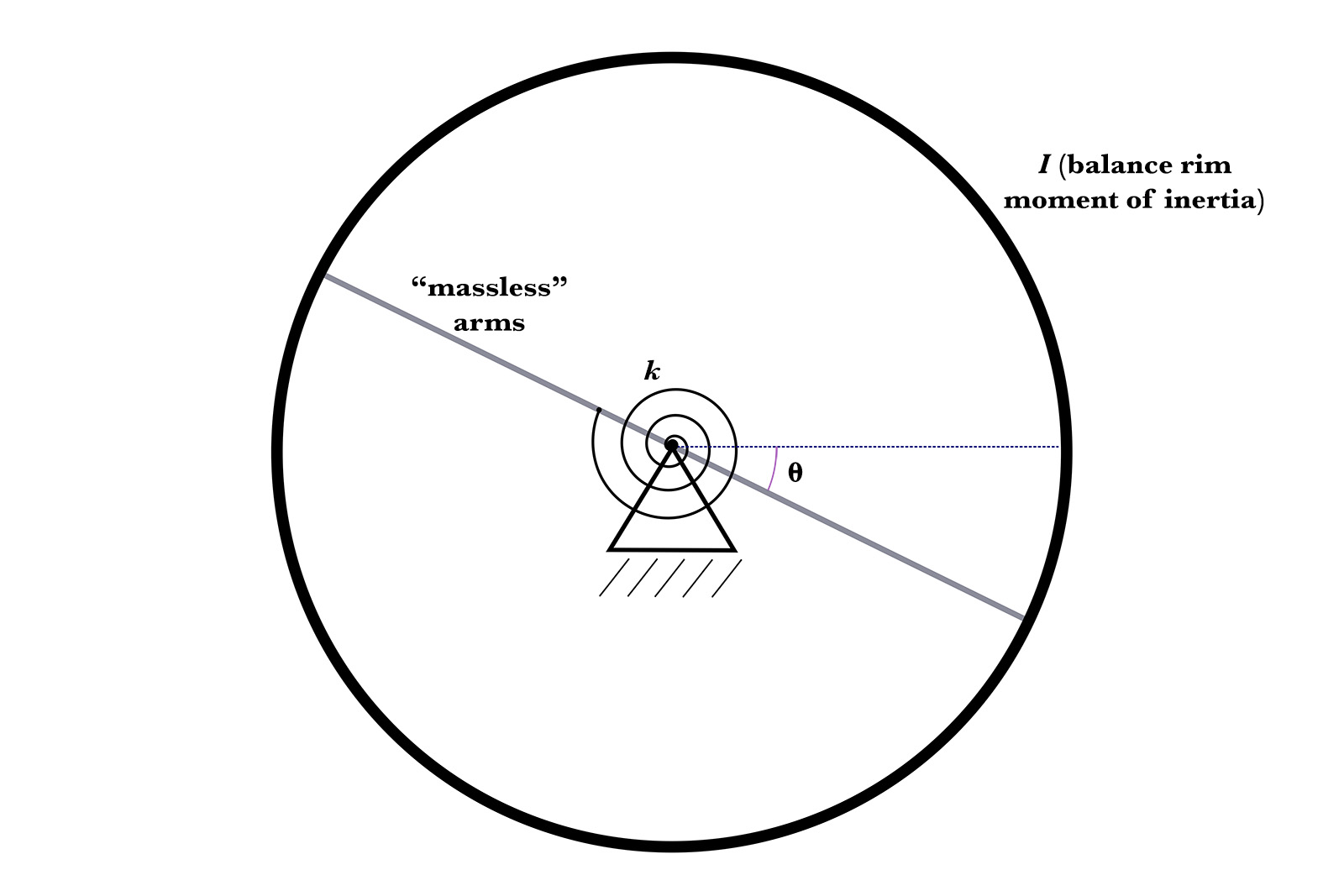
Figure I. Simplified model of a sprung balance wheel.
So in practice, any shakes and arm rotations can add a bias to the balance’s beat, disrupting its accuracy. The best way to counter — or at least minimise — these effects is to make sure the balance carries a healthy amount of angular momentum, such that it is harder for outside angular accelerations to disrupt its run.
The industry has now mostly settled for fast-beating 4 Hz light balances, which have proven to perform well on a large scale. The Pulse 60 asks the question, how stable can a 1 Hz balance be? We can attempt a comparison using some basic theory.
The large balance found in the Pulse 60 has a 20 mm diameter. Any standard ETA/Sellita 4 Hz movement has a balance between 9-10 mm in diameter. Given the geometry of the balance, we can cautiously assume that the mass of the Pulse 60’s balance is at least twice that of a regular balance m.
By applying the simplified moment of inertia formula (Figure II, row 2, mass times the radius squared) we immediately get that the Pulse 60’s moment of inertia is almost ten times that of a regular 4 Hz balance.
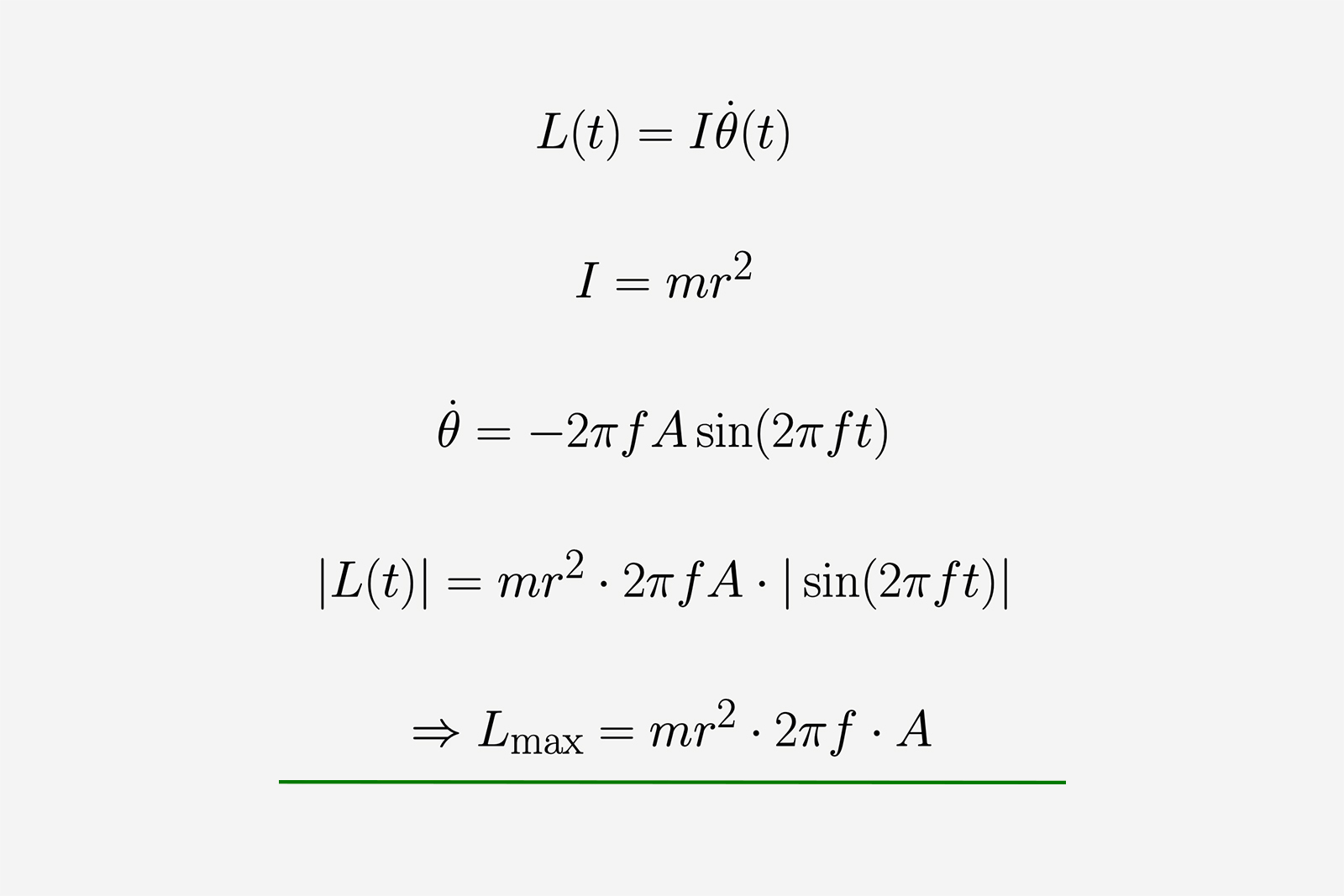
Figure II. Angular momentum expression derivation.
Since stability is directly related to the angular momentum L (Figure II, row 1) rather than just to the balance inertia value, let’s take a look at that formula too. Angular momentum is the product of balance inertia (which is constant) and angular velocity (which oscillates between a maximum and a minimum along with the balance).
The expression of angular velocity (Figure II, row 3) is the angular position derived over time. We have covered oscillators before and we won’t go into deeper detail now regarding the theory behind these expressions.
For easier understanding, we’ll focus on the absolute value of the computed angular momentum (Figure II, row 4). Being a vector quantity, the sign of angular momentum serves only to point to a change in direction, not magnitude. The absolute value of the sine function goes from zero to one.
Finally, we see how the angular momentum of the balance goes from zero to a maximum (maximum expression in Figure III, last row), as the balance oscillates. This quantity only reaches zero when the balance momentary stops at the end of one swing, before changing directions. We also see how the final angular momentum expression is also dependent on the amplitude of oscillation A (maximum angular displacement of the balance wheel from the equilibrium point).
The optimal running amplitude for modern watches is over 270°, although movements in good shape can get nearer to 300°. Anything over 310° becomes perilous for the escapement, as the balance wheel might run into over-banking. The phenomenon happens when the oscillation arc is too large and the impulse pin on the roller knocks against the outside of the locked escape lever. This greatly upsets the oscillation and can harm the components.
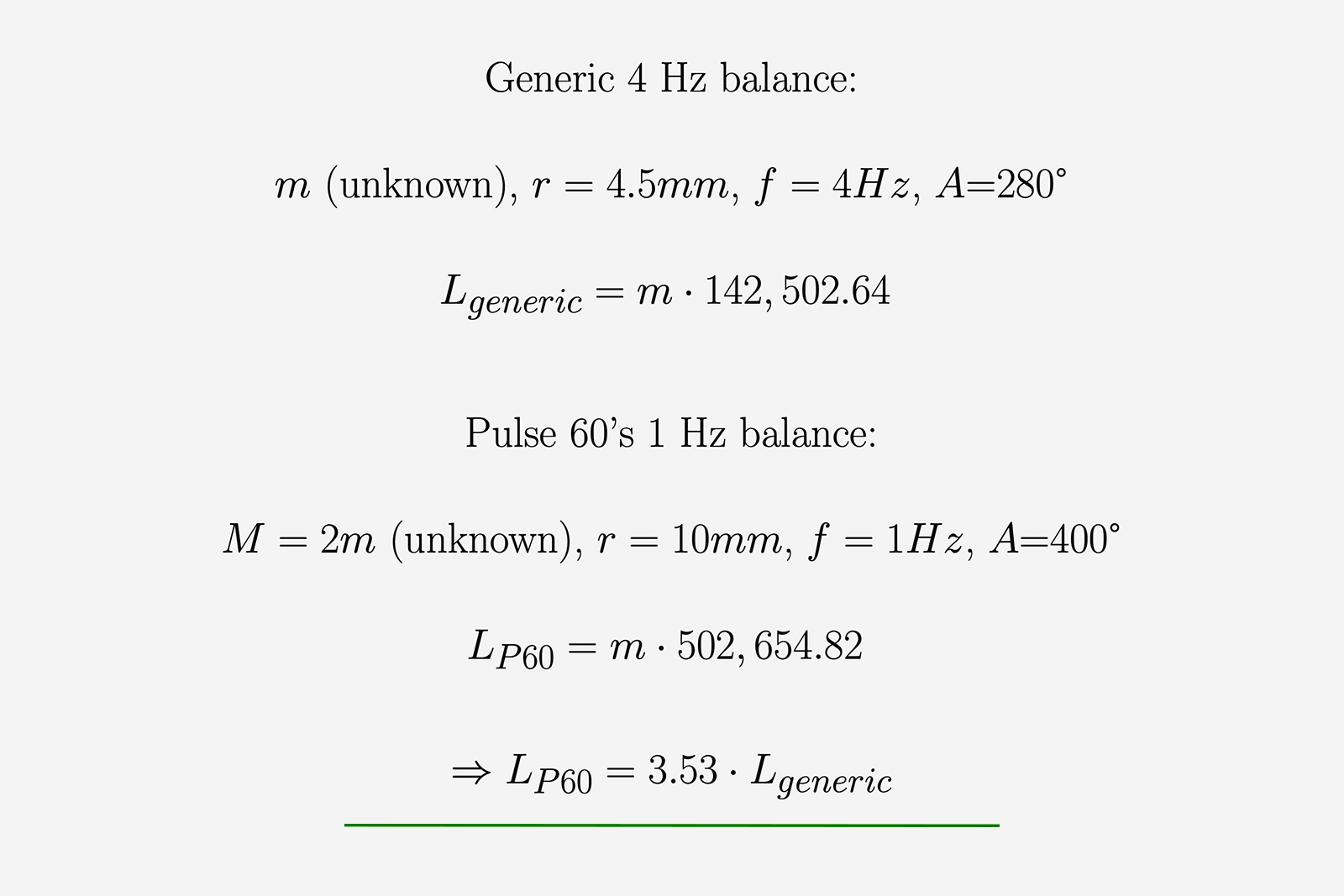
Figure III. Angular momentum comparison.
The Pulse 60’s construction allows the balance to turn over 360°, since the special architecture of the escapement doesn’t impose any physical blocks. Dominique Renaud claims the system can theoretically reach over 700° in amplitude, but the pieces we examined were running closer to about 400° over one vibration.
Keeping m an unknown constant, we plug these values into the angular momentum equation. Not knowing m in this instance doesn’t affect the end result. Finally, we get that the Pulse 60’s balance maximum angular momentum is about 3.5 times higher than a standard 4 Hz balance (Figure II, last row).
This is not to say the larger balance is necessarily three and a half times more stabile than its lighter, 4 Hz counterpart. The relationship however points toward a significantly larger resistance to the effects of outside acceleration. This should be enough to assure sceptics that the Pulse 60 is indeed a wearable proof-of-concept timepiece.
Concluding thoughts on construction
A few more points on this special construction. In order to be able to exceed 360° in amplitude, the large balance is separated from the impulse roller and jewel. The impulse roller is geared to the balance and the broad Swiss lever anchor “hugs” around the balance pivot. The light escape wheel and lever are manufactured using LIGA, which allows them to have a light and intricate construction.
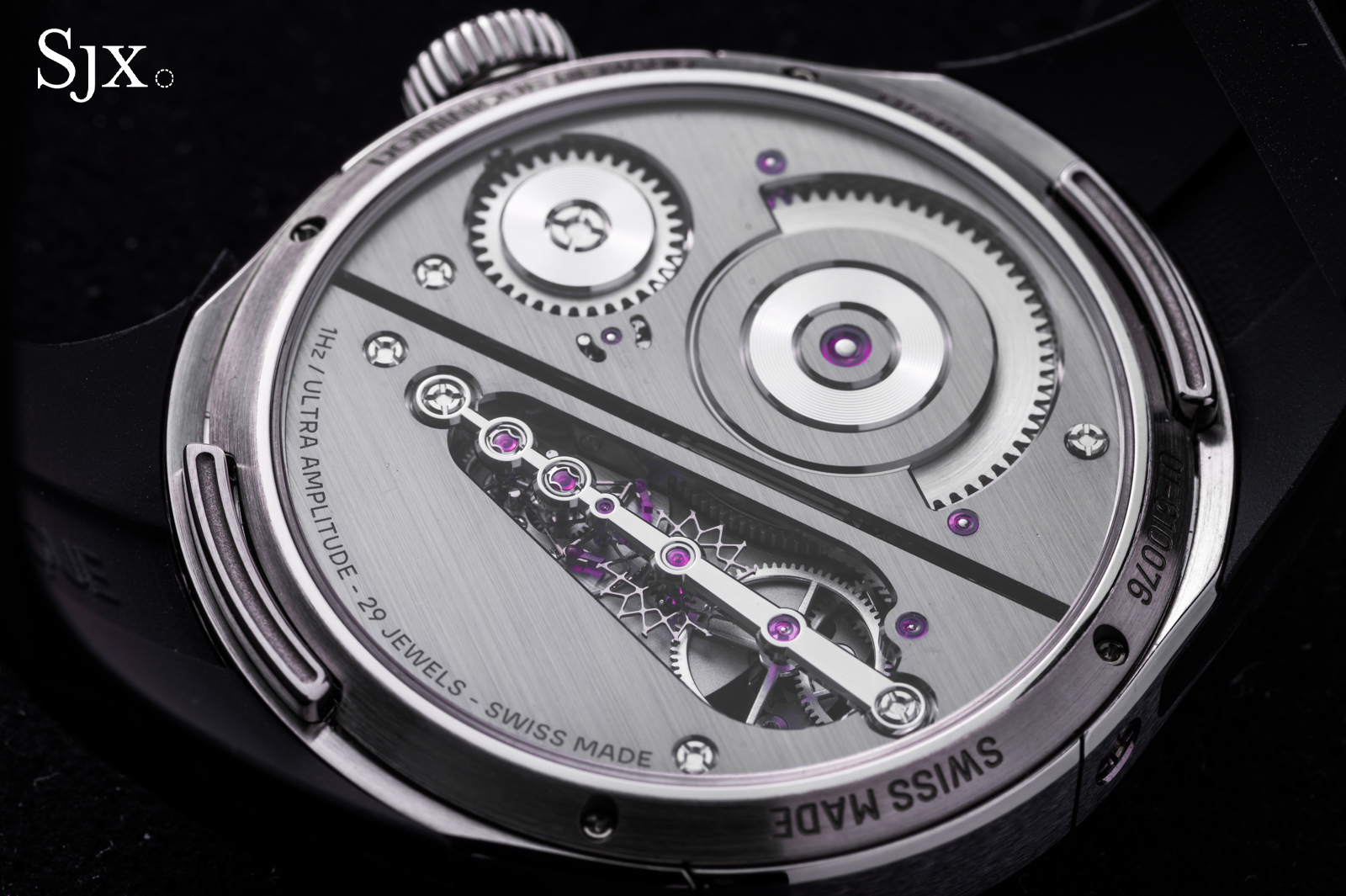
The meshing ratio between the balance and roller reduces the amount of angular travel the roller has to do over one oscillation. So although the balance turns over 360°, the roller’s travel stays inside the 270°-300° range, without risking any over-banking. A similar separation of the roller from the balance can be found in Konstantin Chaykin’s ThinKing.
Also since the total oscillation arc is so large, the disrupting interaction with the escapement is minimised over a full oscillation. This lets the balance run its course more freely, closing the gap between the real-life system and the ideal harmonic oscillator model.
Purists might object to the lack of a Breguet overcoil in the Pulse 60. An argument can be made that due to the increased size of the hairspring, any defects resulting from its uneven breathing are multiplied. While this might be true, applying classic overcoil theory to a hairspring with these proportions might not really work, so it is perhaps better that DR left such experiments aside for now.
Key facts and price
Dominique Renaud Pulse 60
Diameter: 40 mm
Height: 12 mm
Material: Titanium or titanium and 18k pink gold
Crystal: Sapphire
Water resistance: 30 m
Movement: Pulse 60
Functions: Hours, minutes, seconds, and torque indicator
Winding: Manual wind
Frequency: 7,200 beats per hour (1 Hz)
Power reserve: 96 hours
Strap: Interchangeable rubber strap
Limited edition: No
Availability: Available for pre-order through Dominique Renaud retailers
Price: CHF49,000 (titanium) or CHF59,000 (titanium and 18k rose gold) excluding taxes
For more, visit dominiquerenaud.com.
Back to top.