
Hands On: Patek Philippe Cubitus 5840 Perpetual Calendar
A look through the brand's first sports skeleton.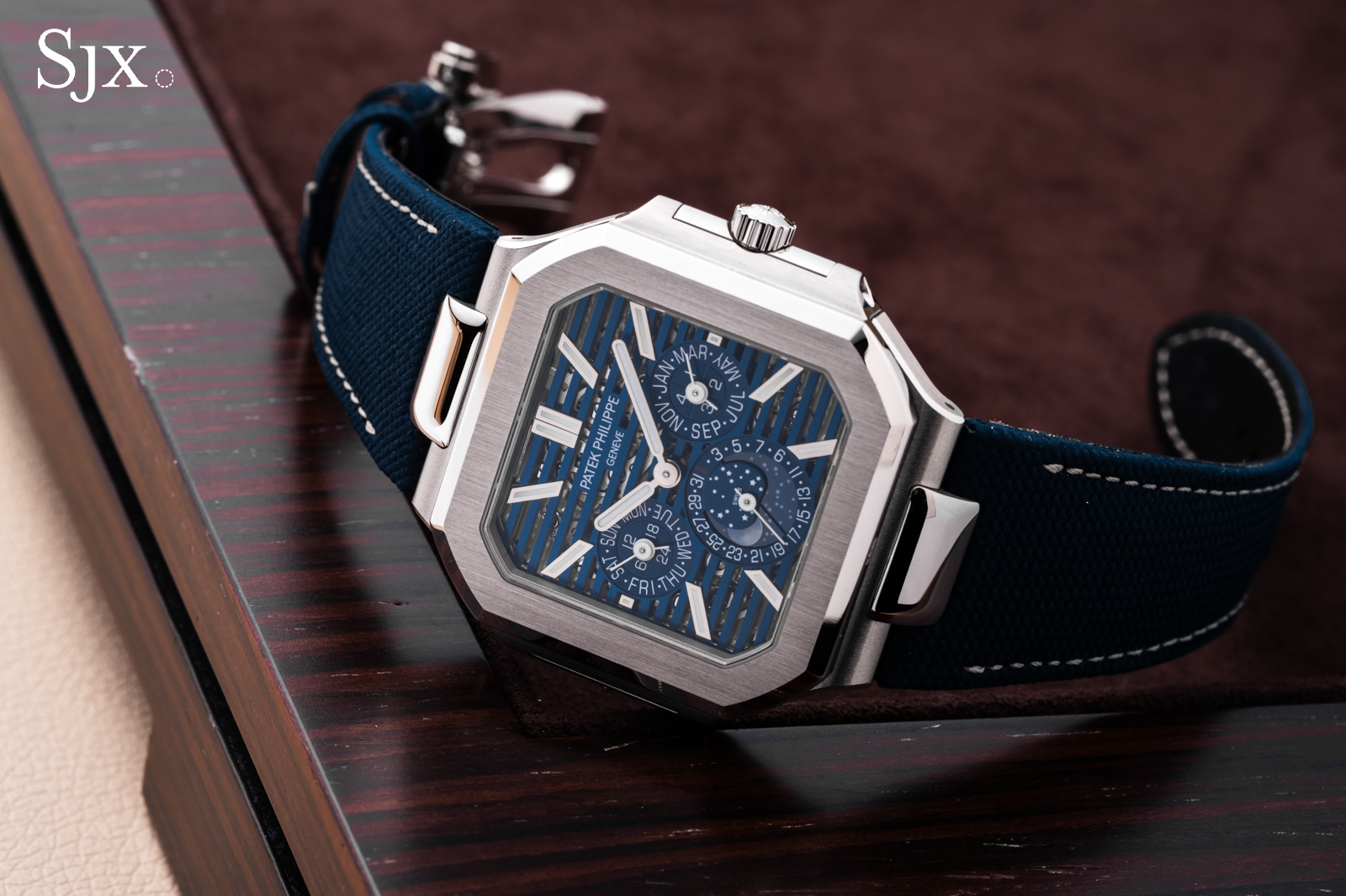
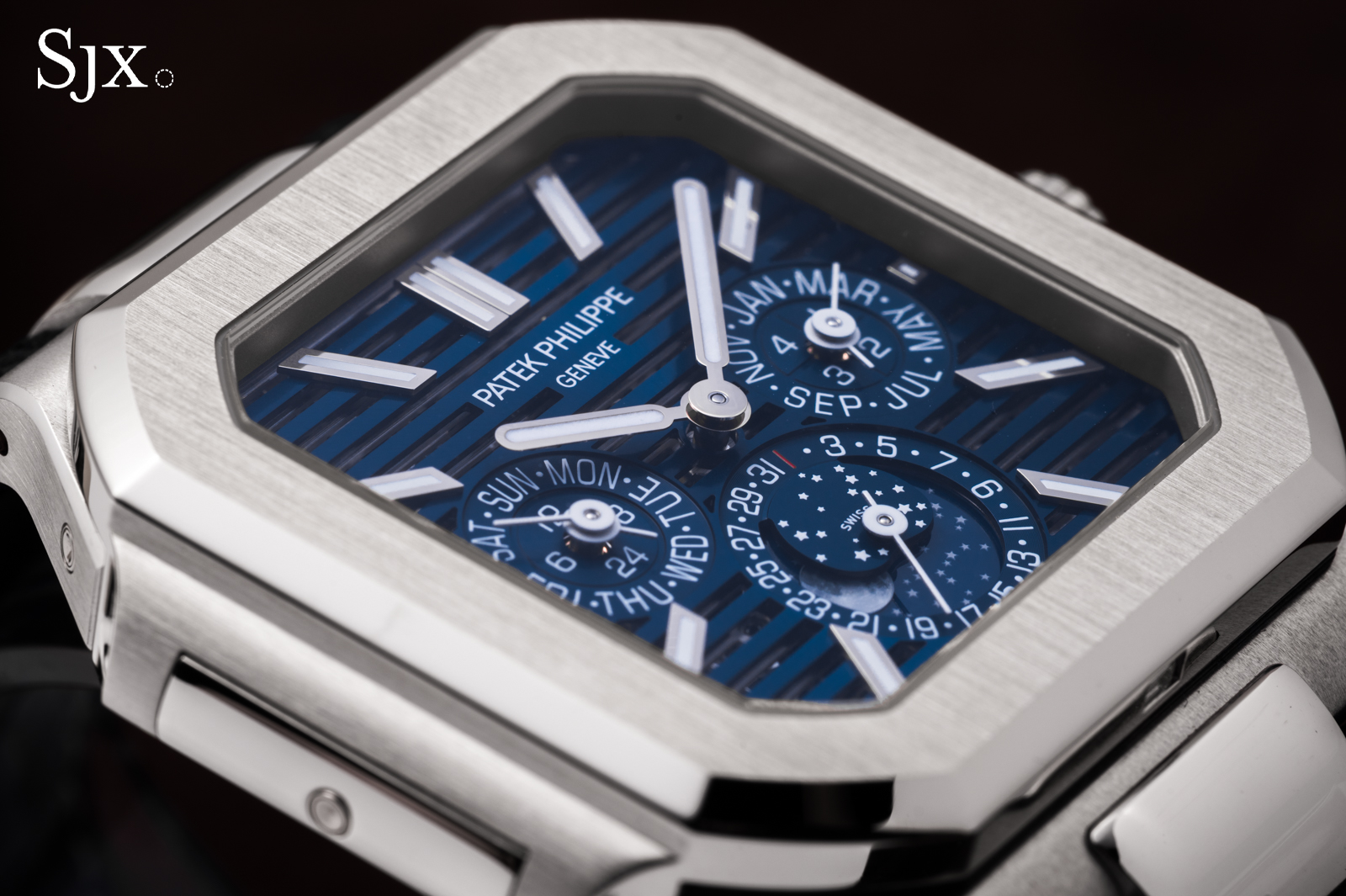
Patek Philippe’s divisive Cubitus collection enters its third year with the firm’s first truly skeletonised perpetual calendar wristwatch, the Cubitus ref. 5840p-001 Perpetual Calendar Skeleton. As the first member of its clan with a shaped movement, it also welcomes a contemporary aesthetic that breaks with the brand’s established codes of movement decoration, though it’s built on a decades-old foundation.
In short, the ref. 5840P is an ideal ambassador for what the Cubitus line can be when it steps out from its brother’s shadow.
Initial thoughts
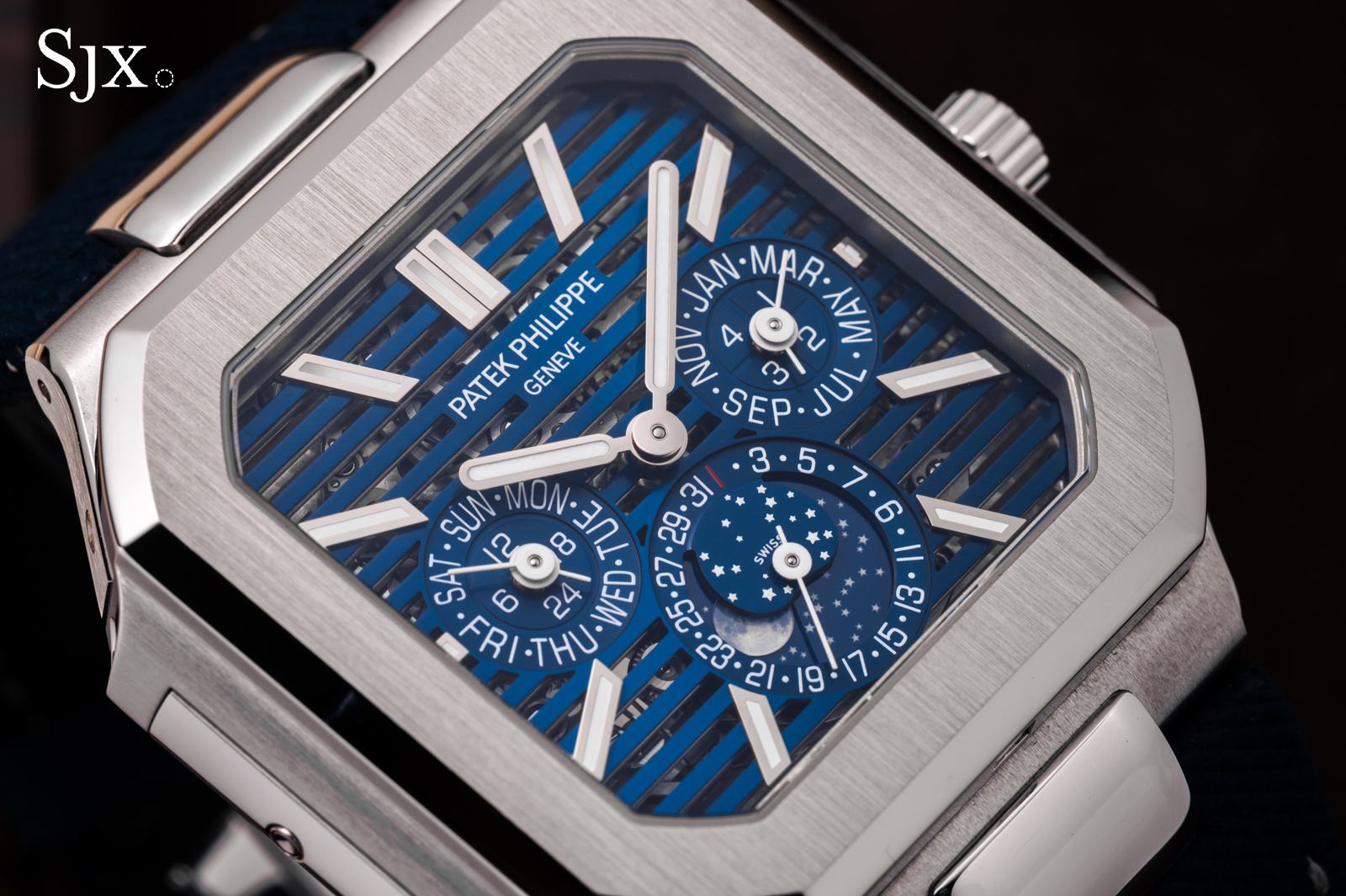
The most complicated — and most expensive — Cubitus yet is also arguably the best model in the collection to date, as it probably should be. While on paper it sounds derivative of the Nautilus perpetual calendar, this watch may have the strongest identity of any Cubitus launched so far by fully leaning into the bolder, more contemporary aesthetic that Patek Philippe has, until recently, hesitated to explore.
Several details allow the ref. 5840P to have its own identity. The first is the use of a strap, rather than the typical Nautilus-style bracelet. The reshaped movement is another differentiator, as is the new finishing style, which makes it more than just a square Nautilus. Yet the teak deck motif remains central, integrated seamlessly into the skeletonised design.
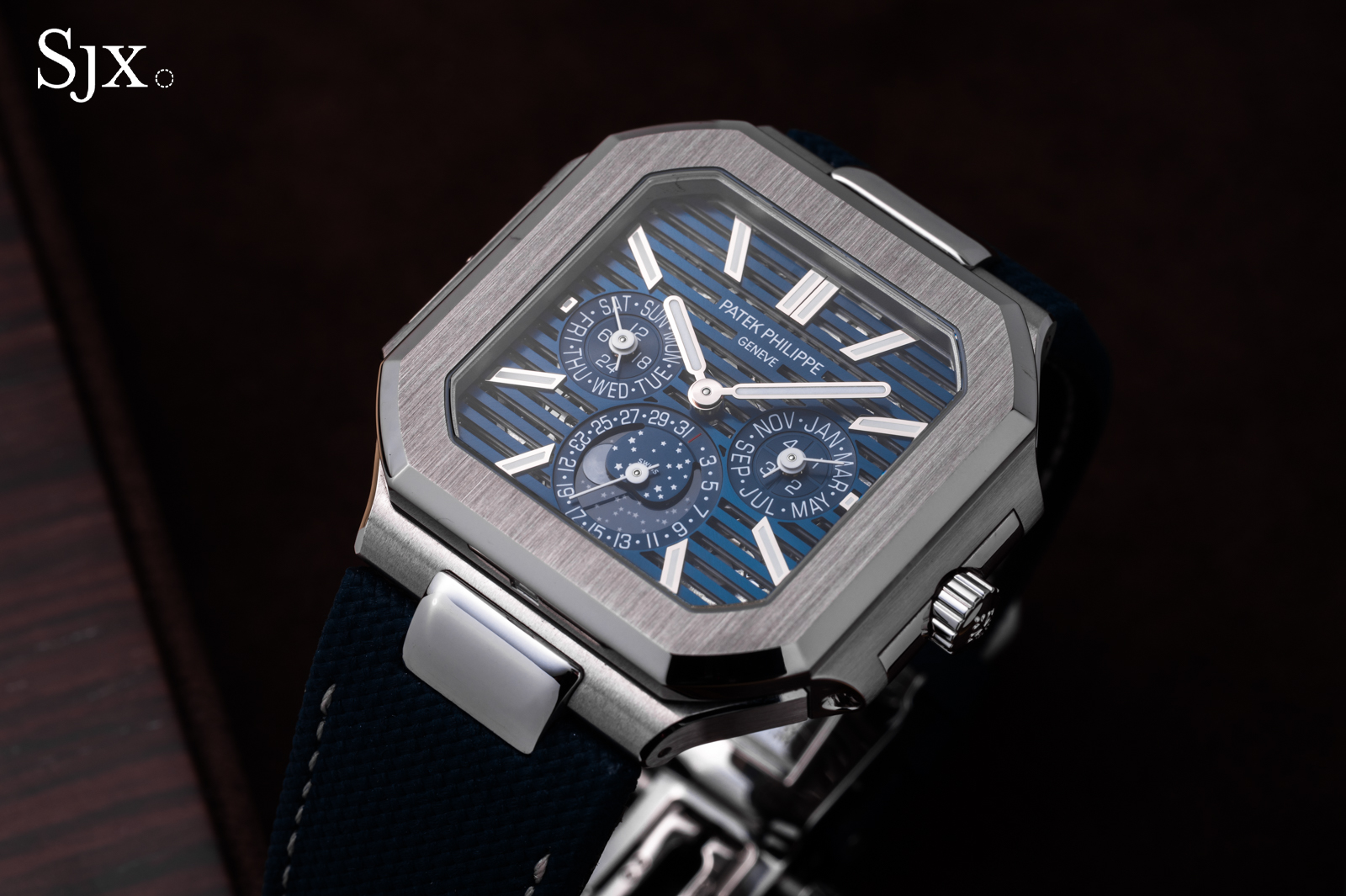
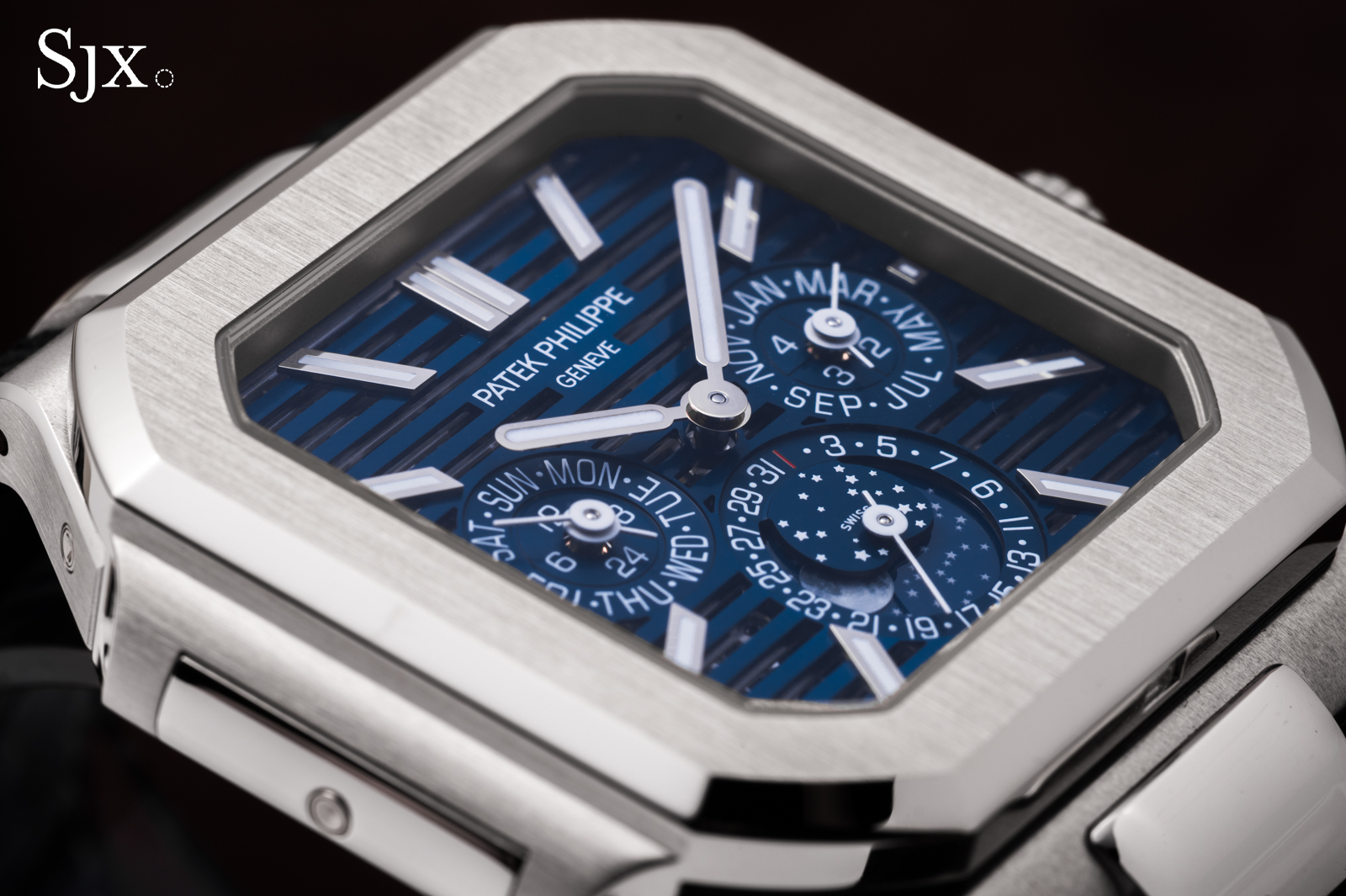
Two other details that stand out are the use of a baguette-cut diamond to denote the platinum case, rather than the usual brilliant-cut stone, and the oversized photorealistic moon phase indicator. The latter detail debuted on a pair of limited edition world time watches back in 2014 but this is the first time it’s appeared in the regular collection.
While it might not be as romantic as the enamelled moon phase discs of the past, it’s probably an improvement over the rather bland moon phases on most modern Patek Philippe watches, excepting designs like the Celestial ref. 6105 and the Sky Moon Tourbillon.
As a derivative of the venerable cal. 240 Q, with all the latest technical updates, the cal. 28-28 Q SQU will surely be a reliable and excellent timekeeper. That said, the use of a legacy platform feels at odds with the contemporary ambitions of the Cubitus.
This is something Patek Philippe already leaned into with the new big date complication that debuted with the Cubitus in 2024, which helped that watch stand out. Furthermore, the cal. 240-based platform doesn’t use the Cubitus’s large size to its full advantage, nor does it stand out from the Nautilus perpetual calendar as much as it could have if Patek Philippe had equipped it with the in-line perpetual, for example.
Of course, there is formidable competition in this segment from Audemars Piguet’s latest — and slightly more expensive — Openworked Royal Oak Perpetual Calendar, which sports a movement that is more technically advanced but less proven.
The cal. 7139 in the Royal Oak also boasts more than 200 interior angles, a figure that’s notable since inward angles were evidently not a priority for cal. 28-28 Q SQU that powers the Cubitus. Sharp interior angles might be a hot topic in enthusiast circles, but seemingly not something that will move the needle enough for Patek Philippe to make them a design priority.
That said, I am not convinced that the movement’s slat-style design would benefit from such treatment. And for those who prize such details, Patek Philippe makes another skeletonised cal. 240 variant found in the ref. 5180.
Case and calibre
Patek Philippe launched 24 models this year, and 10 of those are powered by venerable cal. 240 in its many forms. This movement is essentially a cal. 240 Q — which has powered everything from the ref. 3940 to the Nautilus Perpetual Calendar — inside a square frame.
It could be described as a “shaped movement” but only in terms of aesthetics — it doesn’t make use of the extra space afforded by its square footprint. This isn’t new for Patek Philippe — the brand used the same trick to turn the round cal. 215 into the rectangular cal. 25-21 REC.
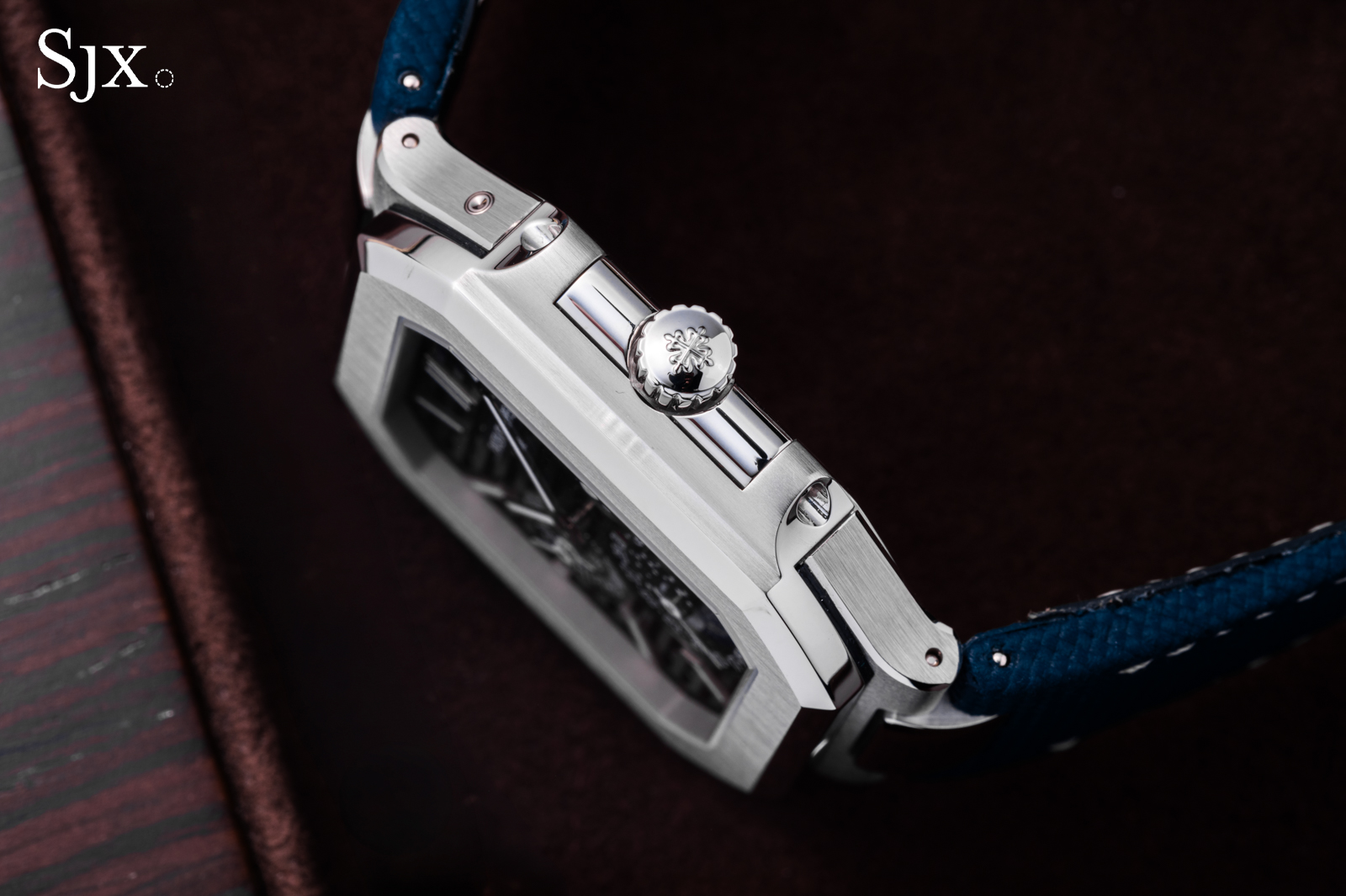
While the movement isn’t altogether new, it’s quite thin. This factor helps keeps the case rather slim for a complicated water-resistant sports watch, at exactly 10 mm. But it’s taller than its sibling in the Nautilus collection, giving it a more substantial look and feel.
Height aside, the size and proportions match those of the normal large Cubitus model, measuring 45 mm diagonally. It feels smaller than that number suggests, and wears bolder — but only a little bigger — than a Nautilus ref. 5811.
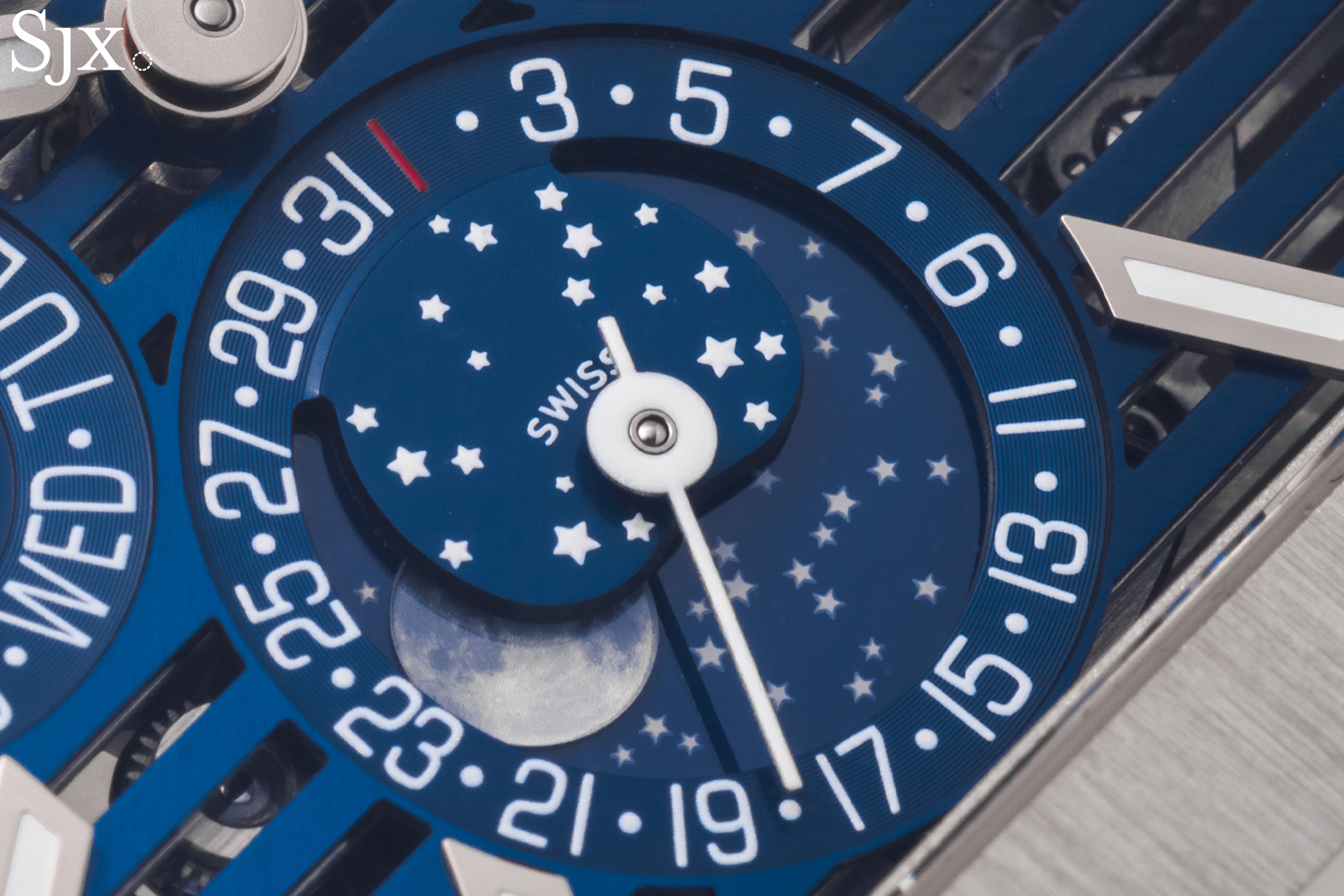
Many of the components sandwiched between the square plates of the movement are also skeletonised, such as the barrel and parts of the perpetual calendar. The last major change to the movement lies in the moon phase indicator, which uses a single, photorealistic moon printed on a glass disc that rotates at twice the speed of a normal double-moon moon phase disc. It sits over another glass disc which is printed with starts, giving it depth.
Like Patek Philippe’s other full-sized mechanical movements equipped with a Spiromax silicon hairspring and Gyromax free-sprung balance, the cal. 28-28 Q SQU is rated to run between -1 and +2 seconds per day, despite its small-diameter balance wheel and moderate beat rate.
This exceeds even Rolex’s Superlative Chronometer standard, and is a testament to Patek Philippe’s industrial excellence and prescient investments in silicon technology.
In fairness, not everything about the cal. 28-28 Q SQU is state-of-the-art. The calendar indications must still be set using a stylus. With each passing year, this traditional approach feels increasingly antiquated. Of course, with the proper tool it is quick and easy, and the watch remains water resistant enough for swimming and diving down to 30m, according to Patek Philippe.
But this method introduces more opportunities for user error, especially if the user loses the stylus and attempts adjustment with a makeshift stylus that might damage the pusher or the case.
Styling
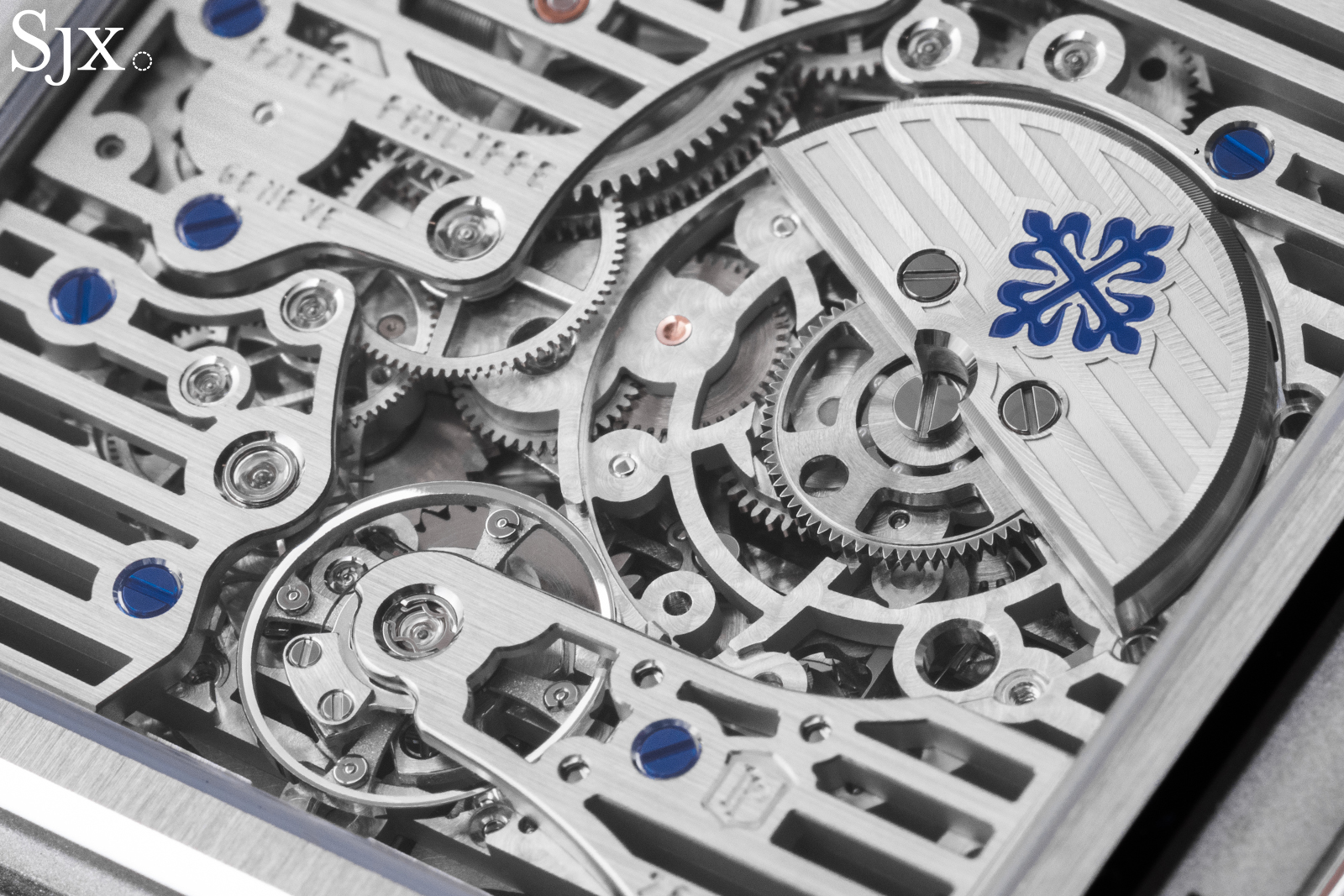
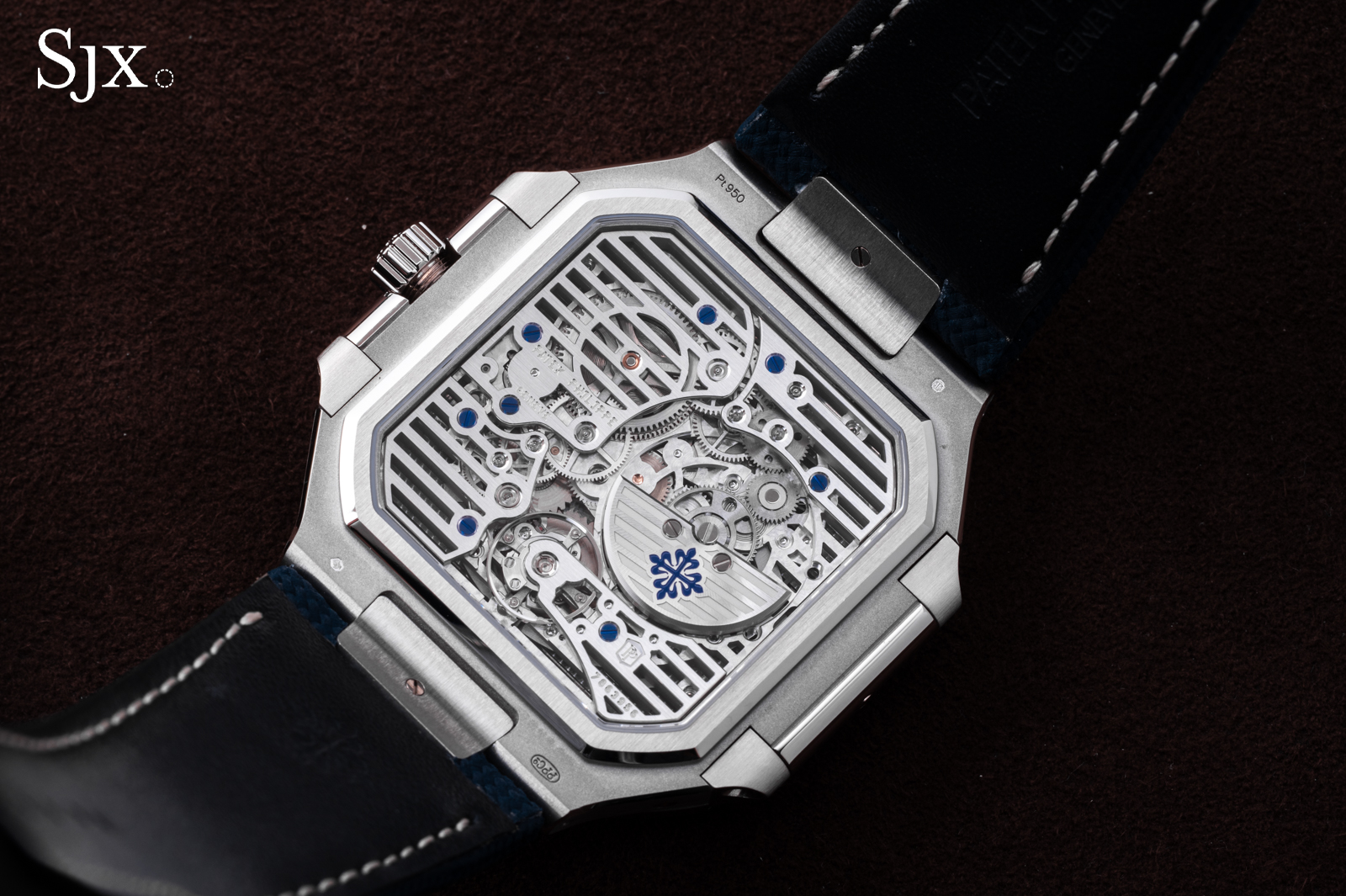
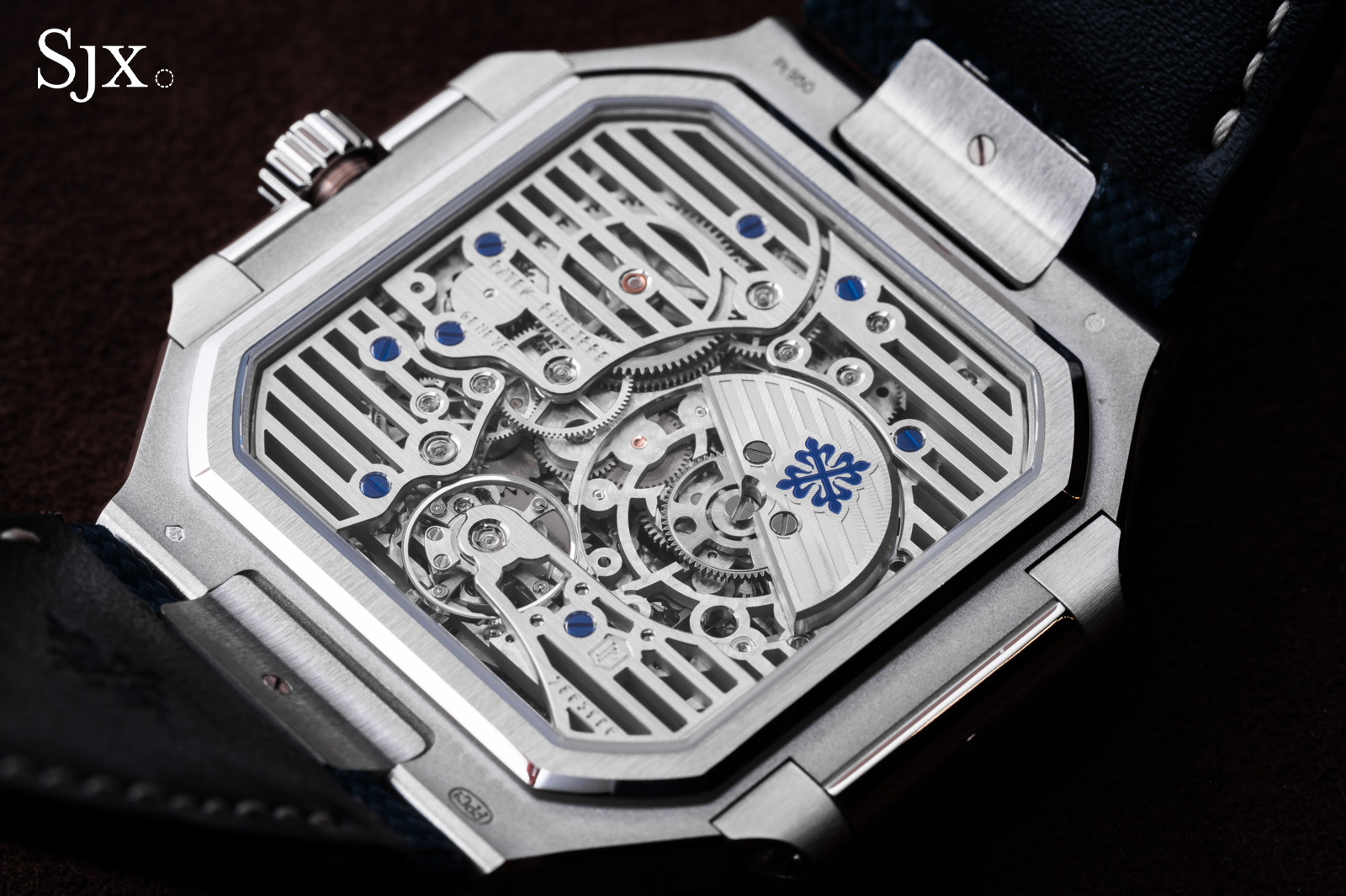
The styling of the movement is highly unusual for Patek Philippe, with a straight-grained, brushed surface finish on the plates. The going train and balance are rhodium-plated rather than the usual gilt, and the monochromatic look is furthered with the use of clear sapphire jewels.
That leaves the blued screws — which are truly heat blued — as the only pop of colour, other than the pink pallet stones, which are said to be retained for the watchmaker’s benefit since they are easier to see.
Patek Philippe generally does not use blued screws, as the firm adheres closely to the Genevois style. Blued screws could be found on occasion in watches made for the English or German markets, where they were favoured.
Use of clear sapphire jeweling is another departure and it is interesting Patek Philippe went with blue screws rather than blue jewels, as the firm historically (but sparingly) used blue jewels in its highest grade simple watches.
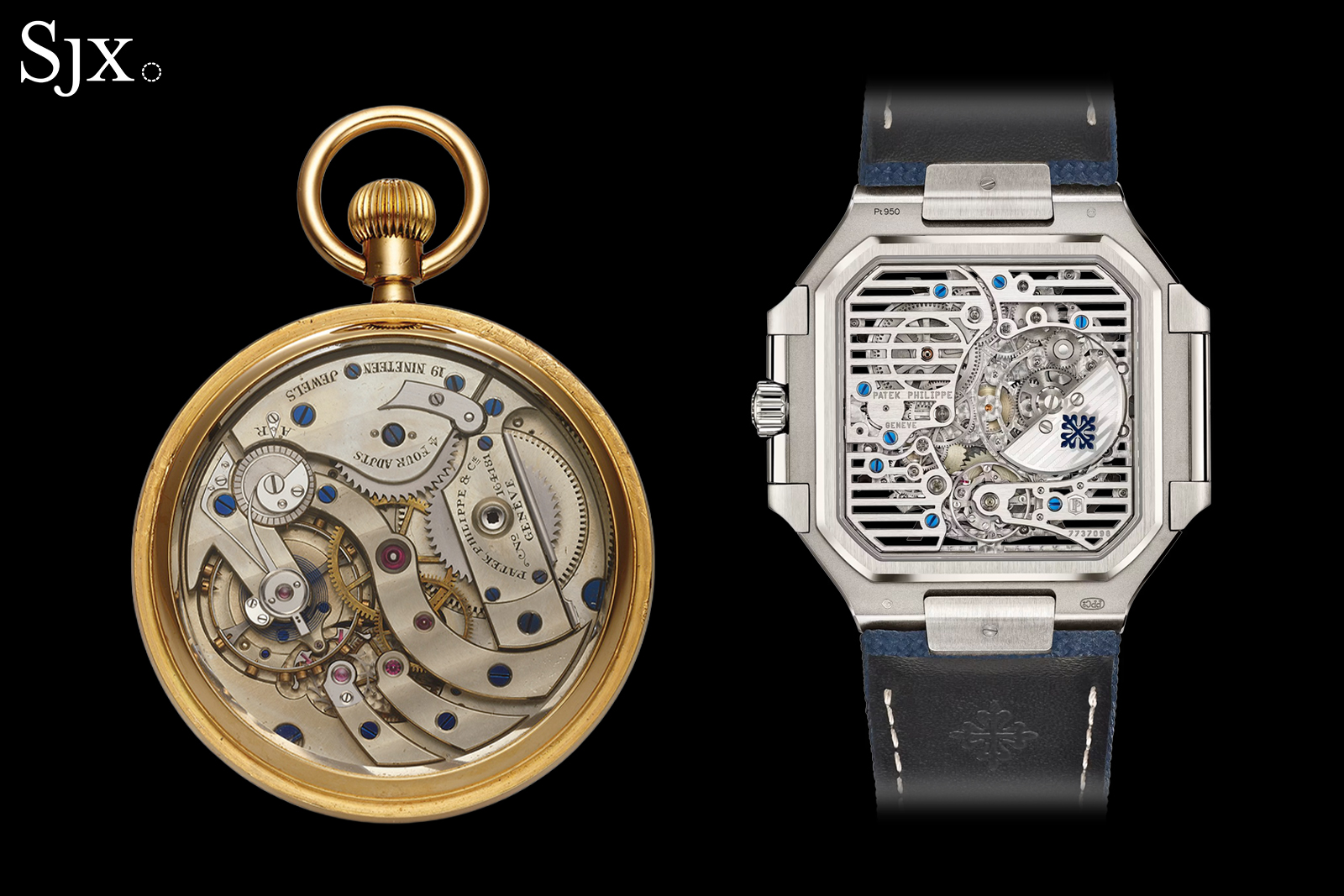
The new Cubitus movement compared to a Patek Philippe movement with blue screws, cased by Frodsham in 1912. Image – Antiquorum
Clear jewels are increasingly common in avant-garde designs, such as those from Richard Mille and Ulysse Nardin, but they have also found their way into more traditional calibres from the likes of Louis Vuitton.
Their presence in a complicated movement from Patek Philippe shows the historical brand isn’t done trying new things. It’s worth noting Patek Philippe holds a significant stake in La Pierrette — a manufacturer of jewels and precision parts in Le Chenit that also supplies Rolex and Richemont — so it has ample access to the stones of its choosing.
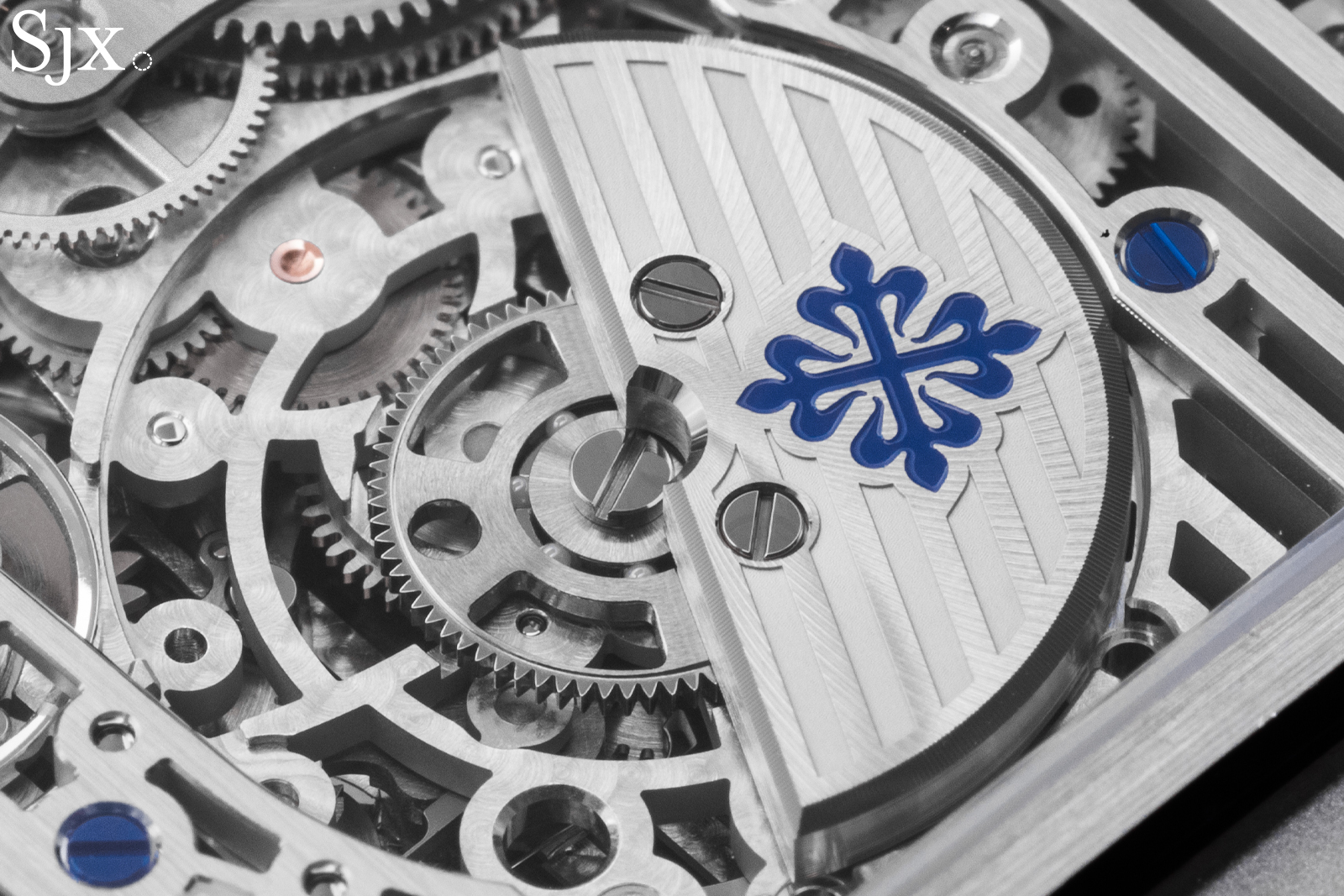
The rotor is also worth mentioning. While Patek Philippe has switched to platinum 950 for many of its micro-rotors, this remains 22k gold under the rhodium plating. It is machine-engraved with the teak deck motif, then further engraved with the Calatrava cross, which is filled with blue varnish — an enclave of the old Patek Philippe in a bold new one.
Key facts and price
Patek Philippe Cubitus Perpetual Calendar Skeleton
Ref. 5840p-001
Diameter: 45 mm (diagonally)
Height: 10 mm
Material: Platinum 950
Crystal: Sapphire
Water resistance: 30 m
Movement: Cal. 28-28 Q SQU
Functions: Hours, minutes, perpetual calendar with day, date, month, leap year, day/night indicator, and phases of the moon.
Frequency: 21,600 beats per hour (3 Hz)
Winding: Automatic
Power reserve: 48 hours
Strap: Textile pattern composite with platinum folding clasp
Limited edition: No
Availability: At Patek Philippe retailers and salons
Price: US$187,547 excluding taxes
For more, visit Patek.com.
Back to top.