

In Depth: Leroy 01
The world's most complicated watch for 85 years.
The pocket watch format is experiencing an unexpected renaissance. From auction salerooms to high street queues, collectors of all stripes are talking about pocket watches more than at any time in recent memory. That makes it a perfect time to continue our series on groundbreaking historical pocket watches, including Breguet No. 160. This installment analyses the Leroy 01, which reigned as world’s most complicated watch — by most measures — for 85 years.
The calm before the storm
On the first of November 1897, Charles Piguet began work on an ébauche for which no contract yet existed. In his workshop at Le Sentier, a stone village strung along the floor of the Vallée de Joux at an altitude where winter arrives early and stays long, he opened a commission that would occupy the better part of seven years and produce the most complicated portable timepiece ever constructed.
The formal agreement with his client, the Parisian house of L. Leroy & Cie — formerly known as Le Roy & Fils — would not be signed until January 1898. Piguet started anyway. In the Vallée de Joux, a man’s word was sufficient.
This detail — two months of work before the ink dried — says something essential about the relationship between the French brand and the Swiss établisseurs on whom it depended. L. Leroy & Cie, founded in Paris in 1785 by Basile-Charles Leroy, had maintained that relationship across generations.
When Louis Leroy, who had acquired the firm in 1889 and established a manufacturing atelier in Besançon with his director Émile Maillard-Salin, needed movement makers of exceptional capability, he did not look south toward Geneva or east toward the Jura arc — he looked to the Vallée. He already knew what Charles Piguet could do. And Charles Piguet already knew, in broad terms, what Louis Leroy was about to ask.
The client and the impossible request
The commission originated with a collector. António Augusto de Carvalho Monteiro, born in Rio de Janeiro in 1848 to a family enriched by Brazilian coffee and precious stones, had accumulated by the 1890s one of the more extraordinary private collections in Europe: the second-largest butterfly collection in the world after Rothschild’s, a library of 30,000 volumes containing the largest private assemblage of Camões editions ever held, 10,000 shell species, and countless musical instruments and watches.
He was known in Lisbon as Monteiro dos Milhões. In 1896, he acquired a Leroy pocket watch made in 1878 for a Russian client, Count Nicolas de Nostitz. The watch featured 11 complications in a gold case, a demonstration of what the house could produce when given the opportunity. But the Nostitz watch was not enough.
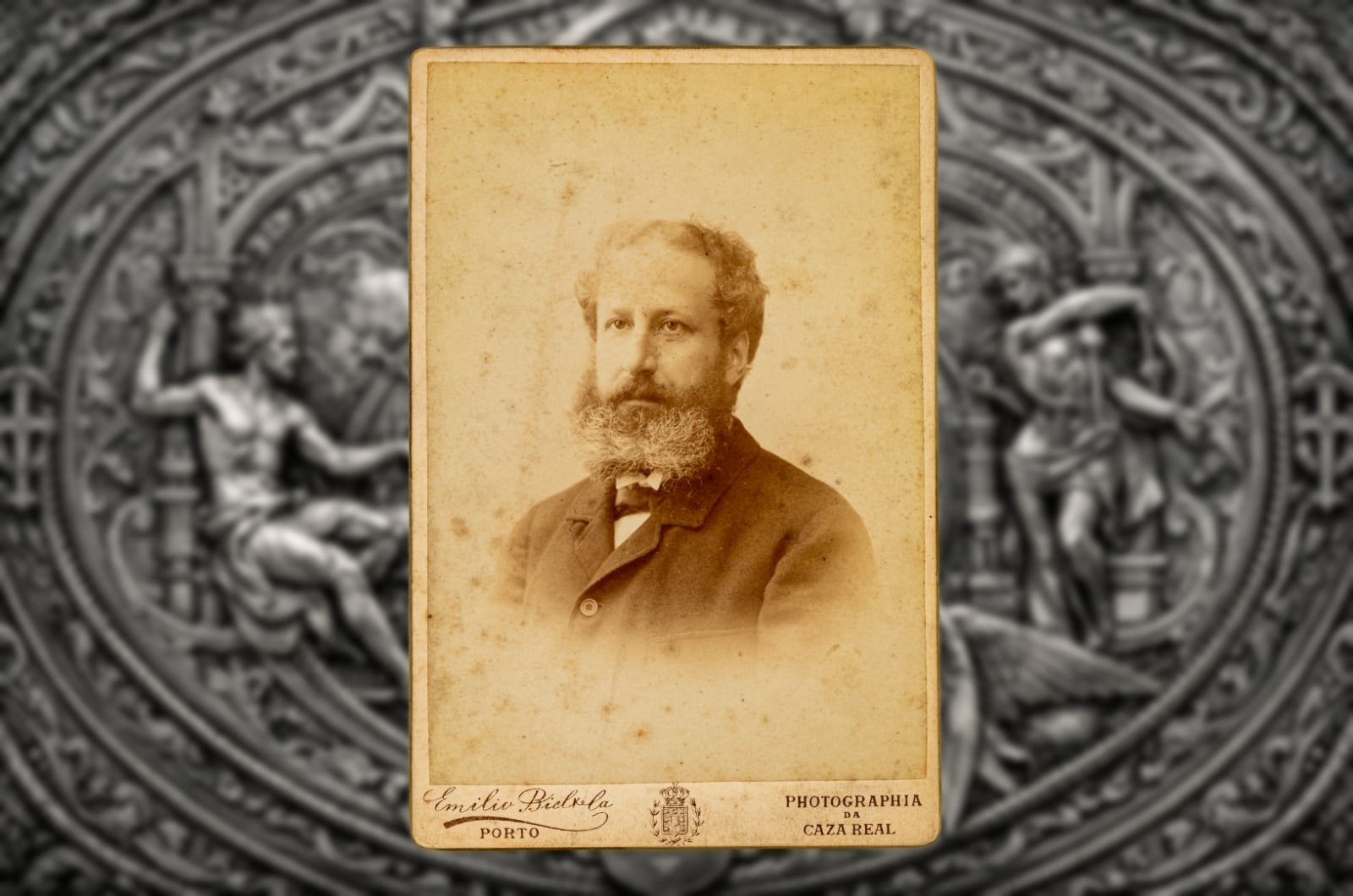
Portrait of Antonio Augusto Carvalho Monteiro. Image – SJX composite – Fundação Cultursintra FP, Quinta da Regaleira.
What Monteiro wanted, as he conveyed during two visits to Besançon and further negotiations with Louis Leroy in Paris, was a watch that would contain everything that science and mechanics permitted within a portable volume. He also had supplementary requests.
He wanted eclipse predictions. He wanted a tidal indication. He also wanted a foudroyante, a dedicated high-frequency train beating continuously, its hand completing one revolution per second in visible steps, marking fifths of a second in real time rather than only when a chronograph was activated.
Leroy studied the programme carefully and refused all three supplemental complications. Eclipses, tides and the foudroyante were, in his own words, “rejetées comme impraticables” — a polite way of explaining that each would have consumed spatial and kinematic resources the movement could not spare while carrying everything else. The refusal was not a failure of ambition but a precise act of engineering triage.

The Count Nicolas de Nostitz with eleven complications, made in 1878 and acquired by Monteiro in 1896. Image – SJX composite – Antiquorum
Monteiro, Leroy records, expressed his regret at seeing certain important complications eliminated. What remained was a commission of 27 indications across five functional categories. The programme was formally decided in January 1897. A full year of technical study followed before Piguet began the ébauche in November 1897 and the contract was signed on the January 5, 1898. Work, as noted, had already begun.
The house and its credentials
To understand why Monteiro approached Leroy rather than the Swiss firms that dominated the ultra-complicated market, it is necessary to understand what the house had accomplished in the five years preceding the commission.
Between 1893 and 1896, the Besançon atelier under Maillard-Salin won first prizes at the Besançon observatory timing trials in consecutive years. In 1896, it competed at Geneva and placed behind only a single Swiss firm. Far from mere ceremonial distinctions, the observatory trials tested chronometric performance under monitored conditions over prolonged periods; they were the most rigorous public evaluation available to a movement maker at the time, and Leroy’s successive placings established it, at the moment of Monteiro’s approach, as a house operating at the highest demonstrable standard.
There was also the matter of historical coherence. L. Leroy & Cie traced its lineage to 1785, to the period when Breguet was still alive and the foundations of complication watchmaking were being laid in Paris. Basile-Charles Leroy had supplied instruments to the French court.
His successors maintained the house through the turbulence of the 19th century, retaining premises in the Palais Royal district and a client list that included European aristocracy and colonial administrators who needed exact timekeeping at a distance. By the time Louis Leroy took charge, the name carried the weight of more than a century of uninterrupted practice.
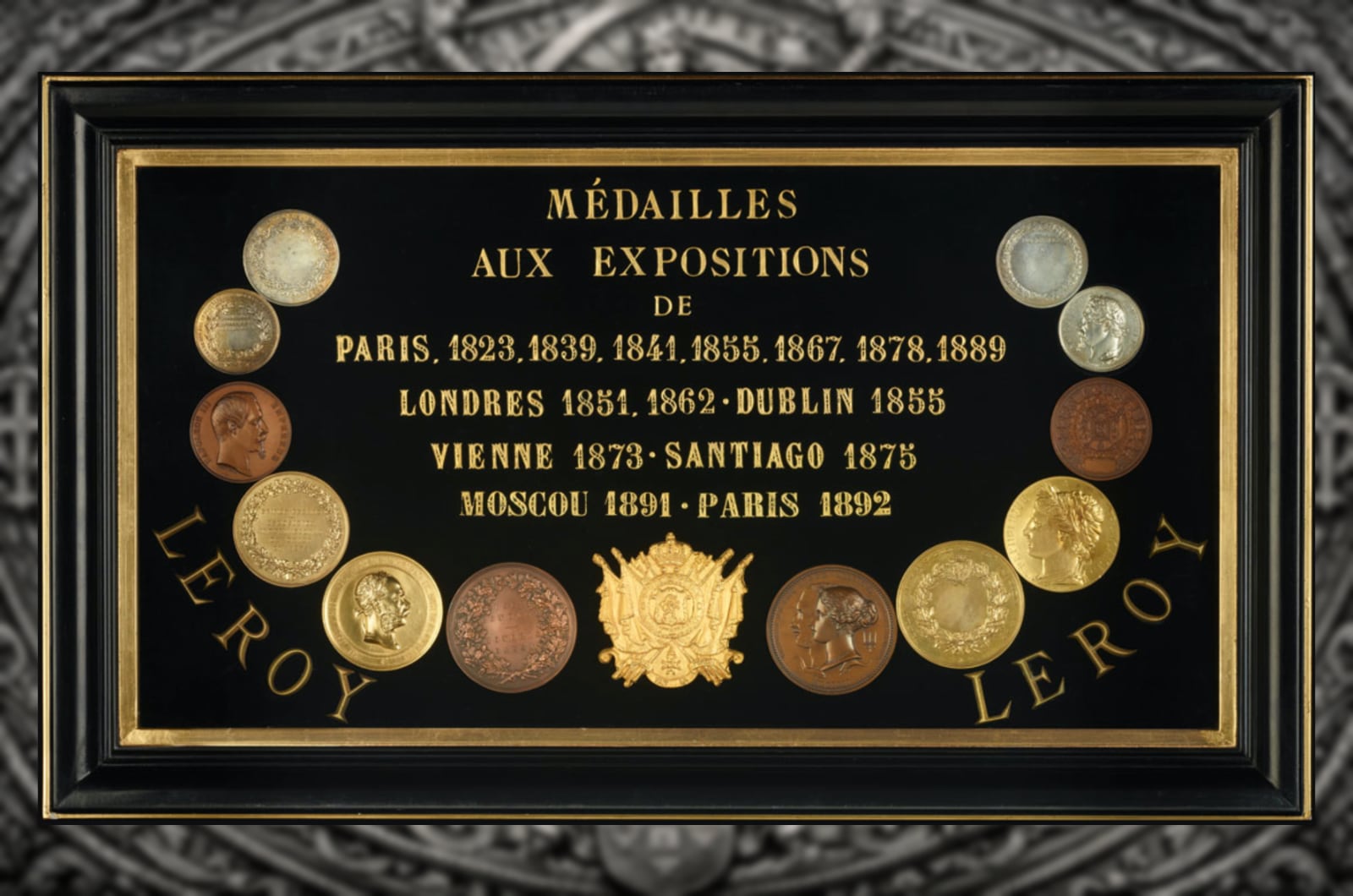
Medals won by Leroy at International Exhibitions between 1823 and 1892. Image – SJX composite and Montres Leroy
For Monteiro, who assembled his collections with deliberate attention to provenance and lineage, this history was not incidental. He was at that same moment commissioning the Quinta da Regaleira in Sintra, an estate he would build between 1898 and 1910 with Manini, an exercise in architectural symbolism so dense that scholars have been mapping its esoteric programme for decades.
Louis Leroy was therefore the point of articulation between a client who wanted a philosophical instrument and an industrial network capable of constructing it. He had the necessary relationships with suppliers in the Vallée de Joux and an atelier in Besançon for final assembly and regulation. He also had a name that could sign the dial.
What he did not have, and knew he did not have, was the technical capacity to build the movement in Paris. That capacity lived in the Vallée de Joux, in a cluster of workshops within a few kilometres of one another along the valley floor, staffed by men who had been building complicated movements in isolation and in collaboration for three generations.
The network
The ébauche that Charles Piguet began in November 1897 was an object of four mechanical levels. At the base, the going train and the two mainspring barrels provided the power. On the second level, the striking train. On the third, the perpetual calendar. On the fourth, the astronomical and scientific indications.
To build across all four levels simultaneously, integrating their kinematic relationships, guaranteeing that the perpetual calendar’s annual cam supplied transmission to the astronomical mechanisms above it while independently driving its own indications, required not one craftsman but a network of specialists, each working on delegated components and returning them to Piguet for integration.
This was the Vallée de Joux’s characteristic mode of production — the établissage system applied to its most demanding expression. Piguet, born in 1864 and operating from Le Sentier, handled the ébauche itself, the most demanding single contribution. It took nearly 13 months before the mechanism was finally delivered to the Besançon atelier in January 1899. His father, John-César Piguet, contributed to its subsidiary mechanisms.

The splendour of the Leroy 01. Image – SJX composite – Musée du Temps, Besançon
Léon Aubert, working from Le Brassus at the western end of the valley, was responsible for the astronomical indications — specifically, the mechanisms for sunrise and sunset — which he had developed and refined across several commissions during the 1890s. Aubert’s system used paired annual eccentric cams, one governing the daily sunrise time, one the daily sunset, driving rack-and-pinion sectors that translated the cams’ continuously varying profiles into the angular positions of dedicated hour and minute hands on two subsidiary dials.
The cams had to be computed and filed individually for a specific geographical latitude. For the Leroy 01, the primary calculation was for Lisbon, where Monteiro lived. The annual extremes for that city, sunrise ranging from 7 hours 21 minutes on the first of January to 4 hours 36 minutes in June — with sunset traversing a comparable arc in the opposite direction — were encoded mechanically in the cam profiles. To achieve this, Aubert worked from astronomical almanacks, converting tabulated solar times into the exact geometry of steel.
The same man was simultaneously building the astronomical mechanisms for Dent No. 32573, a double-faced pocket watch being made for the London-based firm through the Capt & Co établisseur at Le Solliat. The correspondence between Jules-César Capt and Aubert, which survives, shows the two men working through the tooth counts for the lunar train in the spring of 1904.
The correspondence shows Capt proposing a gear ratio of 64 × 43 × 57 / 37 — which approximates the lunar day of 24 hours 50 minutes to an accuracy within one hour over 80 years — and asking Aubert to price the work while requesting discretion about the new commission. In other words, Aubert was not a man who worked on one thing at a time.
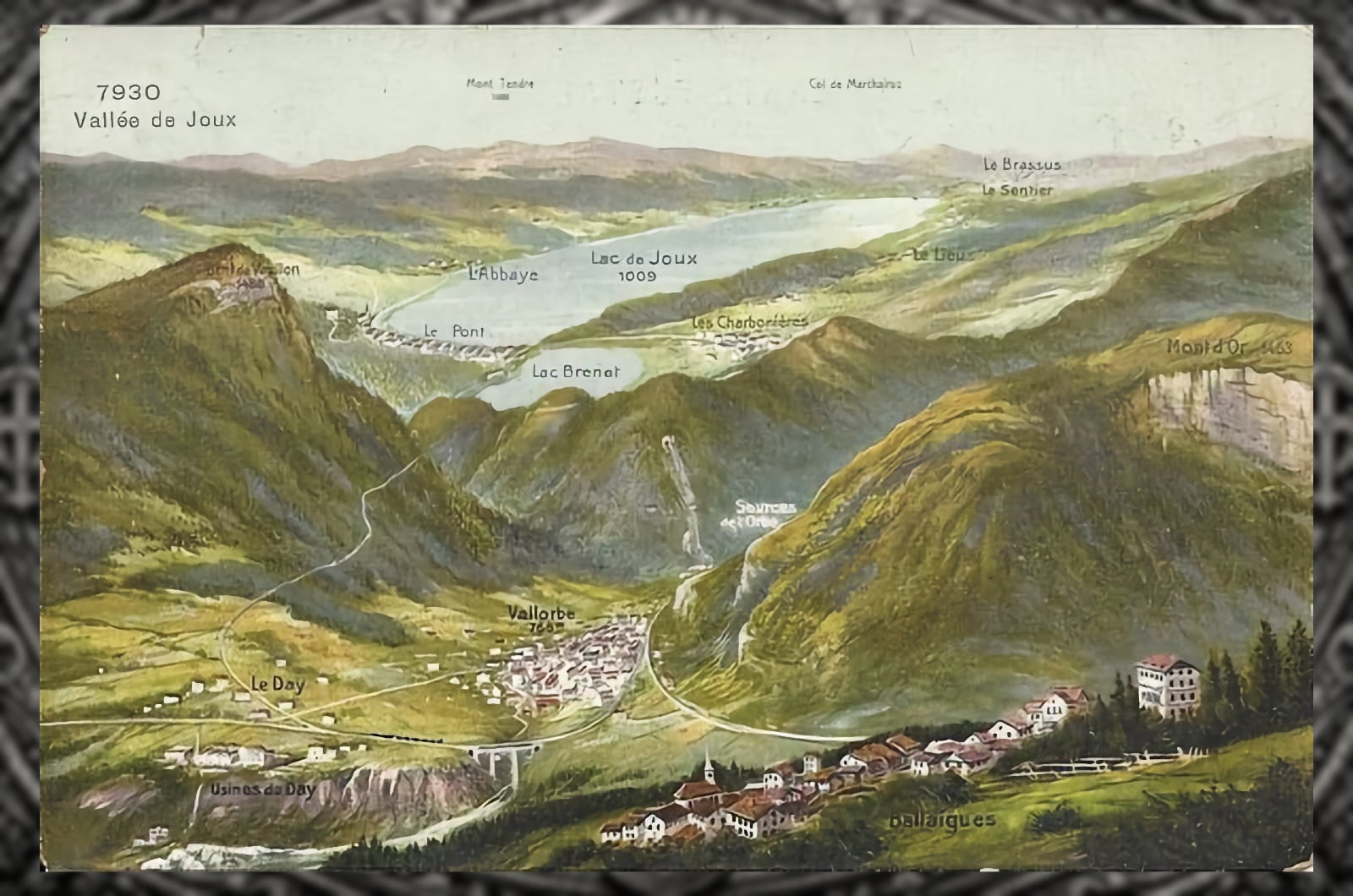
A map of the Valée de Joux, the center of complicated watchmaking in 1900. Image – SJX composite – Wikipedia
Ulysse Capt, a chronograph specialist working at Chez Villard near L’Orient, contributed to the Leroy 01’s striking mechanisms. Marcel Capt handled further sub-contracted work. Charmingly, one of M. Capt’s suppliers was his own wife, who provided a lock of her blonde hair to calibrate the hygrometer. At the time, human hair was the only reliable organic hygrometric element available — its length varies predictably with atmospheric humidity.
M. Junod of Sainte-Croix, the repasseur responsible for the final technical assessment of the completed movement before it left the Vallée, produced a 50-page manuscript critique examining the watch’s performance across all its indications. This document, which survives in the archive associated with the Droz and Flores monograph, is among the most detailed technical assessments of any 19th-century complicated movement in the primary record. It is not a celebration but an inspection, with observations, corrections and recommendations for adjustment. The watch had to satisfy Junod before it left Switzerland.
The Besançon atelier under Maillard-Salin received the ébauche from Piguet in January 1899. From that point, Louis Leroy managed the commission from Paris, and was the direct intermediary between Monteiro in Lisbon and the dispersed network of specialists in the Vallée and in Sainte-Croix.
The atelier continued its assembly and regulatory work, but the client relationship — which dealt with dial instructions, the case back design, and the correspondence over the astronomical nomenclature — were all conducted by Leroy personally.
The watch appeared at the 1900 Paris Universal Exposition in an unfinished state. Despite its condition — the case was not yet complete and certain indications had not yet been installed — the watch was awarded a Special Grand Prix. The French horological establishment was declaring French supremacy in the ultra-complicated field before the object was even finished. Final completion came on the November 15, 1904, six years and two weeks after Piguet had begun the ébauche.
The watch and its owner
The 27 indications of the completed Leroy 01 divide across five categories: chronometric, perpetual calendar, striking, global, and scientific. The front dial — signed L. Leroy & Cie Horlogers Paris — carries mean time with a central seconds hand, a one-fifth-of-a-second chronograph with split-seconds capability, equation of time, and a power reserve indicator.
The perpetual calendar apparatus reads the day of the week, date, month, leap-year cycle, century, moon phase, and the seasons, with their solstices and equinoxes.
The striking train offers grande sonnerie, petite sonnerie, minute repeater with a three-gong carillon, and a silence setting. The scientific instruments — barometer, thermometer, hygrometer, compass — occupy their own display level, with the compass set into the crown itself.

The astronomical chart of the Leroy 01 came in three variants: for the sky of Lisbon, Paris and for the sky of Rio de Janeiro. Image – SJX composite – Musée du Temps, Besançon
The barometer and thermometer are conventional in principle if miniaturised in execution, but the hygrometer is not. The human hair element of the instrument, a single lock taken from Madame Marcel Capt, blonde, selected for the specific tensile characteristics that determined its hygrometric sensitivity, was integrated into the movement as a functional component calibrated in Le Brassus, in the particular atmospheric conditions of the Vallée, before the watch left Switzerland.
Whether its readings remained accurate in the different humidity conditions of Lisbon or Rio is a question the documents do not answer. But it was there, which was sufficient for the record books.
But what distinguishes the Leroy 01 from a virtuoso exercise in complication cataloguing is the set of three interchangeable celestial charts. The rear dial carries at its centre a rotating disc of blued steel, 27 millimetres in diameter, pierced with holes calibrated to stellar magnitude and fitted with gold pins, each pin flush to both surfaces of the disc, their upper ends rounded and polished.
The disc advances each day by 236 seconds beyond mean solar time, tracking sidereal time, allowing the observer to follow the rising, meridian passage, and setting of the principal stars and constellations as they would appear from a specific point on the Earth’s surface. Three such discs were made, each computed for a different location — Paris, Lisbon, and Rio de Janeiro. The preparation of the three celestial charts alone required 1,075 hours of work, and was the dominant single labour cost in a movement that had already consumed more than six years of distributed effort.
The third stellar disc proved especially challenging. Rio de Janeiro lies at 23° south latitude, in the southern hemisphere, where the apparent rotation of the celestial sphere is reversed for an observer in Europe. A star that rises in the east and transits toward the north for a European observer transits toward the south for an observer in Rio; the entire vault of the sky rotates in the opposite sense.
In other words, a celestial chart made for Paris would not merely be inaccurate for Rio but would be kinematically inverted. The Rio disc, therefore, runs on a separate mechanism with a reversed drive — its stars rotating as they would be seen from the city of Monteiro’s birth.
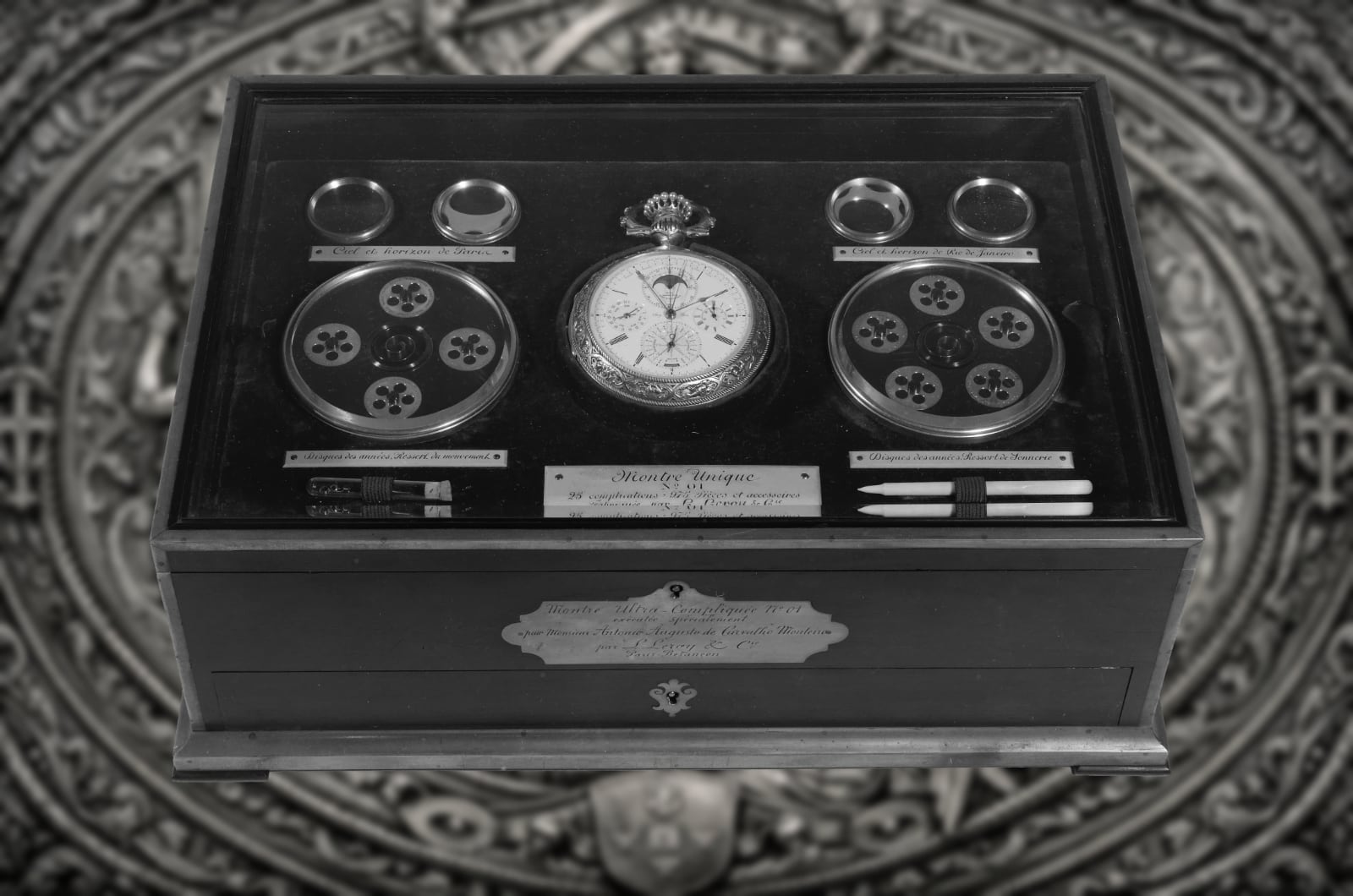
The Leroy 01 original box with suplementary sky chart and calendar discs. Image – SJX composite – Fundação Calouste Gulbenkien
This is not a technical footnote. The three discs together constitute a map of Monteiro’s biography: Paris, where he negotiated the commission and moved in European intellectual circles; Lisbon, where he lived and built his estate; Rio, where he was born and from which his family’s fortune came.
A man who commissions a portable observatory that can show him, on demand, the sky above the city of his childhood, from a study in Sintra, from a carriage in Paris, has built something more than a complicated watch. He has built a machine for holding several worlds simultaneously.
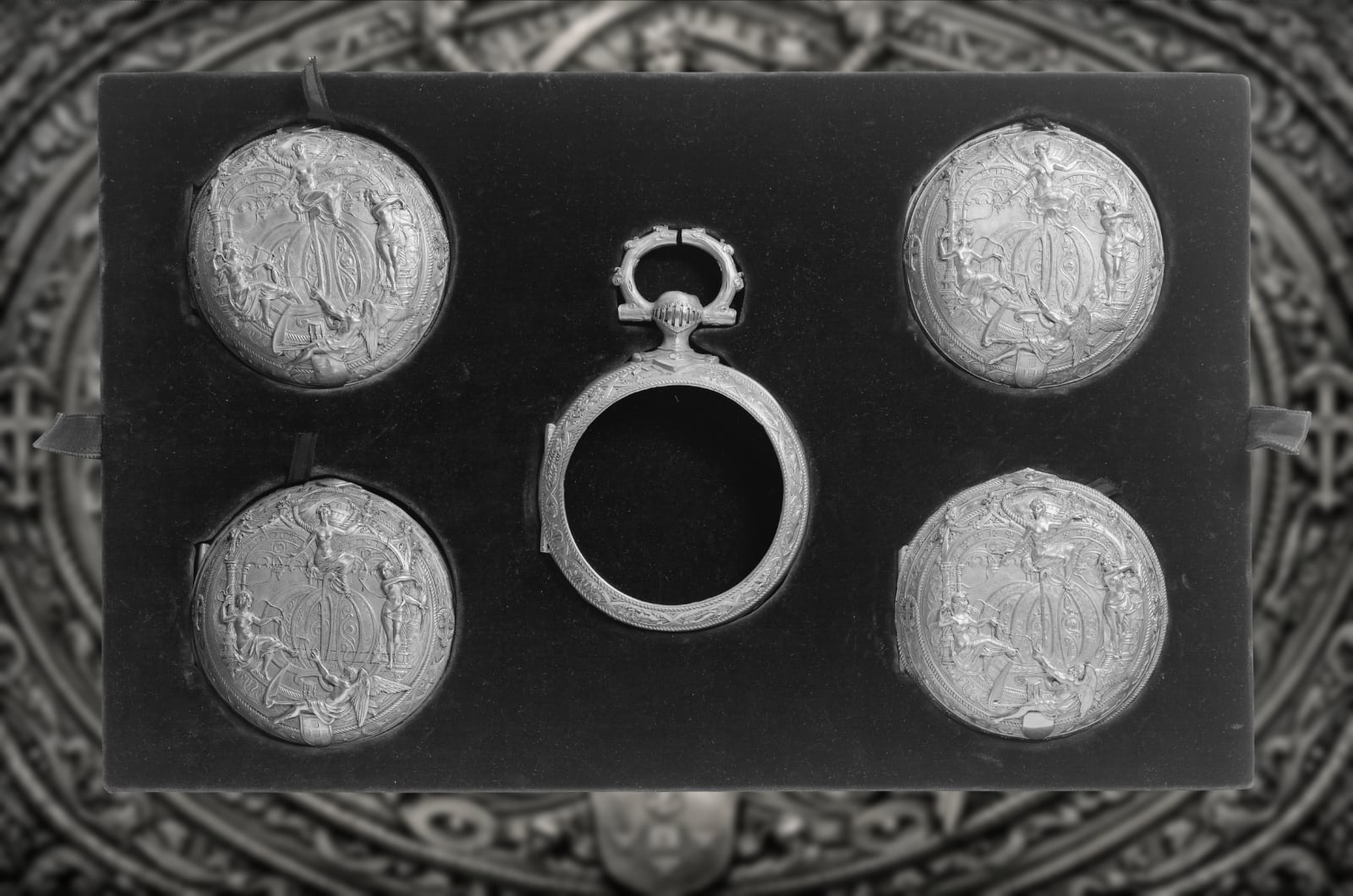
The original cast of the Leroy 01 case designed by Manini and executed by V. Burdin. Image – SJX composite – Fundação Calouste Gulbenkien
The same philosophical intention governs the caseback. For its decoration, Monteiro turned to Luigi Manini, the Italian architect who was at that same moment designing the Quinta da Regaleira: the esoteric estate in Sintra with its inverted initiatory tower sunk thirty metres into the earth, its Templar chapel, its network of tunnels and grottos encoding a programme of symbolic reference that moved between Freemasonry, Rosicrucianism, Portuguese Sebastianism and Dante.
Manini provided the design; the chasing in gold was executed by V. Burdin. The subject was the Three Fates: Clotho, who spins the thread of human life, Lachesis, who measures its length, and Atropos, who cuts it without warning. The Fates were Monteiro’s personal emblem. They appear in the decorative programme of the Quinta, on his funerary monument at the Prazeres cemetery in Lisbon, and now on the case back of the most complicated watch in the world. A man who places the Fates on his watch understands that what he has commissioned is not an instrument for reading time but an instrument for meditating on it.
Completion and delivery
The watch was completed on November 15, 1904 and shown publicly for the first time at Besançon’s Beaux-Arts and Hôtel de Ville from November 24-27, then at Leroy’s Paris premises until Christmas Eve. In fewer than 30 days, the most complicated watch in the world had been seen by its home city and its city of commission. Then it had to travel.
The problem of getting a watch of 27 indications, four mechanical levels, 975 parts and 21,000 francs of agreed value from Paris to Lisbon was not trivial. Standard commercial shipping carried unacceptable risks to mechanical integrity; customs presented additional complications. Monteiro came to Paris himself to collect it and refused to take it. He could not find a way to cross the Portuguese border without paying duty, and the risks of entrusting the movement to a commercial courier were not acceptable to him. Louis Leroy was left in Paris with the watch and no means of delivering it.
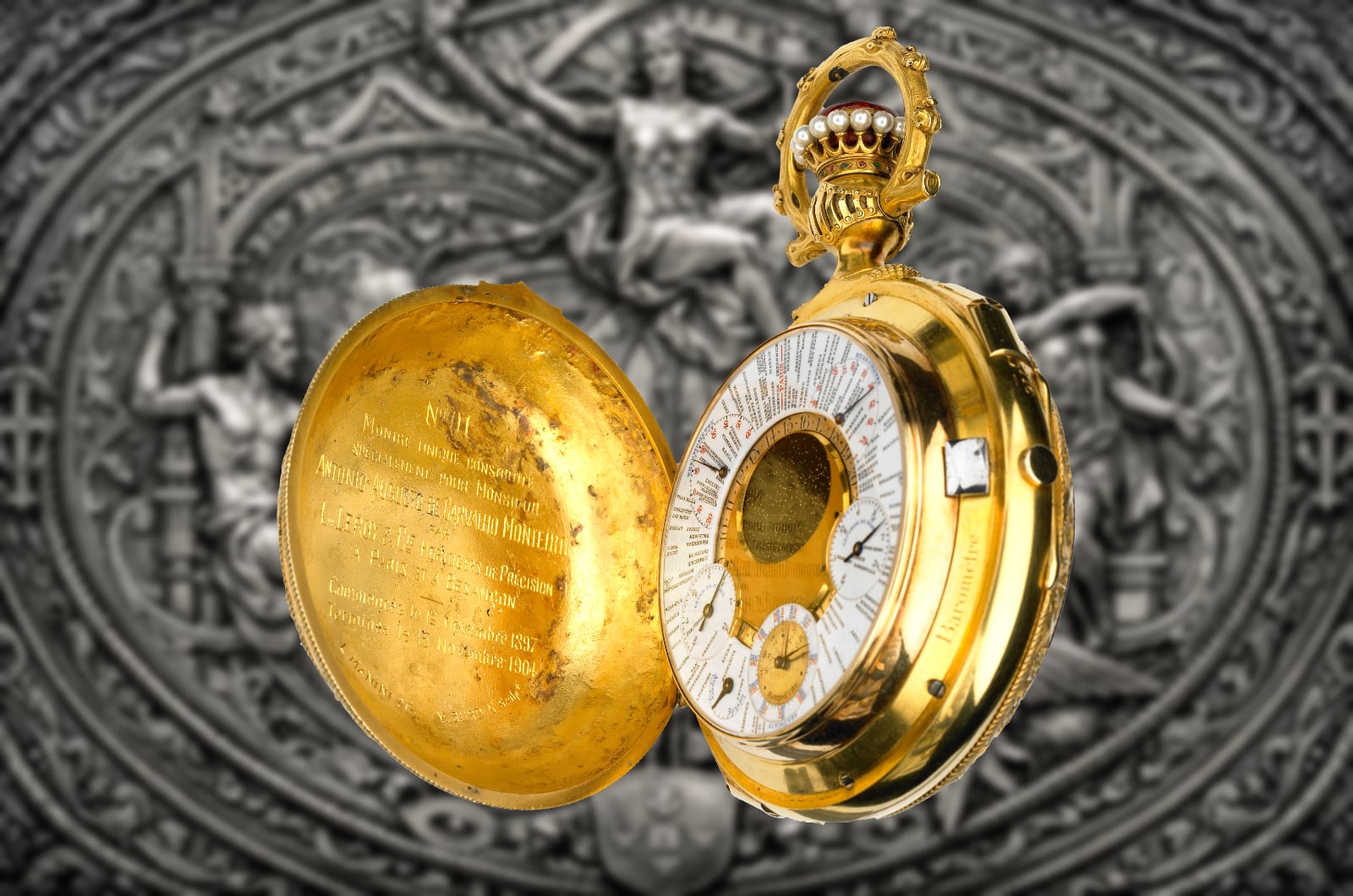
The inscription visible on the internal side of the front cover of the Leroy 01 stating “No 01, Unique watch built special for Mr. Antonio Augusto de Carvalho Monteiro by L. Roy & Cie Precision Watchmakers in Paris and in Besançon. Started on the 1st of November 1897, completed the 15th of November 1804, L. Manini De. V. Burdin Sculp.” Image – SJX composite – Musée du Temps, Besançon
Then, as Émile Maillard-Salin later wrote, the King of Portugal happened to be in Paris. Leroy requested an audience and was received. He presented the watch. “Que voilà une bien belle pièce, Monsieur Leroy.” — “Elle appartient à l’un de vos sujets, Sire.” — “L’heureux homme… Il ne l’a jamais vue et je me demande s’il la pourra voir un jour…” The King laughed, accepted it, and carried it to Lisbon in his personal baggage, where he summoned Monteiro to the palace to receive it. Monteiro was handed the most complicated watch in the world by his sovereign.
Louis Leroy, writing in 1920 on the occasion of the Geneva horology fair, offered his public account of what had been accomplished: “I recall with pleasure that the ébauche of this unique watch, since never equalled to this day, was constructed by the skilled artist of the Vallée, M. Charles Piguet.” This attribution, made 16 years after completion before an audience of peers, is notable for what it concedes. A brand that signs the dial acknowledges publicly that the essential creative and mechanical act was performed in a Swiss workshop by a man whose name would never appear on the object.
Louis Cottier, writing in the Revue Internationale d’Horlogerie in 1954, made the structural point explicit: “When these complications are united on a single movement, they demand for their execution a considerable sum of experience, the possession of varied and difficult tooling, and the contribution of numerous specialists — pivoteers, wheel cutters, spring makers — accustomed to all the difficulties and unforeseen problems arising during execution. These ateliers existed only in the Vallée de Joux.” The dial reads Leroy, but the credit, if offered at all, went to Le Sentier.
The Leroy 01 today
Monteiro died in Sintra on October 25, 1920. The watch remained with his heirs for three decades, until 1953, when they decided to sell. In private hands, the watch remained in relative obscurity. So much so that another complicated watch, made by Patek Philippe for Henry Graves in 1933, is often cited as the most complicated watch of its era — though that’s partly down to disagreement over what constitutes a complication.
Regardless, the prospect of its departure from French patrimony — the watch had been made in France, had won its Grand Prix at a Paris exposition, and was considered evidence of French supremacy in precision horology — prompted a public subscription campaign in Besançon.
The funds were secured by the March 26, 1955. The formal transfer took place on September 8, 1956, in the presence of Louis Leroy fils and the Deputy Mayor of Besançon, Jean Minjoz, during the seventh Salon International de l’Horlogerie. The city paid 2 million francs — approximately 100 times the original commission price.
A world tour of 20 cities followed between 1965 and 1975, including a return to Lisbon in 1967; the insurance valuation rose from 40,000 francs to 150,000 francs over that decade as the watch’s reputation increased in a market that had not existed when it was built.
The Leroy 01 held the title of most complicated watch in the world for 85 years, until Patek Philippe completed the Calibre 89 in 1989 with 33 complications.
The watch is now at the Musée du Temps in Besançon, in the Palais Granvelle on the Grande Rue. The staff call it Lucie, after the woman who saved it for France.

The magnificent palace built by Carvalho Monteiro in Sintra, Portugal, known as Quinta da Regaleira. Image – SJX composite – Fundação Cultursintra FP, Quinta da Regaleira
Acknowledgments
The author wishes to thank Fanny Calley, Adjointe du Patrimoine, Musée du Temps, Besançon, for providing high-resolution images of the Leroy 01 and access to archival documentation; Amanda Bass, Head of Luxury Communications at Sotheby’s, for her assistance with catalogue material relating to the Nostitz watch; and Denise Pereira, Direção Cultural, Fundação Cultursintra FP, Quinta da Regaleira, for the portrait of António Augusto de Carvalho Monteiro.
Back to top.