

Hands On: Audemars Piguet Royal Oak Perpetual Calendar Openworked
Innovation in plain sight.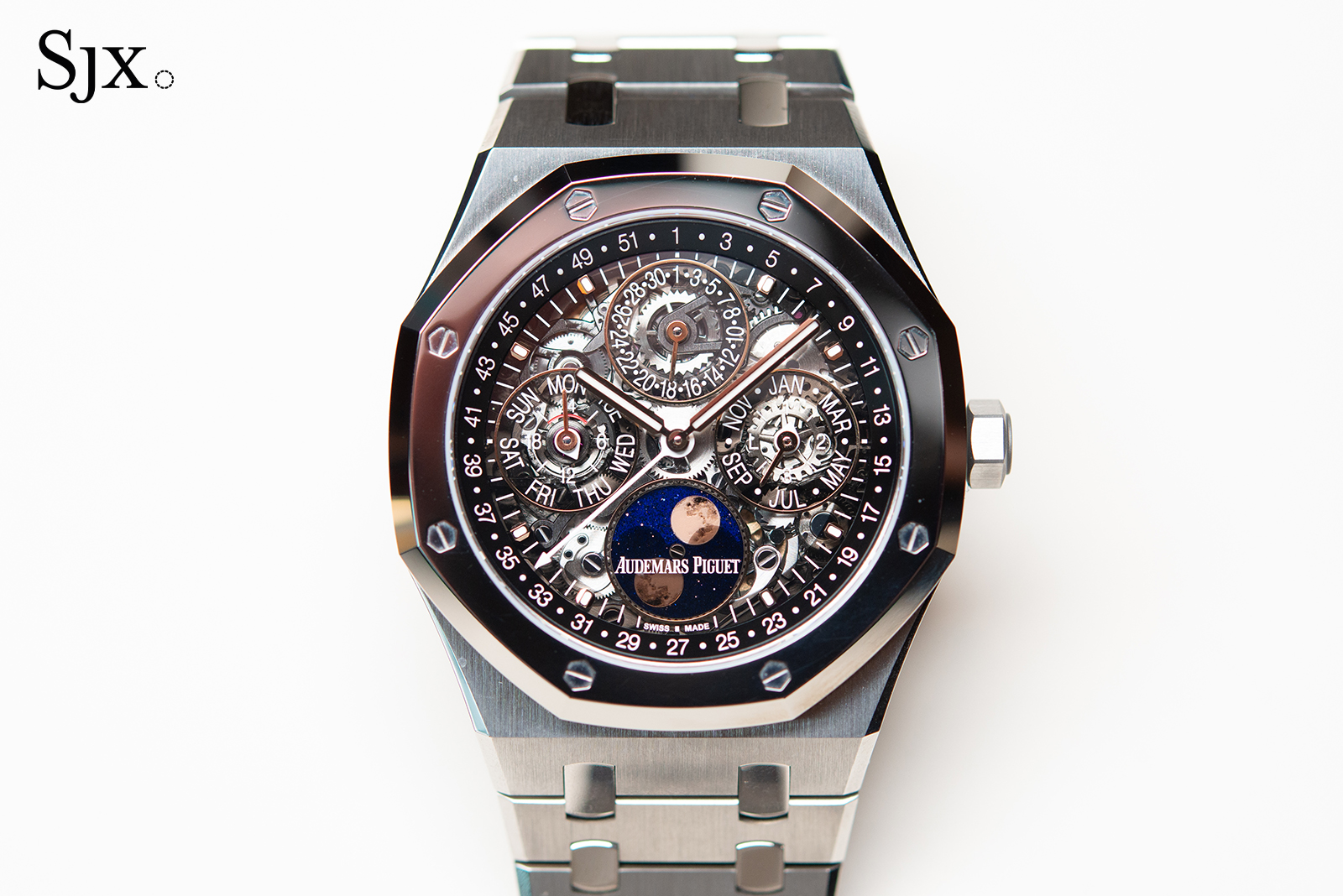
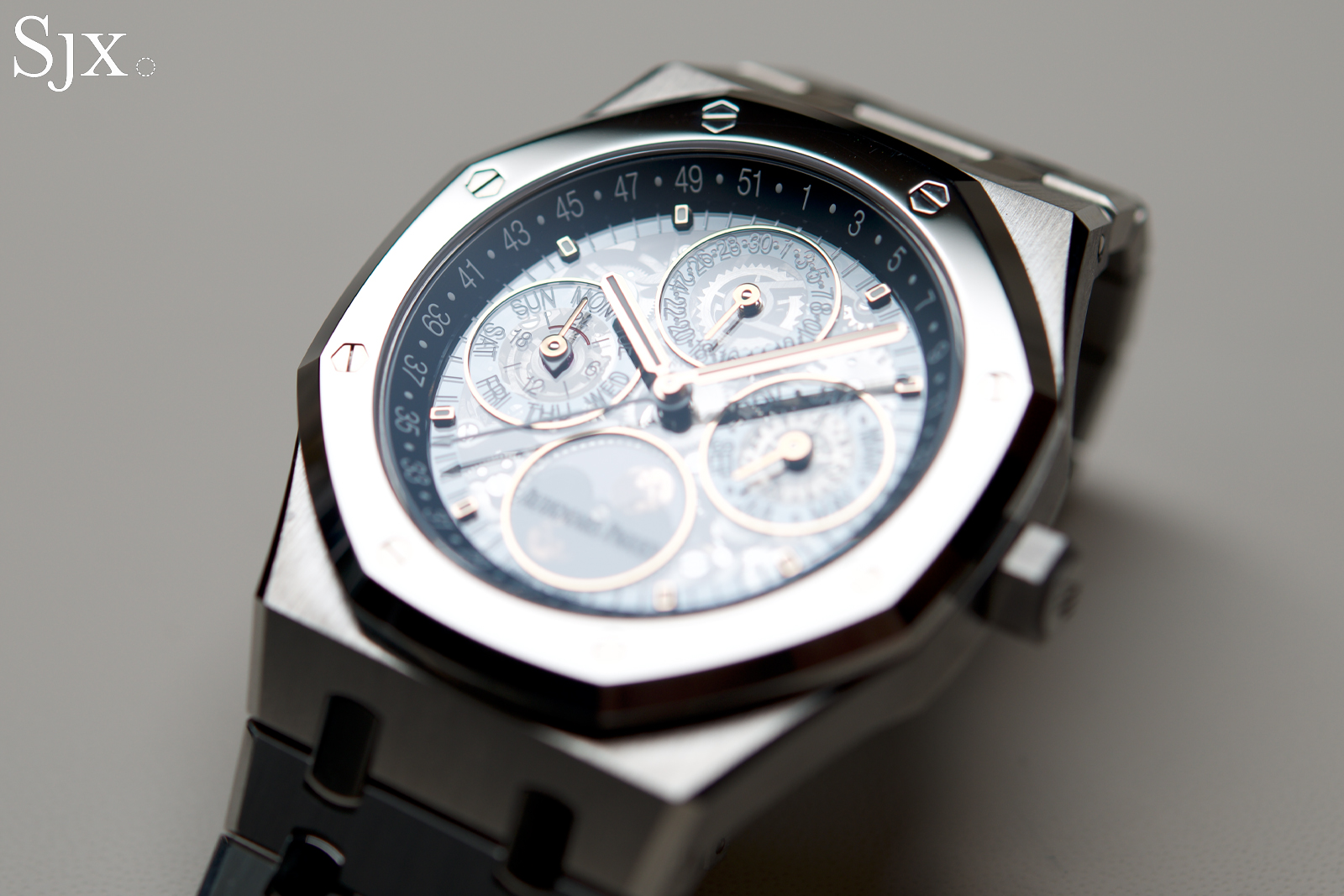
Audemars Piguet (AP) has updated the coveted Royal Oak Perpetual Calendar Openworked, which makes its debut on the next-generation perpetual calendar platform that debuted last year. The new calibre allows for individual adjustment of each calendar indication using just the crown – no stylus (or toothpick) necessary. The first outing for the skeletonised version of this class-leading perpetual calendar is in titanium, with mirror polished accents in scratch-resistant Palladium BMG and pops of rose gold on the dial and case back, though more colourways are sure to come in due time.
Initial thoughts
The latest generation of the Royal Oak Perpetual Calendar is arguably AP’s strongest product. It is heir to the archetypal integrated bracelet perpetual calendar sports watch, which, until recently, was held back to some extent by what had become a dated movement. In fairness, the same can be said of its obvious competitors from Patek Philippe and Vacheron Constantin.
That changed in 2025 when the Royal Oak Perpetual Calendar was upgraded with the AP’s latest perpetual calendar movement, a significant release befitting the brand’s 150th anniversary year. The calibre 7138 introduced individual correction of the date, day, month, and moon phase using only the crown, allowing for quick adjustment without tools and with greater flexibility, and support for more indications, than existing solutions.

And while we already understood the movement’s clever functionality, it remained to be seen whether the new architecture could match its predecessor in terms of aesthetics when opened up. We now have that answer: in short, it does. In fact, at arm’s length it takes a well-trained eye to distinguish between them. Since the previous version remains sought-after, this similarity is a good thing.
And the new movement benefits the open-worked design in particular because it reveals action that’s usually concealed. Most perpetual calendars are black boxes to their owners, but an open-worked variant is more engaging because it allows them to see a what is going on under the hood as they adjust the calendar. It does, however, come at a substantial cost of CHF180,200 before taxes – nearly twice that of the steel version. Not that AP will have any trouble selling these, of course.
Case and coverage
There are no surprises when it comes to wearability. The case and bracelet are dimensionally identical to those of the prior models, so the feel on the wrist will be familiar to anyone who’s worn any other 41 mm Royal Oak Perpetual Calendar we’ve known since 2015. The look is familiar too, taking after the 150th Anniversary Openworked from last year, though the aesthetic can be traced further back to 1997 with the platinum ref. 25829SP, a 25 piece limited edition to celebrate 25 years of the Royal Oak.

Ref. 25829SP.OO.0944SP.01 from 1997 may look like the Ti and BMG Royal Oaks of today, it is entirely platinum. Image – Ineichen Auctioneers
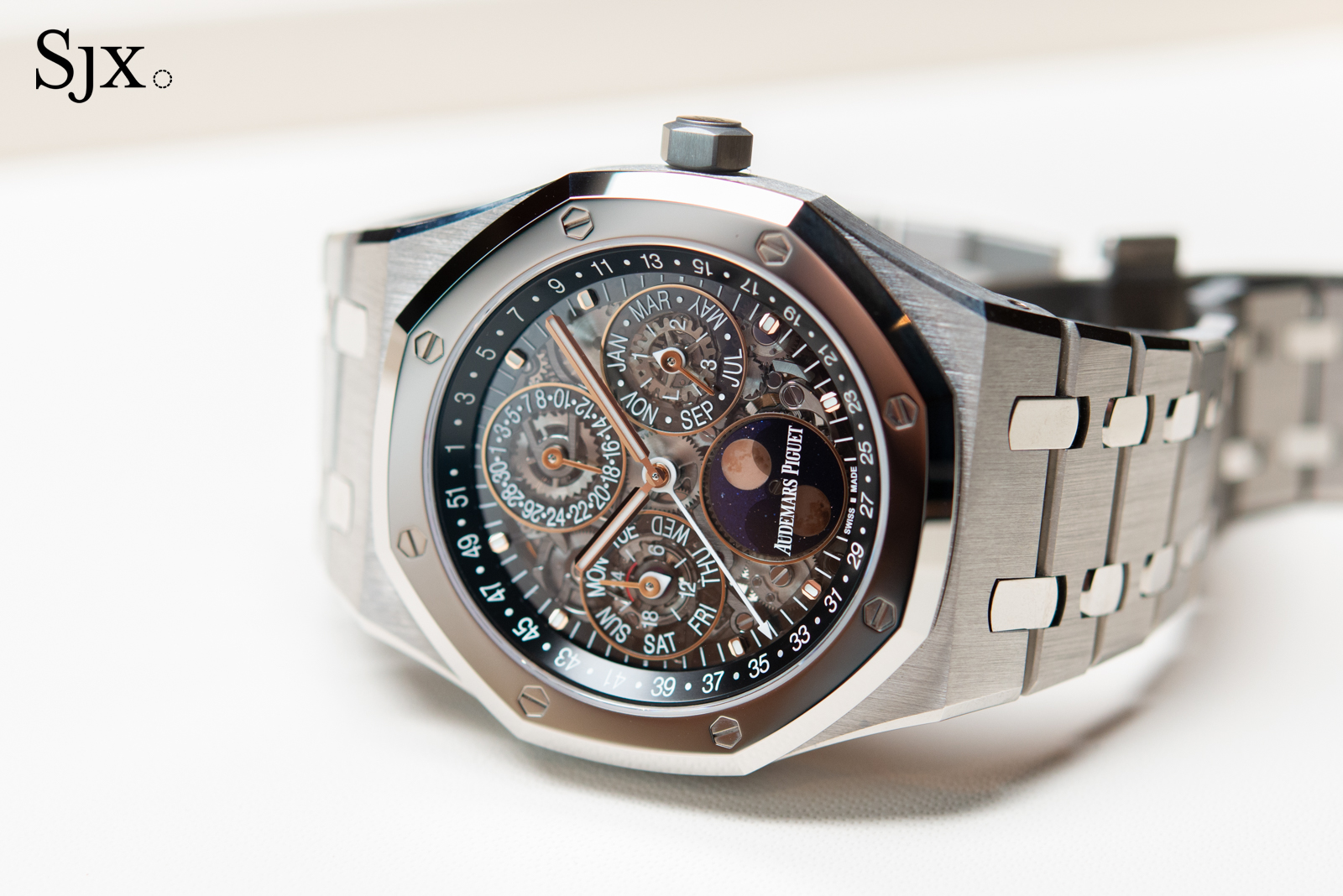
The case, bracelet, crown, and case back are grade 5 titanium, while the mirror-polished bezel and intermediate links are made of Bulk Metallic Glass (BMG), or an amorphous metal, that is half palladium by weight. It resembles the polished platinum bezels of Royal Oaks past, but is much harder, around 500 HV per AP, compared to the 90-140 HV of the platinum bezels – for which scratches were an issue.
The only notable update regarding the case is a welcome water resistance increase from 20 m to 50 m, thanks in part to the new movement that doesn’t require multiple apertures in the case. Audemars Piguet says this watch is safe to swim with, provided you don’t exceed the 50 m depth rating, and provides complimentary (but non-warrantied) water resistance testing at its boutiques.
On that note, the watch is protected by AP Coverage Service which offers repair or replacement in the case of unexpected incidents including damage, burglary and robbery. This unusual service last for two years, with complimentary repairs and replacements provided at the sole discretion of AP during that time. That is a meaningful perk considering the non-trivial cost of insuring watches like this.
A case study in modern finishing
Luxury watch brands can sometimes seem aloof or indifferent to the desires of collectors, but in this case it seems like AP has been listing to the inward angle discourse that has dominated collector group chats for the last few years. As a result, the design of the new perpetual calendar movement incorporates more than 200 inward angles, compared to fewer than 60 on the outgoing model.
Some of these inward angles, including 96 on the barrel covers alone, are first executed by Electrical Discharge Machining (EDM) by one of AP’s partners, before being polished manually. This is increasingly the way that inward angles are produced. Even so, the polishing stage is said to take 30 hours according to AP. While not done the traditional way, this is still costly and challenging work, which is presumably why we don’t see these sharp interior angles in most of AP’s mainline movements – other than the rotor.
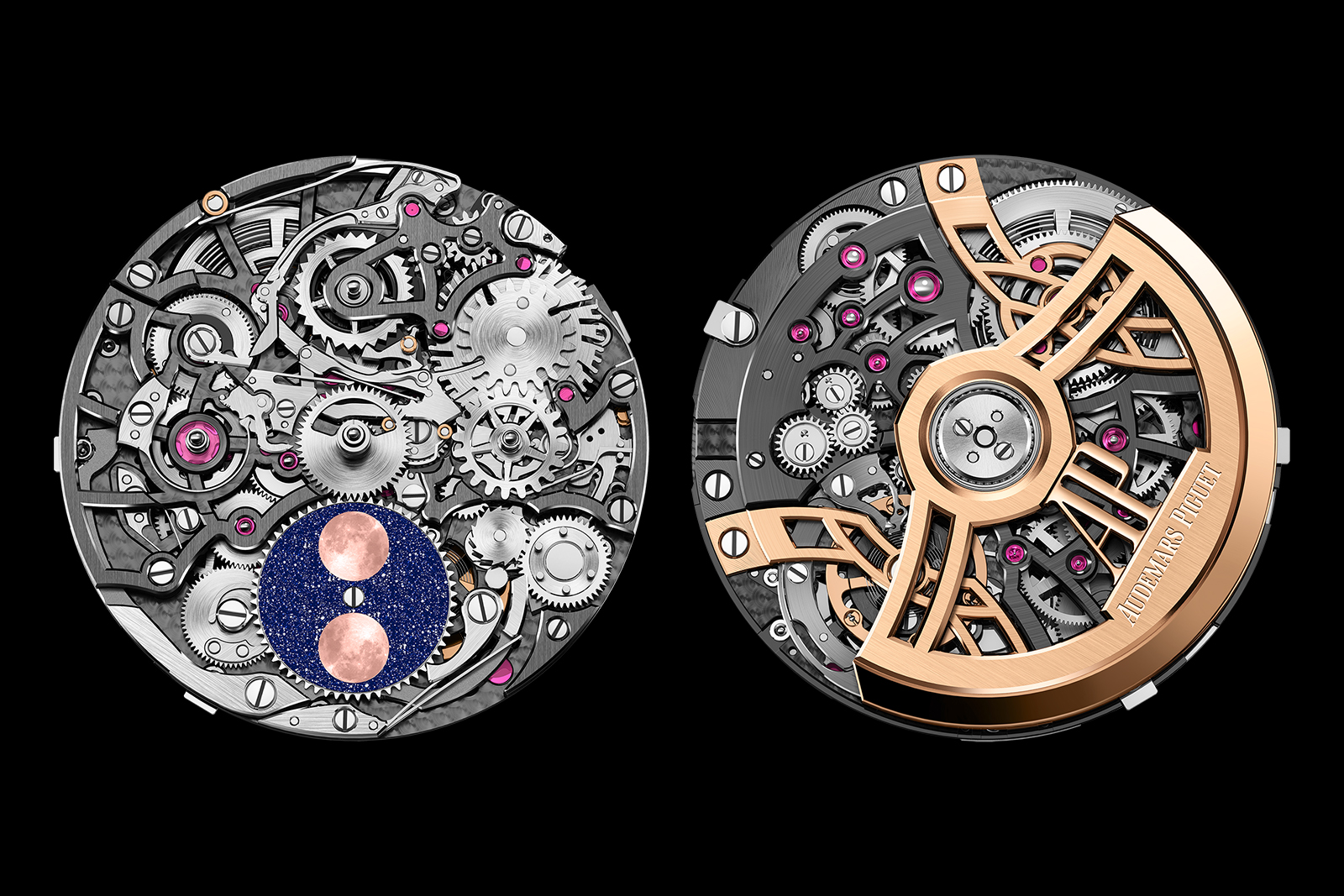
This also helps explain why the bevels are flat, rather than rounded as seen on the previous generation of open-worked perpetual calendars. Though “die-plunge” EDM can create rounded bezels, flat bevels are easier to polish and are more in keeping with the industrial look of the movement.
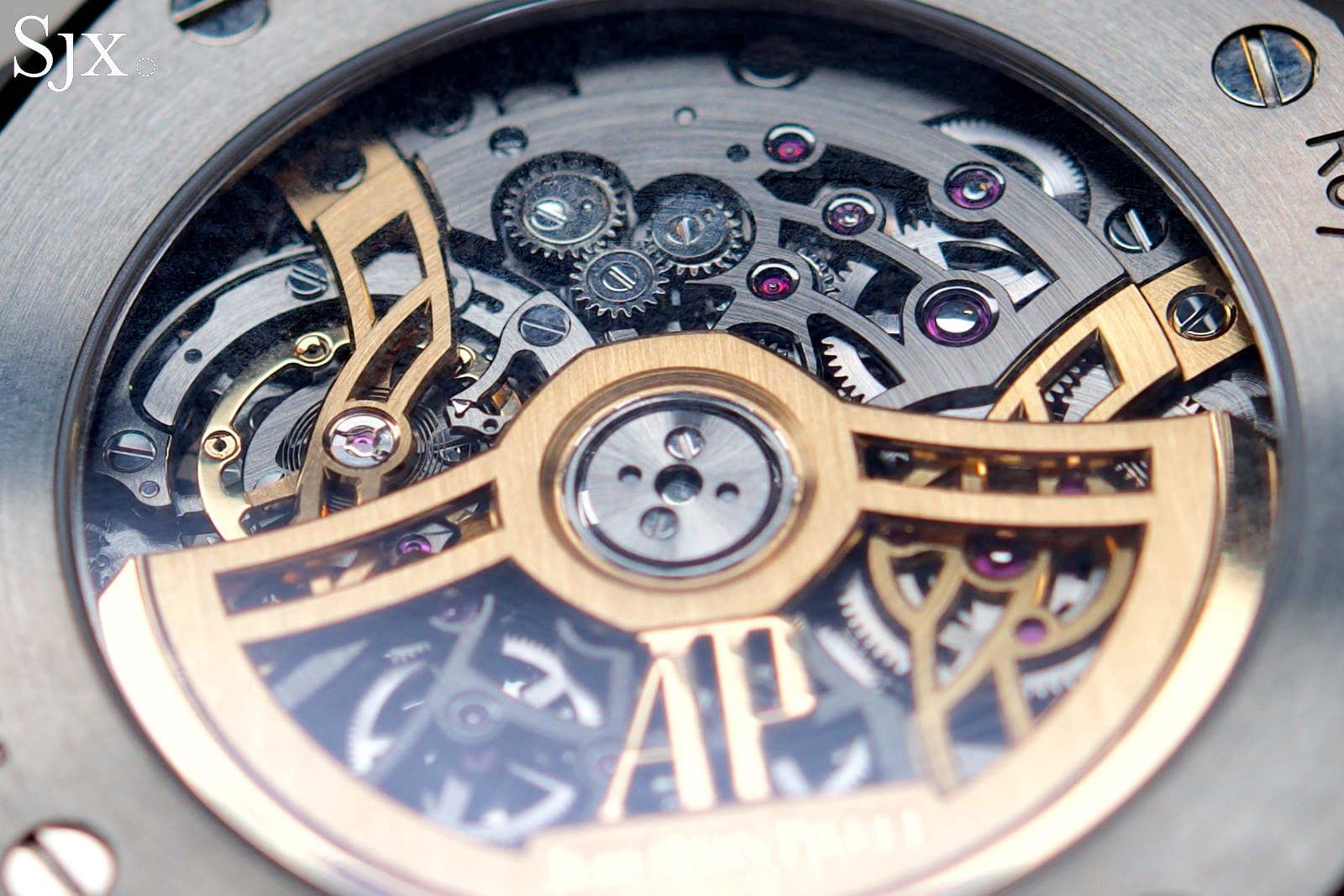
Movement of the new Royal Oak Perpetual Calendar Openworked.

Movement of the outgoing Royal Oak Perpetual Calendar Openworked.
One detail that differentiates the latest edition from its predecessors is the warm tone for the moon disc, which complements the rose gold hands and hour markers. This subtle accent colour warms up the otherwise monochromatic dial, and distinguishes it from the cooler-toned 150th anniversary edition from last year.
Innovation in plain sight
Launched last year, APs new perpetual calendar is one of the most advanced in its segment, even if the fundamentals are traditional, as it allows for individual correction of each indication entirely by the crown. This functionality, visible through a sapphire crystal dial for the first time, is clever and intuitive. As usual, turning the crown clockwise when flush against the case winds the watch. Pulling the crown out one click and turning clockwise advances the date, while counterclockwise advances the months.

The calendar indications are: date, month, leap year, moon phase, day, 24-hour hand, date, and weekly calendar.
Pulling the crown out to the second click allows for time setting as normal. Note that it remains a traditional grande lever perpetual calendar at its core and cannot go backwards, so turning the time clockwise past midnight advances the date while turning counterclockwise past midnight does nothing, as is typical for perpetual calendars. The watch does not stop when the crown is pulled, though there is little reason for it to as it lacks a second hand.
Starting from the time-setting position, pushing the crown in by one click reveals a phantom fourth position, in which turning the crown clockwise advances the day (and with it the weekly calendar) and counterclockwise advances the moon phase. Normally, this ballet is hidden by the dial, which is part of the beauty of this open-worked variant.
The calendar works integrate key innovations from the Royal Oak RD#2 Perpetual Calendar – launched in 2018 and the thinnest of its day – namely the clever single-level date and month wheels which cut down on both height and parts count. It lacks an instantaneous change at midnight, though that can be said for just about every perpetual calendar from AP, even going back to the pocket watch era.
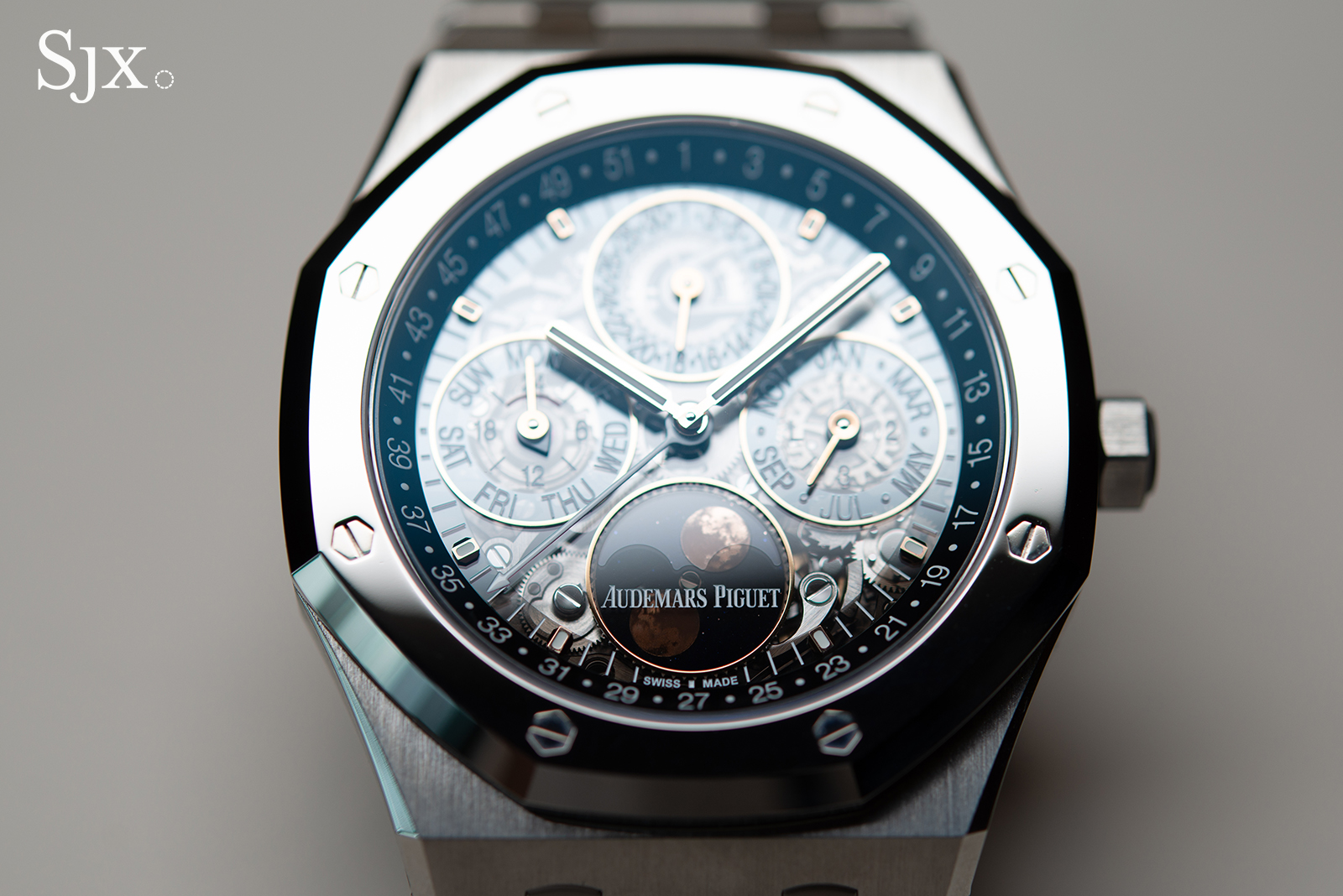
If this calendar has one shortcoming, it is the weekly calendar, which can be something of a chore to set if the watch has been stopped for several months – worse if you overshoot the current week while using the quick set. Oddly, the weekly calendar only goes up to 52, rather than 53 like many other weekly calendars, so it doesn’t quite work with the ISO 8601 week date system either. All that said, the weekly calendar adds character to an otherwise generic calendar layout.
Lean workhorse
The base movement is the same as the cal. 7121 used for the current generation of Royal Oak “Jumbo”, which also shows up in the brand’s RD#3 ultra-thin flying tourbillon and the recently unveiled Neo Frame Jumping Hour. It has a few notable traits of its own, including bidirectional automatic winding (unusual for an ultra-thin movement), a 4 Hz beat rate, and enough torque to power complications for more than 50 hours.

These quantifiable attributes aside, the cal. 71xx movements feature an unusual plate-mounted stud carrier. Surprisingly, it is not a fixed stud carrier as one might assume. Rather, the entire assembly slides within a track, making it easy to put the watch in beat, after which it is secured by tightening a screw. While this system was no doubt devised for some combination of thinness and convenience, it also looks very nice.
Key facts and price
Audemars Piguet Royal Oak Selfwinding Perpetual Calendar Openworked
Ref. 26685XT.OO.1320XT.01
Diameter: 41 mm
Height: 9.5 mm
Material: Titanium and palladium 500 BMG
Crystal: Sapphire
Water resistance: 50 m
Movement: Cal. 7139
Features: Hours, minutes, moon phase, perpetual calendar, weekly calendar.
Frequency: 28,800 beats per hour (4 Hz)
Winding: Automatic
Power reserve: 55 hours
Strap: Titanium and palladium 500 BMG integrated bracelet
Limited edition: No
Availability: At AP boutiques, AP houses, and Authorised Retailers
Price: CHF180,200 excluding taxes (~US$232,000)
For more, visit AudemarsPiguet.com.
Back to top.