
Hands On: F.P. Journe Tourbillon Souverain Vertical Joaillerie Rubis
Maximalist.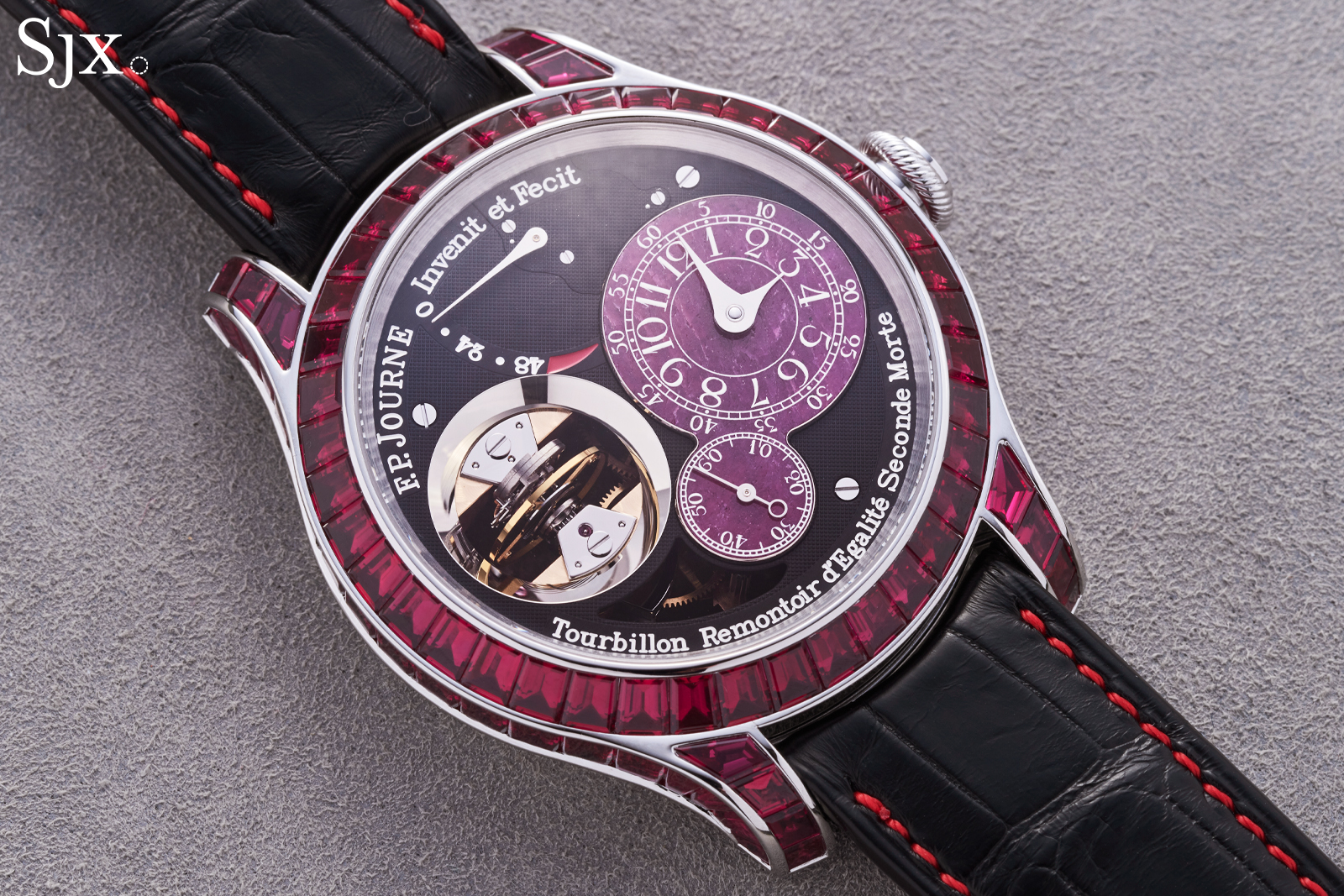
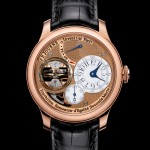
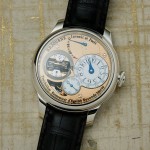
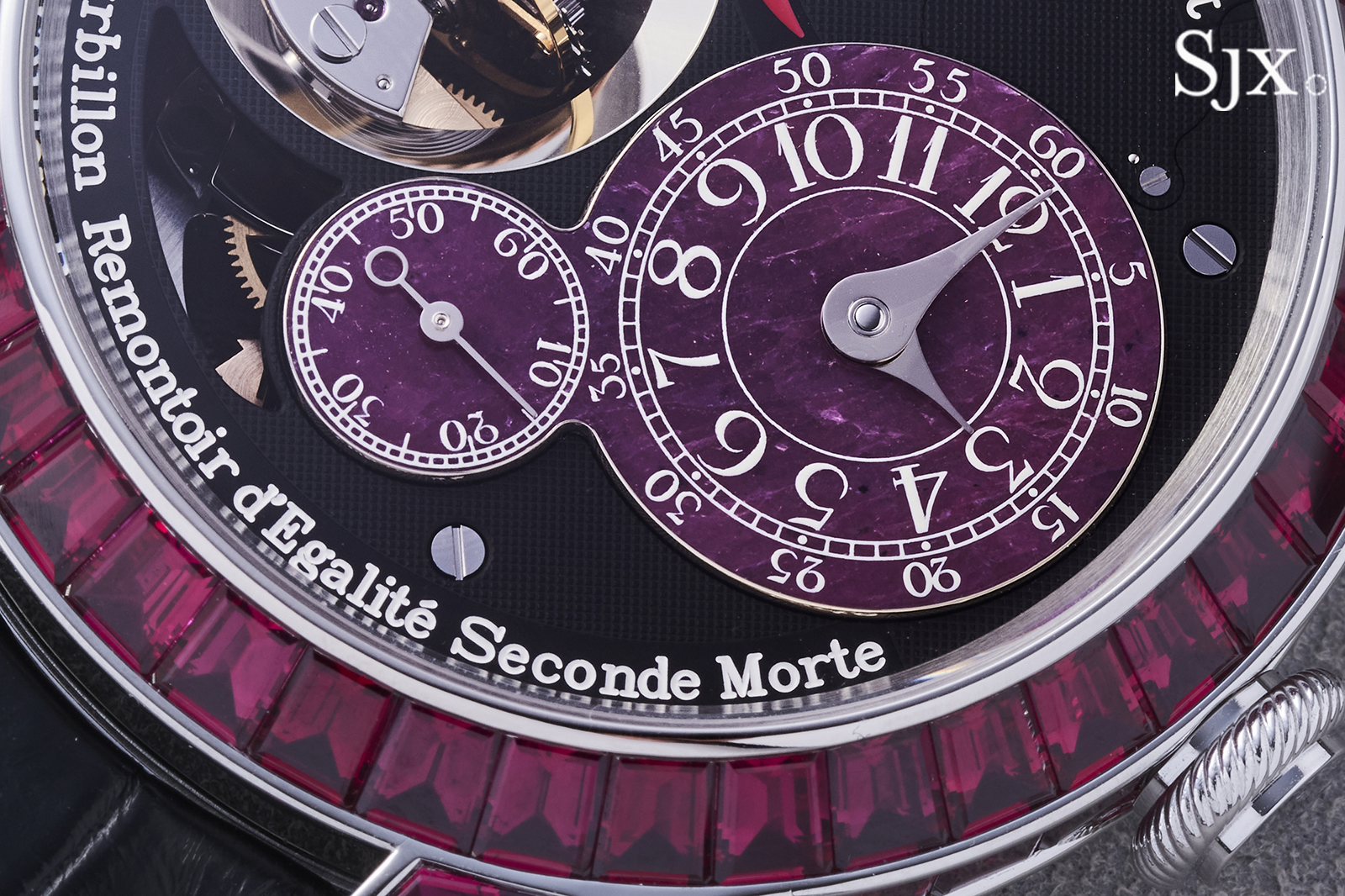
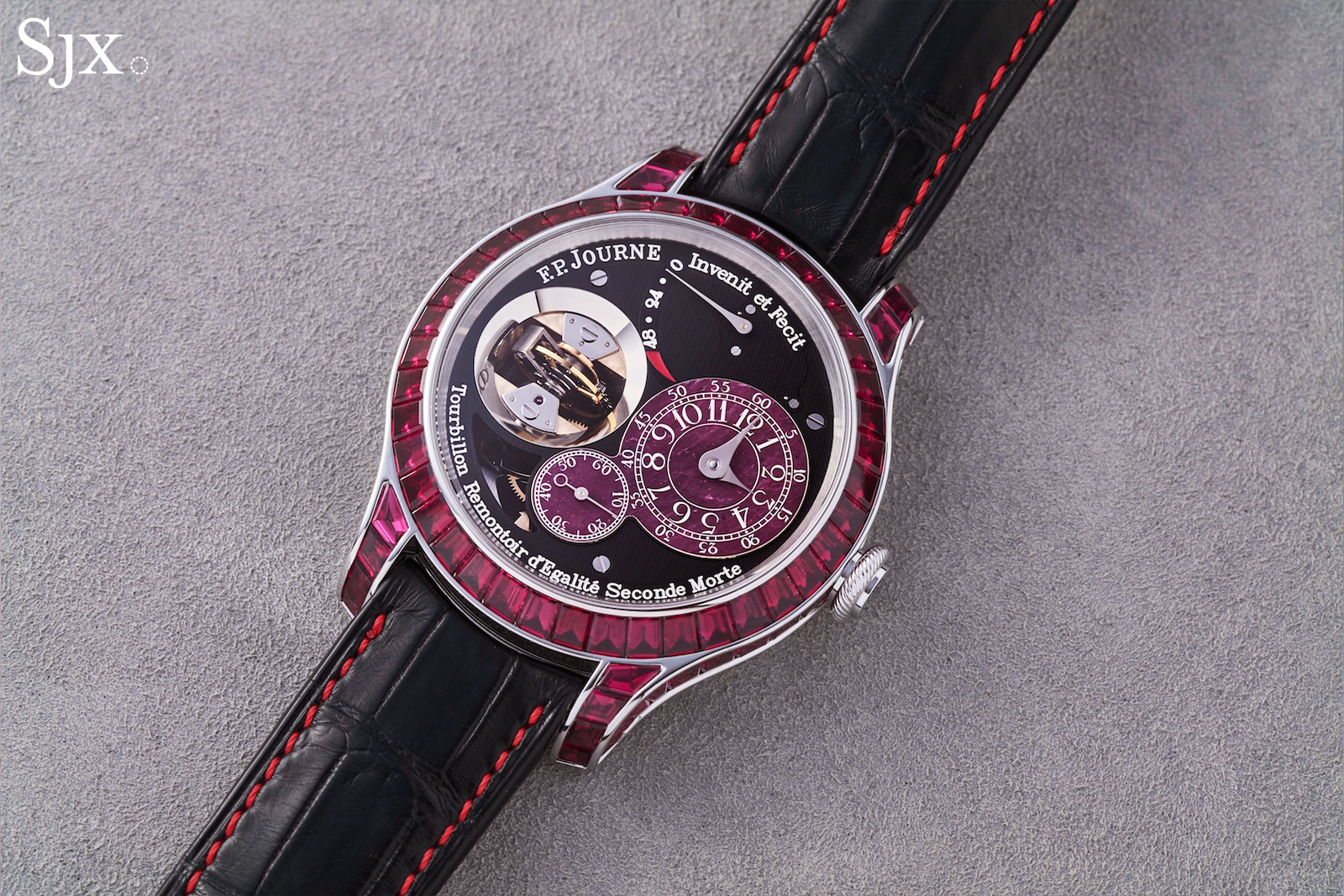
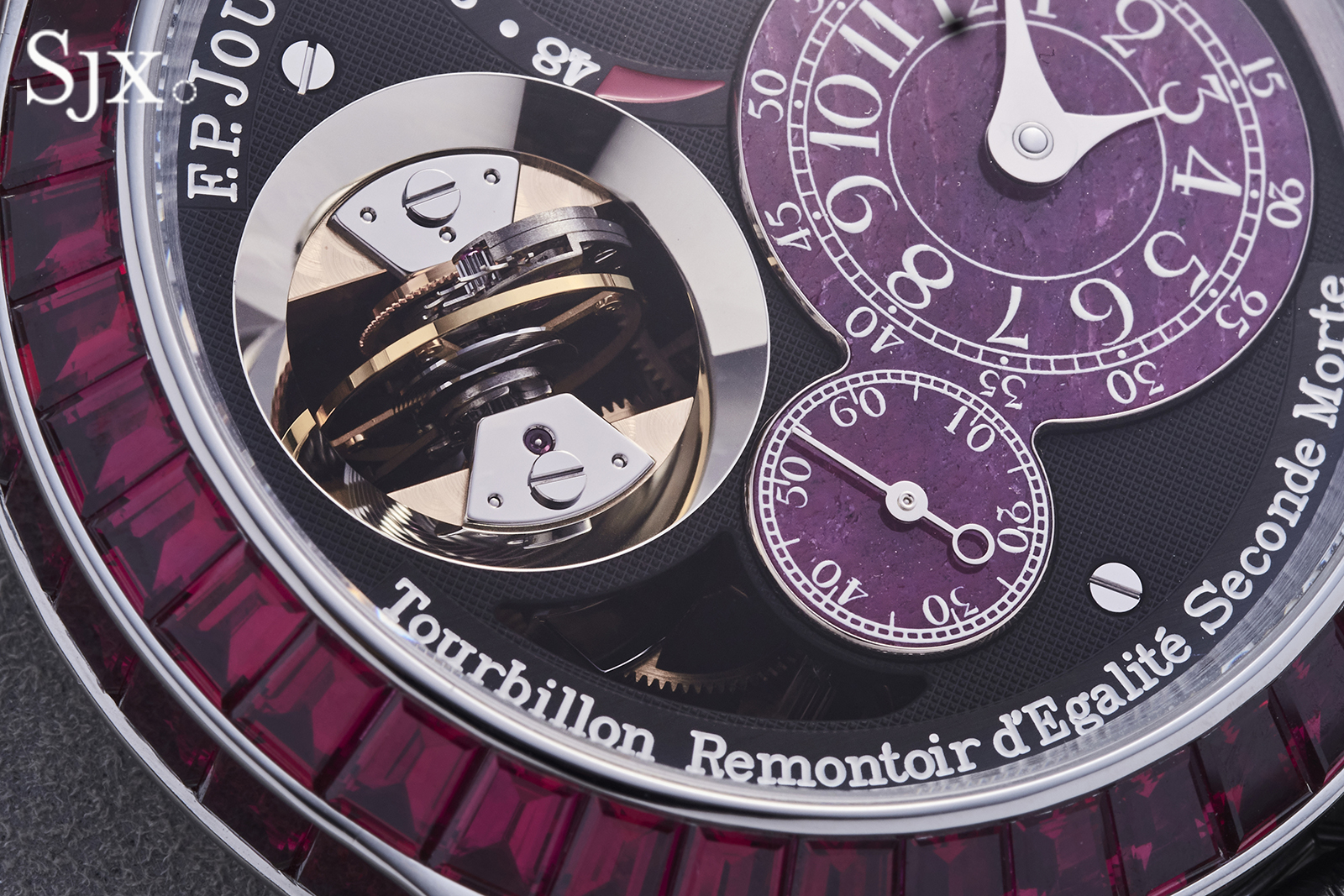
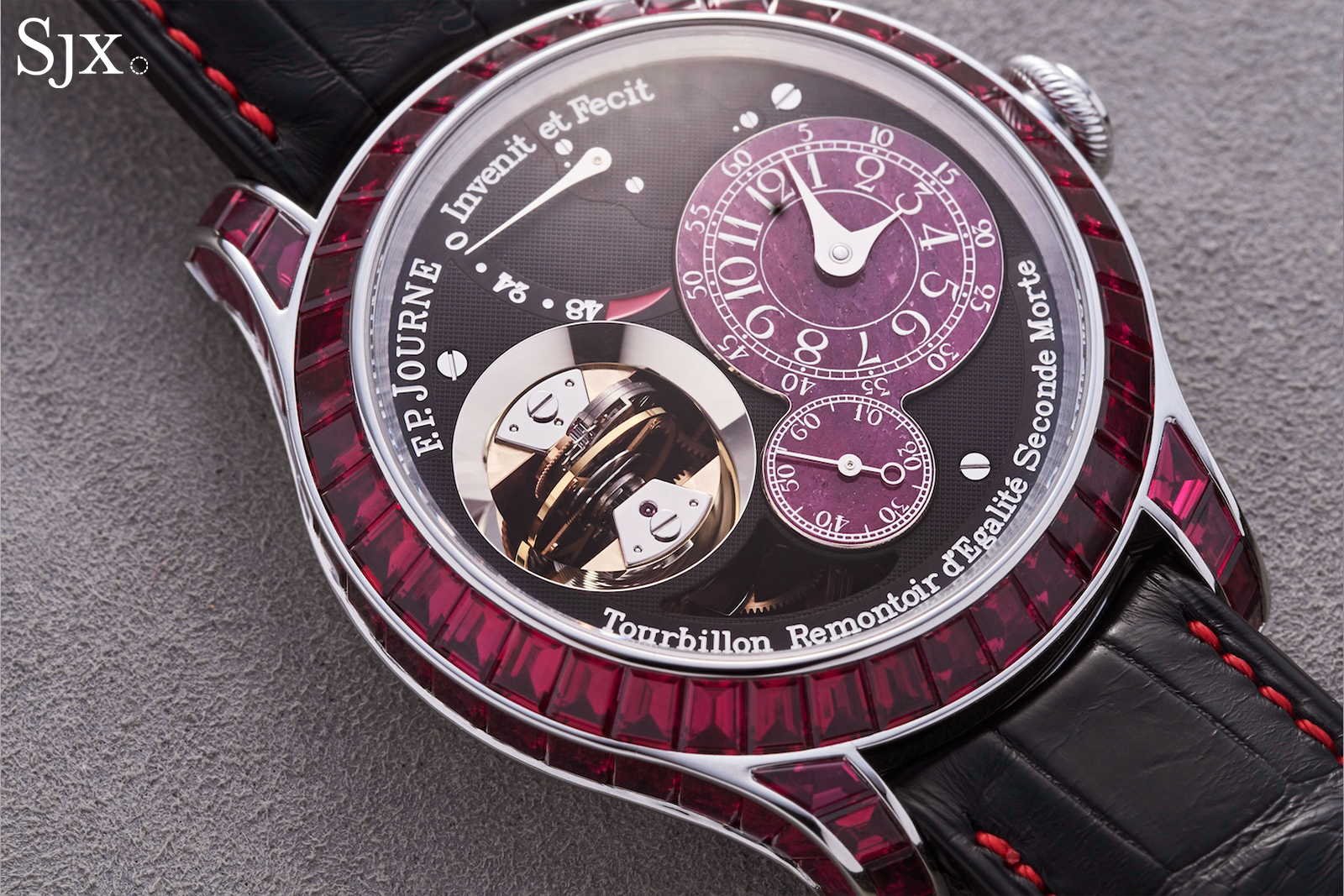
Earlier this year F.P. Journe unveiled its most daring jewellery watch yet, the Tourbillon Souverain Vertical Joaillerie Rubis, set with the largest baguette rubies ever used in watchmaking.
Despite the current popularity of high jewellery watches, the Tourbillon Souverain Vertical Joaillerie (TVJ) Rubis is an audacious undertaking that required eight years to accumulate the right gemstones – and the destruction of 61 carats of gem-quality rubies to make this single watch.
Initial thoughts
Haute joaillerie watches of this sort are not new; the 1980s and 1990s saw significant demand for gem-set complicated watches, especially in Asia. But Over the last decade such watches have shifted from niche offerings to an important (and resilient) pillar of the business for many brands.
Coloured stones are seeing marked interest too, as a sort of trend within a trend, as exemplified by Rolex’s “Rainbow” Daytona, one of the brand’s hottest models. Patek Philippe’s 2022 launch of the gem-set Grandmaster Chime trio can also be seen as a milestone for the genre, with one of Geneva’s flagship fine watchmaking brands adorning its flagship watch with diamonds, emeralds and sapphires.
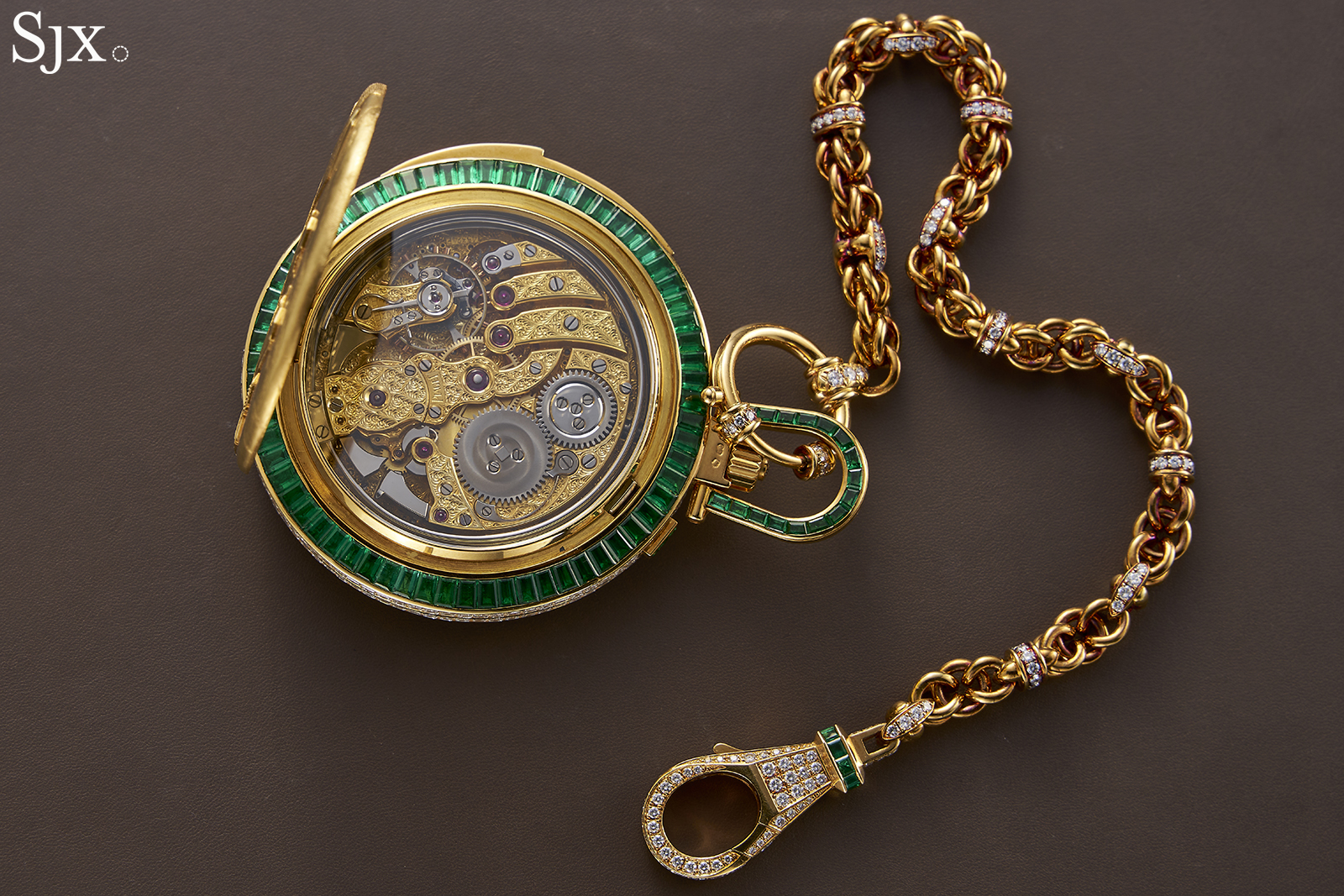
A unique Piaguet minute repeating pocket watch that’s a fine example of 1990s gem-setting high horology
But with the TVJ, it’s clear that F.P. Journe is not simply following industry trends – this watch is eight years in the making and belongs to a two-decade tradition of high jewellery tourbillons from Montres Journe.
The no-half-measures approach to this watch required cutting and re-cutting 86 carats of high-grade rubies down to just 25 carats. The production of a watch like this would be a significant financial outlay for any brand, but especially so for an independent. The price has not been disclosed publicly, but F.P. Journe appears confident this watch is worth more than the sum of its parts, and I cannot disagree.
High carat
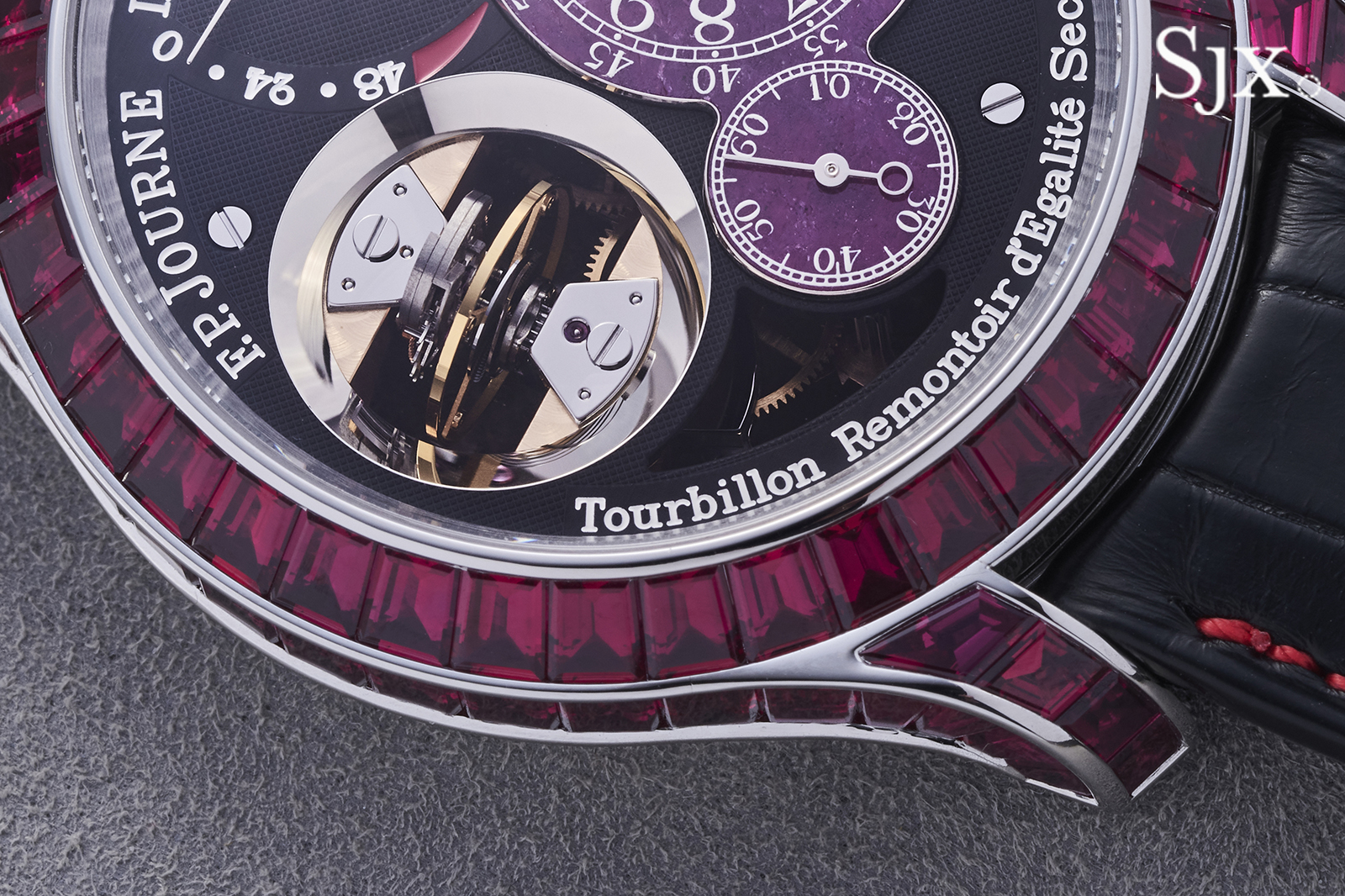
The TVJ, based on the Tourbillon Vertical, is a follow-up to the TJ launched in 2005 that was based on the Tourbillon Nouveau (TN). Both the TVJ and TJ are endowed with the same number of stones, however, the gems are much larger and longer to fit the larger TVJ case, which is 4 mm taller and wider than the TJ. As a result, while the TJ was set with about 13 carats of diamonds, the TVJ boasts some 22.5 carats.
This is not the first TVJ set with gemstones; the distinction goes to the TVJ Diamants, which is in the catalogue. Ruby is about 1.14 times denser than diamond, which might be why the TVJ Rubis has a slightly higher weight at 25 carats than the TVJ Diamants, even though the stones on both appear to be the same shape and size.
Generally, gemstones used in watchmaking are not particularly expensive as they are usually very, very small. Tiny “melee” diamonds used in watches, often under 0.02 carats, are commodity stones sold in bulk and cost very little.
That couldn’t be further from the case here, with an average carat weight of 0.242 per stone when set with diamonds, and 0.269 for this ruby variant, which is enormous by watch industry standards.
For comparison, Patek Philippe’s fully diamond-set Grandmaster chime is set with 30.16 carats of baguette diamonds, which works out to an average of 0.077 carats per stone. For a more down-to-earth comparison, the average weight of the 222 brilliant-cut diamonds on the brand’s own 40 mm Élégante is only 0.007 carats. With that in mind, the diamond TVJ’s retail price is surprisingly reasonable at CHF726,000 before taxes (about US$900,000).
The many facets of gemstone cuts
Natural stones are generally cut to maximise their value by preserving as much of the original rough as possible and removing flaws. In other words, the stone decides how it gets cut. There’s also the consideration of market demand, with some shapes being more liquid than others. The round brilliant cut, for example, maximises the final weight of octahedral diamond rough, and is the most versatile and liquid shape for a diamond.
There is no better example in watchmaking of this approach than the Graff Diamonds Hallucination. During Baselworld 2014, Graff debuted a watch set with 110 carats of fancy coloured diamonds – seemingly cut to maximise the potential value of each individual stone – with a nominal price tag of US$55 million.
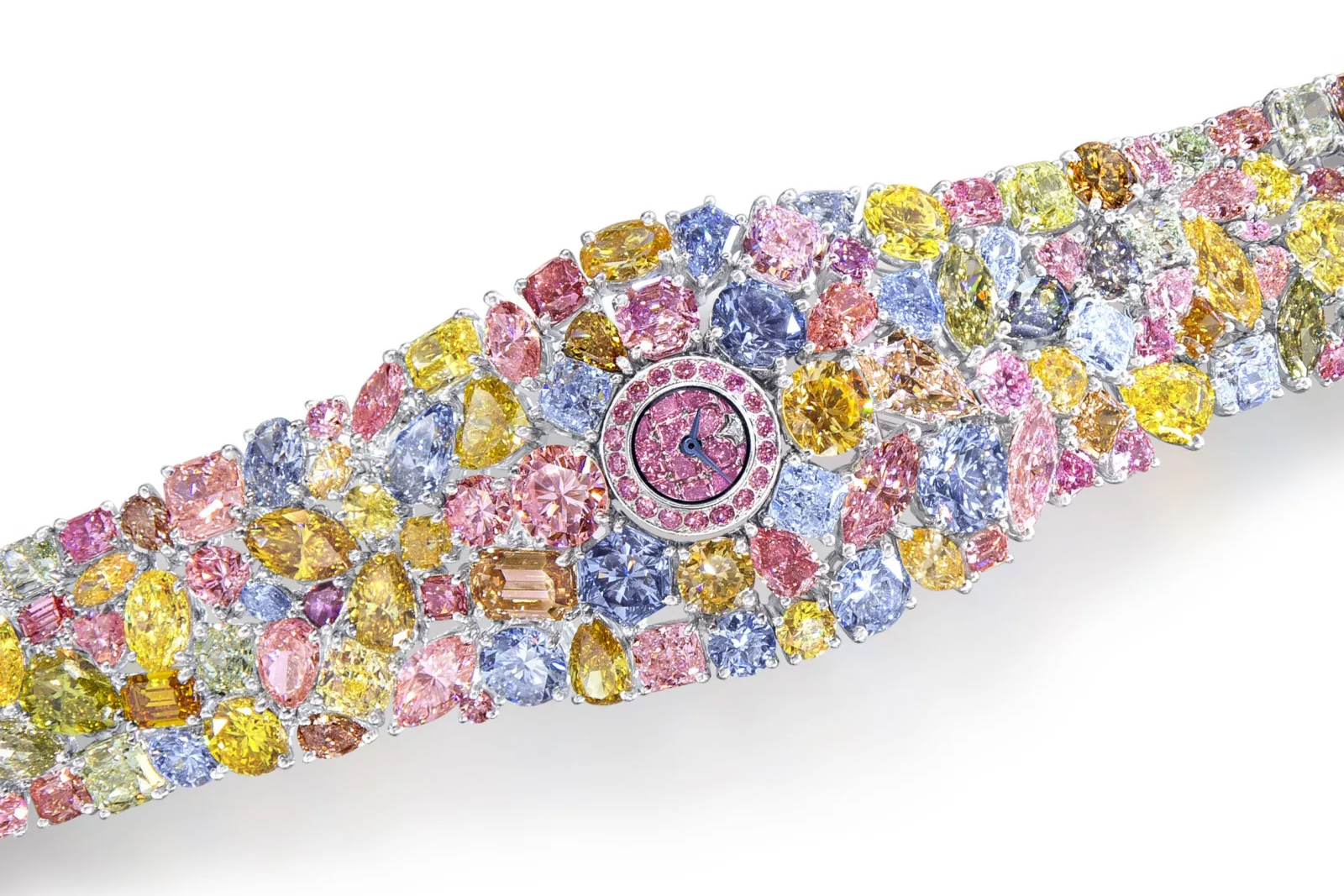
The Graff Hallucination. Image – Graff
The other approach is to ignore what the stone and market want, and cut to your own vision. This is the path F.P. Journe has taken with the TVJ. This meant cutting down 86 carats of generic rubies (gross weight) to 25 carats (net weight) of stones tailored to match the TVJ case. This is likely much greater than the gross weight of stones needed to do the same with white diamonds.
The bezel is channel-set with 40 baguette cut rubies, with another 16 on the lug hoods. The largest stones, however, are among the 37 in the case band. In fact, per F.P. Journe, these are the largest baguette-cut rubies used in watchmaking.
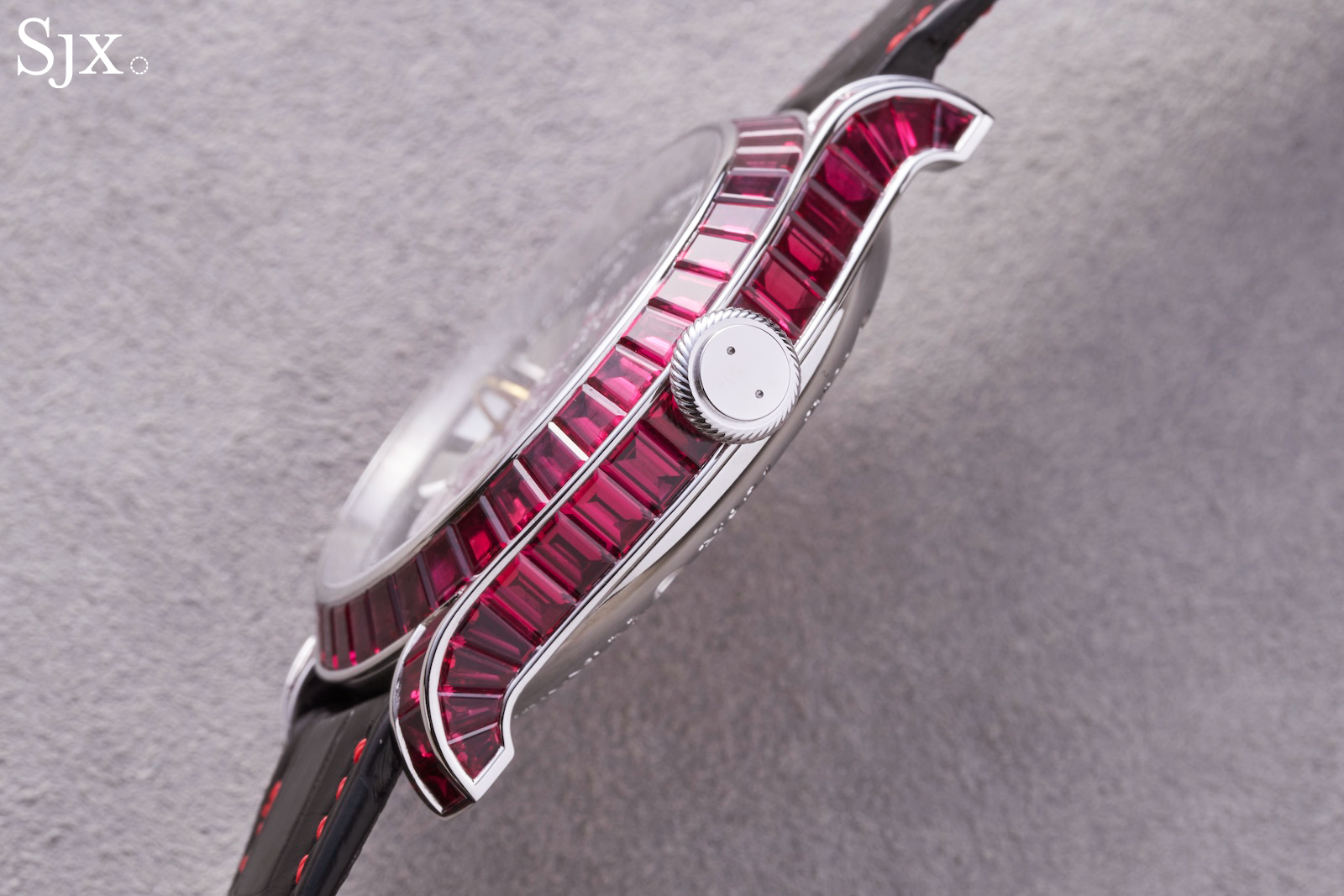
Ruby crystals like to form flat, slightly elongated hexagonal prisms, and as a result gem-quality rubies normally receive an oval or cushion cut. So to pave the case band into appropriately baguettes, F.P. Journe accumulated oval cut rubies of appropriate size over eight years, which were then re-cut to baguettes.
One of the reasons it took so long was that in addition to sourcing stones of the right size and quality, the colour of all 93 stones had to be indistinguishable (at least to the human eye).
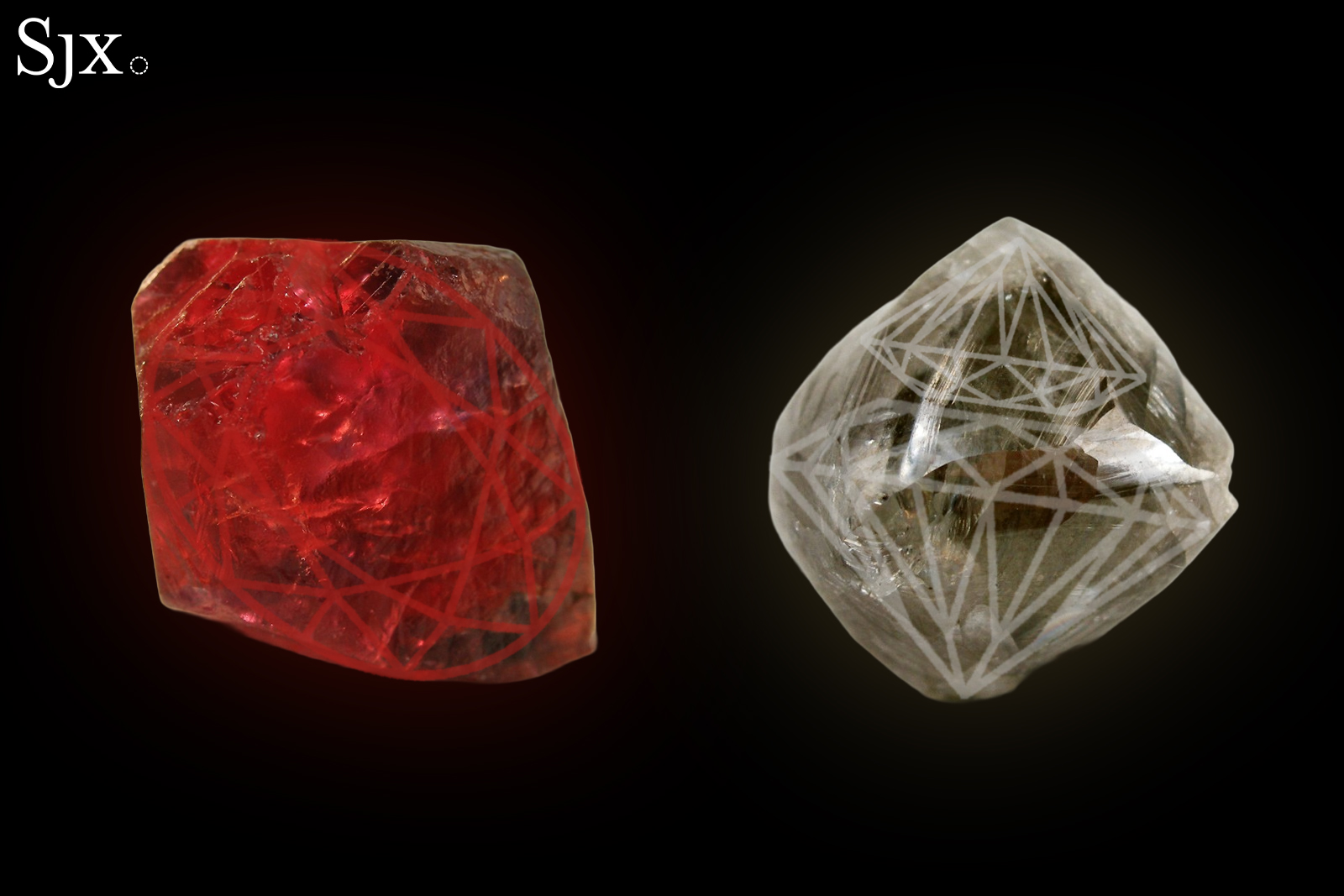
Ruby and diamond rough overlaid with oval and brilliant cuts, respectively. Diamond rough can often produce two stones, one larger than the other size. Images – Robert Lavinsky / iRocks.com, 1, 2 (CC BY-SA), overlay by the author.
Gem setting is difficult and unforgiving, as evidenced by scores of terrible aftermarket attempts. For good results, the cutter and setter must work as a team. It’s even better if the watch’s case is designed to receive stones, like that of the TVJ – which is a full 2 mm wider than the standard TV. Each stone must be cut exactingly, since improperly shaped stones will leave unsightly gaps, or simply won’t fit. And the stakes are high: once material is removed from a stone, it can’t be put back.
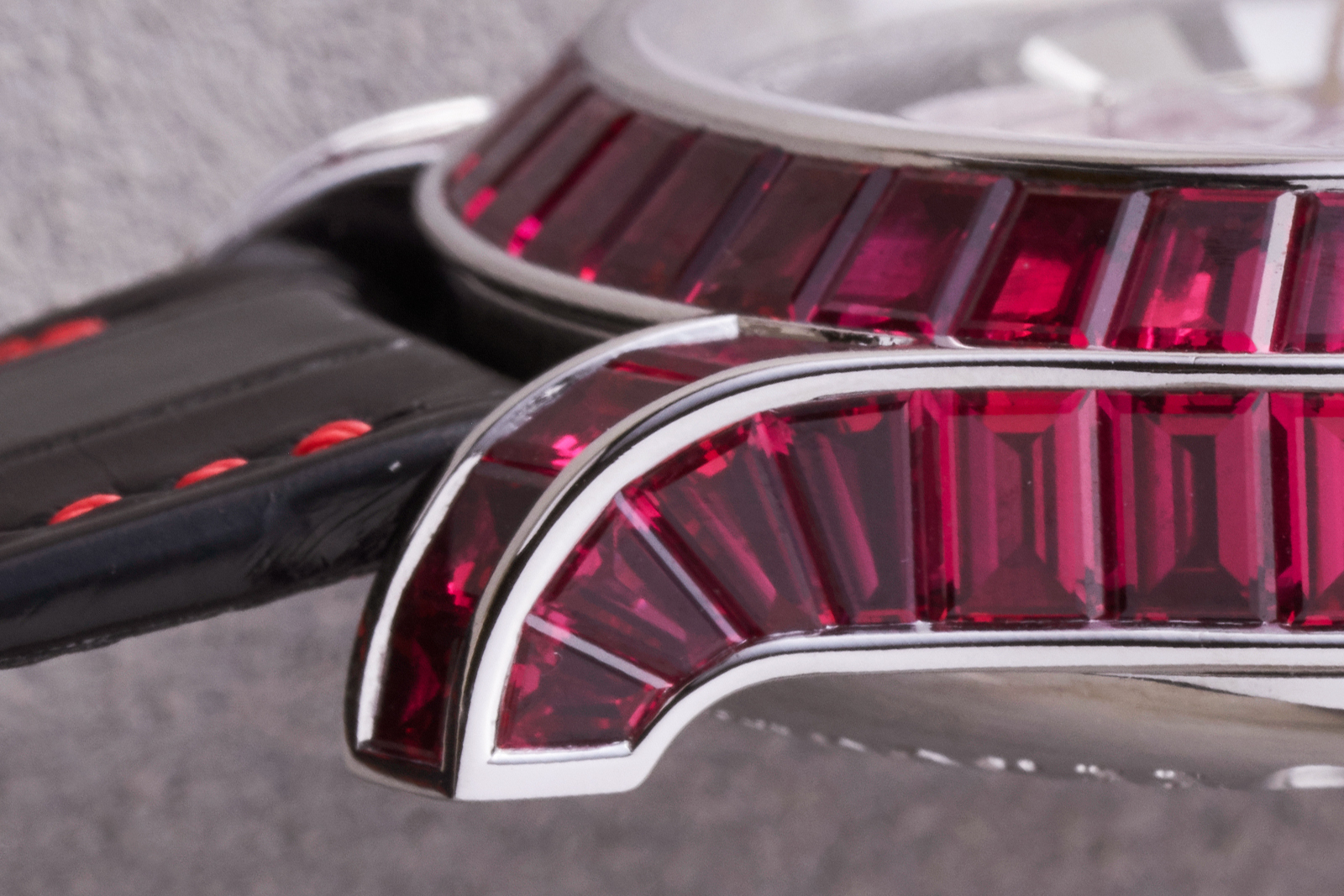
The impressively fanned baguettes that fill the lugs.
A (very) hard stone dial
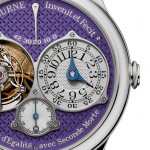
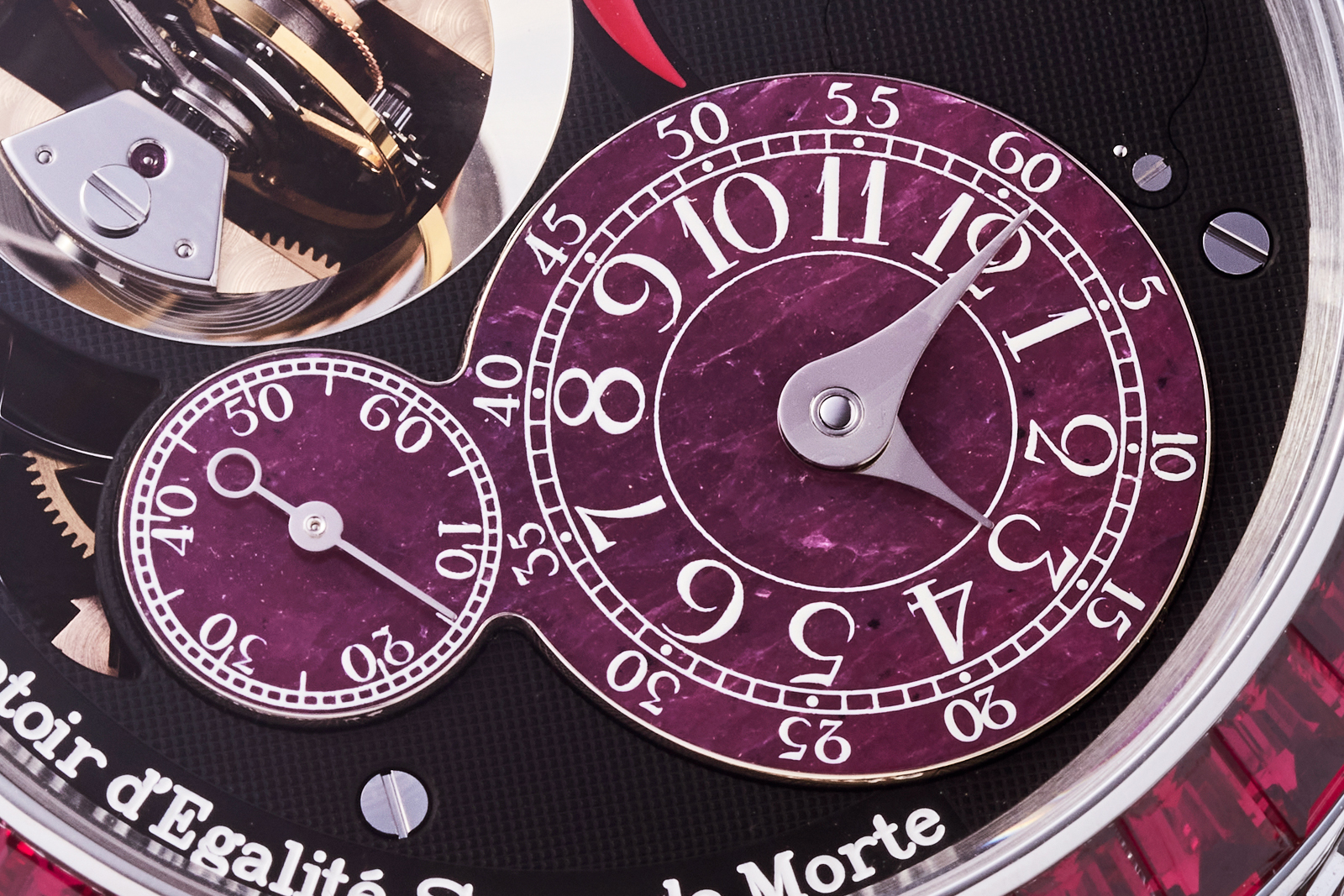
The dial is also ruby, though not gem quality. F.P. Journe – and many other watch brands – refer to it as cœur de rubis, or “ruby heart” in English. The name refers to large growths of red corundum (the “ruby heart”) within zoisite. It is a particularly significant material for F.P. Journe as the brand saw off its most iconic model, the Tourbillon Nouveau, with a final 20-piece run equipped with ruby dials.
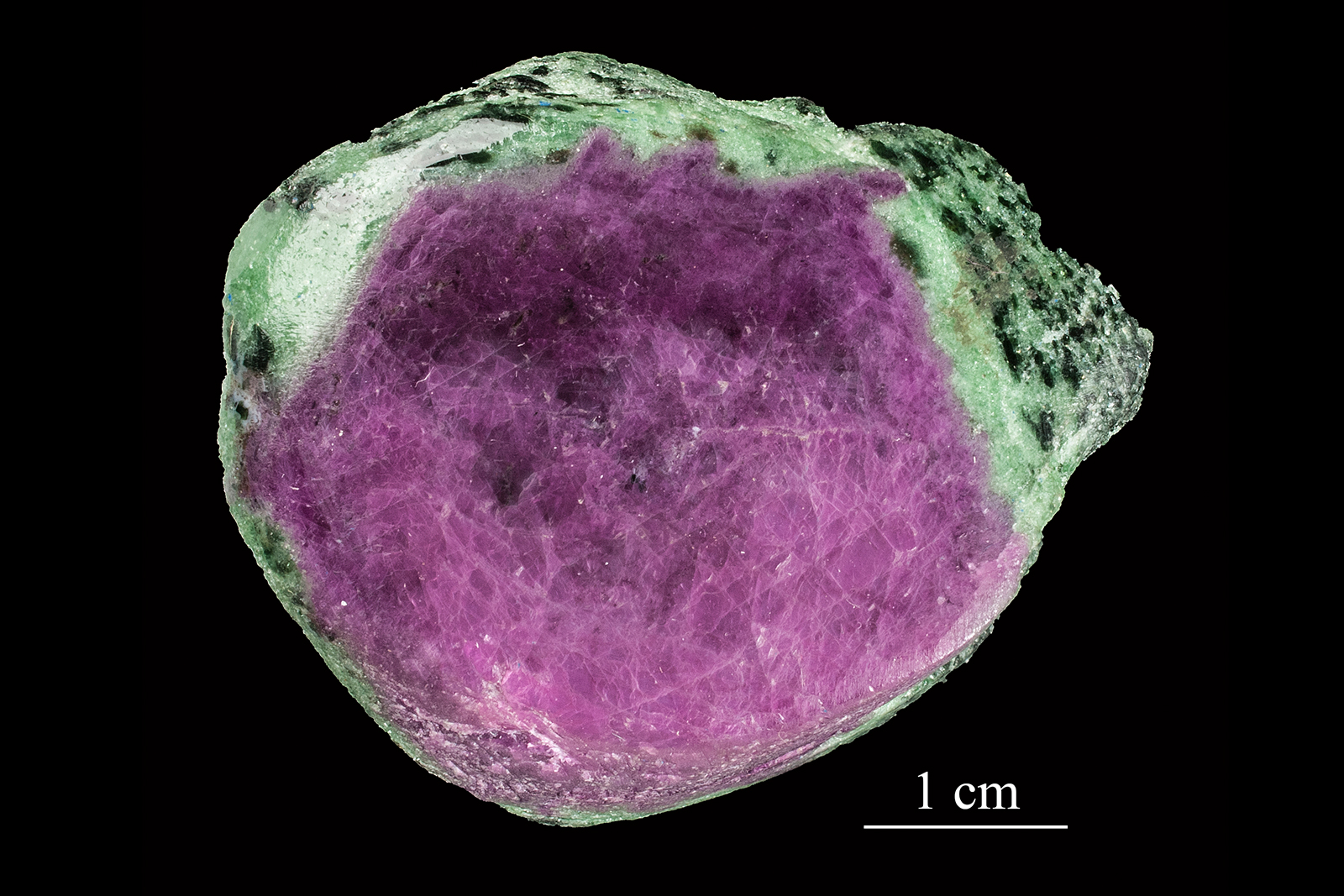
An example of ruby in green zoisite from the Estonian Museum of Natural History’s collection. Image – Saadre Tõnis Saadre (CC BY-SA)
The challenge with ruby dials lies not in the rarity or cost of the material, which is plentiful and not terribly expensive, but rather the difficulty of working with such a hard and brittle stone.
Vertical thinking
Like the Tourbillon Remontoir d’Egalite of 1999 and later Tourbillon Nouveau, the TV employs F.P. Journe’s signature titanium blade-spring constant-force device, which he devised in 1983 at the behest of Swiss collector Eugene Gschwind, who wanted to spite George Daniels. The system also appears in the Chronomètre Optimum and Astronomic Souveraine – two of the brand’s greatest creations.
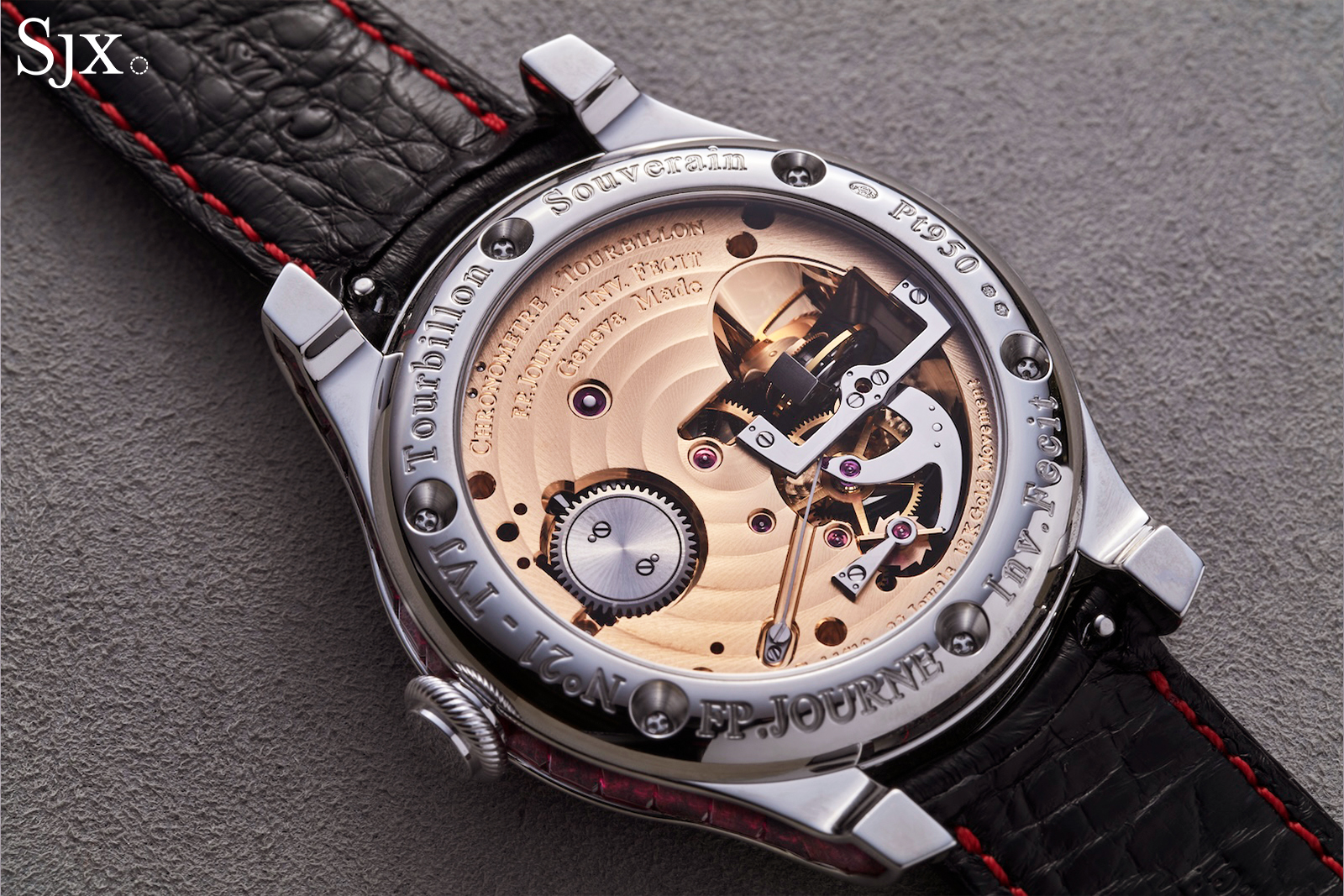
The constant force device also results in “natural” jumping seconds – meaning it doesn’t need an additional mechanism to affect a jumping seconds hand. While aesthetically pleasing, at least to me, the jumping seconds hand also makes it easier to gauge the watch’s accuracy against a reference signal, as the seconds are clearly defined.
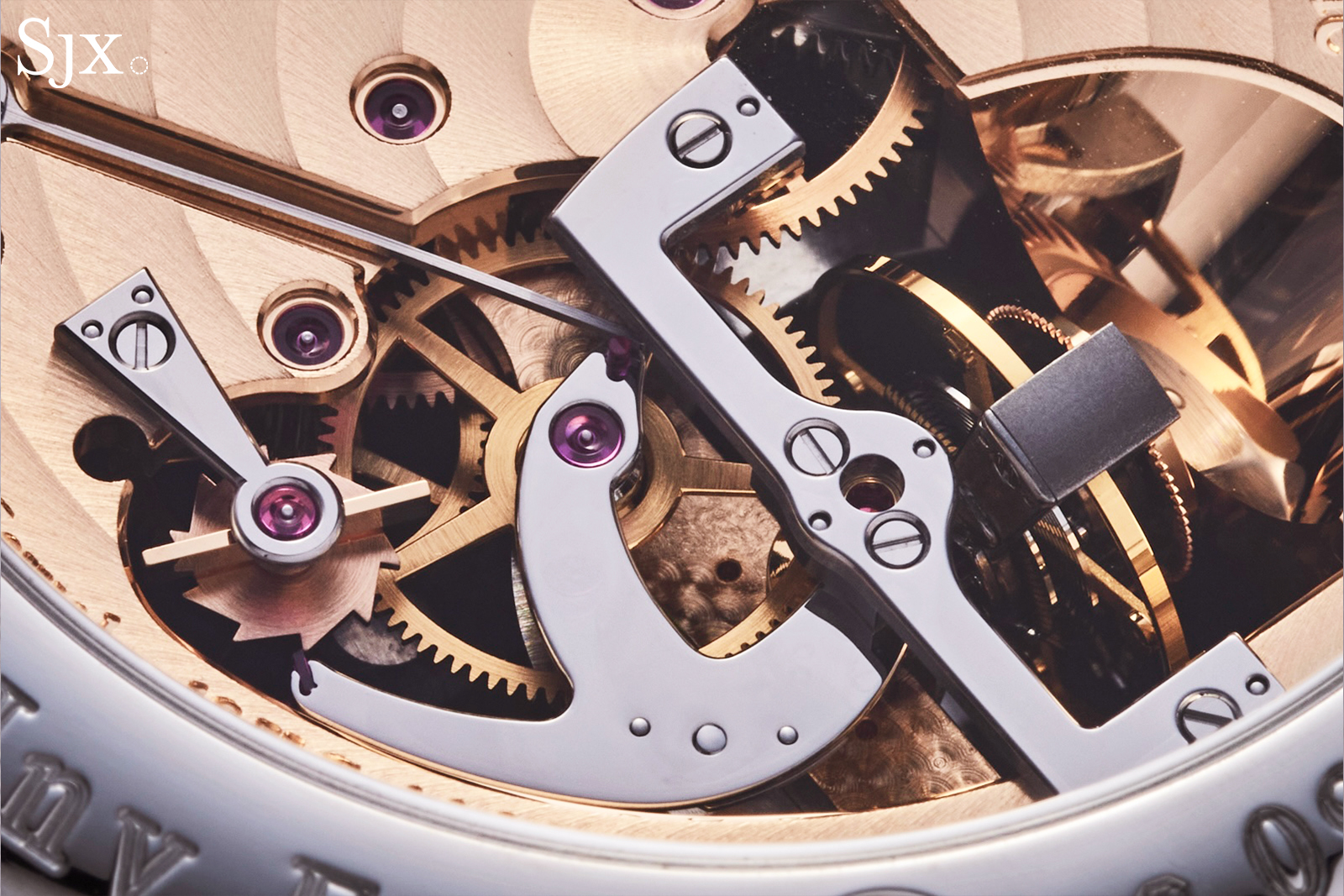
It is important to note that the seconds will only “jump” while the mainspring supplies enough torque to fully charge the constant force device, which is only guaranteed for the first 42 hours.
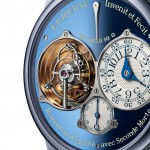
The TV departs from the TN with the 90° oriented tourbillon, using a crown gear (shown below in blue) to bridge the gap. The vertical balance wheel means that the dial up and dial down positions, which are horizontal positions in almost every other watch, are now vertical positions; this reduces the differences between dial up/down and crown up/down positions.
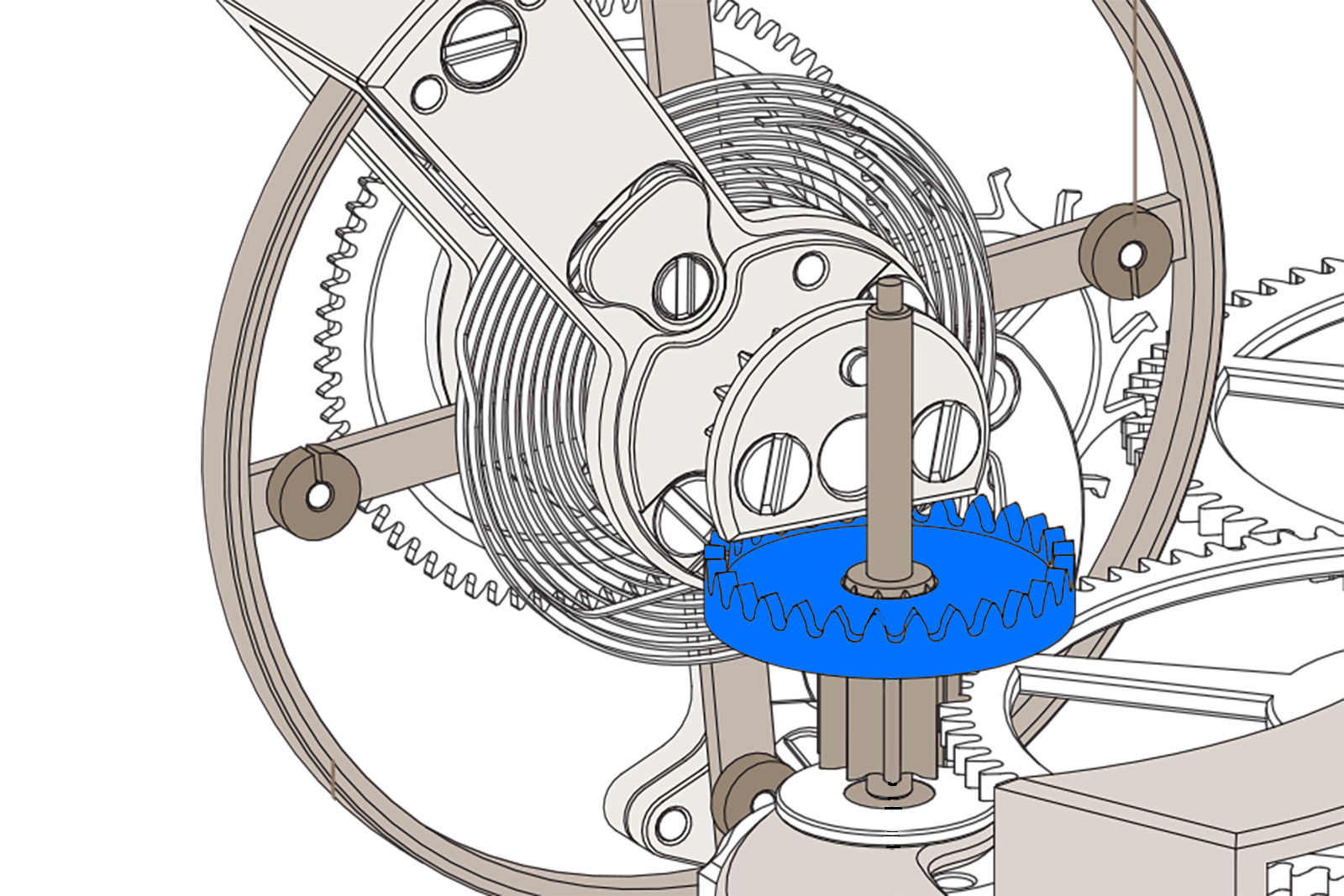
In other words, the vertical orientation helps maximise the utility of the tourbillon, although, ironically, a watch usually performs best in horizontal positions. It’s in this orientation that the balance pivot is sitting on the cap jewel, which has the lowest friction and usually results in the greatest balance amplitude.
Key facts and price
F.P. Journe Tourbillon Souverain Joaillerie Rubis
Ref. TVJ
Diameter: 44 mm
Height: 13.76 mm
Material: Platinum
Crystal: Sapphire
Water resistance: 30 m
Movement: Cal. 1519
Functions: Hours, minutes, natural jumping seconds, power reserve, one second constant force device, tourbillon.
Winding: Manual
Frequency: 21,600 beats per hour (3 Hz)
Power reserve: 80 hours total, 42 hours chronometric.
Strap: Crocodile with folding clasp set with 18 baguette-cut rubies of unspecified weight
Limited edition: Yes, unique piece
Availability: At F.P. Journe boutiques
Price: Upon application
For more information, visit Fpjourne.com.
Back to top.