Voutilainen Appoints Angélique Singele CEO

With the aim of long-term independence.

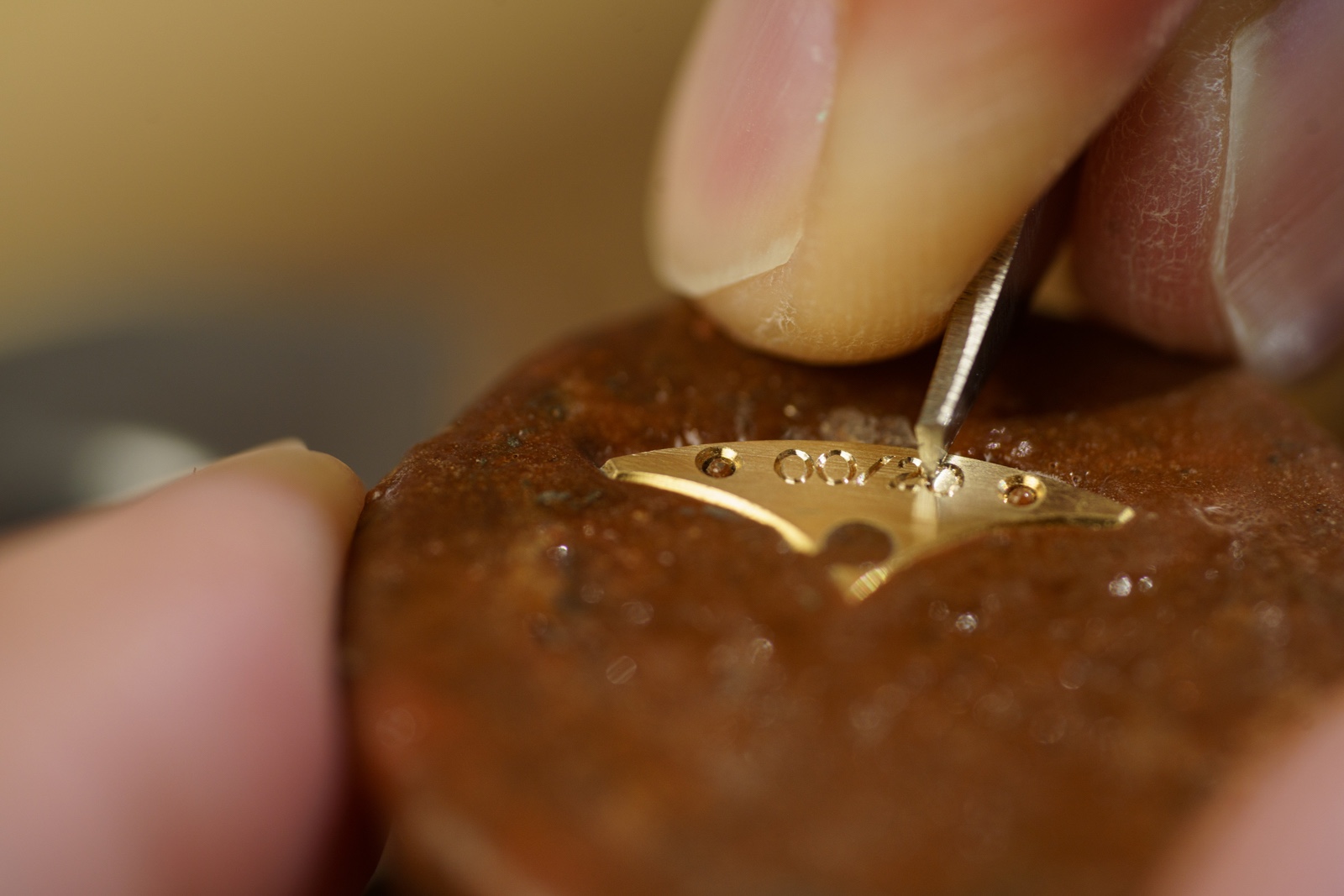
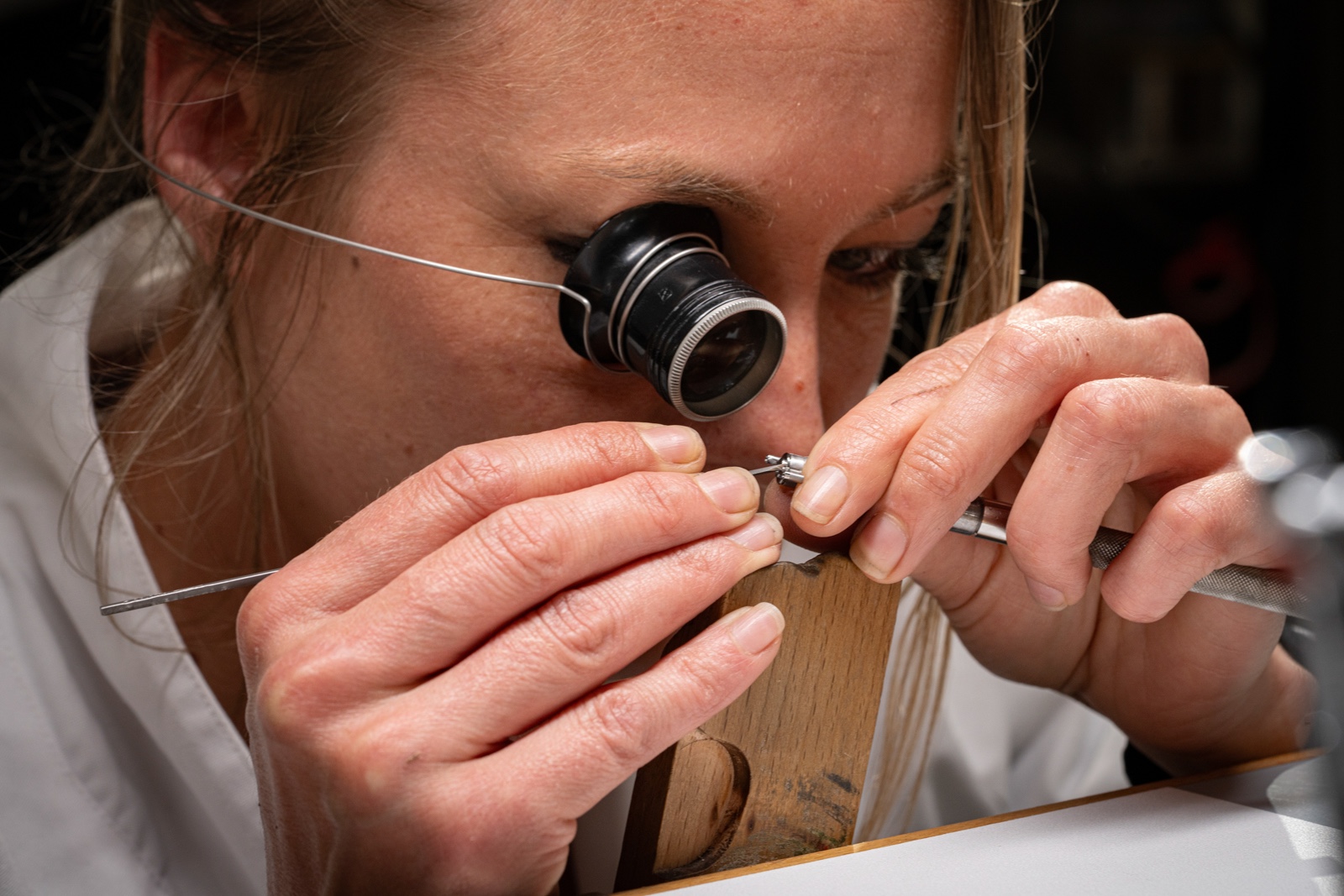
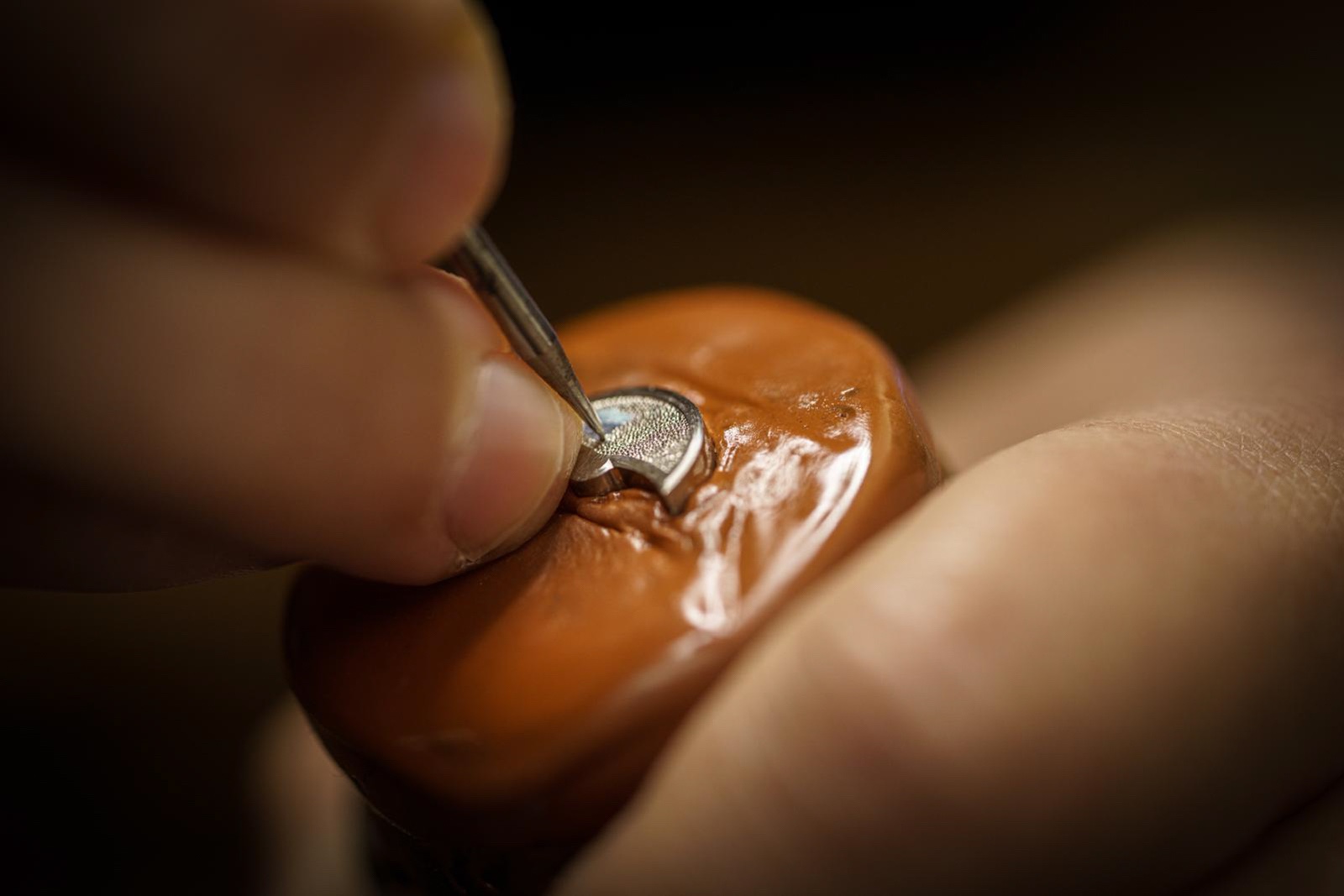
A significant transition is underway at Voutilainen as Angélique Singele is appointed chief executive officer of the brand, marking an important step in its long-term succession planning. The announcement follows Dubai Watch Week, where Kari Voutilainen discussed the future of founder-led independent watchmaking and his desire to keep the enterprise — spanning Voutilainen, Comblémine, Brodbeck Guillochage, and Voutilainen & Cattin — firmly independent.

With Ms Singele taking over day-to-day leadership, Mr Voutilainen plans to refocus on creation, unique pieces, and client relationships, signalling a new chapter for one of the most influential names in contemporary independent horology. In conversations, Mr Voutilainen sometimes expresses frustrations at his long days filled with administrative and management matters, which leave him less time to deal with the watchmaking he is most passionate about.

Initial thoughts

The timing of Ms Singele’s appointment makes a lot of sense coming shortly after Dubai Watch Week, where Mr Voutilainen was a panelist, alongside Maximilian Büsser, on the topic of succession for founder-led independent watch brands. During the discussion Mr Voutilainen revealed that this is something he’s thought about since the beginning.

“I was already thinking, almost at the beginning of my career, that there are only three ways [it might end]: stop the business, sell the business, or have the family continue it.” The appointment of Ms Singele is revealing about which path Mr Voutilainen prefers, especially since his children are still relatively young.

“At the beginning, I had a big conversation [with myself about what] I want to do and how to do it, and I thought that it would be best to remain independent” explained Mr Voutilainen. “So at least I have the power of the decision; that was the first thing.”

Mr Voutilainen went on to explain that his children are likely to take on big roles in the company in the future, including his daughter, Venla, a watchmaker who’s currently in charge of after-sales at Urban Jürgensen, and his son, who is currently studying at a technical university.

The Voutilainen enterprise, which includes not just his own workshop but also Brodbeck Guillochage, dial maker Comblémine and case maker Voutilainen & Cattin, now employs 80 people. Furthermore, Mr Voutilainen also serves as co-chief of Urban Jürgensen alongside Alex Rosenfield.

With the support of Ms Singele as the Voutilainen workshop’s new chief executive, Mr Voutilainen hopes to be able to pivot away from some of the management work to focus on developing new products, engaging with clients, and working on unique pieces.

About Angélique Singele

Ms Singele is a credentialed manager who joined Voutilainen as a logistician in 2020. Barely a year later, she was promoted to the role of chief operating officer, a role that she’s held until now. With the acquisition of Brodbeck Guillochage last year, Ms Singele was also appointed as a director of that business.

Prior to joining Voutilainen, Ms Singele gained experience first as a watchmaker at Rolex before learning the ins and outs of movement development at LTM and Zenith. She later transitioned to the logistics side of the industry with stints at Comblémine and ETA.

Ms Singele brings a watchmaker’s perspective to the chief executive role, and should help unlock the next chapter for the Voutilainen workshop.


Correction December 4, 2025: Mr Voutilainen has two children, and not three as stated in an earlier version of the article.

Back to top.

You may also enjoy these.

Ensemble Debut: The Cavasino Inaugural Tourbillon FT60-S

Industrial engineering meets traditional craft.

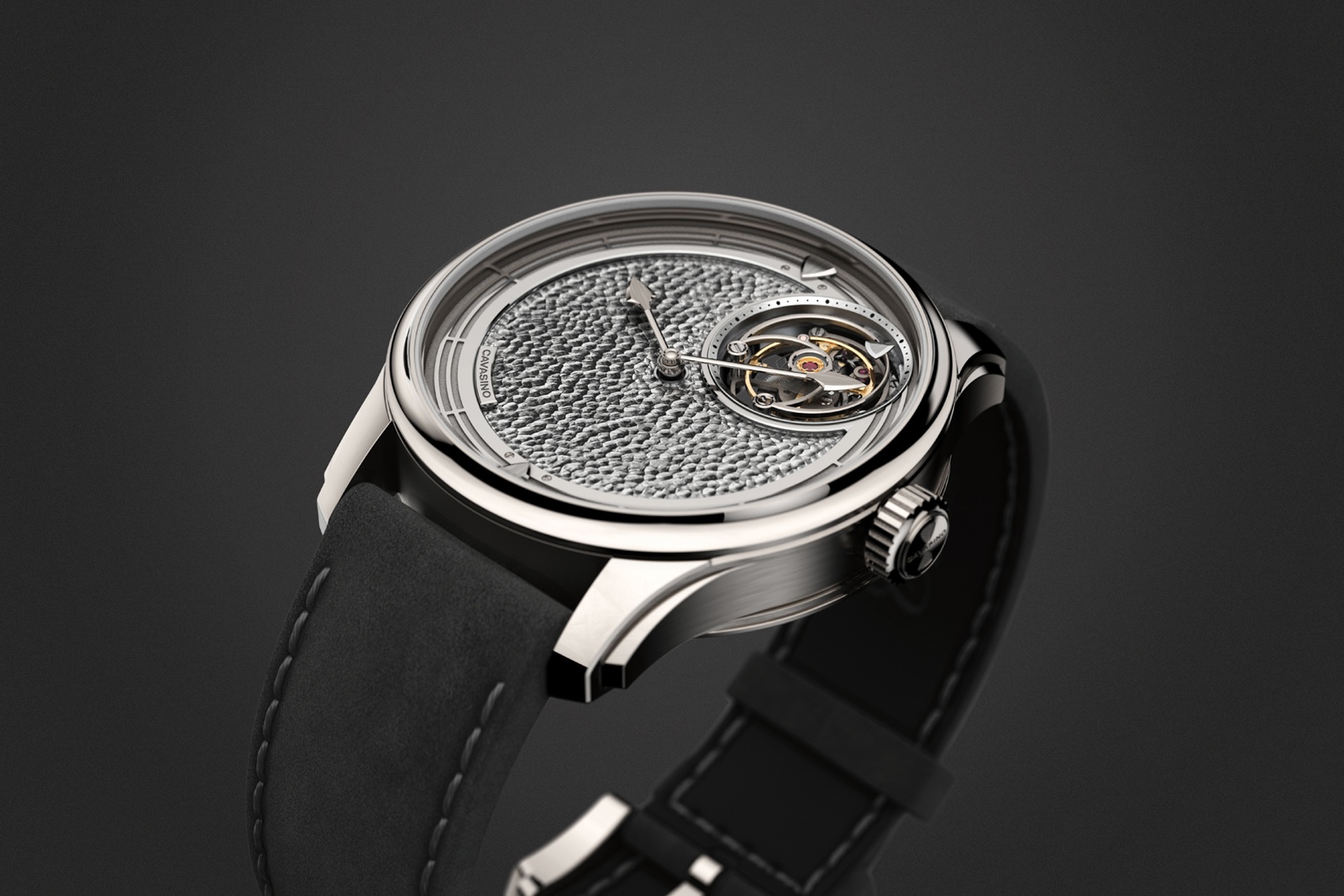
Cavasino makes its debut with the Inaugural Tourbillon FT60, a compact flying-tourbillon wristwatch that reflects the industrial engineering background of its founder, Didier Cavasino. Before establishing his eponymous brand, Mr Cavasino spent more than a decade at Rolex working on the industrialisation of new projects, followed by a leadership role at Bulgari focused on process optimisation.

That experience informs both the FT60’s ensemble execution and supports the brand’s vision, which emphasises modern manufacturing methods and traditional haute horlogerie craftsmanship in equal measure.

Initial thoughts

Cavasino is a new brand making its debut with a deceptively intricate flying tourbillon. An engineer by training with dual degrees from École Nationale Supérieure d’Arts et Métiers (ENSAM) and Karlsruhe Institute of Technology (KIT), founder Didier Cavasino entered the watchmaking industry through industrial engineering roles, including more than a decade at Rolex working on the industrialisation of new projects.

From there, he moved on to Bulgari where he led a team of 20 people focused primarily on process optimisation and continuous improvement.

This background contrasts with the bench training that is more typical among up-and-coming independent watchmakers, but it’s this industrial orientation that makes Mr Cavasino’s plan to produce and deliver 15-20 pieces per year seem quite feasible.

While it’s unreasonable to expect to fully derive a new brand’s design language from its debut product, I have high hopes for what will emerge in the future. Several small details have been handled with aplomb, even the somewhat trivial details like the logo are thoughtful and interesting.

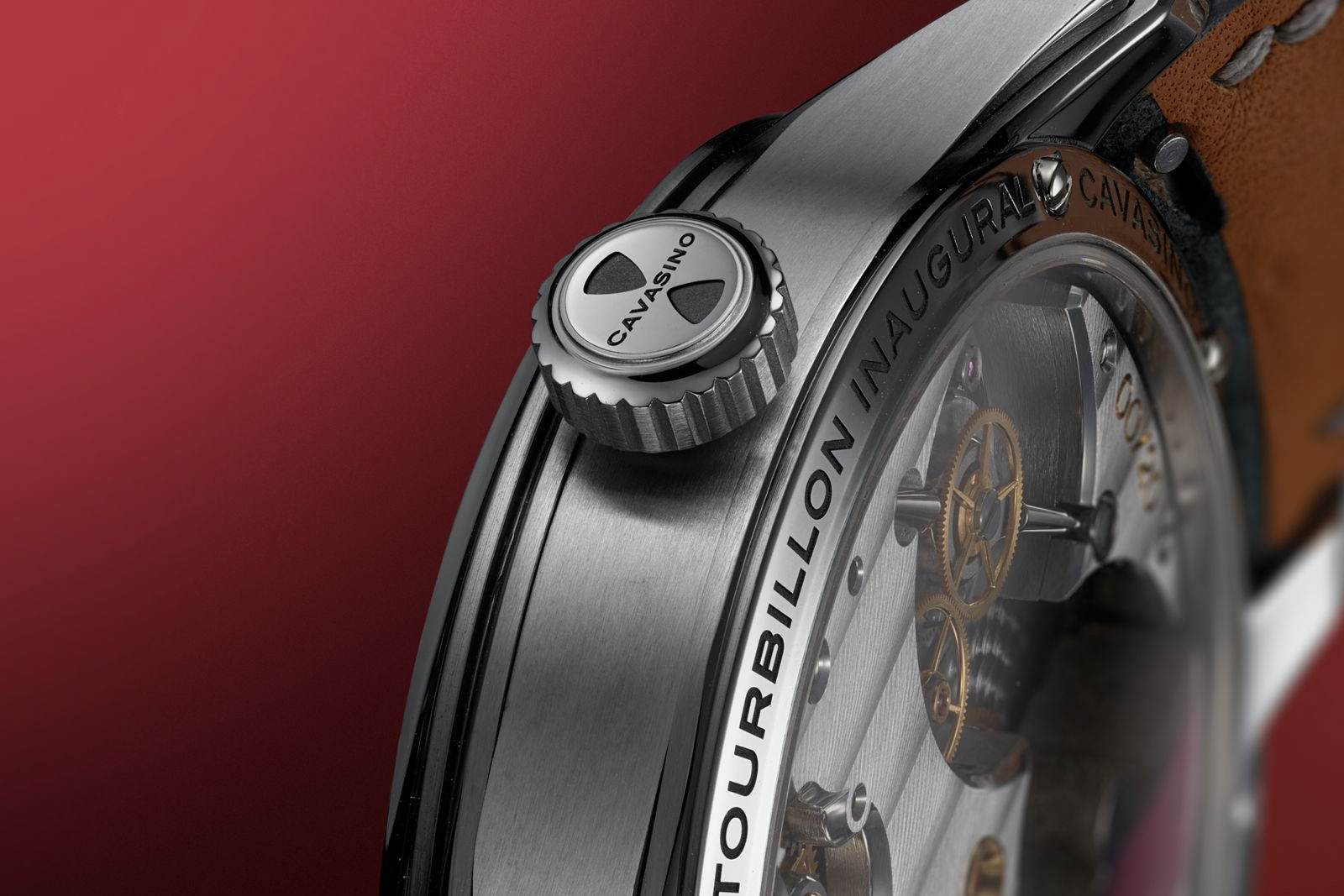
The design takes inspiration from the Cavasino family’s former business making precision scales decades ago. The triangular logo is based on the wedge-shaped display of these scales, and, conveniently, takes the form of an hour glass when mirrored above and below the brand’s wordmark. It’s a simple motif repeated throughout the watch.

If there’s one thing I’d change about the design of the FT60 it would be the dial. Though finely executed and actually quite distinctive up close, at arm’s length the texture is too much like that of many other recent entrants in the space. That said, I look forward to seeing what else Cavasino has in store for the future.

There’s always a degree of risk taking when backing a new venture, but therein lies much of the appeal of independent watchmaking: the opportunity to become a patron and support creators directly. Fortunately for early adopters, the FT60 is priced reasonably by the standards of contemporary watchmaking. The 20-piece souscription series in titanium, which is now sold out, was priced at just CHF77,000.

Thirty more DCR-01 calibres will be produced, priced between CHF88,500 for steel and CHF95,000 for platinum or rose gold cases. At a time when many simple time-only movements tip into the six-figure range, the flying tourbillon-equipped FT60 is priced reasonably given its thoughtful execution and tangible quality.

An ensemble cast

Mr Cavasino is not a watchmaker in the strict sense, so he has contracted out engineering, fabrication, and finishing to suppliers. In this regard, his operation is somewhat analogous to that of Simon Brette, or MB&F in its early days. But Mr Cavasino is an industry insider and he has managed to put together a strong supporting cast of 24 collaborators from across Switzerland for his debut effort.

This approach might explain the relative ambition of this FT60. Many new independent watchmakers start with what they know, by finishing off-the-shelf time-only movements like the ETA Unitas 6497/6498 or Peseux 7001. Without this tether to tradition, Mr Cavasino opted to make his debut with a high-beat flying tourbillon engineered by a specialist in La Chaux de Fonds founded by a pair of well-known constructors.

Overall, the suppliers and artisans working on the FT60 have supplied some of the biggest names in the industry including Patek Philippe, MB&F, Ferdinand Berthoud, Audemars Piguet, Ludovic Ballouard, Simon Brette, Kari Voutilainen, and Vianney Halter.

It’s tempting to look at an outfit like this and conclude that the founder simply pulled up a list of suppliers and called around to order components, but this simplistic perspective obscures the fact that Mr Cavasino has known most of these collaborators for many years, and they’ve supported one another on various projects in the past. Thus it’s quite natural that Mr Cavasino would call upon his friends to help execute his personal vision for the FT60 as well as for subsequent releases (the next launch is slated for 2027).

Thoughtful symmetry

While the FT60 features a pleasing degree of asymmetry on the dial side, the movement layout could hardly be more symmetrical. Attention to symmetry in movement layouts can be traced back at least as far as 1867 when Girard-Perregaux introduced what would come to be known as the ‘three gold bridges’ architecture.

More recently, and specifically within the context of independent watchmaking, Akrivia has been an influential force when it comes to symmetrical movement design. As it happens, Akrivia’s bracelet atelier supplies the straps for the FT60.

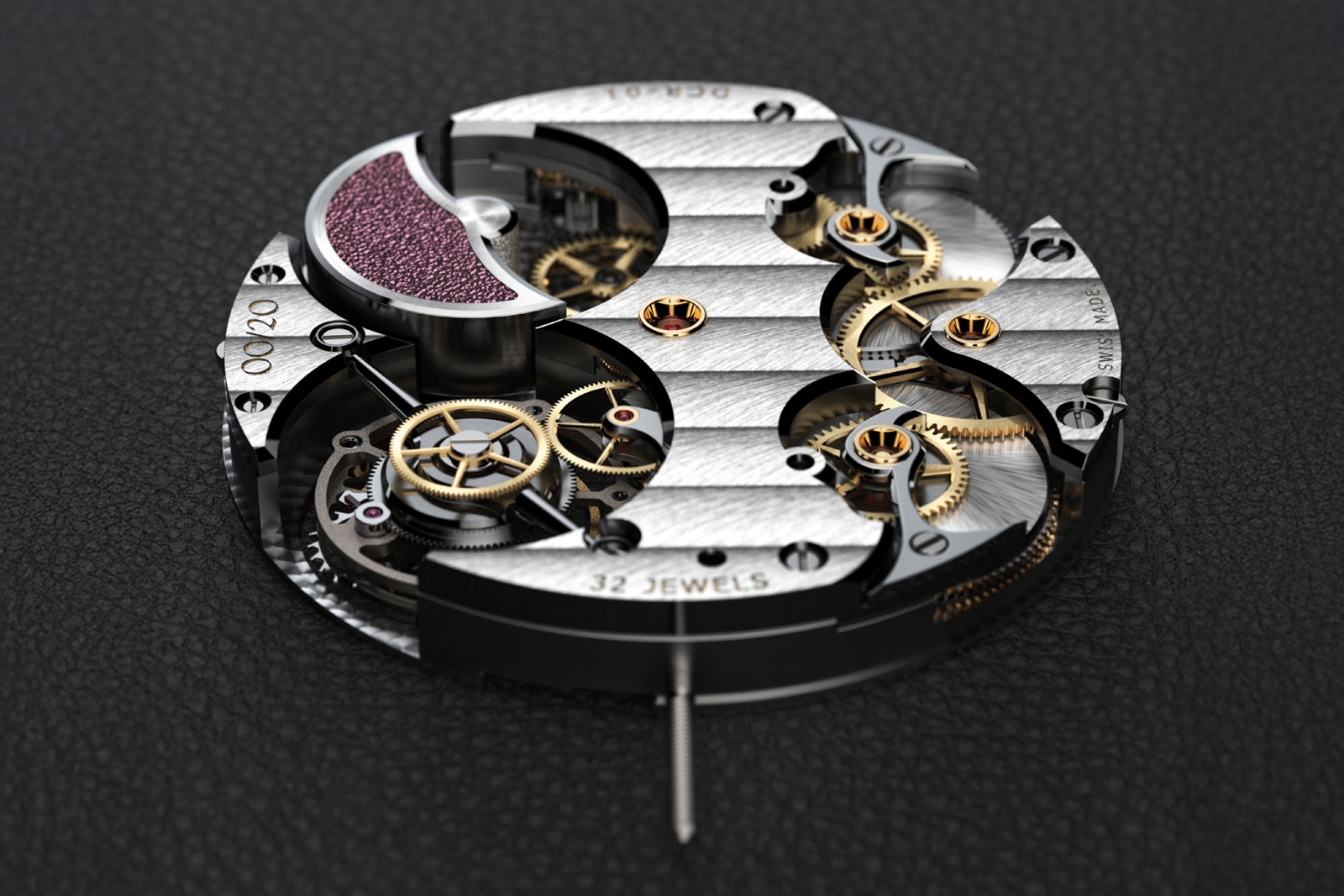
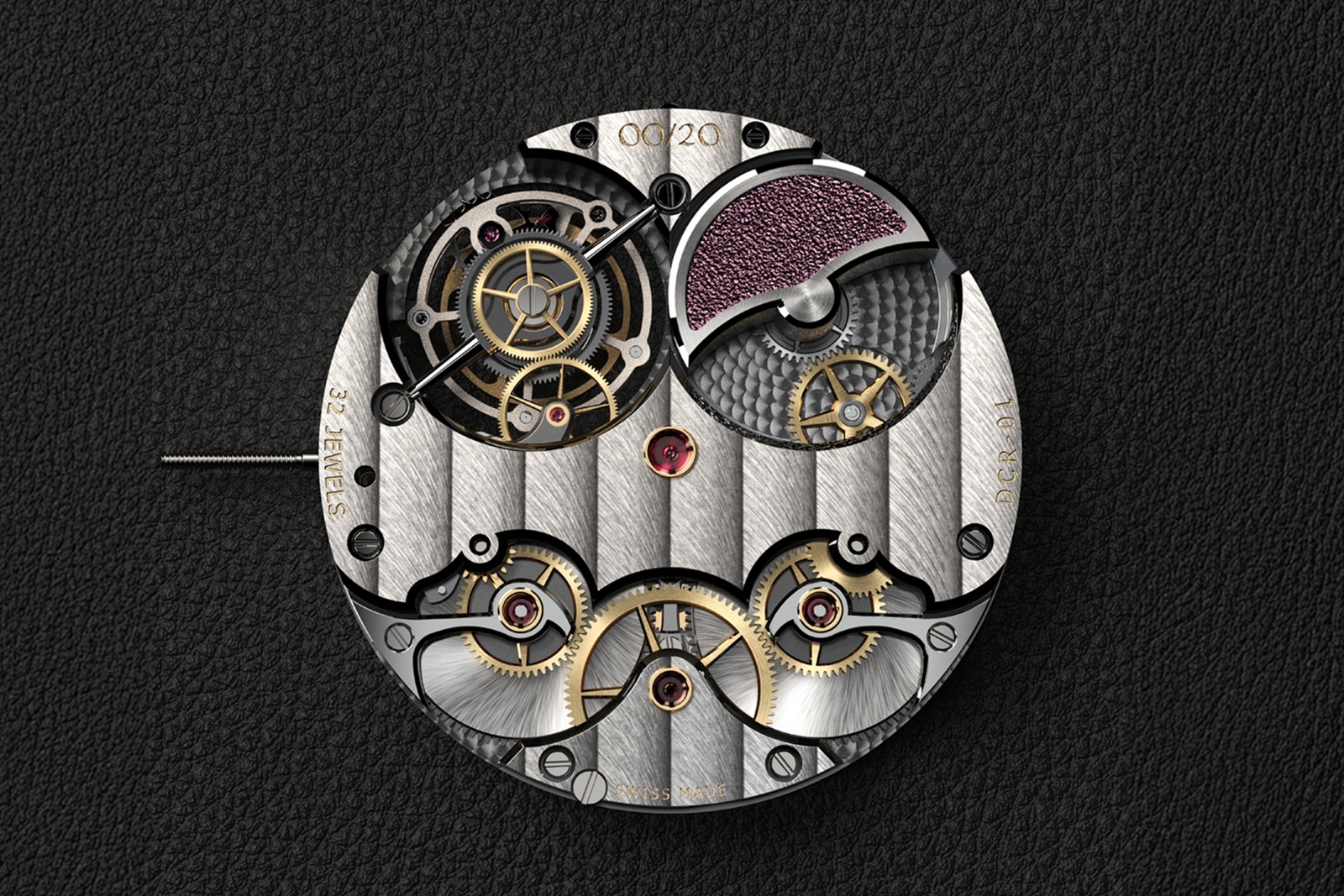
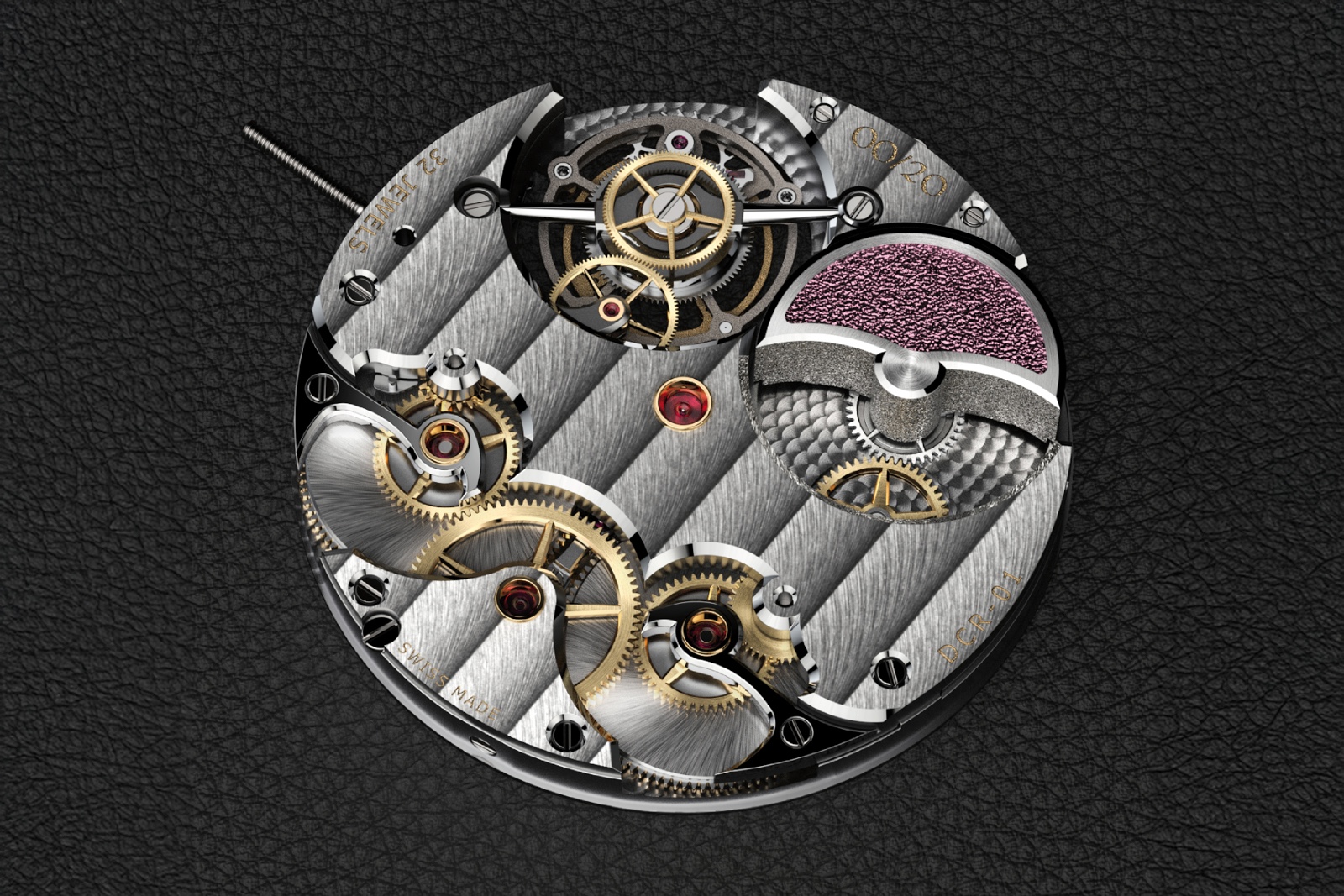
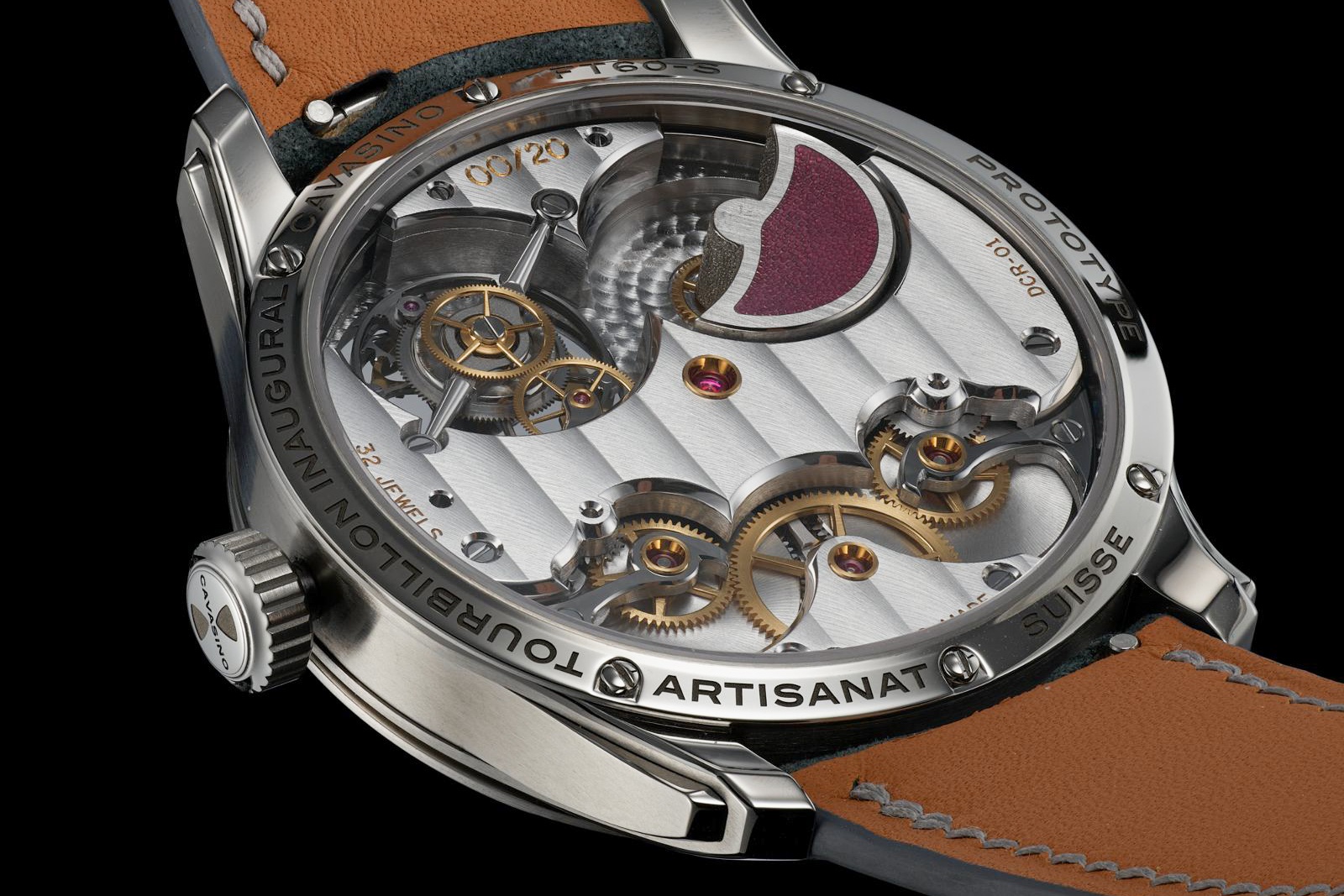
On the back, the DCR-01 movement is dominated by a large batwing-shaped bridge that spans the entire width of the movement. The attention to detail is evident with regard to the spacing of the Geneva stripes, which perfectly dissect the the central jewel for the seconds pinion. On either side, the stripes again line up with the sharp points of the bridge, which follows the curves of the winding wheels.

The pivots for the tourbillon cage, micro-rotor, and each of the mainspring barrels also line up to form a perfect square, a detail that is arguably a bit cute but that speaks to the attention to detail that characterises the movement. In a similar vein, the micro-rotor itself is screwed from underneath to focus attention on the decoration.

A checklist of finishing

Perhaps the only real critique that can be leveled against the finishing of the DCR-01 is the fact that it contains a veritable smorgasbord of techniques, seemingly to check every box that a collector might value. This is not really a problem, since this type of extravagant finishing supports the commercial viability of the endeavour, but it will be something to watch in the future to see which elements will come to define the house style.

In the meantime, the view through the case back affords a good view of generous vertical striping, black-polished steel finger bridges for each of the barrels, a rounded steel bridge for the tourbillon, deep funnel-like gold chatons, tight and tidy perlage on the mainplate, and a micro-rotor embellished with hand-hammered tremblage and flinque enamel. The anglage is also very wide, a style suggestive of Akrivia’s influence on the field.

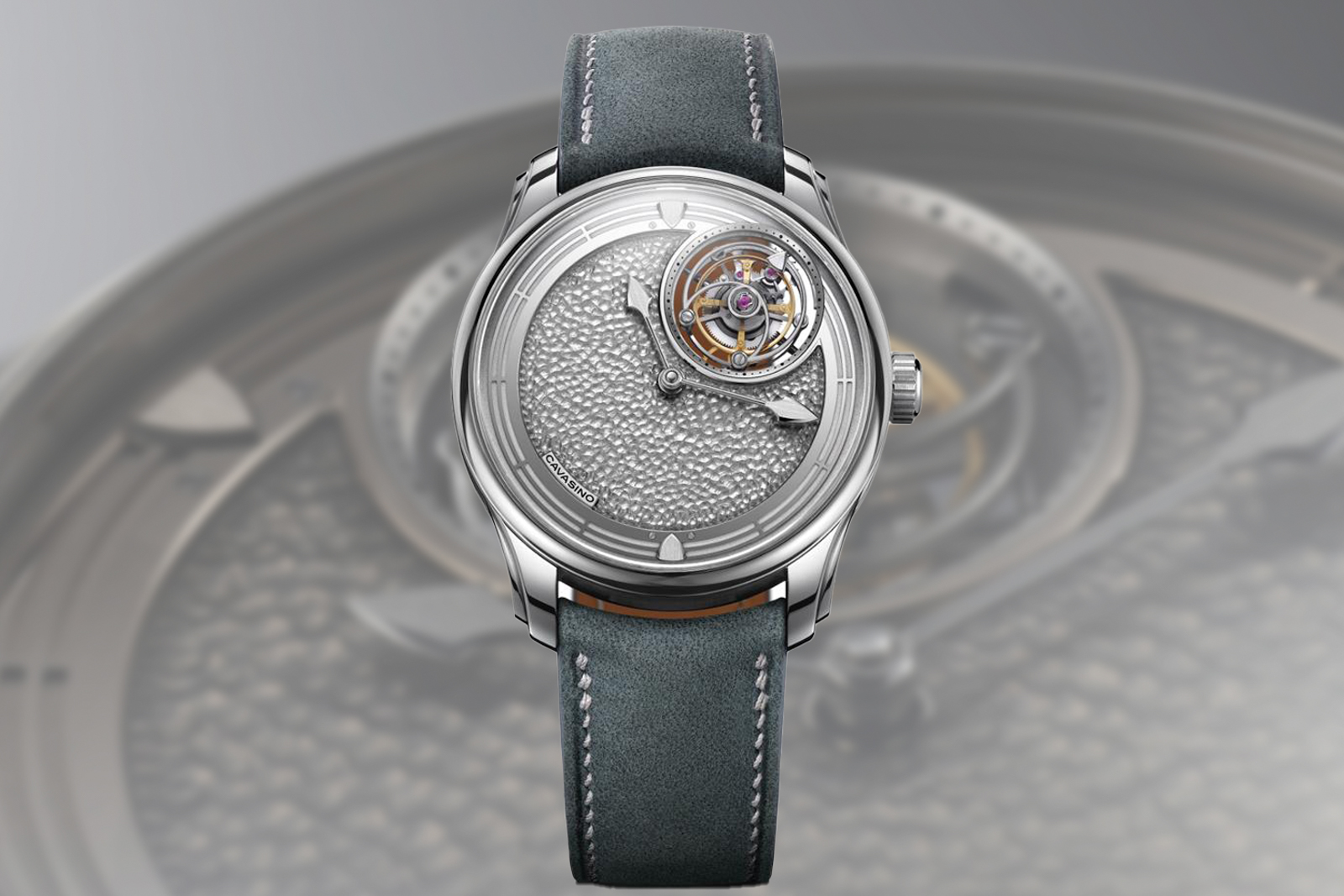
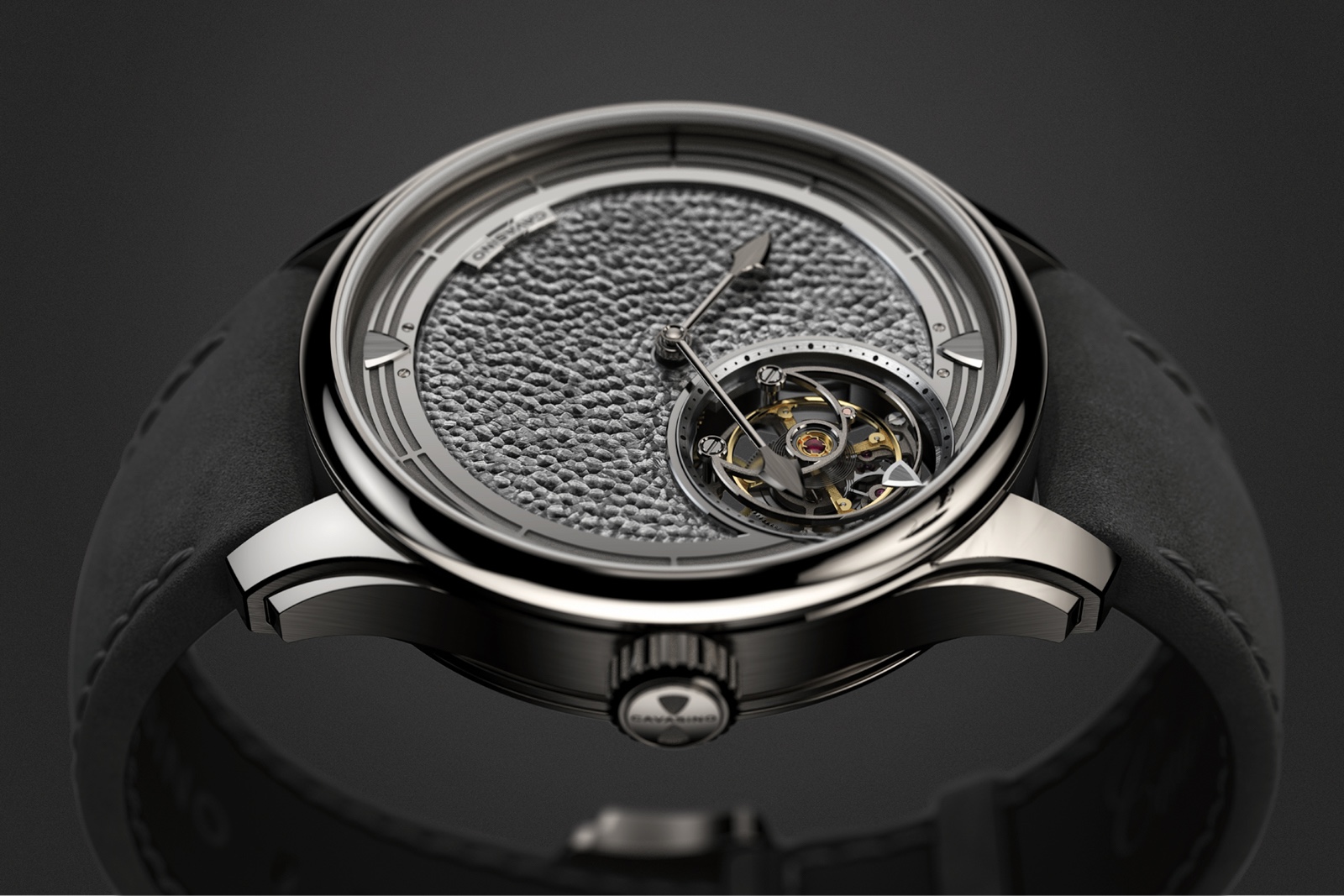
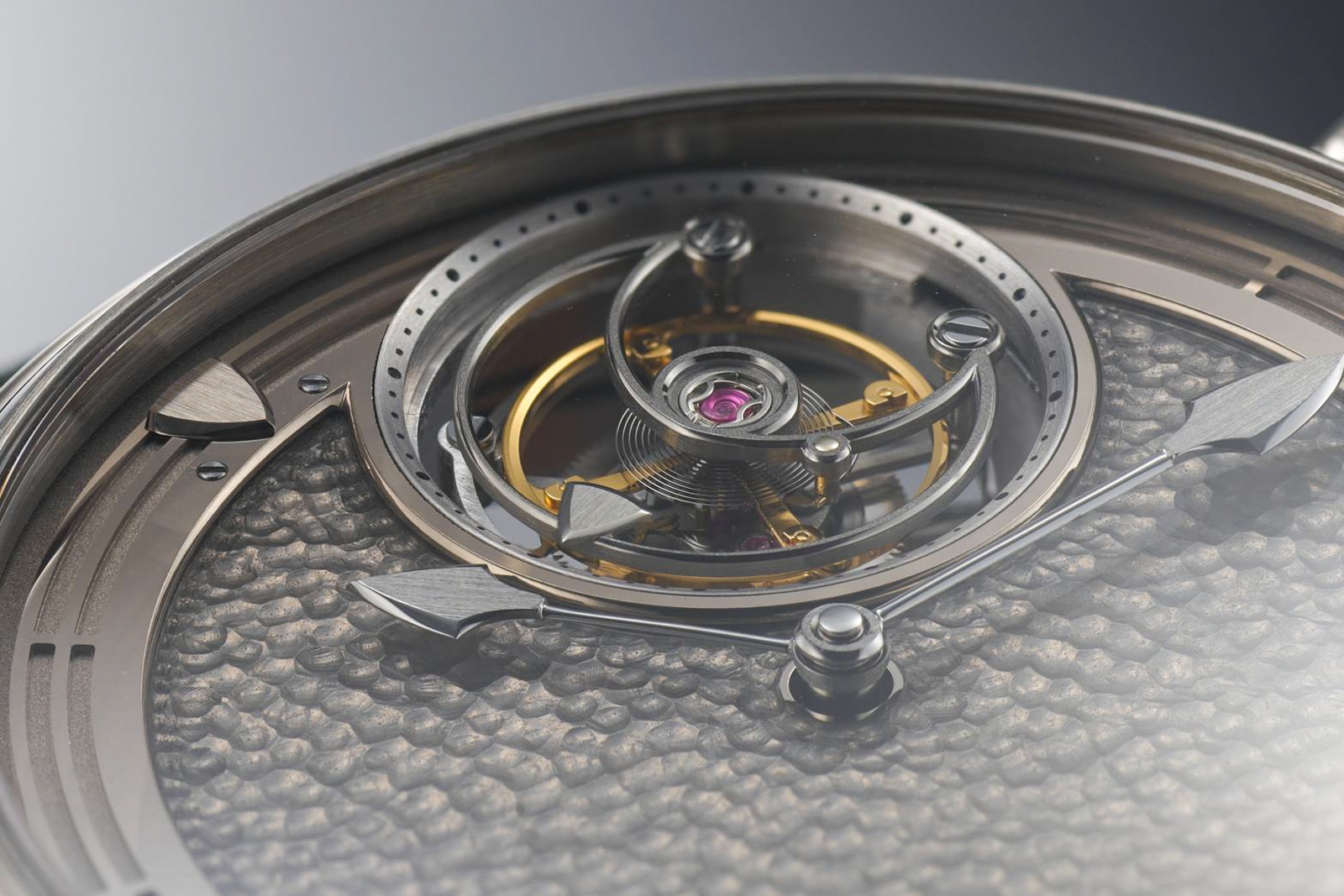
The tour of finishing techniques continues on the dial side, most notably on the flying tourbillon cage, which features the brand’s logo as a running seconds pointer. Tourbillons are no longer as special as they once were, as a growing list of suppliers has sprung up to supply them in all shapes, sizes, and price points. But the Cavasino tourbillon cage manages to stand out from the crowd thanks to it design, construction, and finishing.

For one thing, the cage itself is specific to Cavasino. Even as modern manufacturing methods make it easier than ever to customise the cage shape, this factor is often neglected, and a trained eye can quickly detect the work of suppliers like Olivier Mory, Concepto, and MHC. In this context, the Cavasino tourbillon cage distinguishes the movement and is as noteworthy for its refined and airy design as for its numerous hand-finished inward angles.

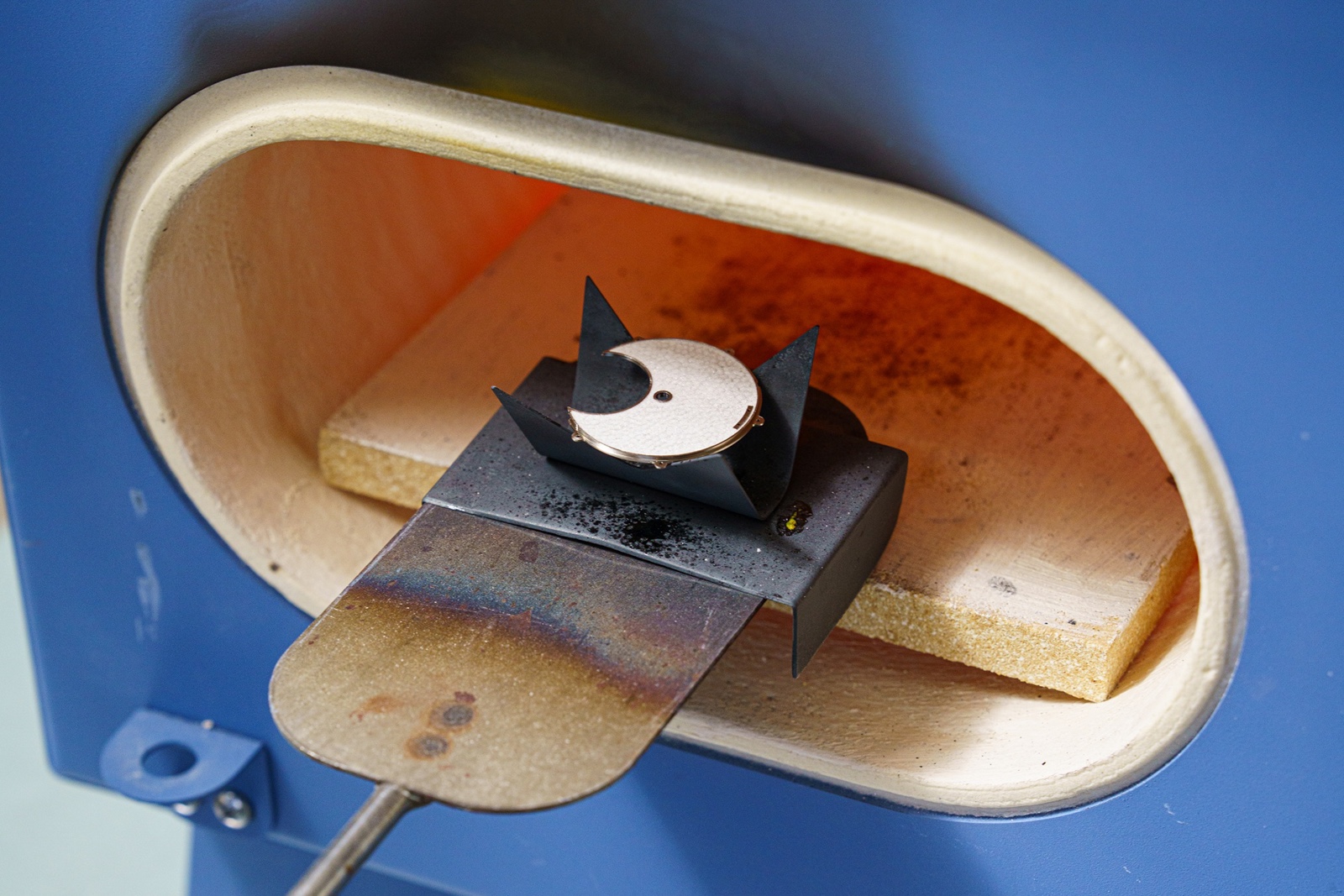
The solid 18k white gold dial, naturally, holds its own when it comes to laborious craftsmanship. What at first appears to be a hammered finish akin to tremblage is actually applied manually with a powered rotary tool that is pressed into the dial at an angle. This textured surface is then painted with clear enamel and oven-fired, a technique known as flinque enamel.

The dial itself is framed by a massive black-polished ring of solid 18k white gold that serves as the chapter ring, with open-worked sections to mark the passing hours and minutes. Though conceptually simple, the dial furniture comes alive in shifting light and features the brand’s logo at the top and bottom. While the centre dial is produced by a small team of artisans in Sainte Croix, the chapter ring and final assembly of the dial are completed by Comblémine.

The logo’s scale motif is also replicated on the two-piece stainless steel hands, which are generously sculpted and three-dimensional. I would have expected the use of gold for the hands, but the use of stainless steel opens up more options for colour. Indeed, the FT60 can be specified with heat-blued steel hands in one of two shades: traditional blue, or deep violet.

The hands are made in two pieces, with the triangular tips faceted with what the brand calls a ‘dying bevel.’ Interestingly, the undersides of the hand tips are decorated with perlage, a small detail that should please even the most fastidious collectors.

Compared to the extravagant finishing on the inside, the FT60’s titanium case is comparatively simple, but it has a trick up its sleeve. The stepped lugs look simple at first glance, but the perfectly crisp transition reveals a two-part nested construction.

Produced for Cavasino by Voutilainen & Cattin, this design ensures that both segments can be finished to the edges, with nothing to dull the transition between polished and brushed surfaces. The tolerances between the case components are impressively close, giving the case a reassuring feeling of precision.


Key facts and price

Cavasino Inaugural Tourbillon FT60-S

Diameter: 38.7 mm
Height: 10.4 mm
Material: Titanium, platinum, rose gold, or stainless steel
Crystal: Sapphire
Water resistance: 30 m

Movement: DCR-01
Functions: Hours, minutes, 60-second tourbillon
Winding
: Automatic
Frequency: 28,800 vibrations per hour (4 Hz)
Power reserve: 70 hours

Strap: Leather strap with titanium pin buckle

Limited edition: Yes, 50 movements in total
Availability: Directly from Cavasino
Price:

CHF77,000 for 20-piece souscription series in titanium (sold out)
CHF88,500 for stainless steel
CHF95,000 for platinum or 18k rose gold

All prices exclude taxes.

For more, visit cavasino-watches.com


Back to top.

You may also enjoy these.

The Owl is an Ambitious Debut from L’Atelier Bernard

An owlish creation with a duplex escapement.

Independent watchmaking continues to draw enthusiasm from collectors, particularly as a new generation of creators begins to establish its voice. New brands are springing up to cater to that demand, and one of the most interesting recent debuts is The Owl by L’Atelier Bernard, a sold-out six-piece limited edition that blends unconventional aesthetics with equally unconventional mechanics.

Handcrafted in Fleurier by the young duo Bernard Van Ormelingen and Bernard Braboretz, the watch showcases now familiar elements of artisanal finishing and inverted-movement architecture, along with something rarely seen, a duplex escapement, which makes The Owl a more distinctive entry in the crowded field of emerging independents.

Initial thoughts

The Owl is handcrafted by a pair of young and talented watchmakers, the Bernards who gave their name to the brand. Clearly a show of their shared aesthetic sensibilities and technical chops, the Owl is meant to kickstart the independent creators’ artisanal venture in Fleurier.

One of the Bernards is not new to independent watchmaking; those who closely follow independent watchmaking might remember Mr Van Ormelingen’s name from Van Bricht, a now-defunct brand for which he produced guilloche dials.
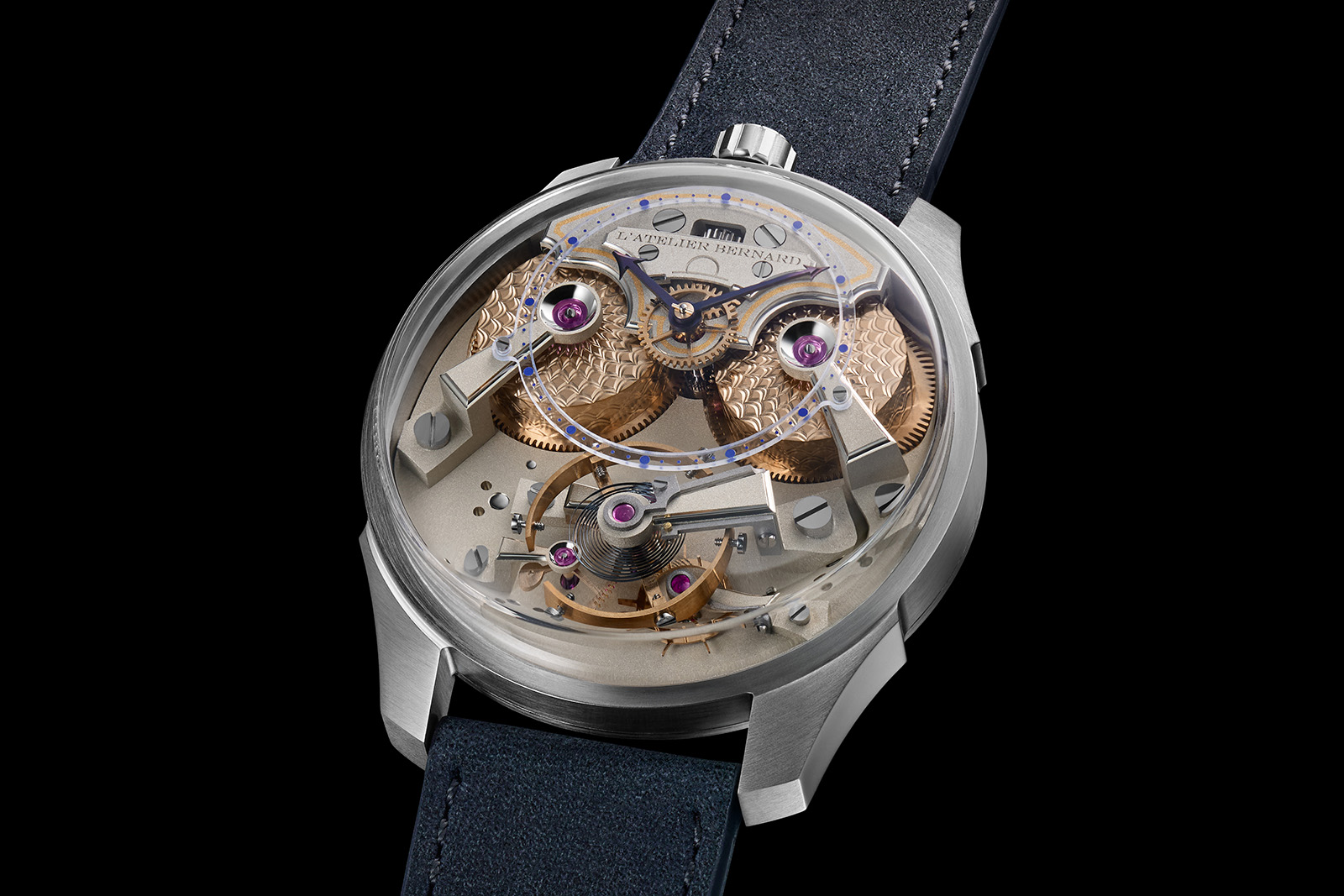
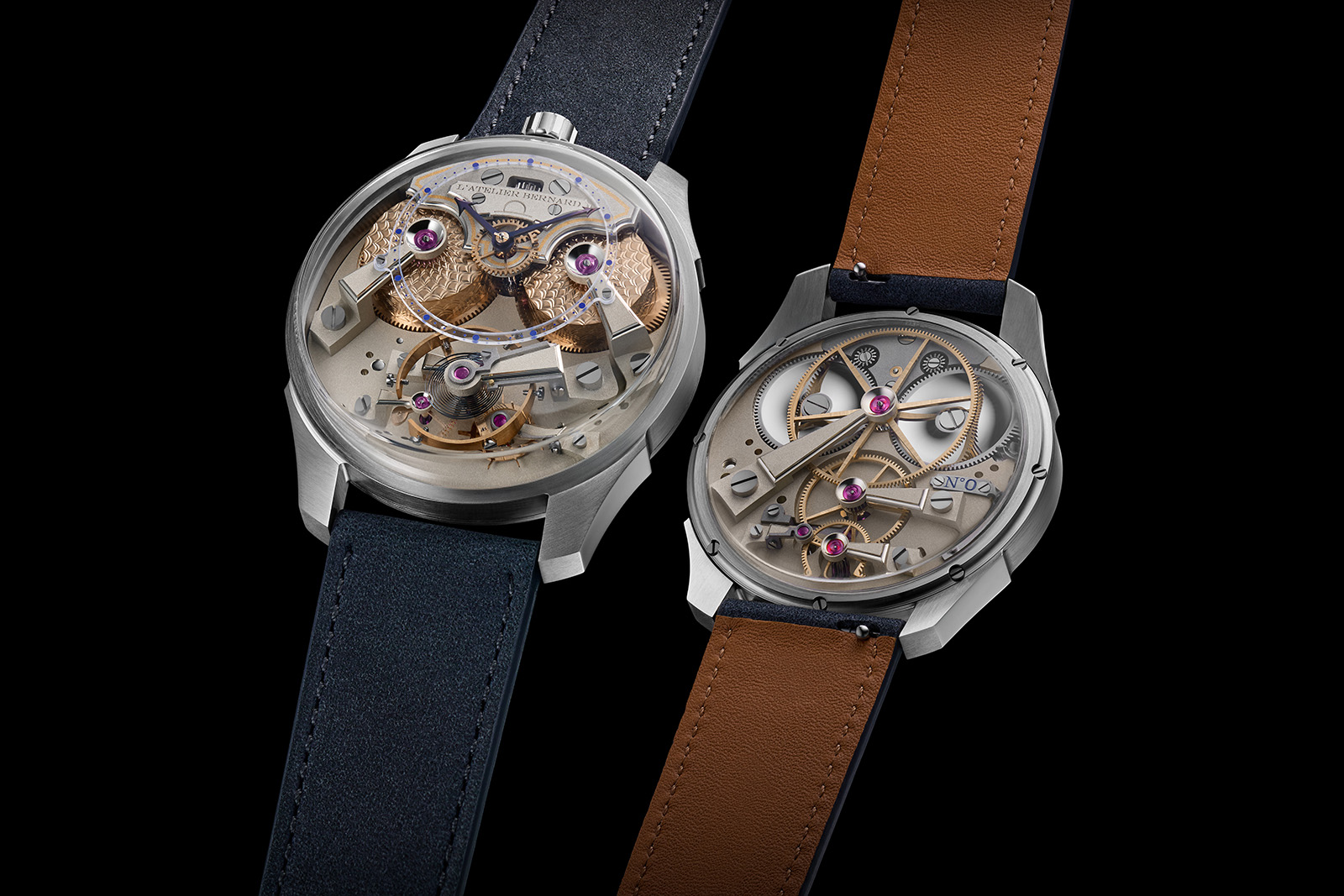
The Owl is unexpected and intriguing on several fronts. Its aesthetics, mechanics, decoration, and layout seem almost at odds with one another, yet the result is a distinctly artisanal object. There is no conventional dial; instead, the watch presents an inverted movement enlivened by a cheerful mix of colours and textures. Even before taking in the surface finishing, the interplay of gold and dark blue accents against the warm grey and copper tones of the movement makes an immediate impression.

The piece is dominated by the two large symmetric barrels which indeed call to mind the inquisitive, ogling eyes of an owl. On the lower portion of the watch face sits the large, slow beating balance, powered by a surprising choice for an escapement: the duplex. A bold move from the watchmakers, we’ll enter the specifics of the particular device a bit later. 
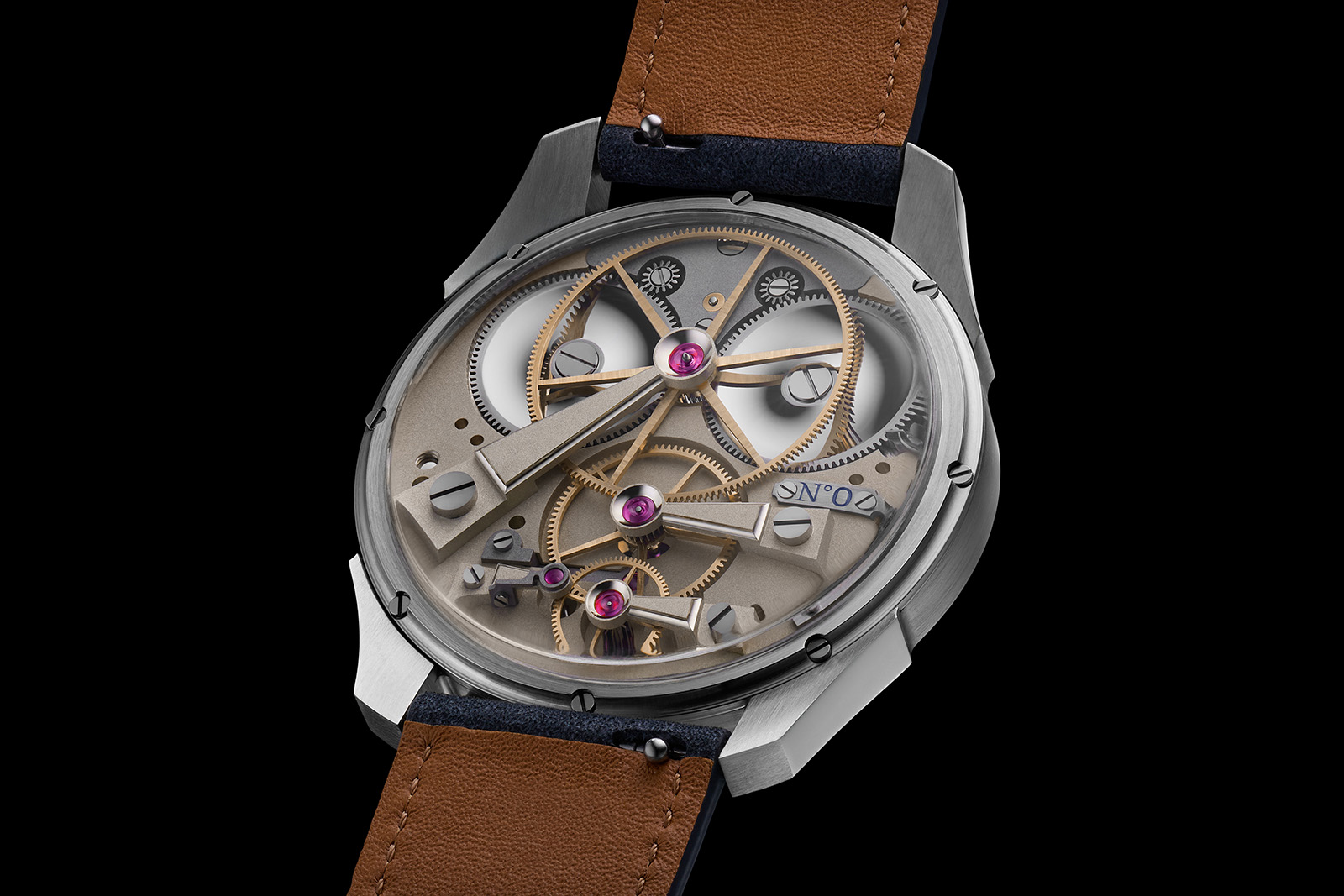
The movement appears to be a deliberate blend of highly refined and more rustic finishes. The lavishly engine-turned barrels (a personal favourite of mine in terms of barrel decoration) contrast with the simply and coarsely grained grey mainplate; the mirror-polished countersinks for the barrel jewels somehow sit alongside the rather crude, “para-chute”-style shock absorber for the balance. Likewise, the intricate blued harpoon hands are secured by a traditional arbour pin.

This intentional contrast lends the piece a pleasant and playful tone, hinting at the young energy and perspective of the two watchmakers.
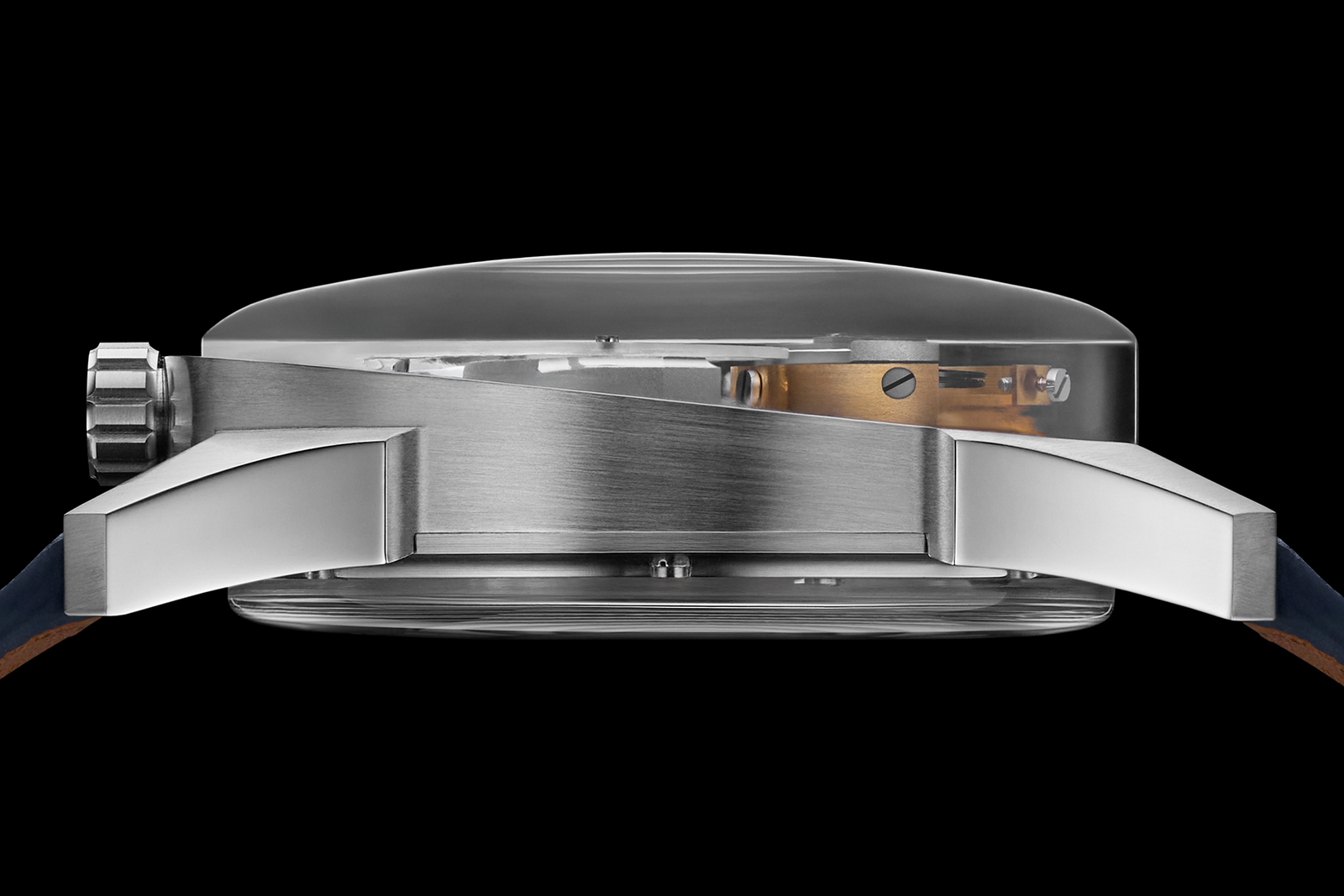
The sloped side profile with angular lugs.

The stainless steel case has strong, angular lugs — a modern abstracted take on the “cornes de vache”. Normally this style isn’t to my taste, but it fits this watch well. Interestingly, the case slopes downward from top to bottom, a trick that reveals the side view of the unusual oscillator thanks to a cylindrical, domed sapphire crystal.

It’s an ambitious debut, which means it will be worth keeping an eye on what L’Atelier Bernard creates in the future. The Owl is limited to just six pieces and all are pre-sold; three pieces are pending delivery in 2026, with the other three to follow in 2027.

Priced at CHF150,000 before taxes, the Owl should give the small brand a bit of runway to begin their next project, which will feature an entirely new calibre. In the meantime, the blend of polished crudeness is a breath of fresh air and a pleasant break from the overabundance of Geneva stripes and perlage. 

About the duplex

For those who aren’t particularly familiar with older pocket watches and their construction, the duplex escapement might be something of an unknown. While the Swiss lever is ubiquitous and the detent has been going through a sort of a revival, the duplex escapement has been largely forgotten in modern times. 

In brief terms the duplex is a frictional rest, deadbeat tangential impulse escapement. This means that an active piece of the escapement is always in contact with a the swinging sprung balance and secondly that it impels the balance only every two vibrations, so once an oscillation. Moreover, the impulse is parted tangentially, in a detent-like fashion. 

The system originated with notable English and French watchmakers. It is believed to have been invented by either Robert Hooke or Jean-Baptiste Dutertre in the early 18th century and later perfected either by the eminent Pierre Le Roy or Thomas Tyrer. As was the case with a number of horological innovations in those days, many inventors claimed credit for the same device, leaving the system’s true provenance unclear. 

At the time of its introduction, the duplex was a better performing system compared to the widely-used cylinder escapement. That said, the duplex was never implemented extensively due to the advent of more precise detached lever escapements.
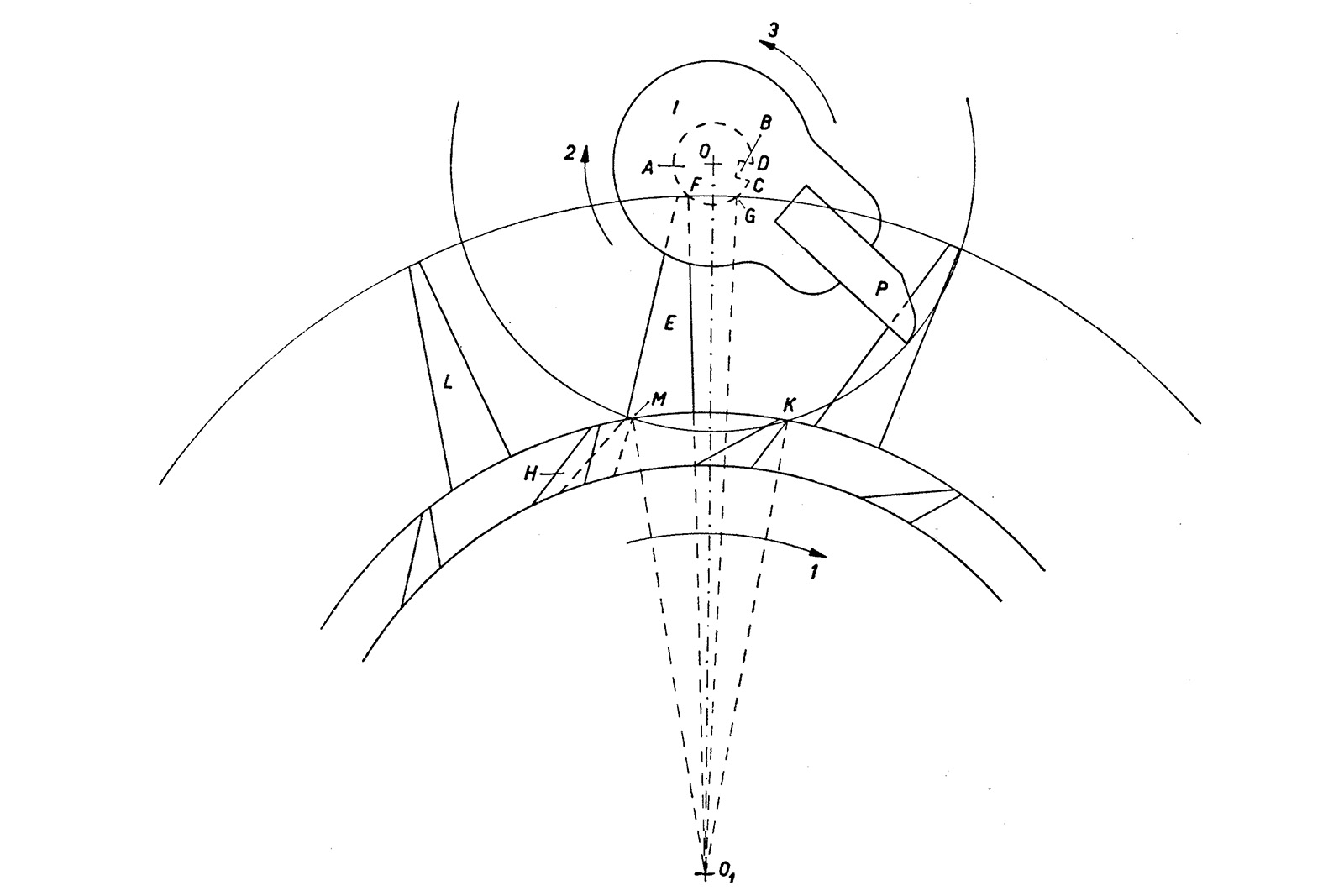
Schematic of the duplex; note the two pairs of teeth. Image – Leopold Defossez

Considered one of the first “co-axial” escapements (having two sets of teeth arranged on different levels), the duplex has dissociated locking and impulse functions. The longer teeth lock the escape wheel in place against a roller formed into the balance staff. A small notch lets the tensioned tooth pass during counterclockwise swings, while only slightly recoiling the escape wheel during the clockwise swings. 

A detent-like impulse pallet is engaged by the shorter tooth-set, imparting tangential and low friction impulse to the balance. The impulse function is virtually identical to the detent escapement, and the locking function is the main difference between the two designs. 

While the parting of impulse is particularly efficient and soft on the parts involved, the constant pressure of the long locking teeth on the balance staff acts as a friction brake, actively dampening the oscillator. 

So while the impulse function is close to ideal, the locking function is a particular disadvantage. Making sure the escapement works flawlessly takes great craftsmanship, since the tolerances of the roller and notch engagement with the locking teeth need to be particularly precise. 
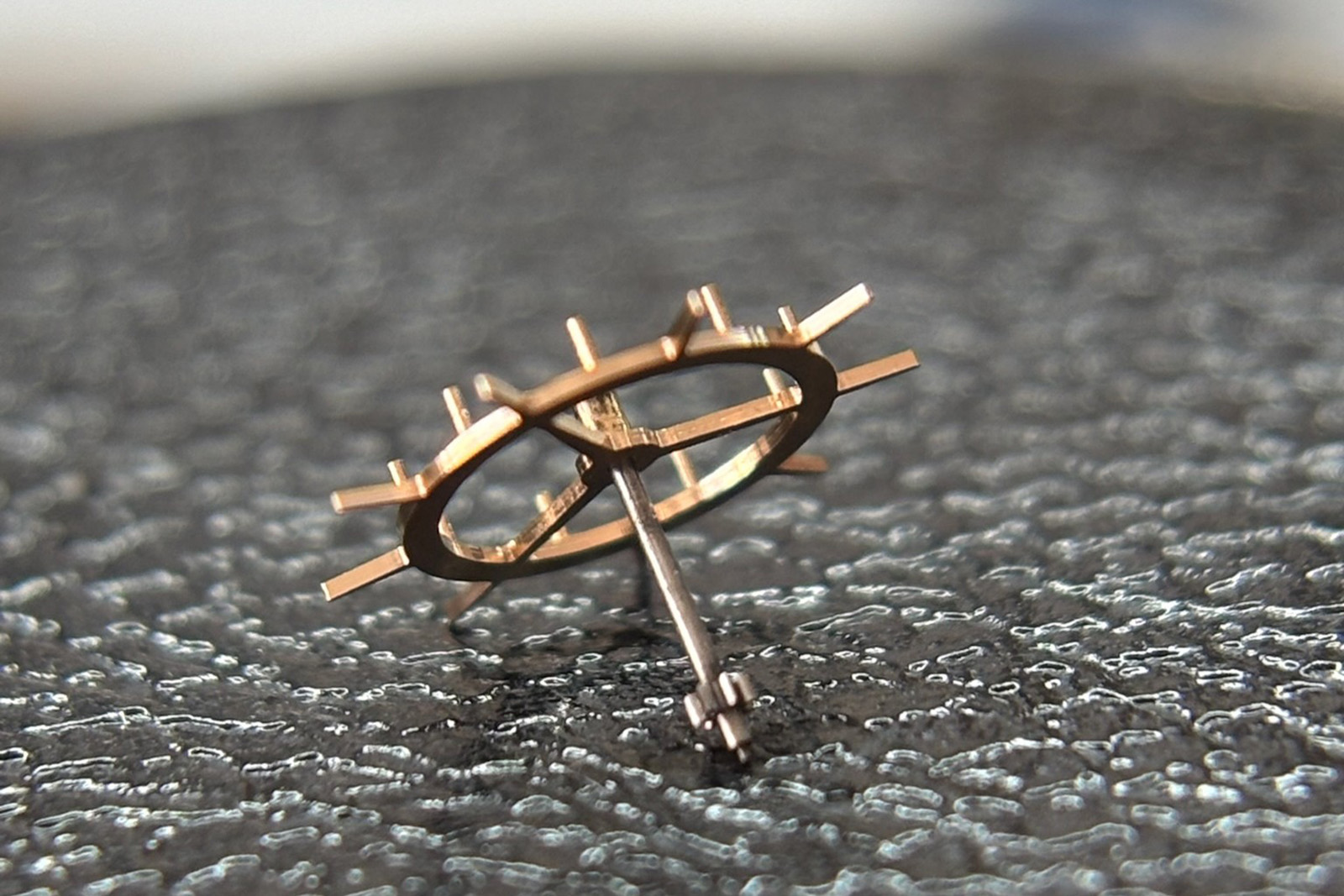
The duplex escape wheel used inside the Owl.

Interestingly, the duplex was used in high quality pocket chronometers, although one might be tempted to assume the frictional rest should disrupt the oscillator’s accuracy. Truth is, the lever arm is quite long, so the escape wheel torque sits at a convenient mechanical disadvantage compared to the balance wheel’s normal force. Thus unbearable friction is not generated in well-dimensioned pieces with slim rollers. 

Also, the unlocking function is particularly soft, since there is no additional lever to be accelerated from standstill. The escape wheel simply starts turning as soon as the notch allows the locked tooth to pass through. Keeping in mind that the friction on the balance wheel is otherwise constant, a good watchmaker can regulate the piece to compensate for the losses. 

Seeing the duplex used in a modern piece was surprising for me at first, thinking that no emerging independent watchmaker would be brave enough to sell what can be perceived as an outdated escapement. Looking at the Owl the decision makes sense, playfully straying away from the dull uniformity of some time-only creations. 

The Owl’s duplex

L’Atelier Bernard came up with their own version of the duplex escapement, which falls under the more rustic elements of the Owl. For example, the escape wheel is built with tall pins instead of the conventional second level of impulse teeth. Also, the impulse pallet on the balance is not ruby, but rather made of the same material as the escape wheel. Due to the soft nature of the radial impulse the watchmakers perhaps believed a jewel was not required. 
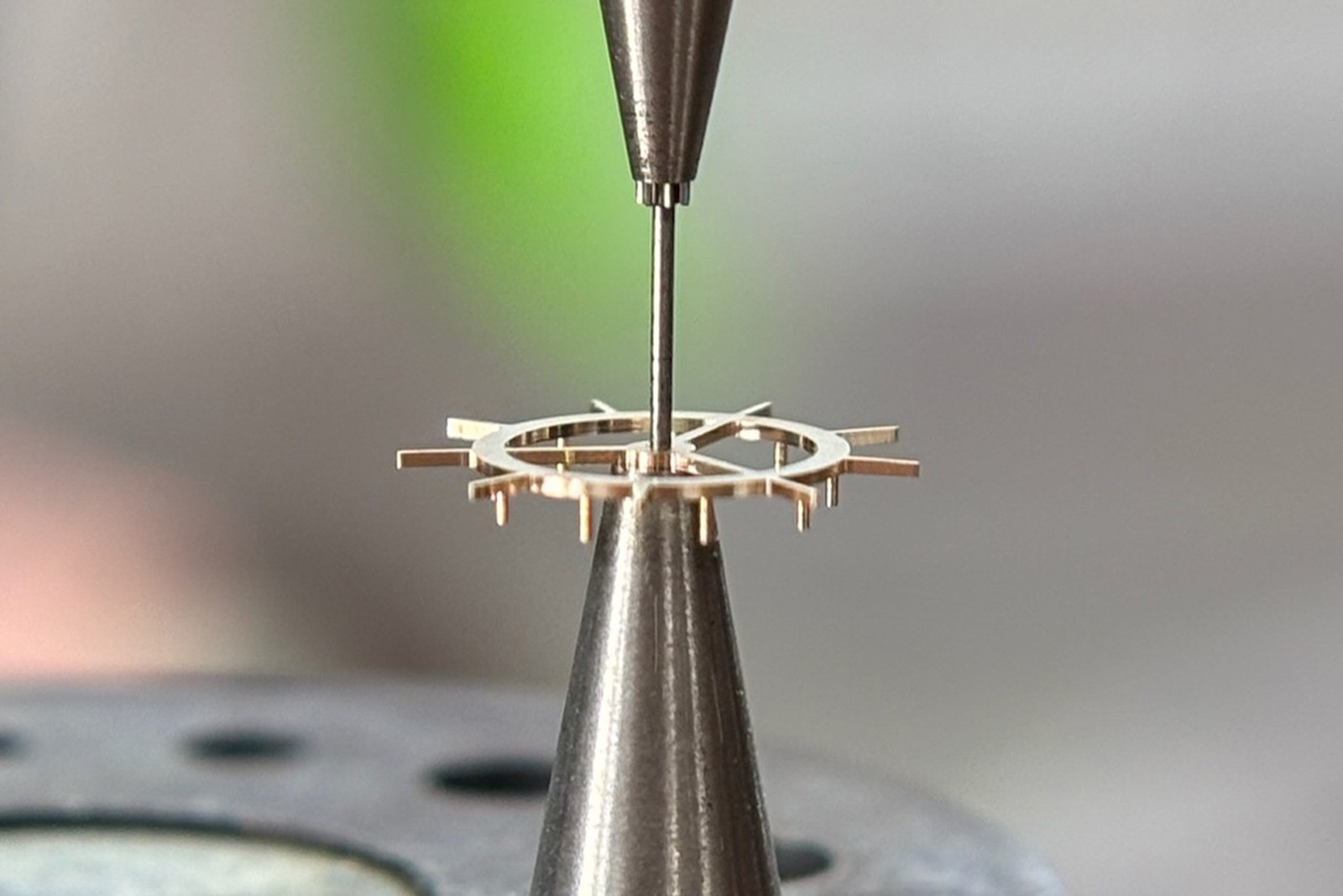
Compared to classic duplex escapements, the Owl’s specimen has an additional component: a safety implement. Since the duplex only locks the escape wheel through the notched roller, at high amplitudes it can unlock the wheel twice during the same vibration. This can bind the escapement and break or deform the overstrained hairspring. This phenomenon is sometimes called galloping and can occur in detent escapements as well. 

Furthermore, the two large parallel barrels likely supply a hearty amount of torque to the escapement and oscillator, increasing the risk of over-banking the balance. To compensate for this risk, the watchmakers put an additional counterweight geared to the balance, assuring the added “dead weight” keeps the balance oscillating at suitable amplitudes only.

The free-sprung balance beats at an unusual 1.5 Hz frequency, meaning the large cut and screwed balance wheel makes a 2/3 oscillation per second. The slow vibration of the regulator is certainly an interesting sight, the pace giving a sense of slowed time. The Own runs for a modest but comfortable 45 hours on a full wind. 
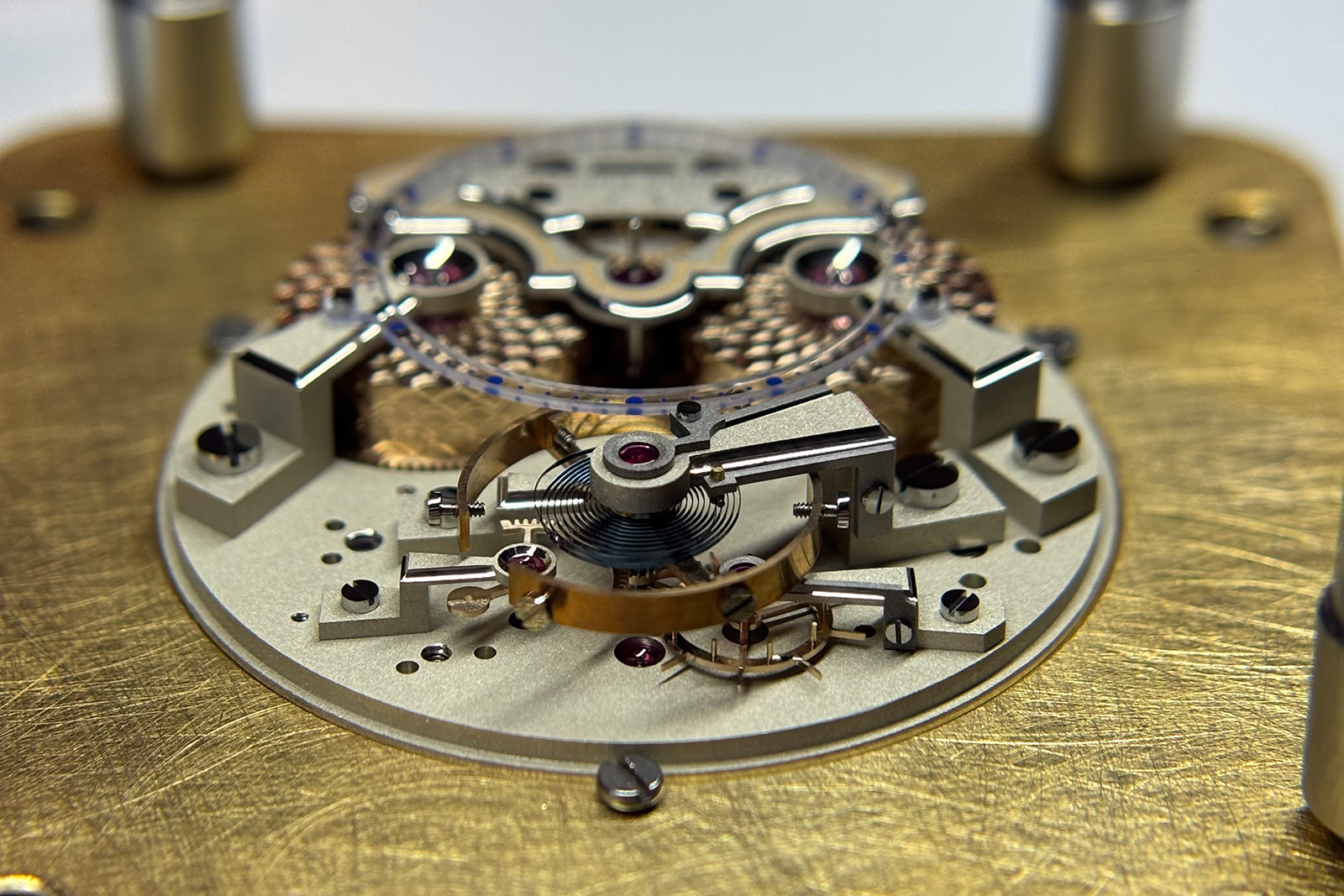
Uncased view of the movement.

The hairspring has an interesting dark blue hue and a prominently raised overcoil, forming a wide end curve. The springs are new old-stock Nivarox 2 quality, which is a touching nod to the past.

The Owl lacks a seconds hand, partly due to the movement construction and perhaps also due to the watchmakers’ preference. Because of the slow and peculiar sequence of the duplex escapement, a seconds hand would have moved in seemingly unequal jolts, so maybe the choice to leave it out was for the best. 
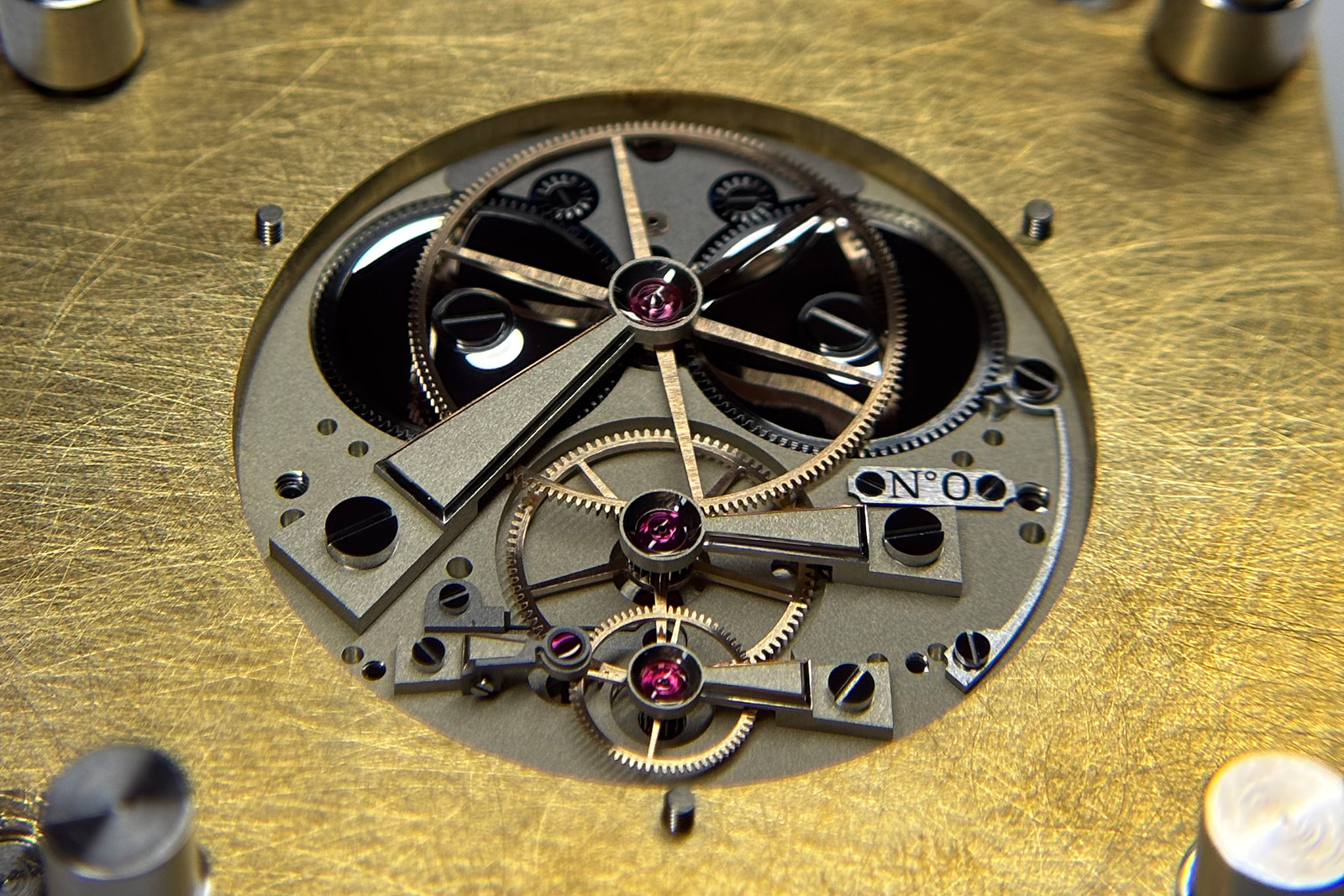
Uncased backside of the movement.

L’Atelier Bernard specifies the Owl keeps a rate of -/+3 seconds per day, which is a surprisingly good result for the slow (but steady) beating duplex-powered balance. They also have a prototype that’s been ticking quite happily for the better part of three years, which gives a degree of assurance as to the reliability and consistency of their duplex escapement.

A generous blend of finishes

As mentioned, this piece strikes a balance between haute horlogerie and rustic finishes. One element that draws the eye and that falls into the latter category is the parechute shock absorbers securing both the balance and escape wheel pivot jewels. Lacking any polish or bevels, the springs are coarsely grained, giving a above all a sense of utility.  

Grained surfaces dominate the caliber: the mainplate is fully grained, as are the feet of the finger bridges. The finish pairs well with the soft yellowish-grey hue of the German Silver. The tops of the French-style bridges are thickly beveled — the polished surface creating a welcome contrast of textures.
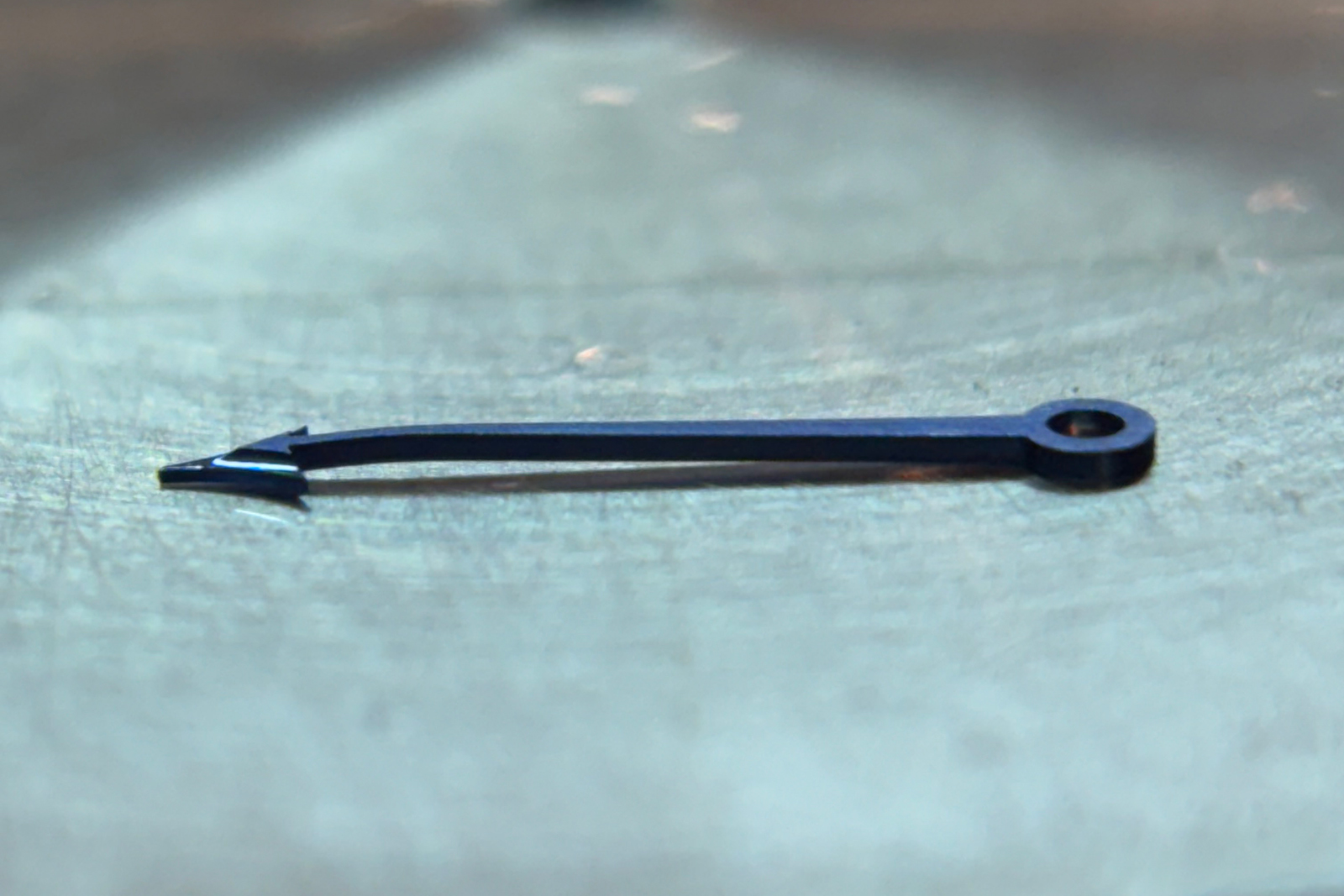
The blued and curved minute hand.

Two lesser-seen decorating techniques mastered by Bernard Van Ormelingen are gold inlaying and concave beveling. Mr Van Ormelingen trained with a Belgian gold inlay artist and applies the delicate technique to watch decorating. The large plate at 12 o’clock is framed by a subtle gold inlay, while its broad edges are concavely bevelled. The bridge also features the brand’s rising sun logo. 

Compared to straight or rounded bevels, concave bevels are just what the name implies: the cut is curved with a concave profile. While many watchmakers call attention to their rounded (convex) anglage, this particular finishing technique is seldom seen even within haute horlogerie. 
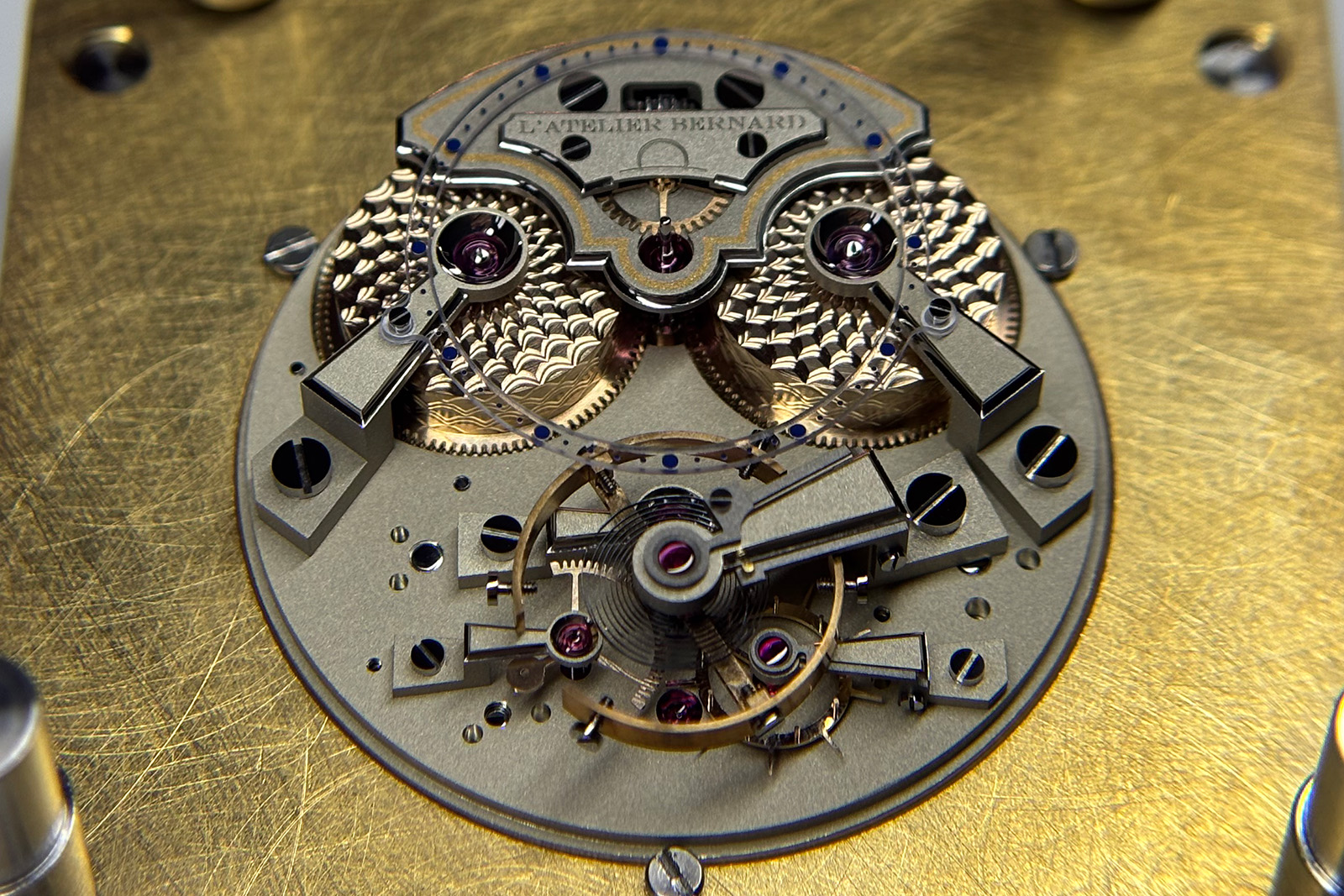
The broad gold-inlaid and concave-beveled plate serves as a supporting bridge for the time setting gears while also hiding the keyless works. Above it glide the two blued-steel, harpoon-shaped hands, each ending in a concave-bevelled spear tip. Their hue is a deep blue, almost shading into purple. A nod to early pocket watches, a short pin keeps them secure at the end of the cannon pinion. 

The most striking piece of finishing inside the Owl has to be the guillochage on the tall barrel drums. Executed on a hand-operated rose engine, the wavy pattern graces both the flat tops of the inverted barrels as well as the cylindrical drums. The engravings, which almost look like feathers when one considers the avian inspiration, meet seamlessly at a 90-degree angle, creating the impression of the pattern seeping from one surface to the other. 
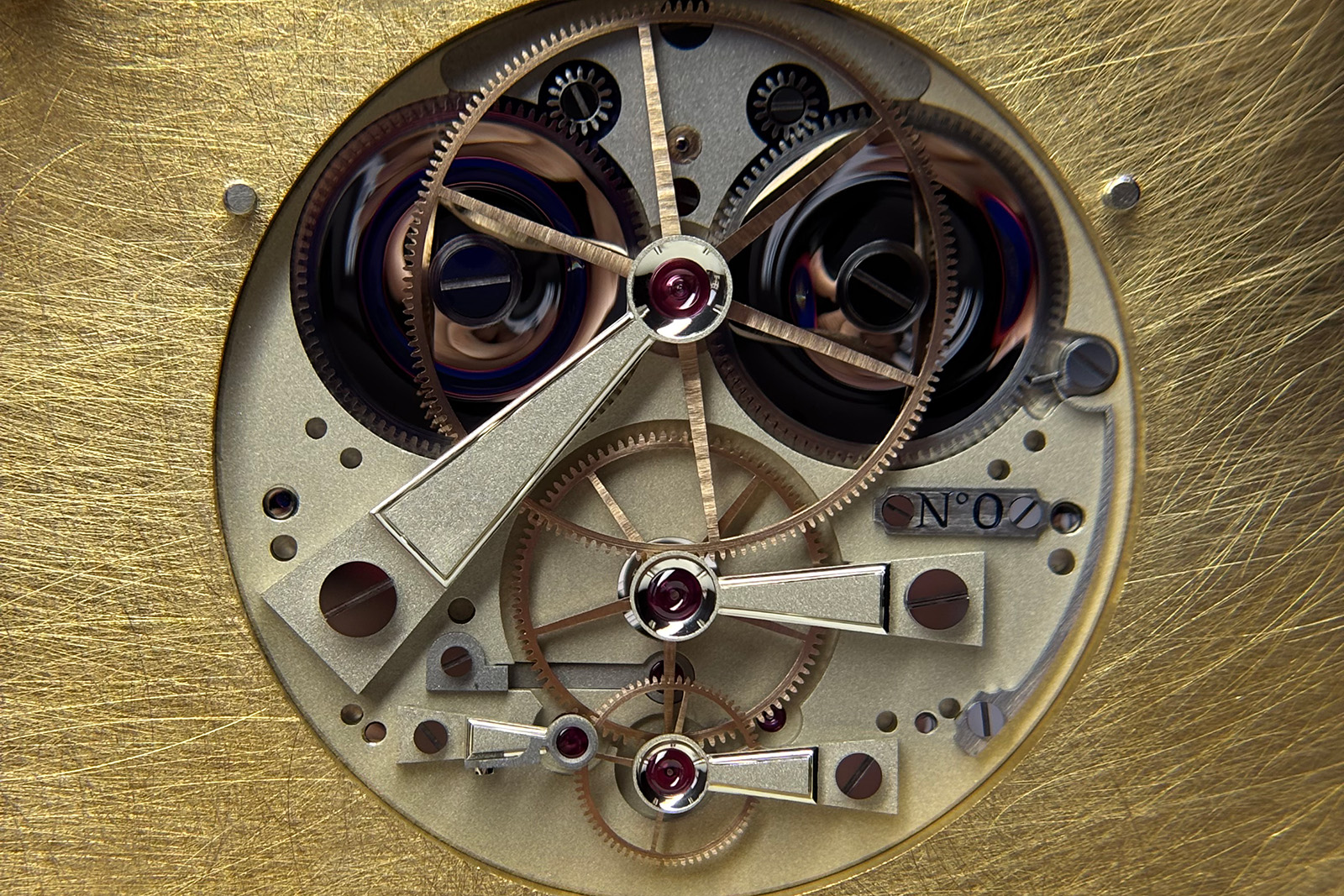
Turning the piece around and we are greeted with another compelling view: the expertly black polished, slightly concave click wheels and the dominating centre wheel. Its diameter is slightly larger than the radius of the movement — the gear’s exaggerated size accounting for the recalculated going train ratios required by the 1.5 Hz oscillator. 

The shape and finishing of the finger bridges is the same as on the dial side. Overall the backside is not a very exciting sight when compared to the front, but the consistency of design and architecture is most laudable. 


Key facts and price

L’Atelier Bernard The Owl

Diameter: 39 mm
Height: 14.5 mm
Material: Stainless steel
Crystal: Sapphire
Water resistance: 50 m

Movement: In-house calibre with duplex escapement
Functions: Hours, minutes
Winding
: Manual
Frequency: 10,800 vibrations per hour (1.5 Hz)
Power reserve: 45 hours

Strap: Leather strap

Limited edition: 6 pieces to be made and delivered by the end of 2027 (all pieces sold)
Availability: Directly from L’Atelier Bernard
Price: CHF150,000 excluding taxes

For more, visit @l_atelier_bernard on Instagram.


Back to top.

You may also enjoy these.

Welcome to the new Watches By SJX.

Subscribe to get the latest articles and reviews delivered to your inbox.