
Hands On: Ulysse Nardin Super Freak
A freakish mechanical spectacle.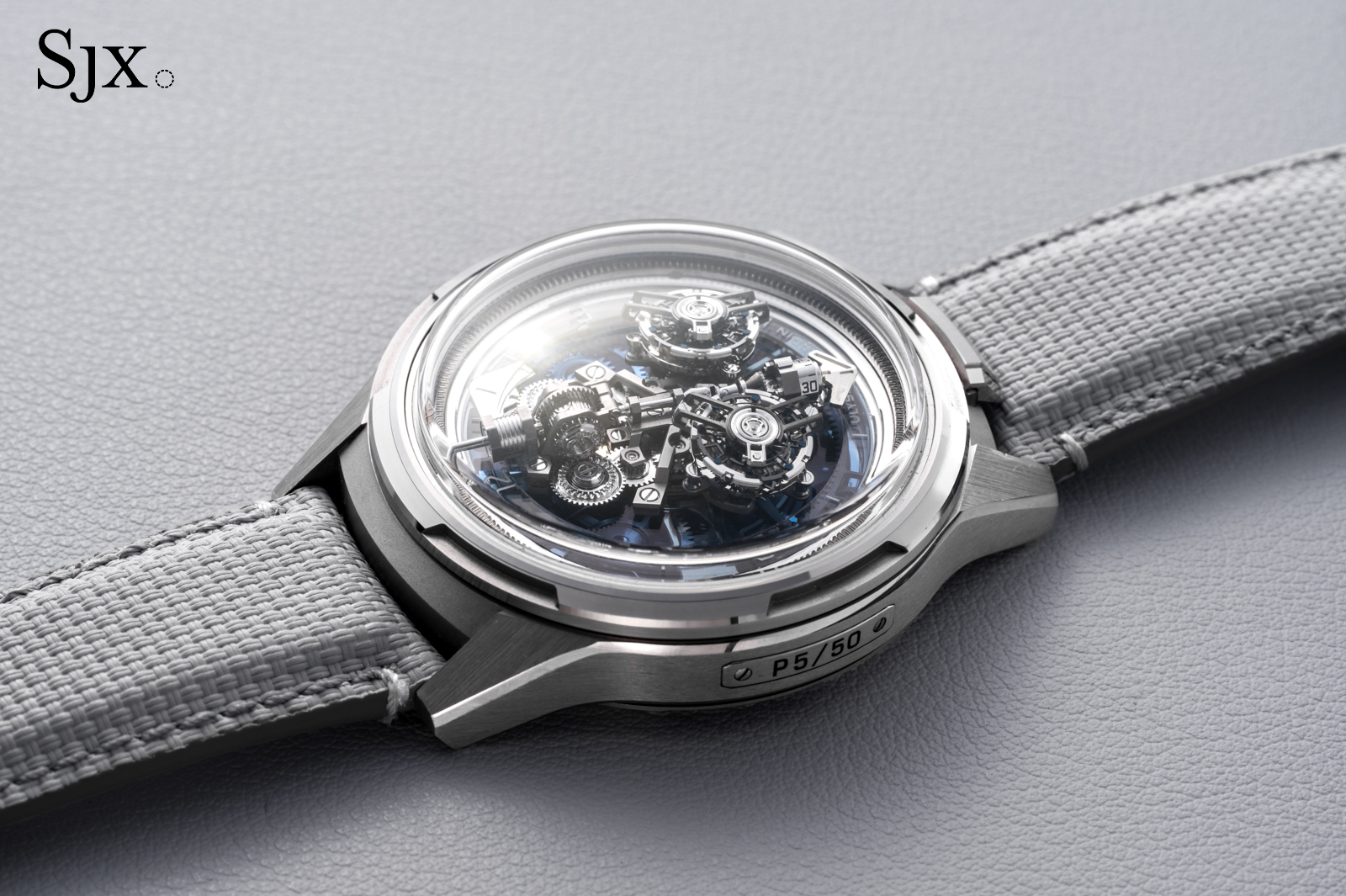
Ulysse Nardin (UN) celebrates 25 years of the landmark Freak with the aptly named Super Freak — a timepiece that pays homage to its predecessors while asserting its own distinct identity. Showcased at UN’s eccentric booth at Watches & Wonders 2026, the Super Freak was advertised as the most complicated time-only watch ever made — an ambitious claim that appears to be true.
Blending cutting-edge mechanics with an artisanal touch, the exuberant Super Freak comfortably reaches into the “hyper-watch” echelon, echoing the first groundbreaking Freak launched back in 2001. Ulysse Nardin also celebrates its 180th anniversary this year, so something extraordinary was to be expected.
Initial thoughts
Even before going hands on with the Super Freak, just visiting UN’s booth at Watches & Wonders 2026 was an experience. Passers-by were greeted by two humanoid robots and a large sculpture of Dr Ludwig Oechslin’s head, with his eyes peering down over the proceedings.
The extravagant entrance hinted at the research-focused Super Freak, which looks and feels more like the product of some advanced laboratory rather than a 180-year-old manufacture. A very dynamic watch, the Super Freak’s face now more than ever resembles a space craft.
The Super Freak pays tribute to 25 years of the Freak while also adding something truly new to the mix. The result is the UN 252, the first Freak movement featuring running seconds and two flying tourbillons (2010’s Freak Diavolo was the first featuring a nested tourbillon).
Of course, the Freak’s platform is a slow-turning tourbillon itself, but much of this analysis revolves (no pun intended) around its nested tourbillons.
The Super Freak also includes the world’s smallest spherical differential (first seen in the Freak S back in 2022) and — entirely new for this model— the world’s smallest universal joint. This miniaturised mechanism — commonly found in automotive applications — enables an efficient and compact implementation of the running seconds.
In a prior series, we have extensively covered the first two decades of technological evolution of the Freak platform, from Dr Oechslin’s brainchild to more recent innovations like the Grinder winding system. We recommend reading Part I, Part II and Part III of the Freak Saga to fully appreciate the Super Freak.
The dynamic spaceship
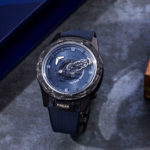
The Supper Freak is an imposing timepiece. With a case measuring 44 mm and crafted out of white gold, the watch feels equal parts high horology and UFO sighting. The case lines were thankfully kept simple, since the mechanics under the sapphire crystal are anything but.

Final production pieces will have lume blocks for the hour and minute pointers — they are missing from this prototype.
In classic Freak fashion there is no traditional crown and time setting is accomplished simply by turning the front bezel. The revised bezel lock feels assuringly mechanical without looking like a crude clamp. Although the bezel is rather slim, it is grippy enough to ensure time setting isn’t a chore.
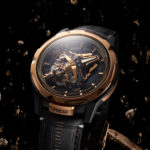
Nestled inside the white gold case sits a large revolving platform, which carries two flying tourbillons, one differential and the world’s smallest universal joint. The alien-looking assembly turns once every 60 minutes, thus serving as the world’s largest minutes hand.
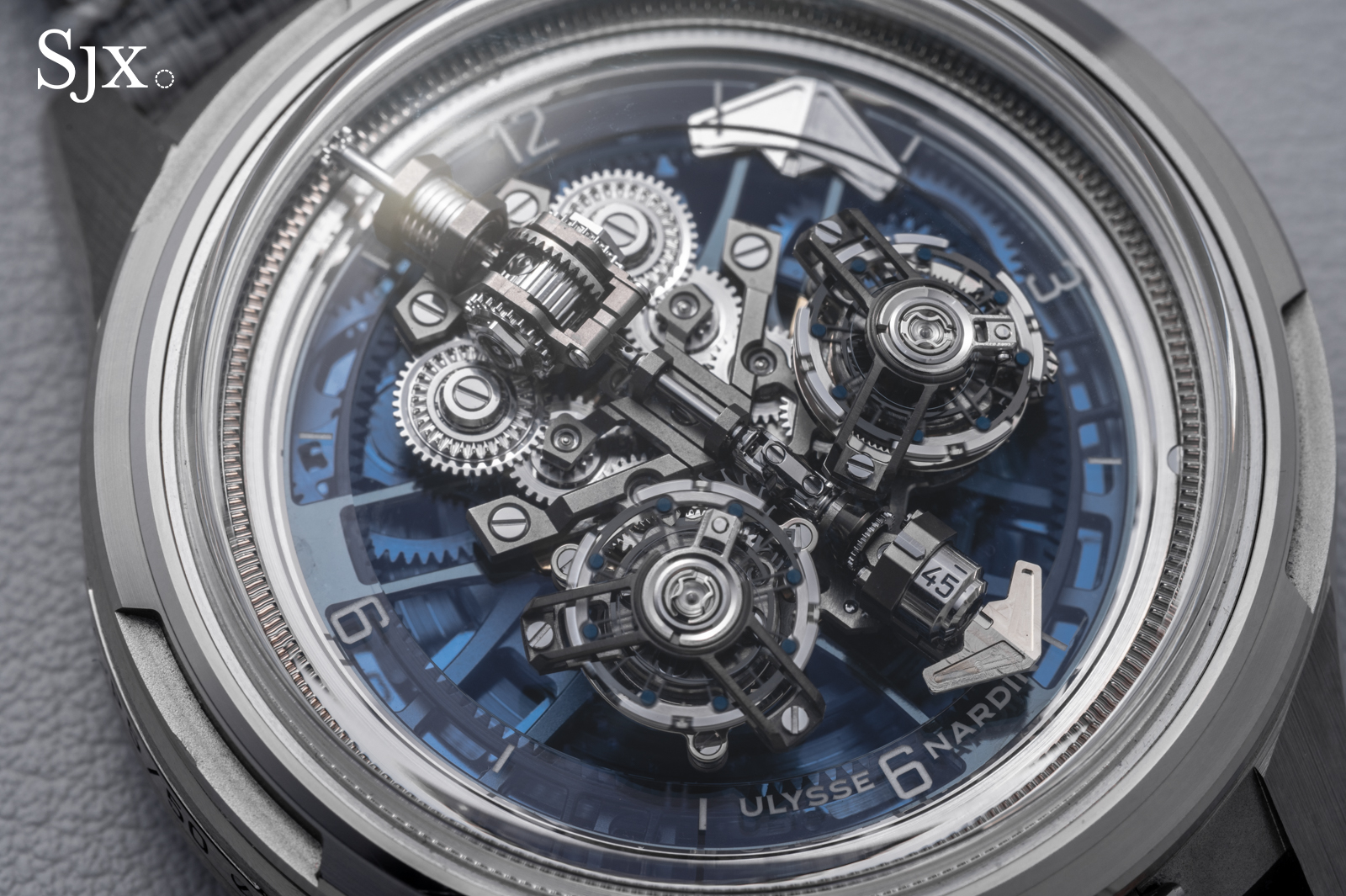
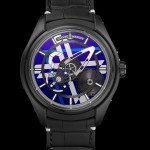
Right underneath it lies a translucent blue plate that doubles as the hours indicator. The see-through plate provides a glimpse at some of the usually hidden assemblies underneath the show-stopping upper platform.
The plate is made form a special material developed by UN called Nanosital. The material is a mix of silicon dioxide and aluminium oxide. The icy blue hue is a subtle tribute to UN’s rich heritage as a marine chronometer maker.
Although we can glimpse a few gears under the Nanosital hour disk, much of the view remains obscured by the large platform, which contains most of the moment components. Because the view is obstructed, it’s unclear whether the original central large barrel design was retained or some other barrel setup was used instead.
The Super Freak achieves a 72 hours power reserve, which is commendable given the torque required for the UN 252 movement to run.
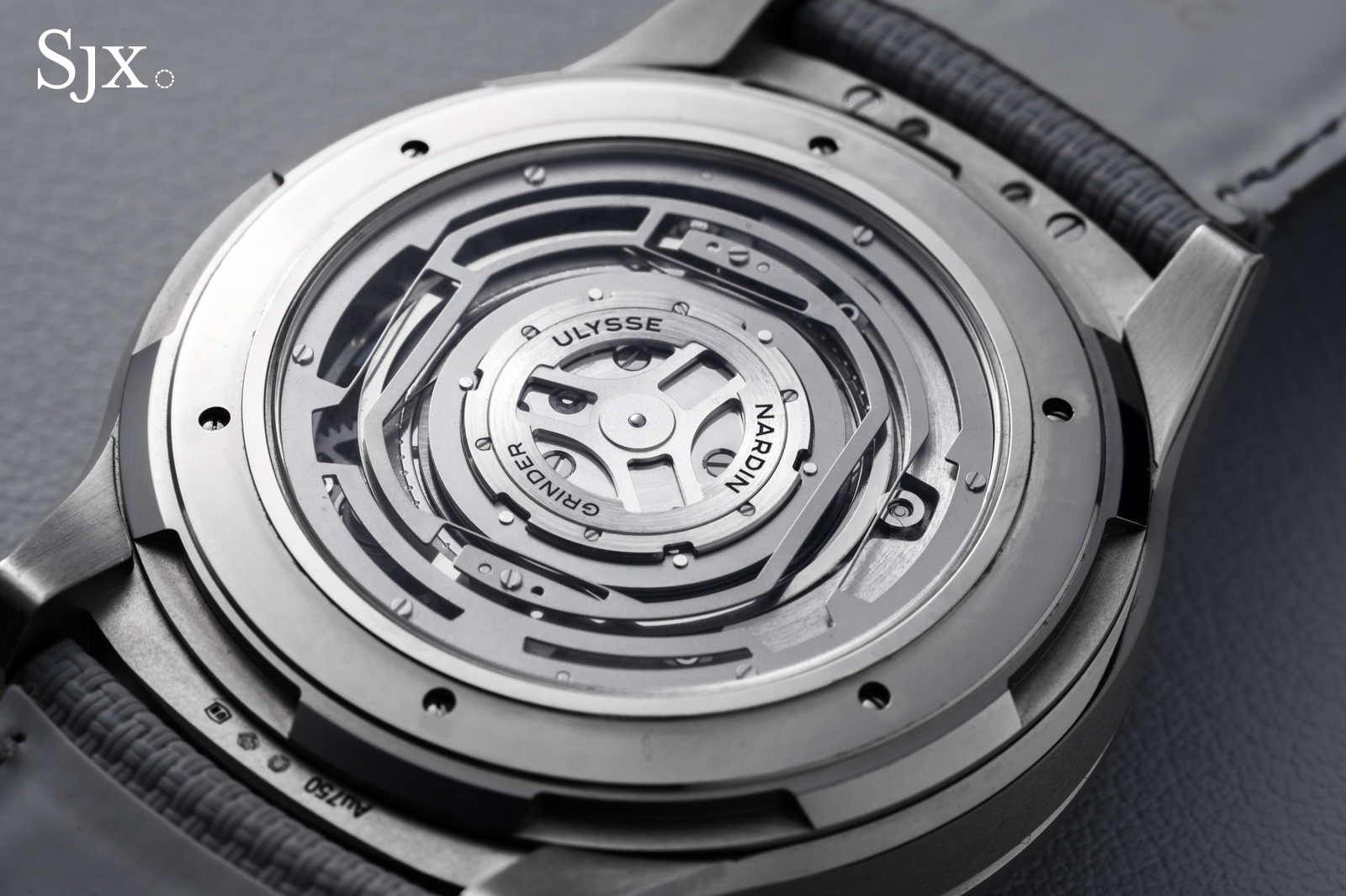
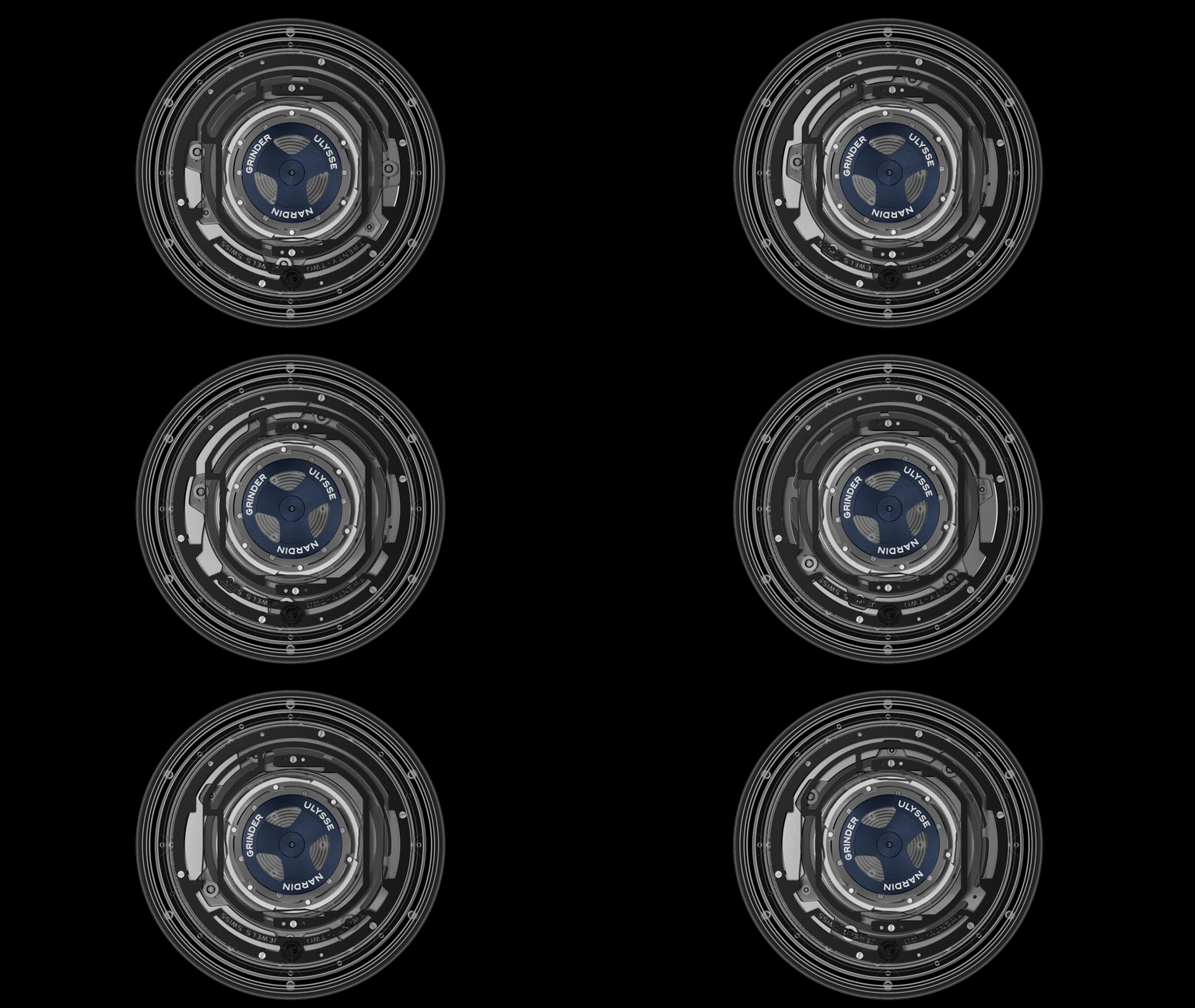
The Super Freak is wound automatically by the inventive Grinder system. A four-pawl mono-block assembly, the Grinder is considered the most efficient automatic winding mechanism on the market — a claim with sound theoretical basis. The compliant system resembles Seiko’s Magic Lever winding system, but improves the geometry and adds a second pair of pawls. The functioning of the Grinder can be seen below.
Gliding over the translucent backdrop, the minutes platform is a lot to unpack. Much like virtually all Freak movements, there is a large fixed gear attached to the outer bezel that engages with the platform’s gearing. As the platform is engaged in rotation from underneath, the stationary bezel gear causes the platform’s wheels to turn — thus powering the going train.
In classic Freaks, the bezel gearing features simple internal toothing; here, due to the presence of the spherical differential gear set, the toothing is vertical. Meshing with the platform is accomplished by a rather small pinion (of 8 leaves) through which torque flows toward the two escapements.
The pinion shaft is connected to the differential’s casing through another crown-like gear. This brings us to the differential itself, which looks virtually identical in execution to that previously found in the double-balance Freak S. The small assembly is composed of a staggering 69 parts even though it only measures about 5 mm across.
A short refresher on differentials
Differential gear sets are among the most useful pieces of mechanical design. Differentials are famously found inside cars, as they ensure rear tyres can gyrate properly when cornering. In fact, an almost identical version of a car’s rear differential can be found — miniaturised to the max — inside the Super Freak.
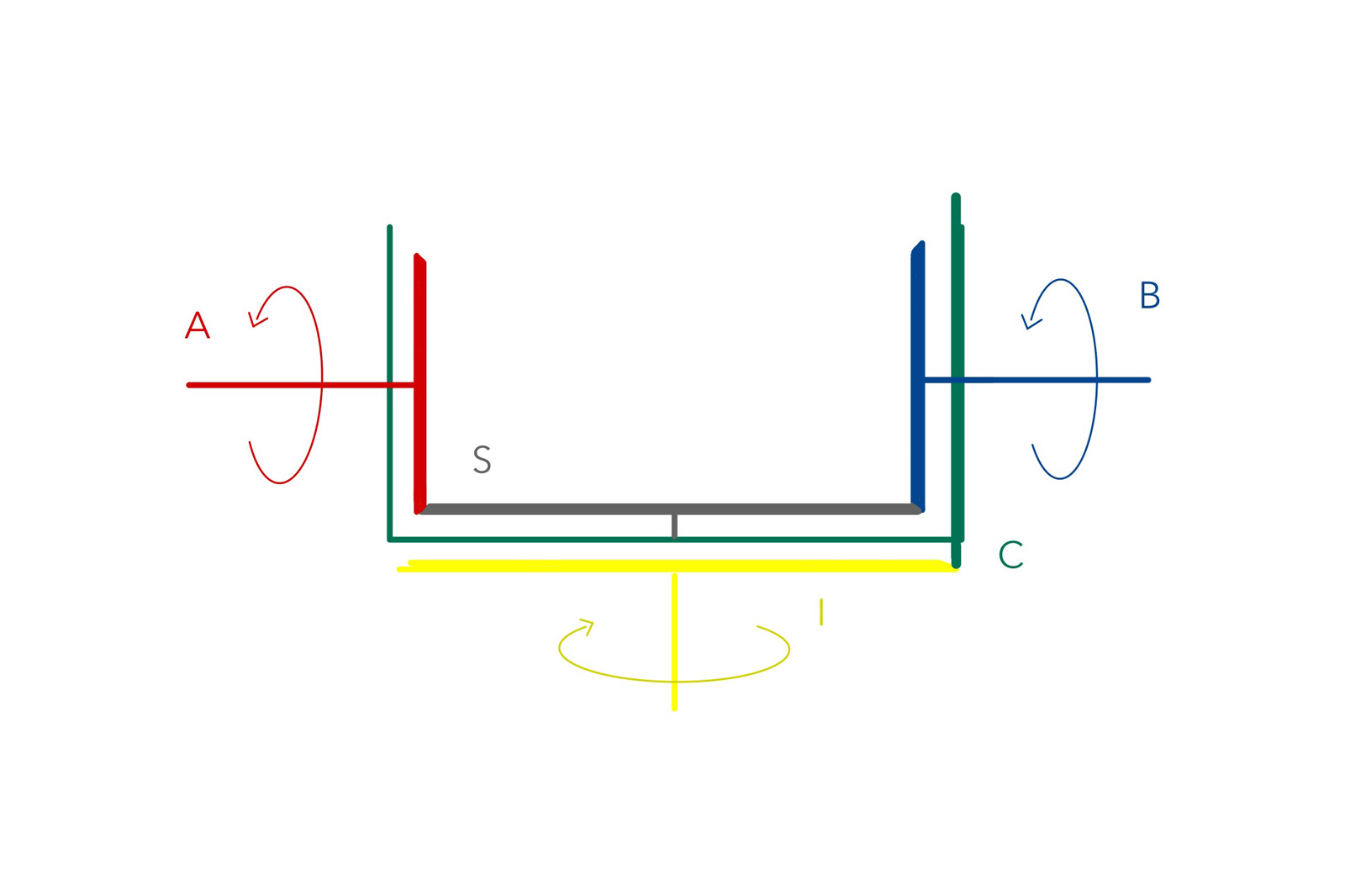
Figure I. Spherical differential diagram.
As shown in Figure I a basic spherical differential has an input I, which turns the casing via a gear C. Inside the casing reside three meshed gears: A, S and B. Satellite S pivots on the casing itself, while A and B serve as output shafts. Intermediary engaged through C, the ratio between A and B is -1:1. The minus sign only appears because the gears spin in different directions due to the right-angle setup. That is, if the casing remained immobile and one was to turn A clockwise, B would turn counter-clockwise.
If the casing itself becomes mobile, the two (free) outputs would turn at the same speed in the same direction. But should one input be braked or accelerated, that would indirectly affect the other, if the input speed received by the casing was constant. As a basic rule, the angular speed of the casing is always the average of the two output speeds. This relates to watches in an interesting way.
In a basic watch movement, torque is supplied by the barrel through the gear train to the escapement, but the speed of the components is governed by the balance and escapement. If torque is supplied through a differential to two separate balances, each would impose its own rhythm. So although the shafts work as torque outputs, they also serve as “speed inputs” for the differential, together governing the velocity of the casing.
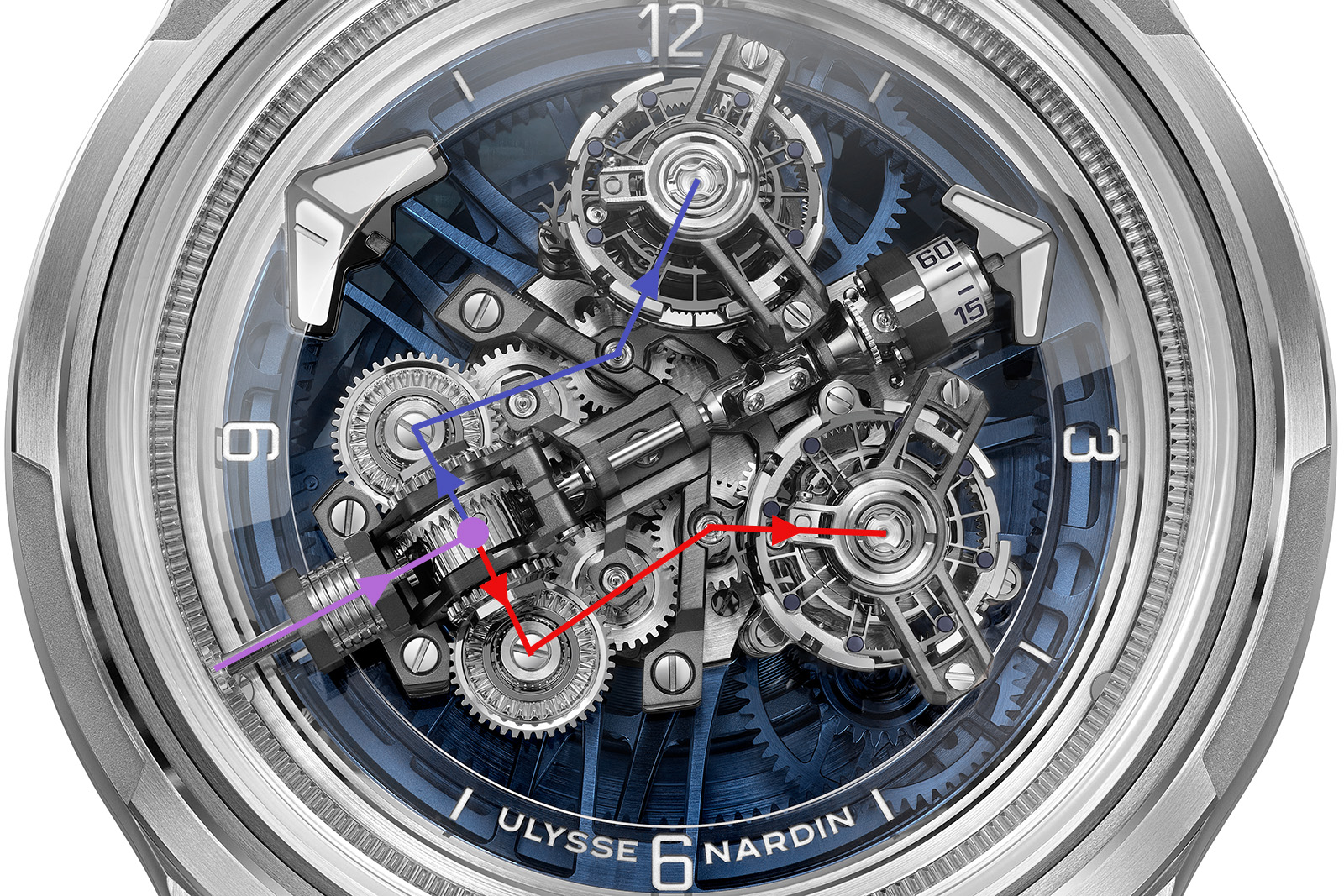
Figure II. Torque flow through the differential to the regulators. Image – Ulysse Nardin, annotated by the author.
This is the case with the Super Freak as well; both tourbillons receive the split mainspring torque from the differential (coloured arrows in Figure II), but the rate at which the differential itself turns is the average of the two going trains. As such, any rate difference between the two regulators is balanced in the running of the timepiece but each tourbillon is allowed to run at its own individual pace.
Twin inclined tourbillons
We’ve seen why a differential gear set was necessary when using two regulators. The two split outputs each link at a right angle to the their separate going trains via a special wheel, with both vertical and horizontal teething.

The laid-out gears have softer transmission ratios than usual, due to the special construction of the Freak platform. The sharp ratios found in classic constructions are not needed here, hence the less noticeable tooth count difference between gears and pinions.
Each going train leads to a flying tourbillon and the two constructions are identical. As it has become the norm for modern flying tourbillons, the cage is supported by a sturdy ball bearing, which has little to no axial play.
Each cage is also inclined at 10° from the movement’s plane — theoretically improving gravity compensation. That said, given its extraordinary level of complexity, the Freak platform is hardly tailored for chronometry, so the precision of the Super Freak should be taken with a grain of salt.
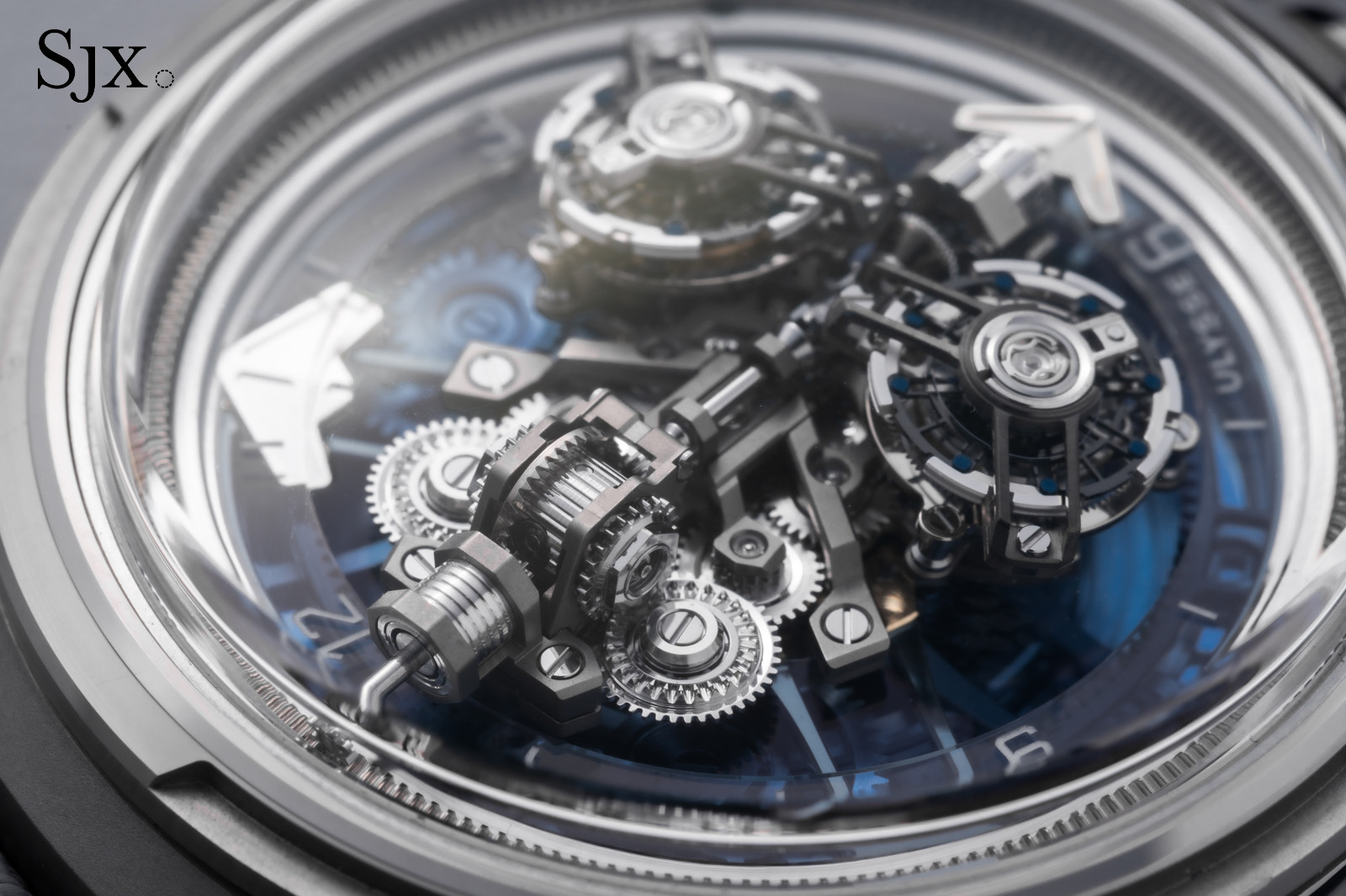
The cage of each tourbillon is rather ergonomic, with just two arms. The escape wheel’s pinion is entertained in motion by stationary internal toothing (not visible in the pictures) and the cage itself is powered by a pinion underneath. Overall the execution is simple but strong and power efficient.
Beating inside each tourbillon is a 2.5 Hz balance wheel. Slow by modern standards, the lower frequency was adopted for energy management considerations. This is not only a double tourbillon movement, but also one that has to turn a large and inertially-heavy platform.
Both escapements are fashioned out of DIAMonSIL, UN’s own composite of silicon and diamond. Over a piece formed from silicon, a superficial layer of artificial diamond is grown. Silicon’s surface is hard enough on its own, but the diamond coating should further reduce the escape wheel’s coefficient of friction.
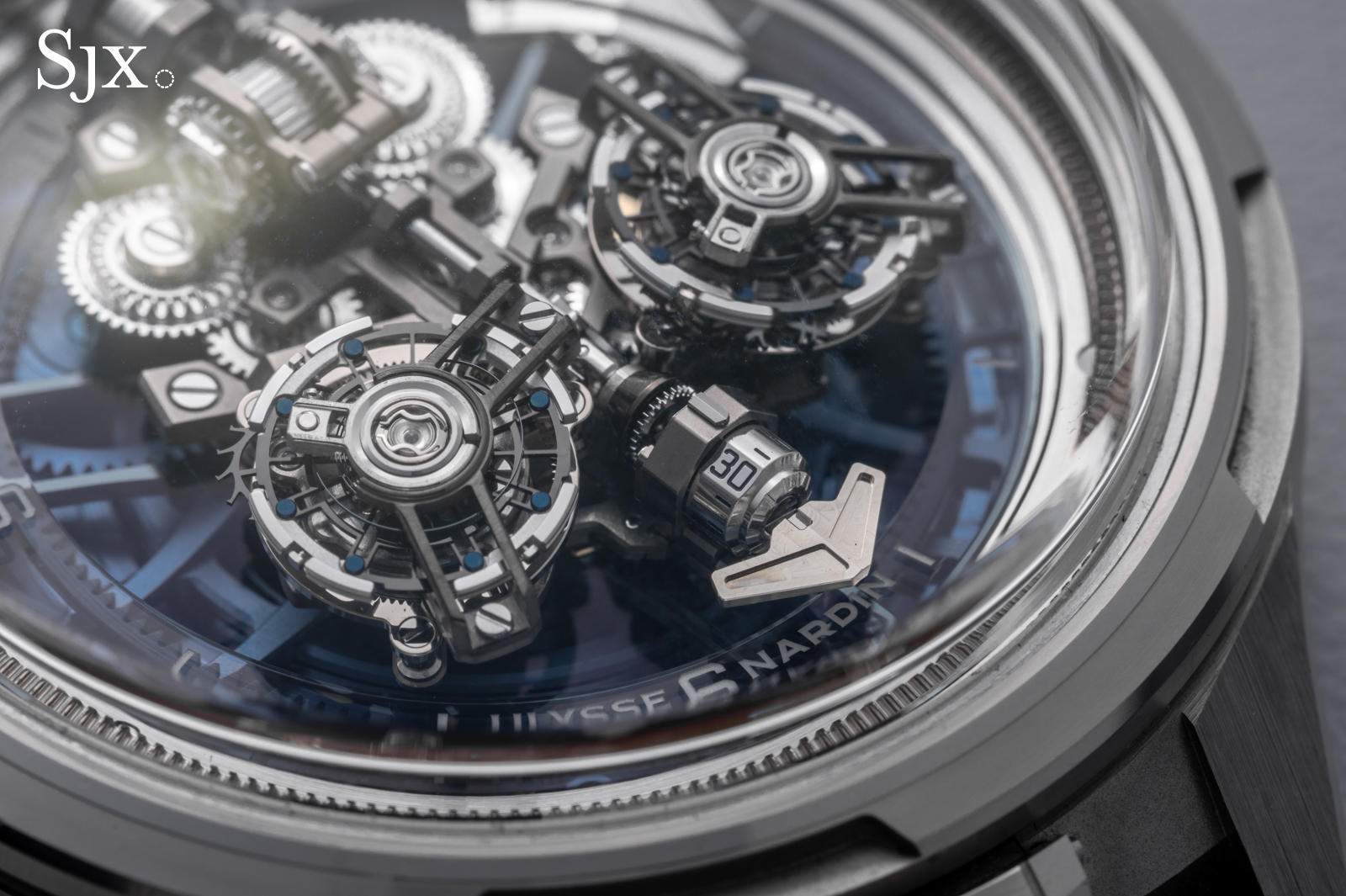
The balance wheels used inside the Super Freak mark a new design from UN. Featuring a silicon structure with white gold outer weights and regulating screws, the new balances differ in execution from past UN balances.
Past silicon-gold balances from UN featured a more progressive look, with an intricate silicon core and arrow-shaped regulating weights. This new incarnation looks more like a traditional balance with two pairs of regulating screws. The two balances also appear to be smaller compared to those used in the Freak S — probably due to them being used in conjunction with tourbillon assemblies.
Paired to the silicon-gold balances we see the standard silicon hairsprings used by UN, with their oval-shaped end curve. As seen in Figures III a and b, this specific hairspring keeps the coils’ breathing concentric, thus improving isochronism to a degree. UN is among the few manufactures actively researching and filing patents on improved hairspring geometries.
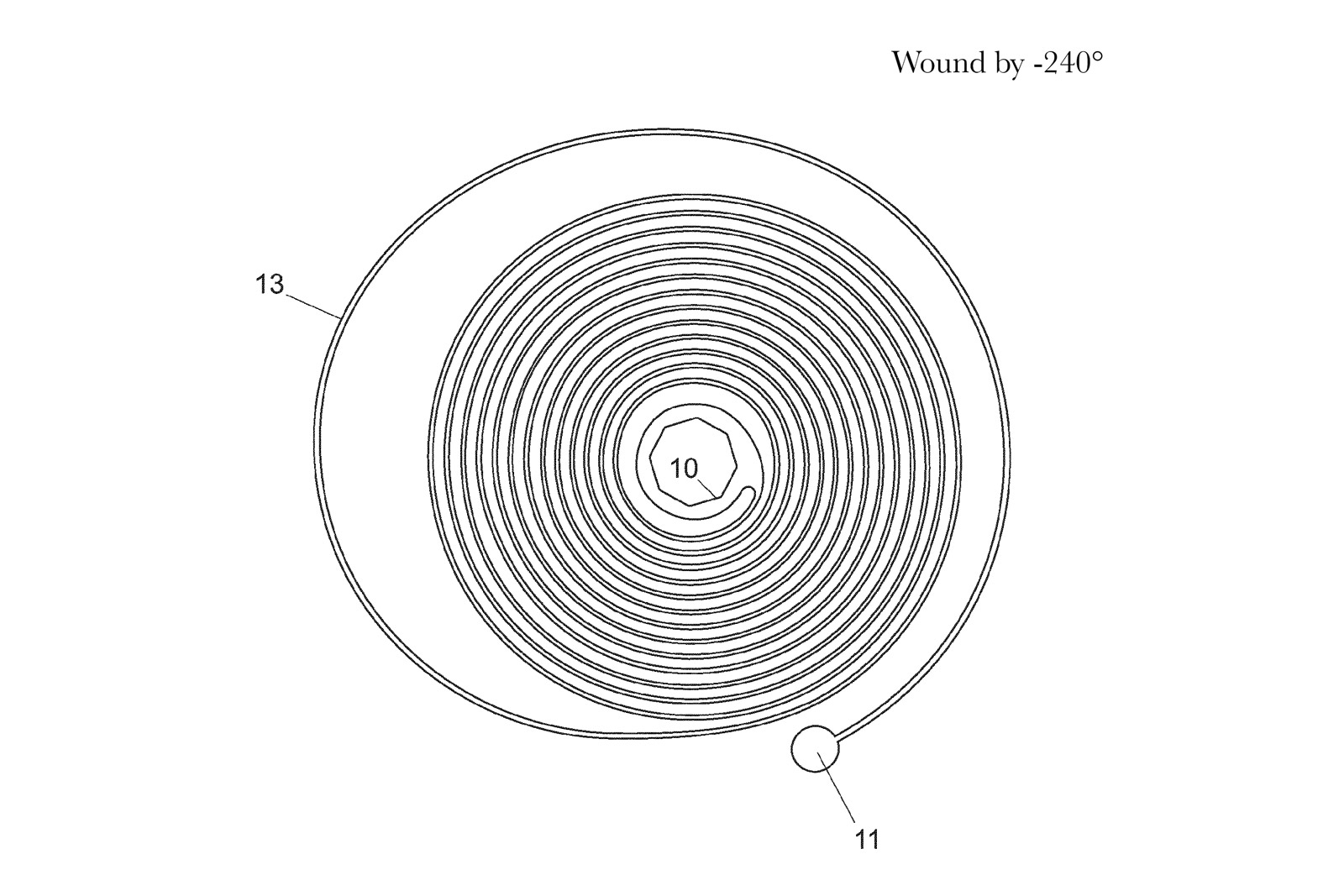
Figure III a. Wound UN silicon hairspring. Image – Ulysse Nardin patent
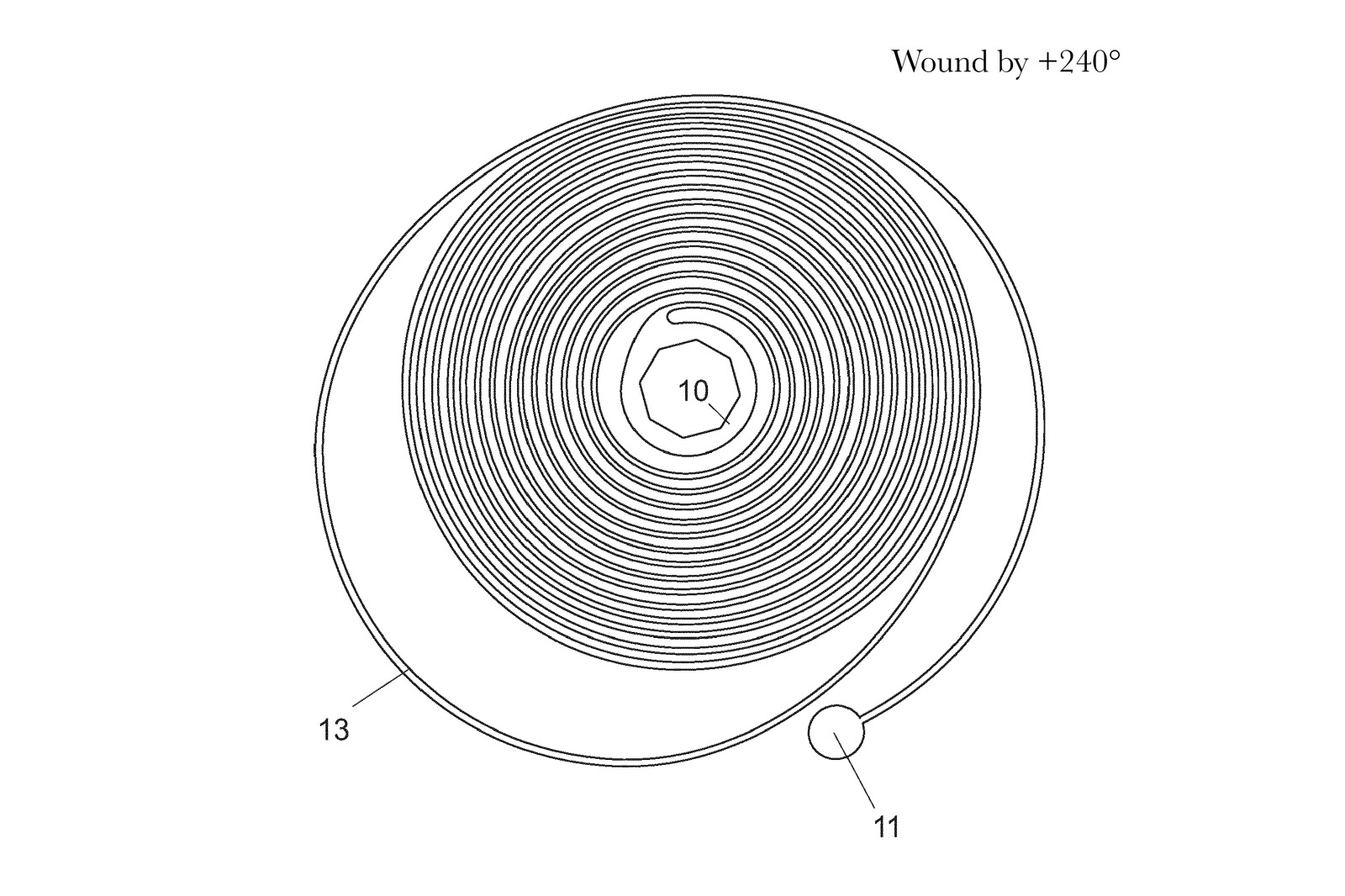
Figure III b. Wound UN silicon hairspring. Image – Ulysse Nardin patent
An interesting remark is how the two tourbillons don’t appear to be truly mirrored and synchronised. This is related to the differential’s effect, which allows the two going trains to go at their own pace, while averaging their rate for the platform’s turning.
This means that one cage will speed up while the other decelerates — vice versa — depending on the watch’s position, thus creating a visible offset between the two regulators.
The wondrous joint
One of the more interesting constructional choices of the UN 252 movement inside the Super Freak is the use of what is called an universal joint. A basic universal joint uses gimbals to couple in motion two shafts at an angle. There are no gears involved, only yokes and spindles.
If the two shafts are placed at small angles (commonly less that 20°) the motion transmitted from one shaft to the other is virtually linear; if the angle is increased the motion becomes unreliable and full of jerks; the mechanism does’t work at right angles and binds even before the 90° limit.
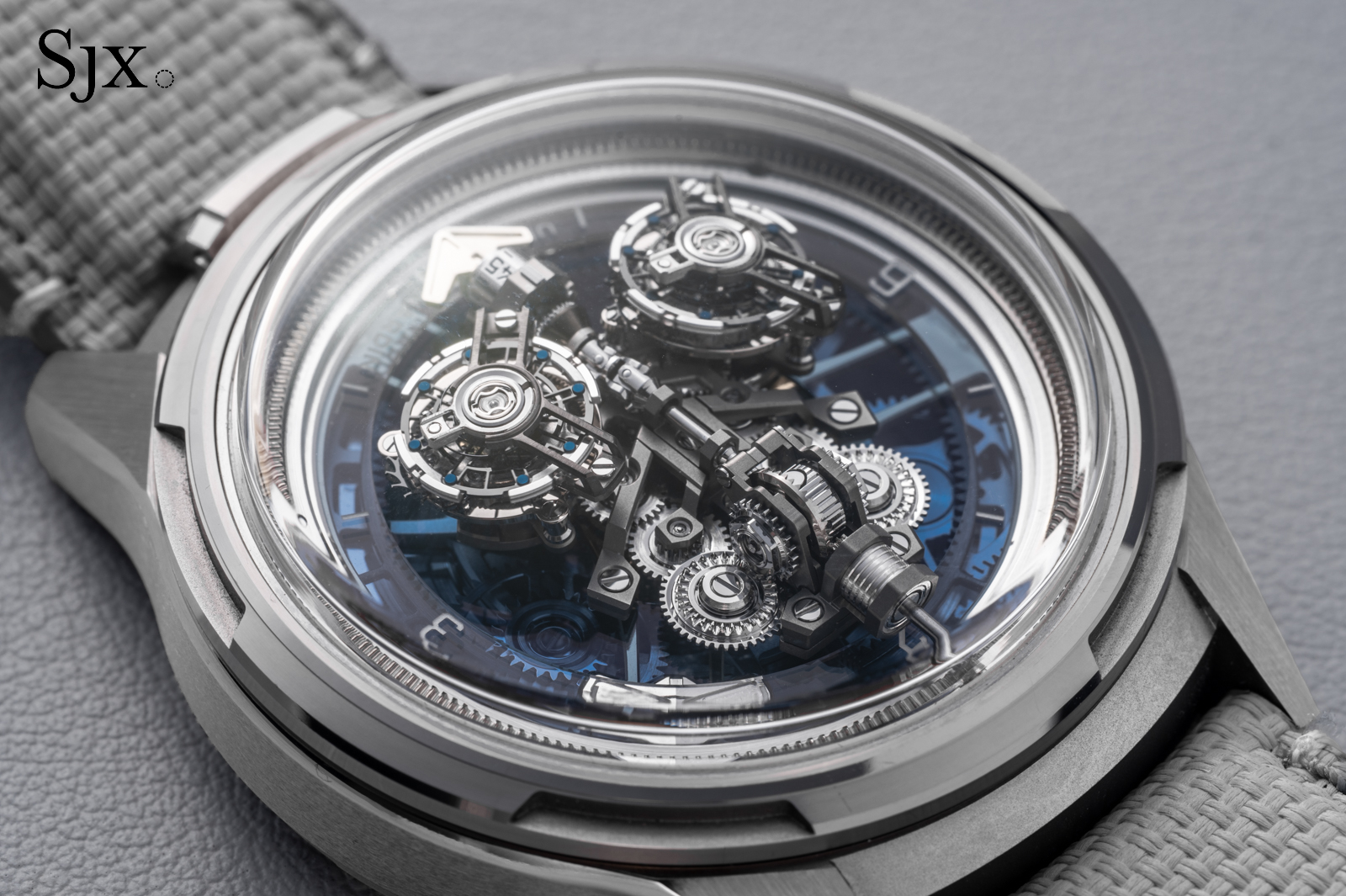
In order to easily link two parallel shafts (or extend the range of angles for linear motion) one can couple two universal joints serially. This is precisely the setup used inside the Super Freak.
But why develop such a complex solution? In the Super Freak’s case, the reason can be found in the platform’s architecture. Because the entire assembly is on the thicker side, the platform’s baseplate is not flat. The differential assembly is mounted higher than the going trains, which need to accommodate the 10° inclination of each tourbillon.
Since the Super Freak sits at a moderate 16.5 mm in height, some creative geometry choices were made to fit everything together.
The running seconds indicator is an engraved cylinder placed at the tip of the minutes hand — namely at the far end of the platform. The running seconds is powered off the differential’s casing, in order to reflect the averaged rate of the two regulators.
This means the pathway from the driving wheel to the running seconds cylinder must go down and then back up. The easiest mechanical solution for accommodating these constraints is indeed an universal joint assembly.

Ulysse Nardin calls it the world’s smallest universal joint, which might be the case. Both the joint and differential were developed in partnership with MPS, a Swiss company that specialises in manufacturing micro-mechanical systems catering to the watchmaking, biomedical and aerospace industries.
Inside UN’s booth at Watches & Wonders 2026 there was a small vial filled with what appeared to be grains of sand to the naked eye; the vial’s contents were in fact microscopic marbles for the ball bearings used inside the differential and joint assemblies. What UN and their partners have achieved in terms of miniaturisation inside the Super Freak is nothing short of amazing.
An artisanal Freak
There are 511 components inside the Super Freak’s UN 252 movement. Approximately 70% of those are decorated by hand. As hand decoration usually takes a step back when it comes to technically innovative pieces, it is both surprising and refreshing to see UN putting in the effort to apply such extensive manual decoration to the Super Freak.
Most of the surfaces are sandblasted by hand and the angles are polished using traditional burins and wood sticks. Given the extensive use of titanium, the decorator’s job was made harder. As a result, each Super Freak requires more than 60 hours of skilled handwork.
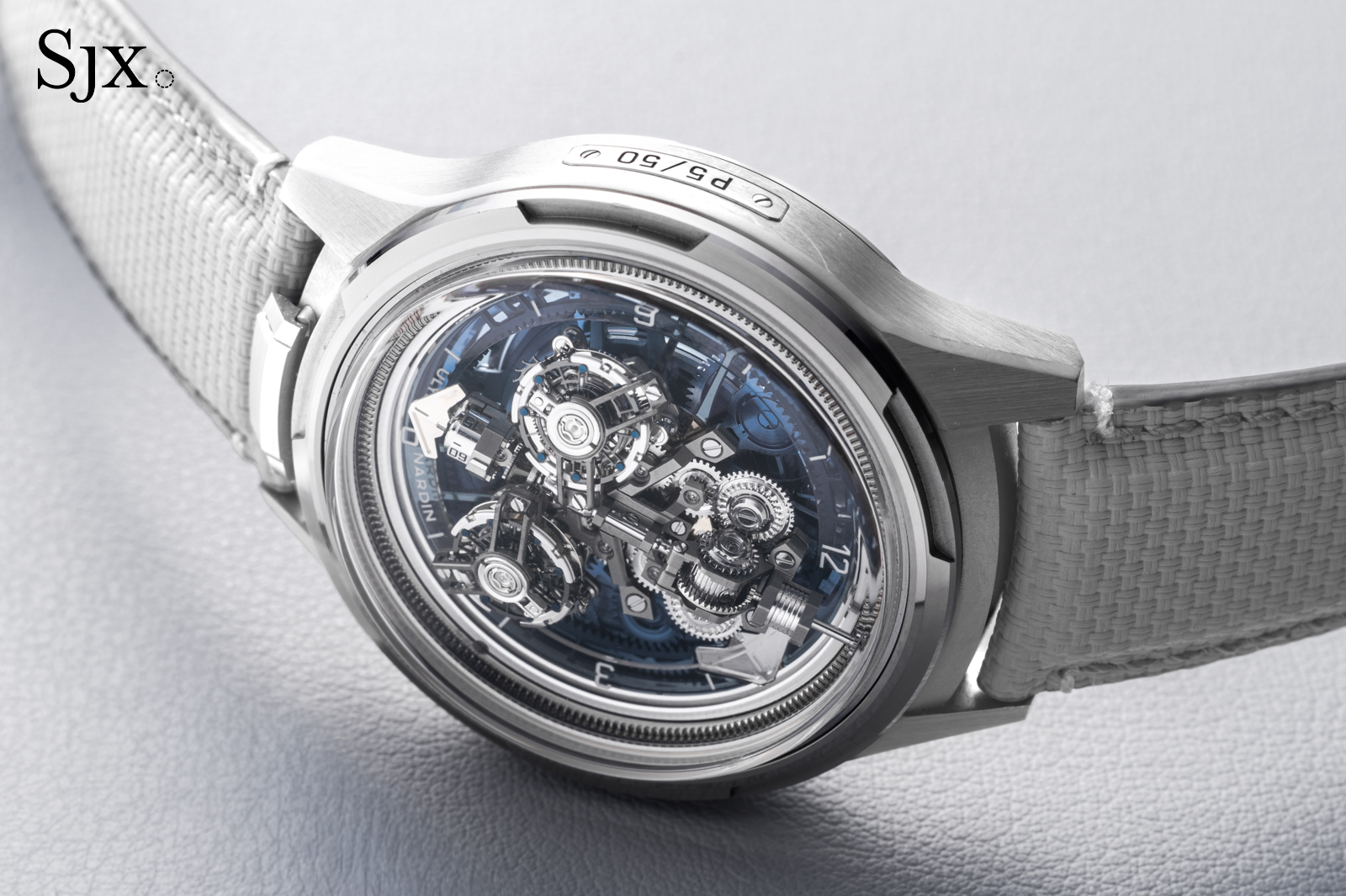
It’s also worth noting that each Super Freak is assembled from start to finish by a single watchmaker. Only five watchmakers from UN’s Haute Horlogerie department were selected to complete the demanding task.
Concluding thoughts
The Super Freak feels and wears less like a complicated wristwatch and more like a mechanical manifesto. It is pointlessly complex for a time-only watch but remains — much like the 2001 original — a mechanical spectacle.
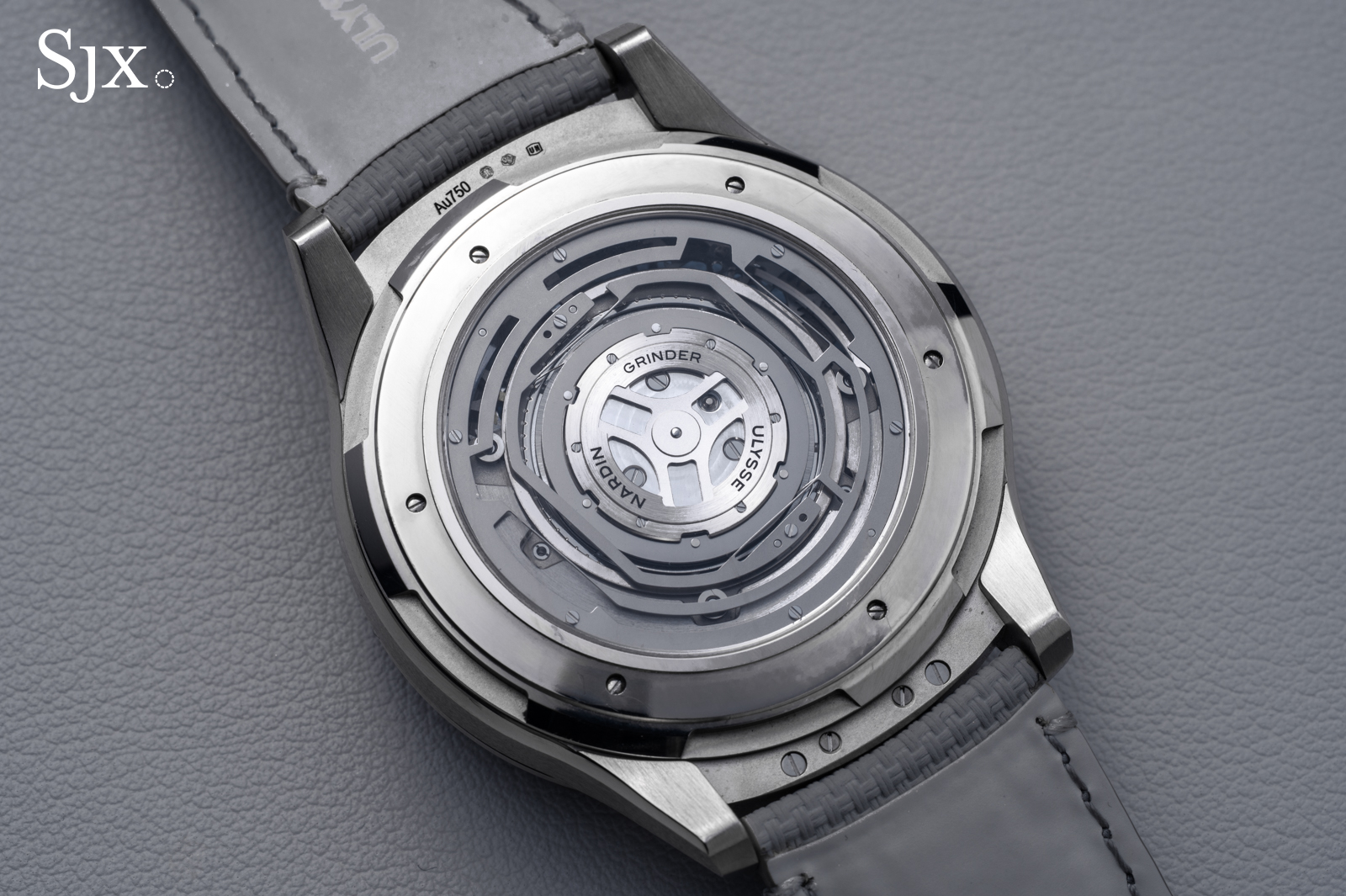
Playing on a mix of layers and textures, UN managed to fit twin flying tourbillons and a novel transmission line onto an already heavy and difficult architecture. In short, the Super Freak reaffirms UN’s place as one of the most technically competent and inventive players in the industry today.
Key facts and price
Ulysse Nardin Super Freak
Ref.2520-500LE-3A-BLUE/3A
Diameter: 44 mm
Height: 16.54 mm
Material: White gold
Crystal: Sapphire
Water resistance: 30 m
Movement: UN-252
Functions: Hours, minutes, and seconds
Winding: Automatic
Frequency: 18,000 vibrations per hour (2.5 Hz)
Power reserve: 72 hours
Strap: Rubber strap with titanium folding clasp
Limited edition: Yes, 50 pieces
Availability: On request from Ulysse Nardin
Price: CHF320,000 including 8.1% VAT
For more, visit Ulysse-nardin.com
Back to top.