
Urwerk’s Reimagines Entry-Level UR-100V in Ceramic
"Lightspeed" in fibreglass-ceramic composite.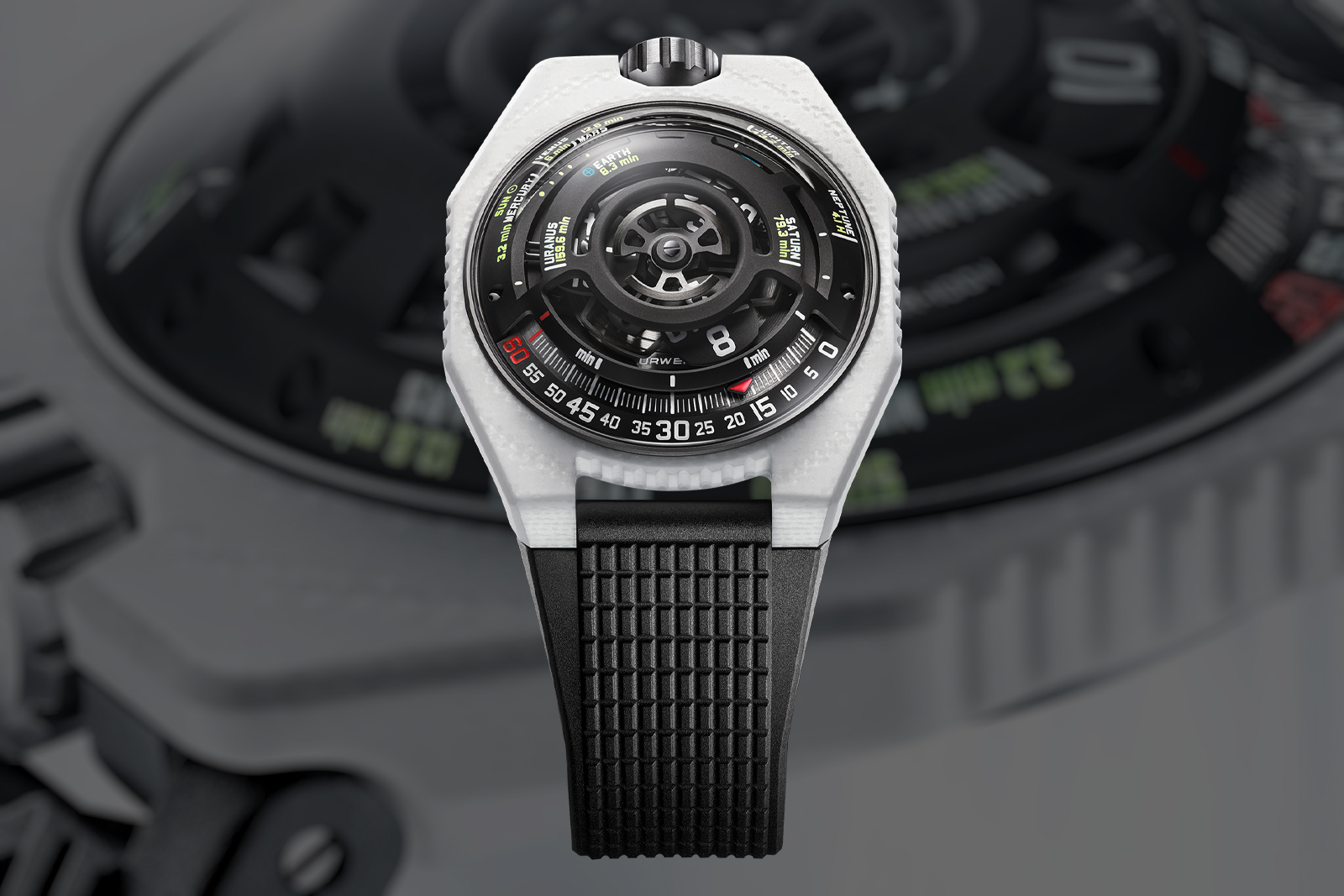
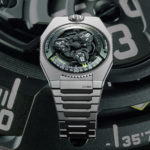
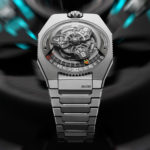
Urwerk continues to iterate its most accessible model with the UR-100V “LightSpeed” Ceramic. The Lightspeed is essentially a variation of an earlier model, with ceramic composite replacing carbon composite. The ceramic composite incorporates fibreglass and carbon fibre, giving it a textured surface and greater strength.
Though it’s relatively affordable compared to other Urwerk models, the UR-100V still retains the brand’s signature elements, including a wandering hours display and various astronomical-time indicators on the dial.

Initial thoughts
The UR-100V now exists in a multitude of variations, perhaps too many, but the Lightspeed stands out as one of the most interesting in both material and style. The ceramic composite case is appealing for both its appearance and utility – it is hard, strong, and lightweight – and is being used for the first time by Urwerk. It also doesn’t cost that much more than earlier versions of the model, making this iteration more compelling.
More broadly, I would have liked Urwerk to vary the display across the UR-100V line, beyond the case material, making each iteration more distinct. As they stand, most share the same dial and indications, with only the case changing for each edition.
Light and white
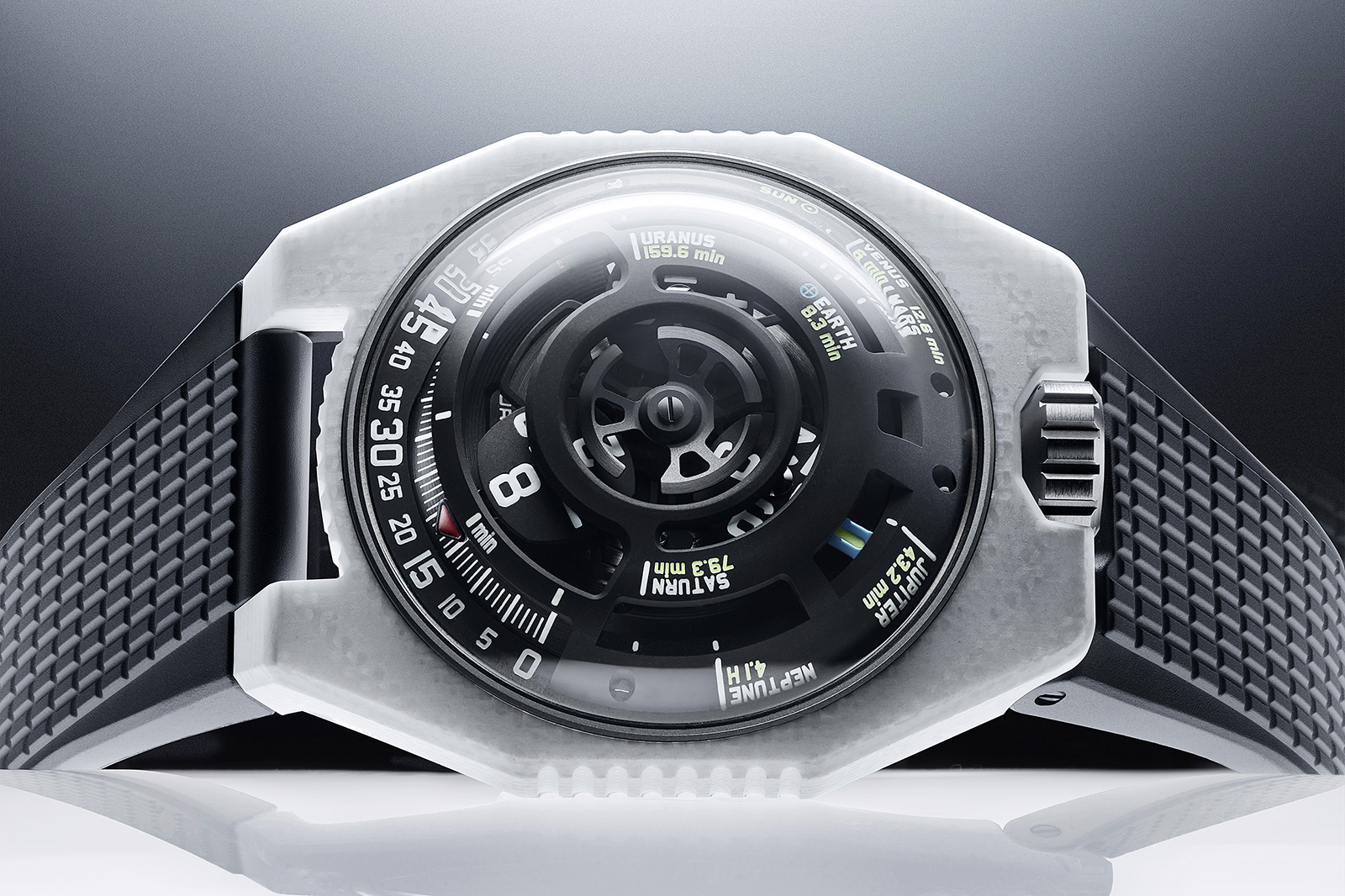
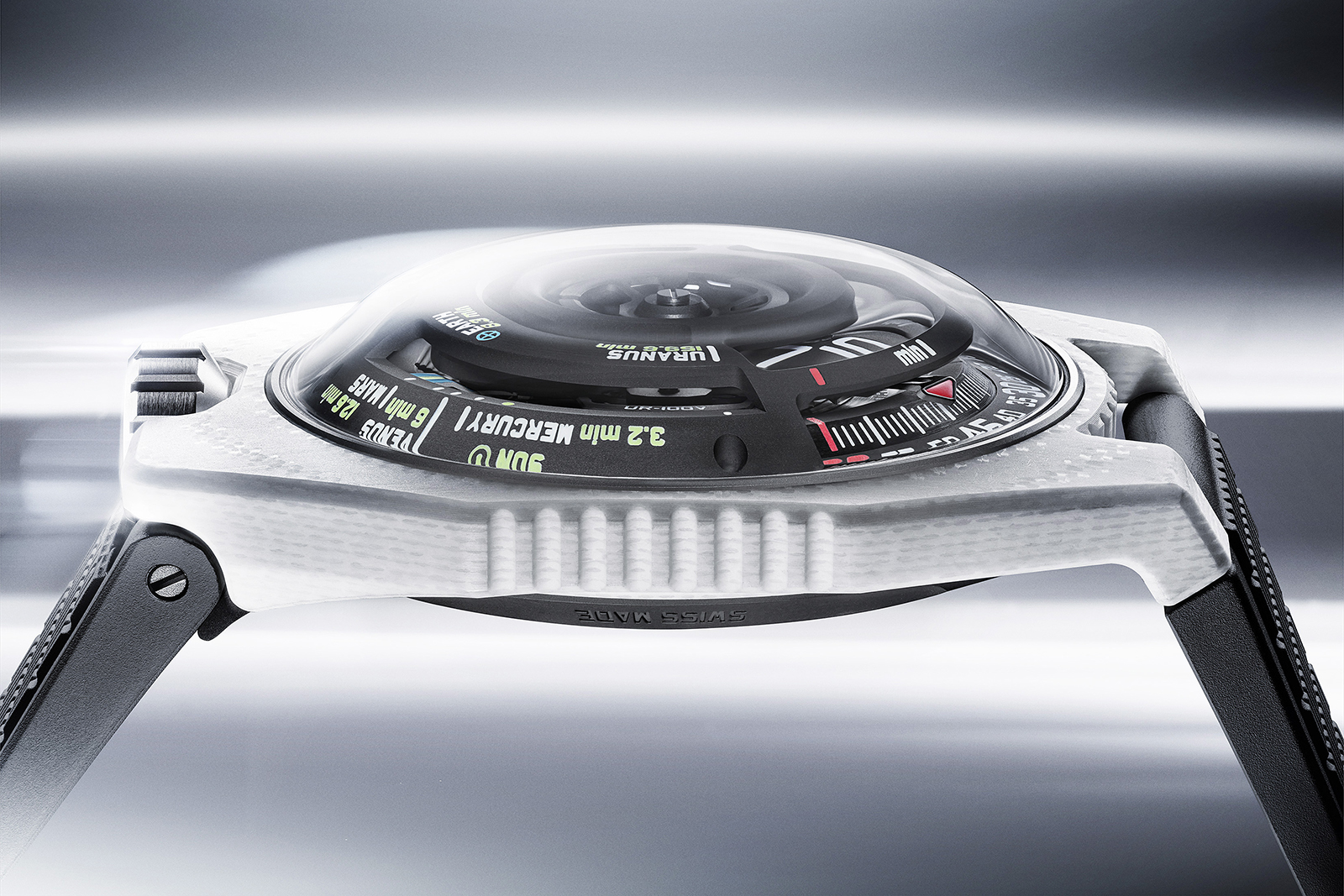
Because the case is a ceramic composite rather than pure ceramic, it has a textured surface with a slight glossiness. These characteristics stem from the fibreglass and carbon fibre sheets within the composite, explaining the woven pattern visible within the composite. While the Lightspeed case is white, the ceramic composite can be executed in a wide variety of colours so model variations are possible in the future.
The ceramic composite case has the same dimensions and construction as its carbon composite counterpart from 2024. Thought it’s similar in style to the original series of UR-100 models with conventional metal alloy cases, the construction is entirely different due to the nature of ceramic.
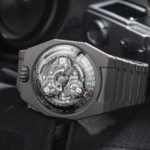
The case is actually double-layered, with the movement sitting inside a titanium inner case that is nested in the ceramic composite outer case. As is usual for Urwerk, the case back is titanium.
The Lightspeed is powered by the UR 12.02, the same calibre found in other UR-100V models. The base movement is made by Vaucher, hence the “V” suffix in the model name. It looks nothing like a typical Vaucher calibre, as the usual rotor has been replaced by Urwerk’s “Windfänger”, a turbine-like winding mechanism that’s meant to regulate the speed of winding.

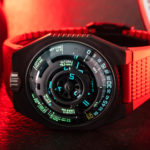
On the dial side sits Urwerk’s in-house time display module that shows the hours and minutes via orbital satellites, a “wandering hours” display that has been an Urwerk signature since the brand’s founding. A trio of aluminium satellites sit on an aluminium carousel mounted on an Arcap plate, with one of the discs indicating the current hour along with the minutes on a scale on the lower edge of the dial.
The upper half of the dial incorporates astronomical-time displays, namely the duration of time required for sunlight to reach various planets. It’s 8.3 minutes for Earth and six minutes for Venus, for instance. This is not a separate complication, but rather indicators that are built into the time display.

Key facts and price
Urwerk UR-100V “LightSpeed” Ceramic
Diameter: 43 mm by 51.73 mm
Height: 14.55 mm
Material: Fibreglass-carbon-ceramic composite
Crystal: Sapphire
Water resistance: 50 m
Movement: UR 12.02
Functions: Satellite hours and minutes; Speed of light to reach the eight planets in the solar system
Frequency: 28,800 beats per hour (4 Hz)
Power reserve: 48 hours
Strap: Rubber strap with folding clasp
Limited edition: 50 pieces
Availability: At Urwerk retailers
Price: CHF67,000 excluding taxes
For more, visit Urwerk.com.
Back to top.