

In-Depth: Understanding Resonance in Watches
The magic behind coupled oscillators.
Resonance watches are among the most elusive machines in modern watchmaking. Creations such as F.P. Journe’s Chronomètre à Résonance perform well at auctions, commanding high prices. While their rarity and appeal are undeniable, watches that purport to harness resonance tend to be viewed with a degree of skepticism. A measure of skepticism is understandable — the concept of sprung balances becoming almost magically coupled is anything but straightforward and requires a profound understanding of oscillators in general.
This story seeks to shed some light on the concept of coupled oscillators by explaining the two models of coupling and explore the nuances of each system. Before exploring resonance, the reader is encouraged to review the basics of sprung oscillators and isochronism in order to become more familiar with the hairspring and balance wheel model.
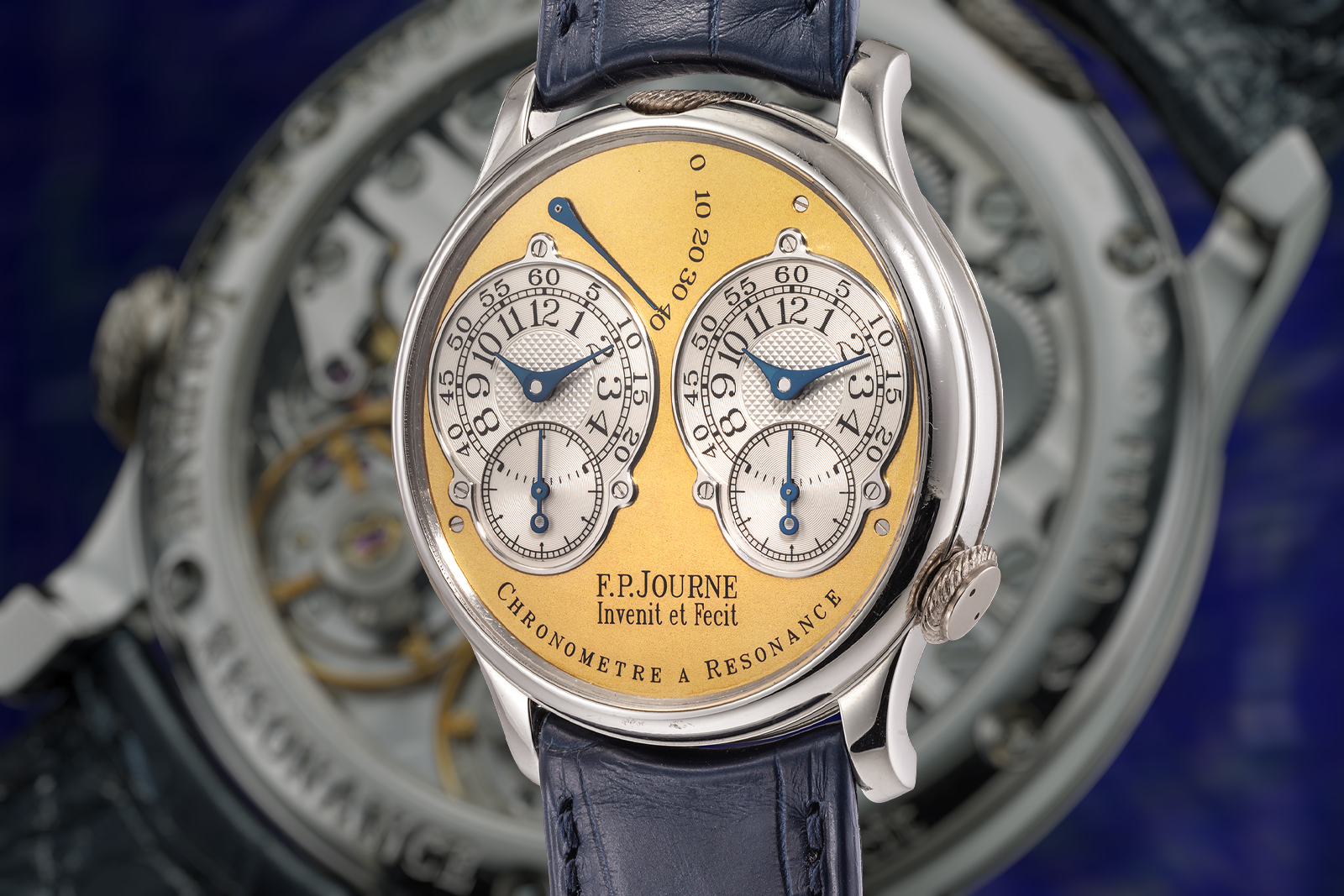
The F.P. Journe Chronomètre à Résonance Souscription No. 2 sold for more than CHF3 million in November 2025.
A confusion of terms
First, the term resonance itself requires definition. In classical physics (mechanics, electrical engineering, signal processing, etc.) resonance is a phenomenon where a system vibrates under the influence of an external driving force that matches the system’s eigenfrequency (natural frequency).
This is to say that a system at rest, which includes mass and spring elements, can be excited into a state of resonance by an external force when particular conditions are met. An important aspect of resonance is that the system may not be designed to oscillate (a building structure, bridge, piece of glass, etc.) but under certain circumstances some random outside force can engage the structure in a parasitic oscillation pattern.
Resonance occurs in many instances and can have both harmful and useful effects. Structural engineers take great measures to ensure that building structures are properly dampened to limit the risk of catastrophic resonance during seismic events. Conversely, radio signals are captured by antennas tuned to the desired frequency and their amplitudes magnified through resonance, thus making all kinds of signal transmissions possible.
Using the term “resonance” when speaking of double-balance watches is thus plainly wrong. The more accurate description is coupled sprung oscillators, since in all cases each balance has its own motor source (escapement) and they only lock in phase, not really engaging each other in motion from standstill nor increasing each other’s amplitudes. Terms such as “acoustic”, “viscous” or “air” resonance are misnomers as well.
The watch industry routinely gives examples of tuning forks or piano-guitar strings resonating when near each other and tuned to the same frequency; these instances are not true examples of coupled oscillators, but rather of real resonance. However, in order to remain consistent with what has been written and the common vernacular shared among horology enthusiasts, we will continue to call these interesting pieces “resonance watches”, as the term is evocative enough.
Some brief history
The phenomenon of coupled oscillators was famously discovered by a bed-ridden Christiaan Huygens (1629 – 1695) in early 1665. In a letter addressed to the Royal Society dated 27 February 1665, Huygens reported observing how two side by side pendulum clocks suspended on the same wall fixture (thus oscillating in the same plane) slowly locked in a 180° out-of-phase swing.
The 180° value here doesn’t refer to the relative position of the two pendulums in the physical space, but rather to the “shift” between their sine patterns. This is to say that when a pendulum was at its extreme left-hand swing position, the second pendulum was at the extreme right-hand side swing. Both pendulums reached the equilibrium point at the same time. Huygens famously called this behaviour “an odd kind of sympathy”.
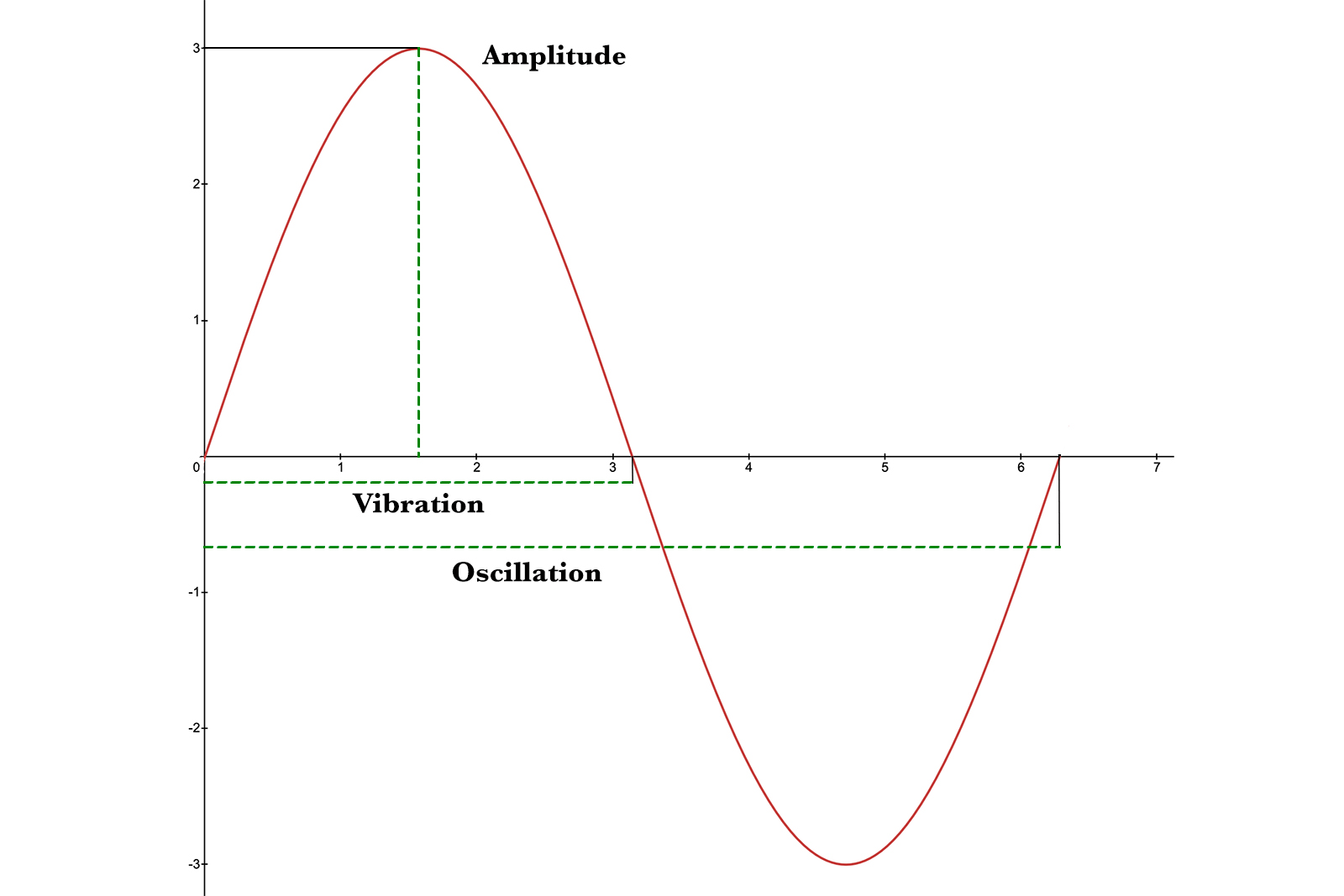
Anatomy of a sinusoidal wave.
When the Dutch scientist disturbed one of the pendulums on purpose, he noticed it took roughly half an hour for it to return to the anti-phase (180° phase offset) lock.
Huygens continued experimenting with coupled clocks, hoping that the coupling strength would counteract the rocking motion of a ship, thus enabling precision timekeeping at sea. While he didn’t manage to make such sea clocks reliable, his extensive experiments showed that two pendulums too far apart would not synchronise, and the coupling would not occur if the pendulums were placed at a 90° angle to one another, such as on perpendicular walls.
Huygens suspected that the coupling was due to some periodic tension transmitted between the two pendulums due to microscopic motion of the shared fixture. He was partly right in his assumption, but lacked the mathematical tools to further model and study the system.
Much later, French clockmaker Antide Janvier (1752 – 1835) revived the idea of using coupled pendulums in order to increase the global accuracy of standing clocks. The idea was that the lock between the two pendulums would actively keep each other in check, should any disrupting factors appear. Three such clocks have been produced under Janvier’s name and a couple others exist signed by Breguet (Nos. 3177 and 3671). While records are unclear, it appears that Janvier ran into financial distress and eventually declared bankruptcy, with fellow clockmaker A.-L. Breguet (1747 – 1823) acquiring his workshop, equipment and much of his existing stock. Rumour has it Breguet even employed a bankrupt Janvier at some point.
Breguet No. 3177, a double-pendulum clock in the style of Janvier but signed by Breguet, is on permanent exhibit at the Musée des Arts et Métiers in Paris and was restored by a young François-Paul Journe and his uncle, Michel Journe. Meanwhile, No. 3671 was made for King George IV of Great Britain and to this day remains inside Buckingham Palace.
Around the same time, the lesser-known French horologist and clockmaker Auguste-Lucien Vérité (1806 – 1887) was also experimenting with coupled pendulums. Although Vérité’s greatest works remain the astronomic clocks he made for cathedrals, he also carried out extensive experiments with coupled pendulums and electromagnetic synchronisation for clocks.

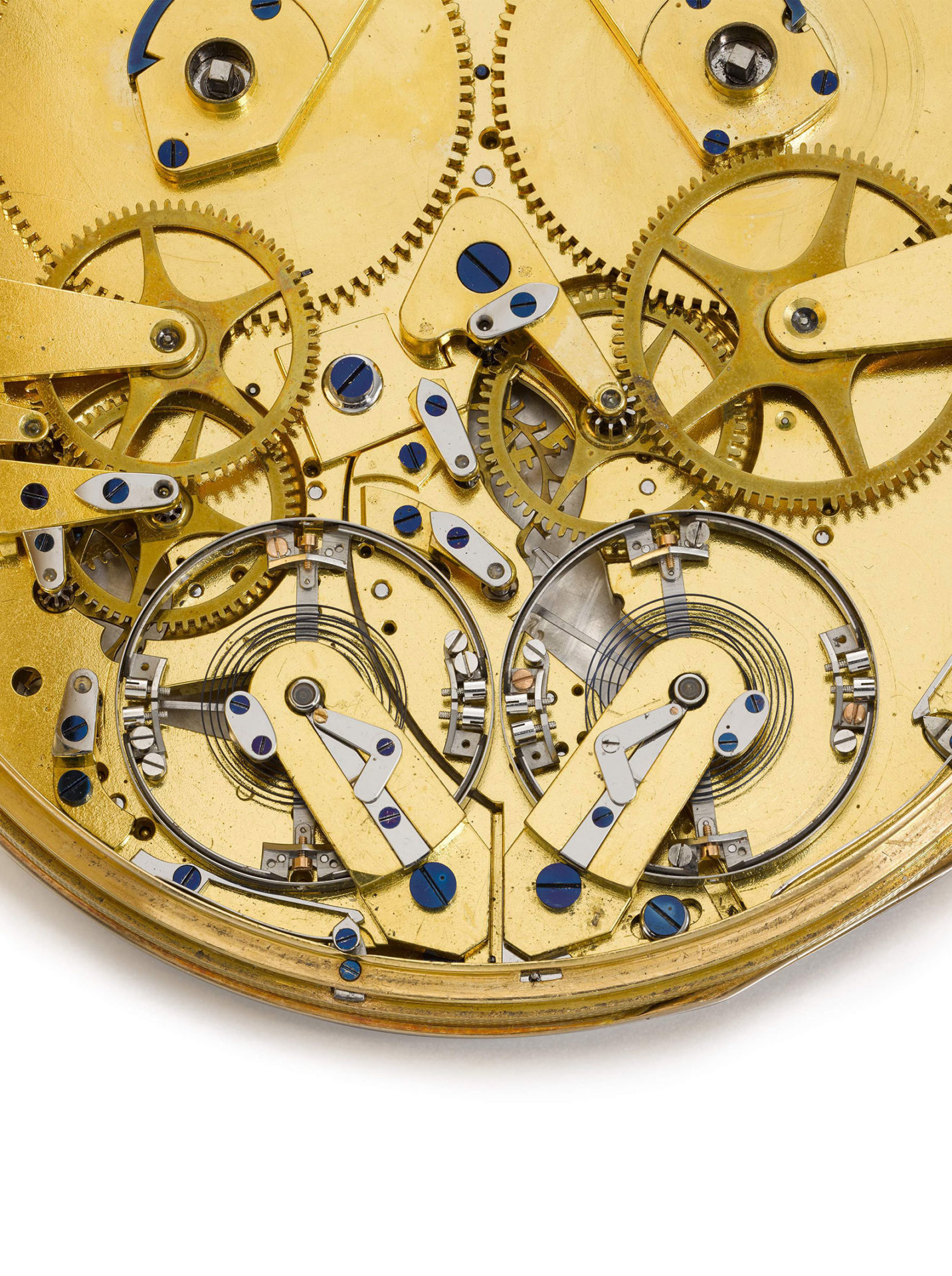
Breguet Ref. 2788
While double pendulum clocks seem to have been Janvier’s own innovation, A.-L. Breguet was definitely the first to experiment with double balance watches. He suspected that if pendulums can share energy and become almost magically coupled, then so could sprung oscillators.
There are three known pocket watches featuring this experimental design: references 2667, 2788 and 2794. The pieces clearly served as prototypes, with varying construction parameters. The general outline was that of two mirrored going trains, each powering two balances placed quite close to each other.
Breguet even added a thin “air barrier” between the oscillators to see whether synchronisation depends on the air disturbance. His experimental work with coupled portable oscillators has defined modern resonance timepieces. Thankfully that ethos of innovation seems to have been rejuvenated with the recent introduction of the Expérimentale series by modern-day Breguet.
A personal anecdote
Even though they are small, watch movements harness quite a lot of energy for their size — both potential and kinetic. Abstractly, a movement works by transforming potential elastic energy stored inside the mainspring into kinetic energy, with the escapement and oscillator setting the discharge speed of the going train. The oscillator cyclically transforms kinetic to potential energy and back, and is fed additional kinetic energy every cycle by the escapement — since there are consistent energy losses involved in real systems.
The key to the resonance phenomenon lies in the fact that watch oscillators (as closed systems) sink a great deal of energy into the environment (rest of the movement). In order to describe the strength of the energy transfer between the oscillator and its environment, I’ll recount a short personal anecdote.
A few years back I was fiddling around with an undistinguished automatic movement of Asian make. The dial-side plate had a large date complication and the two digit disks were in need of synchronisation. While examining some components separately, I left the running movement resting dial-side up on its well-lubricated automatic rotor.
It didn’t take long for the entire caliber to start gently rocking, turning on the rotor pivot. So while the rotor remained still (“ground”), the movement itself was swinging, seemingly under the action of the running oscillator. The whole caliber oscillated with an amplitude of less than 5° in each direction — probably inside the inactive clearance of the automatic winding gears.
My initial amusement left aside, this unintentional experiment revealed how strong the energy exchange of the sprung oscillator with the environment really is. The movement as a whole, laying flat, could only be assimilated to a reduced inertia block — so definitely not a natural oscillator model.
If a simple sprung balance was enough to put in motion a much larger inertial block, then it became clear to me that wha we’re calling “resonance” can definitely appear between two balances in specifically built wristwatches, should the conditions be right.
By studying and comparing specialised research literature on the subject of coupled pendulums, I concluded that horological resonance as we’ve come to know it is indeed very real and supported by scientific fact. This article will try and shed some light on how resonance timepieces really work and see if there is a clear analogy between sprung oscillators and gravity pendulums.
Two types of coupling
Early in researching the subject of coupled sprung oscillators I realised something important: there must be two types of coupling, which work quite differently. Take the eloquent example of Armin Strom timepieces, where the two balances are linked by a large “Resonance Clutch Spring”, which joins the outer pinning points of the two hairsprings via a sloping, rigid spring.
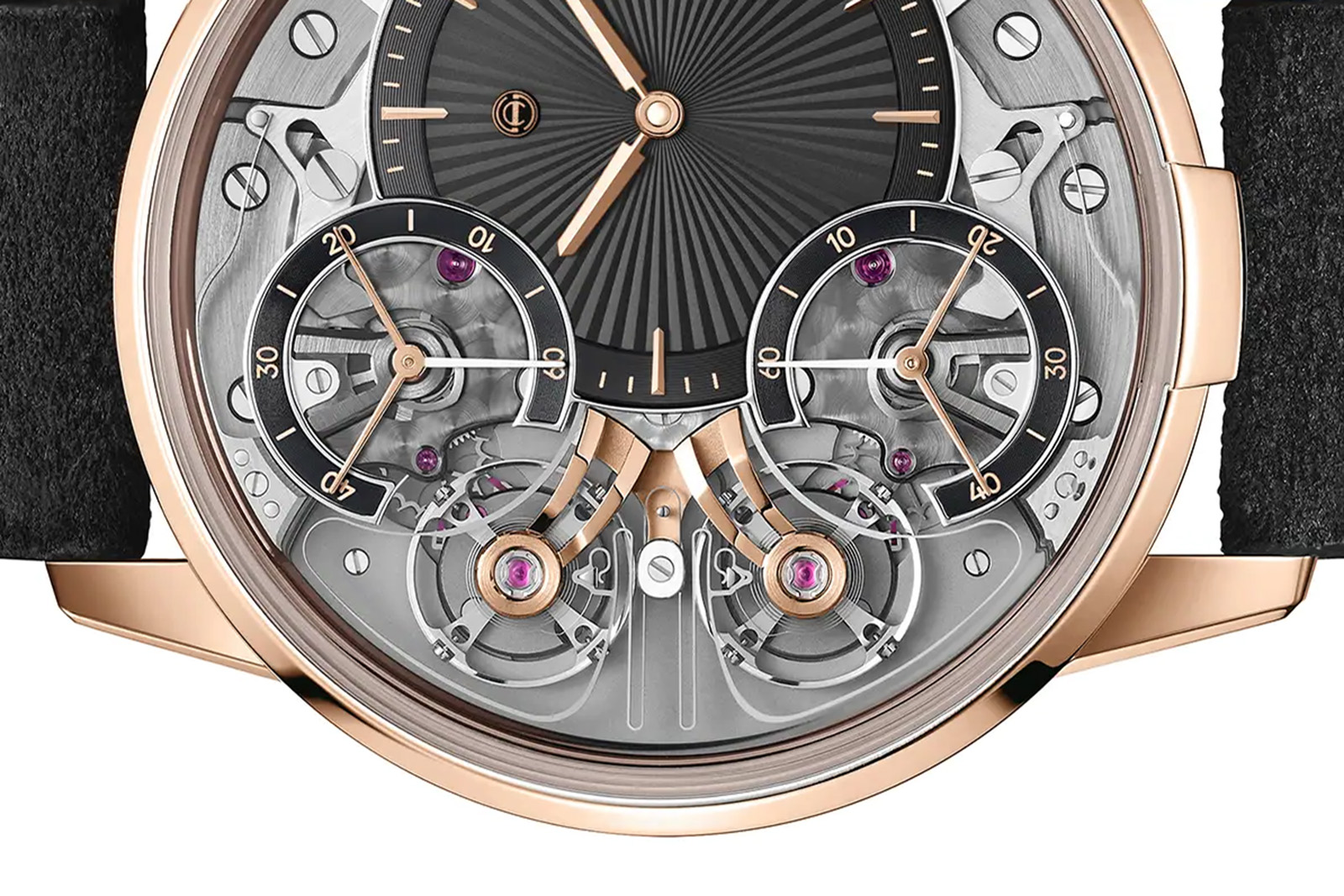
“Resonance Clutch Spring” as seen in Armin Strom Mirrored Force Resonance pieces. Image – Armin Strom
Back to my anecdote involving the rocking watch movement, there was no question of any elastic elements, so the energy transfer making the entire movement gently swing was purely inertial in nature.
Then there was also the issue of whether air has any say in the coupling effect. While surely vibration and mechanical energy can be transmitted indirectly from an input to an output through a fluid medium (theory of sonics), the transfer heavily depends on the geometry of the components involved. The torque converter found in most of the automatic transmission cars works by transferring motion and torque from one propeller to another, through a thick fluid. The system works because the two propellers share the same rotation axis, have optimised geometries for generating fluid drag and the liquid they rely on is dense.
Resonance watches are built with conventional balances, rotating about parallel axis — so the lateral air disturbance between them is negligible. There are rumours (probably rooted in truth) that a diligent collector placed his F. P. Journe Chronomètre à Résonance inside a vacuum chamber and confirmed that anti-phase lock still occurred. A similar experiment was carried out by Breguet himself, who noted that synchronisation would still occur even in reduced pressure or vacuum chambers.
As such, it became clear that sprung oscillators can be coupled either elastically or inertially. This story will explore how the two systems work, their differences and advantages.
Inertial coupling
In standing clocks or wristwatches like F.P. Journe’s Chronomètre à Résonance, there is no direct physical coupling between the oscillators, other than the shared main plate. This points to the idea that kinetic energy is shared between the two through the rigid fixture alone. Literature on the subject of coupled pendulums treats the rigid frame as subject to some very small periodic displacement — thus itself having some kinetic energy.
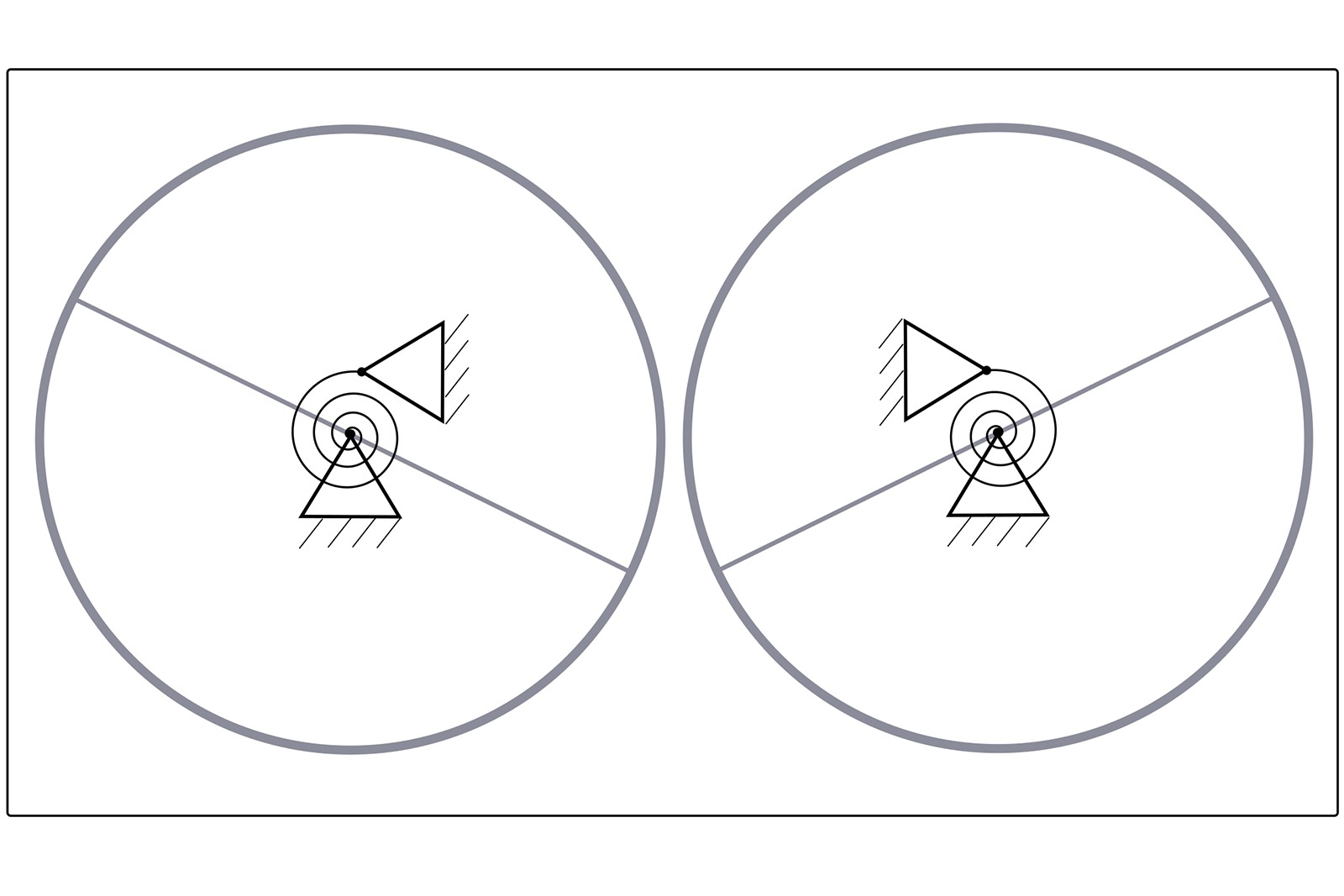
Figure I. The inertial coupling model, with the hairsprings rigidly pinned to the mainplate. The two sprung oscillators and the movement are considered a closed system.
When adapting that framework to watches with sprung balances, it is safe to assume the plates joining the oscillators are subjected to some degree of unknown, microscopic motion resisted by their inertia.
Since classic Newtonian physics fails in accurately describing this particular system, we’ll use Lagrangian mechanics. This is perfect for modelling conservative systems, where energy is only transformed between states. Our model in Figure I is that of two ideal and identical sprung balances (spring angular stiffness k, balance inertia I), fixed on the same rigid frame of inertia J.
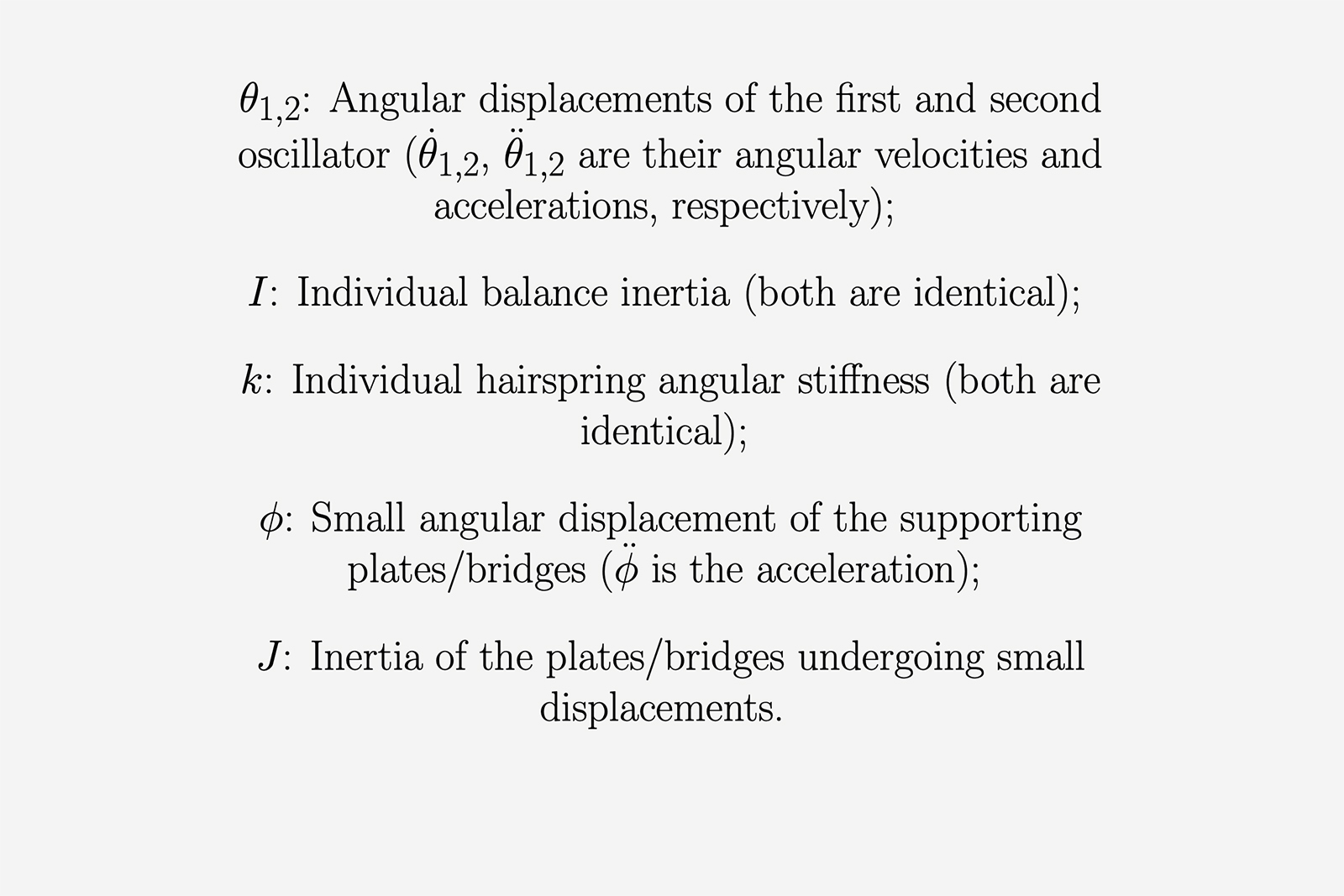
The coiled hairsprings’ inner ends are fixed to their respective balance staffs and at their outer pinning points to the rigid frame — nothing out of the ordinary here.
Writing the Lagrangian (assuming some degree of angular motion in the joining plate), we can derive three equations of motion, dependent on the three generalised coordinates: the individual angular displacements of the two balances and the assumed infinitesimal angular displacement of the fixture.
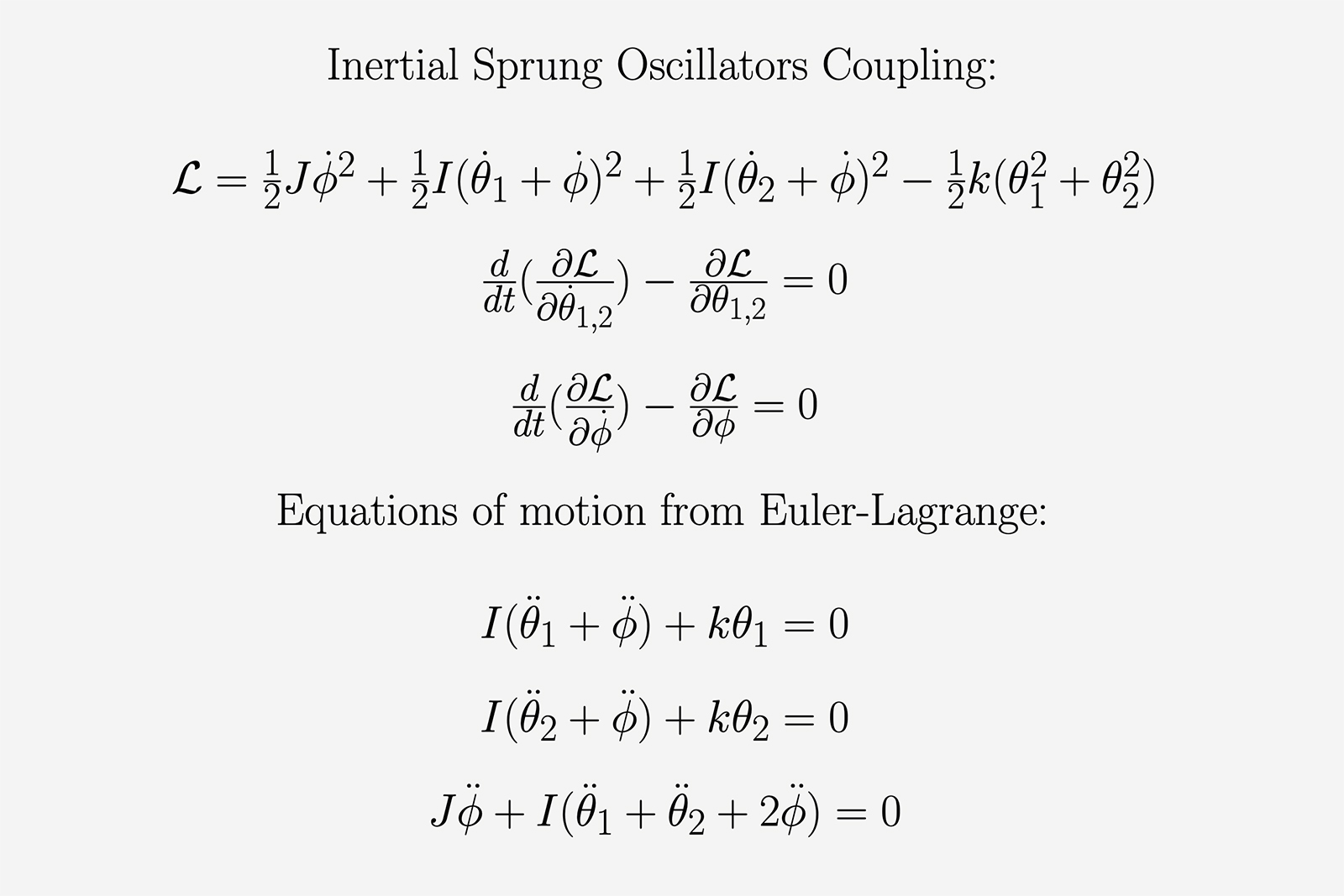
Solving the system of differential equations involves some linear algebra but finally we get two solutions. The first solution is the in-phase mode, where the two balances move in the same direction in sync with a specific pulsation; the second solution describes the anti-phase mode (balances swing in opposite directions, phase offset by exactly 180°) with its own pulsation.
The solution describing in-phase lock involves a pulsation dependent on the plate inertia J. Moreover, the in-phase solution suggests the supporting plate itself oscillates, which real world observations clearly confirm to not be the case.
This leaves us with the anti-phase mode. This mode is observable in all F.P. Journe Chronomètre à Résonance models: the two balances are in sync, but when one swings clockwise, the other mirrors its motion in the counterclockwise direction. The pulsation of each oscillator is simply the one established for all sprung oscillators, independent on the plate’s inertia. Moreover, the plate’s supposed displacement is in fact zero — which might sound paradoxical since we started our reasoning by assuming the plate had some degree of motion.
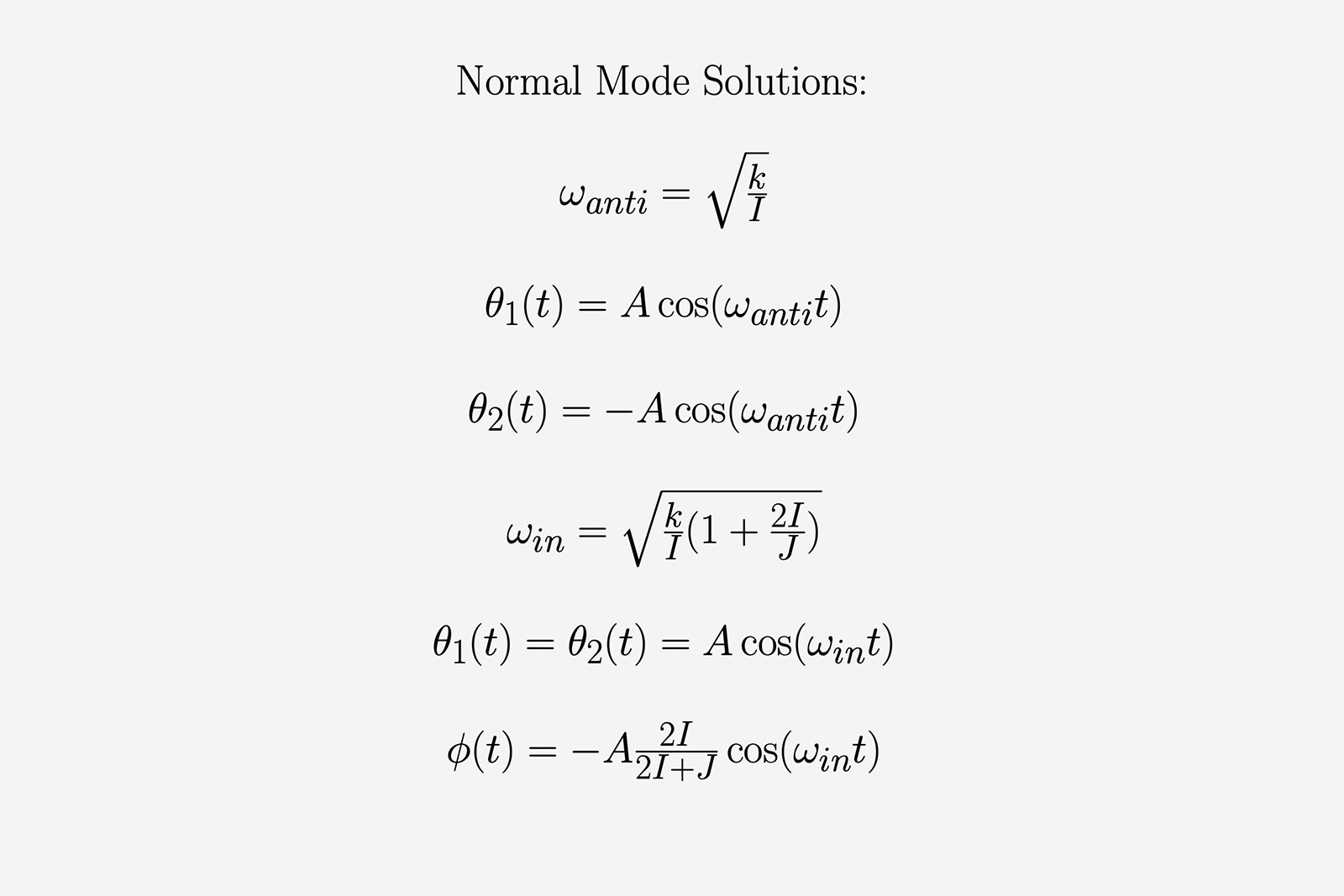
So what happens here and how is energy exchanged between the two balances? It all seems to be related to the angular momentum of the system, which is actually the key to this sort of coupling. The angular momenta of the two balances cancel each other out, leaving the plate perfectly still, while still exchanging energy. This may not seem like much of a revelation, but the fact that the anti-phase mode of this setup exists mathematically and is supported by a motionless plate practically confirms the existence of balance synchronisation solely through a rigid plate.
Vector calculus teaches us that in any spinning system the angular momentum is perpendicular to the rotation plane, co-axial with the rotation axis. The momentum’s orientation (plus or minus sign) depends on the direction of rotation.
When the balance is swinging counterclockwise (as seen from the case back movement’s side), its angular momentum is oriented against the balance cock jewel. When it switches to clockwise direction at maximum amplitude, its angular momentum switches signs and now pushes the staff against the baseplate plate jewel.
The angular momentum has the highest values when the balance’s velocity is the highest — when impulsed by the escapement near the equilibrium point, and the smallest momentum when it swings back, coerced by the hairspring. Between these two limiting values, the momentum practically oscillates perpendicular to the watch movement’s plane.
Considering the movement a closed system, the angular momentum is conserved. This means the plate responds in order to adjust to this cyclic change in the angular momentum. While the response is weak, there is some reaction force generated on the rigid plate, which syncs up with an mirrored one imposed by the second oscillator.
When in anti phase, the angular momenta of the two balances cancel each other out, leaving the plate under no tension and not needing to compensate. As one balance swings in a direction, its momentum has a given value and orientation; the other swings at the same speed, but in the other direction, so its momentum has the same value but an opposite orientation (sign). The two vectors continuously cancel each other out.
This is almost certainly what happened with the swinging calibre on my desk: every time the balance switched its direction of swing, the whole system (the movement itself) needed to compensate for the change in angular momentum, thus rocking slightly from side to side.
Elastic coupling
Elastic coupling (Armin Strom being the premier example here) relies on a direct and dynamic link between the two hairsprings, forcing the energy exchange. Because the studs are not rigidly pinned, they undergo some quasi-linear displacement as the balance oscillates and the spring “breathes”. A way of parametrising this amplitude-dependent linear displacement is by a simple term α ( considering 0<α<<1) having the units of length. Since the spring’s end tends to be displaced the most at the highest amplitudes, this linear characterisation suits well our needs.
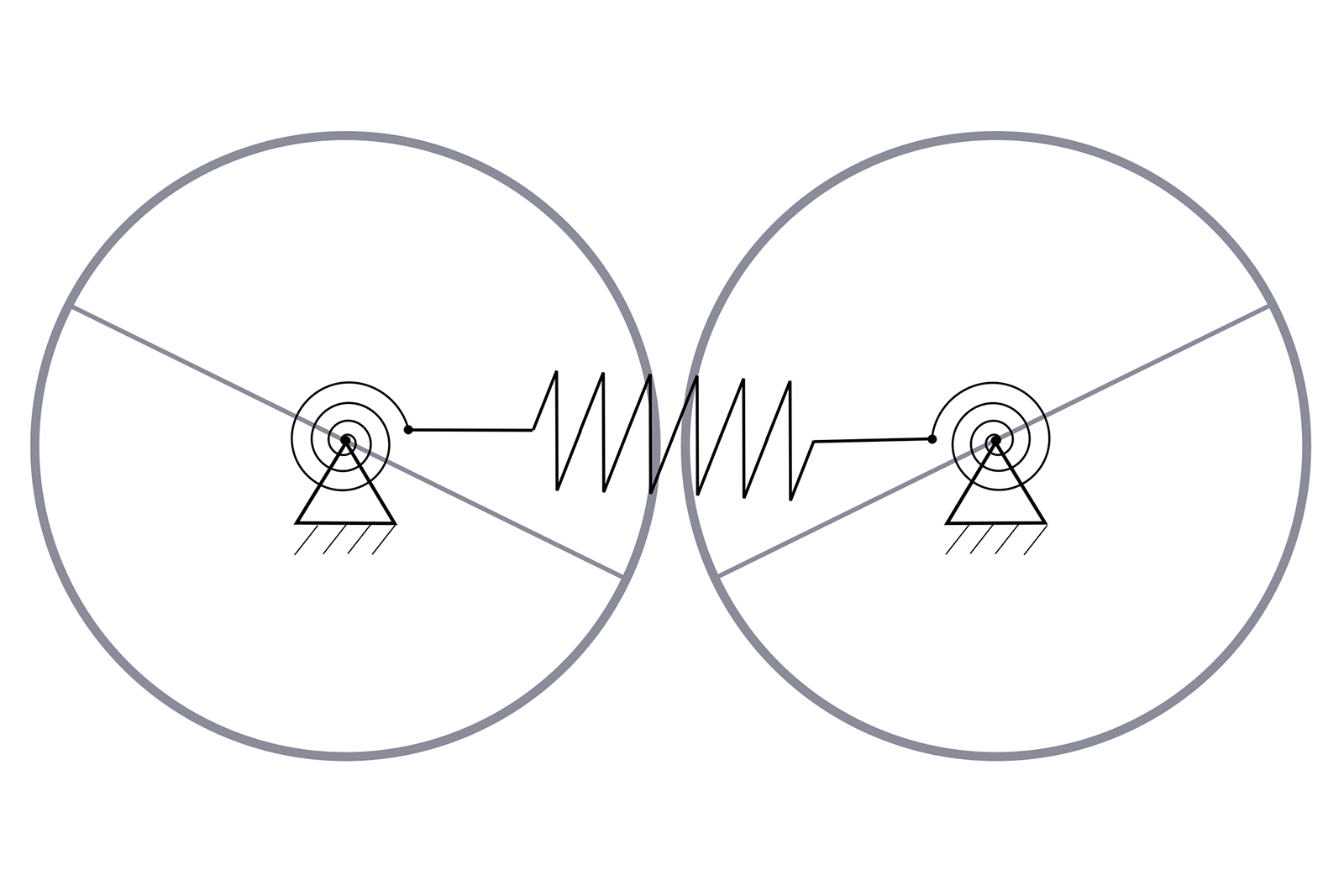
Figure II. The two hairsprings are pinned to an elastic spring and are allowed some degree of freedom.
There is also the question of the large spring joining the two pinning points: it has its own stiffness and some non-negligible mass. For this model we’ll assume each pinning point along with half of the spring to have a mass m. Thus the entire assembly (two studs and a large spring) can be modelled as two m masses joined by a massless ideal spring of stiffness Ks, as shown in Figure II.
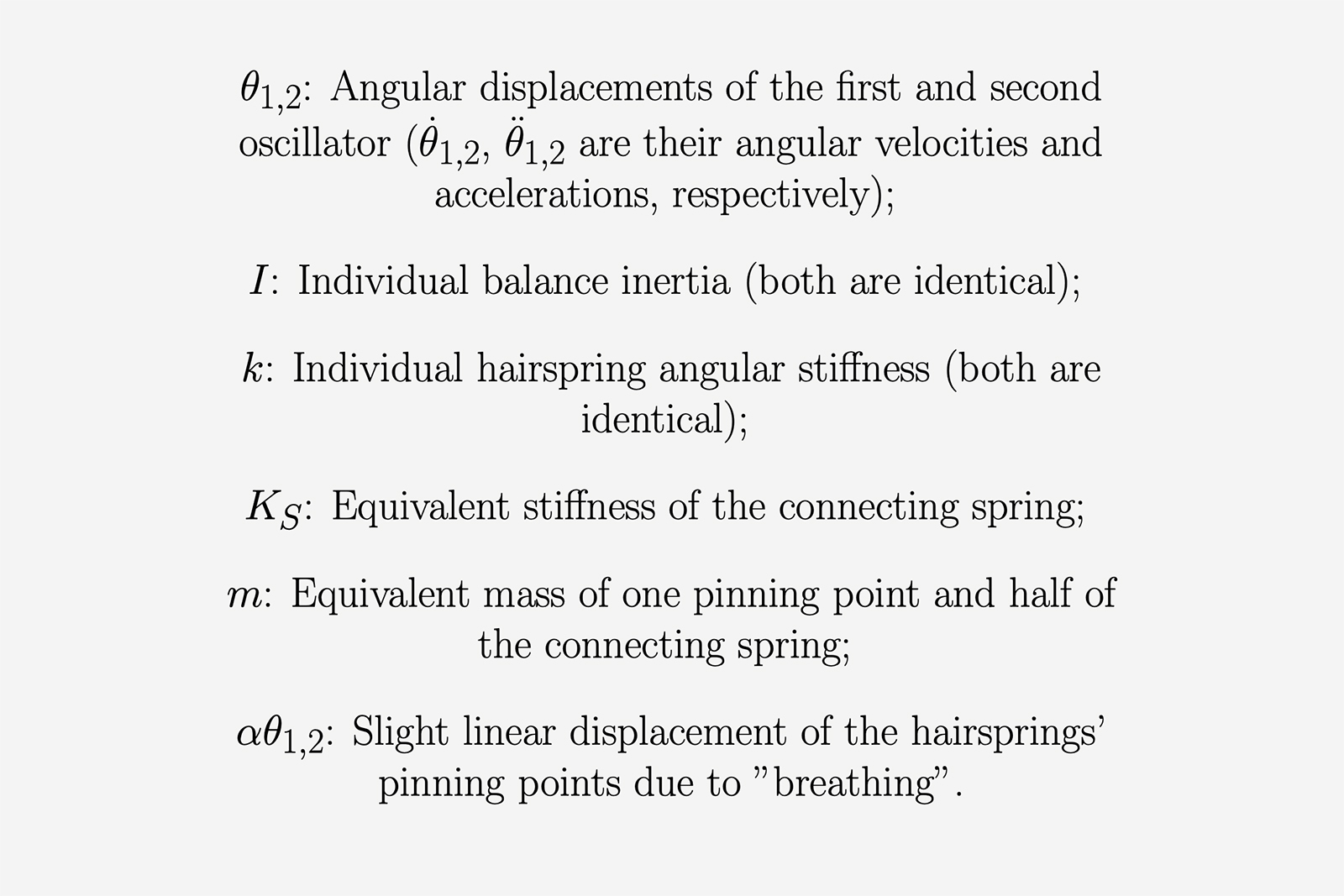
This completes our model: two sprung balances linked together by a spring. Now we can write the Lagrangian for the system, combining both angular and linear kinetic energies. Solving the Euler-Lagrange equation we are left with two equations of motion for the two systems, each a second-order differential function of the balances’ angular displacements.
Solving the differential system through the usual methods (here specifically taking the ansatz approach) we are left with two solutions, each supporting the in-phase and anti-phase normal modes.
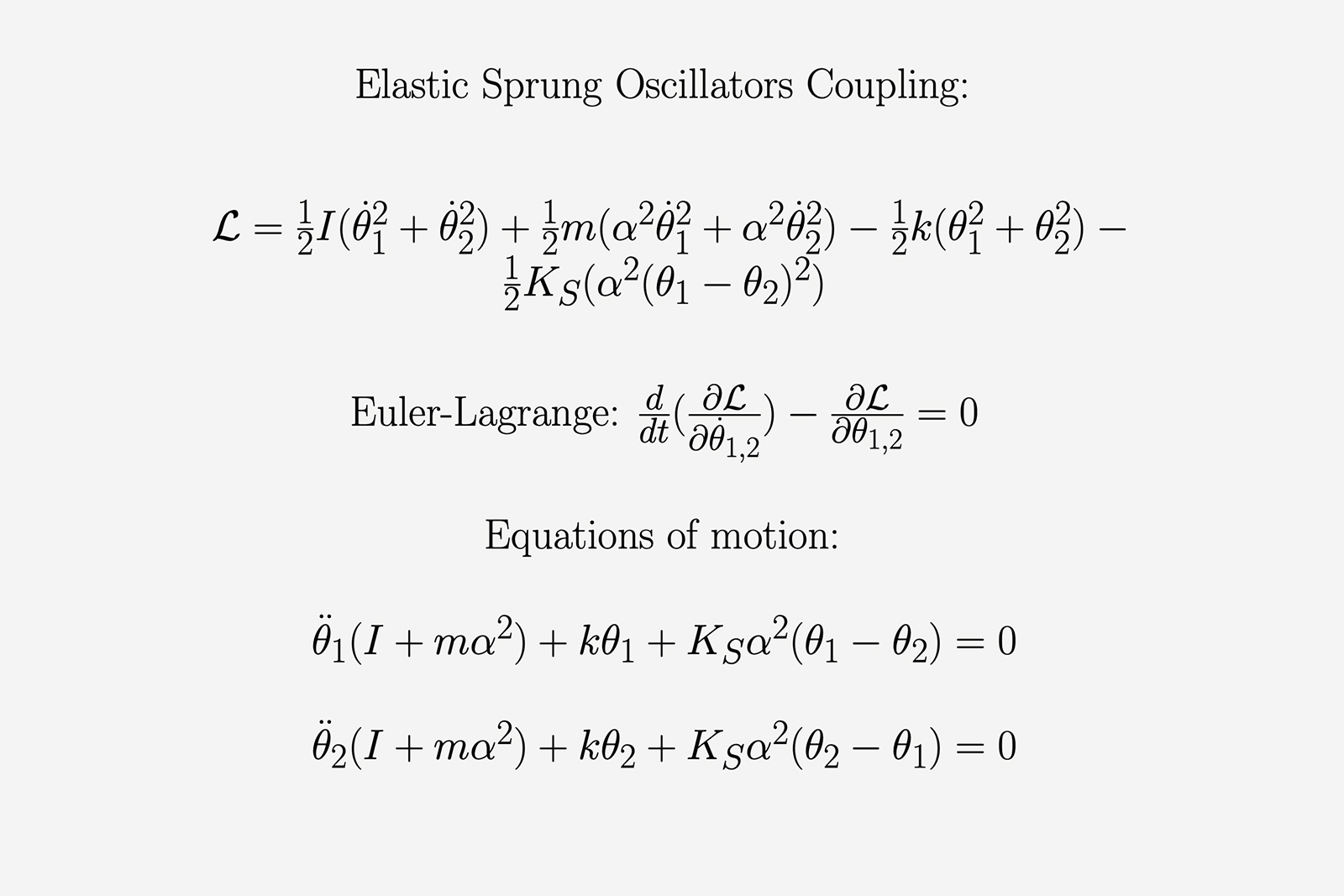
The in-phase mode corresponds to the linking spring not being tensioned or compressed at all and behaving like a rigid link. The two balances would oscillate in tandem in the same direction and the linking spring would rock to their rhythm.
The anti-phase mode corresponds to the maximum energy exchange through the linking spring, with it being cyclically compressed and stretched by the opposite-swinging balances. Having the spring undergo this motion also heavily modifies each oscillator’s own pulsation — it involves the spring’s stiffness and also the added inertia.
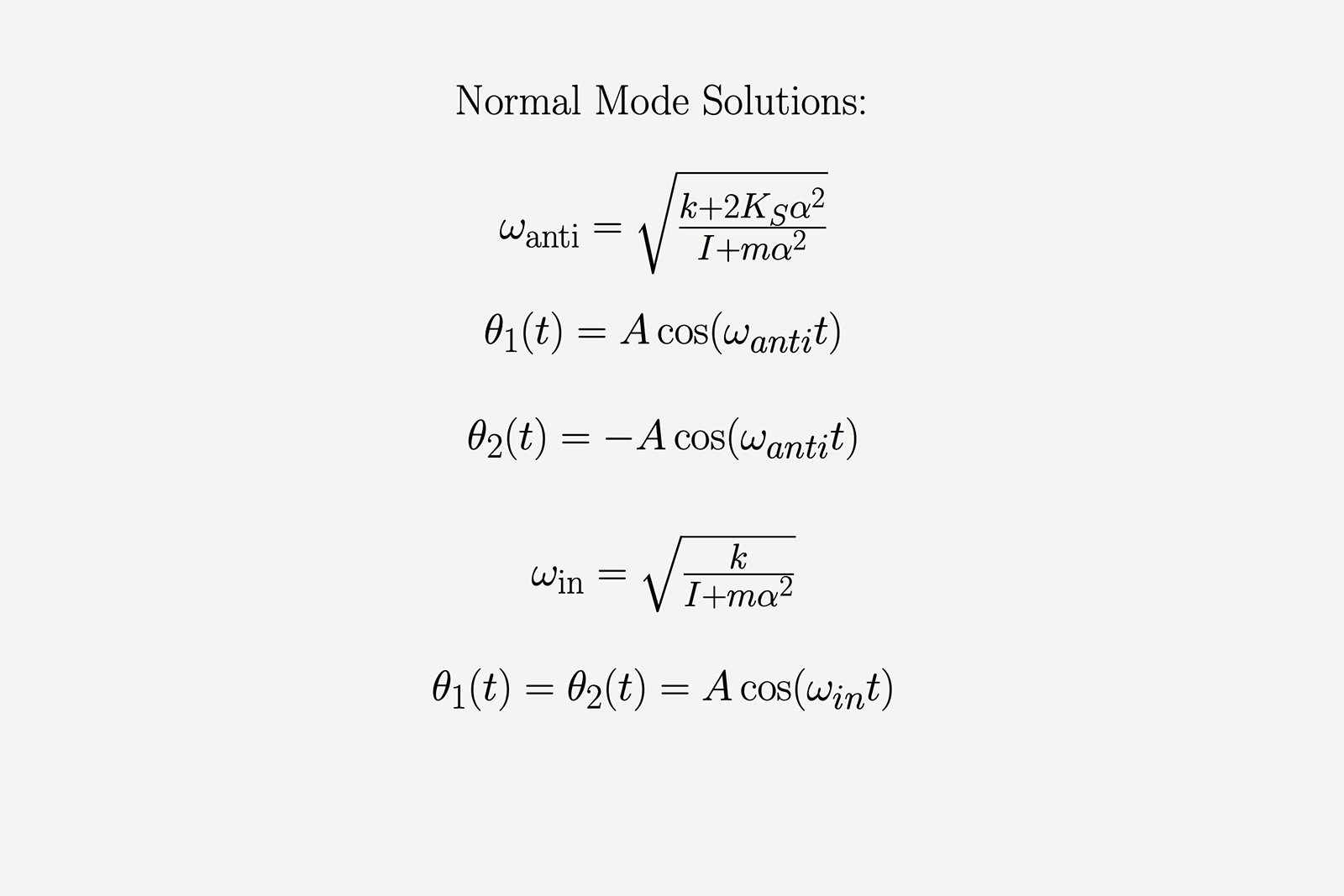
The anti-phase mode is prevalent, since the energy exchange through the active linking spring is maximal. The large spring “breathes” along with the two hairsprings, ensuring a stable synchronicity between the two.
Since the three springs act much like a serial link, the particular pulsation of each of the two oscillators also depends on the coupling spring’s stiffness in the anti-phase mode. The stiffer the coupling spring, the more will the oscillators deviate from their nominal frequencies, thus requiring some additional regulation after the watch is assembled.
Coupling strength
In order for the oscillators to have a chance at becoming coupled, some conditions need to be met. For example F.P. Journe claims their two balances need to be regulated within a 5 seconds/day (s/d) window of each other in order for synchronisation to occur.
Armin Strom on the other hand states that their elastic coupling spring allows the two oscillators to become coupled even if there’s a 250 s/d difference in their rates. This is 50 times more indulgent than F.P. Journe’s very tight clearance. In fact, for coupling to take place inside the Chronomètre à Résonance, the two balances need to have a 99.994% identical rate, while for Armin Strom models the same requirement sits at a lower 99.7%.
In the case of elastically-coupled oscillators, the locking range is proportional to the ratio between the coupling spring’s stiffness and the individual stiffness of the hairsprings. The ratio is greater than one, since the thicker coupling spring is clearly more rigid than the hairsprings, hence the broader locking range.
In the case of inertial coupling, we can guess the locking range and strength are proportional with the ratio between the individual balance wheel inertia I and the supporting plates’ inertia J. Clearly J is much larger than I, so the ratio is less than one. If J is large enough (which is usually the case), the ratio I/J approaches zero — making for an interesting behaviour.
If we return to the two modes of inertial coupling and consider the I/J term to be approaching zero, we see that the in-phase mode tends towards the anti-phase mode. This behaviour was observed with pendulums as well, with the system almost always settling towards the anti-phase mode, since the fixture usually possesses a much larger inertia compared to the oscillators.
All things considered, in terms of wristwatches, elastic coupling tends to be perceived as more stable as secure, since the spring coerces the two balance wheels to interact. So in a case of shock or other disturbance, the elastic coupling might prove faster in bringing the balances back into sync than the subtler inertial lock.


There are also questions of proximity and rigidity. How close should inertially coupled balances be placed for them to become synchronised? How rigid and heavy should the fixture be? All F. P. Journe Chronomètre à Résonance movements are built with a movable plate carrying one of the balances and the escapement. The plate appears to pivot around the fourth wheel’s arbour and aims at bringing one balance either closer or further apart from the second.
Once the perfect position is found, the plate is fixed in place by tightening a screw. Any adjustment of the plate is done by the large screw placed at the very center of the movement. The system is making to a rack and pinion interaction and allows the watchmaker to tweak the plate’s position with great precision.
Advantages and classifications
The two oscillator coupling models presented both achieve the same result — having two balance wheels locked together, keeping each other in check. In theory, if one oscillator is upset and loses its beat, the other will drag it back into the right oscillating pattern. The reasoning is sound, but usually a shock powerful enough to disrupt one oscillator will probably do the same to the second.
So what is the catch? If both oscillators are disrupted, then why bother and try to get them coupled in the first place? Is it just a pointless (and pricy) science experiment for the wrist? While surely resonance watches serve as great and appealing pieces of high horology and exhibit unique craft, there is also some chronometric merit to them: better resistance to positional errors.
While the coupling between two oscillators becomes useless in case of shocks, it is of great use for countering the positional errors caused by gravity. Assuming that small defects (a heavy bias on the balance wheel, uneven breathing of the hairspring etc.) appear in both oscillators, if they beat in a locked anti-phase mode the errors have a good chance of canceling each other out.
The breathing of the hairspring creates uneven development in the inner and outer coils, thus causing the spring’s center of gravity to shift during oscillations, creating a weight bias. If the two hairsprings are mirrored (physically offset by 180° like in Armin Strom models), the defect induced by the outer coils’ development is bound to be canceled out in horizontal positions.
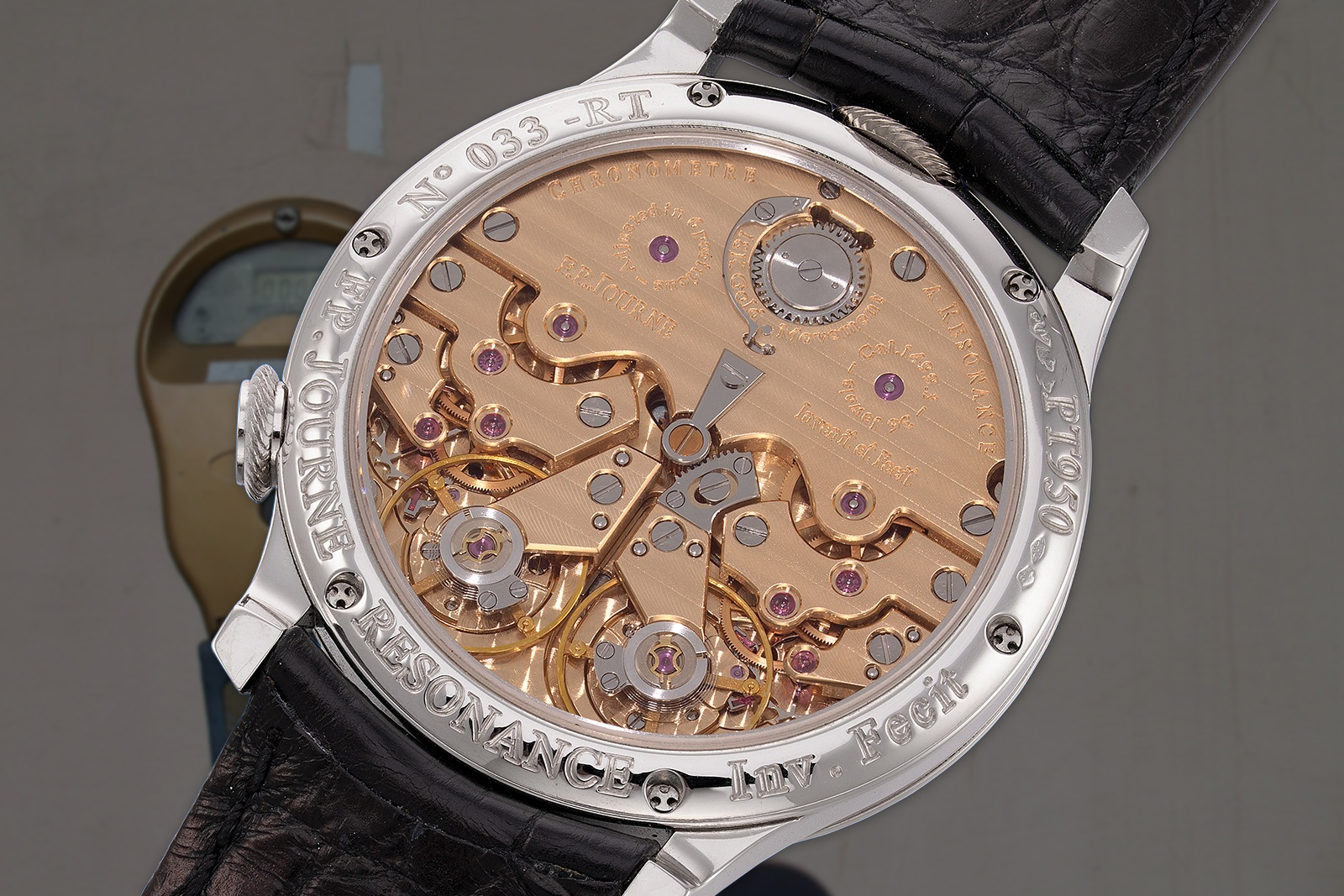
F. P. Journe goes for a 90° offset between hairsprings, which might help with canceling out the inner coils’ uneven development defect. In any case, the tendency of one balance wheel to either speed up or slow down will be met with resistance from the second balance wheel. So even though the coupling will not prove of much use in the case of most shocks, the watch will generally posses more stable and consistent chronometric behaviour overall.
While there aren’t that many resonance watches on the market, we can still attempt a short classification of the most well-known models.
The F.P. Journe Chronomètre à Résonance is clearly a textbook example of inertial coupling. The two going trains, escapements and balances are fully independent (although the latest model features a single barrel feeding the two going trans via a differential) and there is no direct elastic link joining the oscillators. Any exchange of energy happens solely through the rigid fixtures, via compensation of the angular momenta.
On the other hand, Armin Strom’s Resonance model features elastically coupled oscillators, with the hairspring ends’ adjoined by a “Resonance Clutch Spring”. This model is perceived as a more reliable and direct system, but also lacking the magic of the purely inertial coupled oscillators.
The Halidmann H2 Flying Tourbillon Resonance is not as easily classifiable. The system is comprised of two sprung balances, each with its own escapement but feeding off the same going train. The oscillates are mounted on a light flying tourbillon cage and the hairsprings’ pinning points are joined by a thin blade spring having some degree of motion.
Having the pinning points linked via an elastic element suggests that the H2 falls into the elastic coupling category. But also being mounted on a revolving tourbillon platform, I suspect there is also some degree of inertial lock involved. Available videos online show the H2 exhibiting both in- and anti-phase beating modes — thus supporting my guess that energy exchange happens both elastically and inertially, giving rise to a composition of modes.
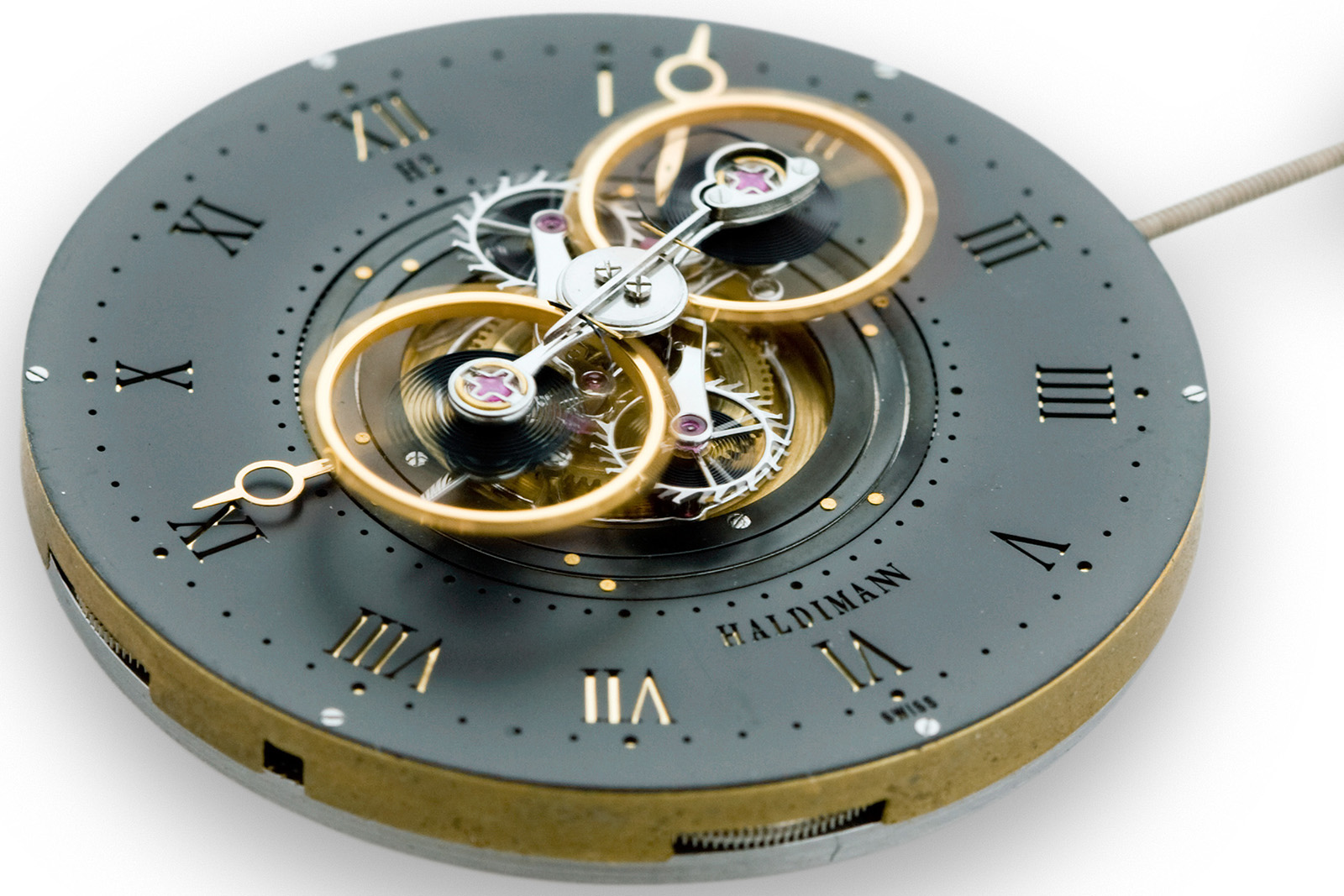
Haldimann H2 Tourbillon Resonance uncased prototype movement. Image – Haldimann Horolgy
Lastly there is also the Vianney Halter Deep Space Resonance, a dynamic extravaganza featuring a three-axis tourbillon and two balances sharing the same axis. The two hairspring pinning points are fixed to the same stud, but that’s a rigid link — so no question of elastic coupling. The particular setup of the two balances might actually improve the exchange of energy between them and angular momentum compensation, but also lends the system a degree of instability: Halter notes that sometimes the balances will sync in-phase, other times in anti-phase. Probably it is a question of mode composition. In any case the Deep Space Resonance falls in the inertial coupling category.

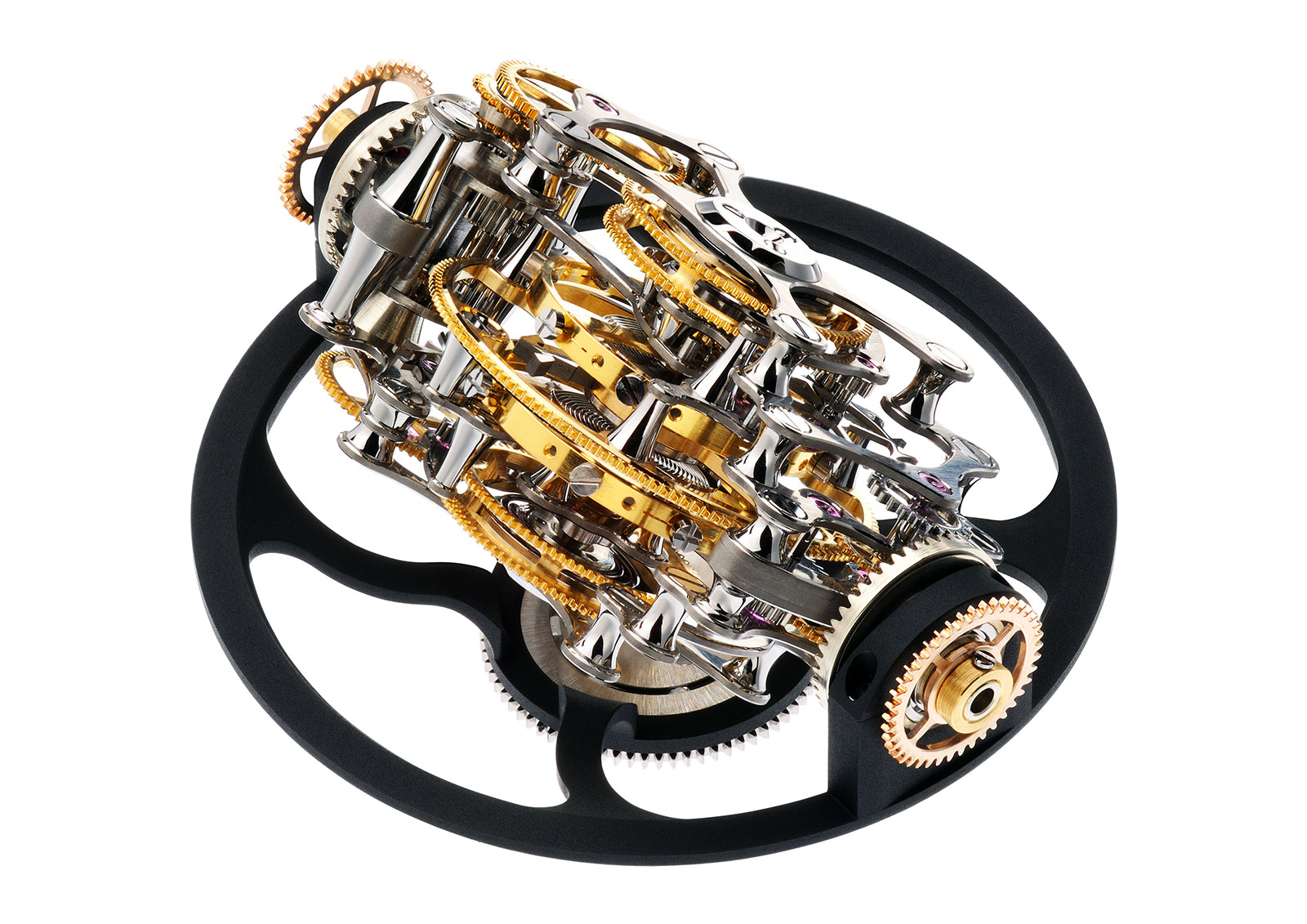
Cage assembly for the Deep Space Resonance. Image – Vianney Halter
Limitations of the model
The two systems discussed so far are ideal models of conservative harmonic oscillators, with no escapement function involved and no losses. The model also never discusses whether the two oscillators are started “out of phase” — meaning that they start oscillating from different angular positions.
The current simplified mathematical model gets away with this by simply assuming the two balances are started from the same position. This assumption stems from the fact that in a real watch the two balances would begin oscillating from the idle equilibrium position when the movement is wound up from run down.
However, real balances aren’t guaranteed to start from the exact same position, and the mathematical model presented here would in fact lock and preserve that initial difference indefinitely, regardless of the normal mode of the beat.
Real-life experience shows that “resonance” watches sync up perfectly after some time, regardless of the initial difference in position. This probably has to do with the controlling effect of the escapement, which induces a quasi-identical “check” in both balances, thus presumably correcting any initial angular difference.
The model discussed here should serve as a good starting point for a rigorous and profound research concerning coupled sprung oscillators as found in wristwatches. There is consistent work in the field of control theory concerning coupled pendulums, but very little, if any, of that work is focused on sprung oscillators. Perhaps some proper research on the subject of wristwatch resonance will be done in the future.
Back to top.