
Complicated Collectors: Edgar Mannheimer
A survivor with an instinct for value.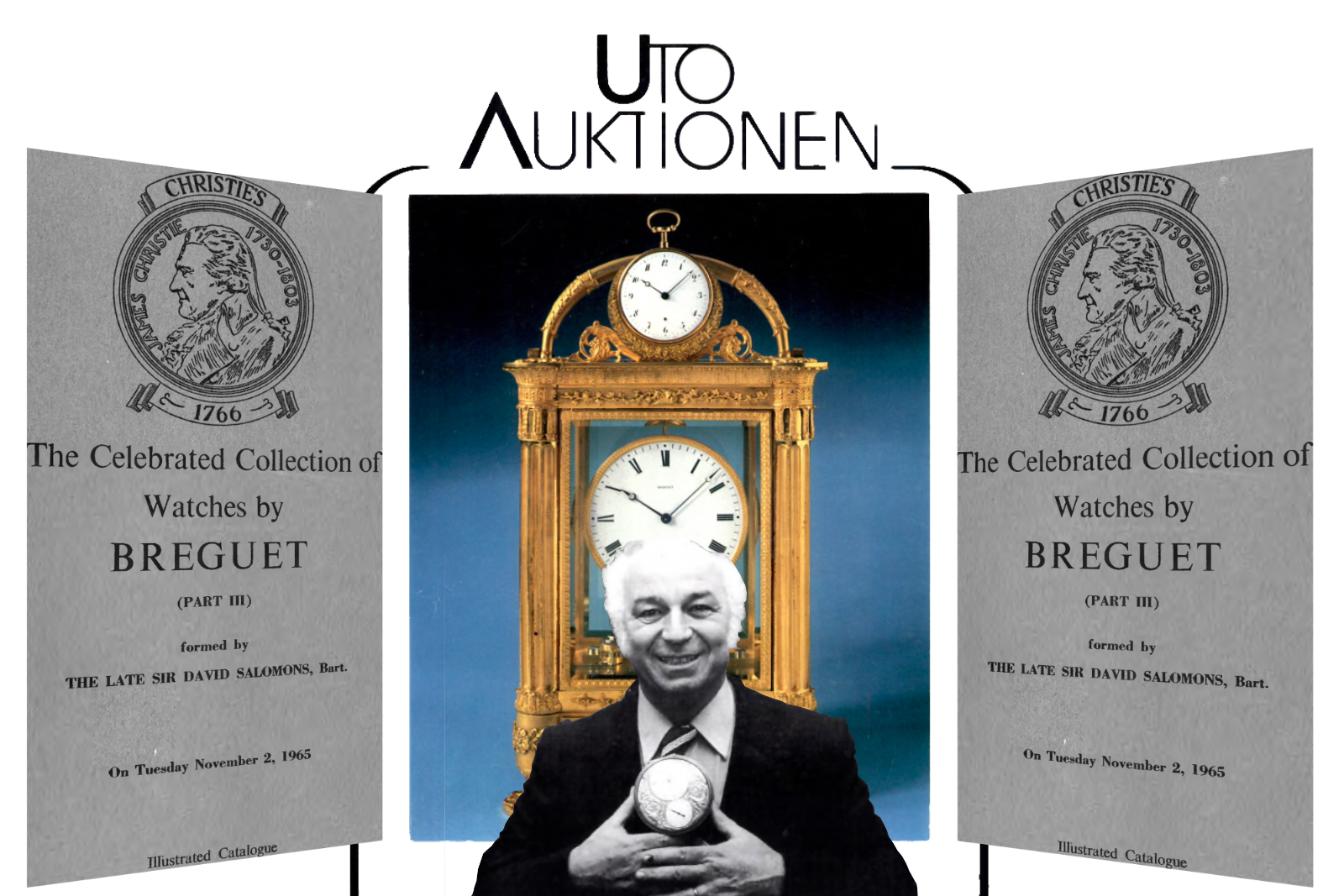
London, 1965. Christie’s had arranged the third and final part of the Sir David Salomons Collection for sale — a sequence of Breguet watches assembled by the Victorian baronet whose obsession with Abraham-Louis Breguet had produced the most important English-language study of the watchmaker’s work. When the bidding closed, one man had bought every lot in the catalogue.
Continuing our ongoing Complicated Collectors series, Edgar Mannheimer left an indelible mark on watch collecting. He was 40 years old, and had settled in Zurich a decade earlier with nothing but the instincts he had developed in the post-war black markets of Germany. He was not a collector in the sense that he did not keep what he bought. What he did, with a consistency and conviction that separated him from every other figure in the mid-century horological trade, was understand, ahead of the market, what something was worth.
The Salomons lots were subsequently divided between two collectors. It was, in miniature, a portrait of how Mannheimer operated: he absorbed the risk, resolved the complexity, and left his clients with the watches.
Neutitschein and Auschwitz
Edgar Mannheimer was born on December 23, 1925, in Neutitschein, Moravia, into a family whose presence in the town was visible and established. His father ran Marsmalz, a confectionery business prominent enough to operate the community’s first delivery van — a small but telling detail about the family’s position within a world where Jewish commercial life and Central European civic identity still intersected with some degree of normality.
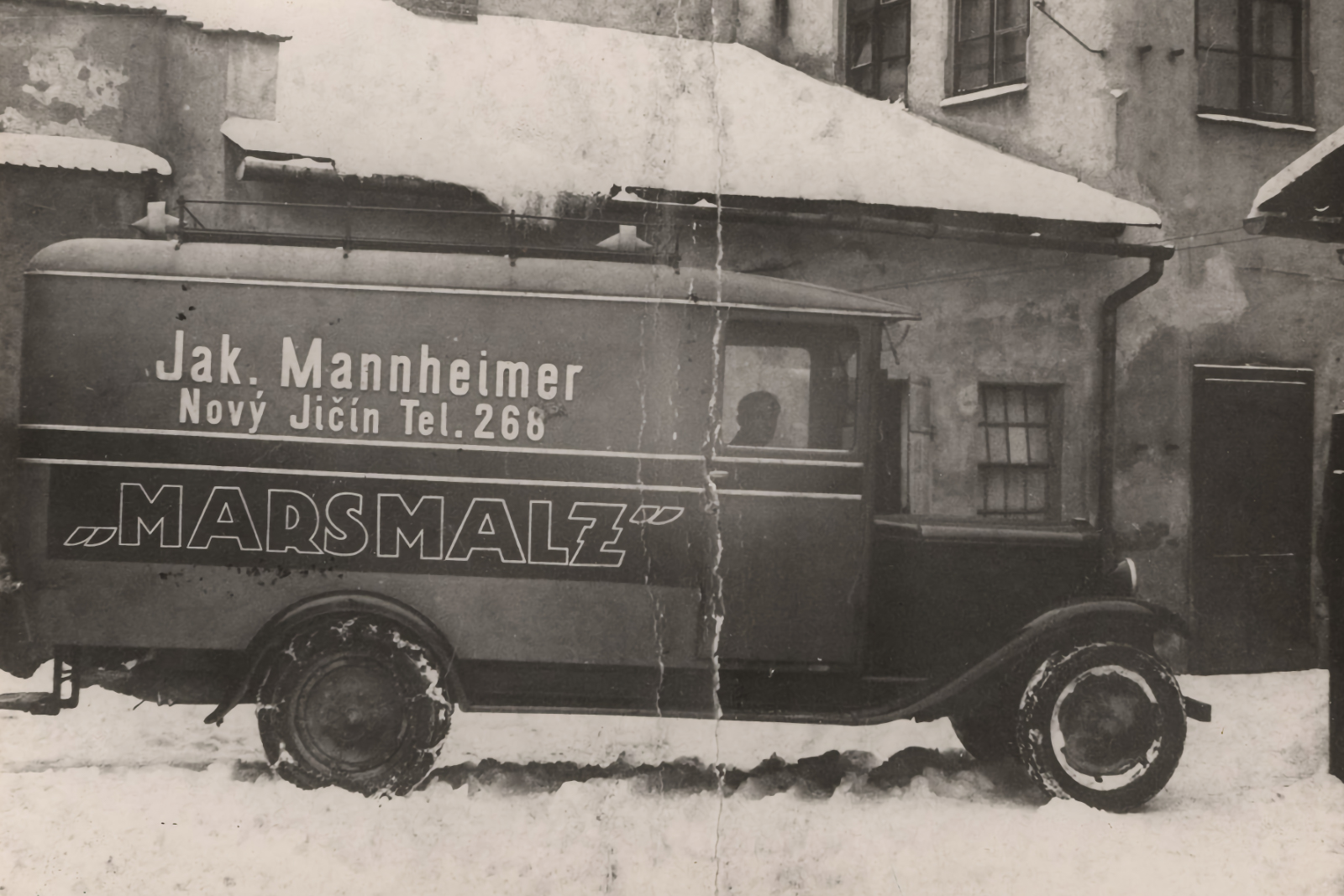
The Marsmalz family truck. Image – Mannheimer family.
As a boy, his ambitions ran to racing cars and mechanical engineering. That world ended before he turned 13. After German forces occupied the Sudetenland, his father was arrested during Kristallnacht, and the family fled to Ungarisch-Brod, his mother’s birthplace in Moravia. When the Germans occupied the Protectorate too, flight ceased to be an option. In January 1943, the family was transported to Theresienstadt before being separated and sent on to Auschwitz-Birkenau.
Mannheimer survived through a skill he had learned by chance: shoemaking, acquired informally before the war. In Auschwitz, it kept him alive. He worked first in the prisoners’ cobbler workshop making wooden clogs, then in the SS cobbler workshop repairing leather boots. The work was, as he later said, more bearable than carrying cement at a run.
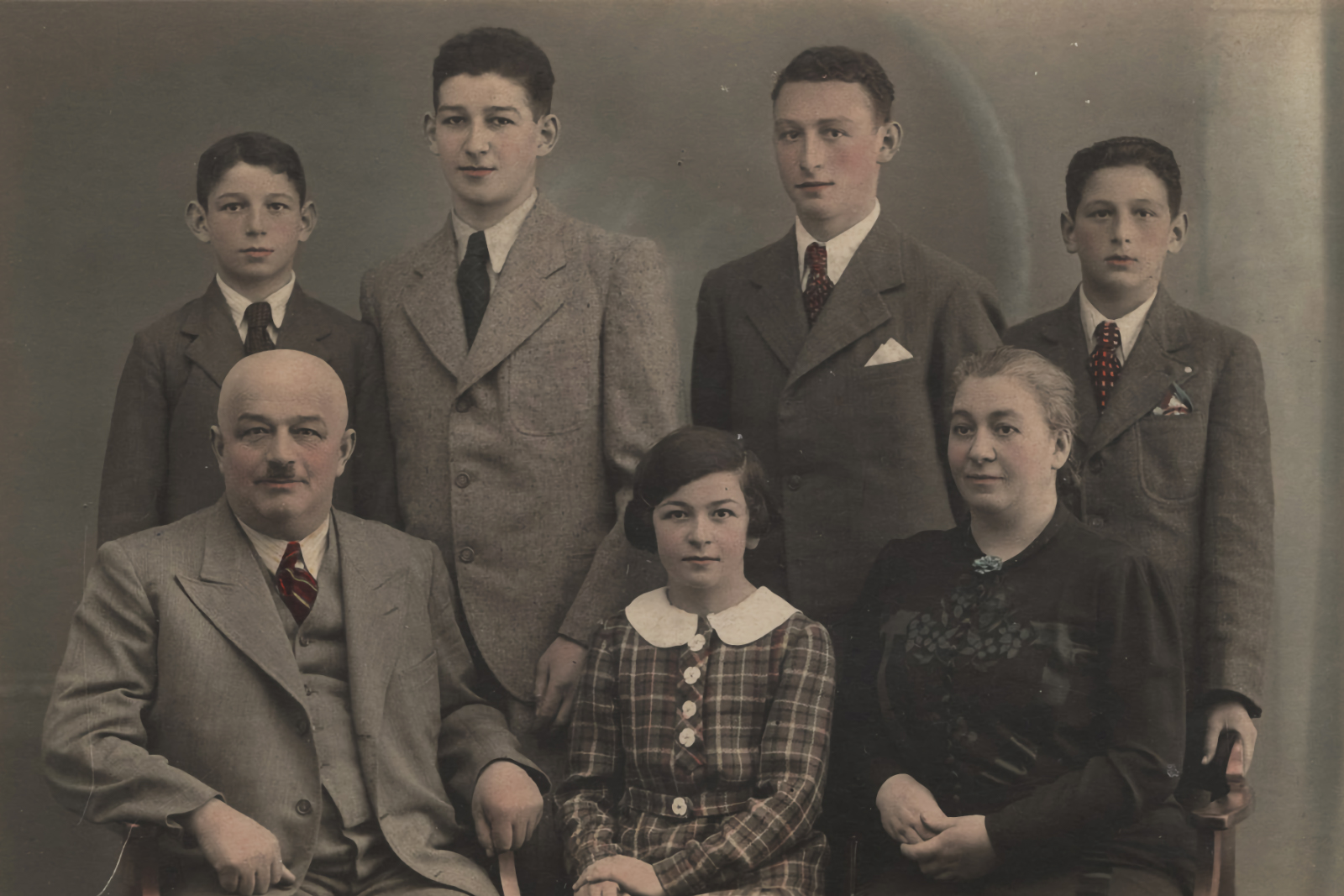
The Mannheimer family picture, before the holocaust. Edgar, standing, first from the left, with his brother Max next to him, the only survivors. Image – Mannheimer family.
This skill put Mannheimer in a position to trade: shoes against bread, shoes against medicine, shoes against the small interventions that kept others alive as well as himself. His brother Max survived alongside him, but tragically, their two brothers, a sister, and both parents died in the camps.
From Auschwitz, the survivors were transported to Warsaw, then through Dachau and its satellite camp at Allach, and eventually to Mühldorf. Mannheimer emerged in May 1945 at the age of 19, having contracted typhus in Warsaw and spent weeks in a coma. He survived by what he described as a miracle and the help of friends. He weighed a mere 45 kg.
Post-war life
The two brothers who survived took entirely different paths. Max Mannheimer returned to Germany, eventually settling near Munich, and dedicated the rest of his long life to public witness, speaking in schools and universities, chairing the Lagergemeinschaft Dachau, receiving the French Legion of Honour, and inviting Angela Merkel to become the first German chancellor to visit the former Dachau camp. A square in front of the Munich Documentation Center bears his name. He died in September 2016, aged 96.
Edgar went to Switzerland and built one of the most influential careers in the 20th-century art and horological market. Both responses to the same destruction were remarkable. Neither was reducible to the other.
What followed for Edgar was a return to Neutitschein, then departure in 1948 through Israeli connections to Munich, where Max had already been living for two years. In Munich, Edgar began dealing in art and antiques, eventually running a liqueur factory before returning full-time to the trade he had identified as his vocation.
By 1956, Mannheimer was in Zurich, where he married Jeannette Brodheim and began again as an antiques dealer in Switzerland.
The white Cadillac
By the mid-1950s, Zurich had become the fixed point of Mannheimer’s universe. He established himself at Sonneggstrasse 22, using it as both his residence and place of business, and eventually founded Uto Auktionen and the Uto Galerie together with a partner.
His presence in the city was not easily missed. A white Cadillac convertible parked outside the address was sufficient advertisement that Mannheimer was in — a calling card that said everything necessary about the distance he had travelled from post-war Germany and everything about his instinct for theatre.
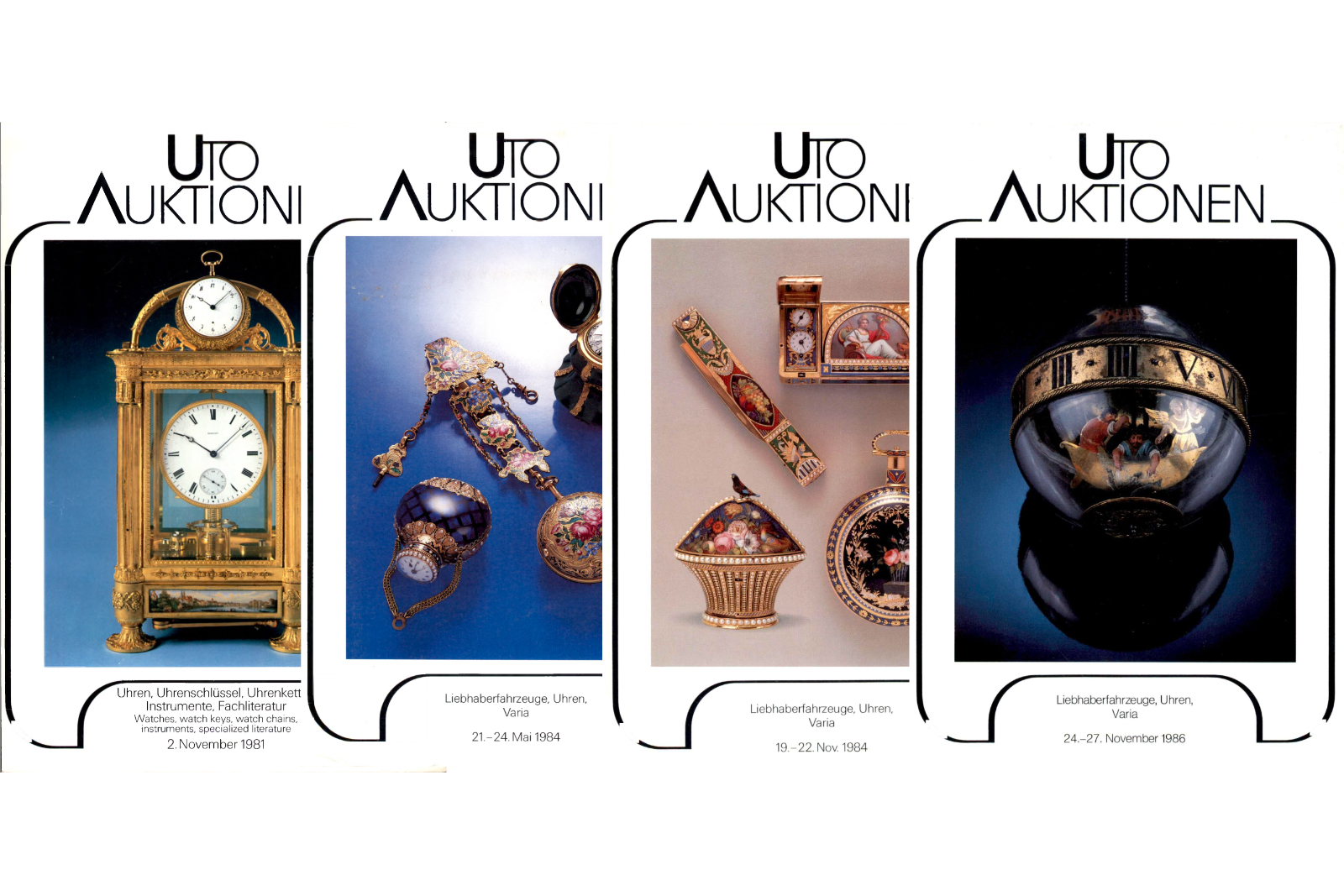
UTO Auktionen catalogues. Image SJX composite.
That instinct extended to the rostrum. Mannheimer was an unconventional auctioneer in a field that rewarded convention. If an opening bid failed to materialise, he would engage what those who knew him described as a smooth reverse gear, lowering the estimate until a taker appeared, or declaring cheerfully that he had bought the lot himself and would do very well out of it. The performance was deliberate. So was the efficiency beneath it.
Away from the auction room, his methods were similarly direct. Watches, gold boxes, and scientific instruments might surface from his coat pocket with no preamble. His negotiating style dispensed with the velvet-draped presentations of the conventional luxury trade entirely. He stated the price he had paid and the price he wanted, and the transaction either happened or it didn’t.
His wife Jeannette, who accompanied him regularly on buying trips and spoke several languages fluently, provided a formal bridge to clients when needed. Mannheimer’s own Bohemian-Jewish dialect and the sheer force of his presence frequently made her intervention unnecessary.
George Daniels, who knew him across three decades, described him in Michael Clerizo’s biography George Daniels: A Master Watchmaker and His Art as a congenial swashbuckler who brought a flexible and good-humoured interpretation to the rules of the auction room — a man who could drive a hard bargain while maintaining, in all circumstances, his basic honesty.
The art dealer Christian von Faber-Castell, writing in Weltkunst shortly after Mannheimer’s death, identified the same quality from a different angle: Mannheimer had built his international reputation as an expert in old watches, scientific instruments, automata, and cabinet objects not through loupe, tweezers, and fine mechanical tools, but through his highly developed taste and his incorruptible eye.
Daniels went further, observing that he could deal successfully in anything from potatoes to Rolls-Royces without detailed knowledge of the subject. Both remarks point to the same truth: his genius lay in reading situations rather than mechanisms.
Clash of the titans
That intelligence operated in multiple directions. Clerizo records how Edward Hornby described two episodes that illustrated Mannheimer’s command of the auction room environment. In the first, Hornby and Daniels devised a coordinated strategy: Hornby opened the bidding and drove the price upward to draw Mannheimer in, then made a conspicuous show of withdrawing, shaking his head, walking out and dropping his catalogue as he went, signalling to Mannheimer that the competition had collapsed.
Daniels entered immediately from the other side of the room as what appeared to be a fresh bidder. The auctioneer, seeing a new arrival, called a new bid; Mannheimer, believing the room had changed, stepped back. They secured the piece for considerably less than he would have paid.
In the second episode, at Sotheby’s, Hornby bid on behalf of Daniels up to his limit of £1,200 on a watch that Mannheimer ultimately won at £1,500. When they returned after coffee, a complication with another lot had arisen, and Mannheimer offered Daniels the watch at £1,200. Daniels suspected the accommodation was not without its own logic: Mannheimer held a similar piece in Zurich, and a public price of £1,500 at Sotheby’s was all he needed.
Diverse interests
His eye for quality was never confined to horology. At Sotheby’s in 1973 he paid £160,000 for an Augsburg silver-mounted centre table, a record at the time and a signal that he was operating across the full spectrum of the high-end art market. Five years later, at the same house, he acquired a Romanesque ivory medallion carved around 1100 in southern Italy, part of a twelfth-century shrine destroyed during the French Revolution, for £506,000. The piece went to the Landesmuseum in Stuttgart.
Mannheimer was not merely buying for private clients; he acted as a trusted intermediary for German state institutions, outbidding international dealers to secure objects he had determined belonged in public collections. It was the same instinct that drove his horological practice, the conviction that matching the right object to the right destination was a matter of judgment, and that judgment was his particular gift.
Engel and Atwood
Among the collectors who passed through Mannheimer’s orbit, none depended on him more completely than Thomas Engel. The relationship began in London and consolidated in Zurich, where Mannheimer had become the indispensable gateway to Breguet at the highest level.
Engel was a scientist and inventor — systematic, evidence-driven, allergic to approximation. Mannheimer was his opposite in almost every outward respect: intuitive, theatrical, operating on conviction rather than method. The partnership worked precisely because of that difference.
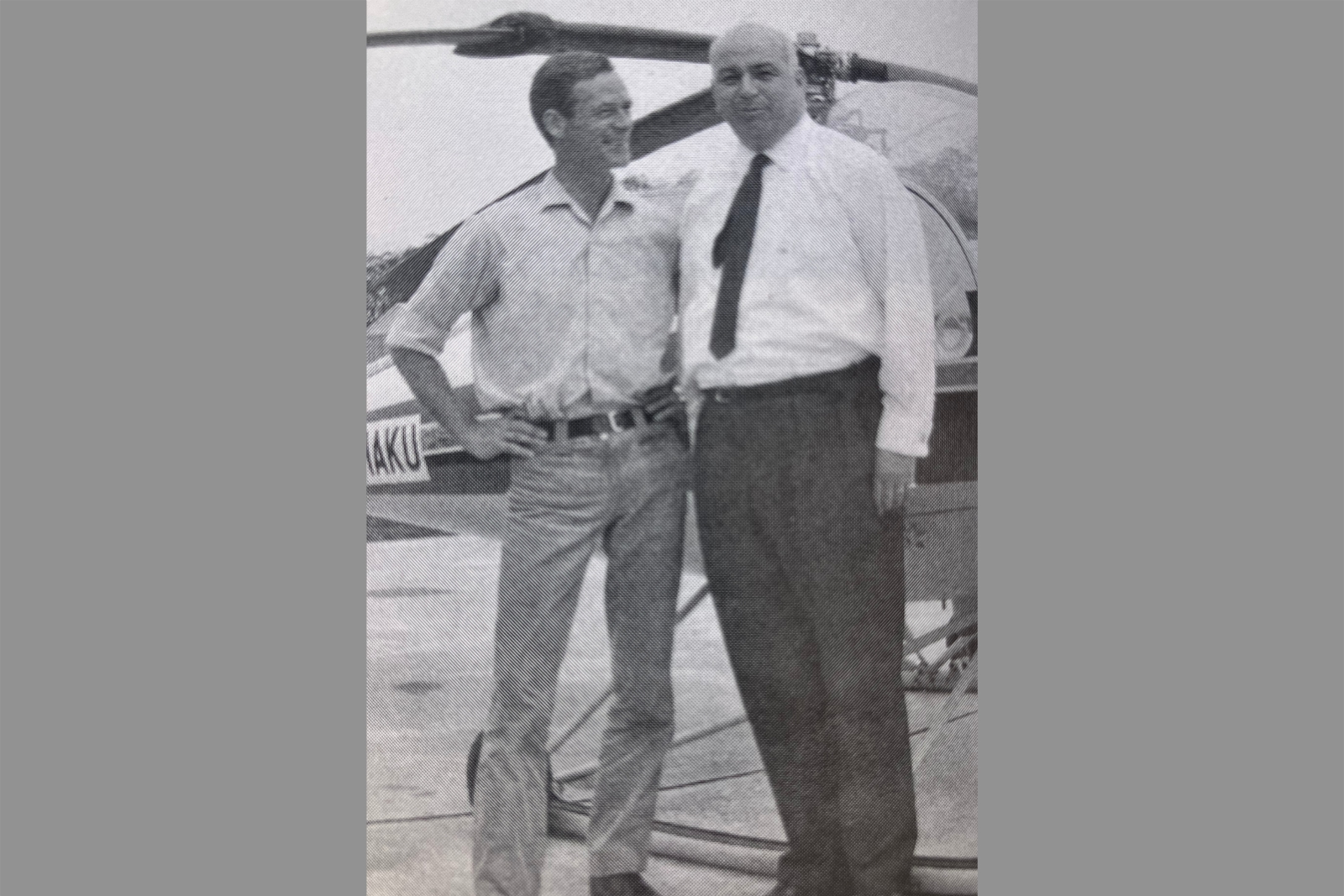
Thomas Engel (left) and Edgar Mannheimer. Image – Thomas Engel
Engel knew what he wanted. Mannheimer knew how to get it without revealing who wanted it.
The auction room required discretion. Dealers who might have pressed against a private collector stepped back when Mannheimer raised the paddle. His reputation was sufficient cover.
Behind it, Engel built a collection of Breguets that would eventually rank among the most significant ever assembled, and which, without Mannheimer, would have looked considerably different. Engel acknowledged as much directly: without him, he admitted, many of the watches would never have come his way.
In his tribute published in Uhren shortly after Mannheimer’s death, he went further: there were watches he knew of that would have ended up in the melting pot had Mannheimer not recognised their value and saved them.
That dependence was structural, not merely transactional. Mannheimer was in contact with every significant collector of the period, including European aristocratic estates, American industrial wealth, and private physicians in New York with watches inherited from naval officers.
He was the node through which information, provenance, and opportunity circulated. A collector working without him was working with an incomplete map.
The reach of that arrangement extended across the Atlantic. When Seth Atwood, the Chicago-based industrialist and founder of the Time Museum, came into possession of a group of Breguets that Engel had failed to secure directly from their New York owner, Mannheimer flew to meet him.
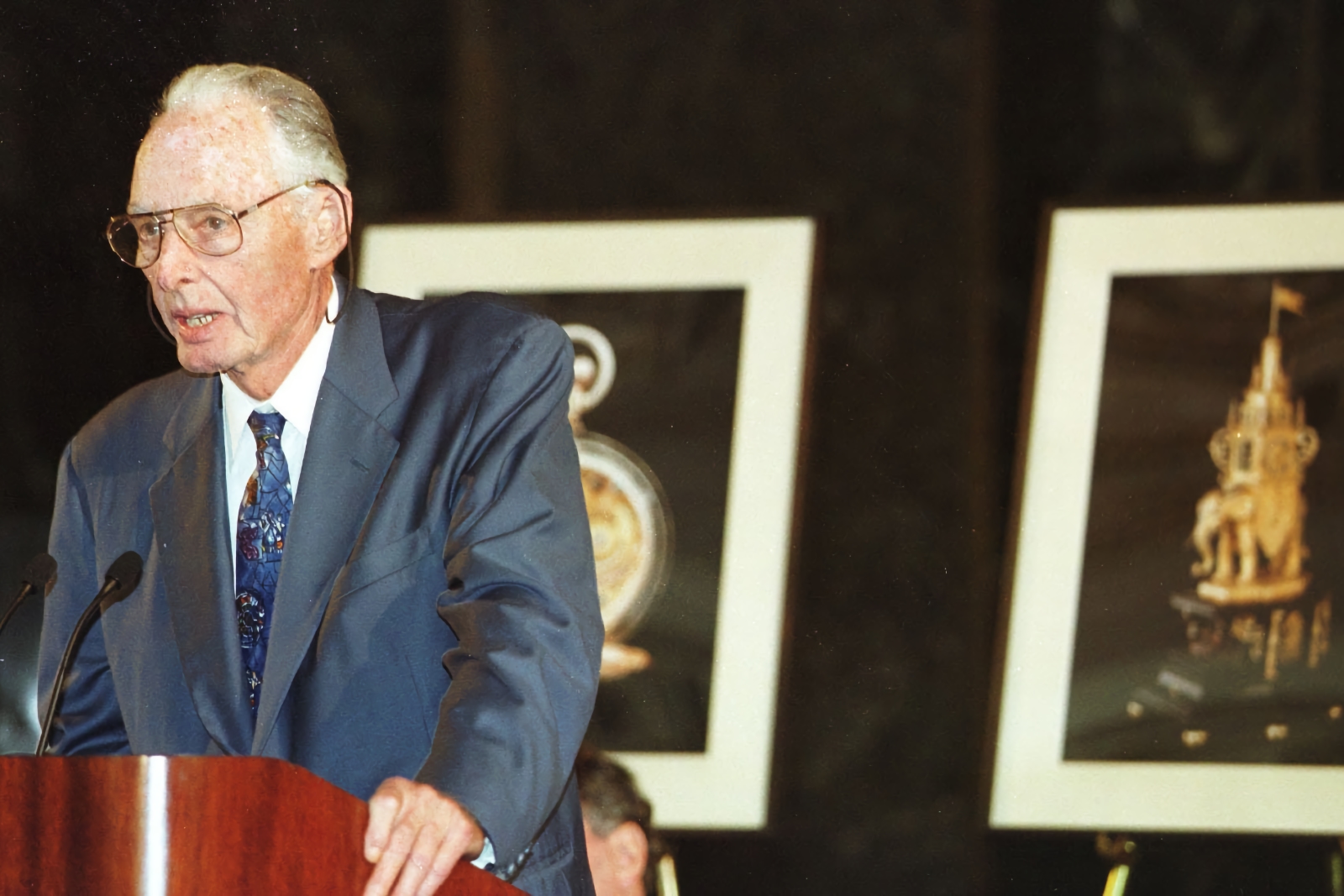
Seth Atwood, founder of the Time Museum. Image – Rockford Star
The two men divided the watches in a hotel room. To determine who would choose first, Mannheimer produced a coin and flipped it. It rolled across the carpet and disappeared under the bed. Both men dropped to the floor to retrieve it. Mannheimer won the toss and, acting on Engel’s instructions, made the first selections. By the time he called Frankfurt to report, the watches Engel had wanted were secured.
Beyond Breguet
Mannheimer’s influence was never limited to a single category. While his trade in Breguet watches formed the backbone of his reputation, the breadth of what passed through Uto Auktionen from its first sale in 1974 reflected a dealer whose curiosity extended wherever mechanical ingenuity and exceptional provenance converged.
The auction catalogues from those years read as a sustained argument about what mattered in the history of the mechanical object. A Janvier mantel clock appeared in 1976; the celebrated Houriet tourbillon two years later. A Breguet table clock with equation of time in 1979; the Sympathique No. 222 in 1981.
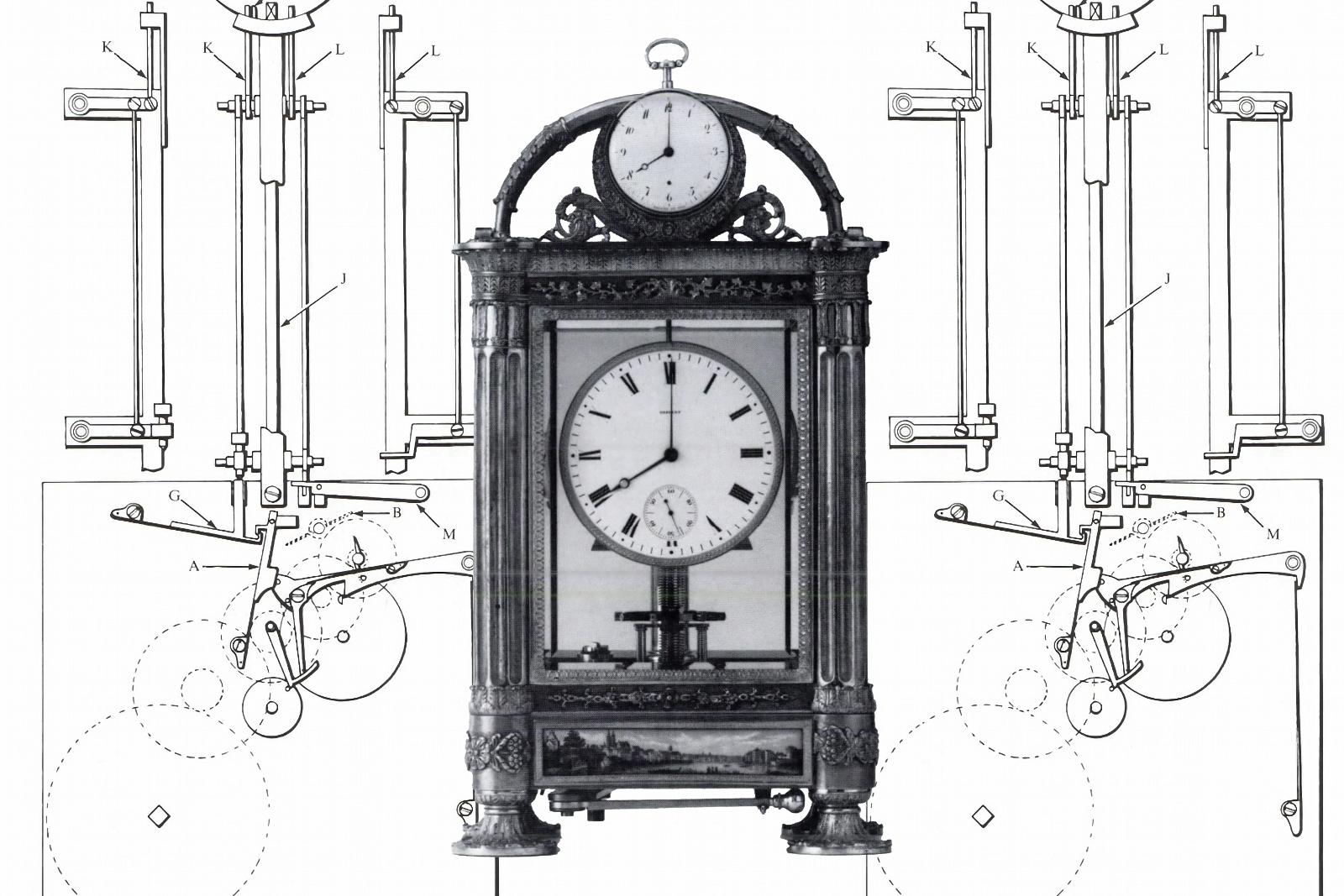
The Breguet Sympathique clock No. 222. Image SJX composite.
In 1983, a Ferdinand Berthoud precision regulator passed through his hands, followed shortly by a musical longcase clock signed Bovenschen, housed in a Roentgen cabinet. Each sale was an event, and the each accompanying catalogue was as much a scholarly treatise as it was a sales brochure.
Among the most significant artifacts he brought to the international market were pieces from the collection of Gustave Loup. Born in 1876 and a long-time resident of China, Loup had acquired timepieces from the imperial collection at the Summer Palace in Chengde — objects produced during the golden era of Geneva enamel work (1780–1840), when the workshops of Henry Capt, Jaquet Droz, and Piguet & Meylan were producing mechanical and decorative works of extraordinary refinement specifically for the Chinese market.
These were not watches as European collectors generally understood them. They were intricate machines designed to imitate living things and pastoral scenes, with moving figures including birds with ivory beaks that rose from oval lids to sing.
Through Uto Auktionen, Mannheimer introduced this subject matter to Western collectors who had no prior framework for valuing it. A consecutively numbered pair of four-colour gold and pearl singing bird snuff boxes by Frères Rochat, sold at Uto in November 1982, stands as one example of the level at which he was operating in this category. The market for such pieces has seen extraordinary growth in the decades since, but Mannheimer was there first.
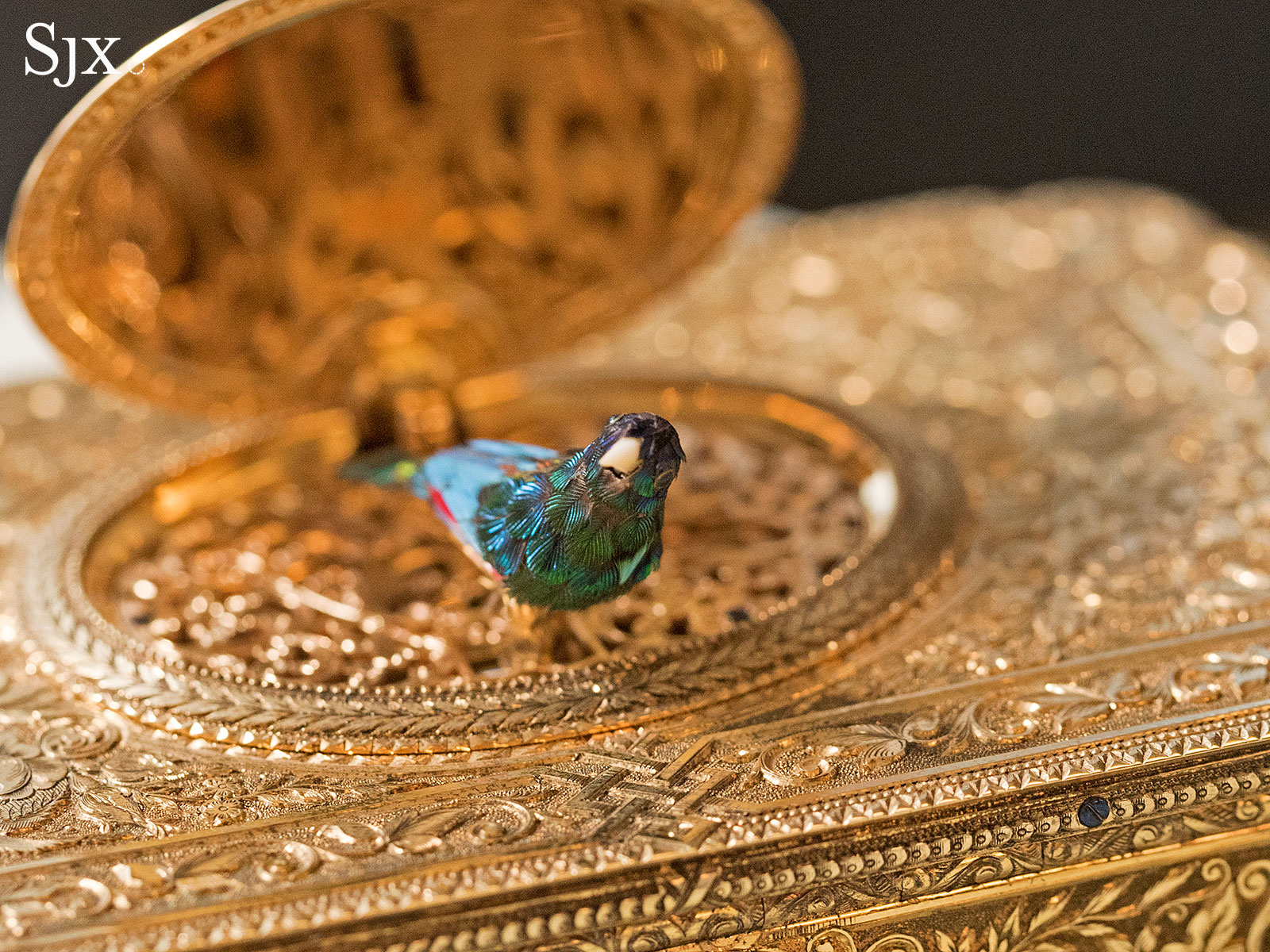
Not a Rochat, but an example of a singing bird automaton from Patek Philippe, manufactured by Bruguier.
His approach to provenance underpinned everything. An object with documents and a clear history was, in his view, more reliable than money or stocks — a conviction that shaped not only his own dealings but the standards he set for the market around him.
Paintings could be forged, but watches with certificates and verifiable ledger entries could not be argued away. This forensic attitude to documentation — applied consistently across two decades of cataloguing — is why the appearance of Uto Auktionen provenance in a current sale at Sotheby’s or Phillips still carries weight. Mannheimer’s 1980 volume dedicated to Patek Philippe, Uhren von Patek Philippe, remains a foundational reference for anyone tracing the provenance of early grand complications.
Im Sonnenbühl
Away from the auction rooms and the suitcases of watches, Mannheimer had built something more deliberate. He married Jeannette Brodheim in 1956, and their three daughters became the centre of his private life. He rarely spoke to them of the camps, choosing to shield them from what he had survived rather than make his past their burden.
The country he chose for that life was not accidental. In an interview recorded in 1986, Mannheimer recalled that during the six weeks of quarantine in Birkenau, which he described as worse than the 28 months that followed, he dreamed every night of running to Switzerland. It was, he said, almost always the same dream.

The house at Uetliberg, Im Sonnenbühl, near Zurich. Image – Mannheimer family.
He knew almost nothing about the country: only that it was clean, and that it produced chocolate, cheese, and watches. In his dreams, he would be running toward the border and would be woken, each time, by the dogs of the SS. Four decades later, settled in Zurich, he reflected that his subconscious had somehow made that dream real. The objects he would spend his career trading had been present in his imagination during the worst weeks of his life.
The house he acquired on the Uetliberg, Im Sonnenbühl, with its garden and its distance from the city below, was the physical expression of that long-carried dream: an idyllic retreat, as far as possible from the world that had destroyed his family. His daughter Jacqueline lives there still.
To his colleagues in the trade, the man who emerged each morning from Sonnenbühl was a burly figure with white curly hair who dominated auction rooms with equal parts authority and theatre. Some of them knew the full weight of what he carried. Occasionally, in the context of a deal or a conversation about trust and value, he would roll up his sleeve and show them the tattoo on his arm. He made no speech about it. He didn’t need to.
Christie’s, 1993
Facing declining health, Mannheimer sold Uto Auktionen to Prince Albrecht von Hohenzollern in 1988. The firm he had built from the first auction in 1974 passed into other hands. Under its new ownership, Uto pivoted away from watches, jewellery, and antiques toward modern and contemporary paintings.
The pivot failed. By August 1990, Uto Auktionen had filed for insolvency. The trade press noted the particular sadness of the situation: the firm’s collapse now attached a sour note to the name of the man who had led its auctions like almost no other.
Mannheimer himself had withdrawn from active business five years before his death. When Thomas Engel visited him in Zurich a few days before the end, he found him mentally fully active despite his serious illness. They spent many hours in conversation about watches and old times. It was, Engel wrote afterwards, only when he left that he understood he had seen him for the last time.
Despite his ill health, Mannheimer appeared at Christie’s in London in May 1993 for what would be the last time. The lot that closed his career was not a Breguet or a Patek Philippe or a piece of Chinese imperial automata. It was a 19th-century mechanical calculator made by the German craftsman Johann Christoph Schuster, estimated at between £15,000 and £20,000. Mannheimer bid £7.7 million.
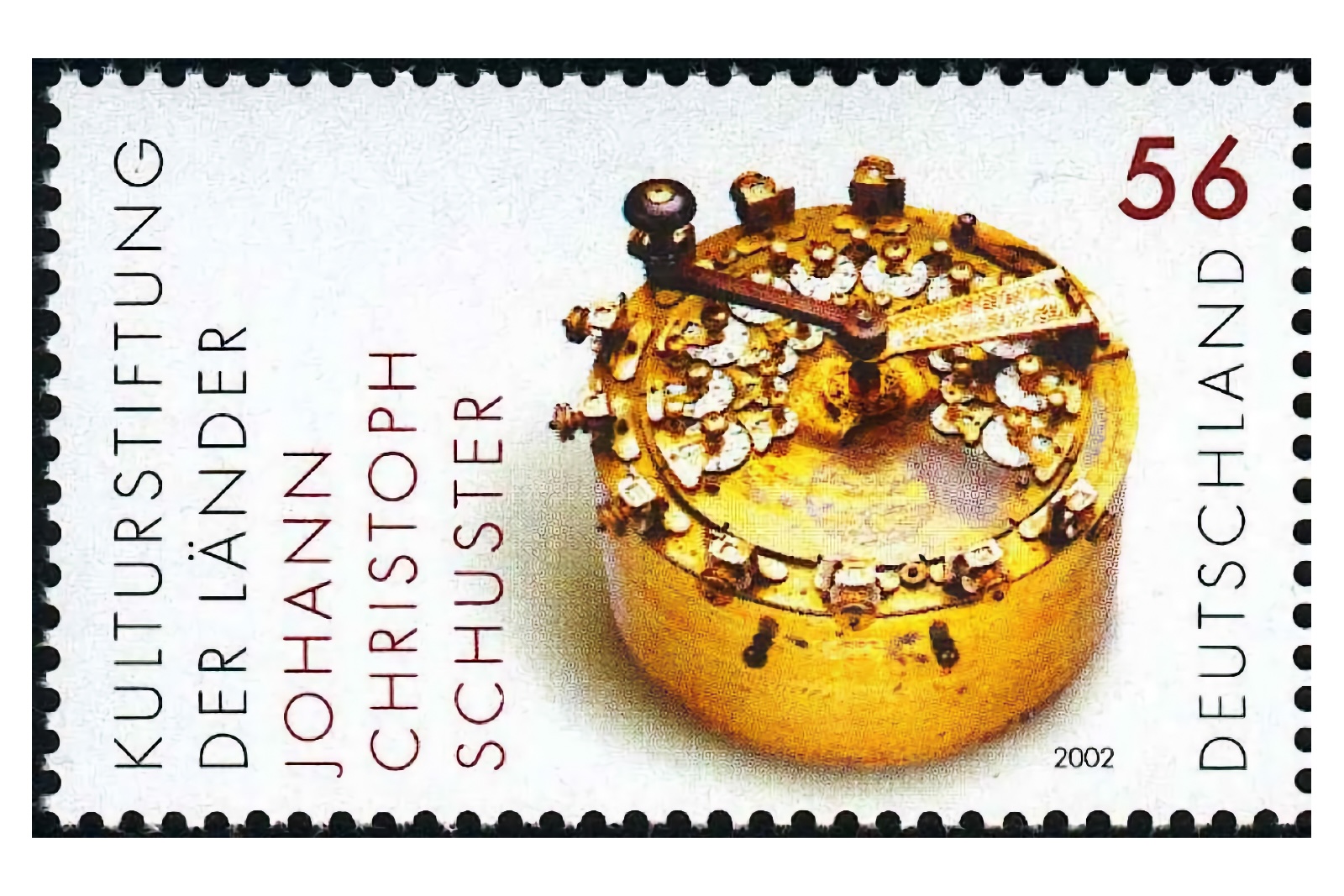
The 19th-century mechanical calculator made by the German craftsman Johann Christoph Schuster, here on a German postage stamp. Image – Wikimedia.
The figure was roughly 350 times the estimate. It outlasted a determined underbidder said to be representing a German museum. But when the 30-day payment period passed without the money arriving, the firm confronted an outcome considerably less comfortable than a record sale.
Speculation circulated that Mannheimer had crossed wires with a collector who had subsequently decided not to go that high, but those who had seen him in the room that day offered a different account, ascribing his behaviour to the effects of the medication required for the treatment of his declining health.
He died on December 26, 1993, three days after his 68th birthday. The mystery of what he intended that afternoon in Christie’s was never resolved. It is perhaps sufficient to observe that the man who in 1965 had walked out of the same auction room having purchased an entire catalogue of important Breguets — and who left a permanent imprint on watch collecting — simply ran out of time.
“His death denied other dealers much excitement and speculation, and the rooms are quieter for his absence.” — George Daniels
Back to top.