
In Depth: The Horological Evolution of Jacob & Co.
The rise of "Jacob the Watchmaker."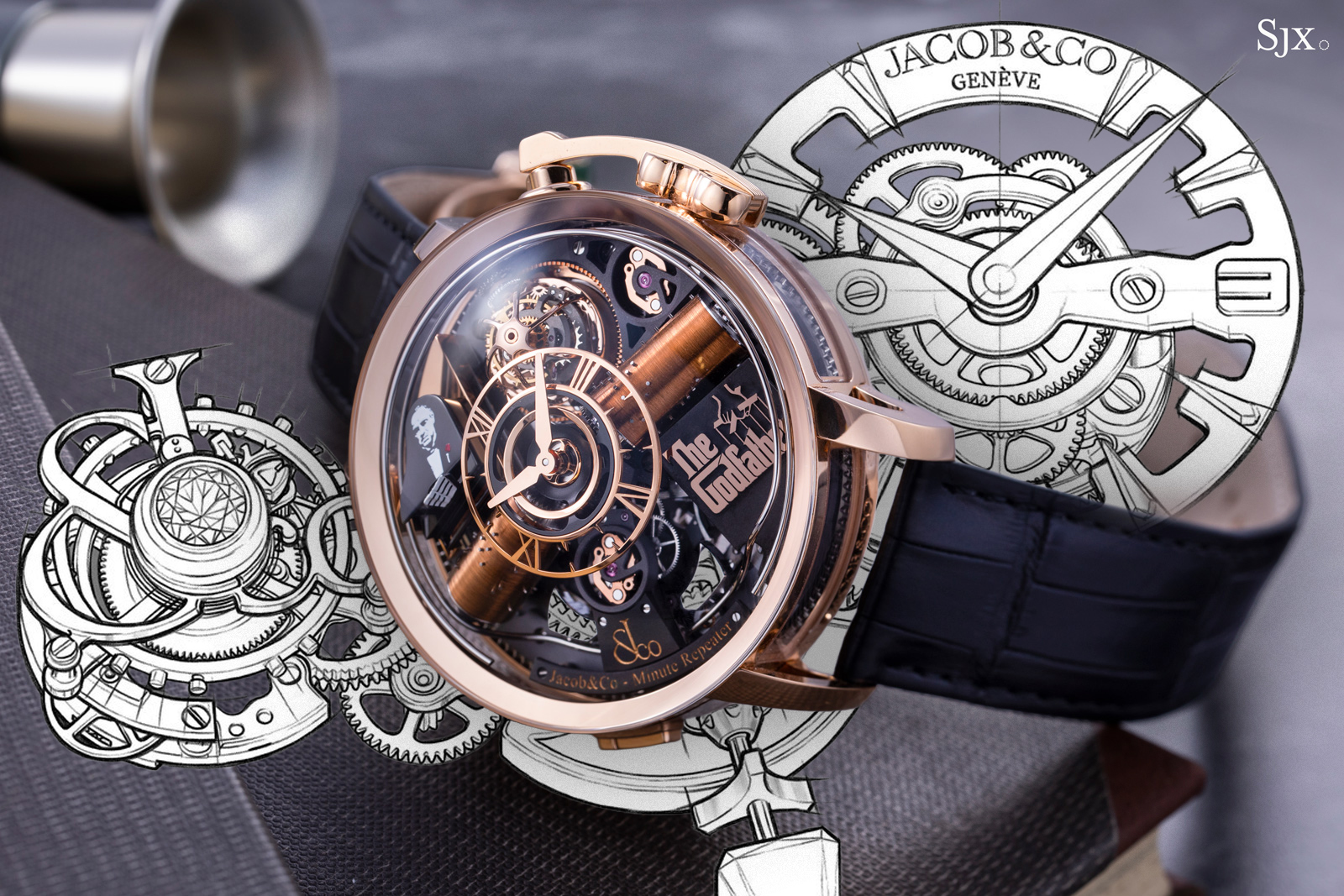
Since “Jacob and Jeweller” made its first foray into fine watchmaking two decades ago, Jacob & Co. has positioned itself as a master of maximalism in all its forms, both bejewelled and technical, with some of the brands’s most audacious creations free of gem-setting entirely.
The story of Jacob & Co.’s rise as an independent watchmaker features a celebrated cast of constructors. While other brands focused on vertical integration, Jacob & Co. opted to become a patron of promising complication specialists and independent watchmakers, funding their visions while challenging them with its own.

Now, 20 years on, Jacob & Co. has evolved into a major player in the ultra-high end watchmaking segment, and is one of the fastest growing brands in an otherwise downbeat market; according to the brand, its 2025 watch sales were close to CHF300 million at retail.
The brand’s obvious success is due to both its astute commercial instincts, founder Jacob Arabo’s inimitable personality, and also its ability to bring technically demanding movements to market and iterate on them with remarkable regularity.

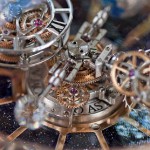
The gongs of a minute repeating Astronomia, one of the line’s many flankers.
Few brands have managed to build credibility in both jewellry and watchmaking simultaneously. On the occasion of the brand’s 40th anniversary, it’s worth looking at how Jacob & Co. has succeeded where others have failed.
Chapter 1: The Quenttin
Jacob & Co.’s first 20 years were somewhat quiet on the watchmaking front. Of course, the brand had a few breakthroughs, notably the quartz-powered Five Time Zone that became an icon in the early 2000s. But the brand took a hard turn toward haute horlogerie in 2006 when it introduced the Quenttin.
The Quenttin was born from the power reserve wars of the 1990s and 2000s, arguably ignited by Frédéric Piguet’s eight-day tourbillon calibre developed for Blancpain. Brands of all stripes joined the fray, from Eberhard & Co. to a nascent F.P. Journe, to Genevois watchmaker Patek Philippe, which held the crown for a time with its rectangular 10-day movements — impressive autonomy, with or without tourbillon.
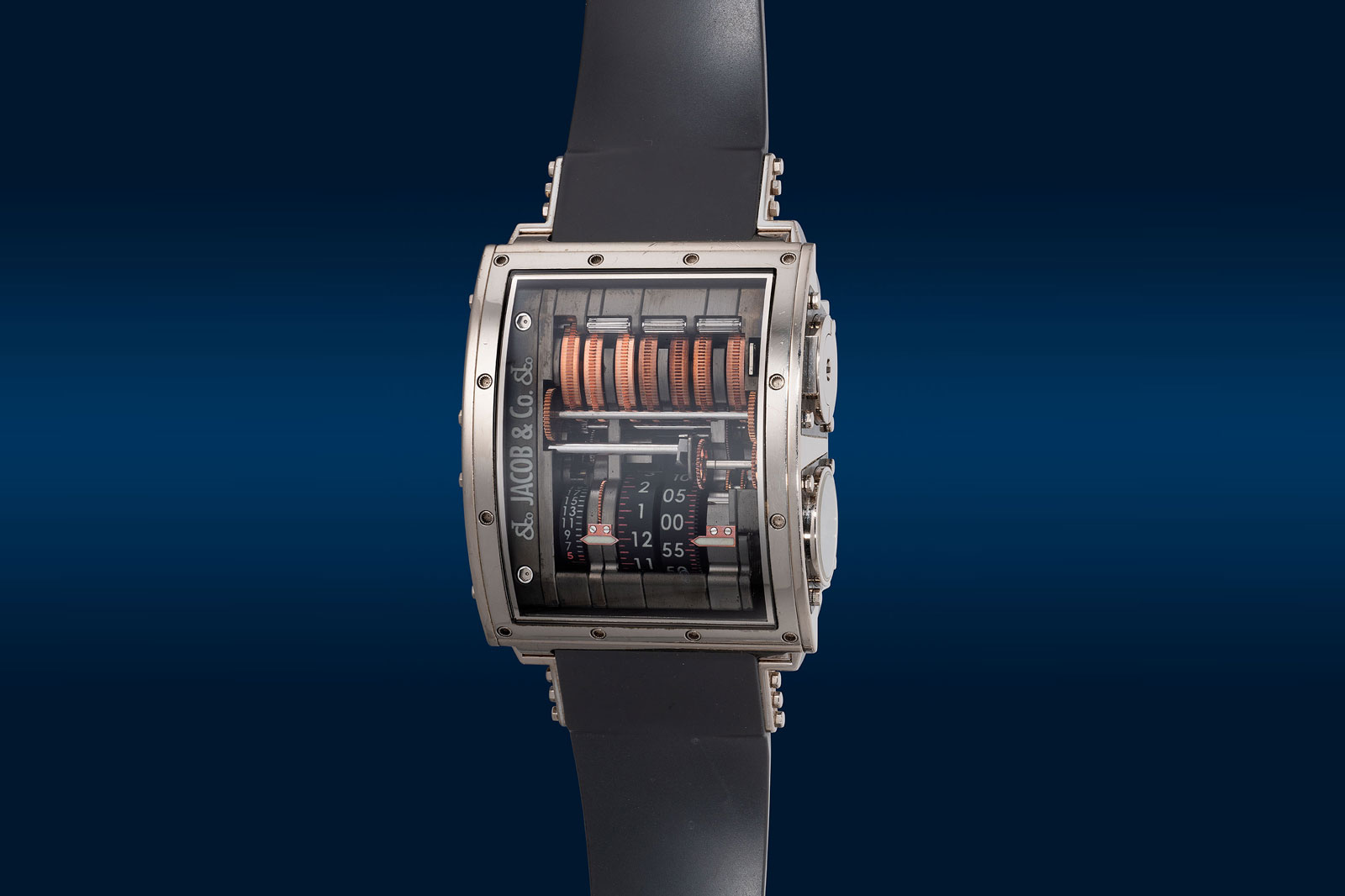
Image – Phillips
But these five, eight, and 10-day movements would ultimately be knocked down a few pegs by the first wristwatch with a 31-day power reserve. The watch in question would come from an unexpected marquee — the New York-based jeweller that launched the Quenttin in 2006.
At the time, Jacob & Co. was a fresh face in fine watchmaking, without the expertise to challenge legacy watchmakers on their home field. So the brand turned to the leading bespoke movement house of the time, BNB Concept. The company was named for its founders, Mathias Buttet, Michael Navas, and Enrico Barbasini.
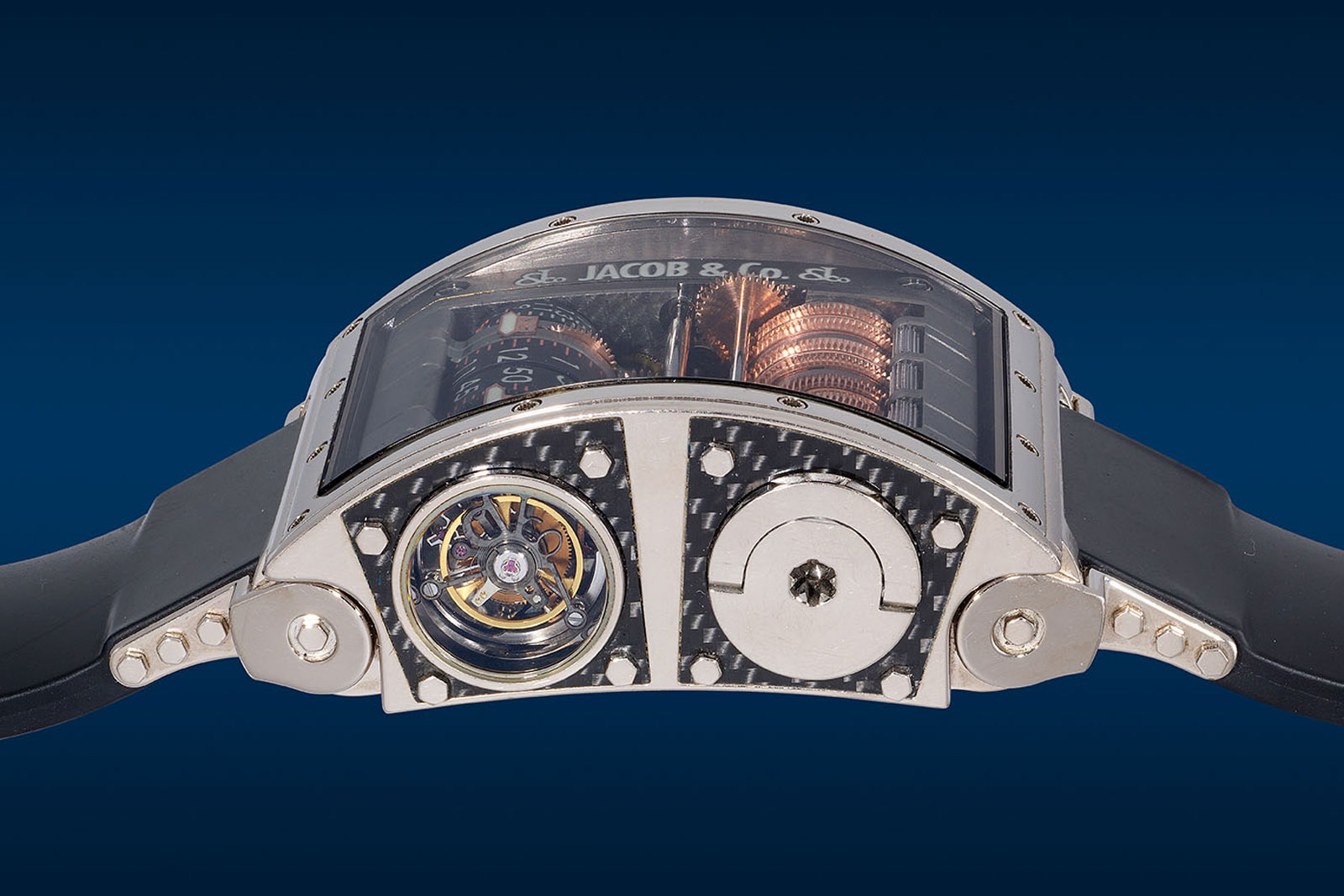
Image – Phillips
The latter two had co-founded BNB after working at Gerald Genta, where they helped build some of the most complicated movements ever made. As a result, BNB specialised in repeating calibres, but proved capable of making almost anything for client brands.
The Quenttin looked like nothing else on the market, and thanks to its headline-grabbing functionality, caused many collectors of high-end mechanical watches to look at Jacob & Co. with a new perspective.
The Quenttin is often described as a vertical tourbillon — like F.P. Journe’s Tourbillon Souverain Vertical— though this is slightly misleading. In fact, the plane of the tourbillon is parallel to those of the barrels, train, and plates. In a sense, the movement is an extraordinarily tall baguette-shaped calibre.
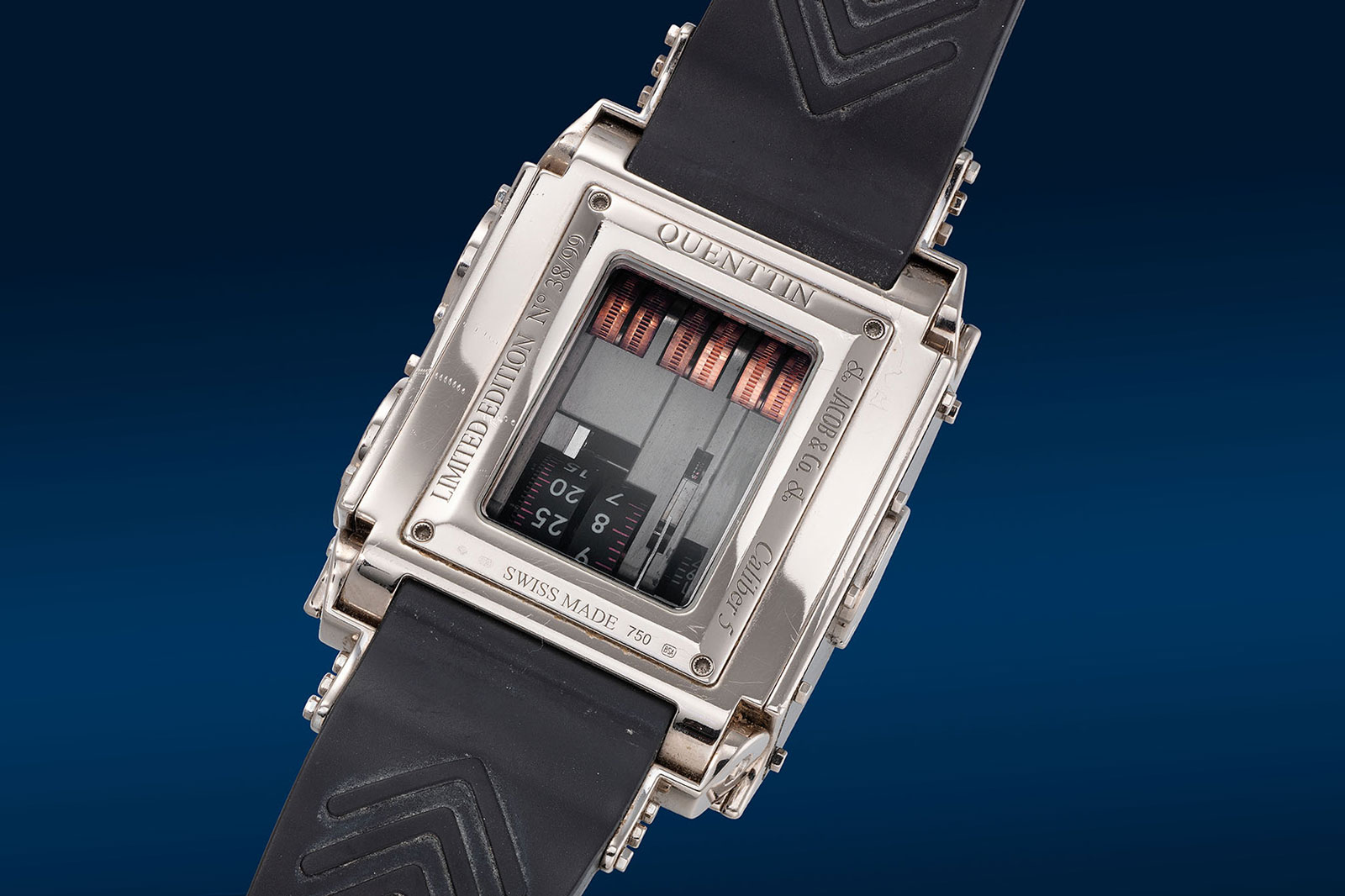
Image – Phillips
Viewed through this lens, the skyscraper-like movement has eight storeys of plates, between which the seven barrels, train, and time display discs are sandwiched, with a penthouse suite for the flying tourbillon.
Impressively, the Quenttin offers keyless winding, which is not always the case for watches with extreme power reserves. For those who’d rather avoid the hassle of hand-winding seven barrels, the watch conveniently features a socket for key winding via an integrated winder built into its display box.
BNB Concept later collapsed in the wake of 2008 financial crisis, scattering talent across the industry. The company’s assets were acquired by Hublot, a former client, while Michael Navas and Enrico Barbasini left to found La Fabrique du Temps, which was soon after acquired by Louis Vuittion. After short stints at Patek Philippe and Rolex, Luca Soprana, former head of BNB Concept’s prototyping workshop, started his own studio named Atelier 7h38 in 2012.
Chapter 2: The Epic SF24
During his time at BNB Concept, Mr Soprana worked on the Concord Tourbillon Gravity, a true vertical tourbillon, and one of his first projects as an independent was a triple-axis Deep Space Tourbillon for his former employer, Vianney Halter. At the time, few watchmakers had experience with such imaginative movements, and this unique background caught the eye of Jacob Arabo, who tapped Mr Soprana to help build his brand’s next generation of mechanical spectacles.
The first project Mr Soprana pitched to Mr Arabo was something of a pet project — a watch with a split-flap time display inspired by the Solari di Udine boards that once dominated public transit hubs.
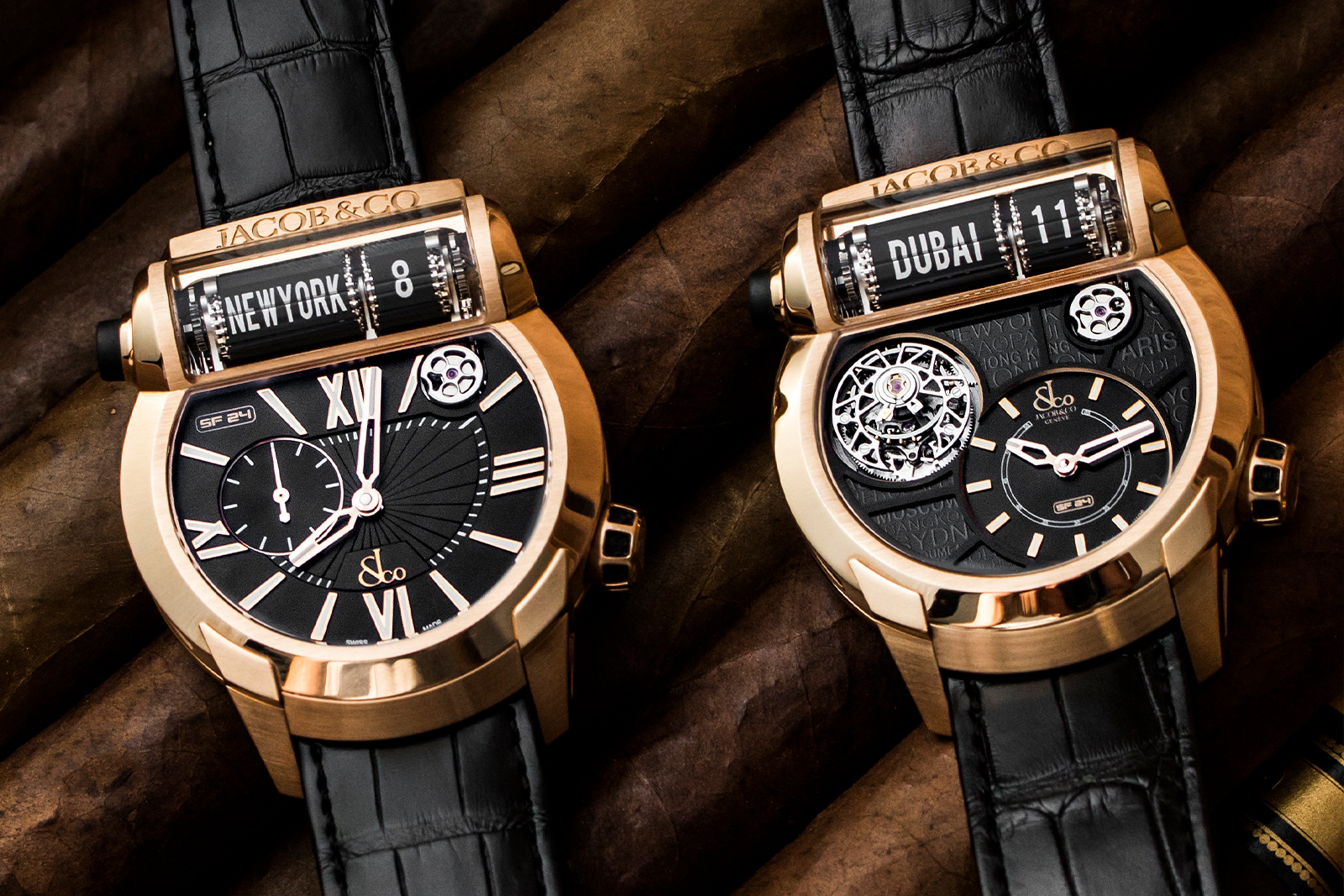
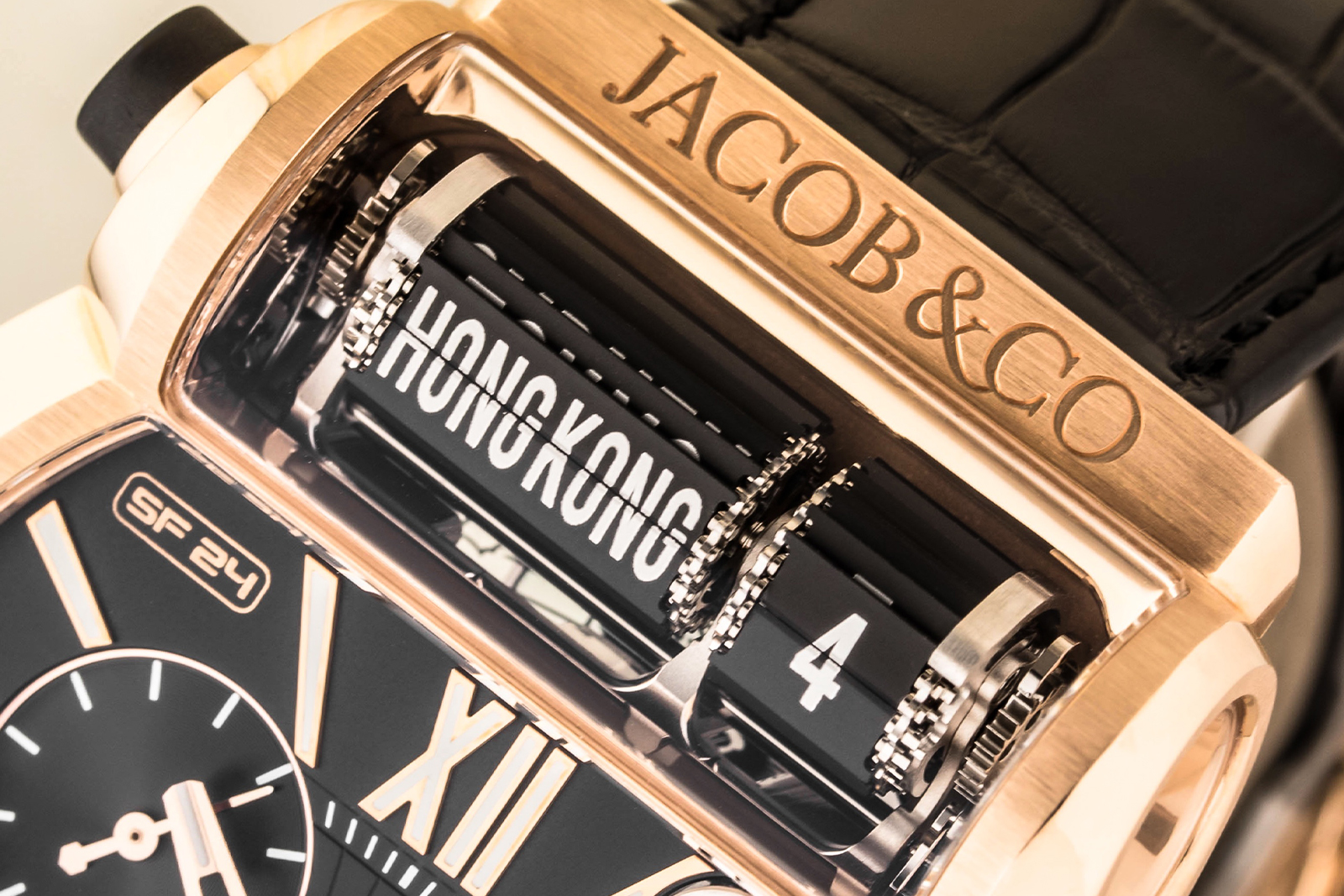
This design had been a dream of Mr Soprana’s, but no one took the idea seriously, except Mr Arabo. The Epic SF 24 debuted at Baselworld in 2013 and featured a second timezone display showing both the full name of the reference city, and its corresponding hour, with a split-flap display neatly housed in a sapphire capsule.
The execution of this familiar complication was uncommon, as was the brand’s practice of selecting a base calibre to power it. At a time when most contemporaries powered their own extravagant modules with simple ETA movements, Mr Soprana opted for a comparatively obscure non-chronograph version of the Concepto C2000 family of movements.
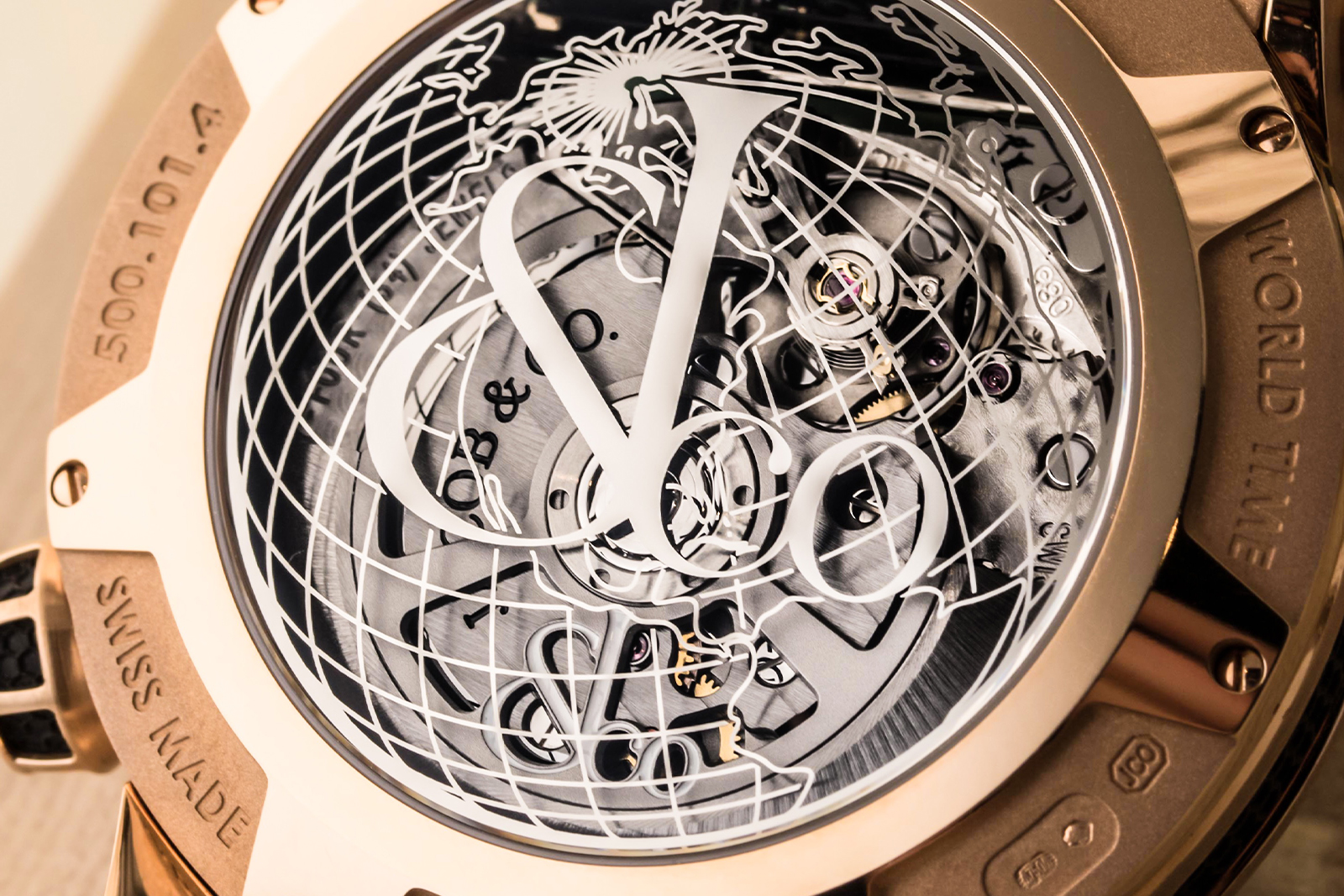
The choice to take a chance on Concepto, which was a relative newcomer having been founded just seven years prior, would pay off as the company is now a key partner of Jacob & Co., responsible for Jacob & Co.’s Bugatti Tourbillon — complete with its miniature V16 engine — as well as the instrument cluster of Bugatti’s latest supercar, the Tourbillon.
Chapter 3: Astronomia
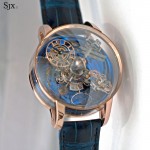
When it comes to Jacob & Co.’s reputation as a watchmaker, the 2014 debut of the Astronomia marked a turning point. A wearable mechanical sculpture if ever there was one, the Astronomia sought to unite the brand’s famous bling with the avant garde style of watchmaking popular at the time.

The Jacob & Co. Astronomia.
A single large barrel, able to drive the entire mobile for 60 hours, sits at the centre of the case, surrounded by aventurine glass panels. Suspended in the centre is an orbital double-axis tourbillon and an orbital time display. The mobile completes three rotations each hour, with each of the four arms driven though an elaborate system of planetary gears.
The simplest element is a one carat white diamond (large by watchmaking standards), cut with 288 facets, which rotates once each minute and acts as a visual and literal counterweight to a globe opposite. The globe is made of blue lacquered aluminium for weight savings and rotates at the same rate as the diamond, but in the opposite direction.

The vitrine-like case of the Astronomia provides a panoramic view of the complicated movement within.
Perpendicular to these are the double axis tourbillon, which makes one rotation a minute on the same axis as the balance wheel, and a rotation every five minutes on a second axis perpendicular to the balance, and, as part of the mobile, completes on revolution around the centre of the movement every 20 minutes.
Thus, it is a double-axis tourbillon, and an orbital tourbillon about a third axis. The time display is opposite the tourbillon, and remains upright as the mobile turns by the magic of planetary gearing.
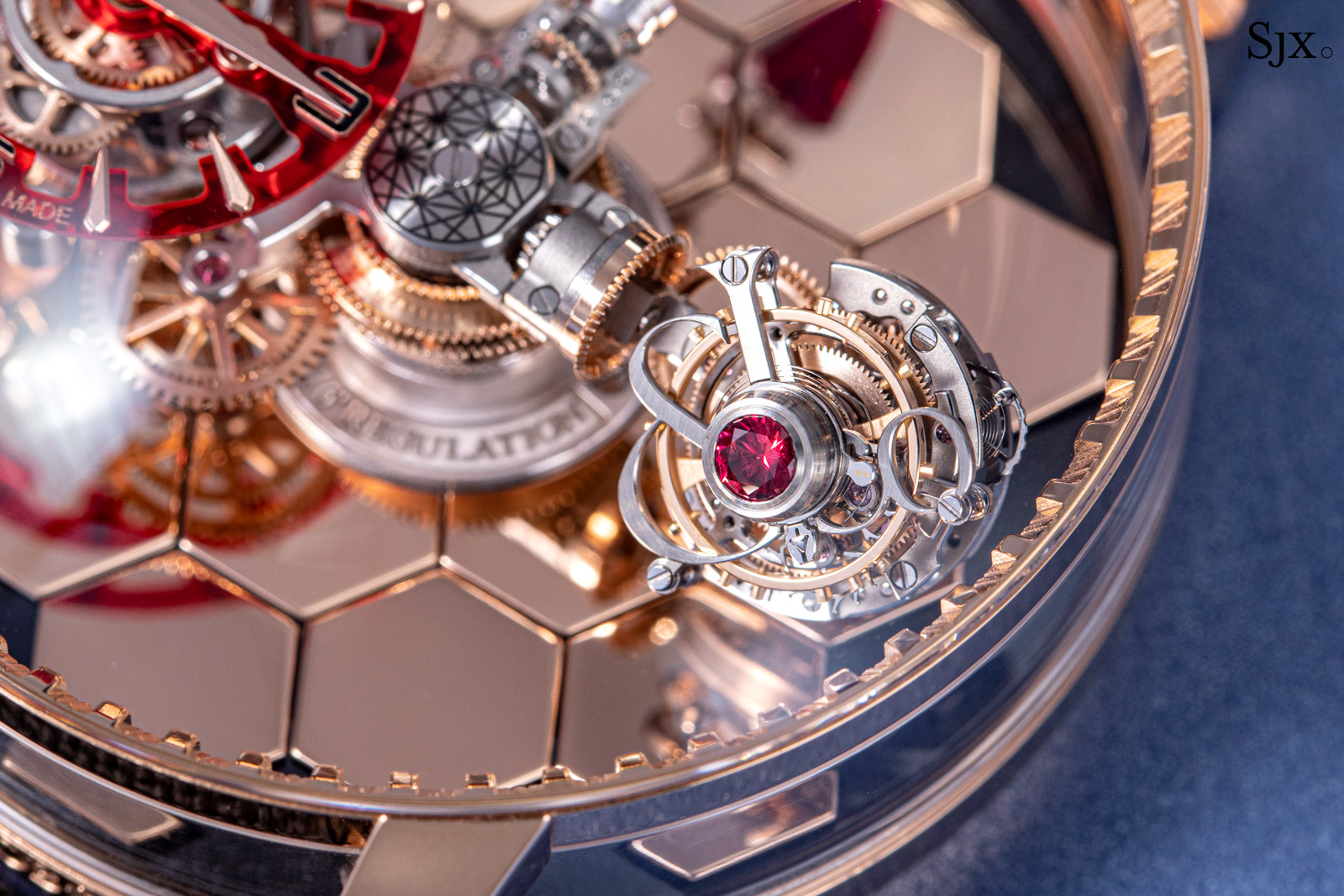
The Astronomia Revolution.
The Astronomia has since become one of the brand’s signature calling cards. It has evolved through a number of iterations, such as the Astronomia Revolution.
Unlike double-axis tourbillons from brands like Greubel Forsey that employ such features in the name of precision, the Astronomia deploys its double-tourbillon service of artistic expression, part of an ongoing mechanical spectacle suspended in a vitrine-like case.
Despite its astronomical price tag — in 2014 the Astronomia retailed for US$540,000, while gem-set models hit seven figures — or perhaps because of it, the Astronomia was a breakout success and countless flankers soon followed.
Some of these were, naturally, aesthetic variations, but other variants continued to break new ground. Case in point, the Astronomia Maestro Minute Repeater — co-developed with Le Cercle des Horlogers — required a complete rework of the time display to accommodate a carillon minute repeater and moon phase display.
Chapter 4: Twin Turbo Furious
In 2018 Jacob & Co. broadened its horizons with its first hyper-watch to feature a chronograph — the Twin Turbo Furious — for which it turned to complication specialist Le Cercle des Horlogers, a firm founded by Nicolas Herren and Alain Schiesser in 2012 after five years at Audemars Piguet Renaud et Papi (APRP) and seven years at Christophe Claret, respectively.
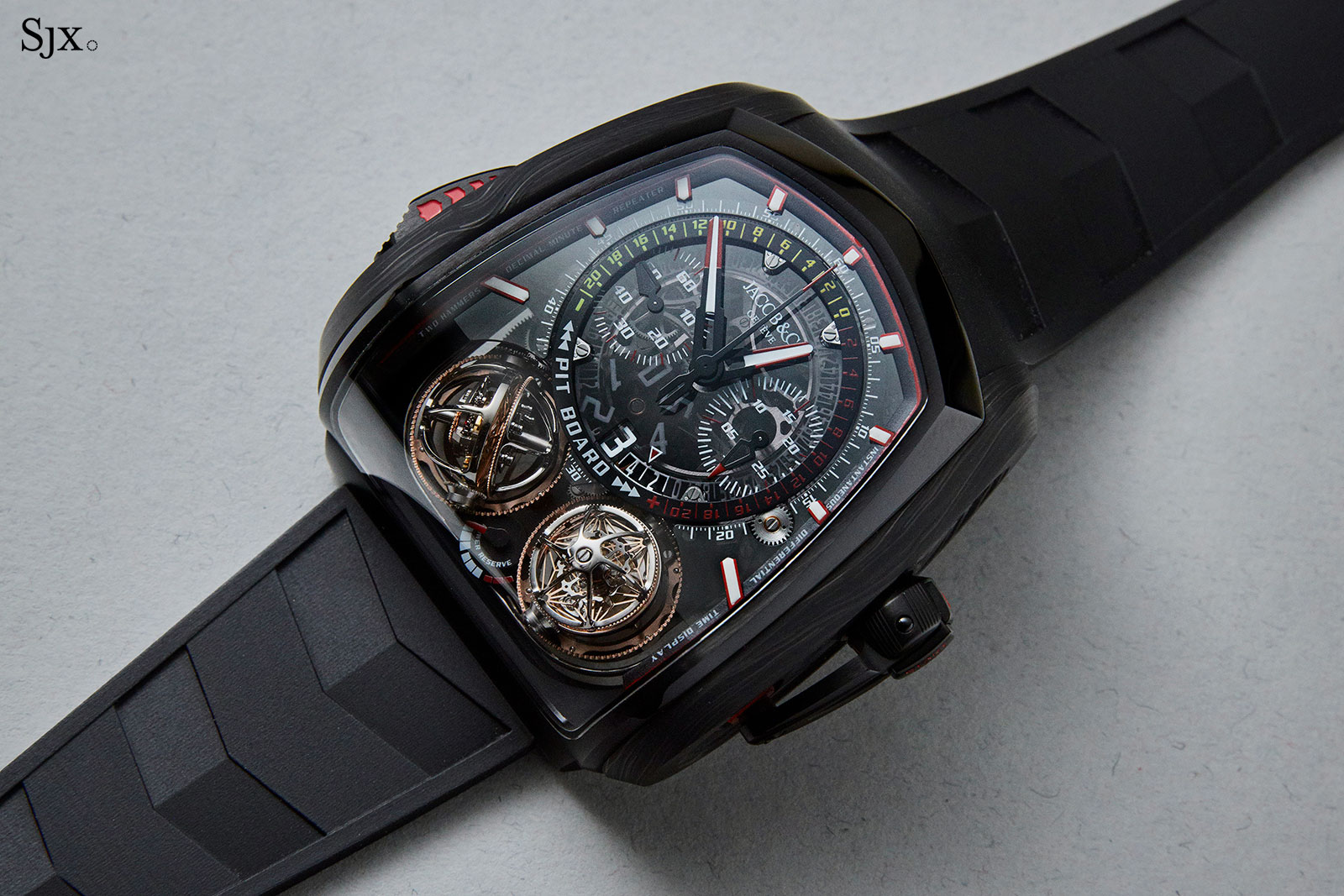
Le Cercle des Horlogers has a broad repertoire. Beyond its work for Jacob & Co., the firm manufactures Biver’s carillon minute repeater movements, the micro-rotor automatic movements found in Louis Vuittion’s slim Tambour, and the Hermes’ triple-axis tourbillon minute repeater which we looked at last year.
The Twin Turbo Furious was a followup to the Twin Turbo of two years prior, which introduced the spritely fast-rotating double tourbillons. In this design, a differential splits the going train in two, with one path leading two each of the furiously rotating triple-axis tourbillons. The differential means the hands display the average of the two rates.

Furthermore, while conventional tourbillons decouple the vertical positions of the watch from the vertical positions of the balance, the horizontal positions must be accounted for.
In a three-axis design like that of the Twin Turbo Furious, the positions that watches are normally measured in such as “crown up” or “dial down” are rendered moot, at least when it comes to the components inside the tourbillon cages.
Both tourbillons have a 24-second period of rotation on one axis, eight seconds on another, and 30 seconds on the third and final axis.
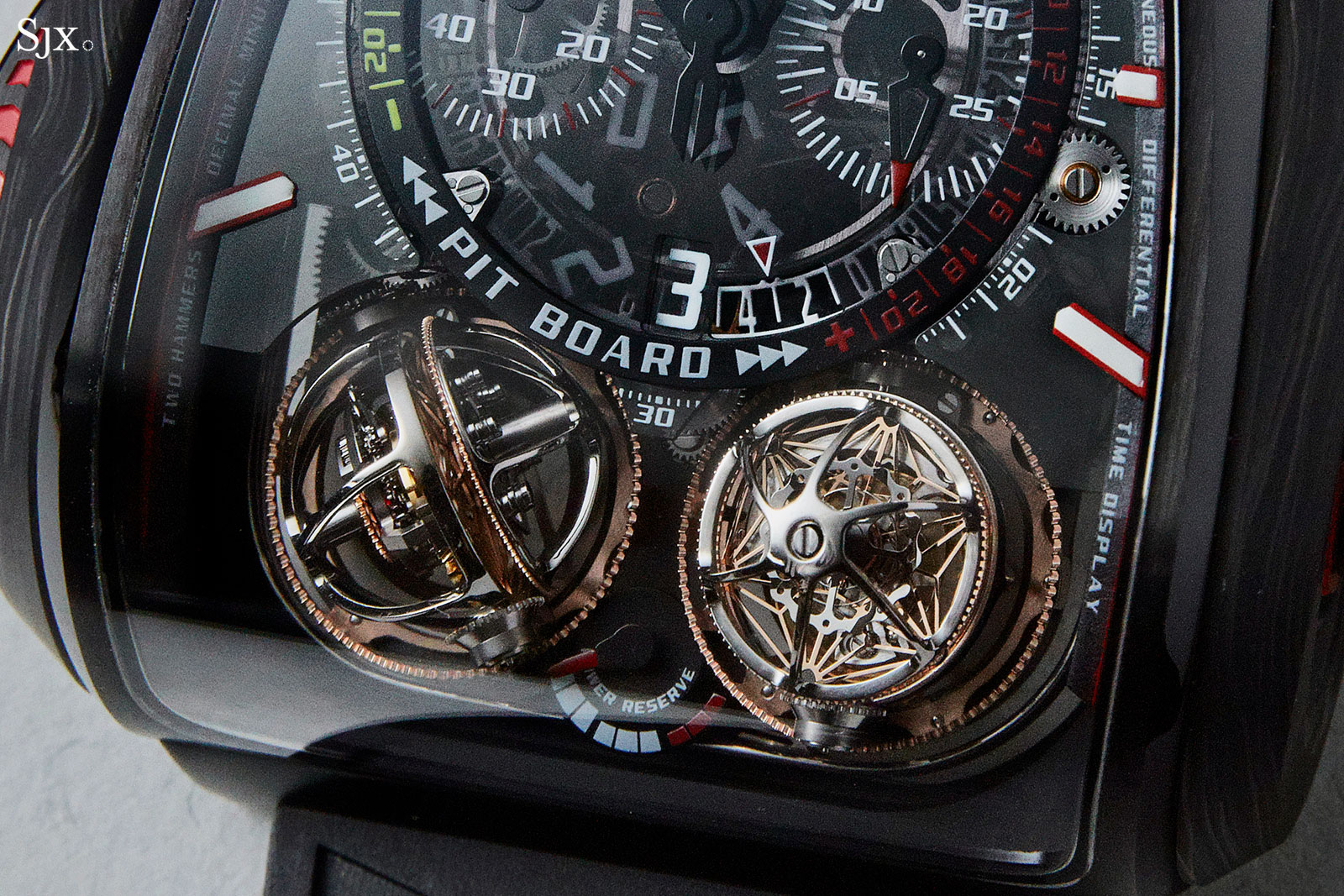
There is even a type of constant force device visible just before the innermost tourbillon cage. This “torque declutching” system is comprised of two coaxial wheels linked by spring so that one wheel cannot get too far ahead, or too far behind, the other.
This protects the innermost tourbillon from the inertia of the outer two. It’s also responsible for a strange phaenomena where, depending on the state of wind, the outer cages can awkwardly lurch around while the innermost cages continue rotating serenely.
This combination of features make the tourbillons in the Twin Turbo Furious some of the most elaborate ever made.
Unlike the tourbillons, the minute repeater is quite conventional, though with an added safety feature that prevents hand-setting while chiming, preventing damage to the racks and snails.

The movement is also a decimal repeater. Most minute repeaters chime the hours, quarters, and minutes – usually in that order. In contrast, the Twin Turbo Furious chimes out sixths of an hour, rather than quarters.
This approach is as old as the quarter-based minute repeater, but the format became vanishingly rare by 19th century and remained so until a resurgence in popularity in just the last 20 years. This approach probably appeals more to younger generations, who, thanks to the proliferation of digital clocks, no longer think of time in terms of quarters.
The single-button chronograph is the most staid of the three principal complications, being very traditional in construction, using column wheel switching and horizontal coupling, as well as a 15-minute totaliser.
From the back, the movement strongly resembles chronographs made by APRP for Audemars Piguet and Richard Mille, probably not a coincidence given the background of Le Cercle des Horlogers’ founders.

The Twin Turbo Furious is also notable for its dial, which features a reference time differential indication inspired by the timekeeping panels used in motor racing to show drivers the difference between their reference and actual lap times.
This is set from the crown and displayed by two adjacent apertures at six o’clock. The larger digit shows the minutes, and the aperture to its right indicates the seconds, displaying up to 5:59.

Once the chronograph is started and stopped, the “pit board” wheel that circles the dial then indicates the time difference between the recorded time and the reference time – red for a positive difference, while yellow marks a negative difference.
The Twin Turbo Furious represented another turning point for a brand seemingly on a quest to prove that no level of complication was out of reach.
Chapter 5: The Godfather
The brutal reality of musical wristwatches is that they will never sound as good as a full-sized music box — while being exponentially more difficult to make — but that hasn’t stopped watchmakers from trying.
The dominant historical approach used a disk to carry the pins, rather than a cylinder, which is more space efficient, and the path taken by Breguet. The other approach is to squeeze a miniature cylinder box, and a very small, entirely discrete movement into the same case.
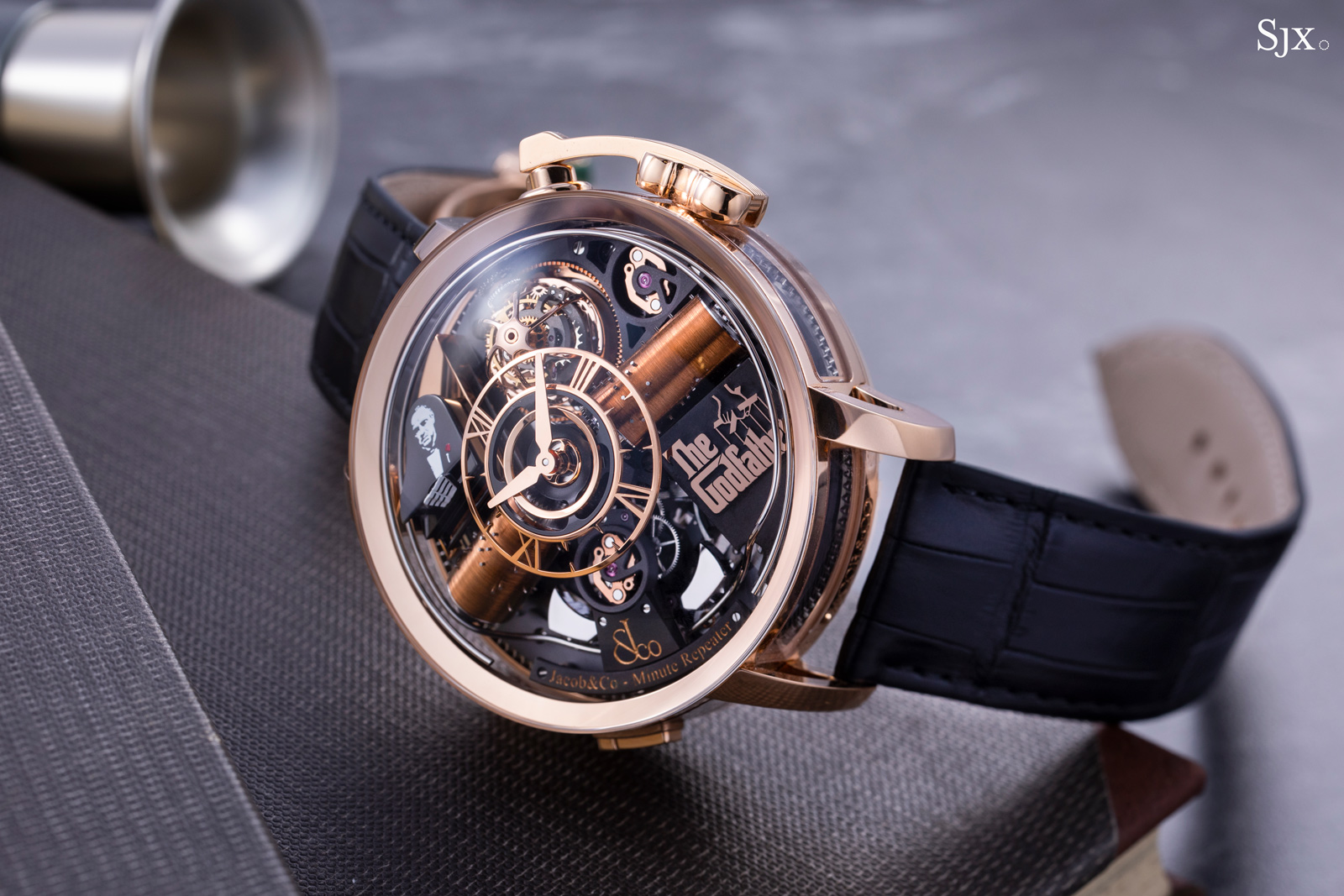
True to form, Jacob & Co. found its own path. Following its success with repeating watches, the brand approached Le Cercle des Horlogers and made them an offer they couldn’t refuse, resulting in arguably the most dramatic musical wristwatch on the market in 2019.
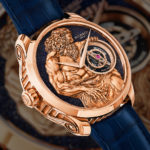
Then, in 2022, the title passed to the Opera Godfather Minute Repeater, one of the most maximalist watches in the brand’s portfolio, despite the lack of gemsetting.
In total, the massive movement has three trains. One is for timekeeping, wound by a violin-shaped lever, and ends with a triple-axis tourbillon similar to those founds in the Twin Turbo Furious, though it only uses one of them.
The second is for the minuter repeater, and is charged by the slide. The third and final train, also wound by the violin shaped lever, drives the musical complication, which is activated with a button impressively suspended in the sapphire crystal case band.
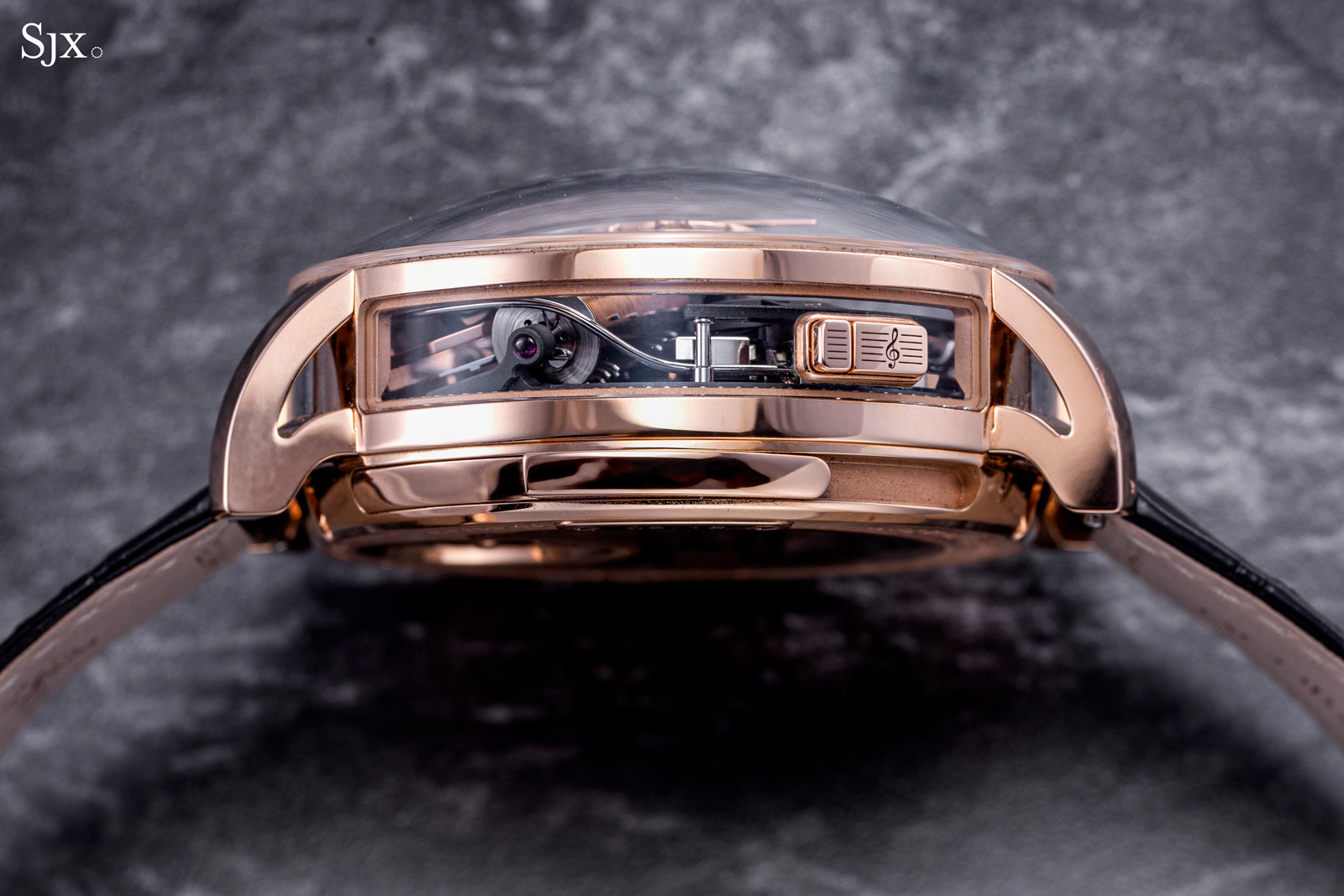
Three-train watches are rare, and perhaps the best comparison is to Patek Philippe no. 198’014, made for James Ward Packard, which also combined a minute repeater and cylinder music box, which was connected to an alarm. Packard chose Lullaby from Jocelyn for the tune because it was a favourite of his late mother, and because Nino Rota hadn’t yet composed the Godfather soundtrack.
A black-lacquered, solid gold piano miniature hides one of two 15-note steel combs, which get plucked by pins on the cylinders. The small size of these combs, and limited number of available notes (30) are challenges, yet the arrangement is still clearly recognisable as the The Godfather theme.
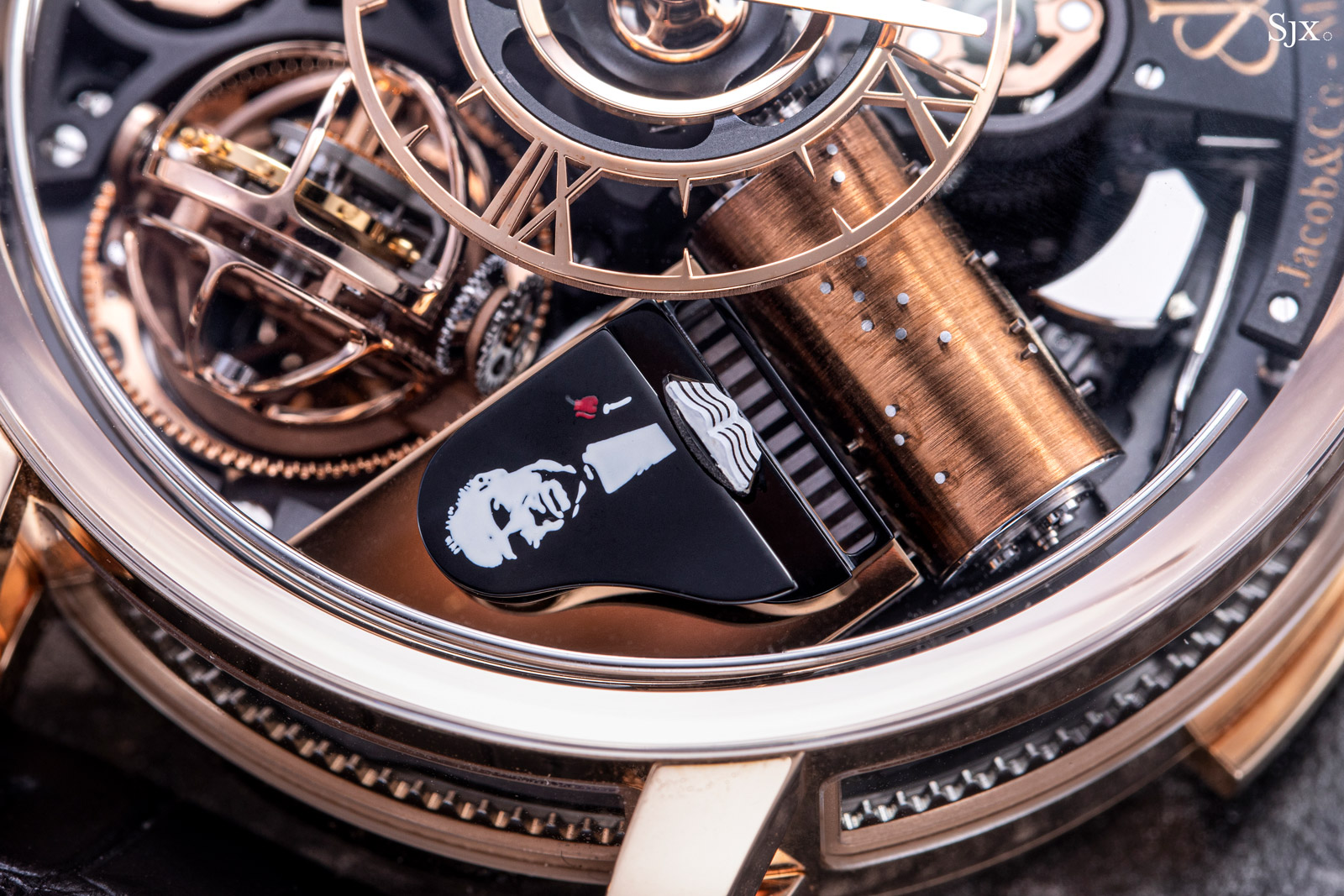
Given everything going on within, the movement is actually rather compact. At 49 mm, the watch is not small, but it’s only incrementally bigger than the less-complicated 48 mm Breguet La Musicale. With that extra 1 mm, Jacob & Co. has squeezed in a minute repeater, a massive three-axis tourbillon, and even a grand piano — albeit a very small one.
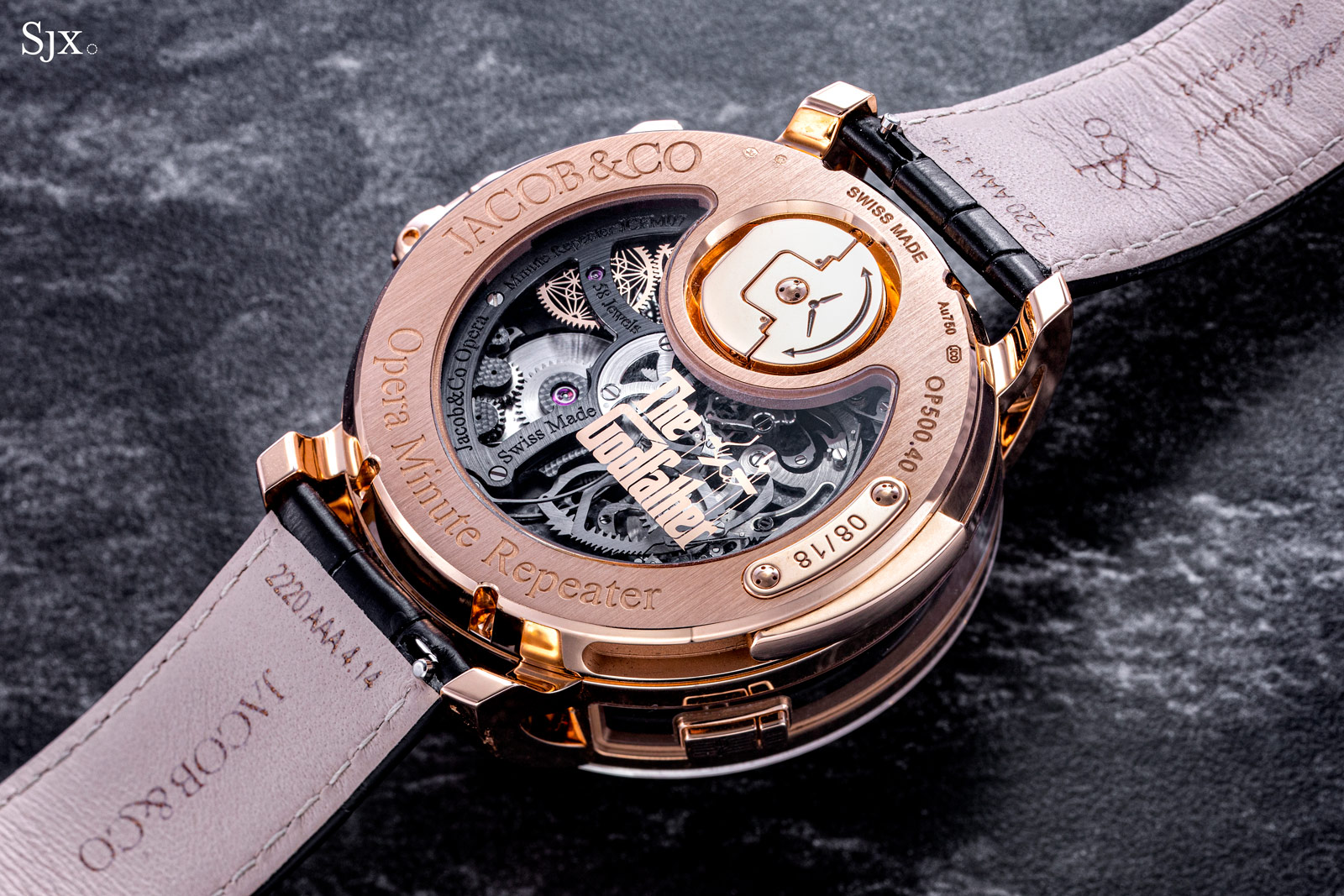
This is thanks to extremely dense packaging of the various subsystems, moving the flat-but-wide repeating work all the way to the back of the movement, and fitting the cylinders, combs, trains, governors, tourbillon, hammers, and gongs together like puzzle pieces.
Chapter 6: The God of Time
Earlier this year, to celebrate founder Jacob Arabo’s 60th birthday, Jacob & Co. broke a new record for the fastest rotating tourbillon ever with the launch of the God of Time. The tourbillon makes one rotation in just four seconds, undercutting Franck Muller’s Tourbillon Rapide by one second.
Unlike the Tourbillon Rapide, which uses an unusual fixed escape wheel, the God of Time uses a conventional, if overclocked, Swiss lever escapement.
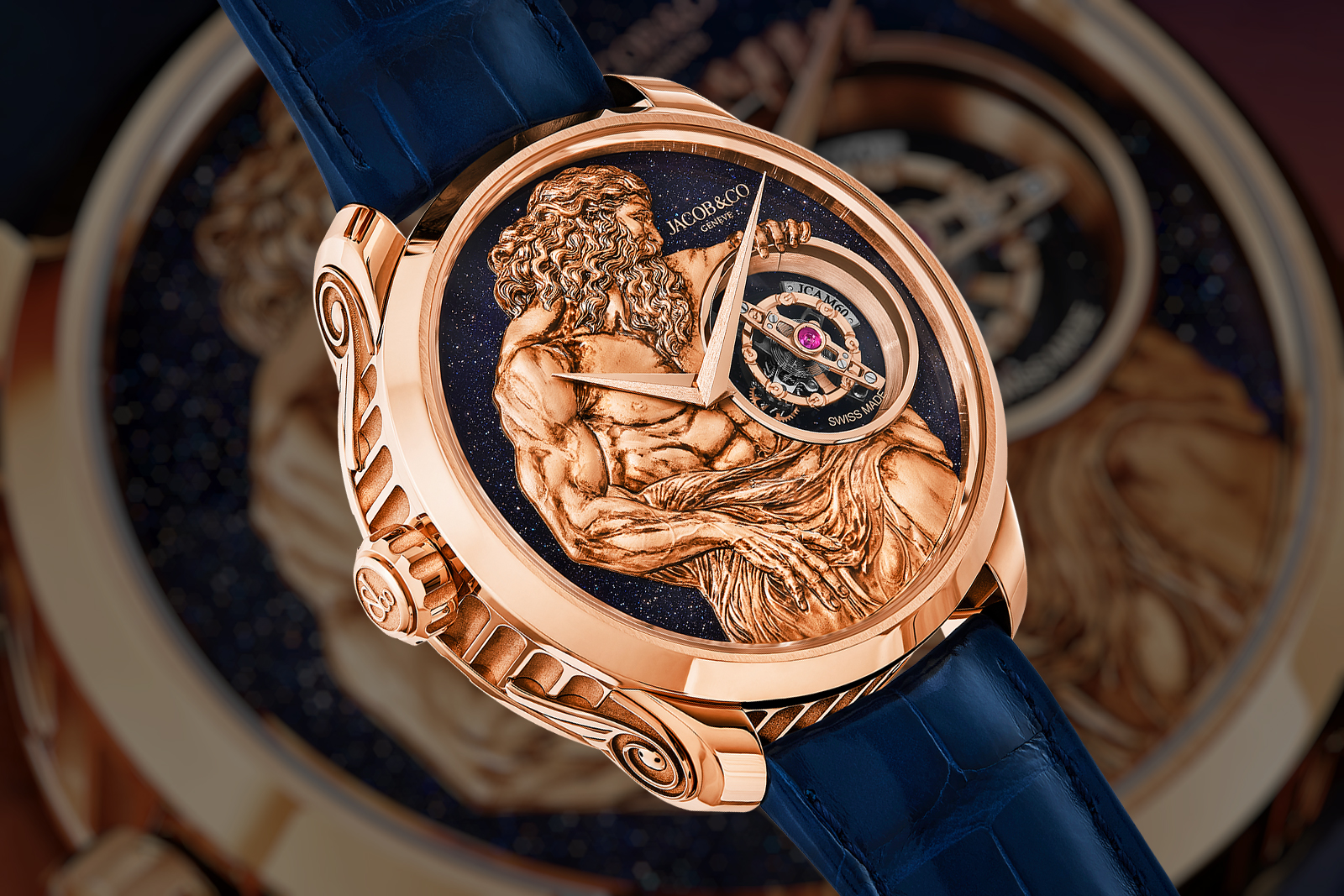
In a conventional tourbillon with a 3 Hz balance and a 15-tooth escape wheel, the ratio from the fourth wheel to the escape pinion is 12:1. The God of Time subverts this norm with a ratio of 4:5, meaning, incredibly, the cage turns faster than the escape wheel.
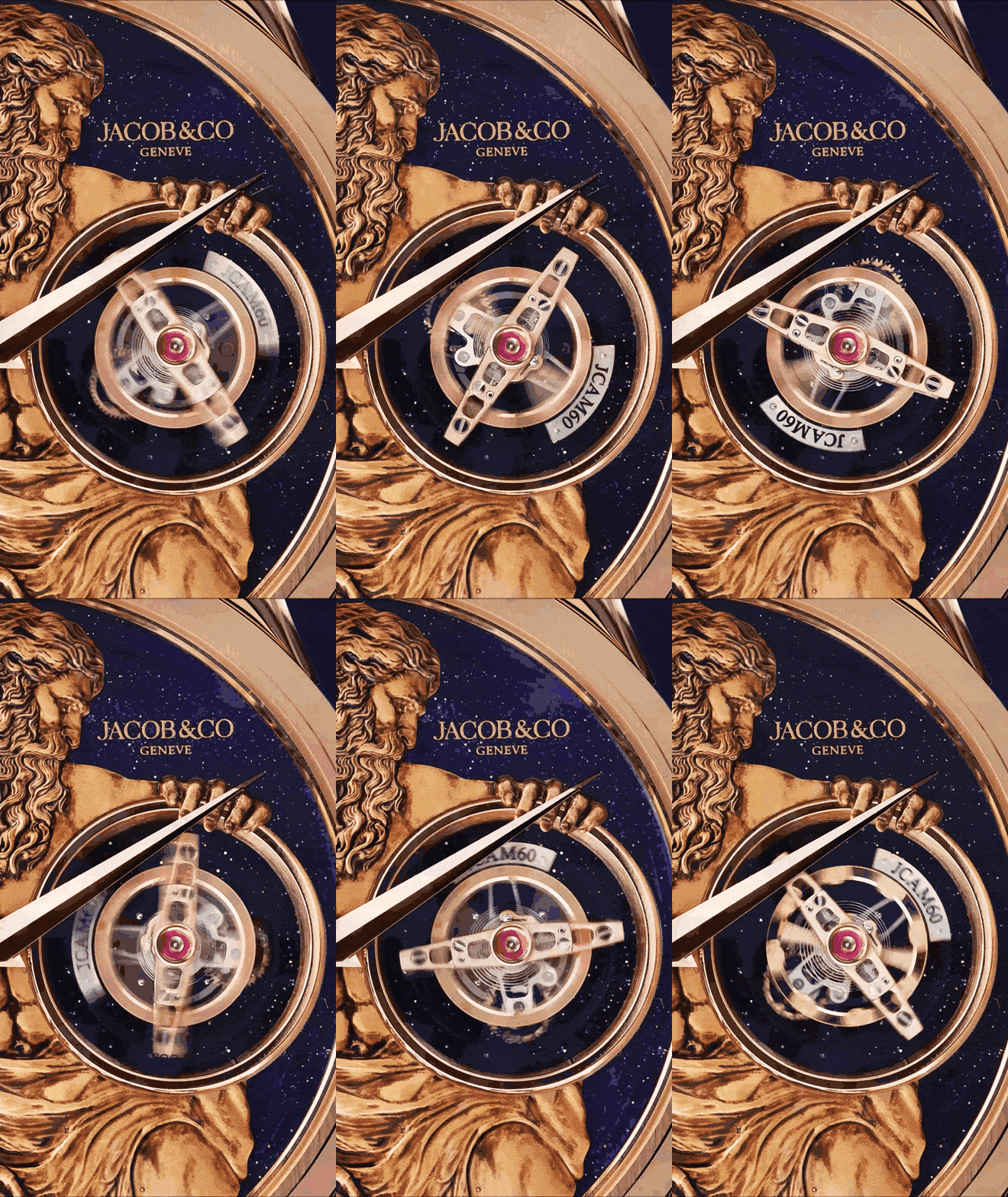
Just as impressive, the fast-rotating tourbillon contains a high-end oscillator comprised of a free-sprung balance and an overcoil hairspring.
It takes god-like power to rotate a tourbillon at that speed, even when the cage weighs a mere 0.27 g. This explains the four massive barrels, wound from the back, that are needed to propel the tourbillon throughout its power reserve.
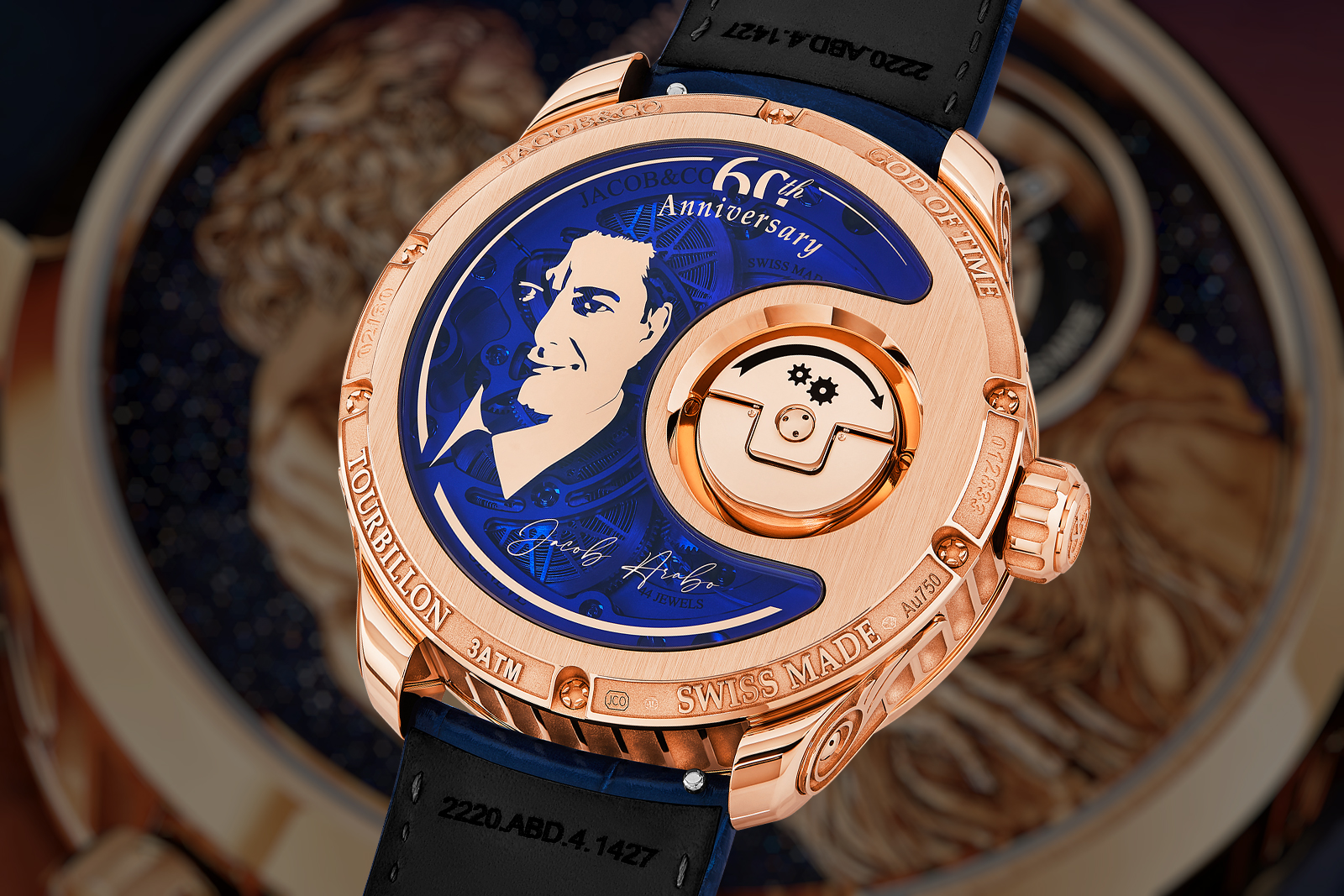
A constant force mechanism, positioned right before the escape wheel, ensures the tourbillon cage accelerates correctly and protects the escapement from the surging power of the quadruple barrels, delivered by a specialised going train.
While the fastest tourbillon ever is quite the technical feather for any watchmaker’s cap, Jacob & Co. has hinted there is more to come.
For more information, visit Jacobandco.com.
This was brought to you in partnership with Jacob & Co.
Back to top.