
Hands On: Audemars Piguet Royal Oak Malachite 37 mm
The watch that won the Super Bowl.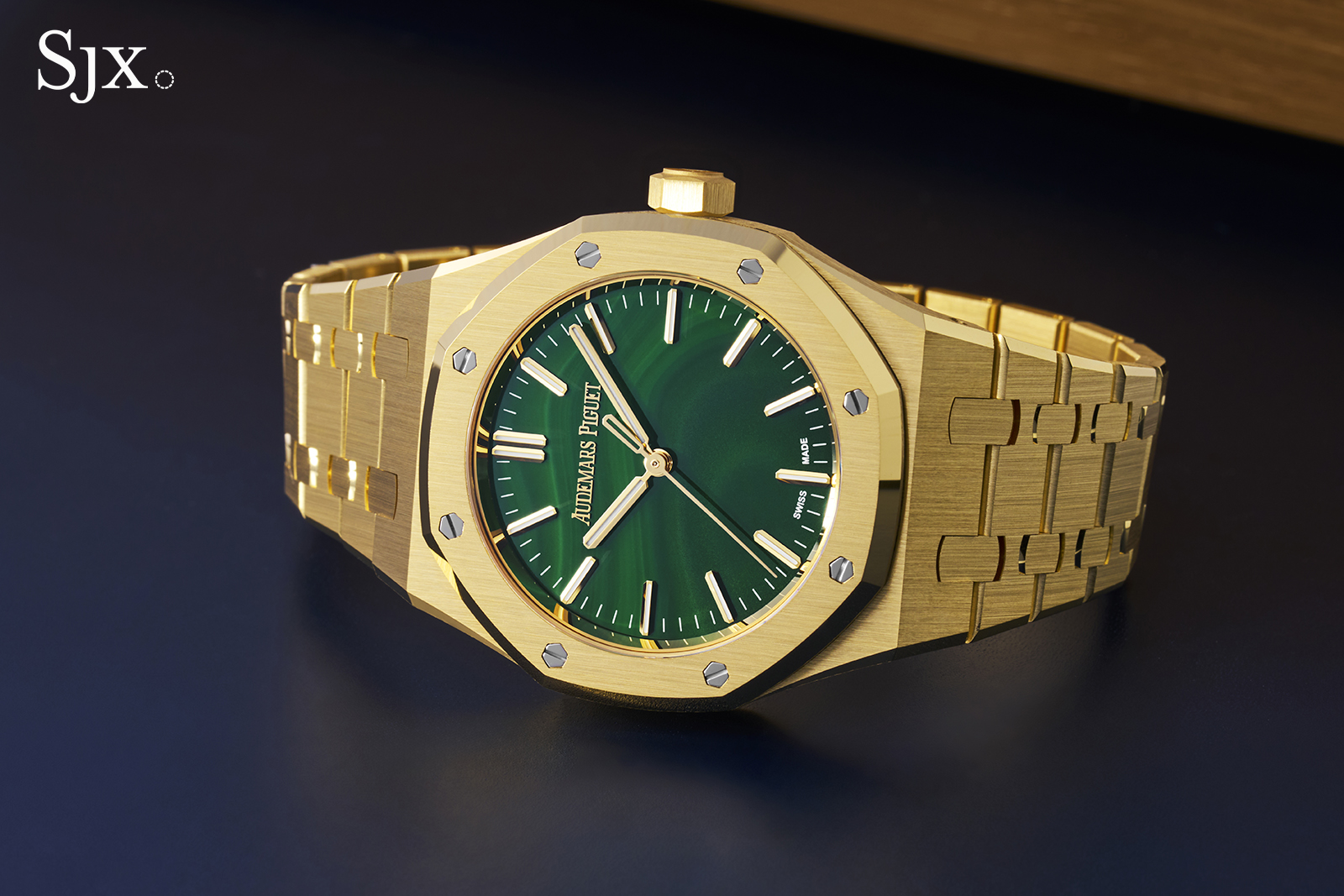
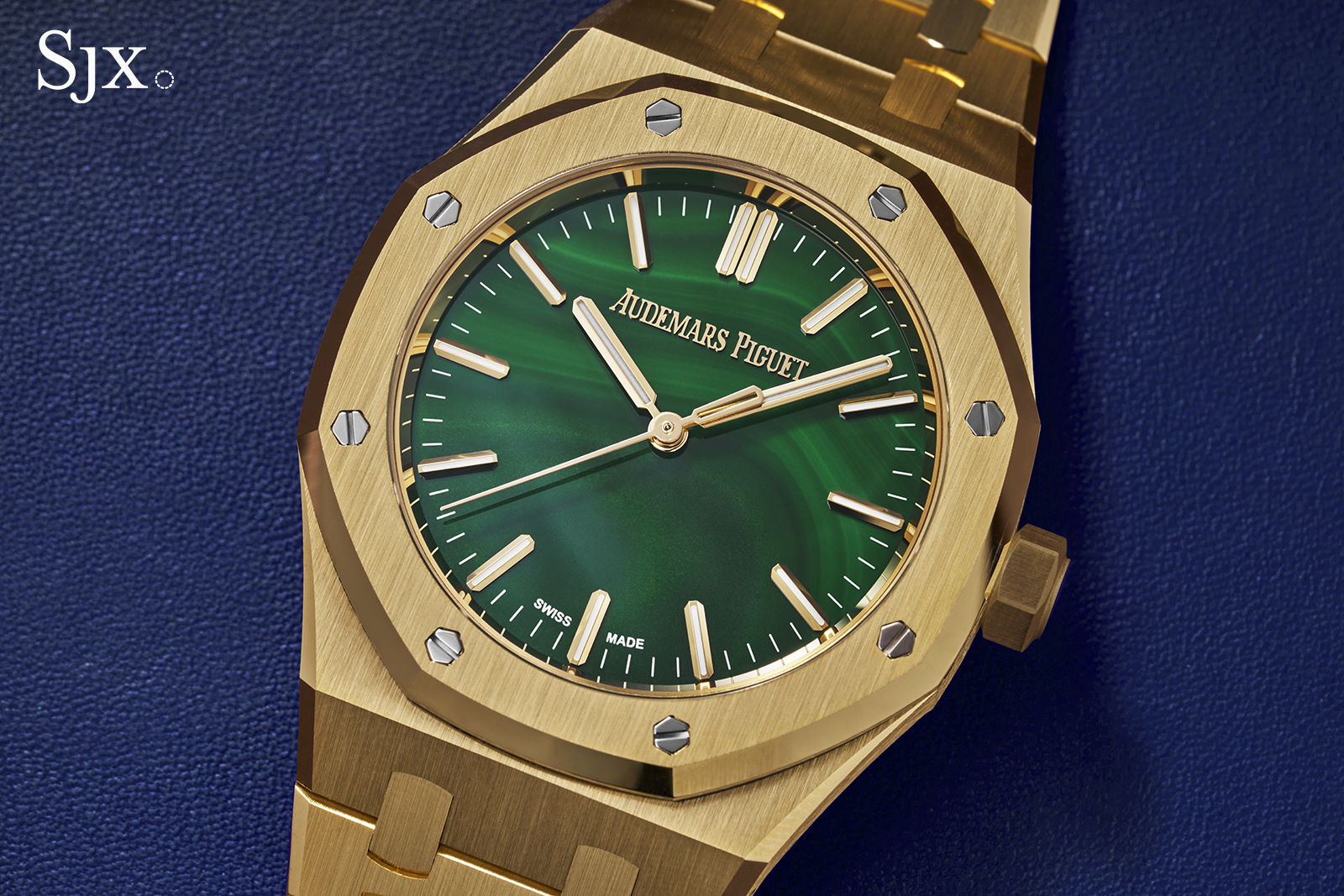
Audemars Piguet expands its stone‑dial lineup with the new Royal Oak Self-Winding 37 mm and 41 mm in yellow‑gold featuring malachite dials, continuing the brand’s cautious re-exploration of trendy stone dials.
Initial thoughts
Last month Bad Bunny, the most-streamed musician in the western hemisphere, took the field for the Super Bowl LX halftime show wearing this yellow gold Royal Oak Selfwinding 37mm. A design as recognisable as any in watchmaking, worn on the wrist of the “King of Latin Trap” in front of over a hundred million viewers — a significant marketing coup for Audemars Piguet.
It was also an implicit endorsement from Bad Bunny’s stylist Storm Pablo, who procured the watch within days of its announcement.

Bad Bunny during the Apple Music Super Bowl LX halftime show. Image – Apple
Pricing remains surprisingly reasonable, with the 37 mm pegged to the same price as the turquoise-dialled sibling from a few years ago, while the 41 mm model is priced just 4% higher than a regular production Royal Oak in pink gold. That’s a large step up in absolute terms, but that comes with the (price) territory.
It is important to point out that despite the premiums brands often attach to stone dials, most are not particularly expensive to make. When it comes to malachite, the raw material cost is negligible, with African mines in and around the Copperbelt producing gemstone-quality malachite by the literal ton.
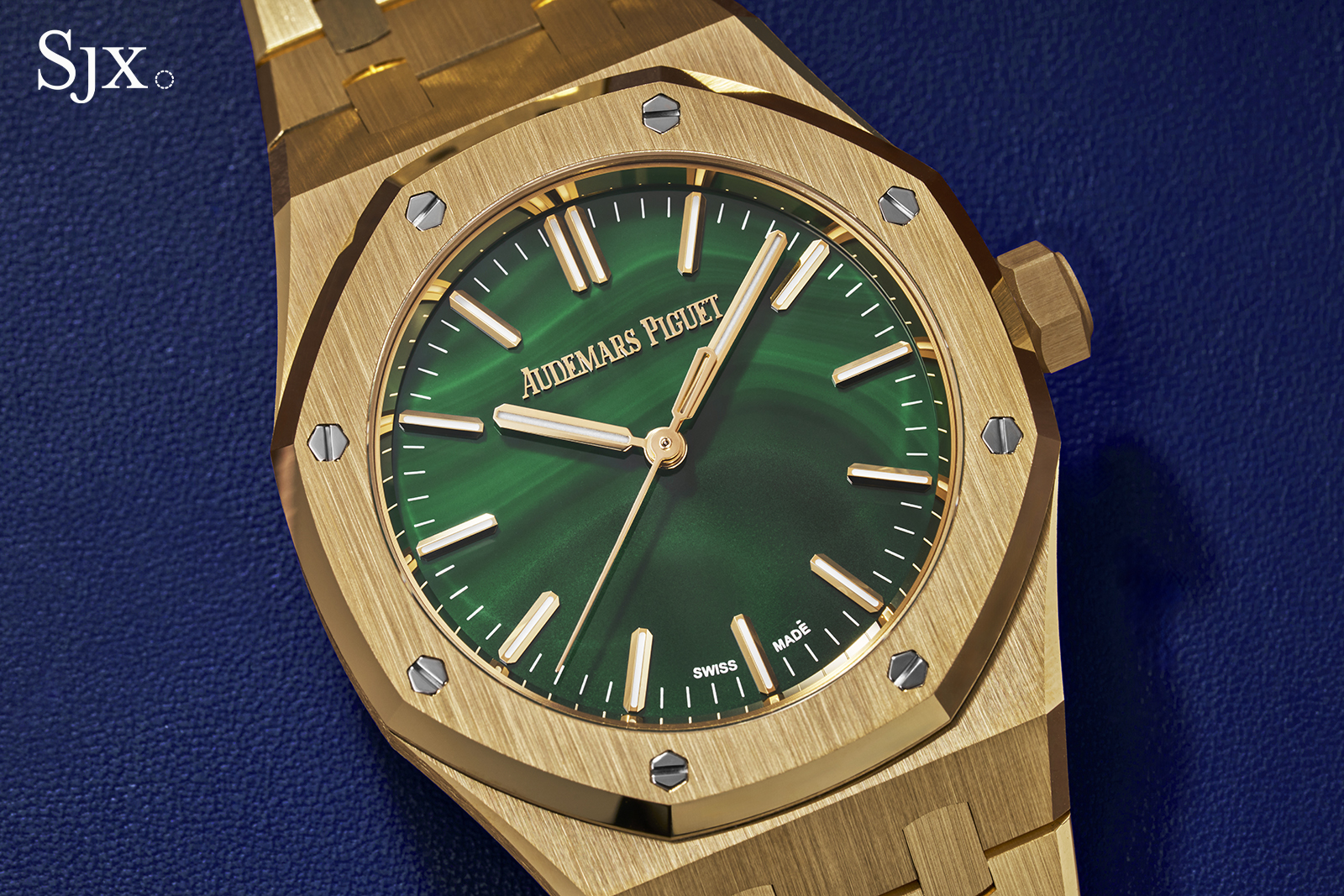
Audemars Piguet made the right choice by avoiding the increasingly cliché sharply defined horizontal banding chosen for most malachite dials; it did the same with the malachite-dialled Code 11.59 from last year. The result is a nice green dial that just so happens to be malachite.
Perhaps the only weakness for either of these watches is that neither is a Jumbo, a configuration that would have meant more ideal proportions, a more interesting movement, and the absence of a sweep seconds hand — which never looks quite right on a Royal Oak that isn’t a chronograph, and only distracts from the dial.
Malachite green
Audemars Piguet is no stranger to stone dials — nor, it seems, is any watch manufacturer that operated between the 1960s and 1990s. The brand has offered Royal Oaks with stone dials before, but to my knowledge never with malachite.
Malachite is a secondary copper mineral, meaning it is formed near the surface by weathering (oxidation) of primary copper minerals, such as chalcopyrite – the most commercially important copper ore. That oxidised copper is responsible for the vibrant green, the varying concentration of which gives rise to the distinctive banding. Where there is smoke there is fire, and where there is malachite there is copper.
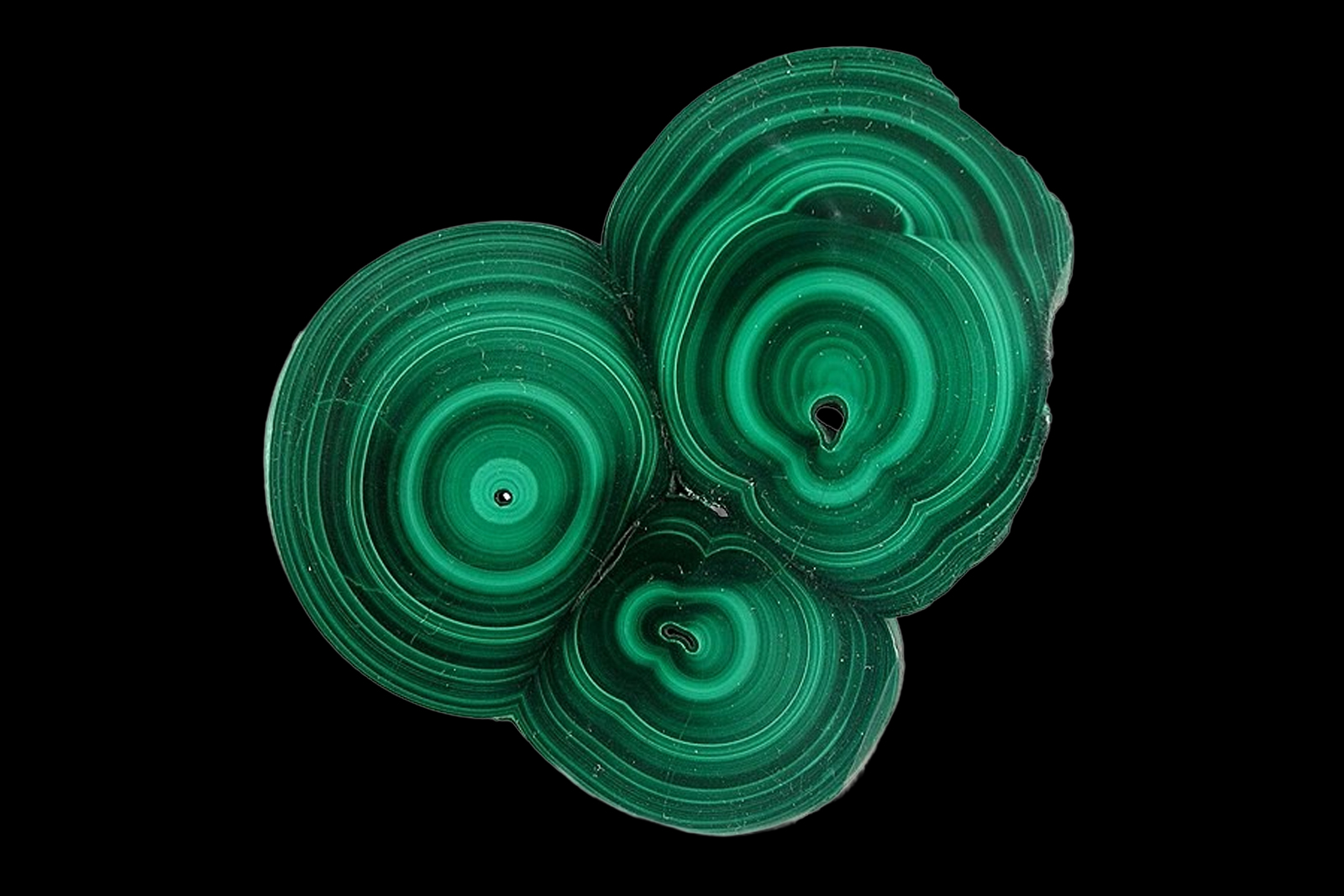
An example of three intergrown malachite stalactites with concentric banding from Kolwezi, DR Congo. Image – Robert Lavinsky / iRocks.com (CC-BY-SA)
That remains true for these dials after processing as the thin slices of polished malachite are adhered to a copper dial base which acts as a stable foundation for the relatively brittle stone. Unlike the 37 mm Royal Oak with turquoise dial from 2023, there is not a cut-out for the date on this 37 mm variant, nor is there one on the larger 41 mm model.
Royal Oak
This 37 mm variant isn’t as faithful to the Royal Oak’s proportions as its bigger brother. The bracelet is narrower relative to the watch case, with a more aggressive taper and less lateral padding around the intermediate links. The polished chamfers along the case are bracelet are also noticeably wider which makes the bracelet appear narrower still. The result looks and wears less like an integrated bracelet.
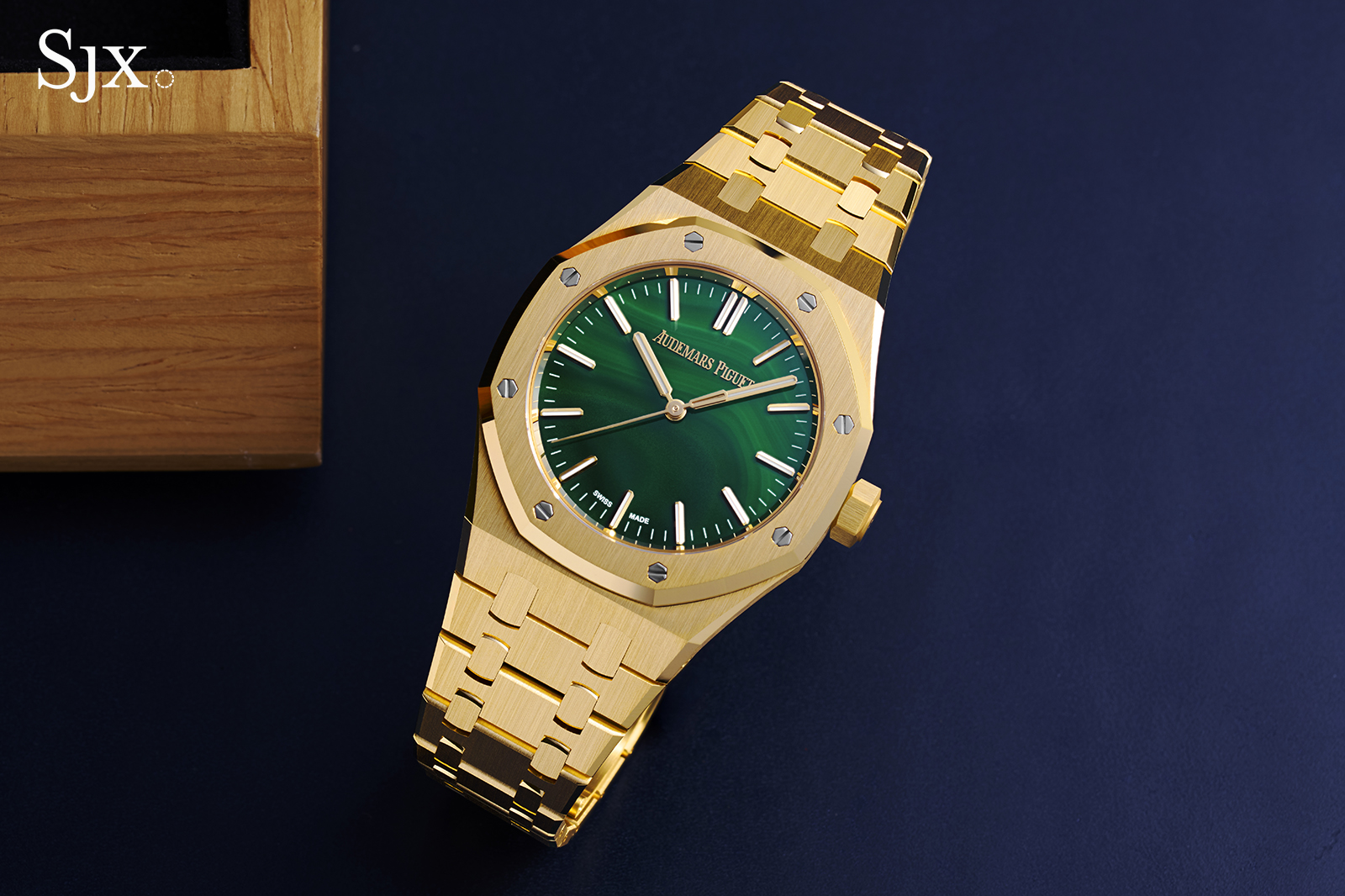
The brand’s recent messaging to enthusiasts has focused on ergonomics — a weak point in Audemars Piguet’s complicated movements before leapfrogging the competition last year, but something it perfected in its bracelets long ago. Even without tool-free micro-adjustment, a good fit is easy to achieve thanks to the short links.
As with all modern bracelet-borne Royal Oaks, the tangible quality of the bracelet is obvious. While Royal Oak bracelets of the past were somewhat dainty, not unusual for bracelets of the era, and would often stretch over time, modern Royal Oak bracelets are built of tougher stuff. The thick-gauge swing arms of the butterfly clasp seem almost unnecessary on a Royal Oak, and perhaps would be more at home on an Offshore, but the chunky clasp acts as a counterweight to the rather heavy gold case.
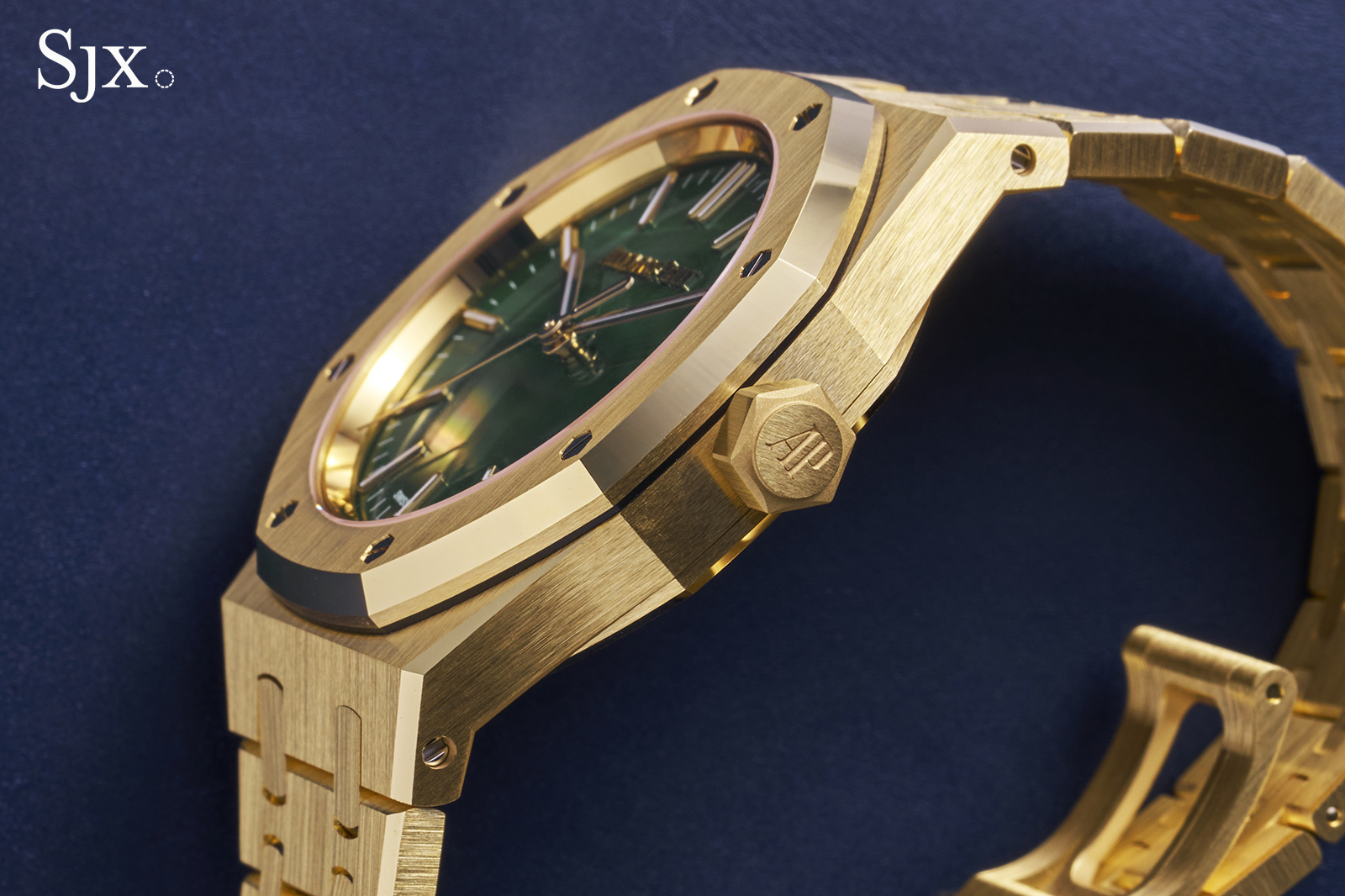
Once overwhelmingly popular, yellow gold has become something of a precious metal pariah. For example, Patek Philippe’s catalogue of 173 wristwatches includes only two in yellow gold, and neither are particularly high volume models, meaning that within living memory the brand’s yellow gold watches have gone from the vast majority of the firm’s precious metal output, to nearly nil. Some brands have even attempted to make yellow gold less yellow, such as Omega’s Moonshine gold, or Breguet’s eponymous alloy from last year.
Perhaps for this reason, Audemars Piguet seems to reserve yellow gold for niche models. Of the 16 mechanical yellow gold watches in its catalogue today, a third are openworked models and four have stone dials. As it happens, turquoise and malachite both pair exceptionally well with yellow gold, which Audemars Piguet clearly understands having paired the materials as part of the Code 11.59 Flying Tourbillon 38 mm stone dial trilogy from last year.
Industrial haute horlogerie
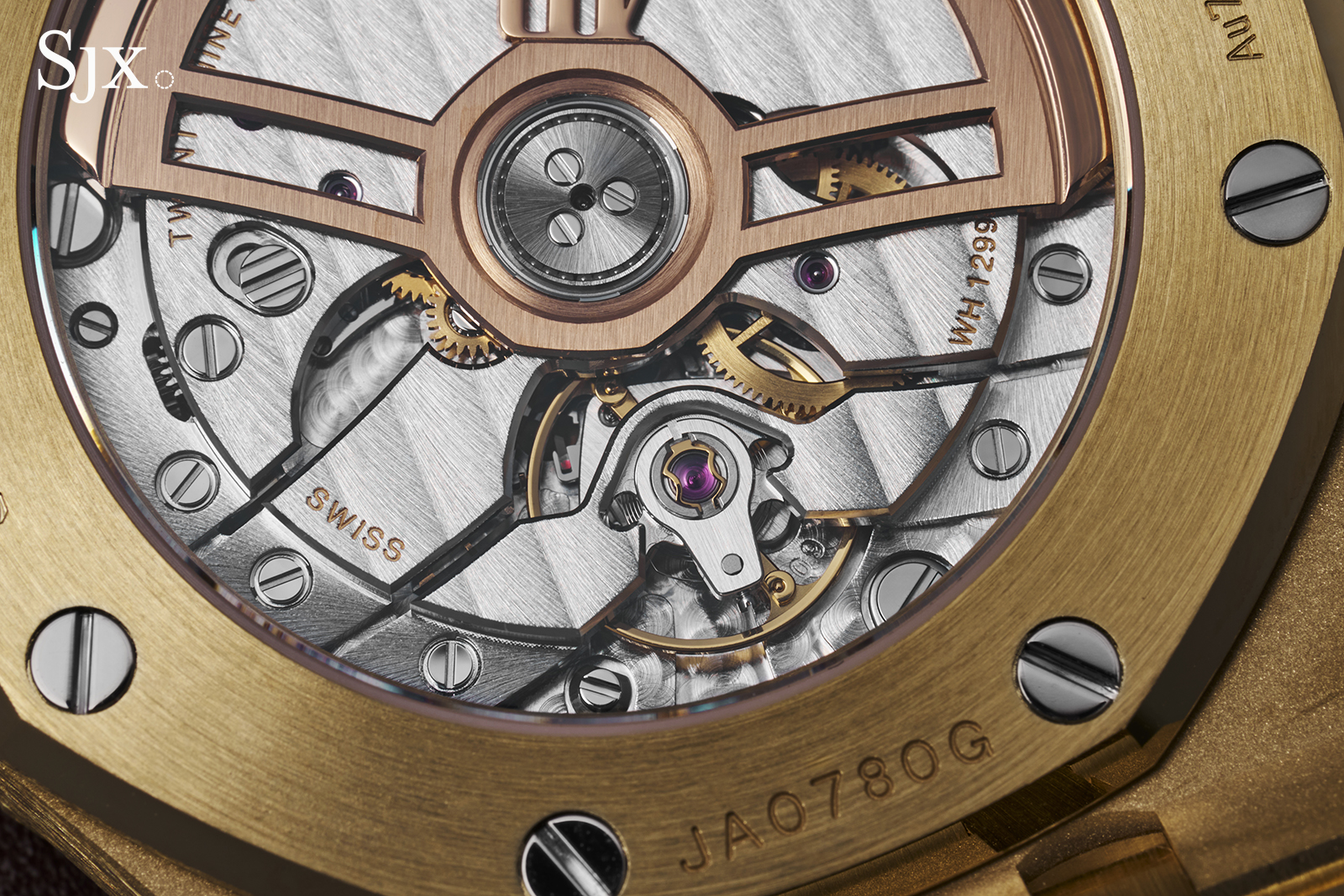
The 37 mm variant is powered by the Vaucher-based cal. 5909, with 60 hours of going from two mainspring barrels. That’s a healthy power reserve for a smallish movement, especially one that ticks at 4 Hz. It is constructed and decorated to a relatively high standard, comparable to the latest-generation Rolex calibres and Grand Seiko’s cal. 9SA family, but falling short of Patek Philippe and Vacheron Constantin’s automatics in this weight class.
The larger 41 mm model houses the massive ~14 ligne in-house cal. 4309 which is more sophisticated despite its bulk. Key upgrades include a 70-hour power reserve and bi-directional winding. This movement family normally features an instantaneous changing calendar, which is absent on this no-date version.
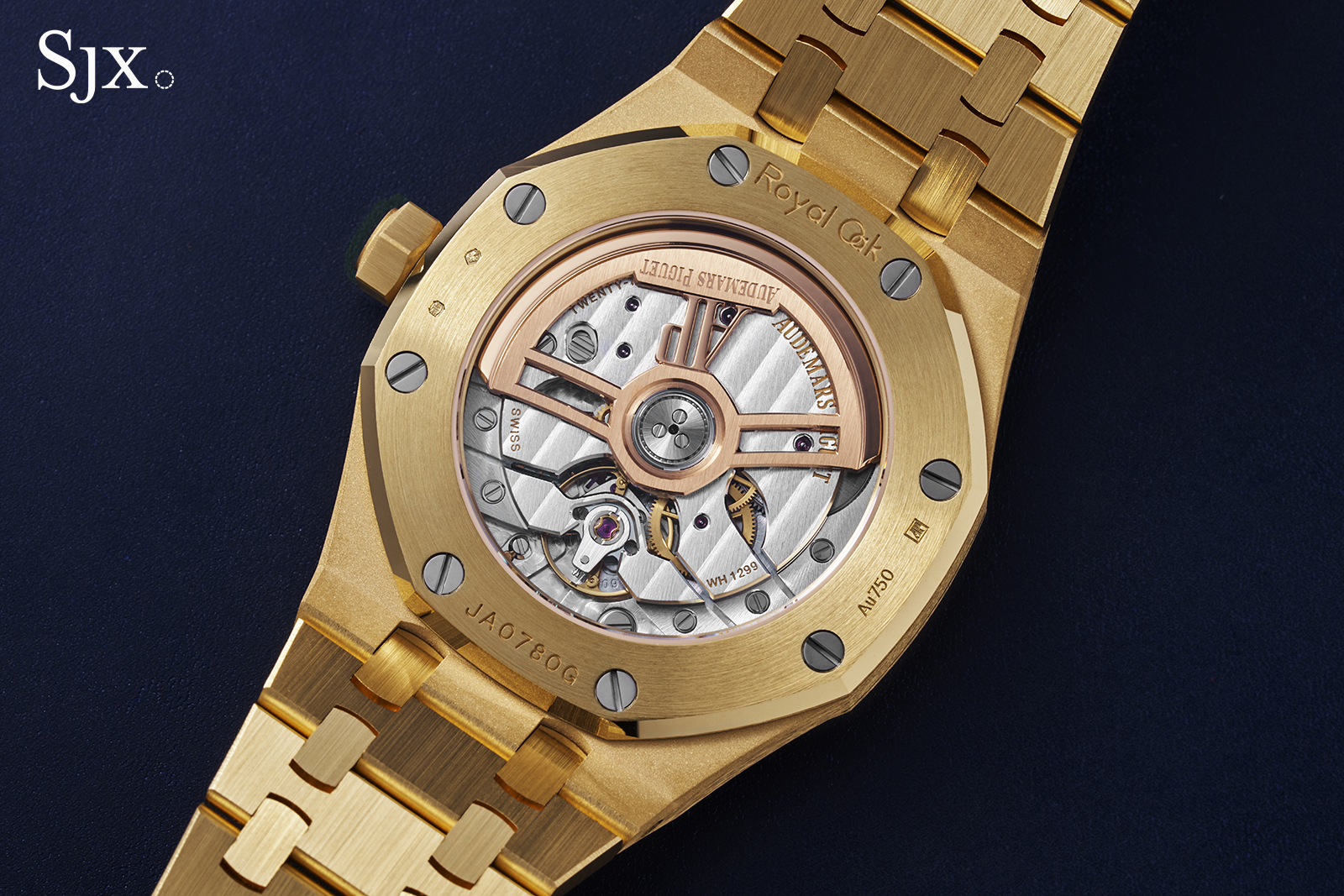
Both feature handsomely openworked 18k rose gold oscillating weights full of sharp inward creases which are costly to machine. Unfortunately, as this is a yellow gold watch, the rotor doesn’t match the case. This is surprising, since Audemars Piguet now equips its openworked yellow gold Jumbos with case-matched yellow gold rotors.
Key facts and price
Audemars Piguet Royal Oak Selfwinding Malachite 41 mm and 37 mm
Ref. 15513BA.OO.1320BA.01 (41 mm)
Ref. 15553BA.OO.1356BA.04 (37 mm)
Diameter: 41 mm or 37 mm
Height: 10.5 mm or 9.3 mm
Material: 18k yellow gold
Crystal: Sapphire
Water-resistance: 50 m
Movement: Cal. 4309 (41mm), cal. 5909 (37 mm)
Functions: Hours, minutes, and seconds
Winding: Automatic
Frequency: 28,800 beats per hour (4 Hz)
Power reserve: 70 hours (cal. 4309), 60 hours (cal. 5909)
Strap: 18k yellow gold bracelet
Limited edition: No
Availability: AP boutiques and AP Houses
Price: US$81,900 (41 mm), $75,700 (37 mm)
For more information, visit Audemarspiguet.com.
Back to top.