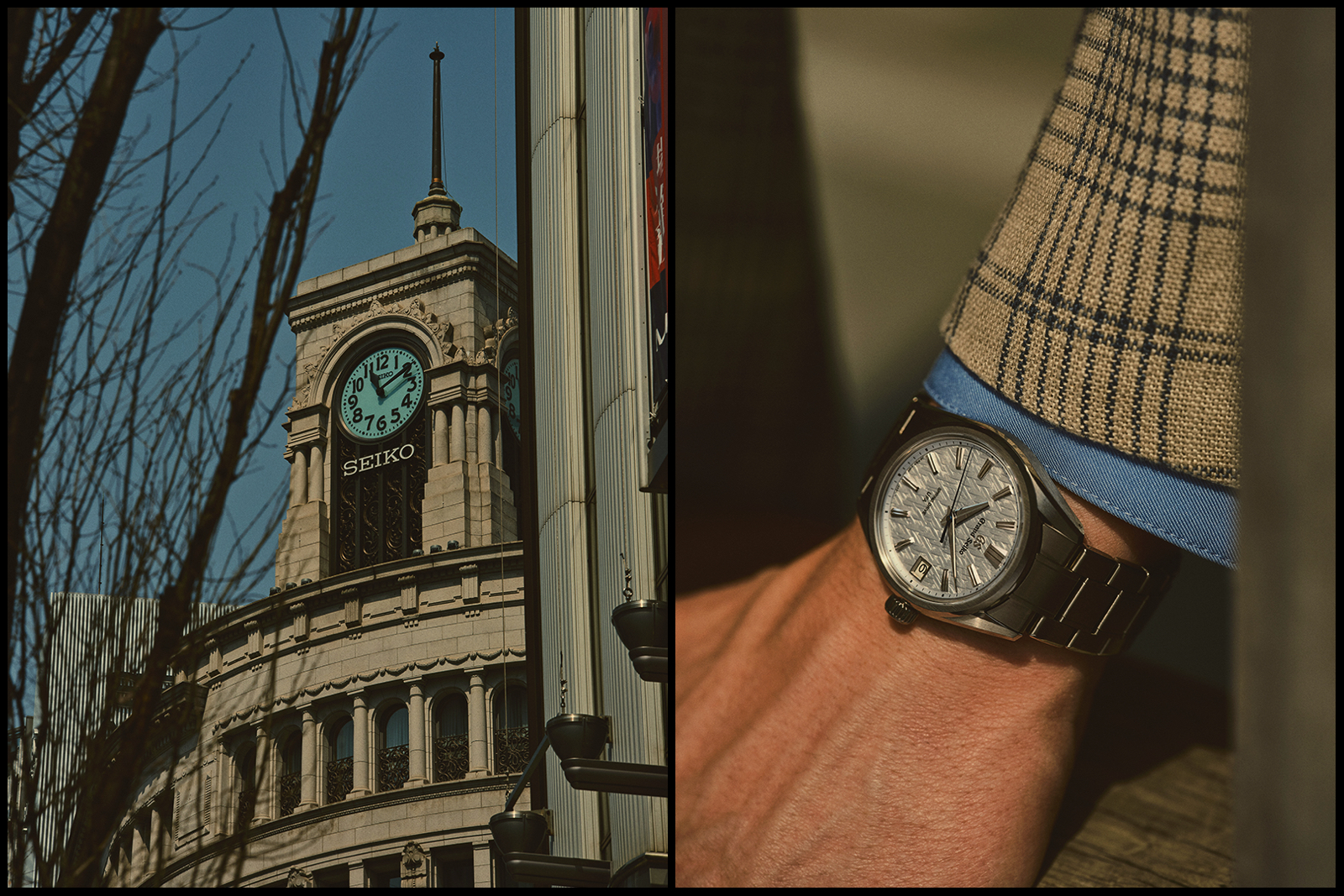
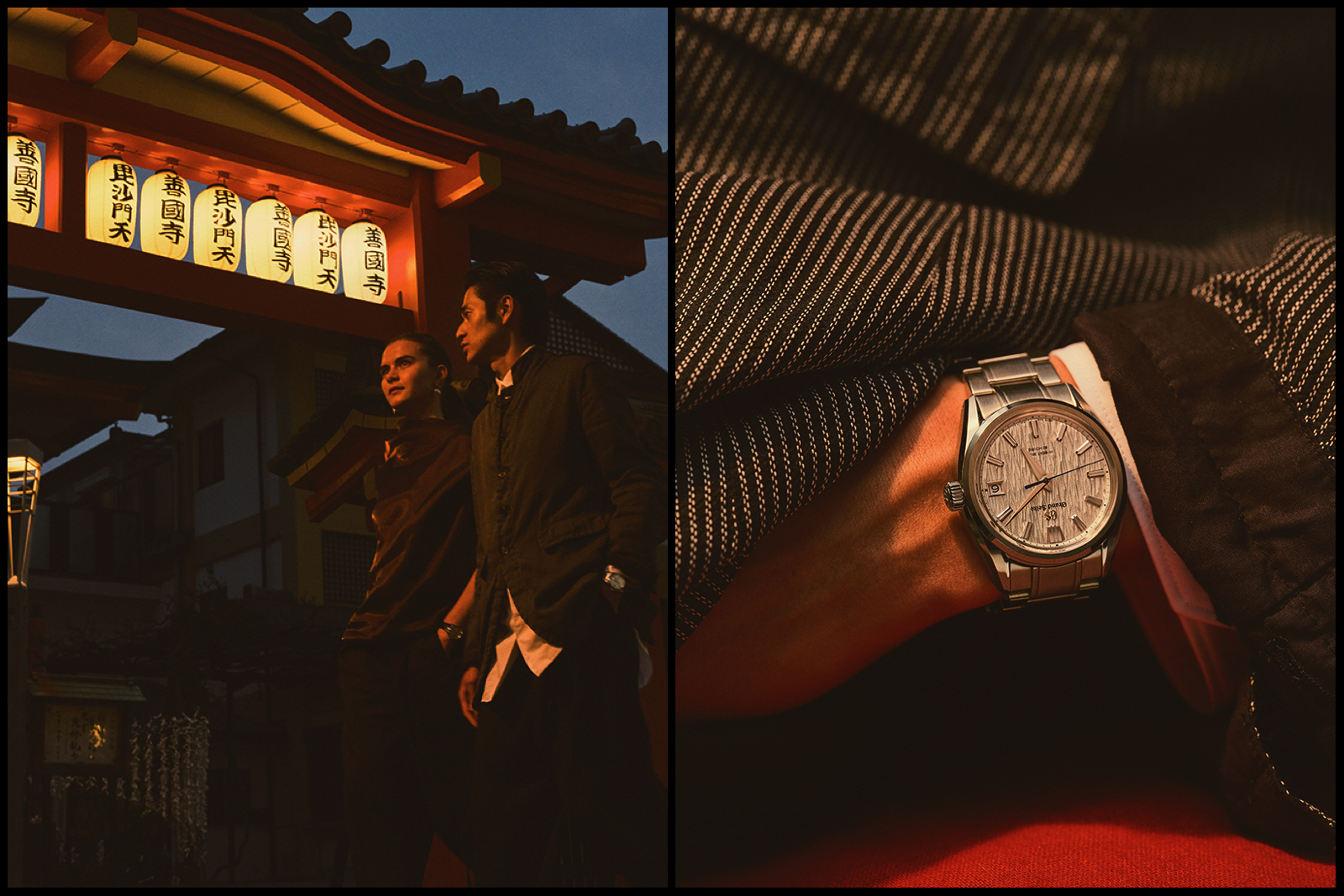
Grand Seiko’s flagship boutique in Singapore is host to Tokyo Time, an event designed to bring the vibrancy of Tokyo into the heart of Singapore.
Thematically, the event focuses on the people of the world’s largest city experiencing the flow of time. As explained by Ida Idris-Low, Managing Director of Grand Seiko APAC, “Tokyo is defined by a beautiful intricacy – eight distinct districts moving in tandem, each with its own culture and cadence”.
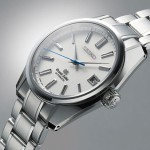
Ref. SLGH0055 White Birch in Kagurazaka. Image – Seiko Watch Corp / Gregory Harris
In order to capture this, the brand enlisted New Zealand-based photographer Gregory Harris to shoot each watch in situ. The pop-up seeks to connect eight Grand Seiko watches to eight parts of Tokyo.
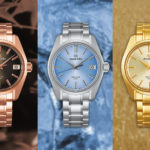
For example, Mr Harris shot the Tentagraph ref. SLGC001 in Toyosu, a man-made island home to the world’s largest wholesale fish market. The Icefall ref. SBGH347 was paired with Roppongi, known for its museums by day and clubs by night. Ginza’s champion is the Evolution 9 U.F.A. Ice Forest ref. SLGB003 – Grand Seiko’s most significant launch of last year.
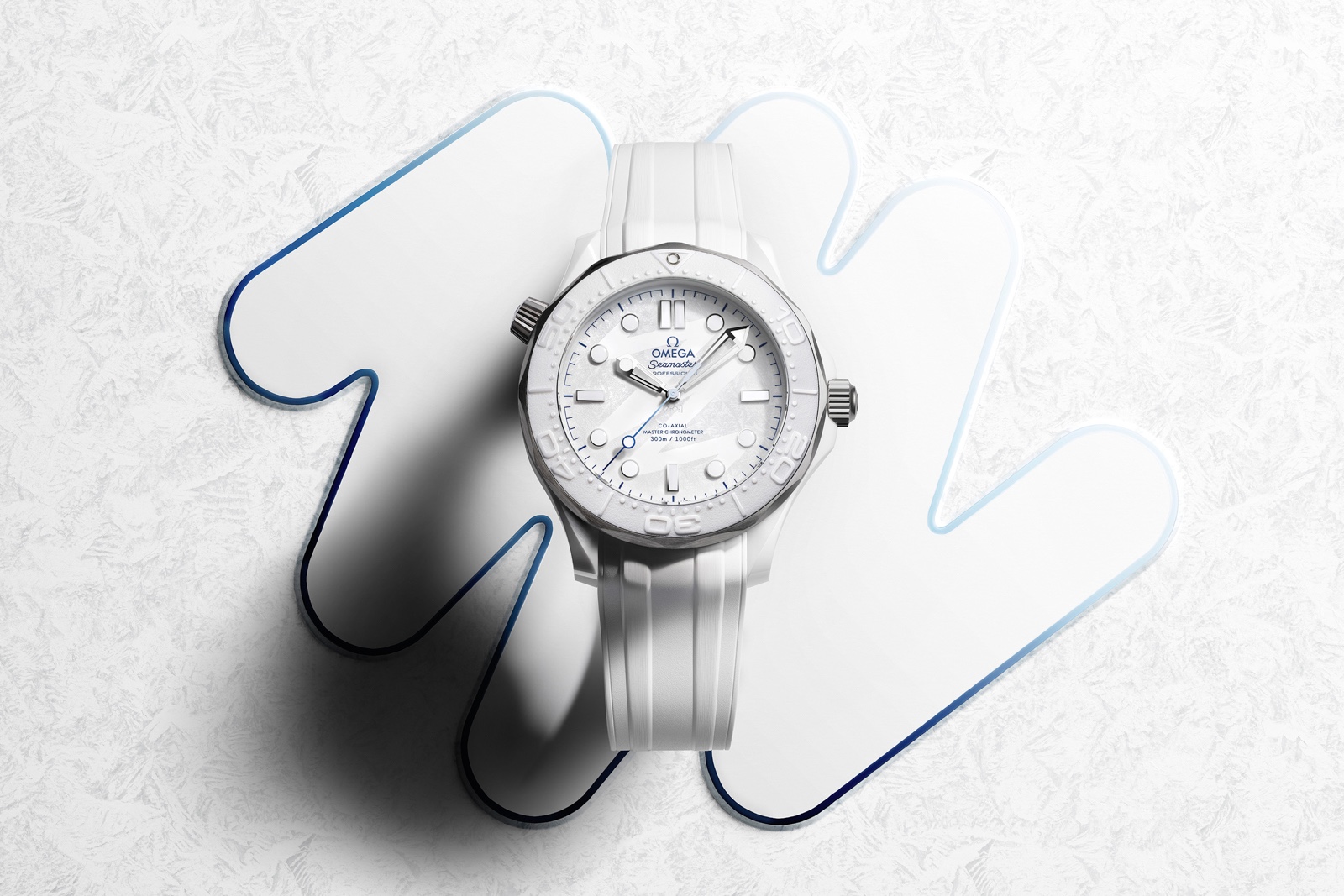
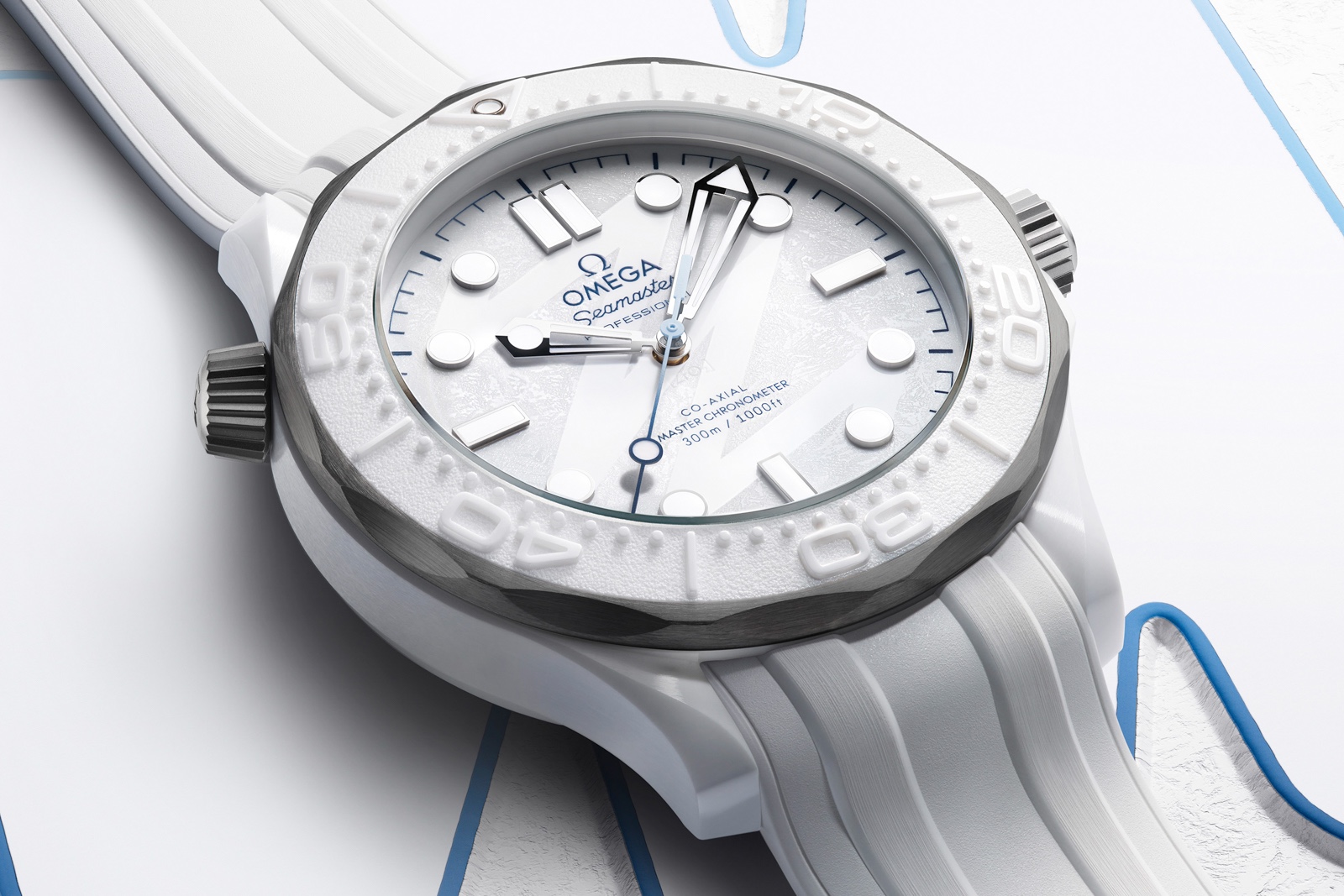
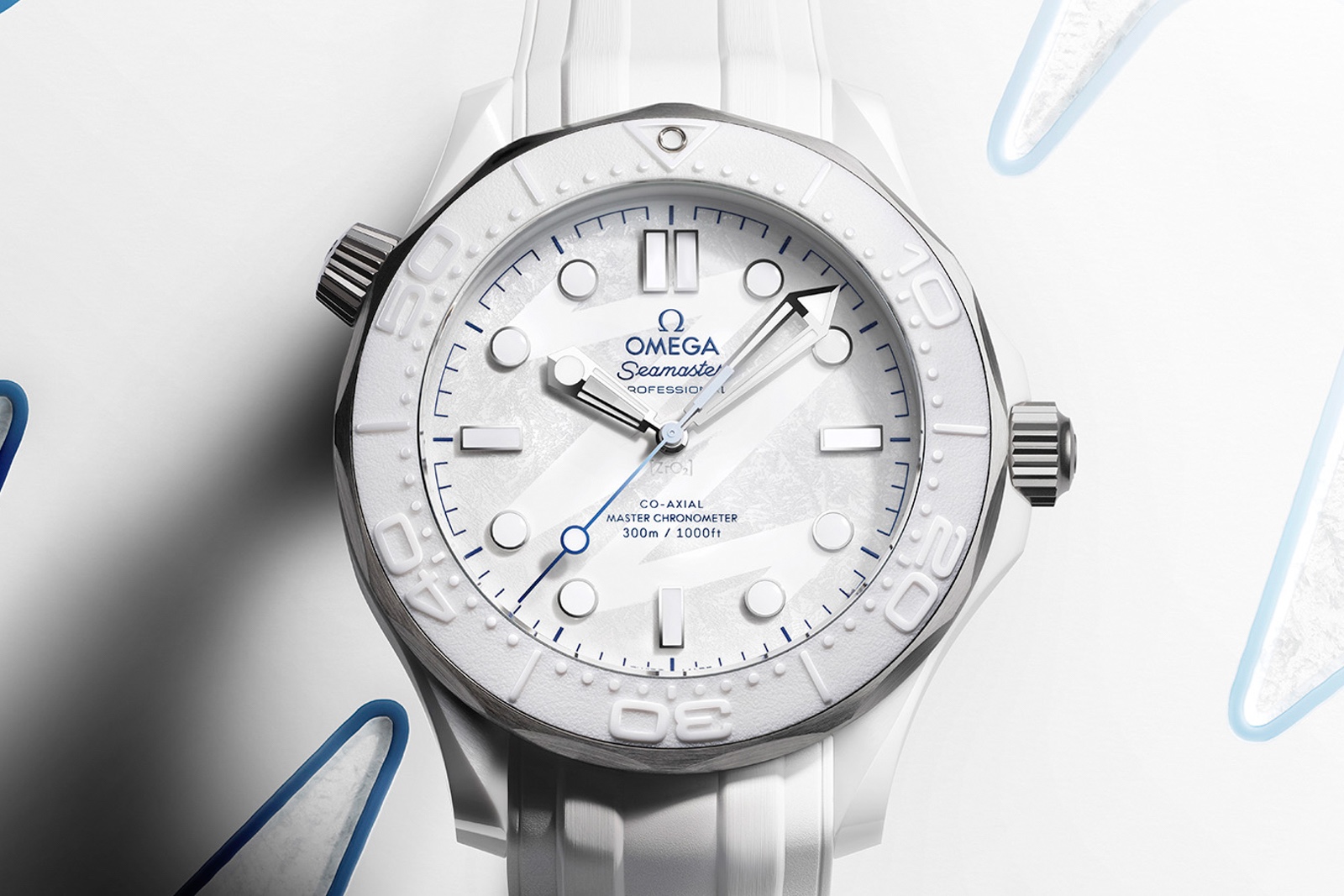
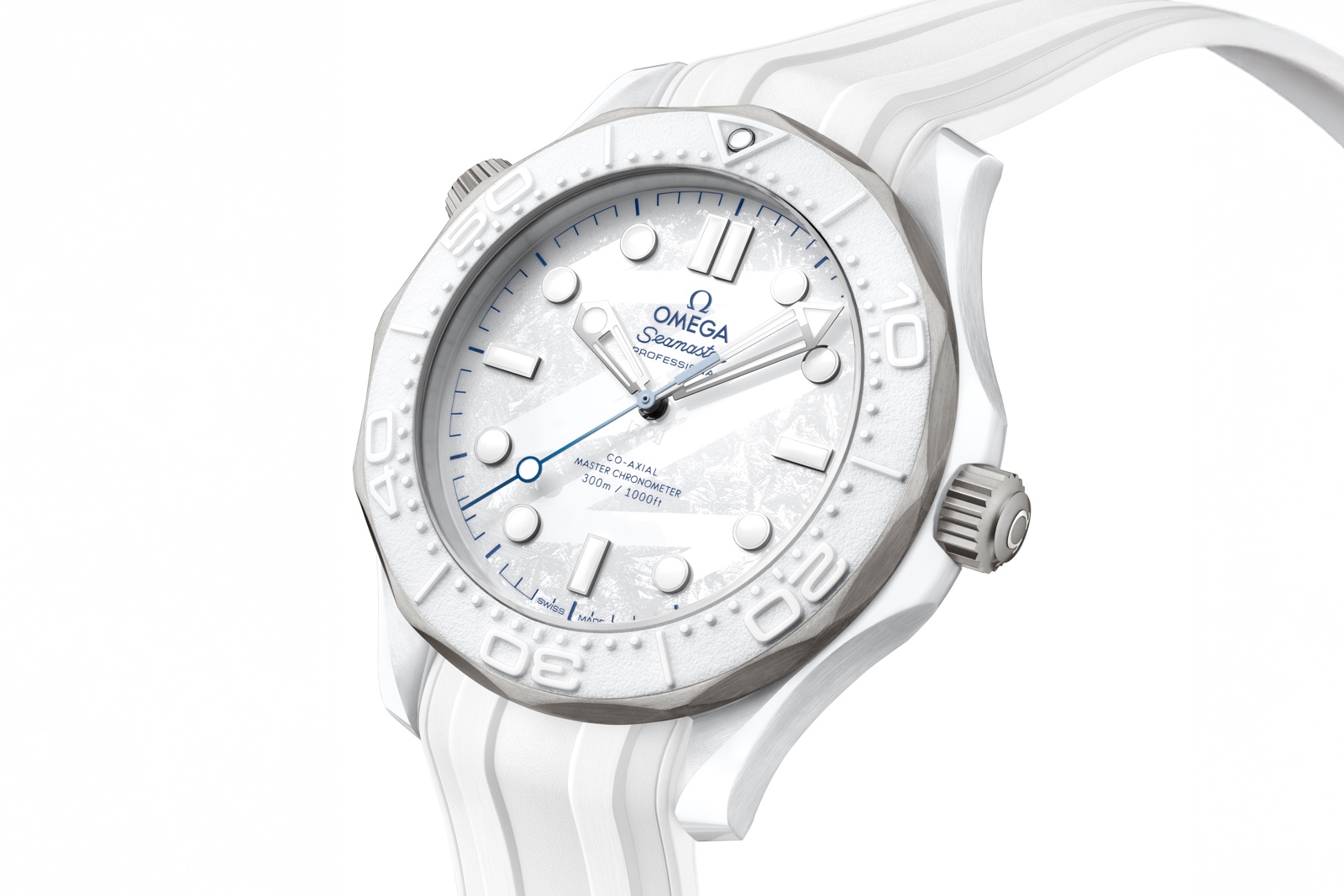
The Olympic Games are just around the corner, which means Omega is getting ready to time 116 events in 16 different disciplines as the Games’ official timekeeper, a title the brand has held throughout much of the past century. That association has resulted in a long line of increasingly tasteful commemorative watches, including the Seamaster Diver 300M Milano Cortina, which applies discreet Olympics branding to an appealing new white ceramic iteration of the Seamaster.
Initial thoughts
It’s hard to see the Seamaster Milano Cortina as an entirely new watch since an almost identical black version was released back in 2021. That said, the snow white ceramic cements the connection to the upcoming Winter Olympics, due to be held jointly by Milan and Cortina.
A common critique of ceramic is that it can look like plastic; I find this to be especially true when it comes to glossy white ceramic. This is where the emblematic Seamaster case and the industrial prowess of Omega pay dividends.
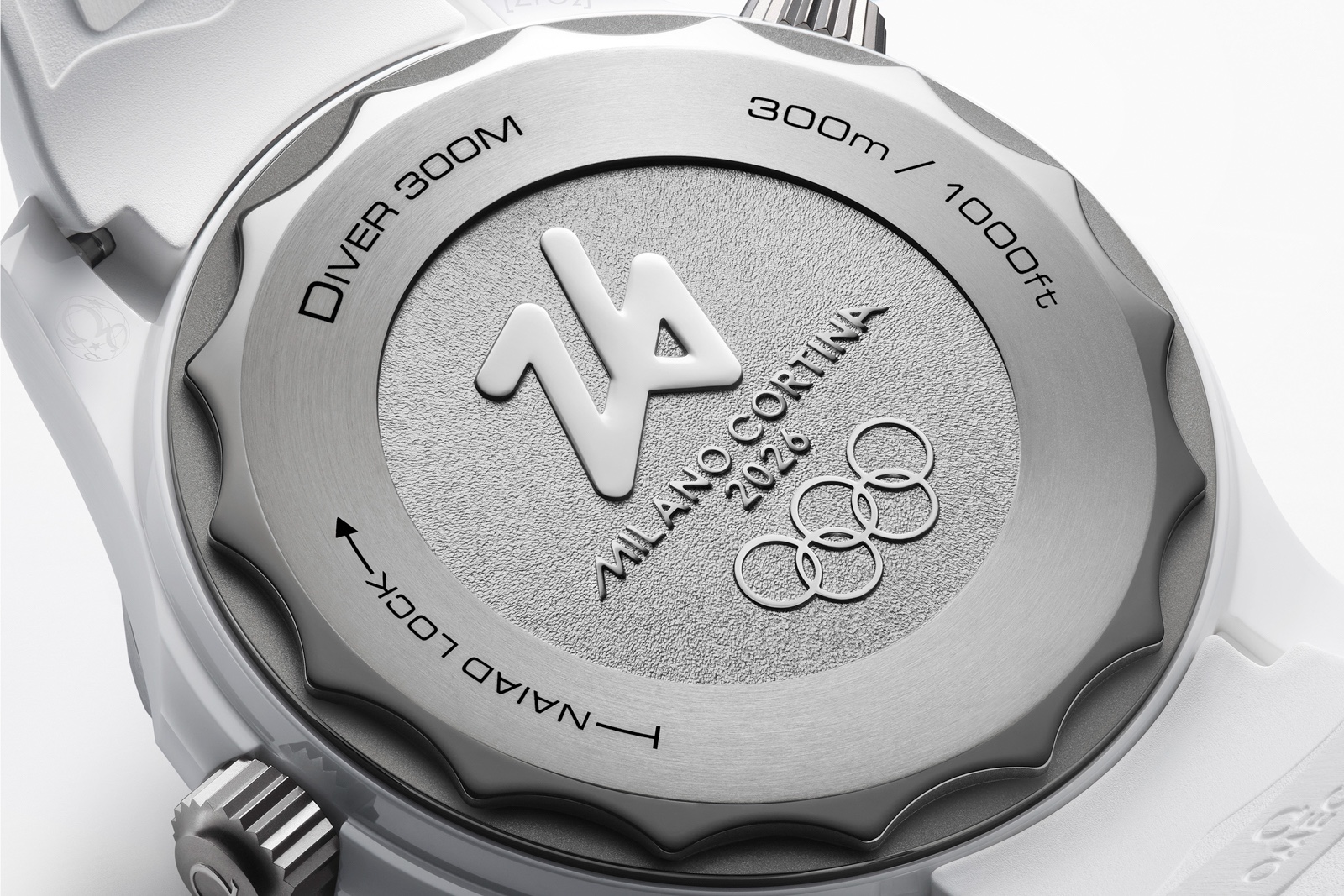
The case is sculpted exactly like its stainless steel counterparts, with contrasting brushed and polished finishes that distinguish it as a premium product. The milky white material is complemented by grade 5 titanium, which is used for the bezel frame, both crowns, the solid case back, and the pin buckle. The ceramic bezel insert is deeply relief-engraved by laser, giving it a satisfying tactility that is all the more appealing considering the ageless properties of ceramic.
Naturally, the Seamaster Milano Cortina is positioned both as a watch and also as a collectible piece of Olympics merchandise. For that reason I’m surprised it’s not a limited edition; a limitation of 2,026 pieces, for example, might help justify the retail price of US$10,500.
Zamboni dial
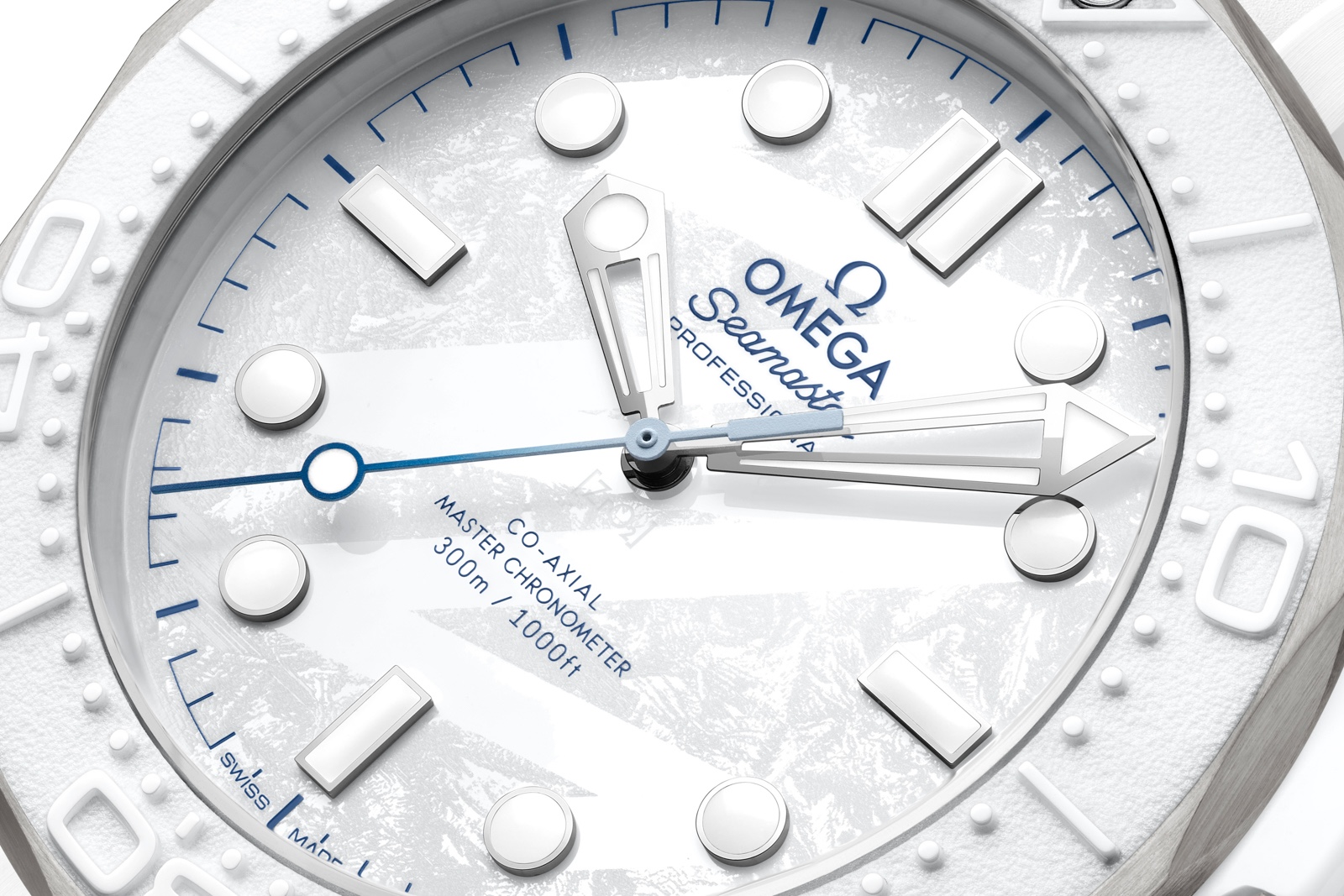
Substantively, the key difference between the black and white ceramic Seamasters is the dial, since both watches share the same 43.5 mm case size. The black edition features the Seamaster’s familiar wave motif, which the white edition has swapped for a white dial suggestive of skating rink in the midst of being resurfaced.
The dial achieves this effect with contrasting textures. Much of the dial has been given an uneven finish that could pass muster as a hockey rink at the end of the first period. Against this backdrop, a mirror-smooth path snakes its way across the dial connecting each of the eight round hour markers.
Up close, the pattern looks like the work of an inebriated Zamboni driver, or perhaps just an inexpert one; speaking from personal experience, they are not easy to drive. That such a delicate pattern can be achieved on a hard surface like ceramic is impressive. The navy blue pad-printed text is neat and precise, and the central seconds hand features a gradient treatment from navy to light blue.
The resulting pattern forms a subtle stylised interpretation of the official Milano Cortina logo, which is the sole Olympics tie-in on the front of the watch. The absence of any other overt branding on the dial might help broaden the appeal, drawing in collectors with little interest in the Olympic Games.
Concealed calibre
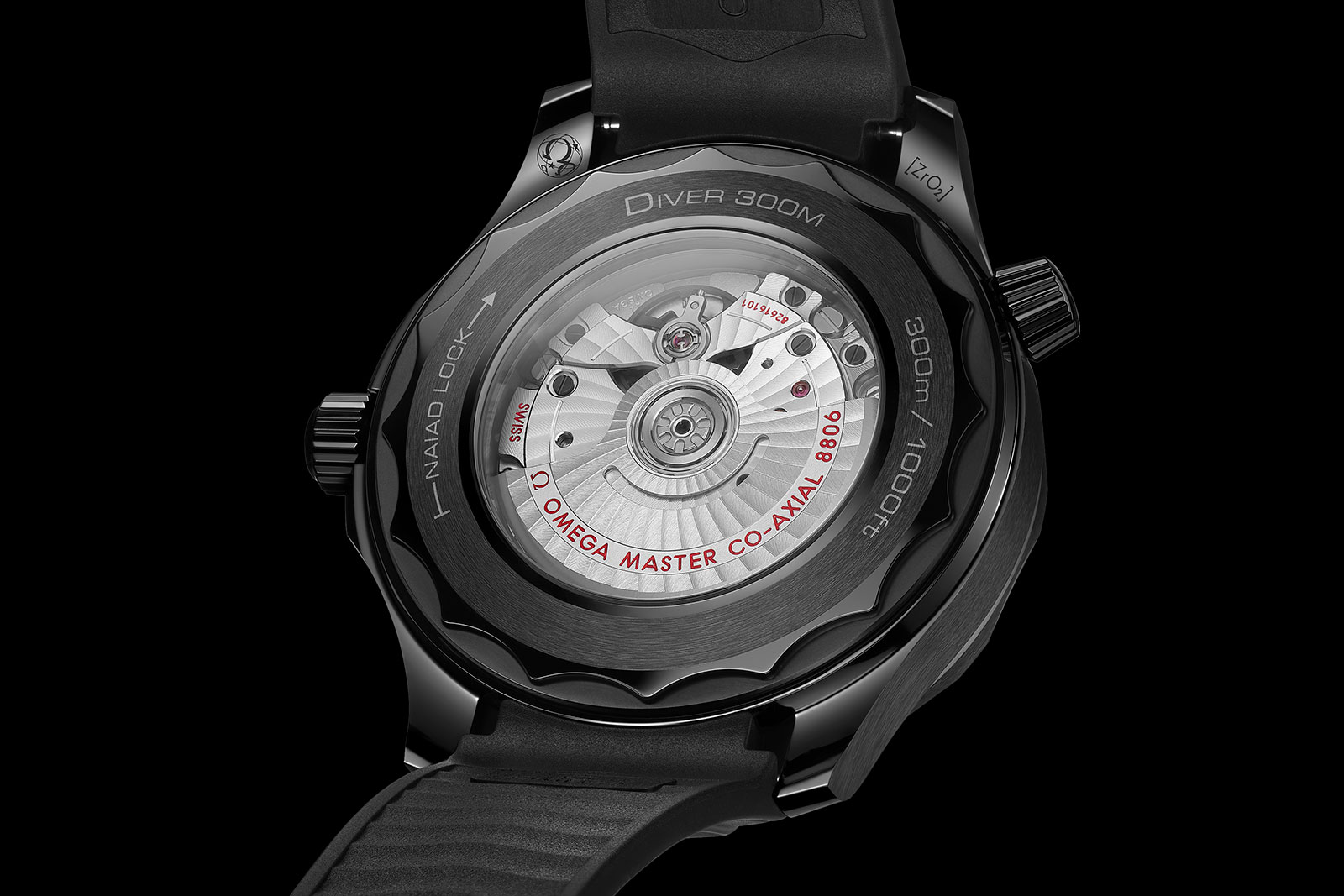
The calibre 8806 is secured behind a solid titanium case back that, thanks to Omega’s bayonet-style Naiad Lock design, attaches directly to the ceramic case. This design limits torsional forces that normally preclude such an interface, and an additional benefit is that the logo is always oriented correctly.
The need for the Olympics branding is understandable, especially since the dial is devoid of such logos, but it’s a shame that the excellent cal. 8806 is concealed. That’s not because it’s especially well finished — it’s finished attractively but within the confines of mass production — but because it’s a worthy technical calibre that deserves recognition.
Featuring the brand’s latest version of George Daniels’ famous Co-Axial escapement, the cal. 8806 is a METAS-certified Master Chronometer, meaning it can withstand magnetic fields up to 15,000 Gauss and is rated to run within a range of 0/+5 seconds per day — among the most stringent performance criteria in the industry.
In other words, the movement embodies the legacy of timekeeping innovation that once saw Omega dominate the observatory competitions and made the brand capable of timing the Olympic Games in the first place.
The Omega cal. 8806 on view through the display back of the black ceramic Seamaster.
Key facts and price
Omega Seamaster Diver 300M Milano Cortina Ref. 522.92.44.20.04.001
Diameter: 43.5 mm Height: 14.37 mm Material: White ceramic Water resistance: 300 m Dial: White ceramic
Movement: Cal. 8806 Functions: Hours, minutes, and seconds Winding: Self-winding Frequency: 25,200 beats per hour (3.5 Hz) Power reserve: 55 hours
Strap: White rubber with titanium buckle
Limited Edition: No Availability: At Omega boutiques and retailers Price: US$10,500 excluding taxes