

Audemars Piguet’s Latest Gen Perpetual Open-Worked or All-Ceramic
Iterations of a clever calendar.
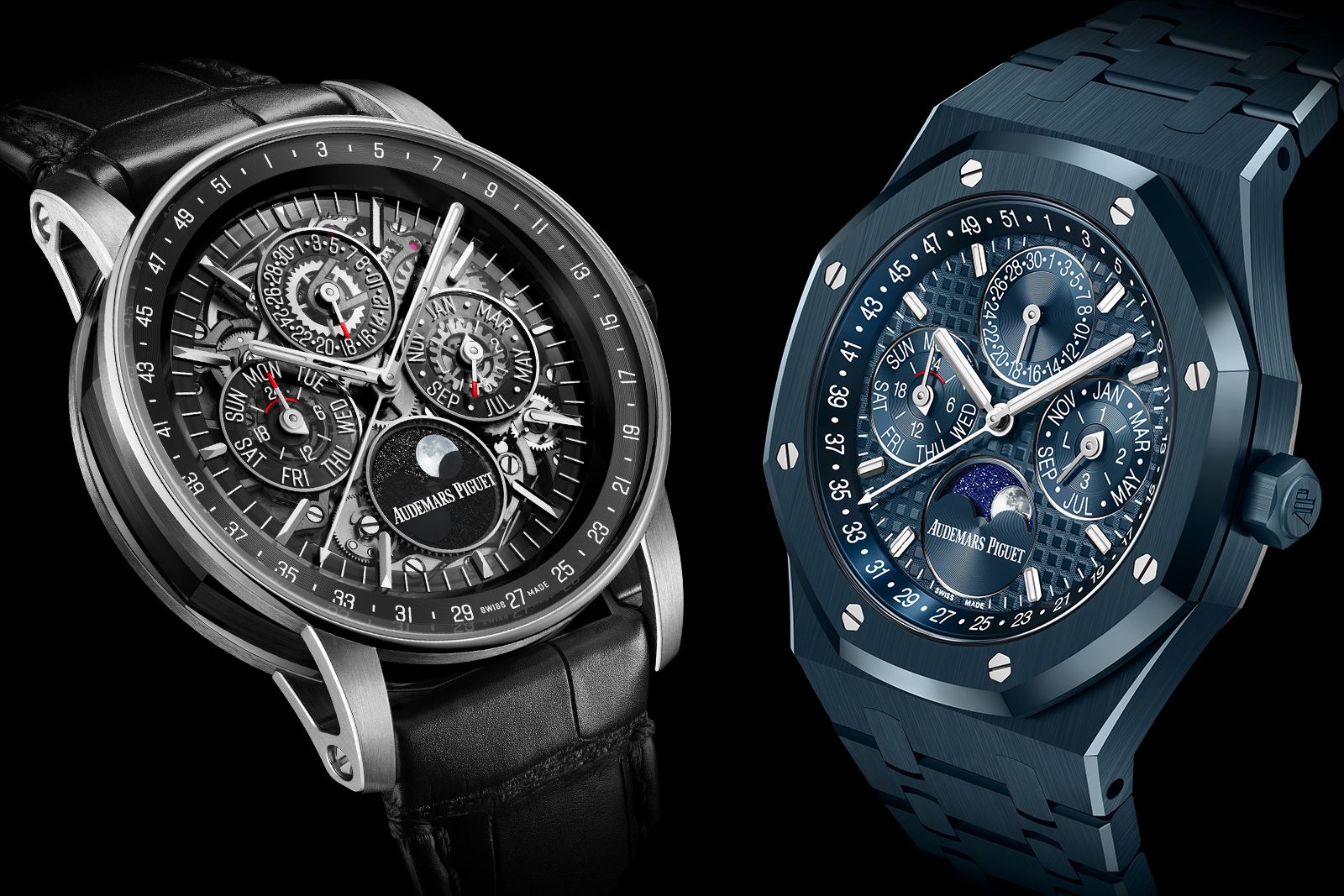
Audemars Piguet (AP) debuts a trio of new perpetuals calendars, led by the first open-worked version of brand’s cutting edge perpetual calendar launched last year with the skeleton cal. 7139 inside the Code 11.59 and Royal Oak. And rounding out the trio is the first all-ceramic Royal Oak Perpetual Calendar powered by the cal. 7138.
Initial Thoughts
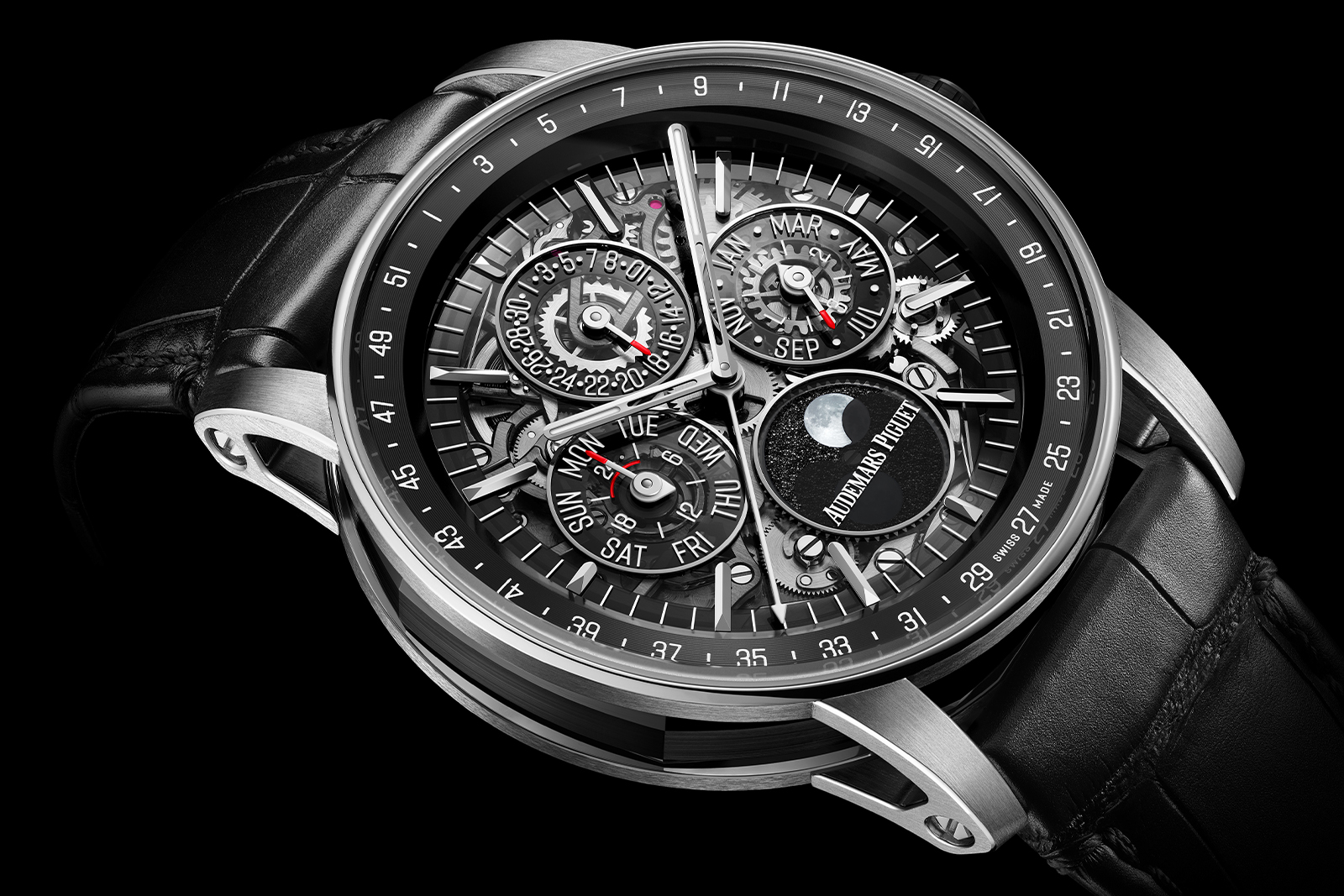
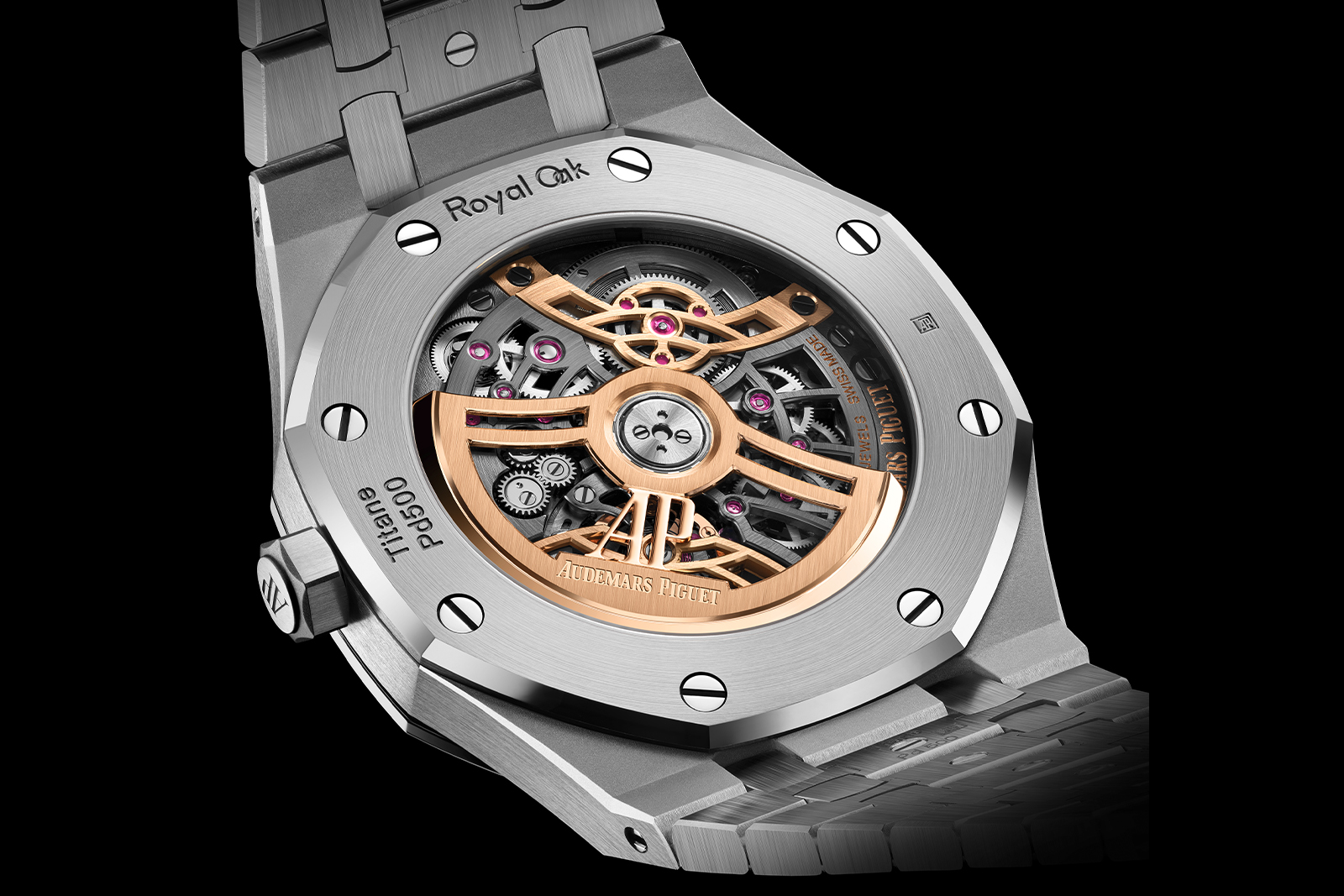
The open-worked version of AP’s latest-generation perpetual calendar movement arguably does most justice to a clever movement that is one of the most notable such movements on the market.
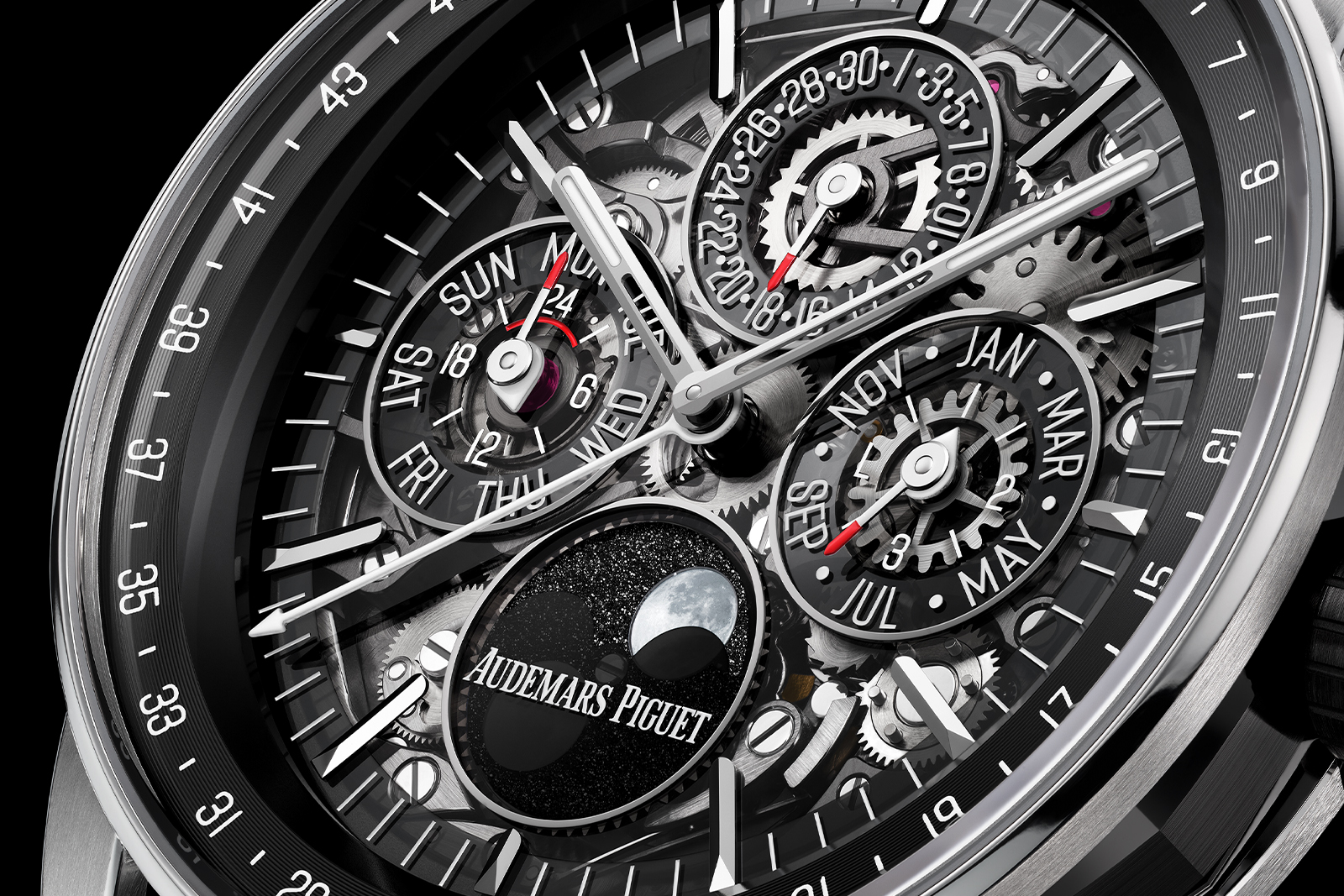
While there was little visual difference between solid-dial versions of AP’s new perpetual calendars and the preceding versions, the open-worked examples are less similar, at least up close, as the perpetual calendar works are so clearly different. The new open-work dial givers owners a look at what is going on under the hood as they adjust the calendar, which I see as a significant value add given the unusual and innovative mechanics.
While AP could have been more daring, the last year’s crop of Royal Oak Perpetuals were good looking watches. The new pair, in both Code 11.59 and Royal Oak formats, look nearly identical from an arms length to their predecessors.
The open-worked models are mostly monochrome, the Code 11:59 is rhodium-plated white gold with a black ceramic mid-case while the Royal Oak is titanium with polished Palladium 500 bulk-metallic glass (BMG) accents and rose gold dial furniture. Neither break new ground for the brand, not that they need to.

Essentially metal with the morphology of a glass, the Palldium alloy BMG bezel is much hardier than the polished platinum bezels of Royal Oaks past.
AP seems to understand that many of its products, such as these and the Royal Oak Chronograph 38 mm, don’t need major design overhauls to stay relevant.
That is, except for the all-ceramic variant, using a shade of ceramic specially formulated to match the Royal Oak’s “Bleu Nuit, Nuage 50” dial, which is a significant departure – and improvement – from the generic and excessively bright cobalt blue ceramic used previously. This looks great, though I’d also like to see the low-key black ceramic model return.

It’s what’s inside that counts
Launched last year, AP’s latest perpetual calendar arguably the most advanced in its segment, despite following the “grand lever” approach codified during the 19th century. The day, date, month, moon phase, and week can all be set entirely though the clever four position crown.
A 48-tooth wheel is pre-programmed with the lengths of each month in the quadrennial leap year cycle, meaning the watch will need its next correction in the year 2100, when we skip a leap year. Unlike many other crown-set perpetuals, this correction won’t require intervention from a watchmaker.
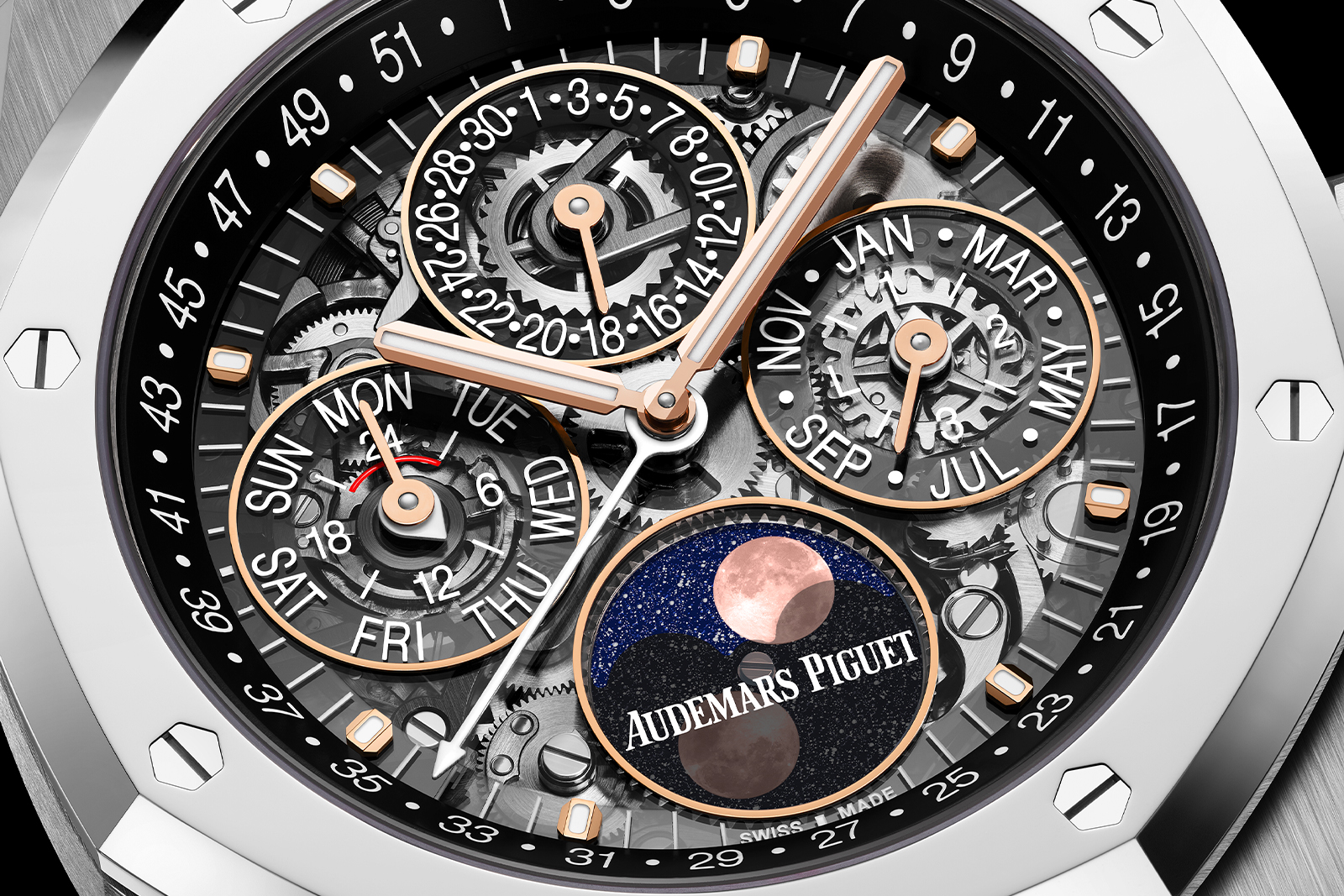
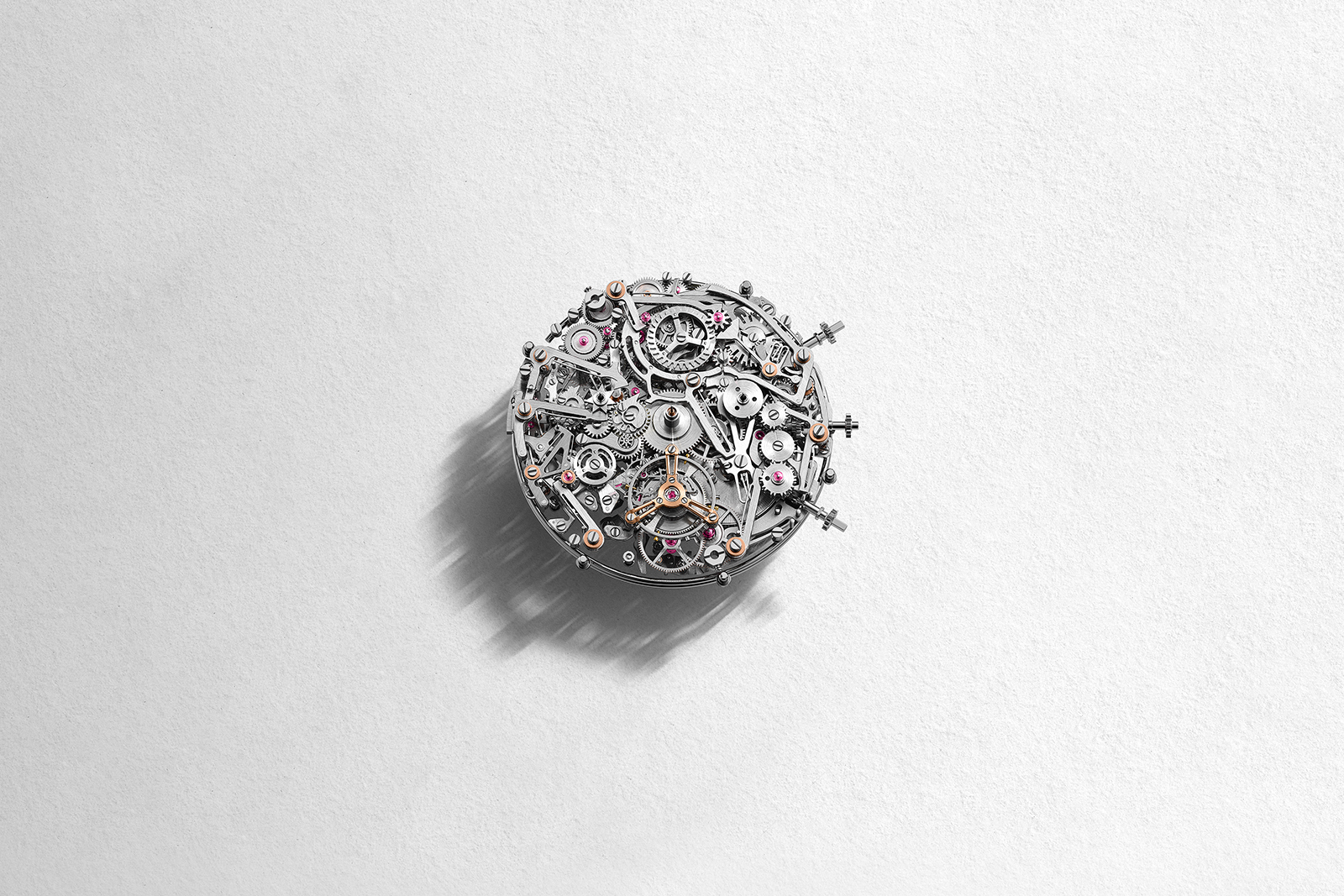
For better or worse, sharp interior angles have become an indicator of superior finishing to many collectors, and this movement has over a hundred of them. According to AP, the bridges and manufactured using EDM machining (though the exact techniques were not disclosed) before being finished by hand, which takes 30 hours.
Even allowing for ample machine assistance, which still requires skilled machinists (whose work is often minimized or ignored in this industry), this movement reveals very involved manufacturing and finishing processes compared to AP’s ranks and file calibres.
Key specs and price
Code 11.59 By Audemars Piguet Selfwinding Perpetual Calendar Openworked
Ref. 26443NB.OO.D002CR.01
Diameter: 41 mm
Height: 10.6 mm
Material: White gold and black ceramic
Crystal: Sapphire
Water resistance: 30 m
Movement: Cal. 7139
Features: Hours, minutes, moon phase, perpetual calendar, weekly calendar.
Frequency: 28,800 beats per hour (4 Hz)
Winding: Automatic
Power reserve: 55 hours
Strap: Alligator with white gold folding clasp
Limited edition: No
Availability: At AP boutiques, AP houses, and Authorised Retailers
Price: CHF118,000 excluding taxes (~US$152,000)
Audemars Piguet Royal Oak Selfwinding Perpetual Calendar Openworked
Ref. 26685XT.OO.1320XT.01
Diameter: 41 mm
Height: 9.5 mm
Material: Titanium and palladium 500 BMG
Crystal: Sapphire
Water resistance: 50 m
Movement: Cal. 7139
Features: Hours, minutes, moon phase, perpetual calendar, weekly calendar.
Frequency: 28,800 beats per hour (4 Hz)
Winding: Automatic
Power reserve: 55 hours
Strap: Titanium and palladium 500 BMG integrated bracelet
Limited edition: No
Availability: At AP boutiques, AP houses, and Authorised Retailers
Price: CHF180,200 excluding taxes (~US$232,000)
Audemars Piguet Royal Oak Perpetual Calendar Selfwinding
Ref. 26674CD.OO.1225CD.01
Diameter: 41 mm
Height: 9.5 mm
Material: “Bleu Nuit, Nuage 50” ceramic and titanium
Crystal: Sapphire
Water resistance: 50 m
Movement: Cal. 7138
Features: Hours, minutes, moon phase, perpetual calendar, weekly calendar.
Frequency: 28,800 beats per hour (4 Hz)
Winding: Automatic
Power reserve: 55 hours
Strap: Bracelet in “Bleu Nuit, Nuage 50” ceramic and titanium
Limited edition: No
Availability: At AP boutiques, AP houses, and Authorised Retailers
Price: CHF133,900 excluding taxes (~US$173,000)
For more, visit AudemarsPiguet.com.
Back to top.