

Complicated Collectors: Sir David Salomons
The world's greatest Breguet collection.
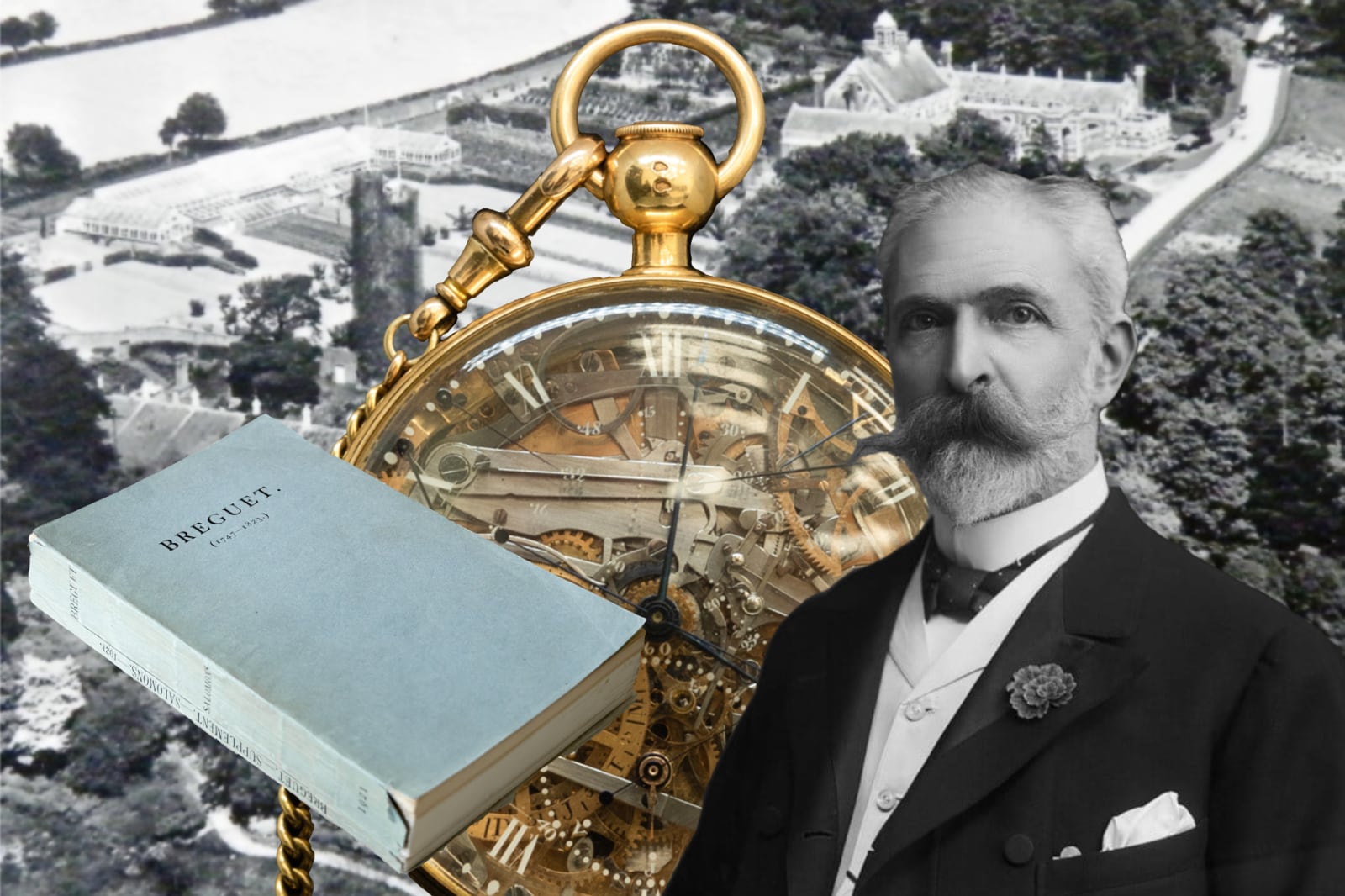
“How can you make a watch, my dear boy?” His aunt, Jeanette Salomons, then under medical care in St. Leonards-on-Sea, wrote back to her nephew, David Lionel Salomons, in early March 1867, shortly before her death. He was 16, orphaned since his father Philip’s death earlier that year. His mother, Emma Abigail Montefiore, had died when he was eight.
At the time, Salomons lived with his uncle, Sir David Salomons (1st Baronet), the Lord Mayor of London, at Great Cumberland Place, near Marble Arch, making frequent visits to a nearby watchmaker’s shop, where he learned to use a lathe and to file metal to tolerances measured in a fraction of an inch.
Fifty years later, that teenage training would allow him to assemble the most comprehensive collection of Breguet watches in history.
Broomhill
Salomons inherited the expansive Broomhill estate in 1873 when he was 22. His uncle, the first Sir David Salomons, had died without children, and the baronetcy passed to his nephew along with the estate near Tunbridge Wells. The house stood on substantial grounds, and Salomons began altering it almost immediately.
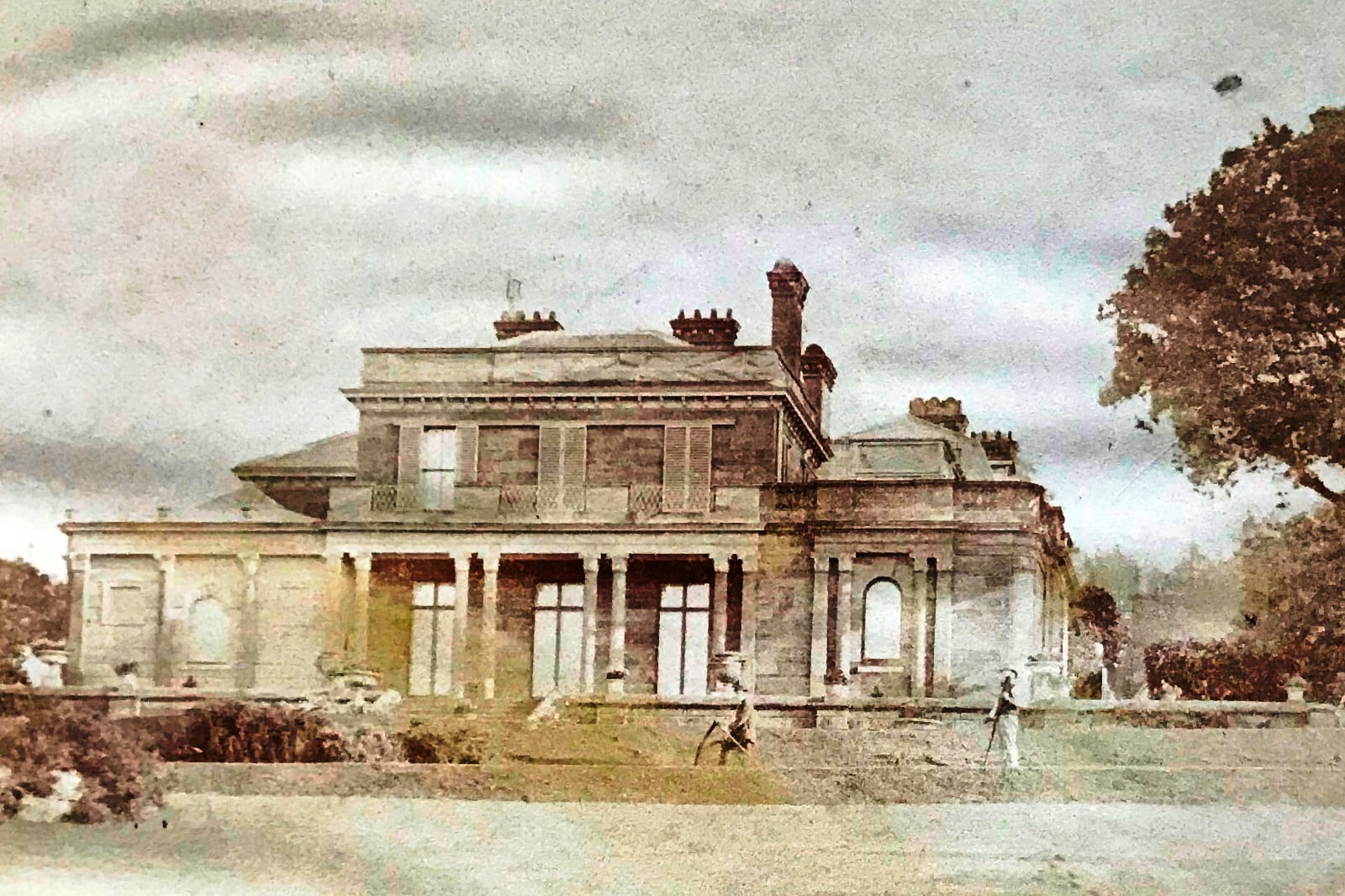
Broomhill from the south, a photograph by Sir David Lionel Salomons, 1868 (cropped). Album 19, Richard Levy Family Archive. Image – By permission of the Salomons Museum.
He built workshops housing machine tools like lathes, drill presses, and milling equipment. Then came electrical apparatus. Then storage for chemicals and photographic equipment. By the 1890s, the workshops at Broomhill reportedly contained 60,000 tools. Salomons could manufacture components at nearly any scale, from watch parts requiring jeweler’s loupes to engine castings requiring hoists.
After his uncle’s death, Salomons continued his education at University College London and then Gonville and Caius College, Cambridge. He graduated with honours in natural science in 1874 and was called to the Bar at the Middle Temple the same year. The legal training proved useful later when he drafted patents and challenged restrictive legislation.
With the inheritance of Broomhill, Salomons’s pursuits found a new center. The estate became his laboratory, and its workshops occupied a natural extension of his technical curiosity and growing independence.
Accumulating expertise
In 1874, Salomons installed electric arc lighting in the workshops. The system used a coal-fired generator to produce electricity during operation, and Broomhill became one of the first private residences in England lit by electricity. To reduce the noise of the generators at night, Salomons installed accumulators — massive lead-acid batteries that could be charged during the day and discharged at night.

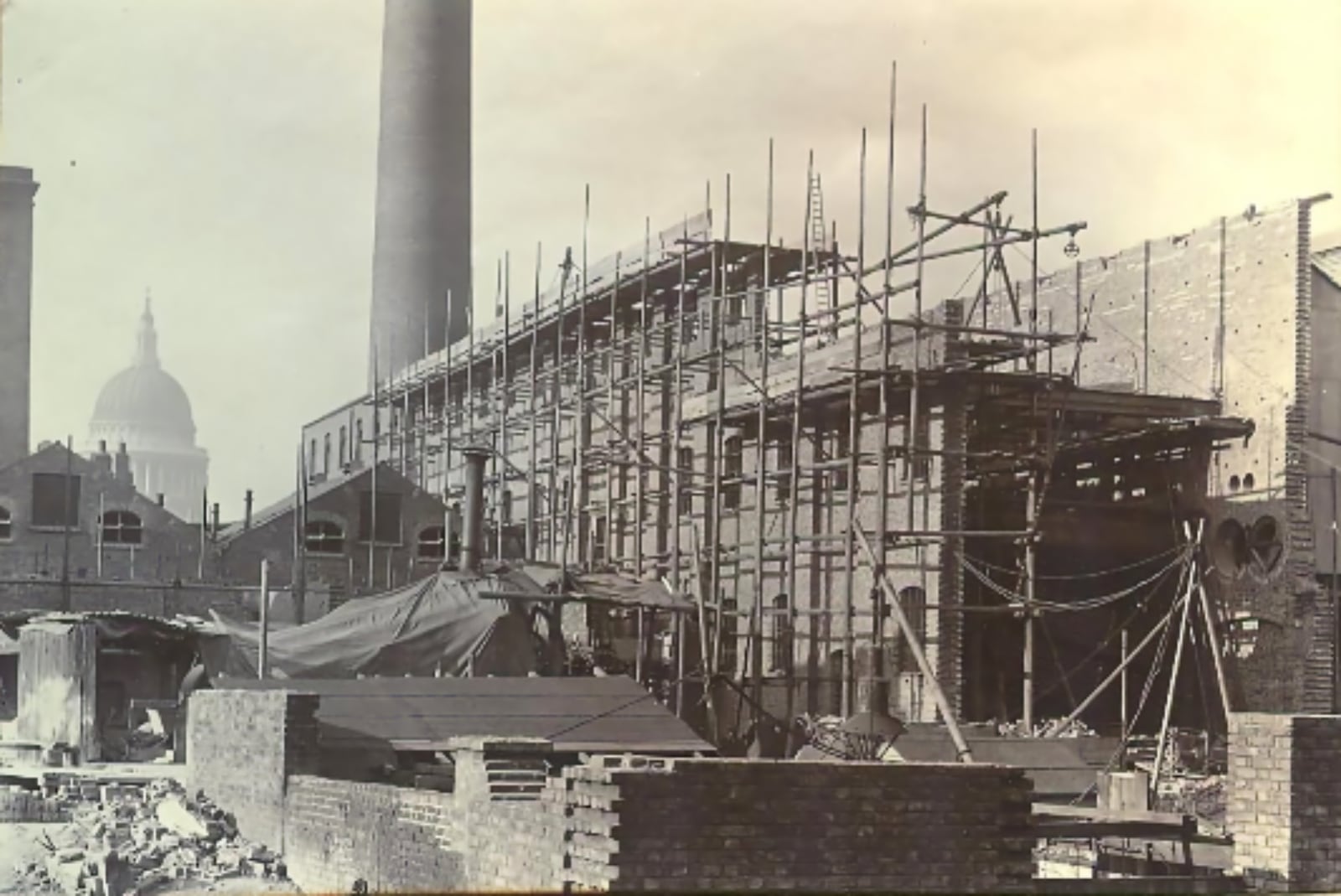
A power station being built for the City of London Electric Lighting Co (Salomons was chairman 1896-1900). Image – By permission of the Salomons Museum.
By 1887, he had accumulated enough practical knowledge to publish Management of Accumulators and Private Electric Light Installations. The book became a standard reference in the field and in 1891, Salomons became the first Chairman of the City of London Electric Lighting Company, a position he held until 1923.
An automotive pioneer
His engagement with automobiles followed similar patterns. In 1895, Salomons imported a Peugeot, the second petrol-driven car to enter Britain. Unfortunately, driving the car on public roads was effectively outlawed at the time. The Locomotive Acts of 1865 classified all self-propelled vehicles as heavy traction engines. They imposed a restrictive 4 mph speed limit, required a crew of 3, and mandated that a man walk 60 yards ahead carrying a red flag. Salomons violated these restrictions deliberately.

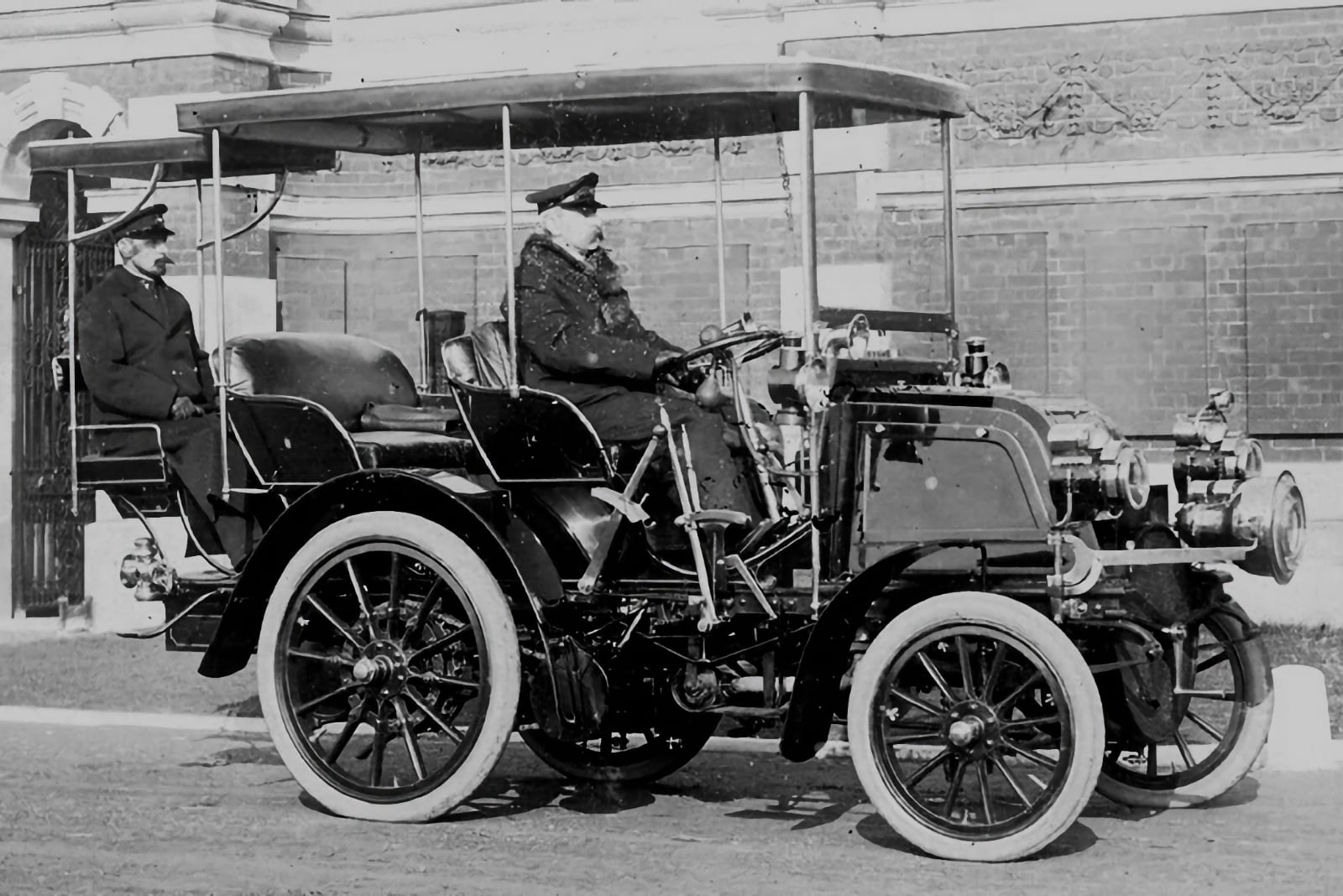
Sir David Lionel Salomons at the wheel in 1902, with George Barclay, chauffeur, in the dickey (similar to where the footman might have perched on a carriage). Image – By permission of the Salomons Museum.
His exhibition convoy drove into Tunbridge Wells at speeds in excess of the tepid speed limit, with no flag carriers, demonstrating that automobiles could navigate public streets without frightening horses or endangering pedestrians. Contemporary accounts noted that “not one of the horses so much as lifted an eye as the horseless carriages sped somewhat noisily by.”
Salomons used this demonstration as evidence when lobbying Parliament for repeal. He formed the Self-Propelled Traffic Association and worked with other early motorists to draft new legislation. The Locomotives on Highways Act of 1896 abolished the red flag requirement and raised the speed limit to 14 miles per hour, legalising the British automotive industry. He eventually accumulated 64 automobiles, a collection that grew through the same mechanism that later shaped his horological acquisitions.
Around 1875, he encountered a Breguet three-wheel clock in a London shop. The price was £150, but despite his interest, he declined to purchase it. For nearly 40 years, watches remained part of a broader field of interests that included electrical meters, optical instruments, marine chronometers, and mechanical regulators. Salomons valued precision instruments generally, but he had yet to engage with them as a collector.

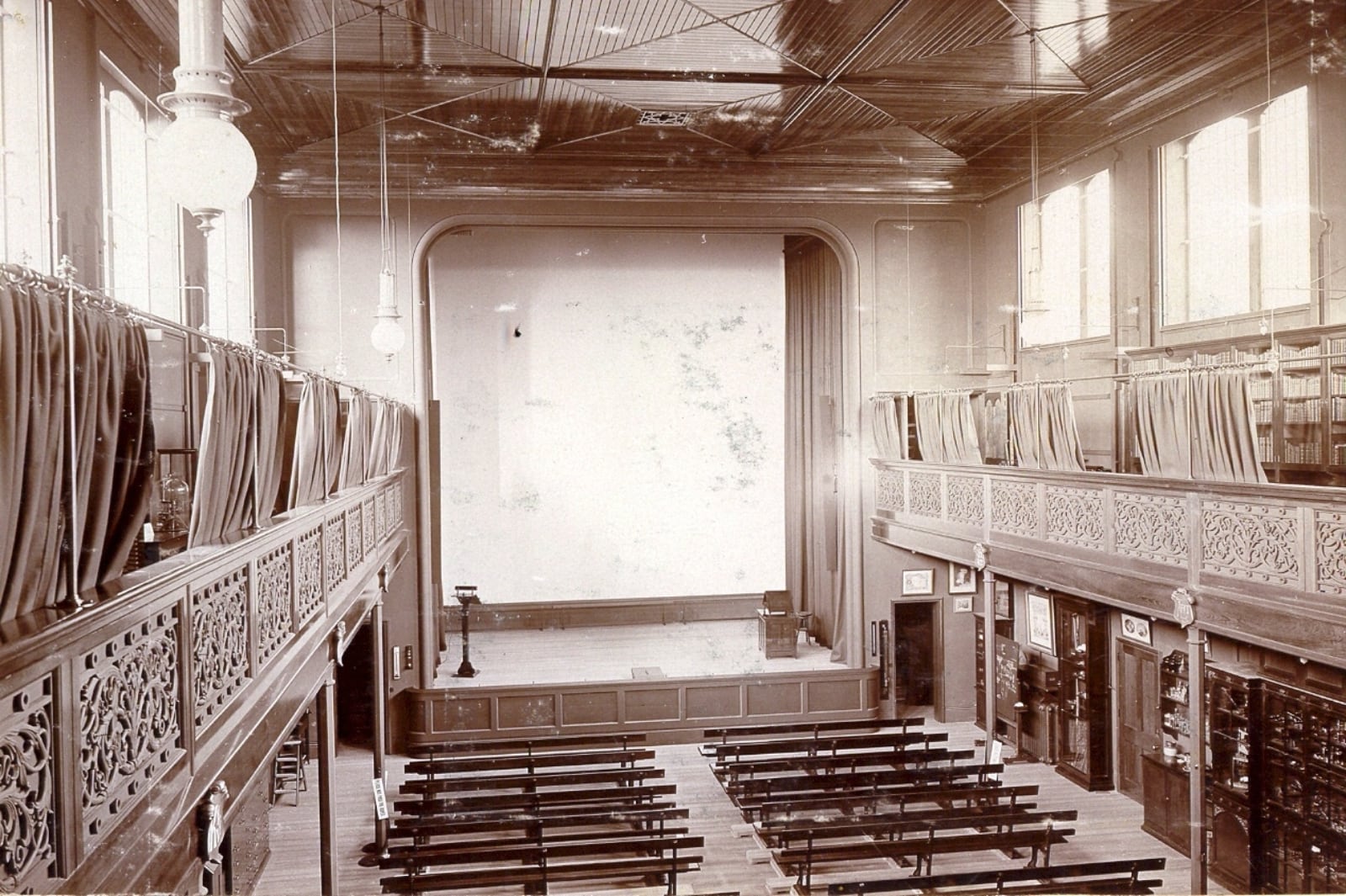
Salomons’ private lecture theatre at Broomhill. ca.1895. Image – By permission of the Salomons Museum.
Between 1894 and 1896, he built the Science Theatre at Broomhill. The structure attached to the rear of the main house was designed for demonstrations rather than dramatic performance. It held hundreds of people and featured massive triple-lens optical lanterns for projection, motorised curtains, and specialized acoustics for organ installation. He hosted meetings of the Royal Photographic Society and gave lectures on electrical phenomena.
In 1882, Salomons married Laura Julia de Stern, daughter of Baron Hermann de Stern. The marriage consolidated wealth from two prominent Anglo-Jewish banking families and produced one son, David Reginald, and four daughters. In 1899, following a bequest from the Stern family, Salomons assumed the additional surnames, Goldsmid and Stern, by Royal Licence. His full legal name became Sir David Lionel Goldsmid-Stern-Salomons, though in scientific and motoring circles he remained simply Sir David Salomons.
By 1914, Salomons was 63. He had spent four decades building, experimenting, lobbying, and publishing. His library held 10,000 volumes. His garage housed dozens of automobiles. His workshops could manufacture nearly anything. But his engagement remained focused on modern systems — watches existed in this landscape as instruments he understood but had not yet studied systematically. That would change.
Tragedy
On October 28, 1915, HMS Hythe left port carrying troops for Gallipoli. The ship was part of the Mediterranean Expeditionary Force, transporting reinforcements to Suvla Bay during the campaign’s final desperate months. Captain David Reginald Salomons commanded the 3rd Kent Fortress Field Company. At 33, the younger Salomons was his father’s only son and heir to both the baronetcy and Broomhill.
That night, his ship collided with another British vessel, HMS Sarnia. Captain Salomons and 128 men of his company were lost in the Mediterranean.
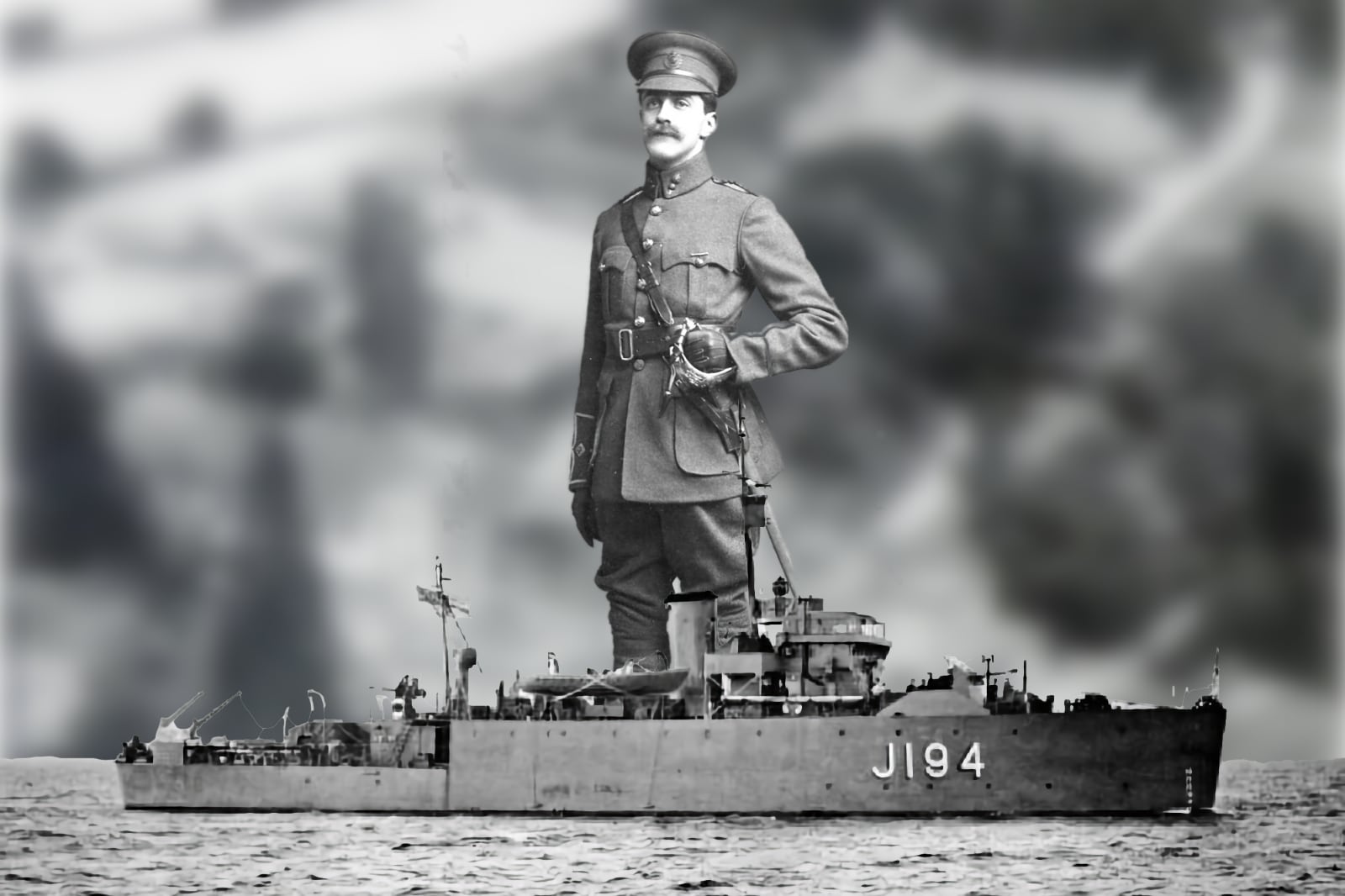
Capt. D. Reginald Salomons and HMS Hythe. Image SJX composite – by permission of the Salomons Museum / Wikipedia
Word reached Broomhill in early November. Salomons was 64 The male line that had been so carefully preserved through the first baronet’s special remainder to his nephew had ended, and the title would become extinct upon Salomons’s own death. The estate would, at least, pass to his daughters.
The loss reoriented his attention. Salomons continued his work; he remained Chairman of the City of London Electric Lighting Company, he maintained his automobiles, and he hosted demonstrations. But alongside these activities, space for something else emerged.
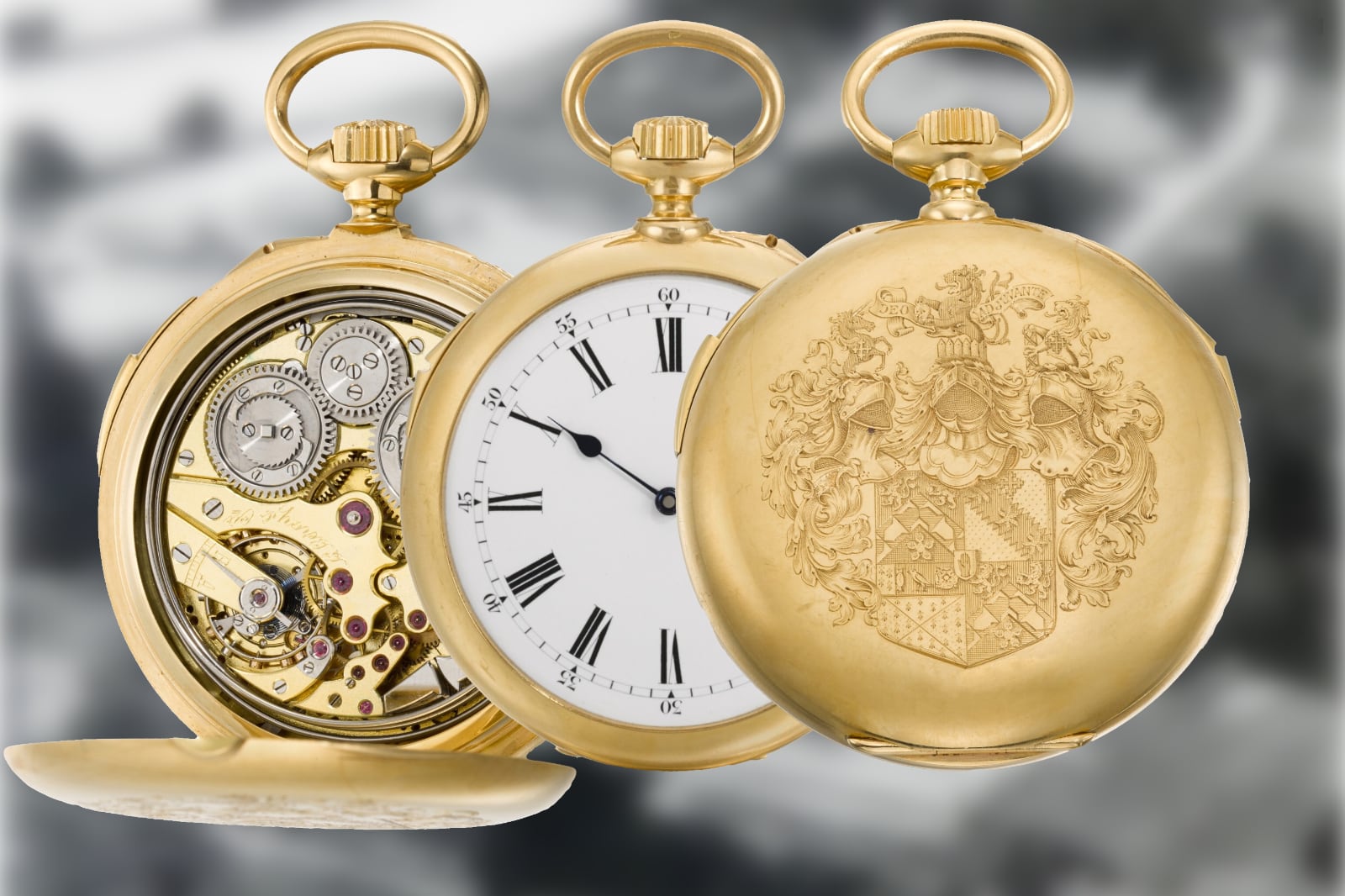
Le Roy minute repeater, ca 1890, the back engraved with the arms of Sir David Salomons. Image SJX composite – Sothebys
Sometime around late 1915 or early 1916, Salomons purchased a Breguet watch from a shop on New Bond Street. The piece was a perpétuelle with a quarter-repeater. Each motion of the watch wound the mainspring through a ratchet system. The principle was familiar — motion captured and converted to stored energy — but the execution belonged to a different era. Breguet had built this watch over a century earlier, working at scales Salomons recognized from his teenage training.
The purchase reopened horology as a field of sustained attention. Salomons had owned watches before, but this marked the beginning of systematic engagement. The perpétuelle mechanism answered a practical problem, and he could study its solution directly. More importantly, the watch carried provenance, documentation, and a connection to a maker whose reputation Salomons knew but had not yet closely investigated.
Then, in May 1917, the collection changed permanently.
Regent Street
In May 1917 Salomons was walking near Regent Street during the rain and passed Louis Desoutter’s shop. The French watchmaker and dealer operated from addresses near Regent Street, a workshop at 1 Maddox Street where he lived with his family above the premises, and a showroom at 4 Hanover Street linking Regent Street to Hanover Square. Desoutter dealt in significant pieces. His window displays attracted informed attention from collectors, dealers, and scholars passing through London.
A watch sat in the window that day. The watch features a gold case, approximately 63 mm in diameter, and a rock crystal dial. A label identified it as having been made for Marie Antoinette.
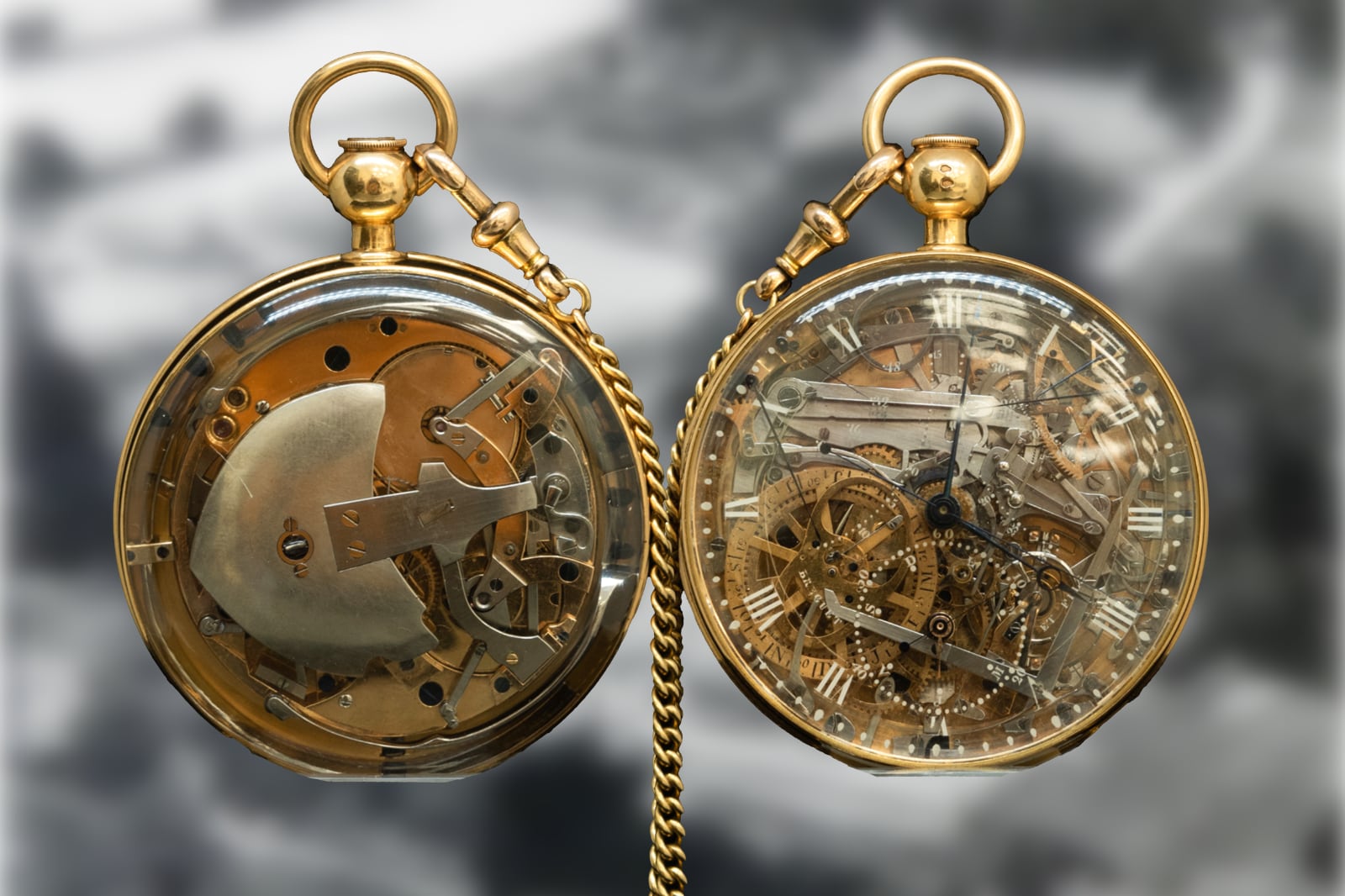
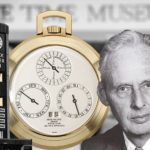
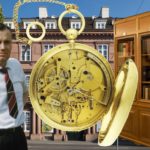
Breguet No. 160, so called “Marie Antoinette”. Image SJX composite – L.A. Mayer Museum for Islamic Art.
Salomons went inside. He examined the watch. Through the crystal dial, the movement showed complications arranged in a dense configuration, including a perpetual calendar mechanism, an equation-of-time display, a thermometer, a jumping-hour indication, and minute-repeater hammers. Every available space was occupied by functional components.
Desoutter confirmed the price. The sum was substantial, reflecting both the watch’s complexity and its claimed provenance. Salomons left the shop. He walked on through the rain. Then he stopped and returned.
The negotiation was brief. Salomons agreed to the asked price and added £50 to secure immediate purchase, preventing any other collector from seeing the watch before he could complete the transaction. Desoutter accepted. Breguet No. 160 entered the collection as the second watch.
The acquisition changed everything that followed. No. 160 demonstrated the outer limits of Breguet’s mechanical ambition. Work began in 1783 but was not completed until 1827, four years after Breguet’s death. Years of work layered into complications integrated within a single case. Through direct handling, Salomons could assess the quality of execution Breguet had brought to problems of layout, finishing, and component interaction.
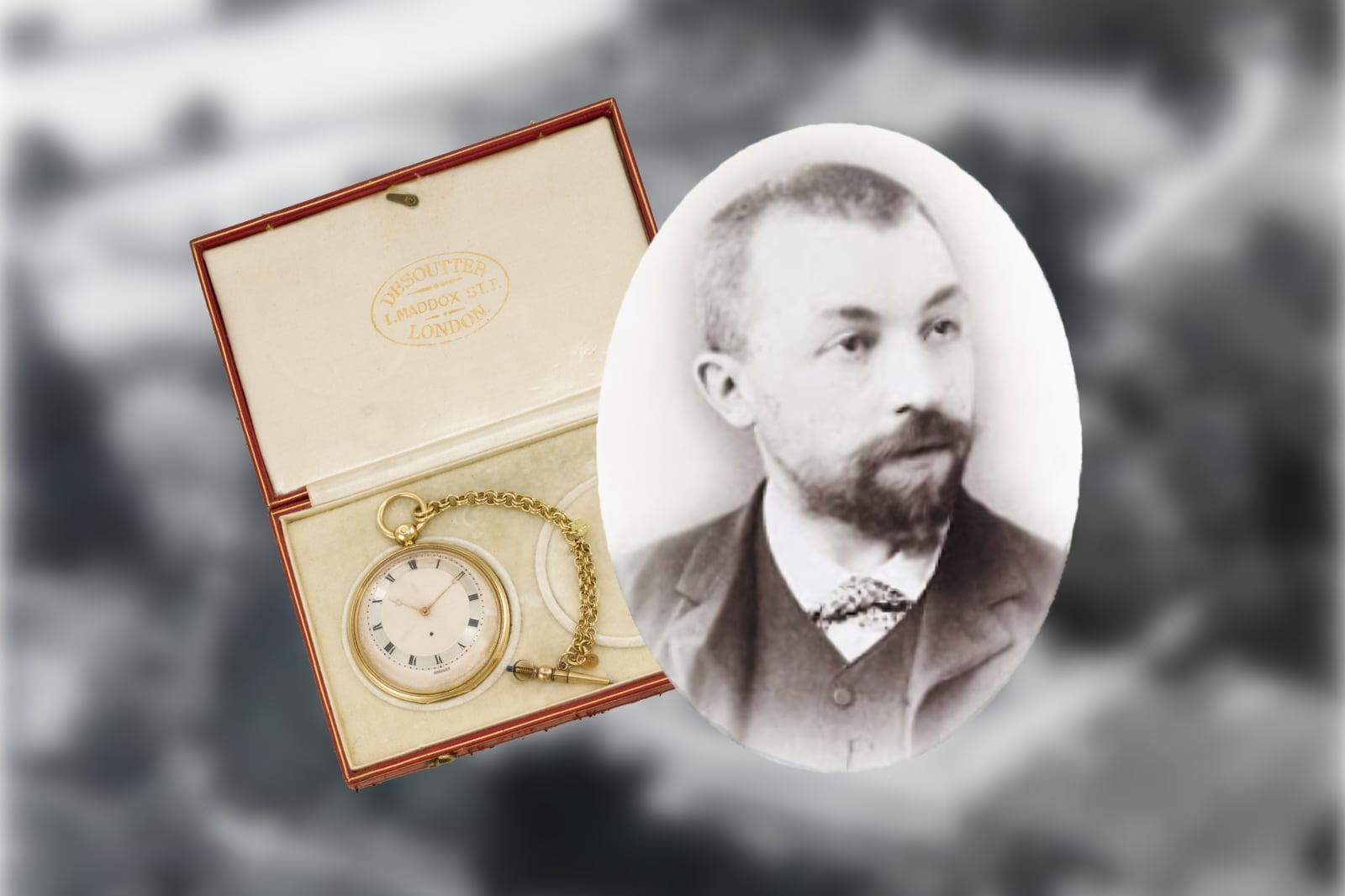
Louis Desoutter, the Breguet expert that helped Salomons build his collection. Image SJX composite – Christies and Wikipedia.
Salomons had found more than a watch — he had also found his dealer. Desoutter knew where significant Breguet pieces resided, understood their mechanisms, could authenticate them, and possessed the technical vocabulary to discuss escapement geometry and balance spring alloy with clarity. The Frenchman bridged linguistic and cultural gaps. Breguet’s archives and the soul of the watches were eminently French, and Desoutter could translate the nuance of French horological terminology for his English patron.
A collection takes shape
Within months, Salomons purchased additional pieces from Desoutter’s stock. Among them: No. 92, a double-sided watch built for the Duc de Praslin in 1805. The front face displayed a perpetual calendar and equation of time, while the back face showed the power reserve and moon phases. Also No. 1052, a montre à tact with gold, enamel, and pearl-set case. Desoutter’s inventory contained pieces he had been accumulating for years, and Salomons was ready to acquire them.
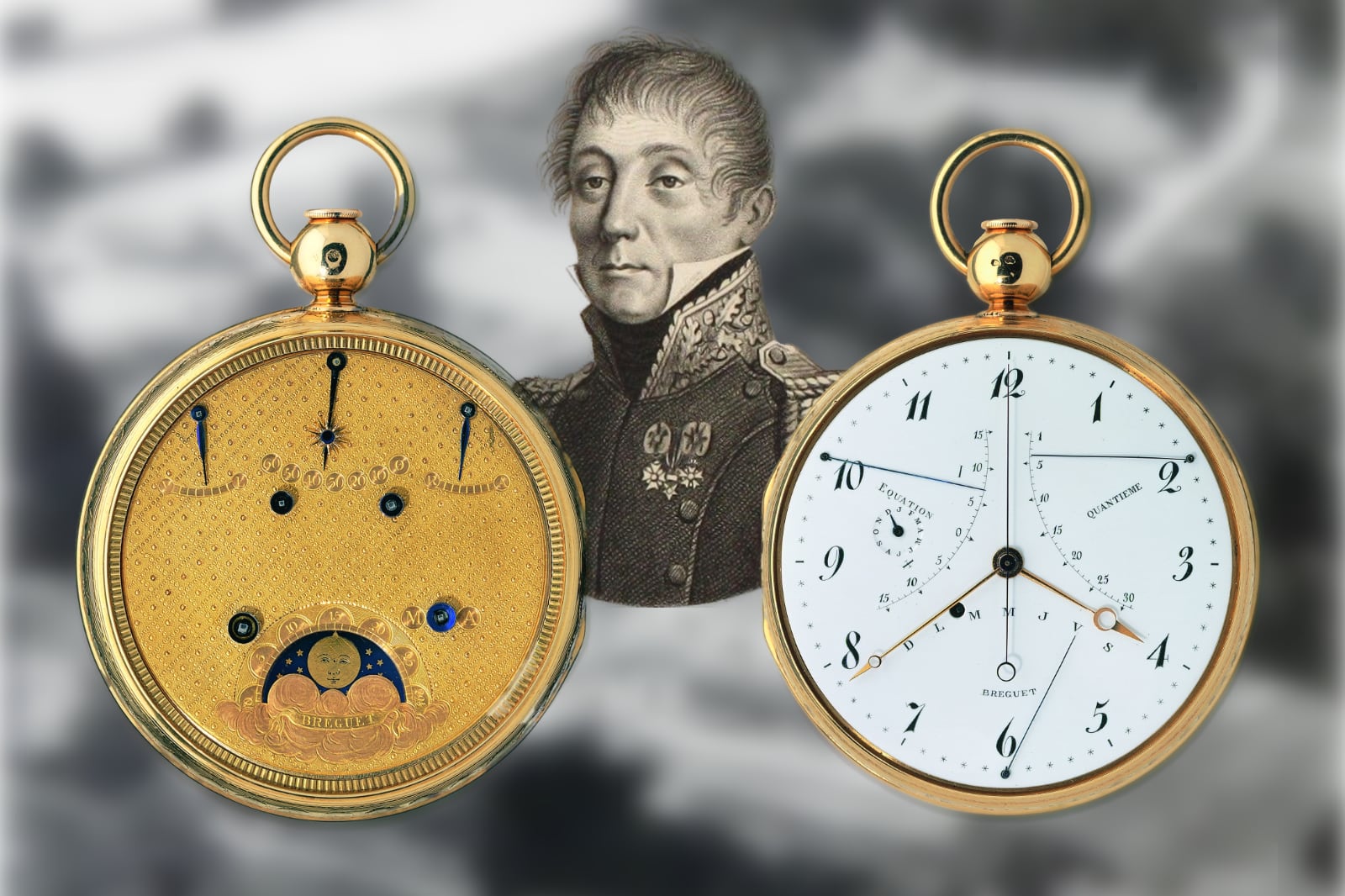
Breguet No. 92, built for the Duc de Praslin in 1805. Image SJX composite – Montres Breguet and Wikipedia.
Now he held multiple Breguet watches that represented different aspects of the maker’s work. Placing them together allowed for unprecedented comparison. Salomons could examine how the same maker approached different problems across decades of production.
This comparative condition encouraged further acquisition. Each new watch sharpened the view. Patterns emerged from preferences in escapement design, calendar layout, and temperature compensation. Salomons must have recognised that a small number of watches could demonstrate individual excellence, but a larger number would reveal consistency of thought.
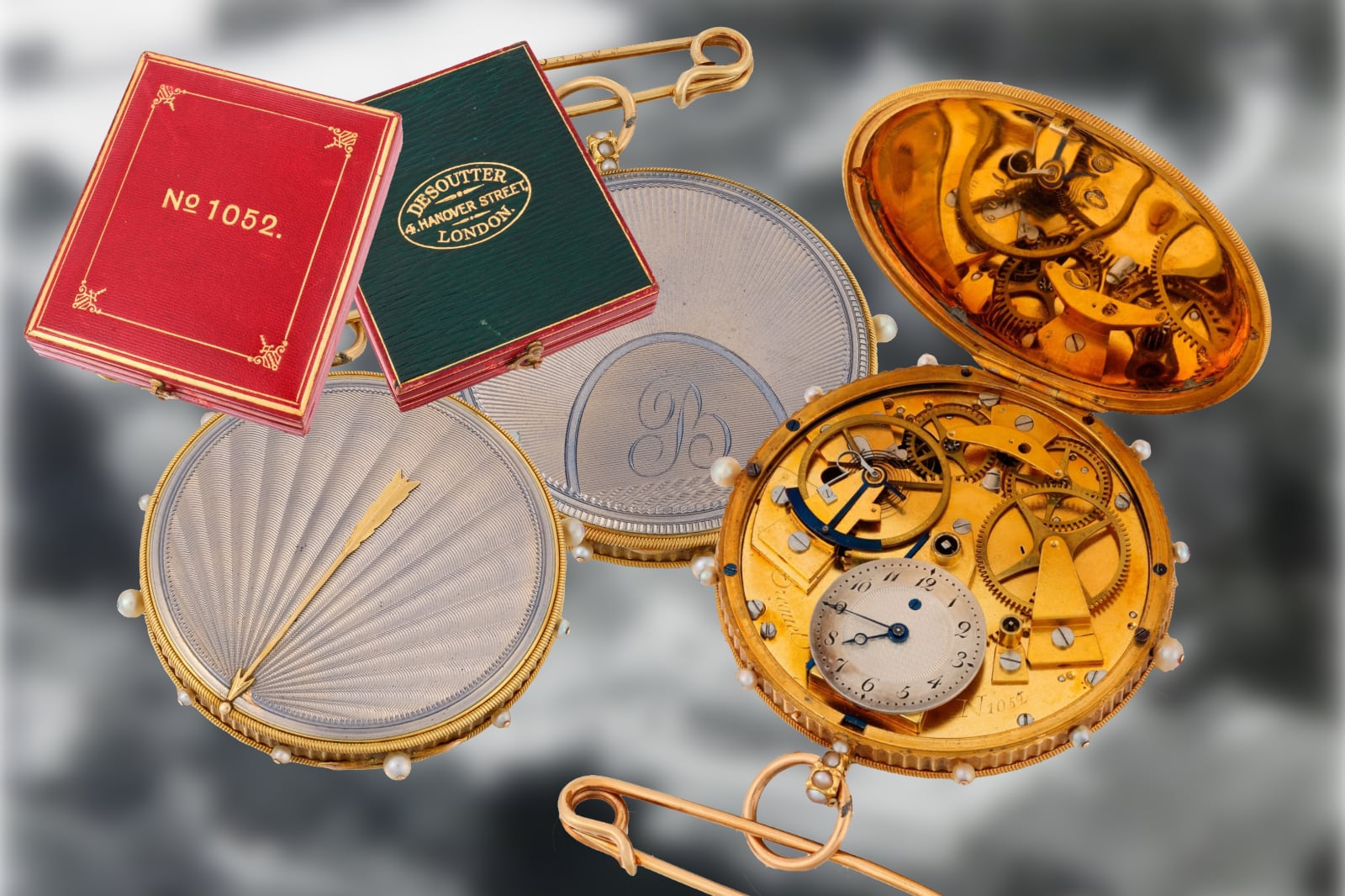
Breguet No. 1052, enamel and pearl set watch, “à Tact” with Breguet escapement with coaxially mounted escape wheels, made for the Duc de Praslin in 1798. Image SJX composite – Sotheby’s.
The relationship with Desoutter extended beyond commerce into collaboration. Years later, when Salomons undertook the publication of his definitive catalogue, Breguet (1747-1823), in 1921, Desoutter photographed the movements. Movement photography required disassembling priceless watches to expose their construction to the camera lens, a task that required both technical skill and trust. In 1923, Desoutter translated Salomons’s book into French, ensuring the research reached continental scholars.
The collection expands
By 1920, Salomons had developed a reputation among numerous dealers. When collections appeared on the market, he received notice. In May 1920, he learned that 16 Breguet watches associated with Sir Berkeley Sheffield were about to be sold privately.
Among the pieces surfacing was No. 2788, a resonance watch sold to the Prince Regent in 1818. The watch contained two complete independent movements with their balances placed in close proximity, allowing synchronisation through plate vibration.
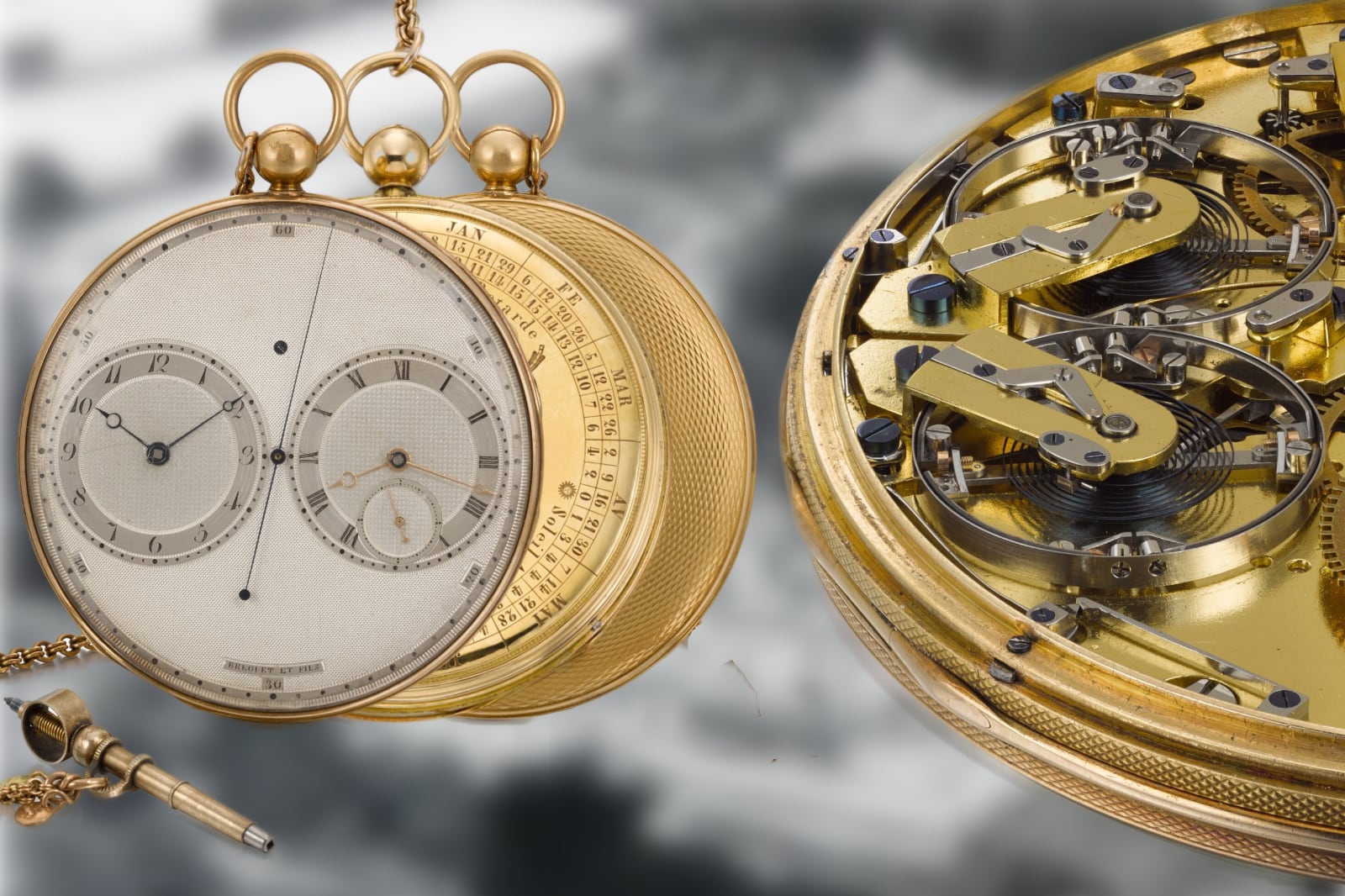
Breguet No. 2788, constructed on the principles of resonance, sold to the Prince Regent on the 2nd of October, 1818. Image SJX composite – Sotheby’s.
The collection also included No. 1806, a quarter-repeating watch with an annual calendar and thermometer, sold to Caroline Murat (Queen of Naples, Napoleon’s sister) in 1807, and No. 2794, a second resonance piece, confirming Breguet’s sustained interest in the principle.
Salomons purchased all 16 watches. The acquisition nearly tripled his holdings and introduced watches with clear historical provenance, including royal ownership. The next two years were marked by intense activity. Between 1920 and 1922, dozens of watches received certificates issued by the Breguet firm confirming serial numbers, descriptions, and historical records.
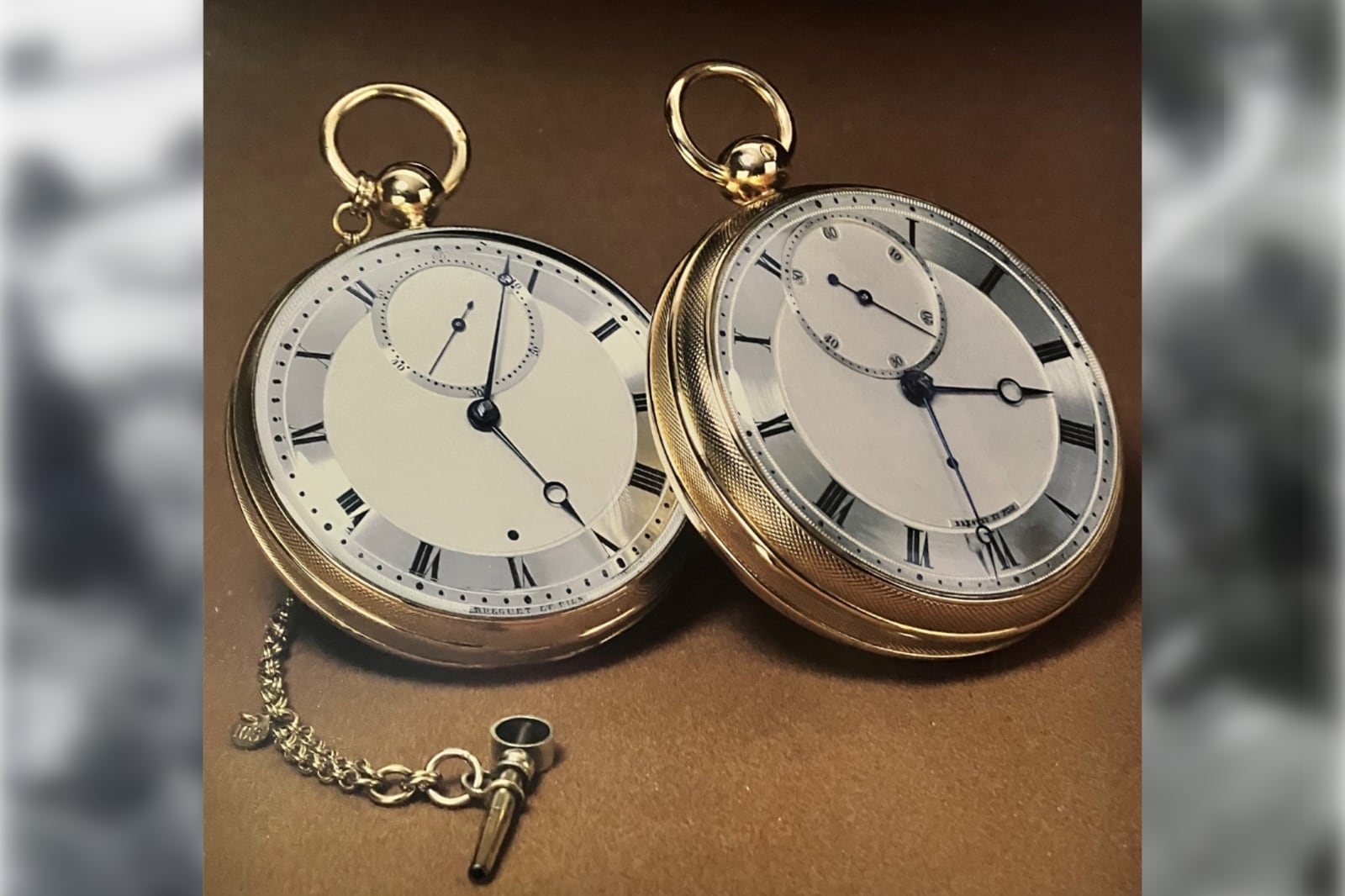
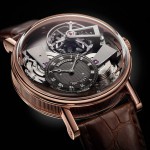
Breguet No. 2568 (left), Garde Temps à tourbillon, sold to Mr Moltshanoff. Image SJX composite – Thomas Engel collection
This surge in documentation coincides with bulk purchases. Around 1921 or 1922, Salomons learned that 52 Breguet watches would appear at Christie’s auction house. Rather than compete at auction, he negotiated to purchase the entire lot before the sale. This single transaction added approximately 50 watches to the collection, raising the total to well over 100 pieces.
The collection now functioned differently. Salomons could trace the evolution of specific complications across decades. He could compare repeater constructions from the 1790s to those from the 1820s. He could examine how Breguet adapted calendar mechanisms as customer requirements changed. He could study the progression from verge escapements to lever escapements to natural escapements to tourbillon regulators. Each watch provided data, and the data accumulated.
In 1923, Salomons noticed a small advertisement in The Times. A Breguet tourbillon was for sale, so he contacted the seller and arranged to purchase it. The watch, No. 2568, cost £35, and Salomons had it cleaned by Desoutter for an additional £5. The transaction demonstrated his continued attentiveness and that even with over 100 watches already acquired, he tracked notices, followed leads, and acted decisively when pieces appeared.
By this point, the collection required documentation beyond his own personal notes. Salomons decided to thoroughly document his collection in book form.
Documenting a treasure trove
The book was privately published in 1921 under Salomon’s name. Breguet (1747-1823) ran to several hundred pages and documented 124 pieces with photographs and technical descriptions. The text did not dramatise Breguet’s biography or inflate the significance of individual watches (with one accidental exception); instead, it presented material that Salomons had been studying firsthand.
Each entry included the serial number, date of sale, the original purchaser when known, and a technical description of the complications. Desoutter’s photography showed dials and, where possible, also movements, while notes included construction details, finishing, and condition.
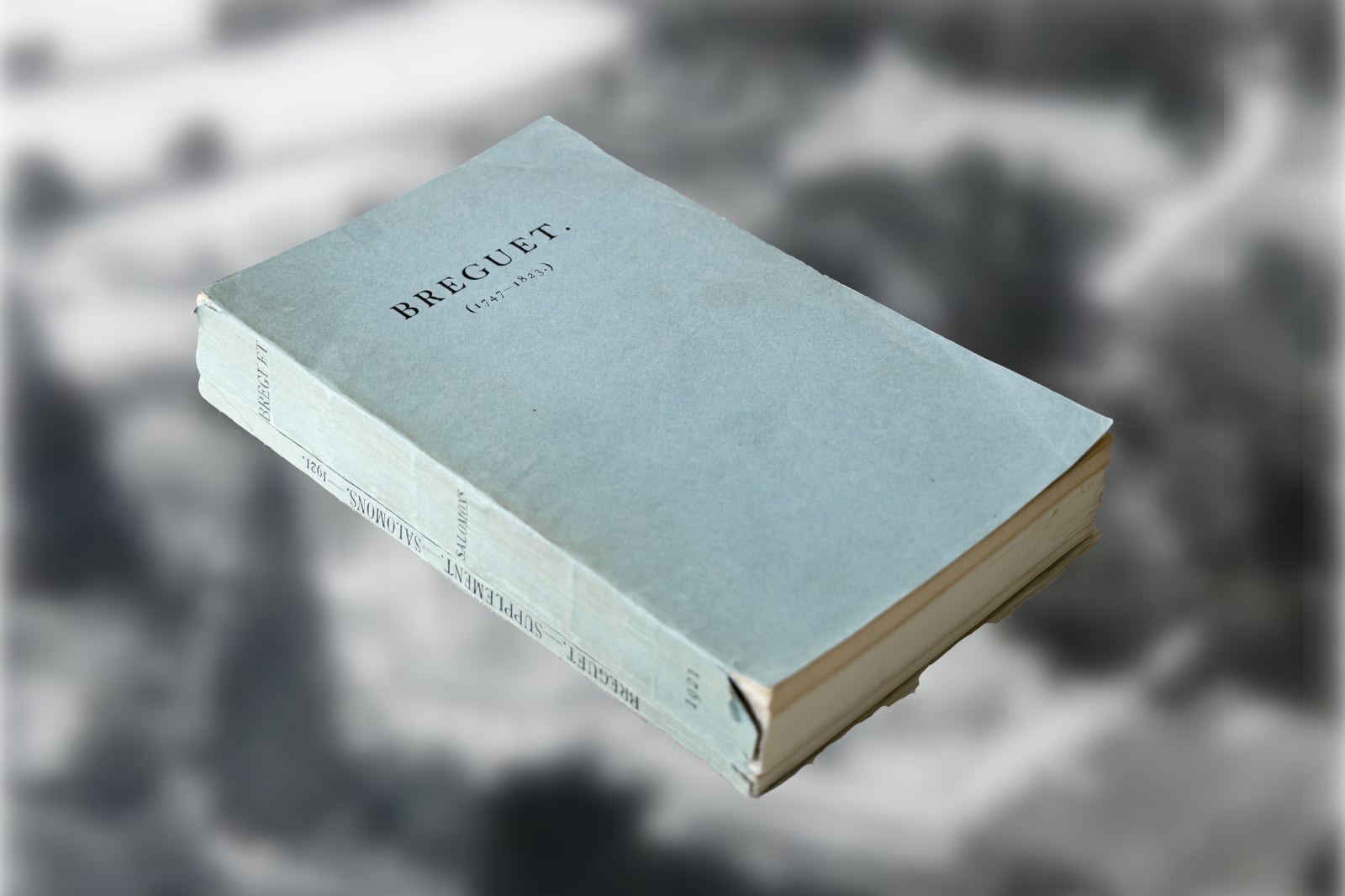
Breguet (1747-1823) published by Salomons in 1921. Image SJX composite – Sotheby’s
The book served as both a catalogue and a reference, establishing provenance records that remain in use today. When a watch described by Salomons appears at auction, his documentation serves as a baseline for authentication.
In 1923, the Musée Galliera in Paris organized an exhibition marking the centenary of Breguet’s death. Salomons loaned substantial portions of his collection to be displayed publicly. The display returned these watches to a French setting while presenting them as a coherent archive.
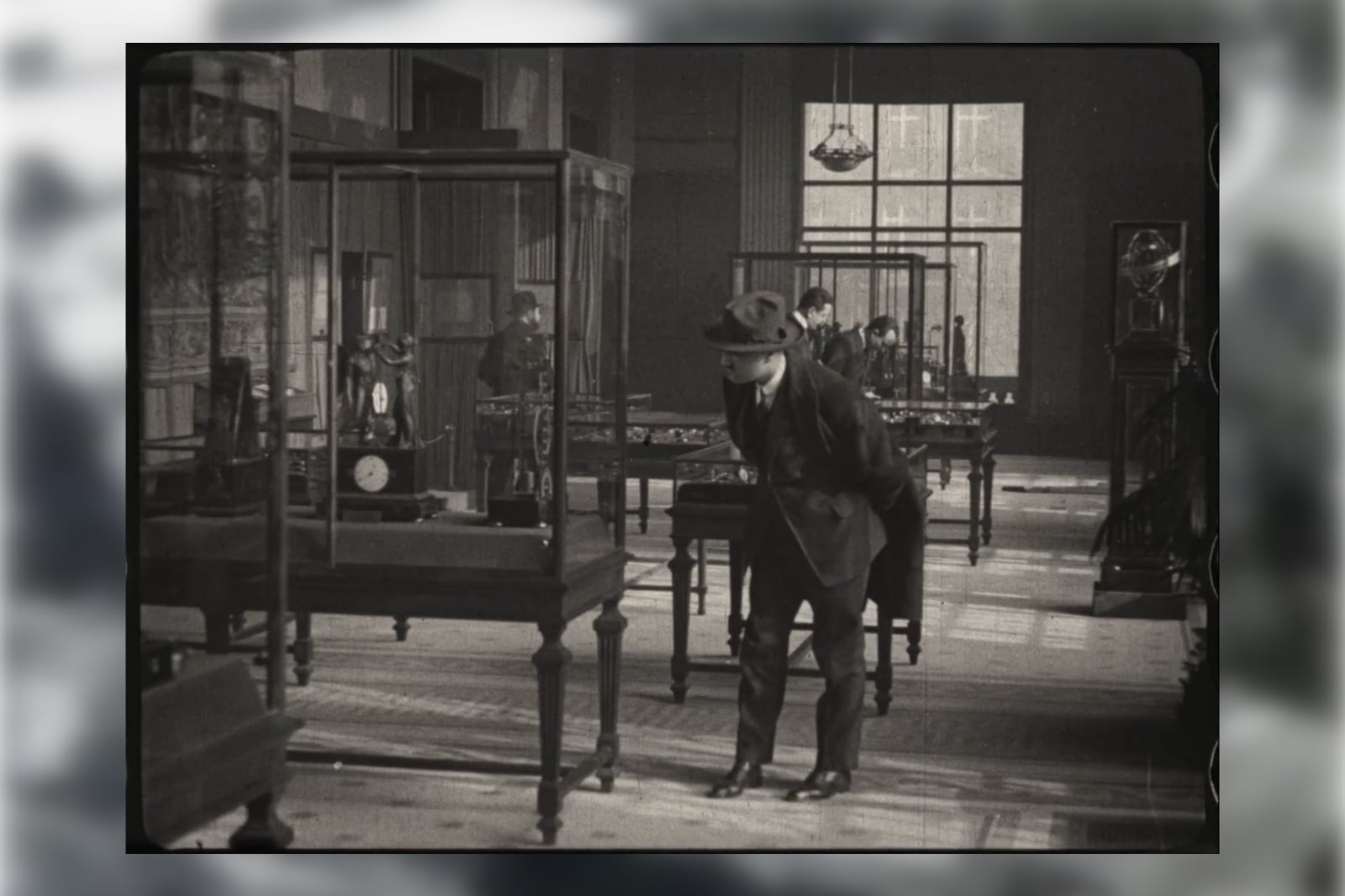
Frame from film L’œuvre d’Abraham Louis Bréguet, le célèbre horloger du XVIIIe siècle made in 1923 documenting the Musée Galliera Breguet centenary exhibition. Image SJX composite – courtesy Bibliothèque de la Ville de La Chaux-de-Fonds, Département audiovisuel, Fonds Musée international d’horlogerie (MIH).
The exhibition confirmed the collection’s scholarly function. It went beyond a private treasure held for personal satisfaction, and served as reference material that could support study by anyone with access.
In 1924, Salomons made this explicit. He donated No. 92, the Duc de Praslin double-sided watch, to the Musée des Arts et Métiers in Paris. The gesture placed one of his most significant pieces in permanent public custody, ensuring its availability for future scholarship.
Dispersal
Salomons died at Broomhill on April 19, 1925. He was 73. The baronetcy became extinct, and his estate passed to his widow, Laura, and their daughters.
The Breguet collection was divided. Vera Bryce Salomons, his eldest daughter, received 57 watches, including No. 160. Laura received approximately 70 watches. The division fractured the archive Salomons had built. For nearly a decade, the watches had existed together, available for comparison, handled in relation to one another. That continuity ended.
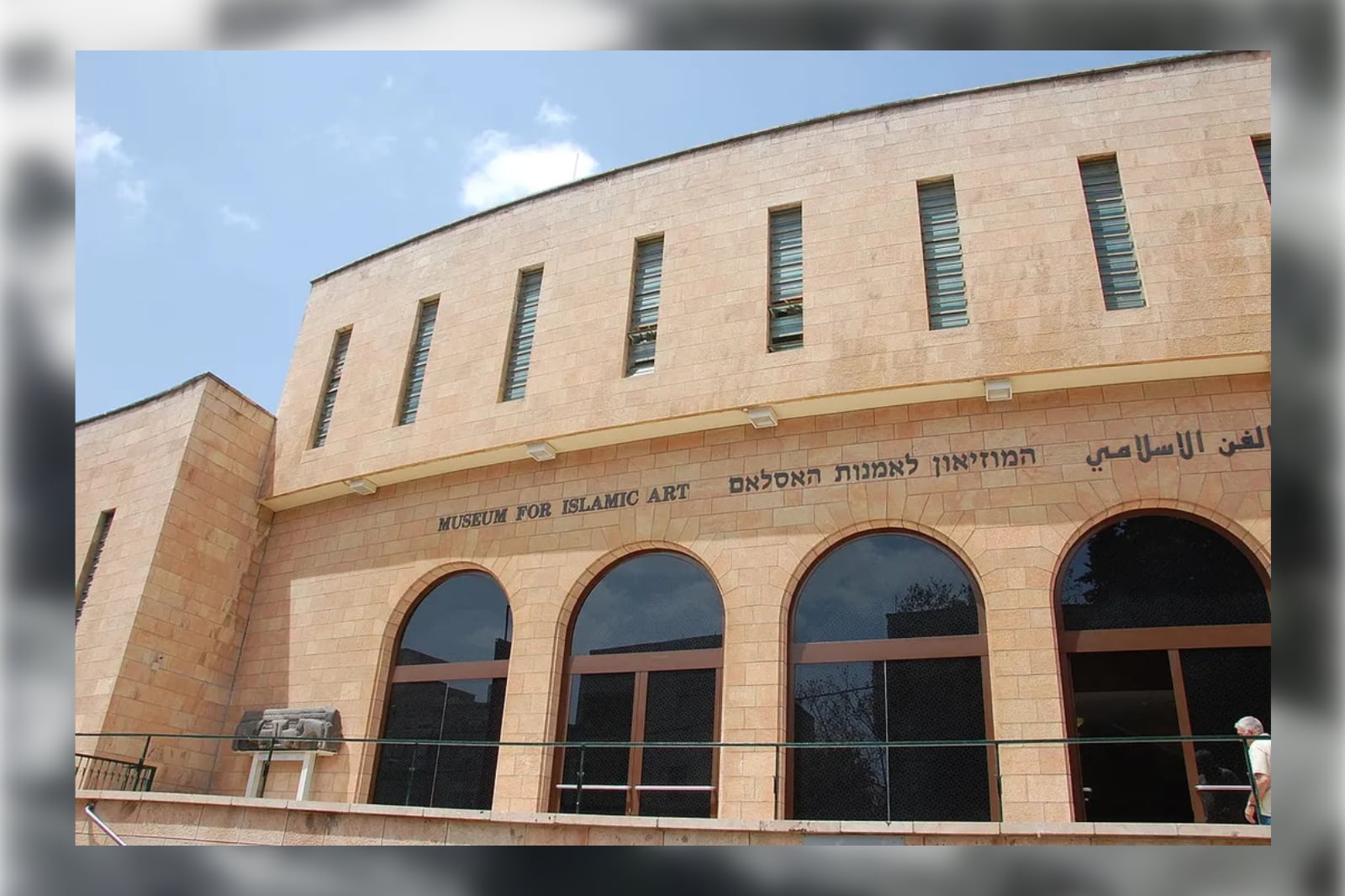
The L.A. Mayer Museum for Islamic Art in Jerusalem. Image SJX composite – Wikimedia Commons.
Vera kept her inheritance intact for decades. She eventually founded the L.A. Mayer Museum for Islamic Art in Jerusalem and placed the watches there in the 1970s. The decision drew criticism from the horological establishment.
George Daniels and Cecil Clutton expressed disbelief that the core of the Salomons collection, some 57 Breguet watches representing the finest concentration of the maker’s work, would be housed so far from the traditional centres of horological scholarship in London, Paris, and Geneva. The geographic and institutional displacement seemed to violate the scholarly function Salomons had intended for his archive.
Yet despite these concerns, the watches remained together, accessible to visitors as a coherent body documenting Breguet’s development across decades of production.
Laura’s portion followed a different path. She held the watches until her death, then her heirs consigned them to Christie’s London. Three sales followed: 20 lots on December 1, 1964, 21 lots on June 1, 1965, and 20 lots on November 2, 1965.
The watches were scattered among private collections, other institutions, and the dealer network. Many were housed in Desoutter’s red leather fitted cases that Salomons had commissioned, protecting them during decades of storage. Each sale catalogue noted “From the Collection of Sir David Salomons,” a provenance that carried weight and commanded premium prices.
On April 15, 1983, a thief named Na’aman Diller entered the L.A. Mayer Museum in Jerusalem. He bypassed alarm systems and removed 106 timepieces, including the entire Salomons Breguet display. No. 160 vanished. So did dozens of other pieces Salomons had acquired between 1917 and 1925.
The theft stunned the horological community. No. 160, then known as the “Marie Antoinette”, was feared to have been melted for its gold content. The collection that Salomons had rescued from dispersal in the 1920s had been stolen from public custody 60 years later. The criticisms voiced by Daniels and Clutton a decade earlier now carried bitter irony.
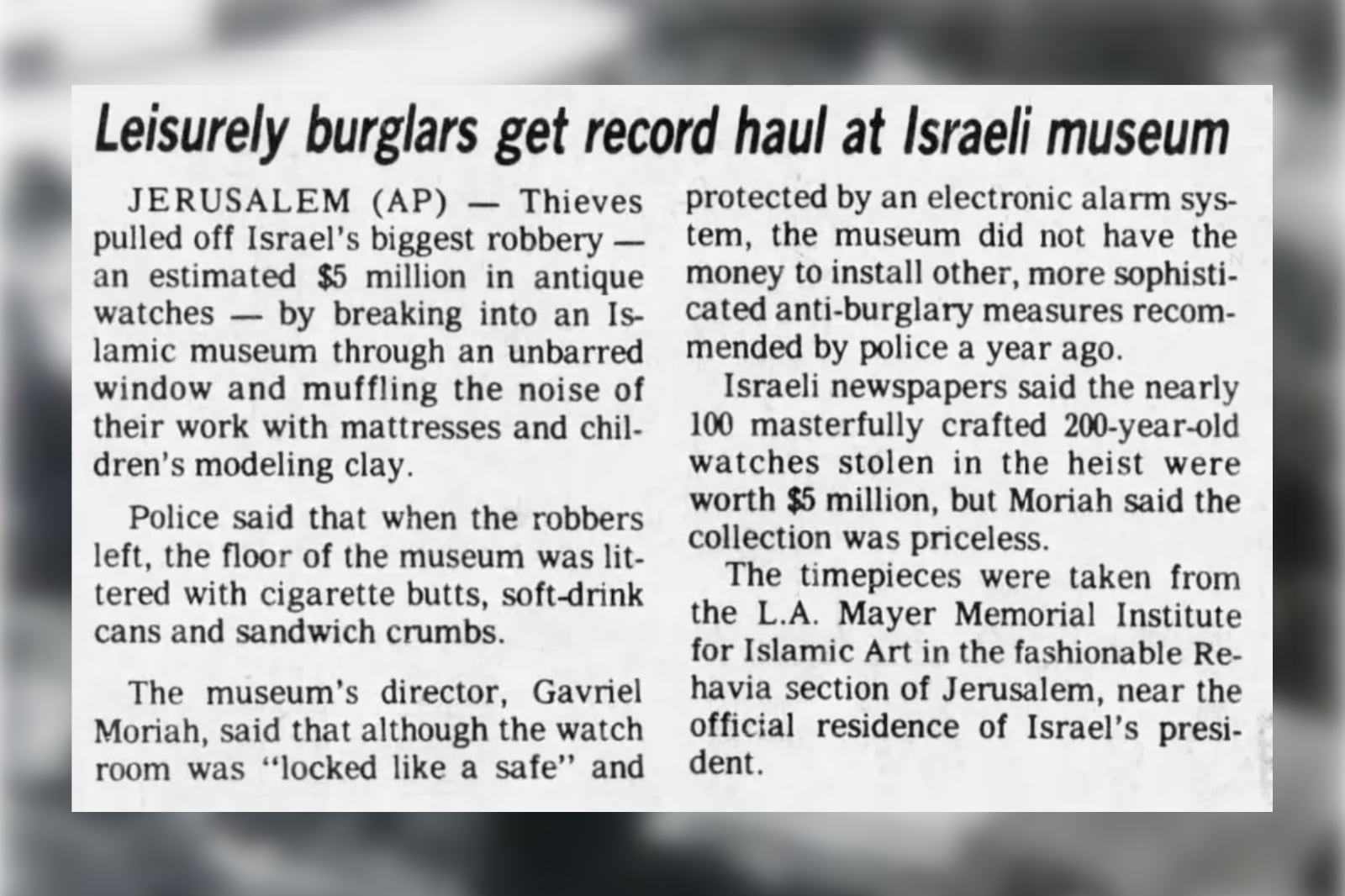
Newspaper ad describing the theft of the Salomons collection in 1983. Image SJX composite – Smithsonian Magazine
The watches remained missing for 23 years. In 2006, following Diller’s death, police received information leading them to his widow in Los Angeles. They recovered the stolen pieces largely intact, stored in boxes, poorly maintained, but physically complete. No. 160 survived, and, with the remaining watches, was returned to Jerusalem in 2007 and went back on display, where it remains today.
Concluding thoughts
It’s worth noting that Salomons was not the first major Breguet collector. The Reverend W. Bentinck L. Hawkins had assembled his “Choice Collection of Watches by Breguet” before his death in 1894. Sir Richard Wallace had worn Breguet No. 4691 daily until 1890. Sir Spencer Brunton had purchased the Marie Antoinette in 1887. When Salomons walked into Desoutter’s shop in May 1917, he entered a market already shaped by a century of discerning collectors.
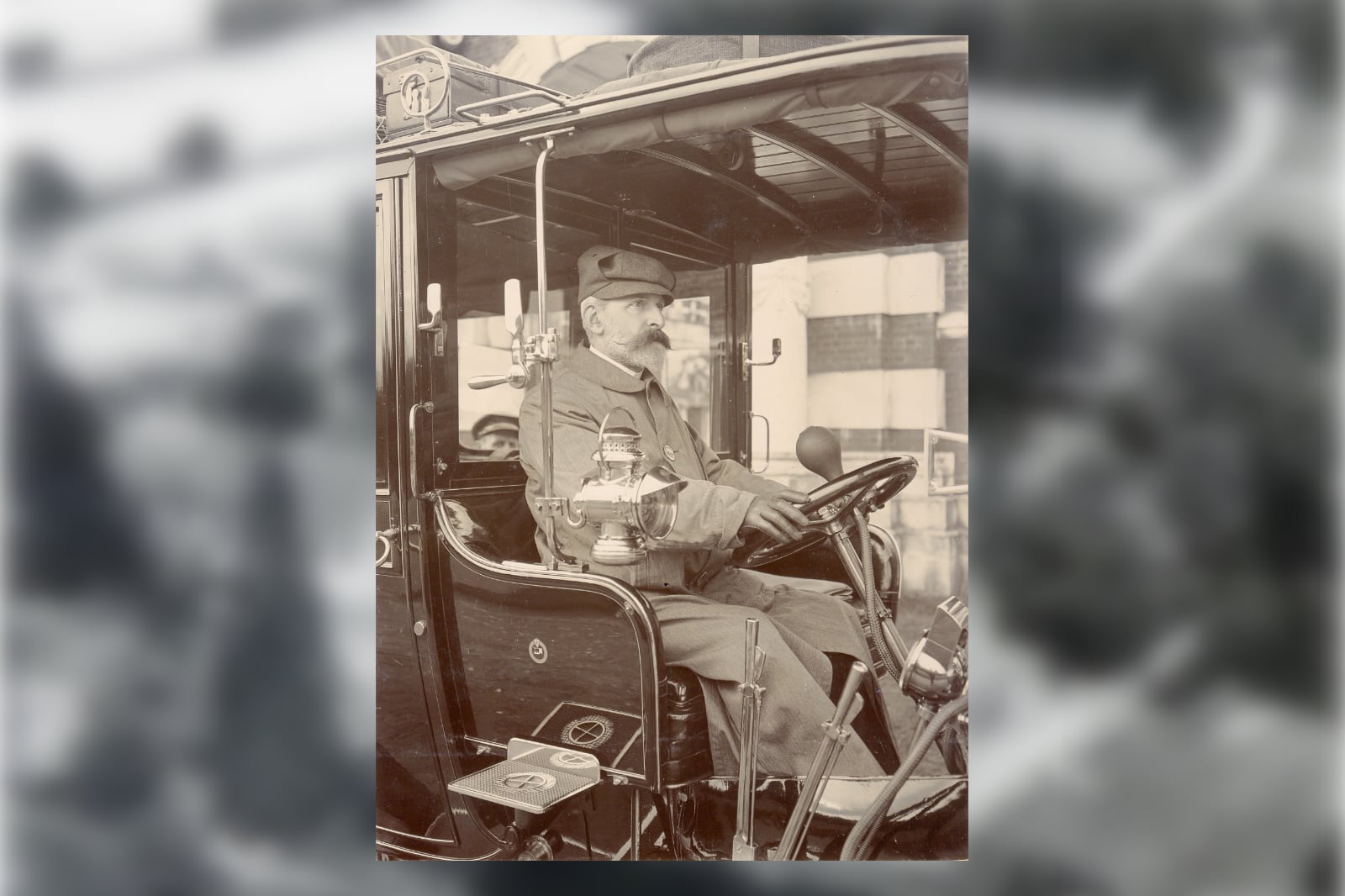
Sir David Lionel Salomons at the wheel of one of his automobiles. Image SJX composite – By permission of the Salomons Museum.
But his contribution was different. Earlier collectors had recognised Breguet’s excellence through provenance, association with royalty, and aesthetic beauty. Salomons recognised it through construction. His teenage training at the bench created a way of reading objects that most earlier collectors could not access.
This explains what he famously articulated: “To carry a fine Breguet watch is to feel that you have the brains of a genius in your pocket.” Wallace had worn his Breguet. Hawkins had curated his Breguets. The Marquess of Hertford had surrounded himself with them as aesthetic objects. But Salomons was the first to explain, through systematic documentation grounded in workshop literacy, exactly why Breguet’s work represented genius rather than merely excellence.
Acknowledgments
I am grateful to Chris Jones, curator of the Salomons Museum, for access to and permission to reproduce material from the Salomons collection. I am also grateful to the Musée international d’horlogerie (MIH), La Chaux-de-Fonds, and the Bibliothèque de la Ville de La Chaux-de-Fonds, Département audiovisuel, for permission to reproduce images from the 1923 film L’œuvre d’Abraham Louis Bréguet, le célèbre horloger du XVIIIe siècle.
Back to top.