

Hands On: TAG Heuer’s Seafarer Navigates the Tides
A tide indicator with pedigree.
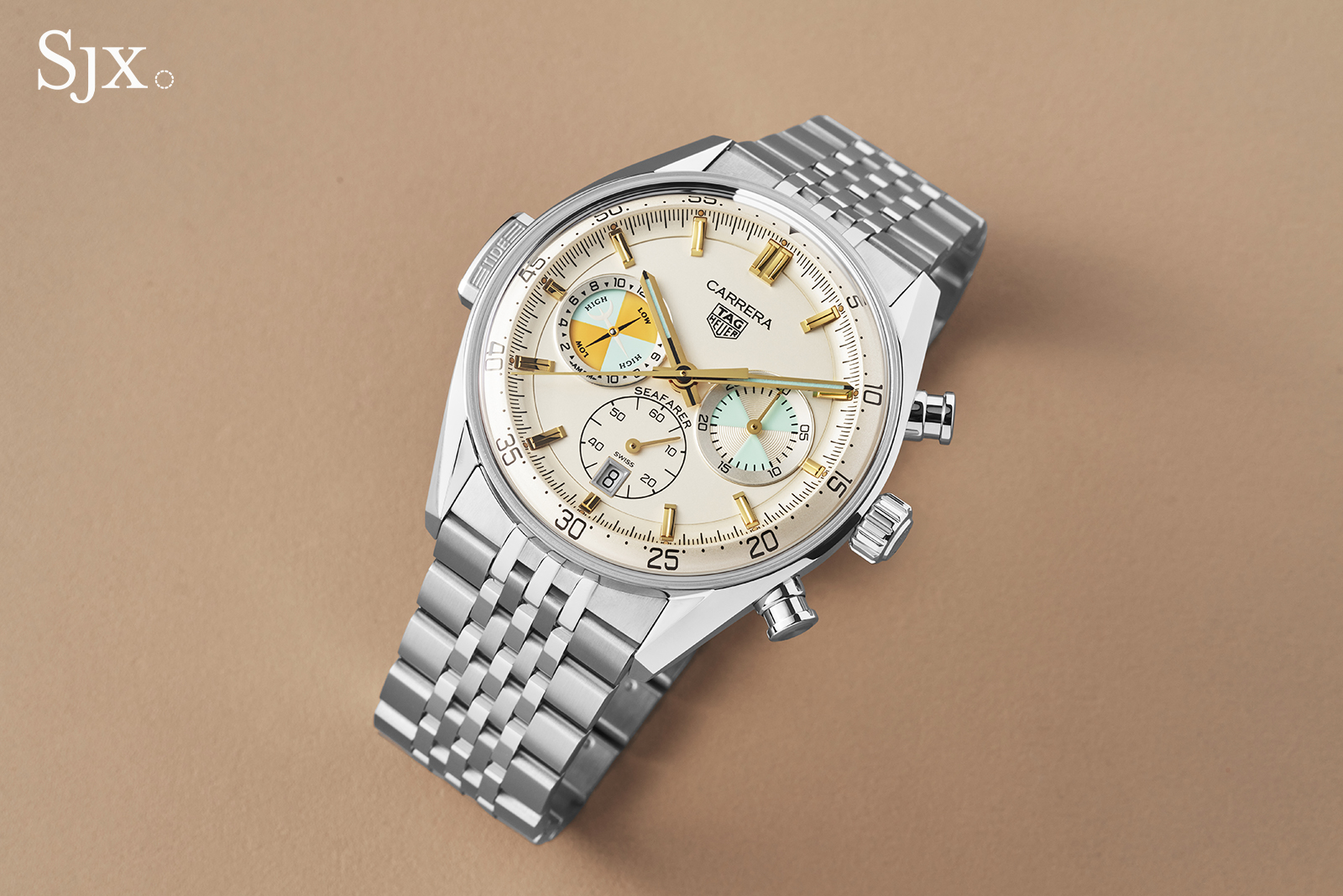
One of the most talked-about watches of this year’s LVMH Watch Week, the TAG Heuer Carrera Seafarer reimagines Heuer’s quirky midecentury tide-tracker in the contemporary Carrera ‘Glassbox’ format. With its warm hues and vibrant teal accents, the Seafarer captures much of the charm of the original while incorporating most (if not all) of the brand’s latest technical upgrades.
Initial thoughts
The Carrera Seafarer belongs to the tradition of historical reissues, in the same vein as watches like the Omega Speedmaster “First Omega in Space” and Breitling Navitimer Cosmonaute B02 that give new life to past icons. While these reruns can get tiring, there continue to be instances in which the original model has become too iconic to not be given another go.
Such is the case with the Seafarer, a quirky creation from the 1940s originally sold under the Abercrombie & Fitch name, which was, at the time, a premium sporting goods retailer trusted by the likes of Ernest Hemingway. Interestingly, the original was never a true commercial success, but its novel complication and vibrant colourways have since made it highly collectible in recent years. Much like early Rolex Daytonas, the original Seafarers were under appreciated in their time but later gained a niche following.
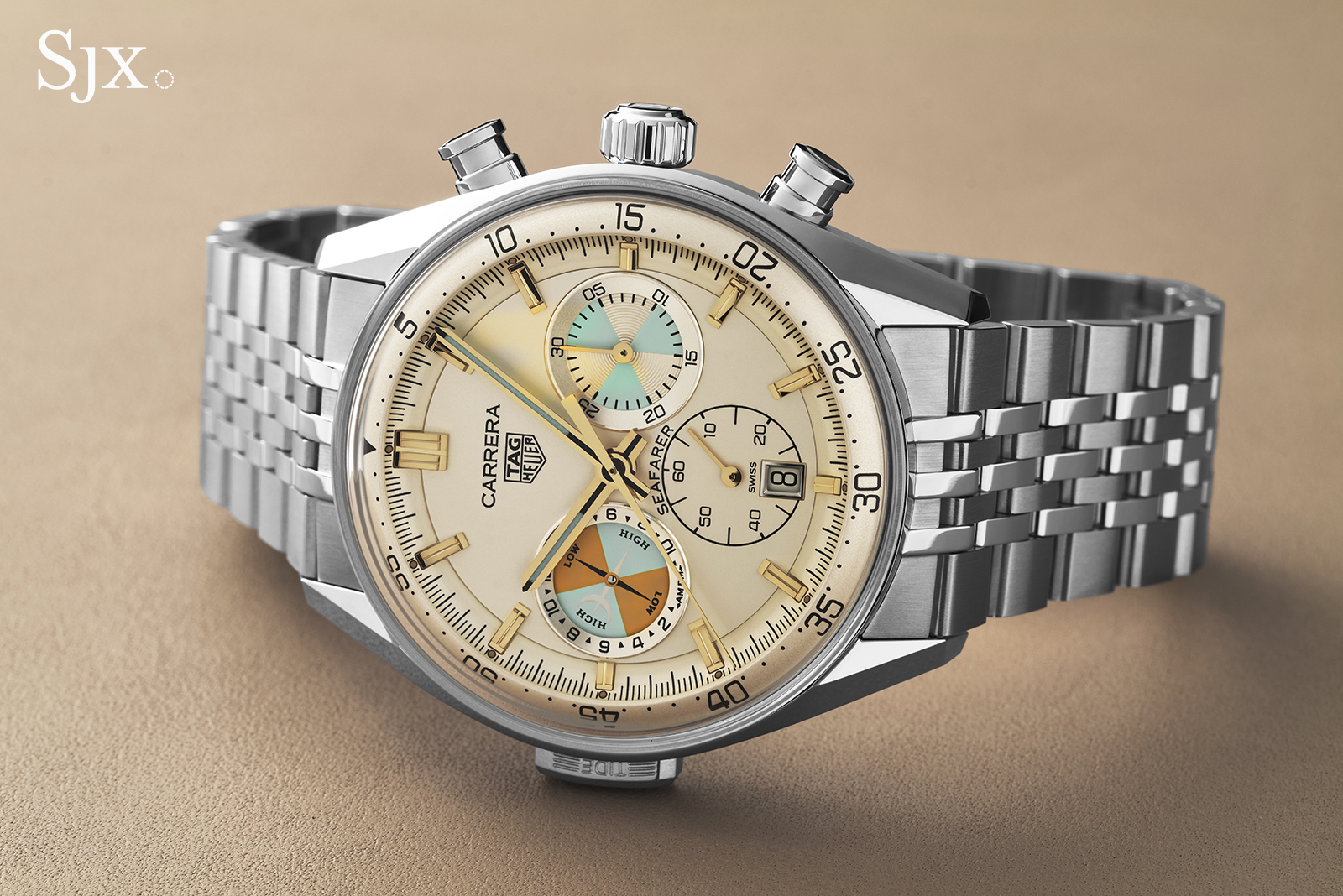
Dressed in the modern Carrera Glassbox case, the Seafarer shines with its champagne-coloured dial, blocky typeface and playful chromatics. Thankfully the reissue stays true to the original’s purpose-built dial, with regatta markings on the elapsed minutes sub-dial and a colourful tide indicator at nine o’clock.
The tide indicator actually replaces the elapsed hours counter, limiting the duration that can be timed to just 30 minutes. That’s excusable given that tide indicators are such rare and quirky complications. While the real-world practicality of a tide indicator is questionable, the same could be said of the extreme water resistance ratings common to many dive watches, which are rarely used for their stated purpose.
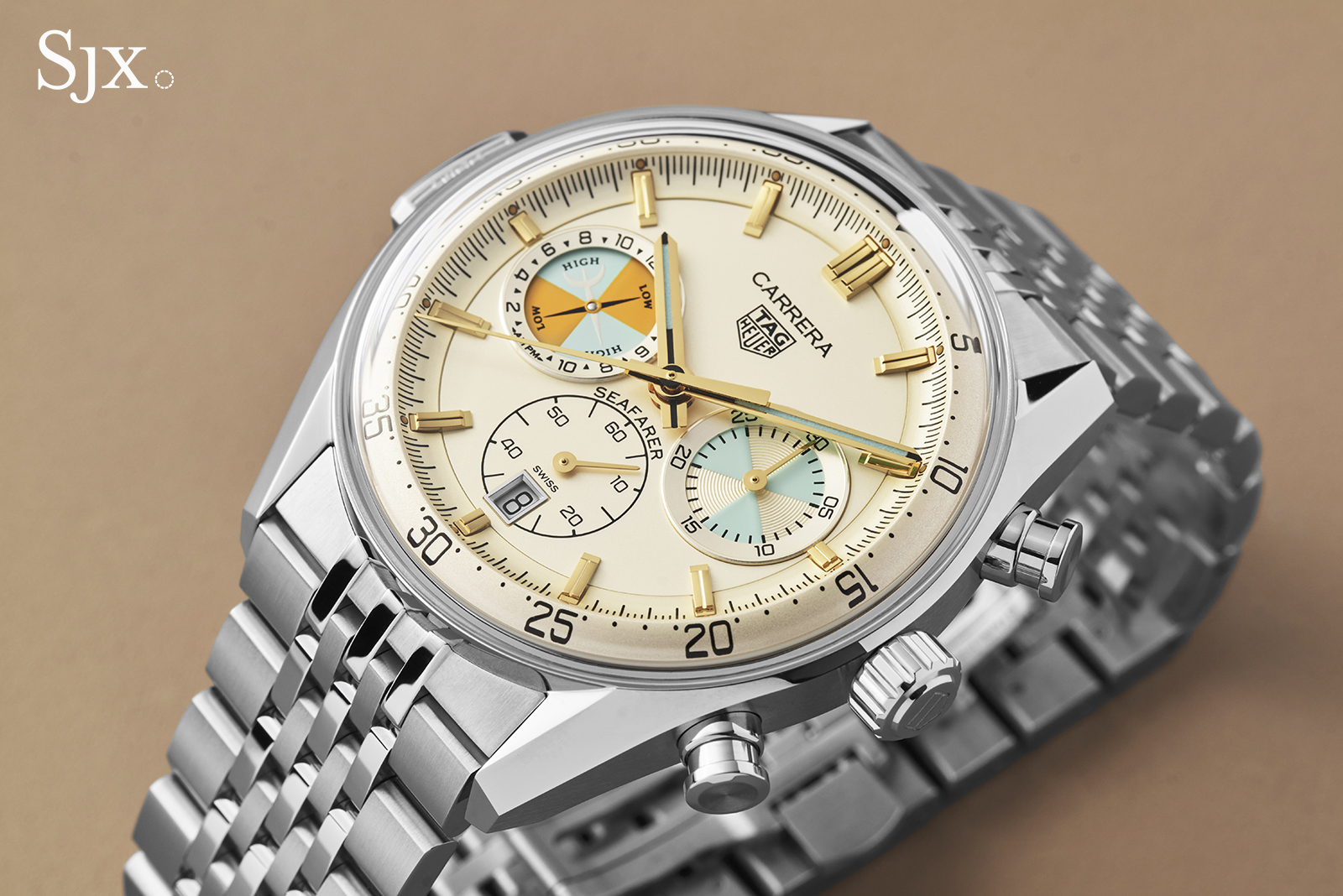
In its place, a colourful rotating disc of the tide indicator introduces a degree of pleasant asymmetry to the dial, not to mention a healthy dose of nostalgia, and the charm of this complication should prove persuasive among many prospective buyers.
The sharp, angular lines of the Carrera case suit the relaunched Seafarer well, imbuing it with a feeling of precision typical of watches made with modern, industrial methods. That said, the Carrera’s pump-style pushers help capture some of the original’s appeal. The blocky ‘tide’ pusher at nine o’clock, however, is undeniably contemporary, possibly leaving room for an even more period-correct variant with a pump pusher for the tide corrector down the road.
Overall, the Carrera Seafarer succeeds at bringing back one of the more interesting models in Heuer’s history. And although it preserves the key aspects of the original, there are a few aspects that could be improved. For example, the TH20-04 movement does not (yet) feature last year’s lauded TH-Carbonspring hairspring.
The adoption of the brand’s proprietary carbon hairspring would have been a significant technical upgrade, bringing the TH20-04 to near-parity with more technically advanced chronographs from the likes of Omega and Tudor. Shortcomings aside, the Seafarer feels like a step in the right direction for TAG Heuer.
The dial under the Glassbox
Measuring a market-friendly 42 mm in diameter, the Carrera Seafarer is a hefty and solid-feeling watch. The sharp, angular lines of the Carrera case remain as timeless and ever, as does the seven-link bracelet. While not period-correct, the seven-link bracelet is an appealingly modern reinterpretation of the iconic ‘beads of rice’ bracelets conceived in the 1940s by celebrated bracelet maker Gay Frères. While vintage bracelets are comparatively flimsy in their build, modern TAG Heuer bracelets feel solid and sturdy.
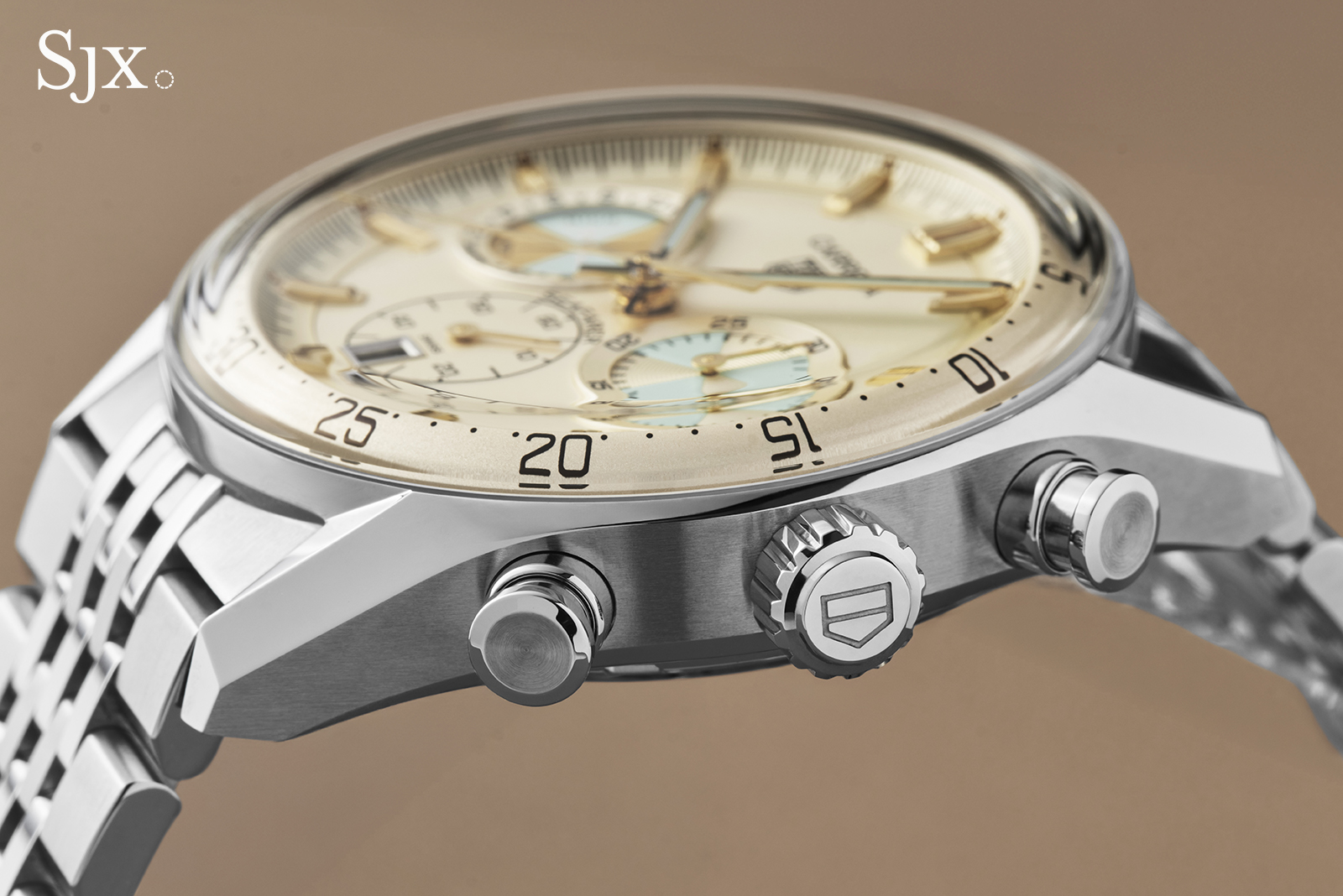
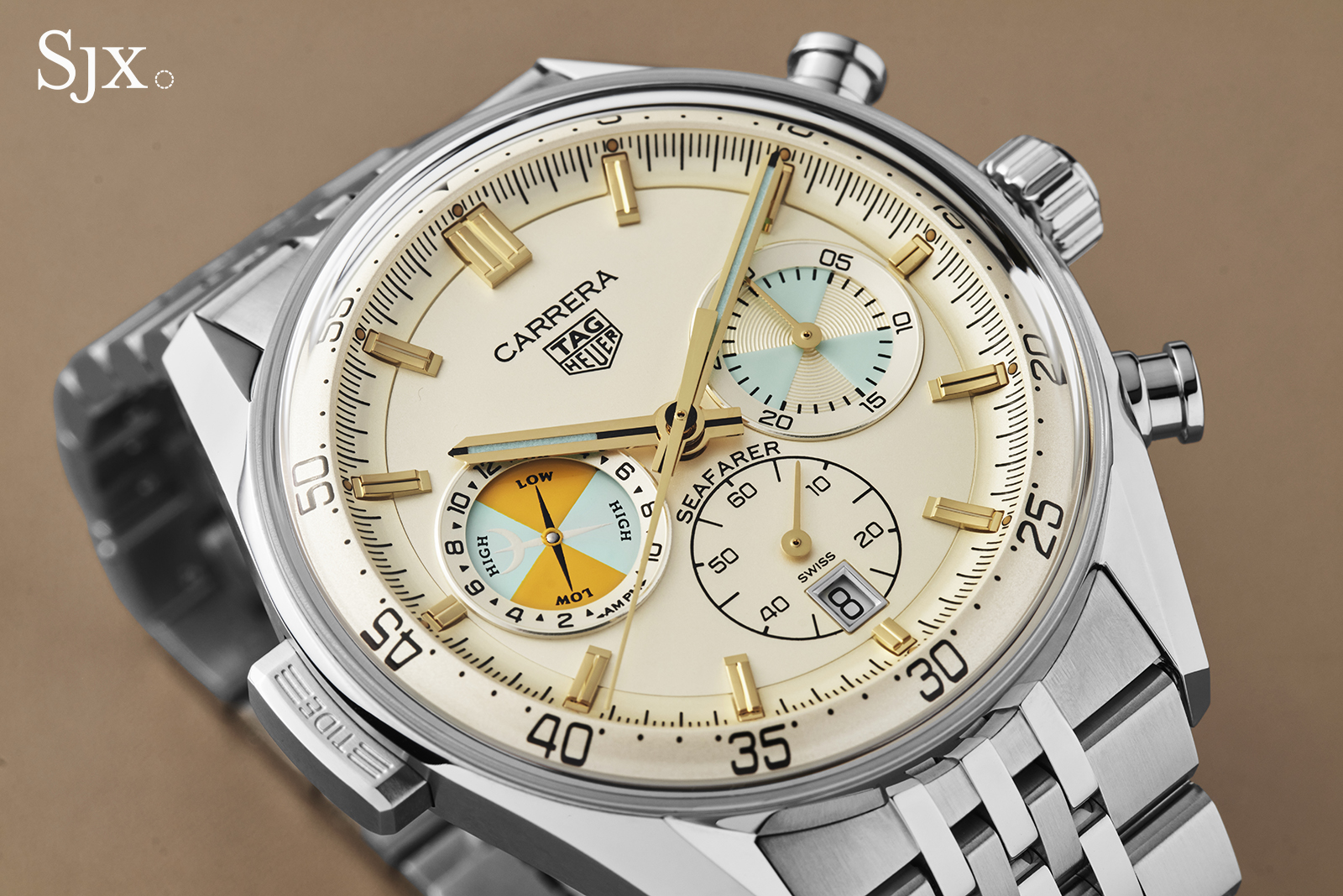
TAG Heuer’s ‘Glassbox’ case format was born decades after the original Seafarer was discontinued, but the colourful vintage-inspired dial looks right at home under the domed crystal. The bowl-shape dial and raised flange common to all Glassbox models gives the Seafarer a premium, sculptural feel missing from the simpler, flat dials of the originals.
The raised flange provides better legibility for both the chronograph and the regular time display, which is punctuated with 12 yellow gold-plated hour markers that bite into the sloped ring and extend onto the flat surface of the dial’s centre.
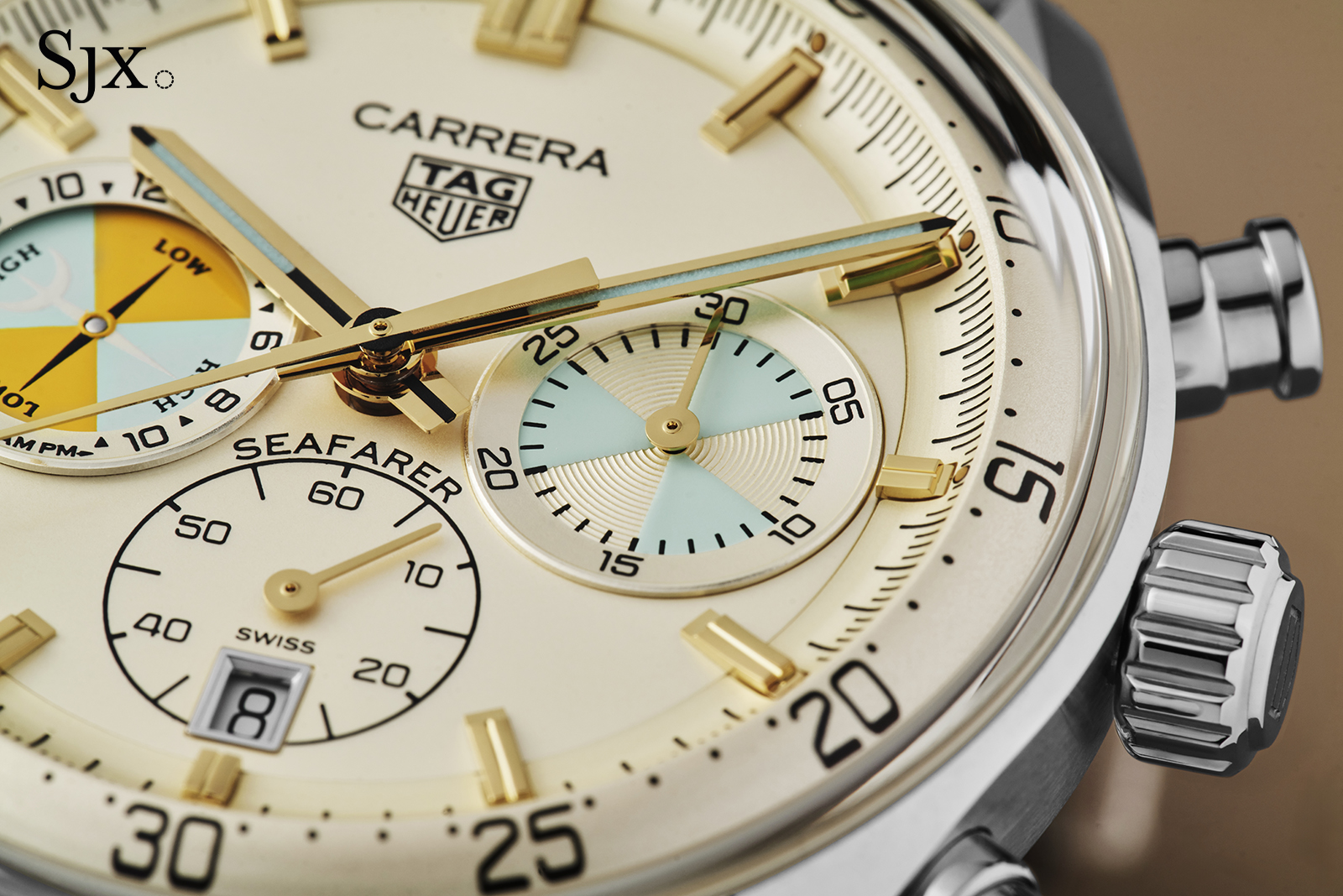
At six o’clock sits the running seconds sub-dial, broken by an elegantly framed date window. The design might have arguably been more successful without the date window, but the date is necessary when looking up local tide tables, making it a reasonable concession to practicality. The two symmetrical sub-dials at three and nine o’clock are framed by raised collars, visually differentiating the complications from the standard timekeeping functions.
A playful chromatic change is made by the use of “Intrepid Teal” for the tide indicator, lume and elapsed minutes graduations. The bright hue was named in tribute to a regatta-winning yacht called Intrepid. The timed countdown of the regatta race format actually explains the shaded five-minute increments on the elapsed minutes sub-dial. The sectors alternate between teal and beige, mirroring the design of the original Seafarer.
About the tide indicator
Tides are influenced almost exclusively by the Moon, or rather by the Moon’s gravity. The Earth and its natural satellite are tidally locked through gravitational attraction; Earth pulls at the Moon and the Moon also pulls back, albeit with a much weaker force. Due to this weak pull and the relative speed difference between a given point on Earth and the Moon large bodies of water experience the motion that we call tide.
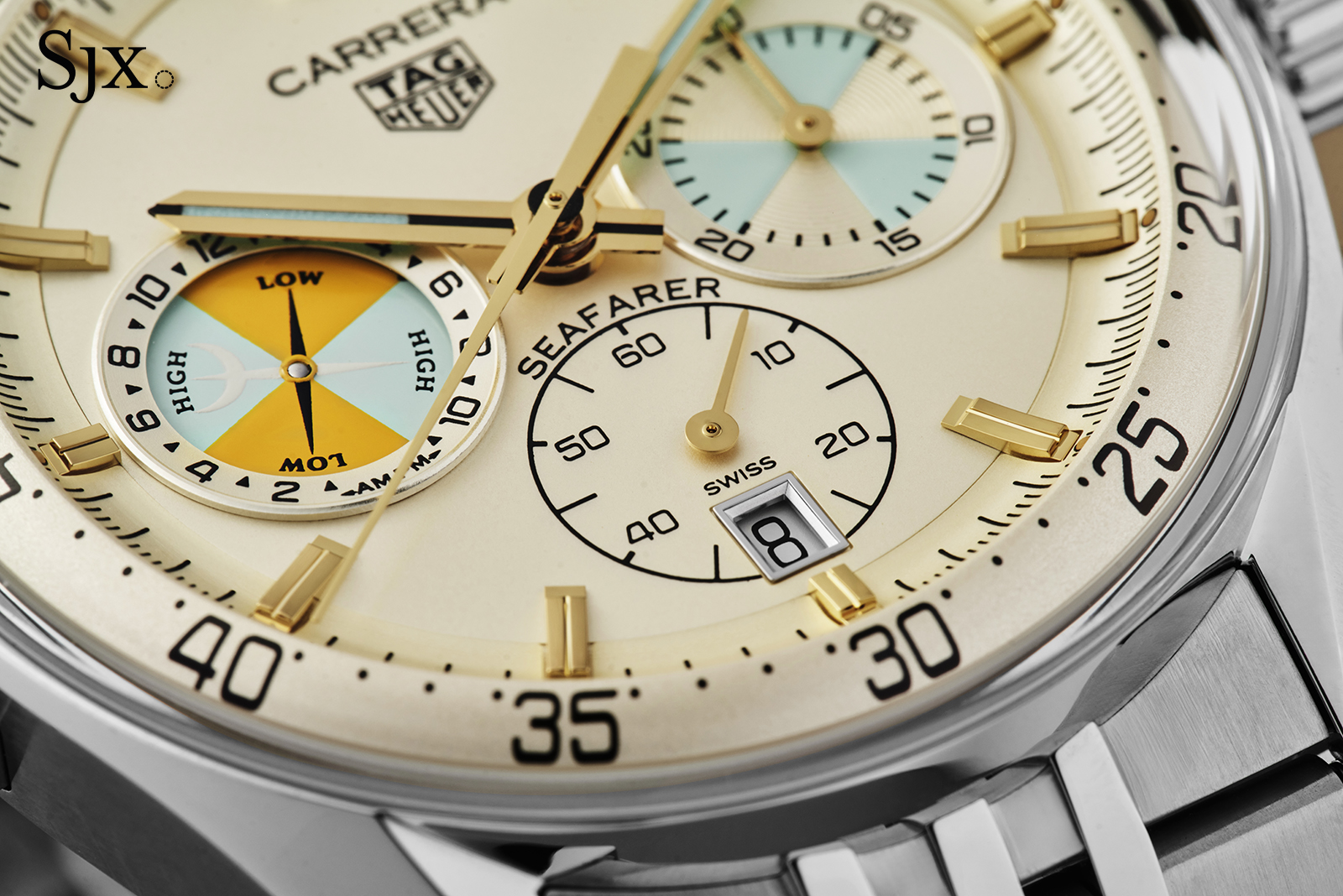
Tide indicator, read against a 24 hour ring.
High and low tide times are important for those who navigate, fish or engage in about any sea-related activity. In the mid-1940’s Abercrombie & Fitch, a sports and lifestyle oriented brand, approached Heuer to develop a tide indicator for mechanical watches. Heuer was at the time already the chief supplier of timepieces for the American retailer. The request was received by Edouard Heuer who delegated the task to his son, Jack Heuer. The young Jack Heuer himself asked his physics professor, Dr Heinz Schilt, for help. The Seafarer is considered Jack Heuer’s first contribution to the family’s business.
Although Dr Schilt was only teaching high school physics at the time, he was actually a retired and much respected physicist trained at ETH Zürich under Nobel-winning professors. He had also been a theoretical researcher at the University of Bern, working in the field of semiconductors (a bleeding edge technology during his time).
Dr Schilt was also a devoted hobbyist and built a number of remarkable sun dials, including some that could work at odd angles or underwater. His extensive work is still remembered in the niche field of sun dials.

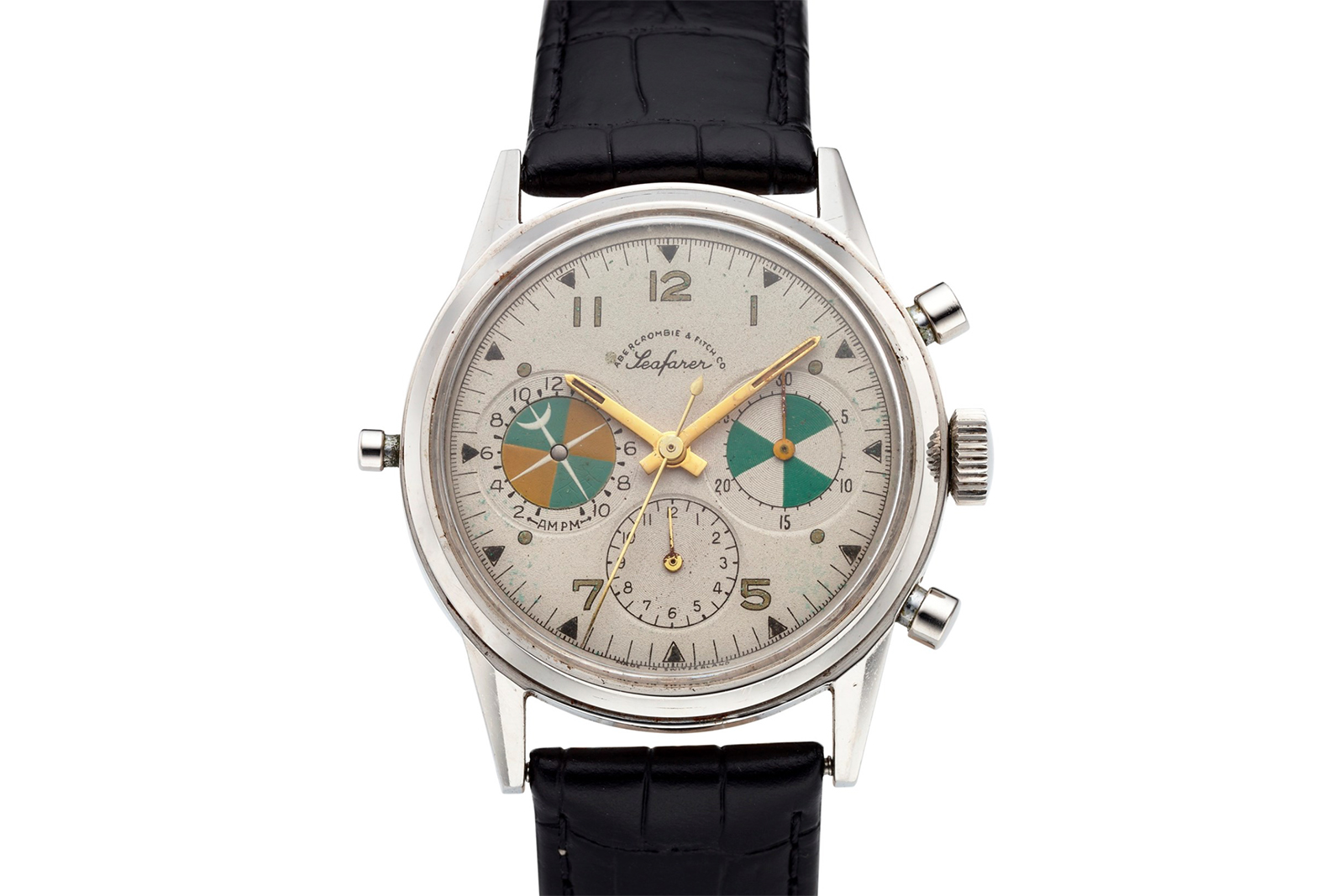
Vintage Seafarer made for Abercrombie & Fitch by Heuer. Image – Christie’s
From Abercrombie & Fitch’s original idea to the involvement of a Swiss physicist, the Seafarer’s tide indicator concept has a strong and frankly unique pedigree. But interestingly, the solution is pretty straightforward and could have been developed by just about any physics teacher. The indicator was even awarded a patent in 1954, which cited Walter Haynes, the Abercrombie & Fitch director, as the inventor.
The Earth-Moon system can be simplified in such a way that Earth becomes a spinning “sun” mobile making one turn every 24 hours in one direction and the Moon a “satellite” mobile making one revolution around the Earth in precisely 29.5 days in the same direction. This becomes a simple problem of angular rotation composition.
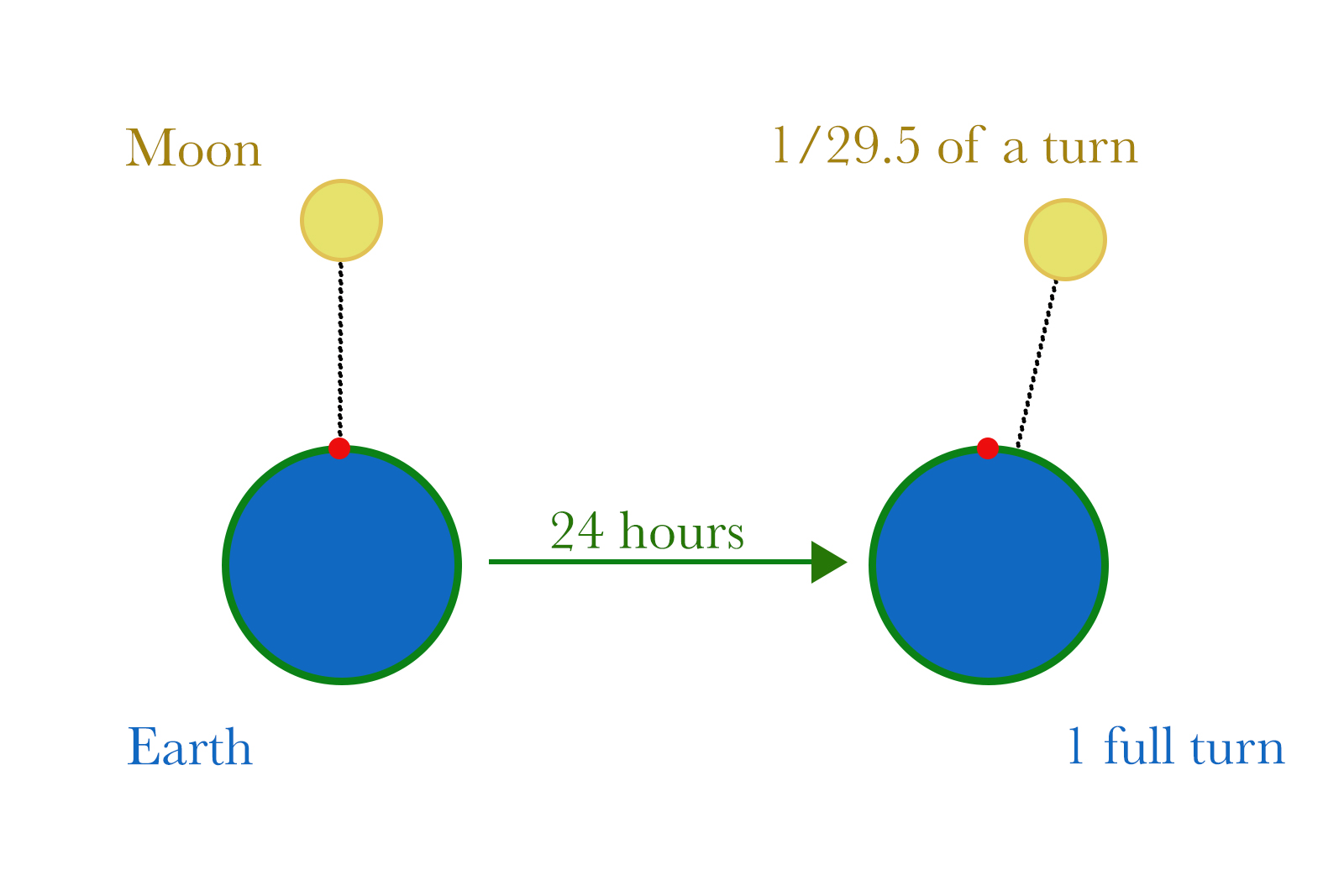
Positions of the simplified Earth-Moon system.
Since compositions of constant angular velocities are periodic, we can always infer the relative position of the Moon from a given point on Earth. Knowing the exact time of the high tide (when the Moon’s influence is the strongest) and assuming it decreases gradually as the Moon moves away, a pretty reliable first-order deduction of the following tide times can be obtained.
The figure above shows the Earth and Moon setup (obviously not at scale) and how it evolves over 24 hours. Suppose the Moon is right above a given position (red dot) on Earth. After 24 hours the Earth makes one full revolution — meaning the red dot returns to the same position.
During the same 24 hours, the Moon makes 1/29.5 part of a full turn around the Earth, so its final position is not directly above the starting point anymore, but rather shifted by a 1/29.5 of a turn.
Since the Earth’s rotation is 24-hour periodic, we can consider it as virtually stationary in 24-hour increments. So the relative position between a given point on the planet’s surface and the Moon shifts daily only by 1/29.5 of a turn. The figure above may suggest that the high tide in a certain spot happens when the moon is right above it, which in practice is only a seldom occurrence. The gist of the simplified system is to show how the position of the moon relative to any random set point can be easily tracked.
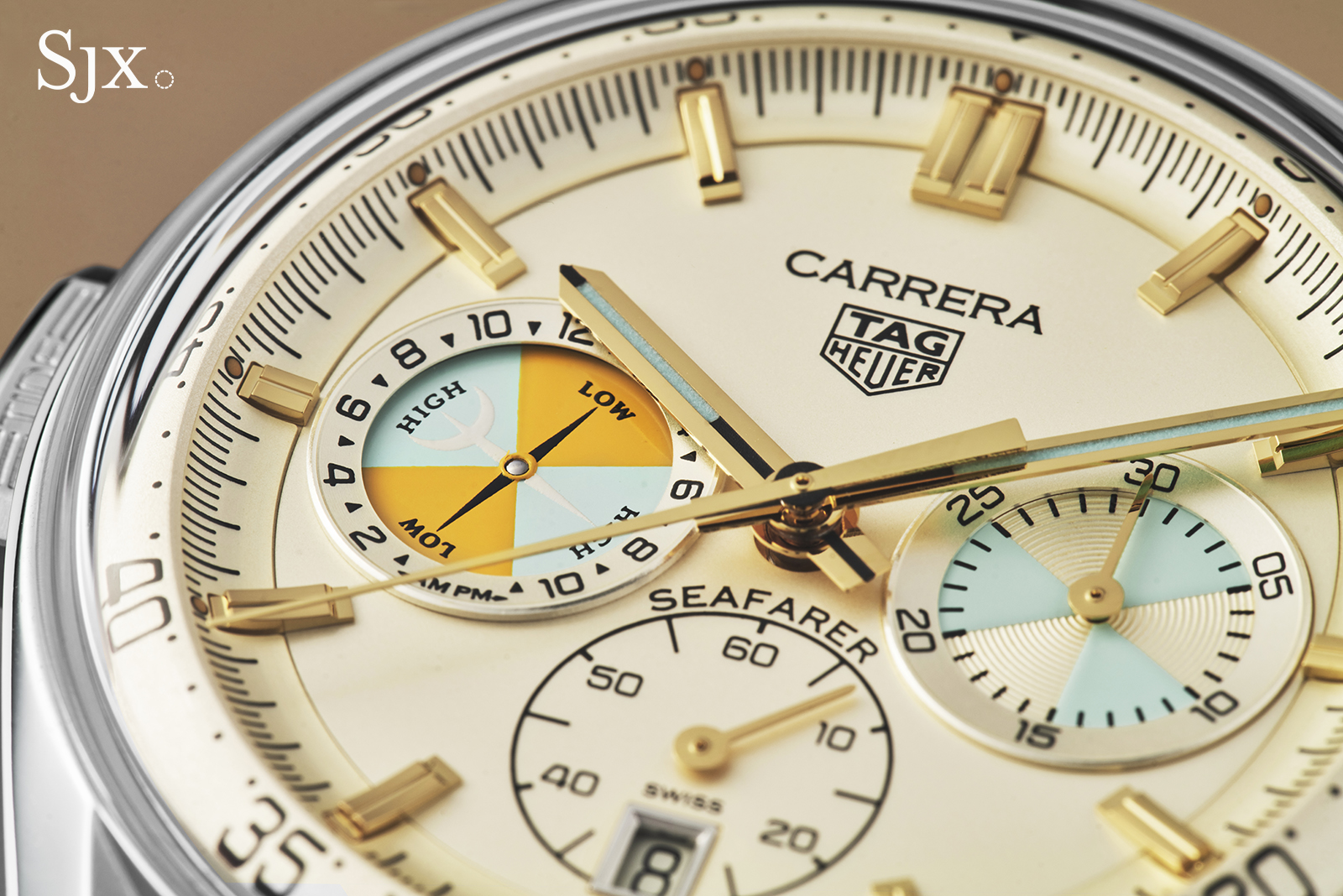
The Seafarer’s tide indicator works by reading a turnable pointer against a fixed 24-hour scale. In the original Abercrombie & Fitch Seafarers the pointer disk made one full turn every 29.5 days — the same as the simpler moon phase indicators on the market. A finger advances the 59-toothed disk clockwise by two teeth at midnight, effectively acting as a moon phase indicator. The 24-hour ring remains stationary, since otherwise it would need to make (one pointless) turn every 24 hours.
A subtlety of tides is that the full extent of the Moon’s interaction (and some inertia) causes tidal behaviour to take place on the exact opposite spot on the Earth’s sphere. So in total for a full 24-hour day, we have two high and two low tides at a given place.
Due to the symmetry of high tides (which also implies a similar, but 90°-shifted symmetry of low tides), the Seafarer’s indicator has four pointers which show the two tide pair times for the current 24-hour period, for a given place. By plugging in the exact time of the local high (or low) tide via the 9 o’clock pusher, one would have a fairly accurate tide indicator for the following days.
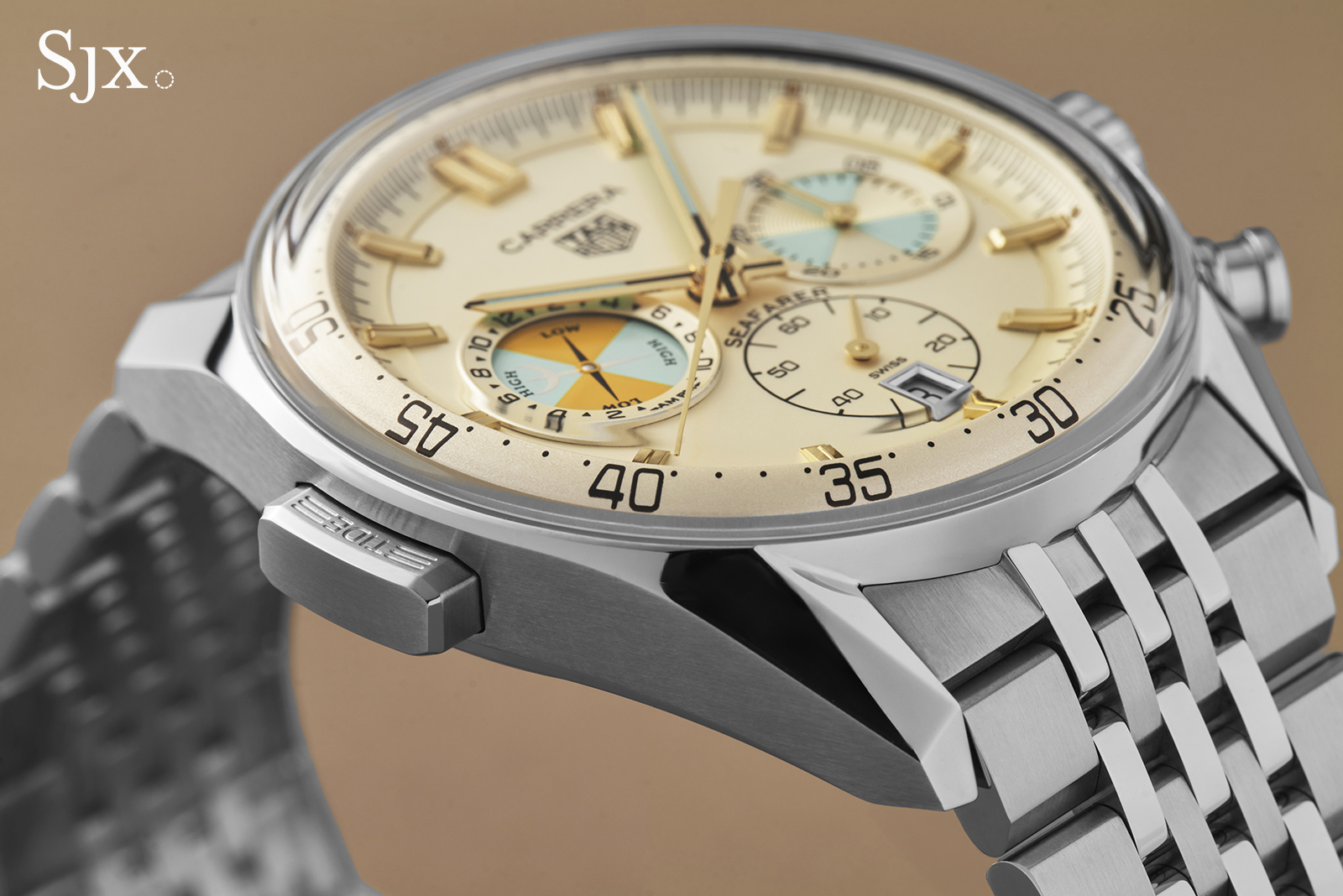
Dedicated pusher for setting the tide indicator.
In reality the motions of the Earth and Moon are far more nuanced and tidal behaviour is influenced by other factors as well, but for casual maritime activity the accuracy of the Seafarer’s tide indicator is more than sufficient. The reading of the indicator is not precise to the minute so any loss of accuracy over extended periods of time should be largely imperceptible.
When the original pieces were made, the Seafarer didn’t enjoy much in the way of commercial success and the utility of the tide indicator was contested by fishermen. The original Seafarers ran on either Valjoux 71 or 72C modified movements, tweaked for displaying the tides based on the crude 29.5 lunar cycle approximation.
That said, TAG Heuer watchmakers have increased the original accuracy of the pointer disk to one revolution every 29.53125 days. This means the pointer will be off by one day in about 1,515 lunar cycles, which works out to 122.5 years. If that number sounds familiar, it’s because this is the modern industry standard for moon phase accuracy. While some highly accurate moon phase indicators far surpass this figure, the Seafarer’s tide indicator plenty precise.
The TH20-04 inside
The TH20-00 base has become the go-to workhorse chronograph movement for TAG Heuer and is rightfully hailed as a true performance chronograph. The underlying architecture itself is based on the now-discontinued Heuer 02. The Heuer 02 was initially launched in 2017 as a replacement for the controversial cal. 1887/Heuer 01 family of chronograph movements that were produced by TAG Heuer but licensed from Seiko.
The Heuer 02 movement introduced a series of updates to the core architecture, from the design of the reset hammers and control levers to the inclusion of a vertical clutch. While Edouard Heuer invented the oscillating pinion, a vastly simplified horizontal clutch used in industrial movements like the Valjoux 7750, TAG Heuer decided to go all-in with a vertical clutch when developing their in-house chronograph.
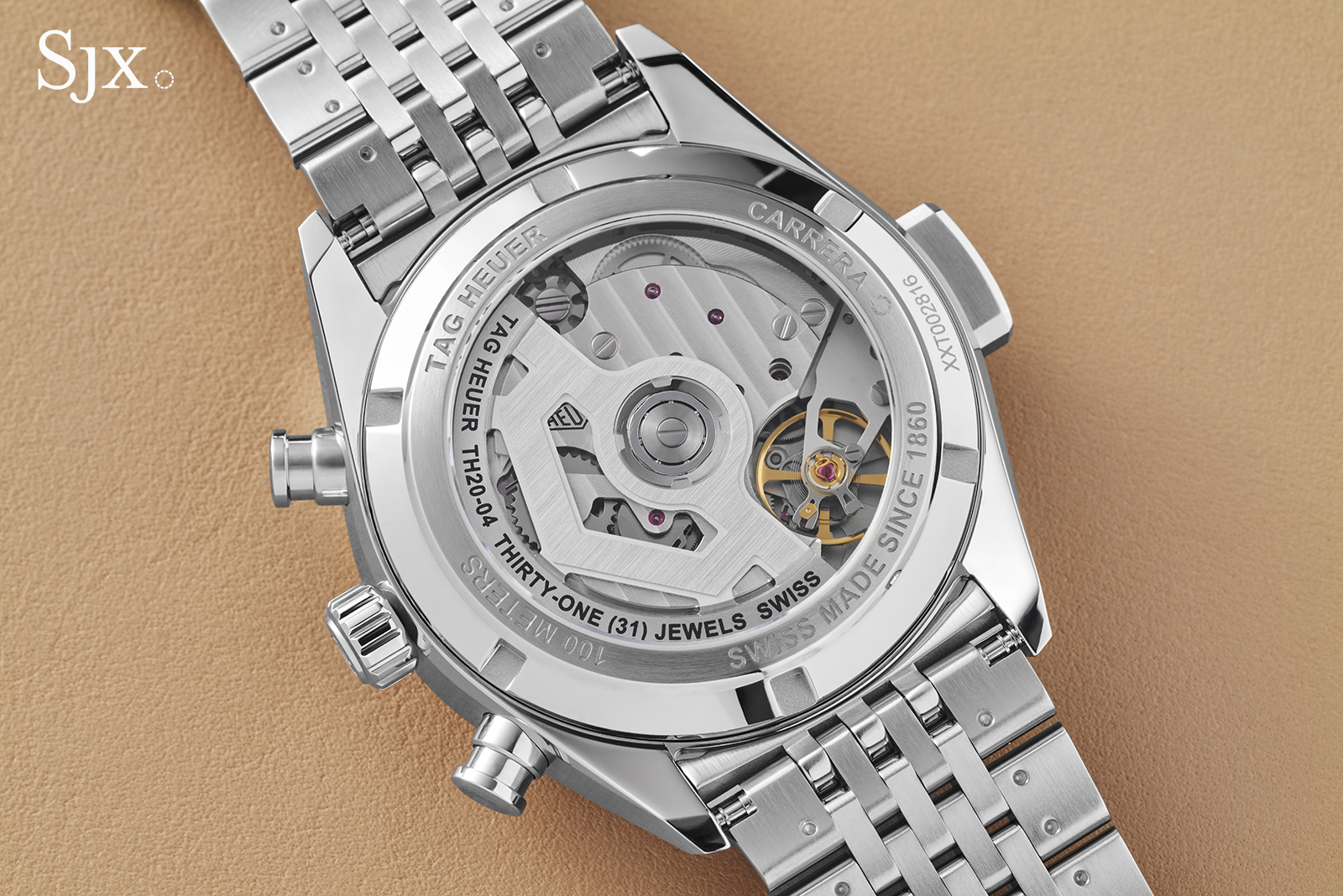
Under the watchful eye of Carole Forestier-Kasapi, the Heuer 02 has evolved into the TH20-00 we know today. This platform has proven reliable enough that the brand now offers a 5 year warranty, up from the typical 2 years. Through the case back, the most obvious difference is the inclusion of a bi-directional winding system (the Heuer 02 was uni-directional) but that’s probably just the tip of the iceberg when it comes to upgrades.
TAG Heuer seems to be reaping the benefits of the lengthy development cycle of the TH20-series, since the platform proved reliable so far and well-suited for additional complications.
The TH20-04 retains the bulk of its base architecture, save for the tide indicator that replaces the elapsed hours counter. As discussed, the tide indicator works much like a moon phase indicator, so the addition of this complication is superficial from a technical standpoint, since it doesn’t require deep integration with the rest of the movement.
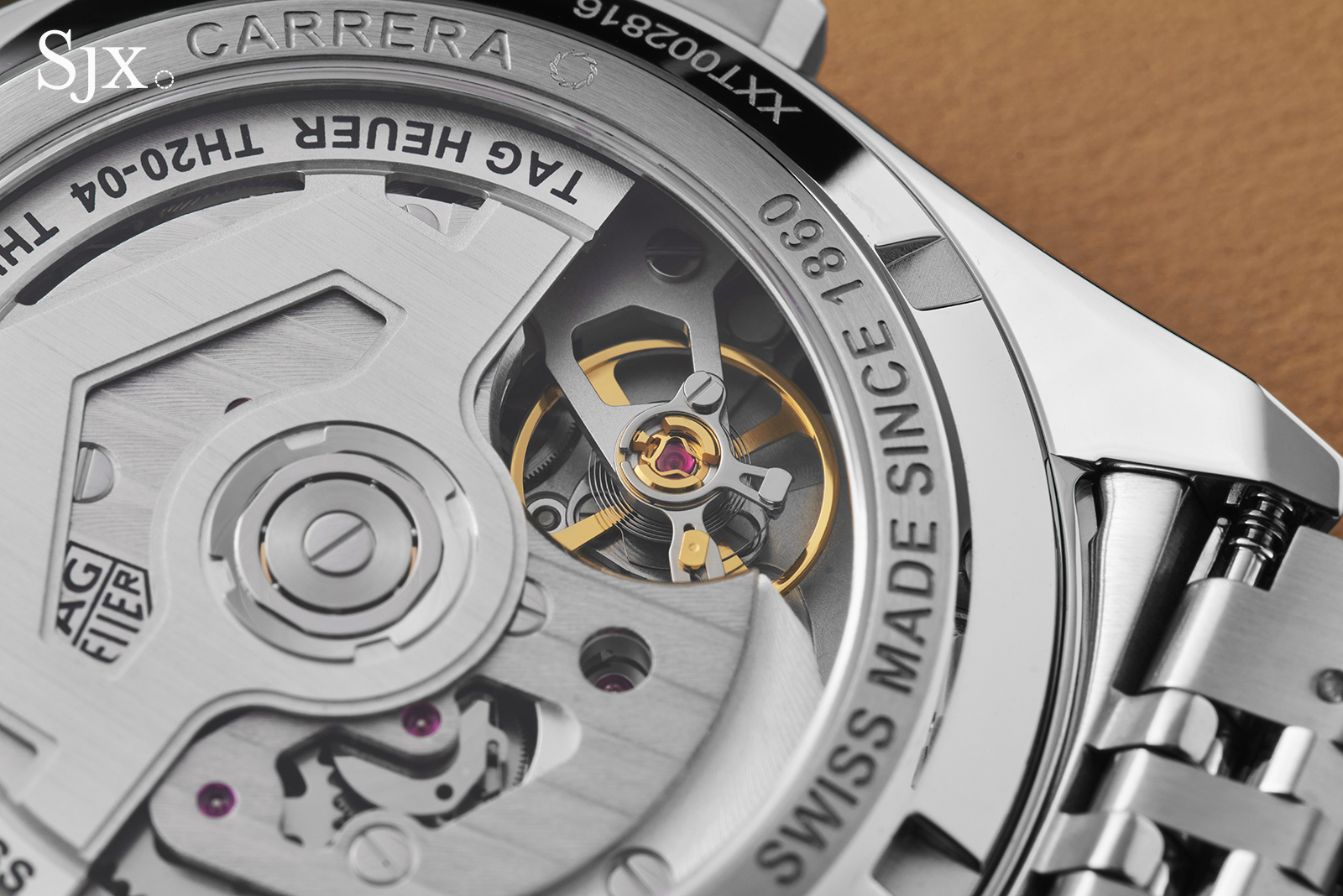
The tidy but unpretentious industrial finish of the TH20-04 could probably be improved. Understandably, the movement is built with efficiency and performance in mind, but the finishing still feels underwhelming, especially when compared to rivals like Breitling that seem to put slightly more care in decorating their equivalent calibres.
Otherwise the TH20-04 has certain pleasant mechanical aesthetic to it — the visible vertical clutch module, the prominent minute counter wheel and the seemingly isolated column wheel all make for a unique and instantly recognisable calibre. The movement still lacks the free-sprung balance offered by Omega and Tudor, but the future addition of the TH-Carbonspring, which unlike silicon hairsprings is compatible with a traditional Etachron regulator, should offer some of the same advantages when it comes to concentric breathing thanks to its engineered terminal curve.
Key facts and price
TAG Heuer Carrera Seafarer
Ref. CBS2016.EB0430
Diameter: 42 mm
Height: 14.4 mm
Material: Stainless steel
Crystal: Sapphire
Water resistance: 100 m
Movement: TH20-04
Functions: Hours, minutes, seconds, chronograph and tide indicator
Winding: Automatic
Power reserve: 80 hours
Strap: Stainless steel seven-link bracelet with butterfly folding clasp
Limited edition: No
Availability: Starting March 2026 at TAG Heuer boutiques and retailers
Price: CHF8,300 excluding taxes
For more information, visit TAGHeuer.com.
Back to top.