

Face Value: Why Painting on Watch Dials is Art
The intersection of art, craft, and horology.
Fine watches have pulled double duty as decorative objects since before the invention of the hairspring in 1675. In this sense, one could almost argue that watches have been linked to art since before they were even watches in the modern sense. This relationship emerged early in part because both types of objects were made primarily for the same clientele: wealthy elite in Europe and elsewhere.
Though art and watches exist for different reasons, they are both often created with eternity in mind. The noble materials and timeless designs of many fine watches, especially those of the quality that would normally be paired with a work of art, also help justify the painstaking (and costly) work of artisanal decoration, which can, in some cases, take more than a year for a single work of miniature art.
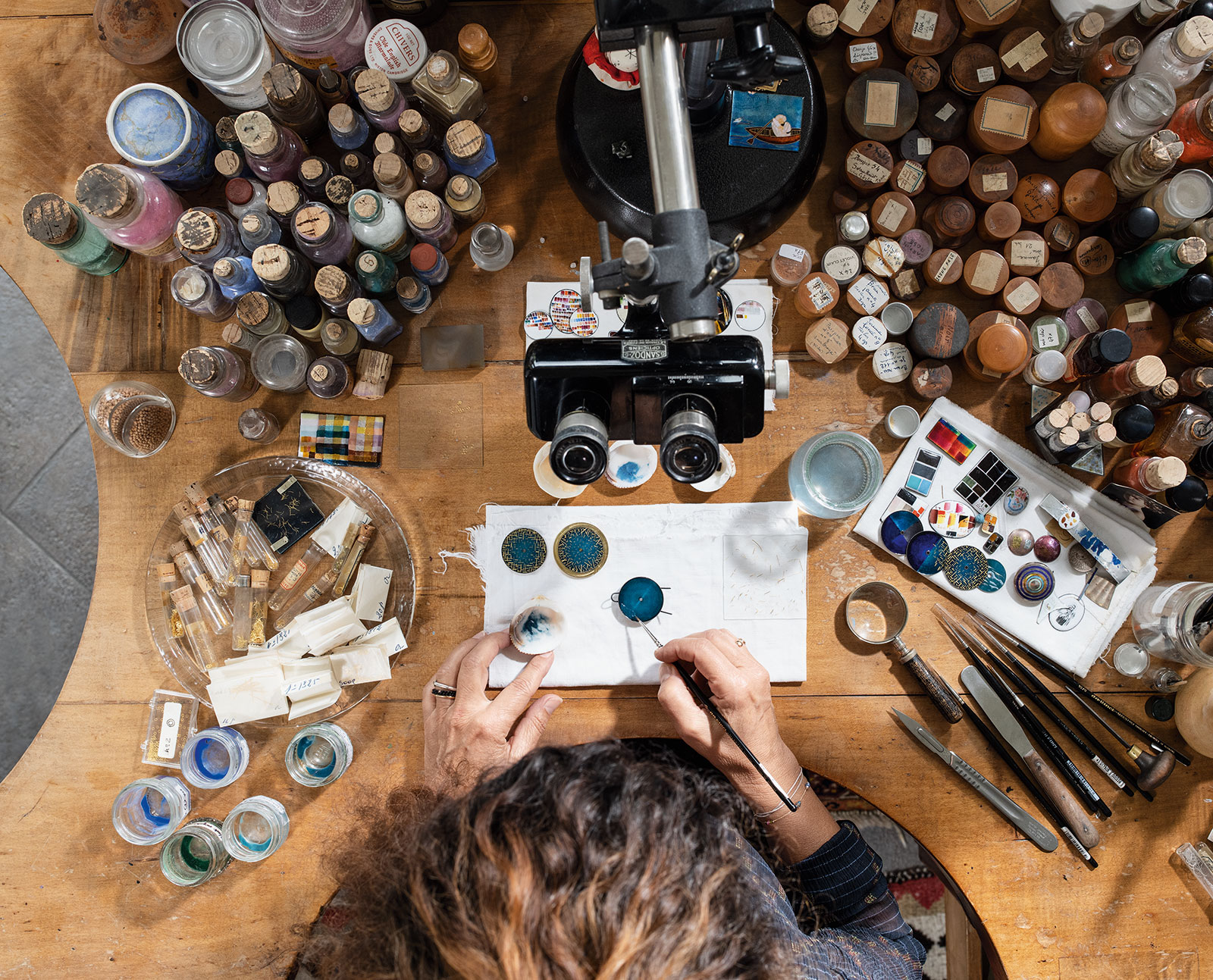

Introduction to miniature painting
Of all the forms of decoration that have been applied to watches, miniature paintings are an especially important genre. Historically, these miniature masterpieces have been produced primarily in enamel, though acrylic paint is increasingly used today. Much has been written about the art of miniature painting, and it would not be an exaggeration to call it a dying art, since the number of living practitioners seems to have rarely exceeded half a dozen at any given time over the past century.

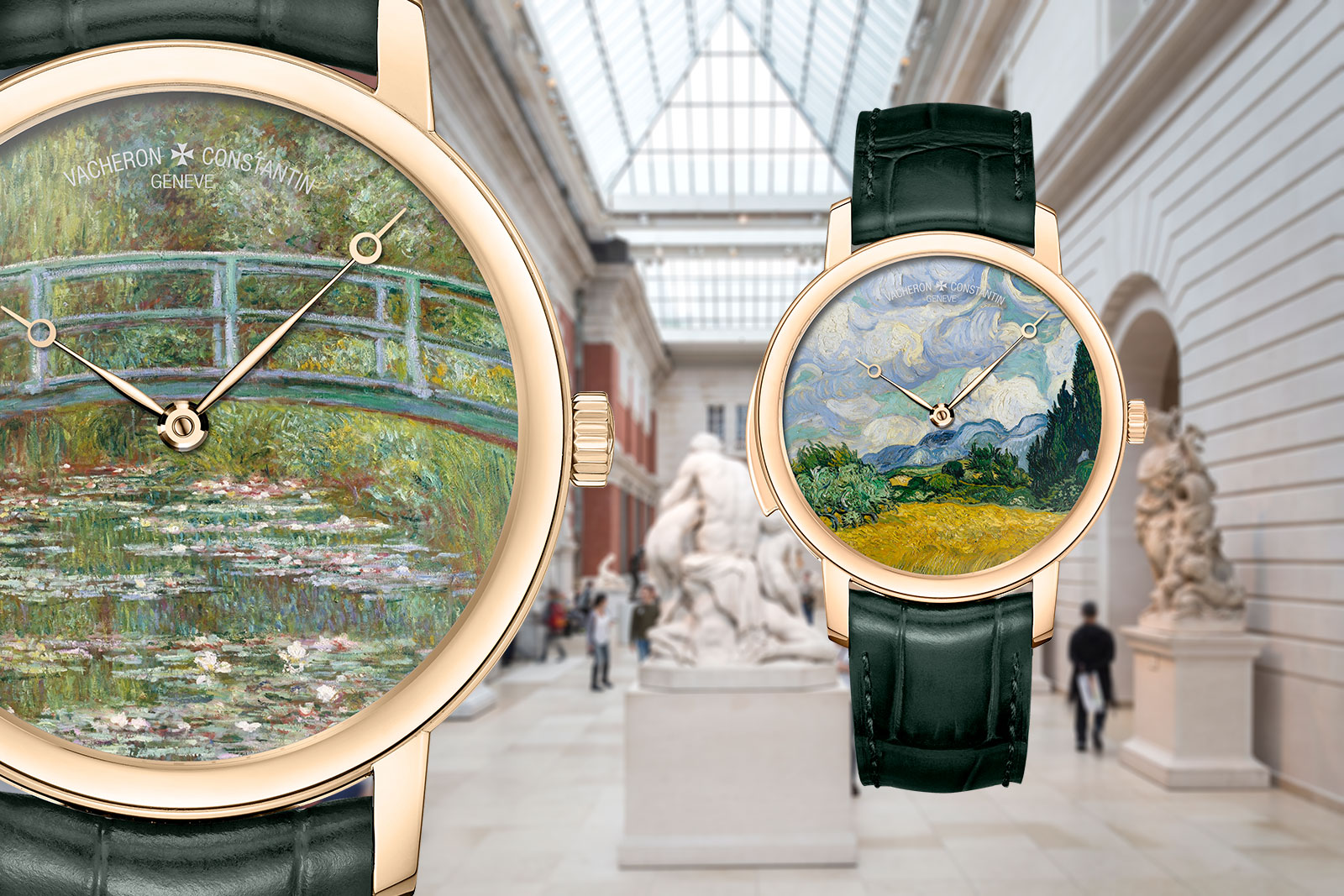
Vacheron Constantin’s Masterpiece on Your Wrist programme is a partnership with the Metropolitan Museum of Art in New York that allows customers to commission miniature replicas of select artworks from the Met’s collection.
The techniques require years to master, and the most celebrated enamellists are now considered living legends and awarded with prizes and a (mostly) steady flow of client orders. The technique of miniature painting is a subject for another time, but it’s worth looking at the landscape of painted dials that has emerged since the resurgence of interest in metiers d’art techniques since the 1990s.
Historical context
While painted dials are the topic at hand, it’s important to understand the historical context that these miniature works of art exist within, and that means going back a little further to a time when it wasn’t the dial, but rather the case back or front cover of a pocket watch, that served as the artist’s canvas. In fact, watches were just one vehicle for miniature painting, which has a long history in European art.
The painted pocket watch achieved maturity in the organised fabriques of 18th-century Geneva, where the art of miniature enamel painting was perfected in the span of just a few generations. But as societies became more industrialised, watches became more vital as instruments of timekeeping, rather than just status signaling.

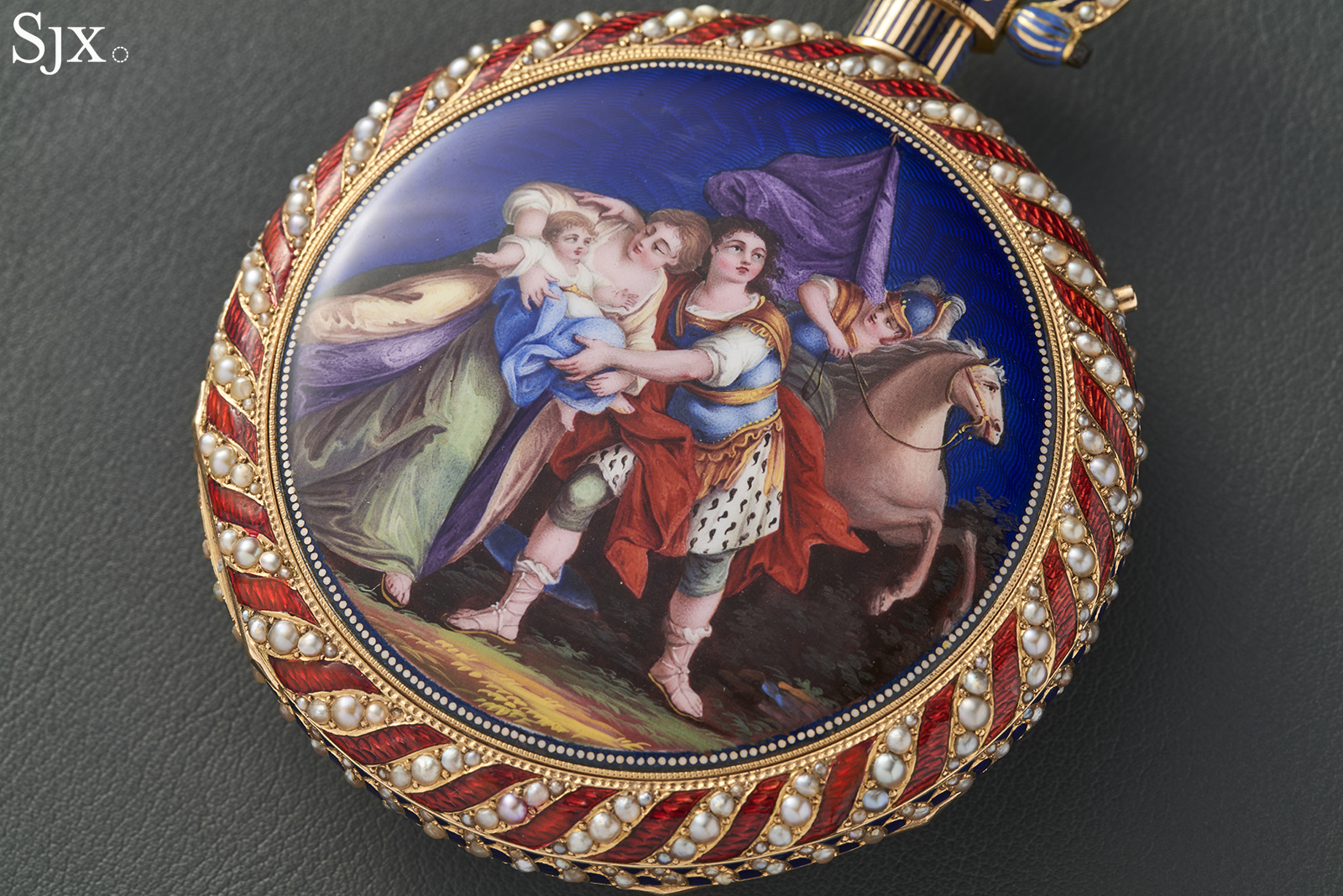
An example of early 19th century Genevan enamel, painted by Jean Louis Richter.
As a result, watch designs became more pragmatic and utilitarian, a trend that accelerated with the transition to wristwatches, which saw the surface area available for decoration shrink dramatically. These trends spelled double trouble for enamel artists, and it wasn’t until the 1940s that the painted dial would re-emerge, reimagined for the wrist.
The first rebirth
The period between the late 1940s up until about 1957 is sometimes called the ‘golden age’ of enamel dials, but a more apt term might be the ‘only age’, since consumer tastes would once again shift away from decorated dials in short order. That this time period can be pinned down so precisely is because of the industrial concentration of the Swiss watch industry at the time, which featured just a few dial makers that supplied the majority of painted dials to high-end brands.
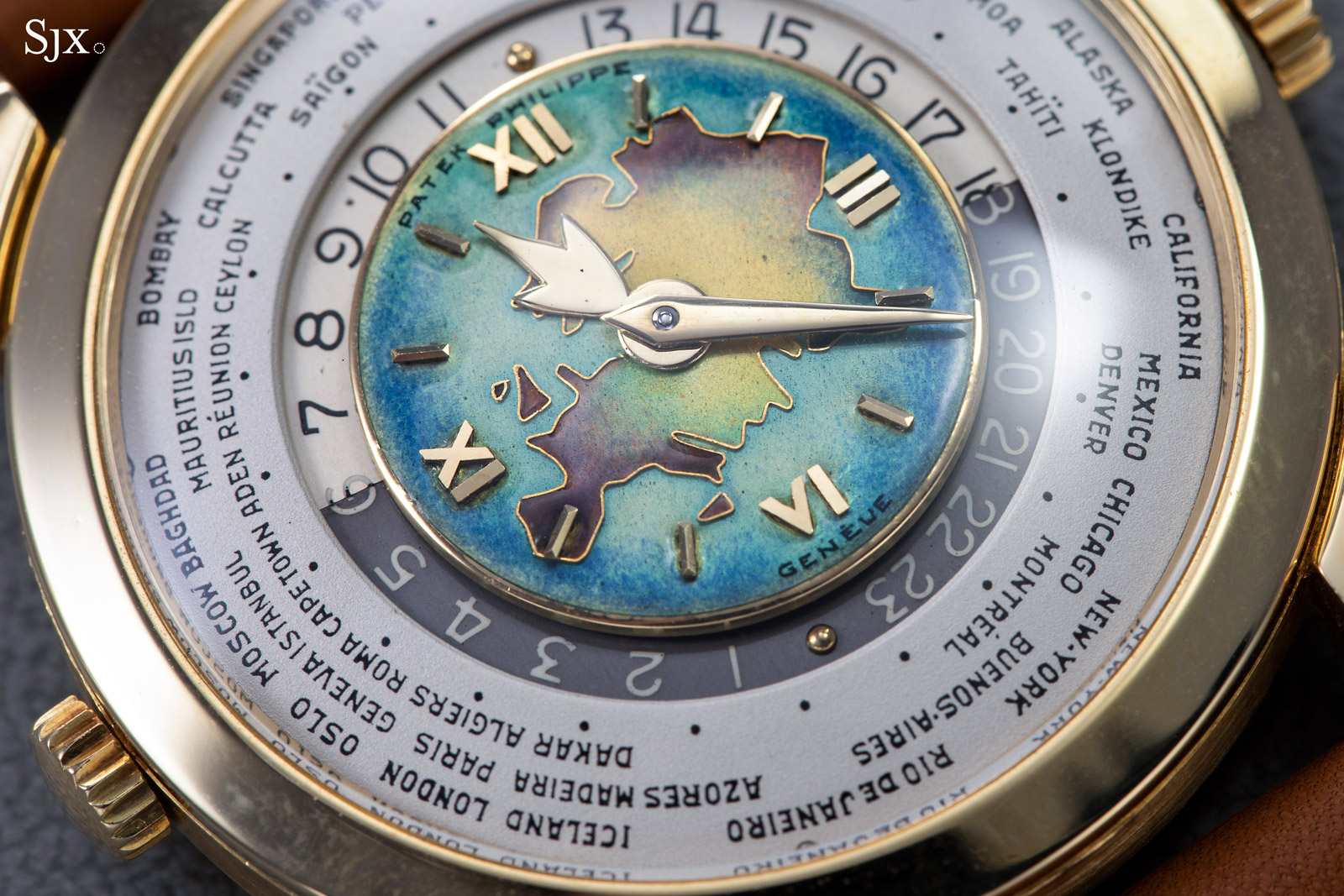
Patek Philippe ref. 2523 World Time Cloisonne “Eurasia” from 1953.
Chief among them was Stern Frères, established by the same family that acquired Patek Philippe in 1931 and remains at the helm to this day. Stern Frères popularised cloisonné enamel watch dials starting in the late 1940s, and while the company kept some of its favoured designs in reserve for its sister brand Patek Philippe, it extended a catalogue of options to third-party brands. This practice explains the similarity between dials of the period, with the same designs available from rival brands like Rolex and Omega.

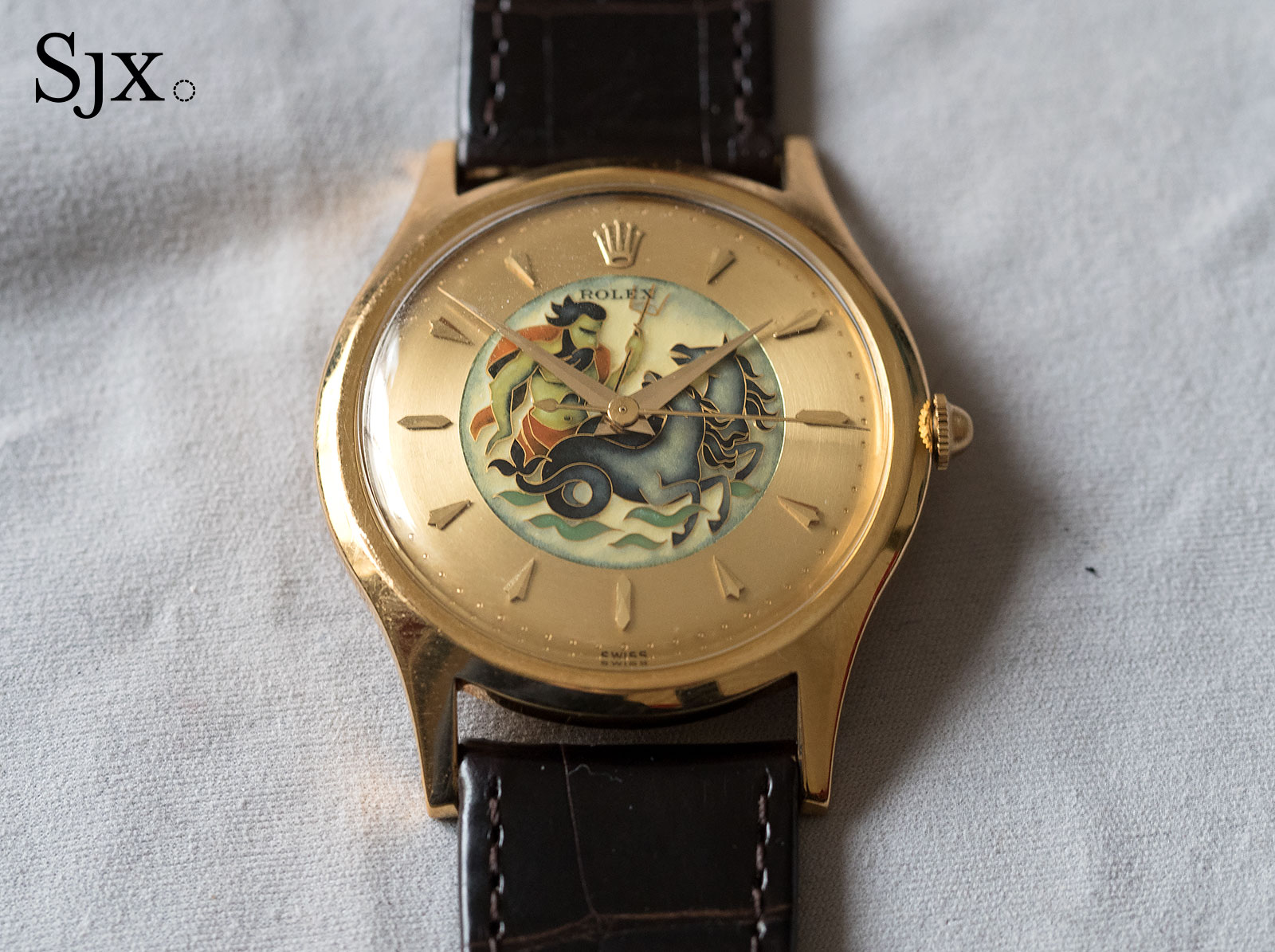
A Stern Frères dial made by Nelly Richard, installed in this Rolex ref. 8382 around 1953. The same design was also used by Omega during the same period.
The designs of these dials were distilled down to their essential forms in order to be rendered at small scale. In this sense, they differed markedly from the elaborate miniature paintings applied to pocket watch covers in prior centuries. To produce these dials, Stern employed some of the most significant artisans of the era. These artists mostly worked in anonymity, though some of them, like Nelly Richard and Marguerite Koch, have lately become somewhat famous thanks to archival research.
Due to the artisanal nature of production, output was extremely limited. Ivan Ponzo estimates that no more than a few hundred dials of this type were produced between the late 1940s and early 1960s. Not only were they rare, they were extraordinarily expensive, and were almost always installed in precious metal cases. The wholesale cost of a typical Stern cloisonné dial could run up to CHF155, which was nearly equivalent to the retail price of an entry level Omega at the time. For a fine cloisonné dial, an artist like Nelly Richard could expect a commission payment of a little more than half the wholesale cost.

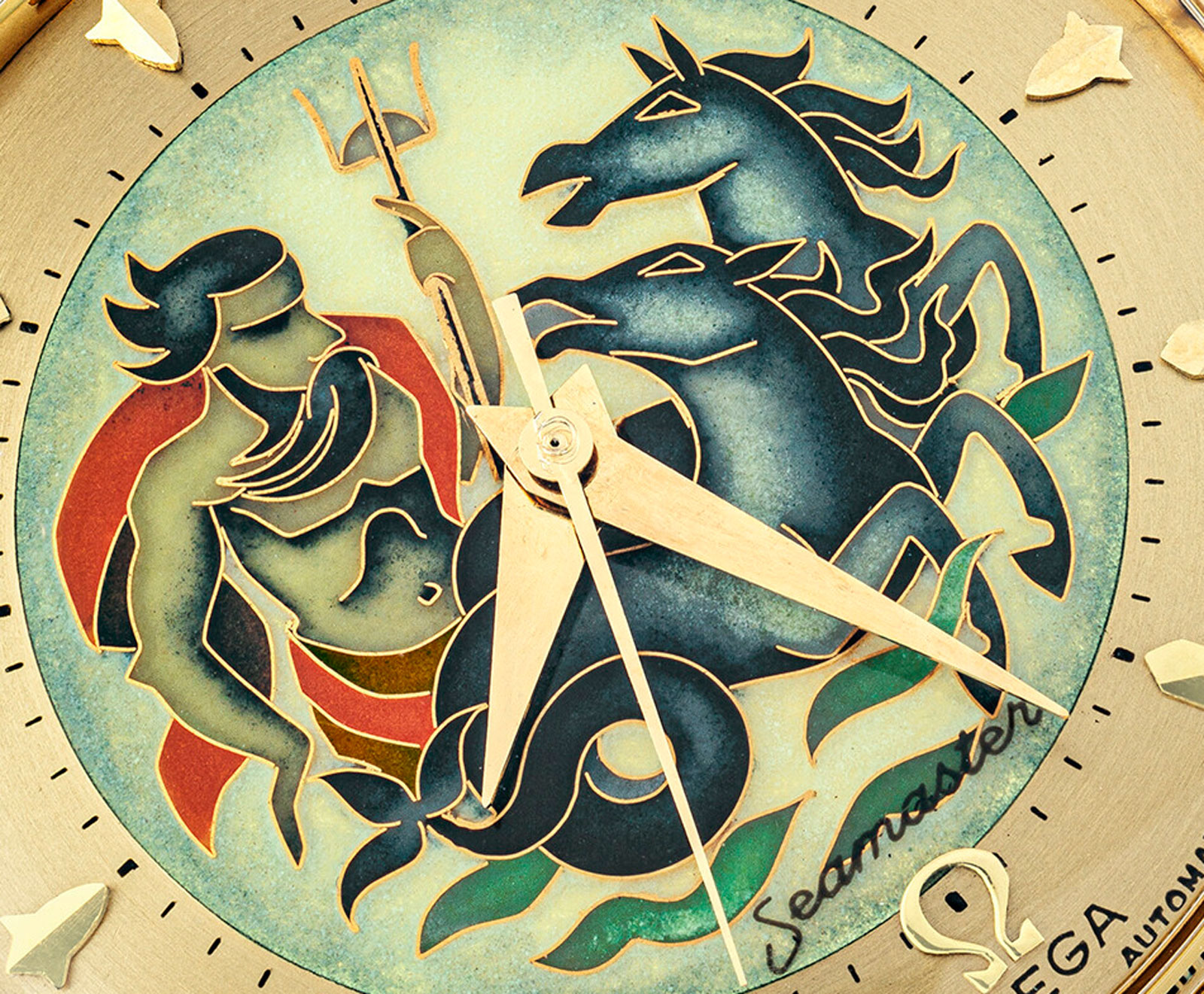
The same Neptune motif, depicted here in an Omega from 1954. Image – Christie’s
The end of an era
Stern would ultimately shutter its enamel department in 1957, a move that mirrored the changing tides of consumer taste and the increasing industrialisation and standardisation taking root in the Swiss watch industry. Yet this critical window established the visual vocabulary for painted dials of wristwatch size, establishing norms for composition that continue to influence the dials of today.
The end of one era marked the beginning of something new: the appreciation of the wristwatch as a holistic work of industrial design. Dials became simpler, but as a result they became more recognisable. It’s no accident that this era witnessed the emergence of many of the most celebrated watch designs in history, including watches like the Rolex Submariner and Daytona, the Omega Speedmaster, and the Audemars Piguet Royal Oak.


Icons like the Rolex GMT-Master exemplify the shift in consumer tastes toward simple, recognisable brand-specific dial and case designs.
In short, customers began to favour simpler more recogniseable designs, a trend opposed to the prevailing practice of sourcing otherwise generic (if finely made) cloisonné enamel designs from the small number of enamel artists working at the time. Furthermore, as wristwatches became more precise and robust thanks to increasing industrialisation, purpose-built tool watches like the Rolex GMT-Master embodied the spirit of technological progress that had captured public imagination in the post-war years. This explains why painted dials entered a dark age that lasted from the mid 1950s to the early 1990s.
Even the most renowned miniature enamel artist of the 20th century, Suzanne Rohr, struggled to find employment at the beginning of her career; she established her own studio by necessity in 1960.
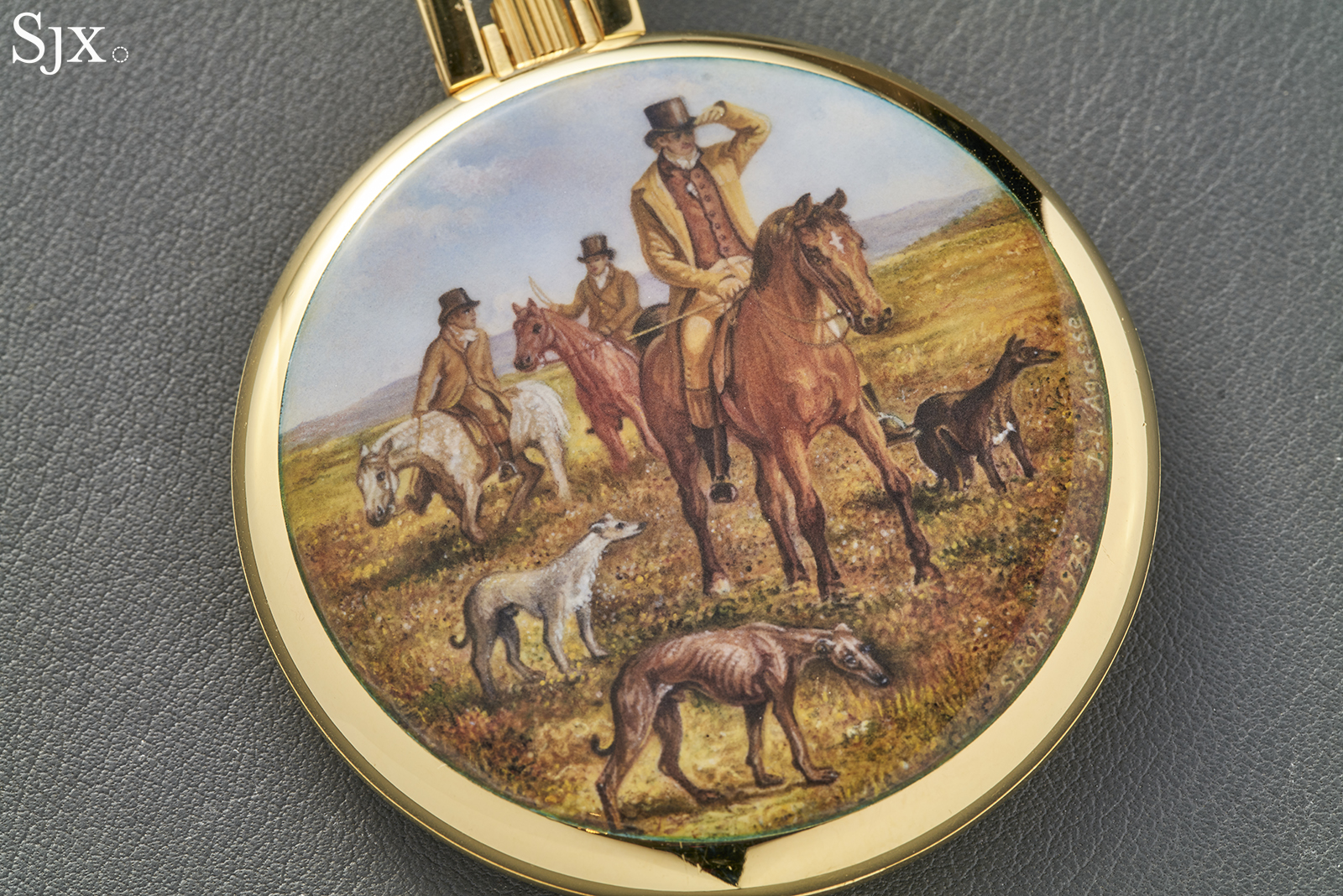
A Patek Philippe pocket watch with a miniature enamel painting by Suzanne Rohr, completed in 1975. Commissions like this were vital to the careers of enamel artists during this time.
The sun rises
The 1990s marked the beginning of renewed interest in painted dials. The new dawn began, fittingly, in the Land of the Rising Sun; Japanese collectors, ever on the forefront, drove early demand. Anita Porchet, the most famous practicing enamel artist today, was able to set up her studio in 1993, thanks in part to commercial commitments from Patek Philippe, which was then led by Philippe Stern.
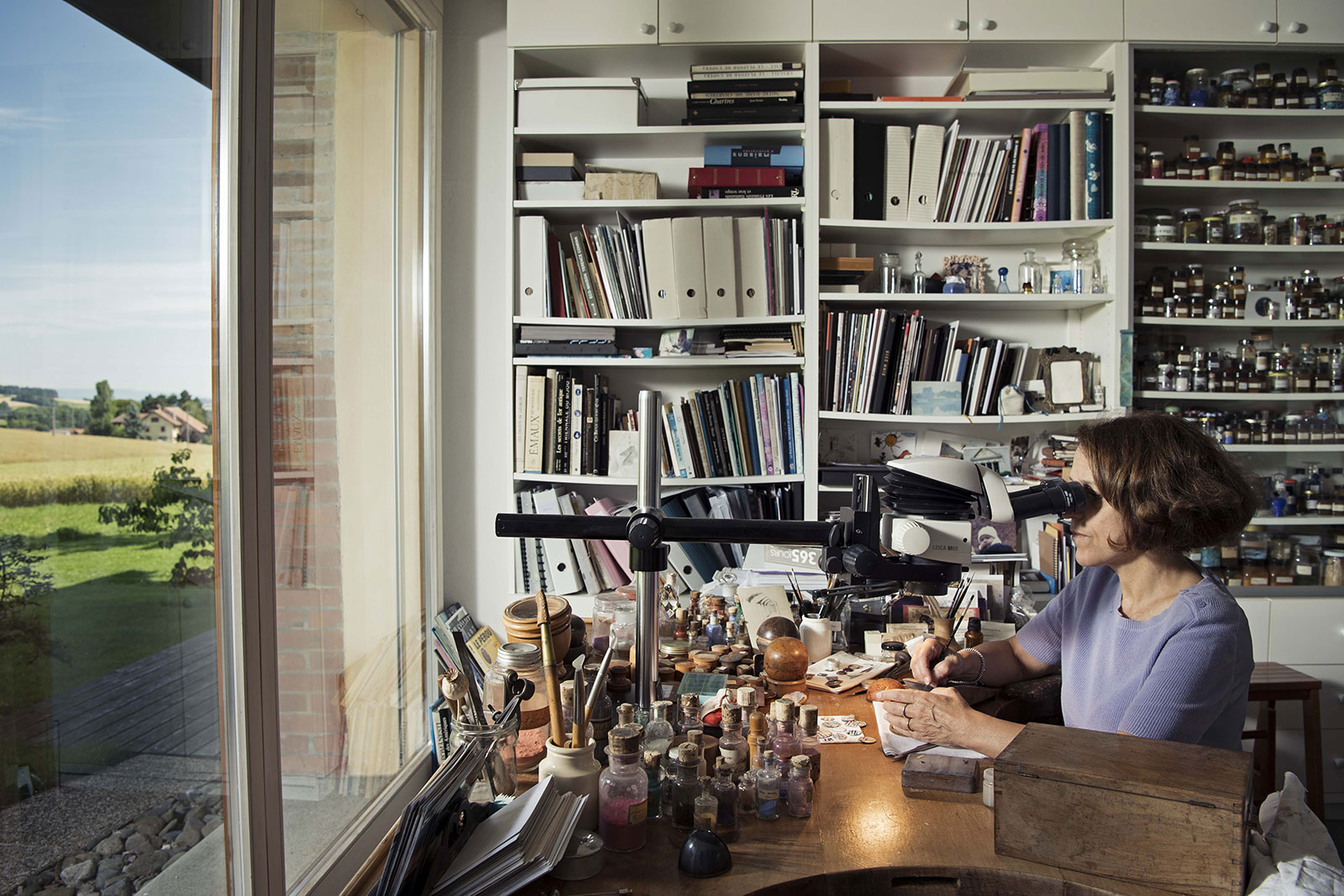
Anita Porchet in her studio. Image – Vacheron Constantin
It’s worth noting that throughout his life, Mr Stern was a devoted patron of enamel artists, commissioning numerous pieces from Suzanne Rohr even when market demand was minimal. Today, 26 examples of her work are on public display in the Patek Philippe Museum in Geneva. In this sense, there’s a pleasing degree of symmetry to the birth, death, and rebirth of painted wristwatch dials; the family that originally founded Stern Frères once again reprised its role as champion of the craft.
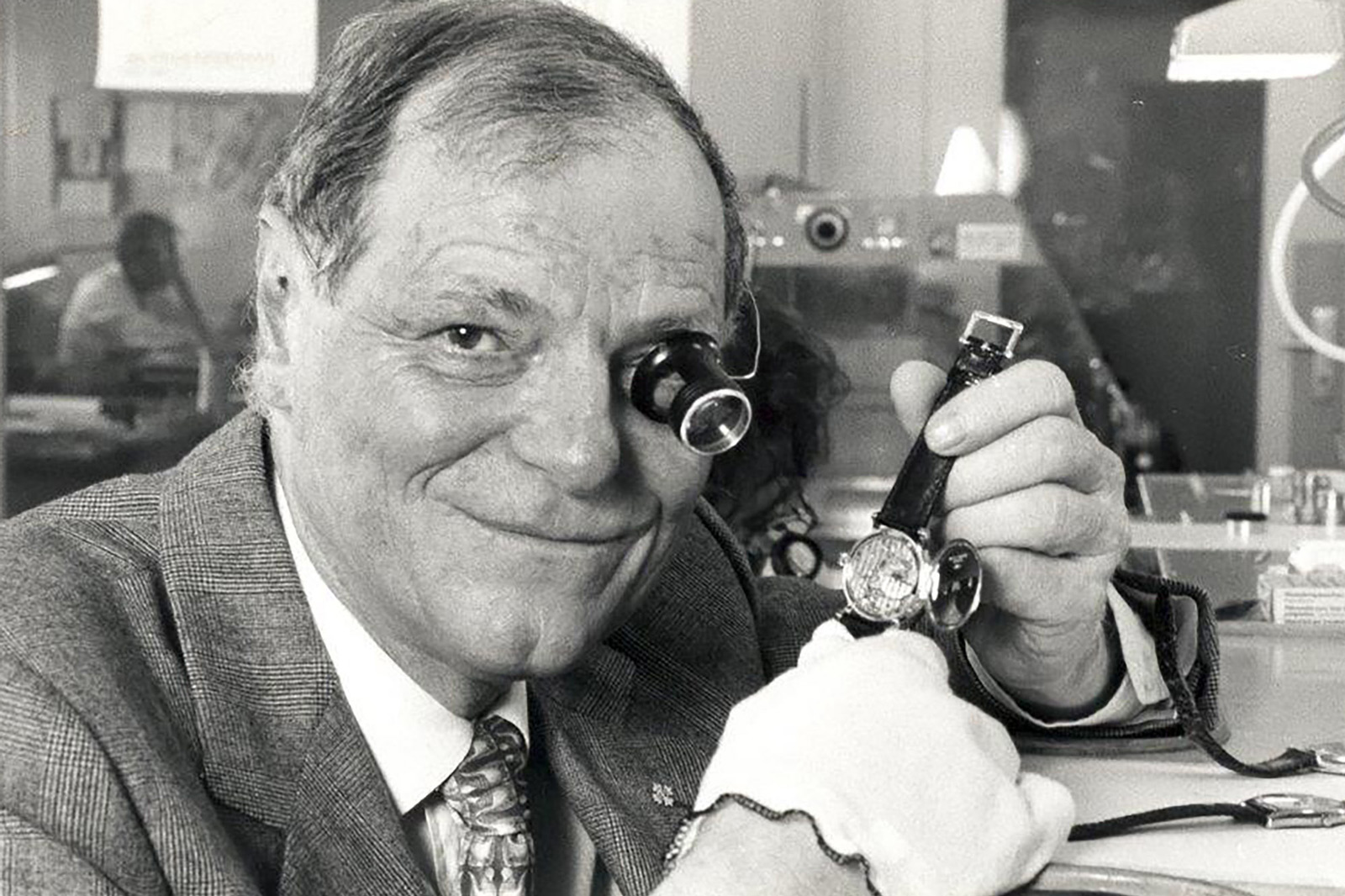
Philippe Stern. Image – Patek Philippe
Over the past 30 years metiers d’art, or what Patek Philippe simply calls Rare Handcrafts, has witnessed growing popularity. For some brands, this expertise has become a strategic priority. In a sign of just how much more vertically integrated the industry has become in the past 25 years, brands like Vacheron Constantin that once relied primarily on independent studios for painted dials have invested in building out in-house enamel painting studios and keep enamel artists on staff.
The future is female
Looking at this cross-section of history, there are several names that come up repeatedly. So frequently, in fact, that it’s difficult to sample this subject without coming into contact with works by Suzanne Rohr, Anita Porchet, Muriel Séchaud, Nelly Richard, Marguerite Koch, Hélène May Mercier, Marthe Leclerc, and Marthe Bischoff, to name just some of the talented, and often unsung, artists that have kept this art form alive for the past 200 years.

Anita Porchet. Image – Audemars Piguet
The recurrence of the same few names is revealing about how few people have ever achieved the level of skill required to paint at such a small scale. It’s also revealing about something else: in watchmaking, where the most celebrated masters tend to be men, the living legends of miniature painting are almost uniformly women. And while the towering influence of Carlo Poluzzi (1899-1978) can still be felt, the traditions of miniature painting have been carried on almost exclusively by women.
That’s likely to continue. Anita Porchet’s studio is one of the last bastions of miniature enamel painting, and both of her apprentices, likely to be the leading lights of the next generation, are also women.
The legacy of the fabrique
The contemporary landscape of painted dials can be segmented into three distinct categories. The first category includes watches that feature miniature enamel recreations of famous works of art. Watches in this category put a major emphasis on fidelity to the original composition, and the artist’s skill in miniaturising the work to retain its essence in a compact size. In this sense, this type of painted dial actually has more in common with the painted pocket watch case backs of the 18th century than it does the ‘golden age’ of enamel wristwatch dials in the early 1950s.
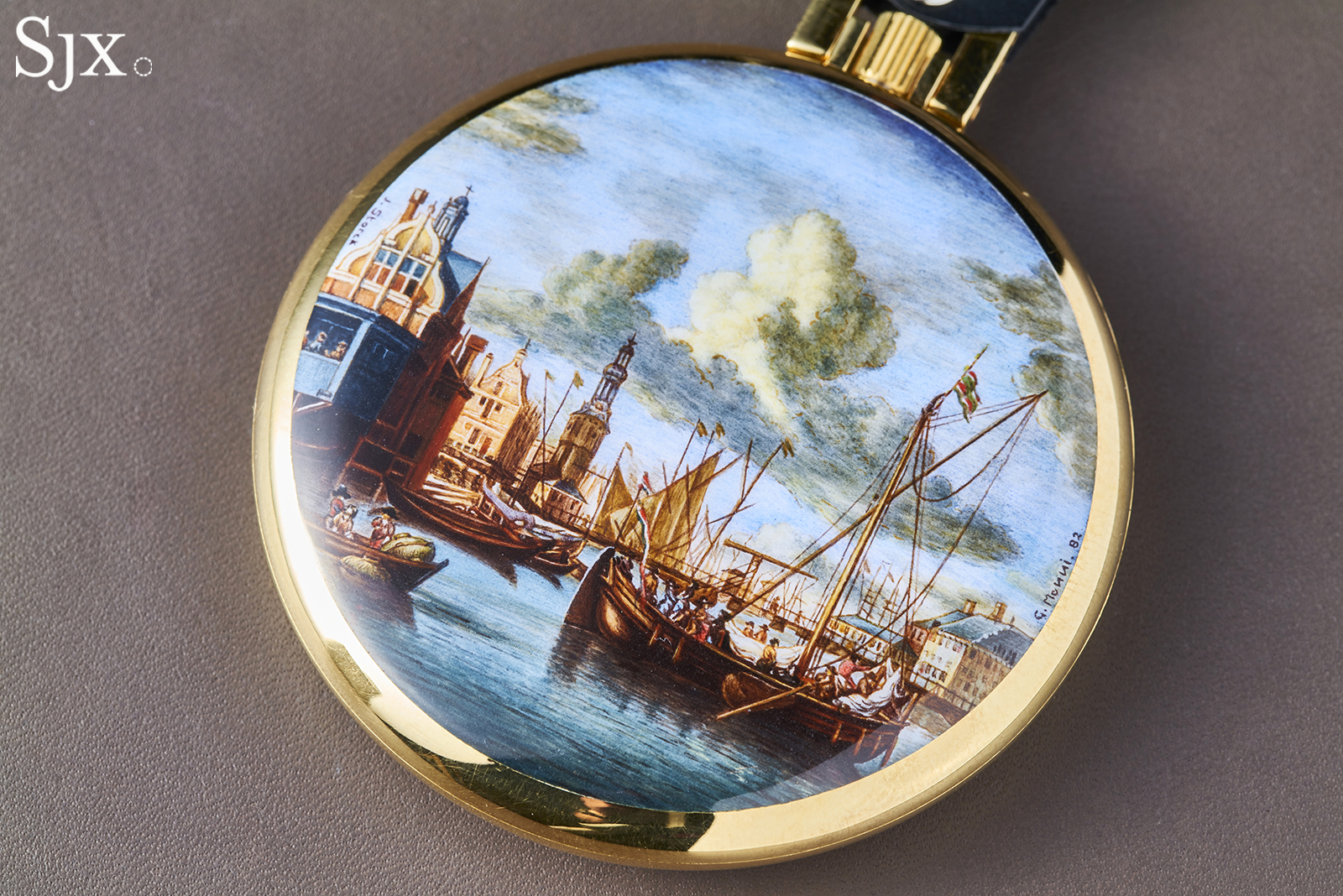
This Patek Philippe pocket watch is an example of Genevan miniature enamel painting from the ‘dark ages’ of the 1980s. The painting was completed in 1982, but the watch was not sold until 1994. Note the miniature painting bears two signatures, according to tradition. The original artist’s signature is recreated on the left, while the enamel artist’s signature is also shown along with the year it was made.
In many cases, the art work selected for recreation may have little to no connection to the world of horology; it might simply be an image important to a collector. Regardless, the primary purpose of the work is to demonstrate technical mastery over the medium. While there’s some room to argue about the distinction between art and craft, to do so is to open a can of worms that’s been a source of contention in the art world for centuries.
Either way, a fine miniature enamel recreation of a Monet or a Van Gogh should be seen in the same light as a Mahler symphony arranged and performed by a string quartet. While the work is not fundamentally original, there’s immense artistic value in the interpretation — the choices made to simplify the original work without diluting its expressive qualities.
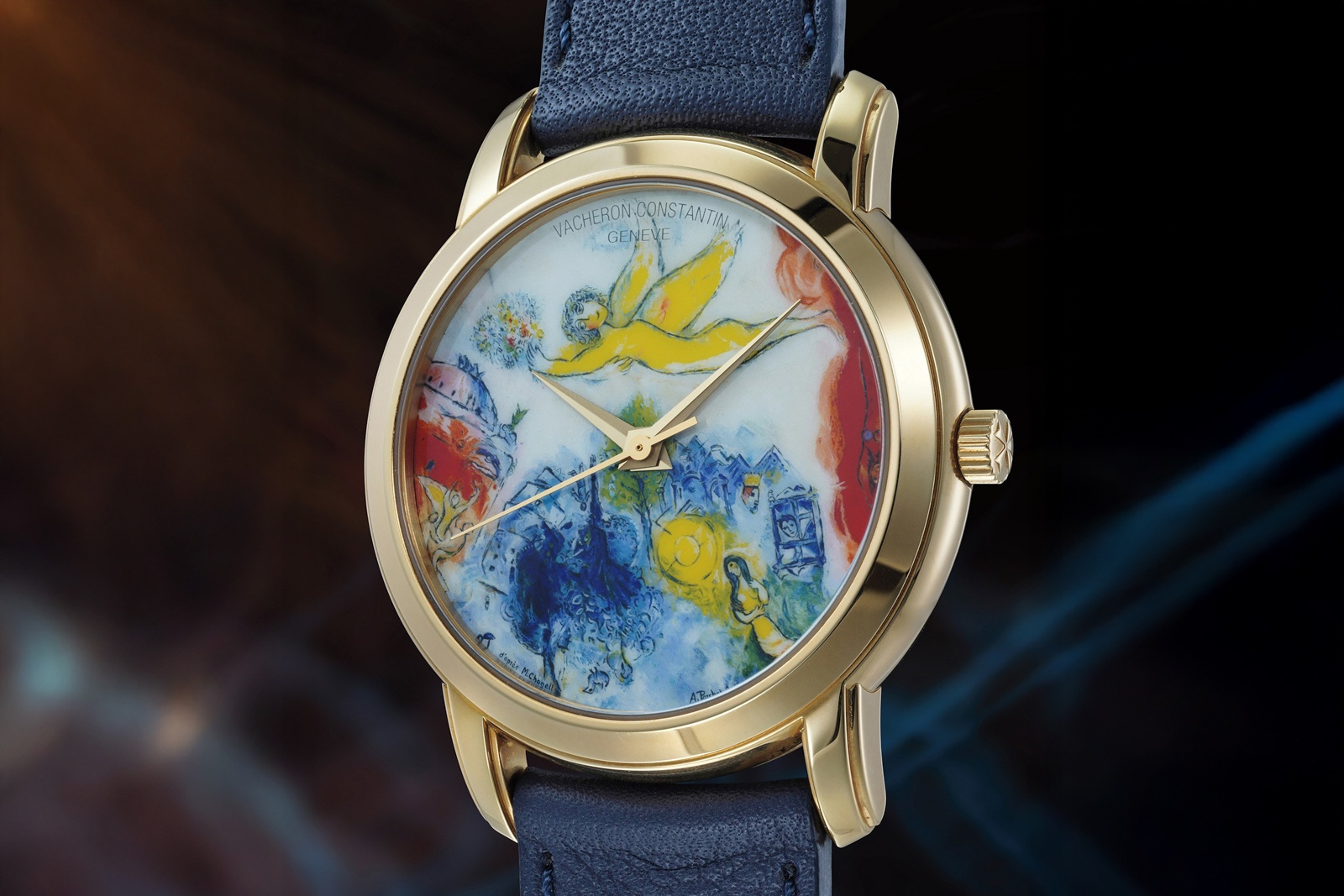
A Vacheron Constantin ref. 86090 that features a miniature enamel recreation of Marc Chagall’s fresco at the Paris Opera, painted by Anita Porchet. Image – Phillips
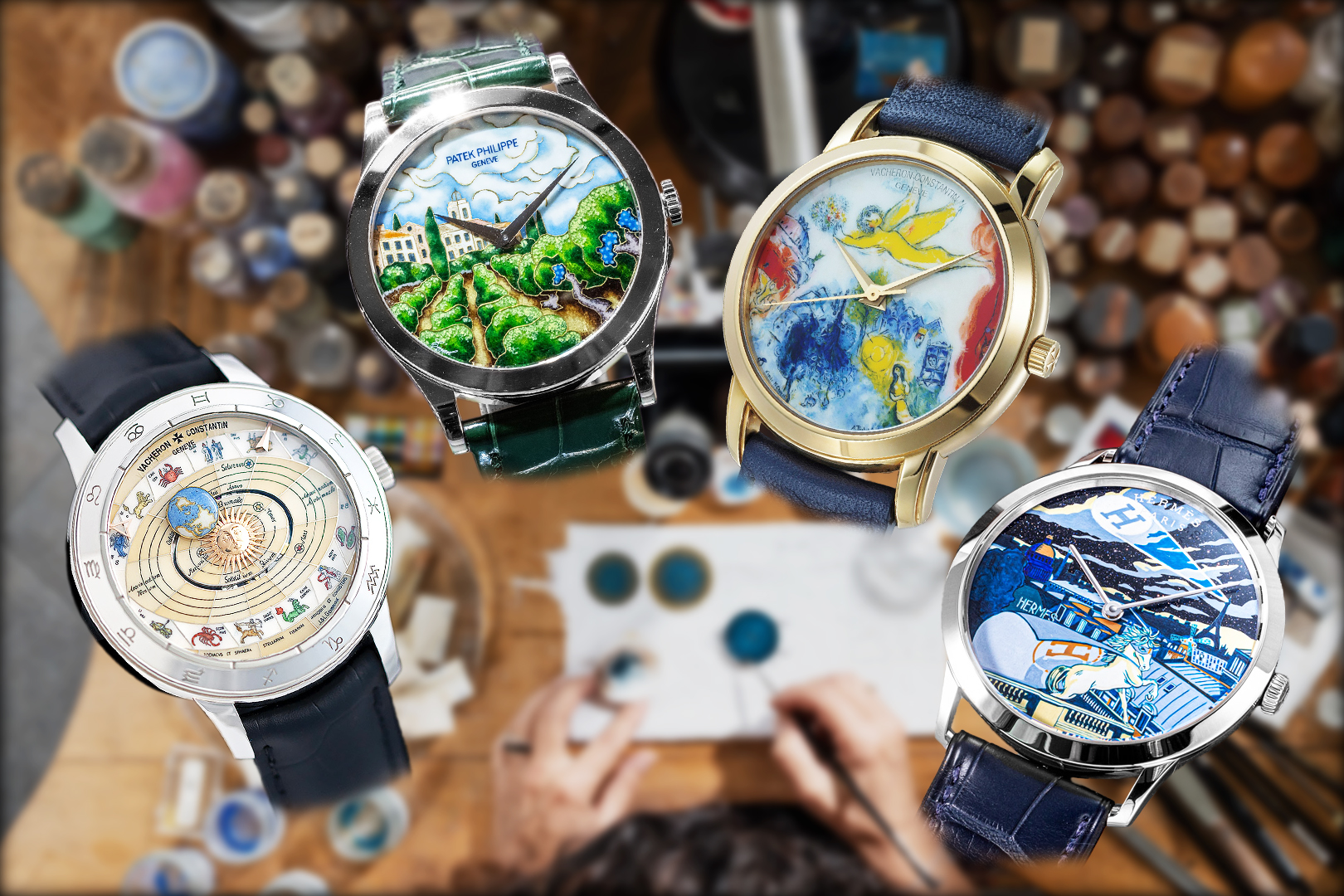
A perfect example is the Vacheron Constantin ref. 86090, an undeniably fine but unassuming watch that takes a back seat to its spectacular Chagall-inspired dial. Painted by Anita Porchet, the dial recreates a portion of Marc Chagall’s playful fresco at the Opéra Garnier in Paris. The example shown is one of 12 unique pieces made, with each depicting a different section of the massive fresco.
Impressively, the work scales a section of the painting approximately 40 sq. m in size down to a wristwatch dial barely 10 sq. cm, while managing to capture much of the expression and vibrant colour of the original fresco in indelible enamel.
In this category, the watch itself is often subordinate to the dial painting. In other words, the painting could exist on its own, with or without the watch. That’s not to say the watch isn’t important. On the contrary, not only does a fine watch make for a protective and dignified vitrine, a watch from a prominent brand reinforces the market value of the object, a factor that should go a long way toward ensuring the work is preserved.
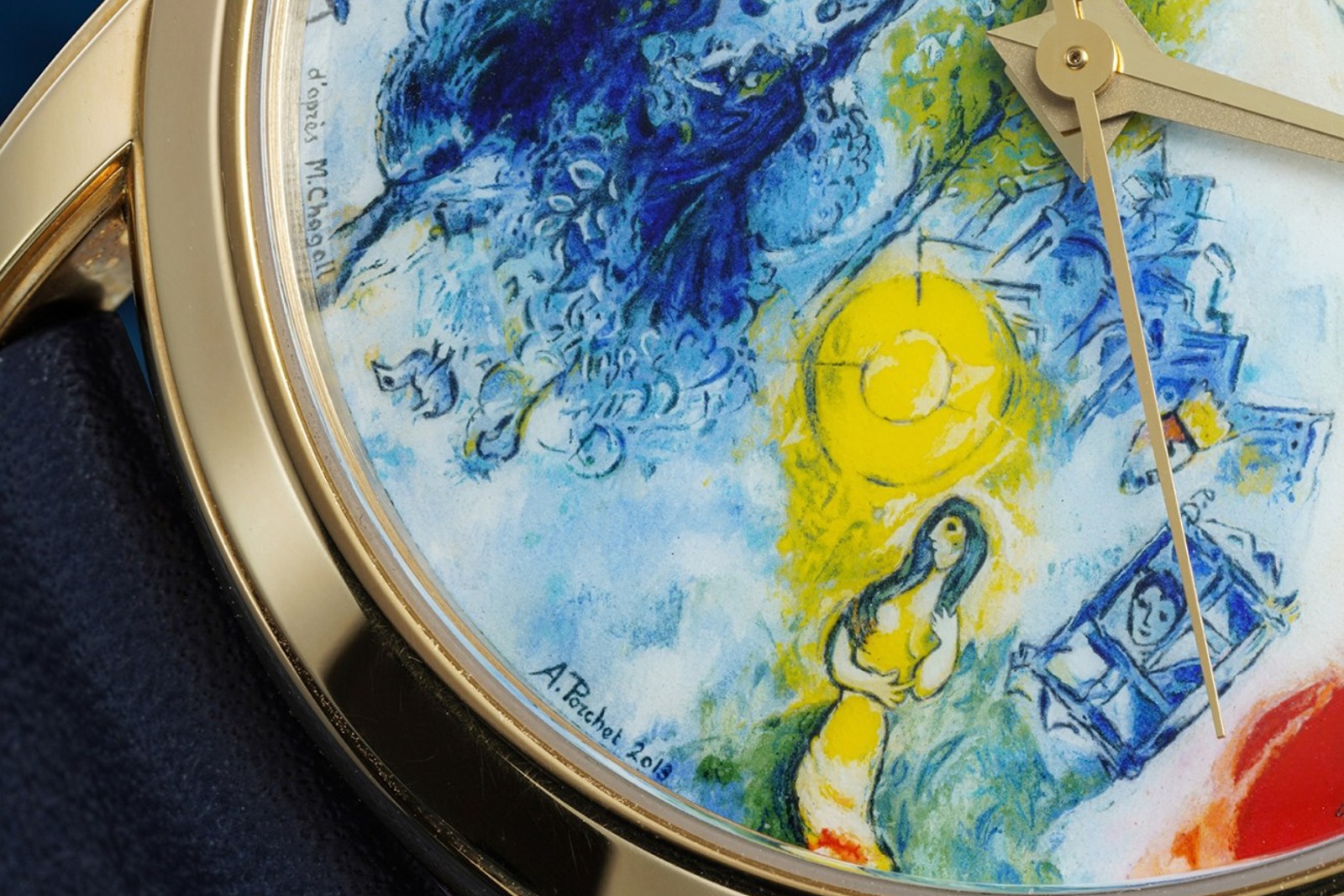
The miniature painting is credited to Chagall (upper left) and additionally signed by Anita Porchet. Image – Phillips
Given the city’s illustrious history, the great houses of Geneva remain the primary practitioners of miniature painting, but they don’t have a complete monopoly. An interesting example is Qin Gan, a Chinese independent watchmaker who made a few painted miniatures executed in the style of traditional Chinese ink paintings. But the market for watches like this remains much smaller than the broader market for high-end time-only wristwatches, so when Mr Gan made his public debut, his Pastorale wristwatch featured a more traditional dial design.

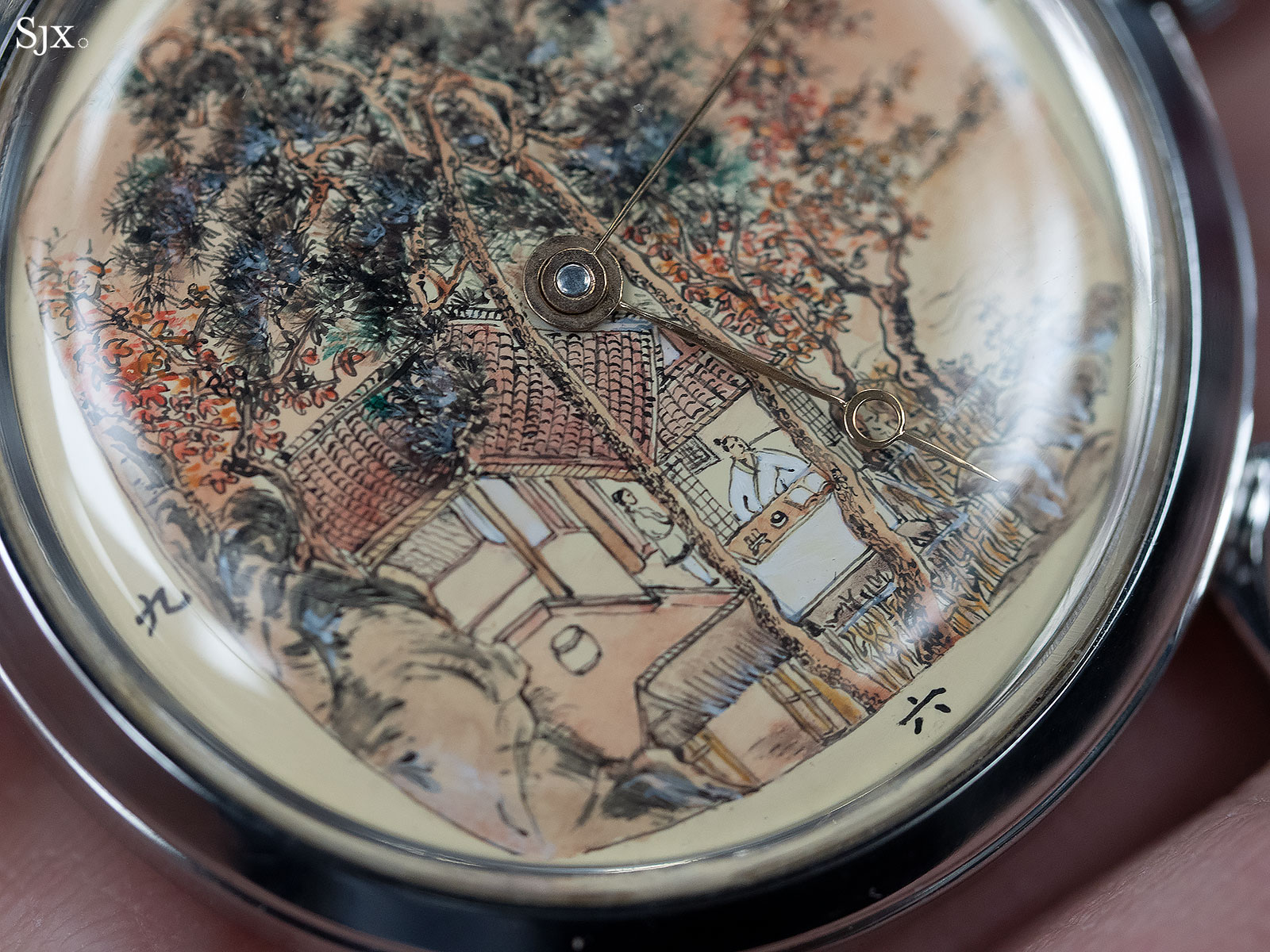
One of Qin Gan’s early watches featured a painted miniature.
Compact compositions
The second category of painted dials carries on the codes established by midcentury cloisonné artists. Though these designs may take inspiration from extant works, they tend to be original compositions designed for a wristwatch-size tableau. True to tradition, this work is most commonly of the cloisonné variety, but traditional enamel painting, porcelain, and more modern mediums like acrylic may also be used.
Like painted miniatures, the subject matter need not be watch-related, but the compact compositions distinguish these types of dials from those that seek to miniaturise large works with minimal loss of detail. In other words, miniature recreations compress expansive compositions like frescoes, paintings, and murals into dial-sized interpretations, while the dials in this segment are purpose-built for wristwatch proportions, often drawing inspiration from broader artistic traditions and brand themes without direct source material.
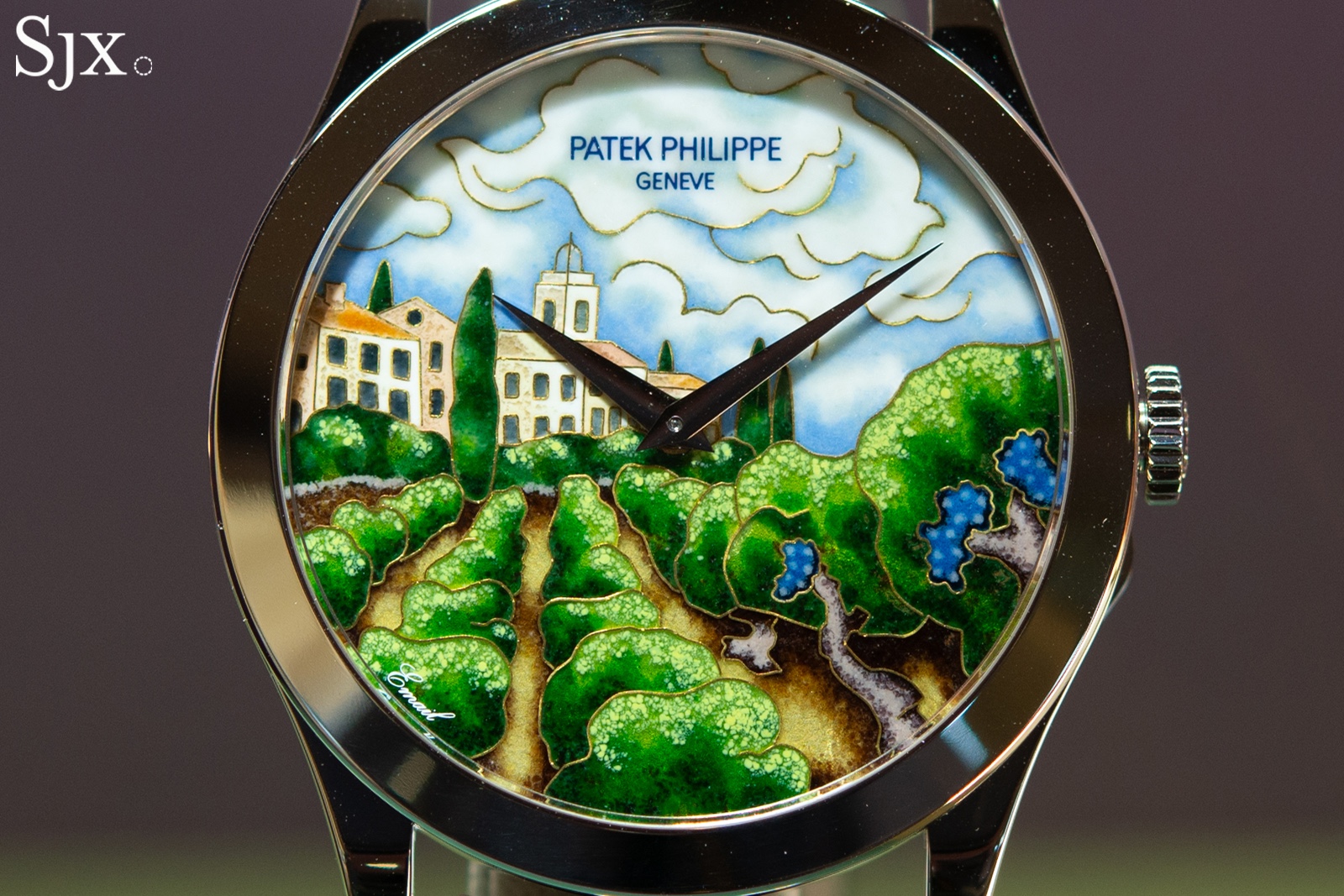
A recent example of Patek Philippe’s Rare Handcrafts collection, the Calatrava ref. 5089G-106 “Vines and village of Gordes”
When it comes to choosing original designs, whether those of an in-house artist or an independent studio, brands tend to favour subject matter that aligns with their own aesthetic codes and values, or that is meant to resonate with the lifestyles and tastes of a specific segment of collectors. In this sense, while the work might still function on a standalone basis, the art is doing a bit more work in service of the watch than would a high-fidelity recreation of a well-known masterwork.
Brands often use this type of dial to make a statement about their unique terroir or aesthetic vision. Exemplifying the former, Glashütte Original has released a range of watches with painted porcelain dials produced by nearby Meissen, one of Europe’s oldest and most revered makers of porcelain. These painted dials help tell a story about the legacy of craftsmanship in the region, which predates its watchmaking industry by nearly 150 years. Makers like Meissen were inspired by imports from China and Japan, and sought to replicate their techniques. In the same vein as Glashütte Original, Japan’s Credor offers painted porcelain dials made by Hata Mantoen Co., a storied name from Saga Prefecture.
Another interesting case study comes by way of Hermès, a brand best known for leather goods that is big enough to also have an active and highly original watchmaking programme with a penchant for painted dials of all kinds. The Slim d’Hermès Minuit au Faubourg is one such watch, featuring a miniature painting of its “Super H” mascot perched above the brand’s original store at 24 Rue du Faubourg Saint-Honoré. Though painted in acrylic rather than fired enamel, each dial nonetheless takes artist Line Descombes some 50 hours to complete, layering acrylic paint on an aventurine glass dial base under a microscope.
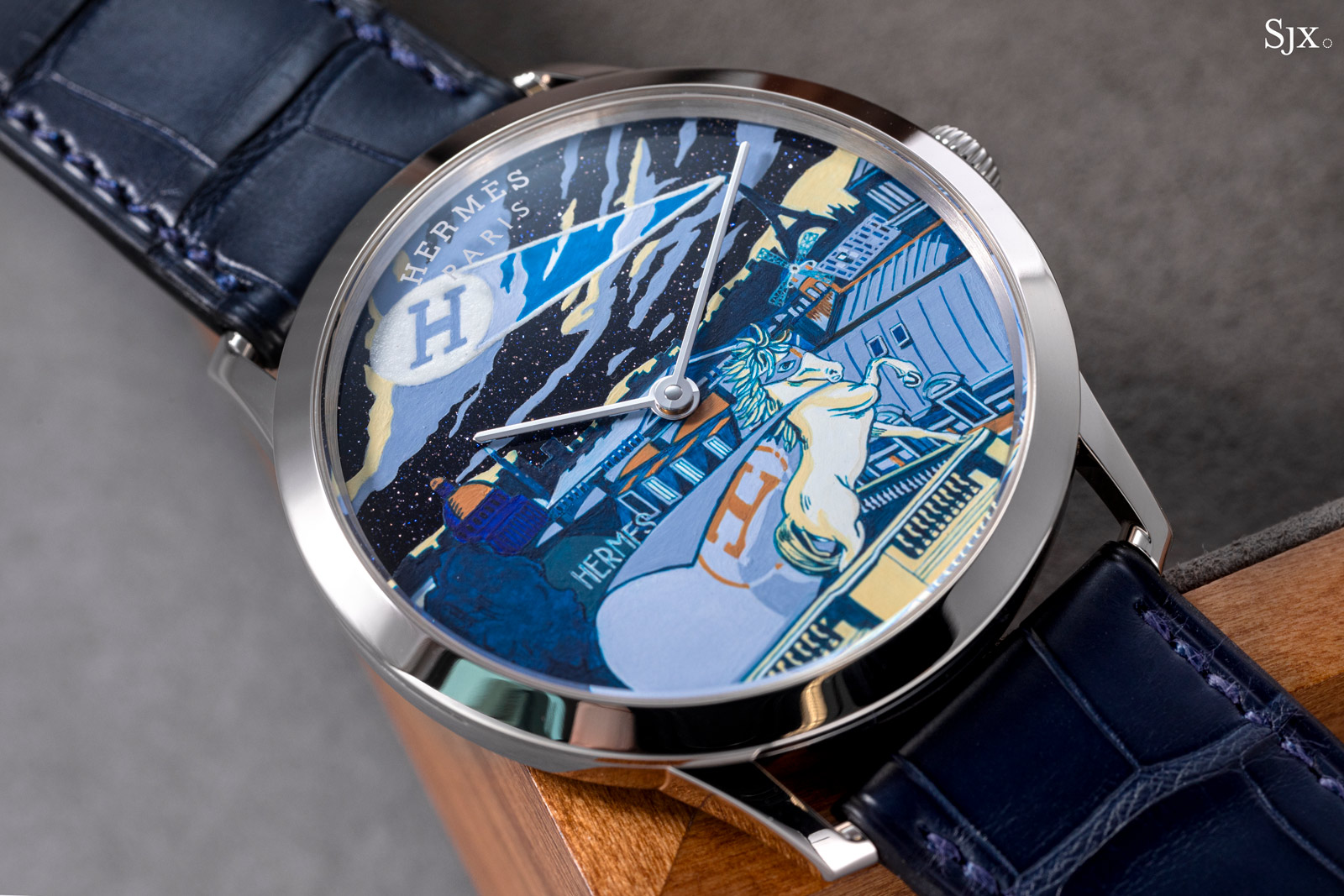
This clever comic book-like illustration was inspired by a scarf of the same name, created in 2014 by Dimitri Rybaltchenko. But unlike recreations of famous masterworks, this image is inseparable from Hermès, not only because it features the brand’s name and logo, but because it captures the playful essence that distinguishes the brand from its more stodgy rivals.
The ‘midnight’ theme was well-chosen, and makes sense for a watch. Leaning into this theme, the dial of the Minuit au Faubourg introduces a critical element missing from the original scarf design: luminous pigment that causes the Eiffel Tower’s beacon to glow in the dark. This detail would not have been possible in fired enamel, a fact that fully justifies the acrylic medium.

When form meets function
The third and final category of painted dials is represented by those that serve a specific horological purpose, which can be thematic or functional. Watches in this category can be micro-painted, in the tradition of the 18th-century Genevan masters, or rendered using techniques more closely associated with midcentury cloisonné.
Regardless, what unites the watches in this category is that the functionality of the watch and its painted dial are fully integrated and inseparable from one another. In other words, the miniature painting would lose much of its meaning if displayed on its own, separate from the watch it was intended for.
An example is the Vacheron Constantin Copernicus Celestial Spheres, a watch that tracks the elliptical orbit of the Earth relative to the signs of the traditional zodiac. While the functionality is impressive in its own right, the key element in focus is the painted enamel dial, realised by Jean and Lucie Genbrugge. Each of the 12 zodiac signs that comprise the chapter ring are painted and fired one colour at a time, just like the 5.8 mm globe that makes one revolution each year.

In a watch like this, the hand-painted signs are not merely expressive; they serve a functional purpose, acting as a zodiac calendar as the Earth makes its annual passage. While art does not need to be functional to have value, a clear horological connection between a painted dial and the watch it lives within can create a more coherent overall design.
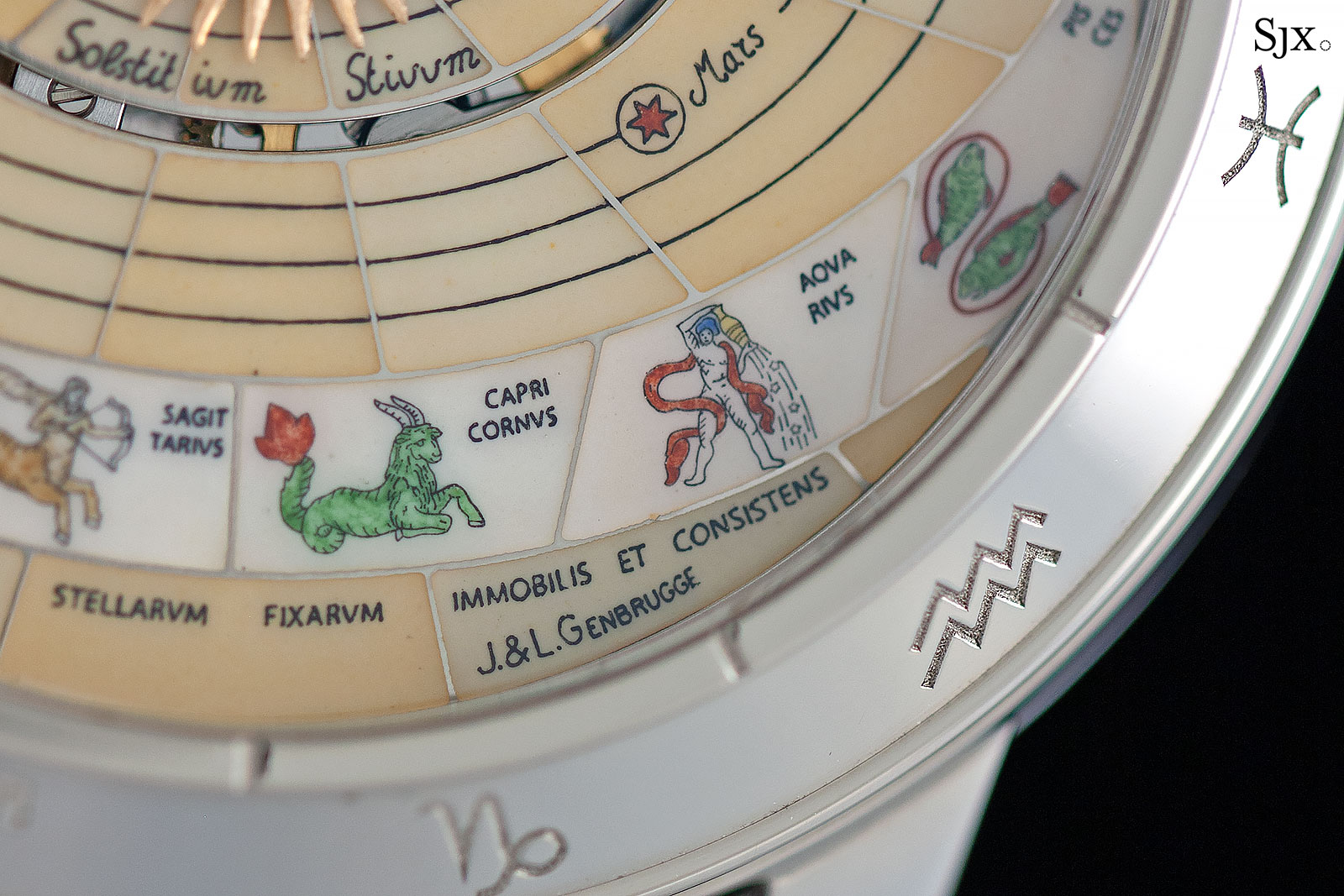
Each dial is signed by the artists.
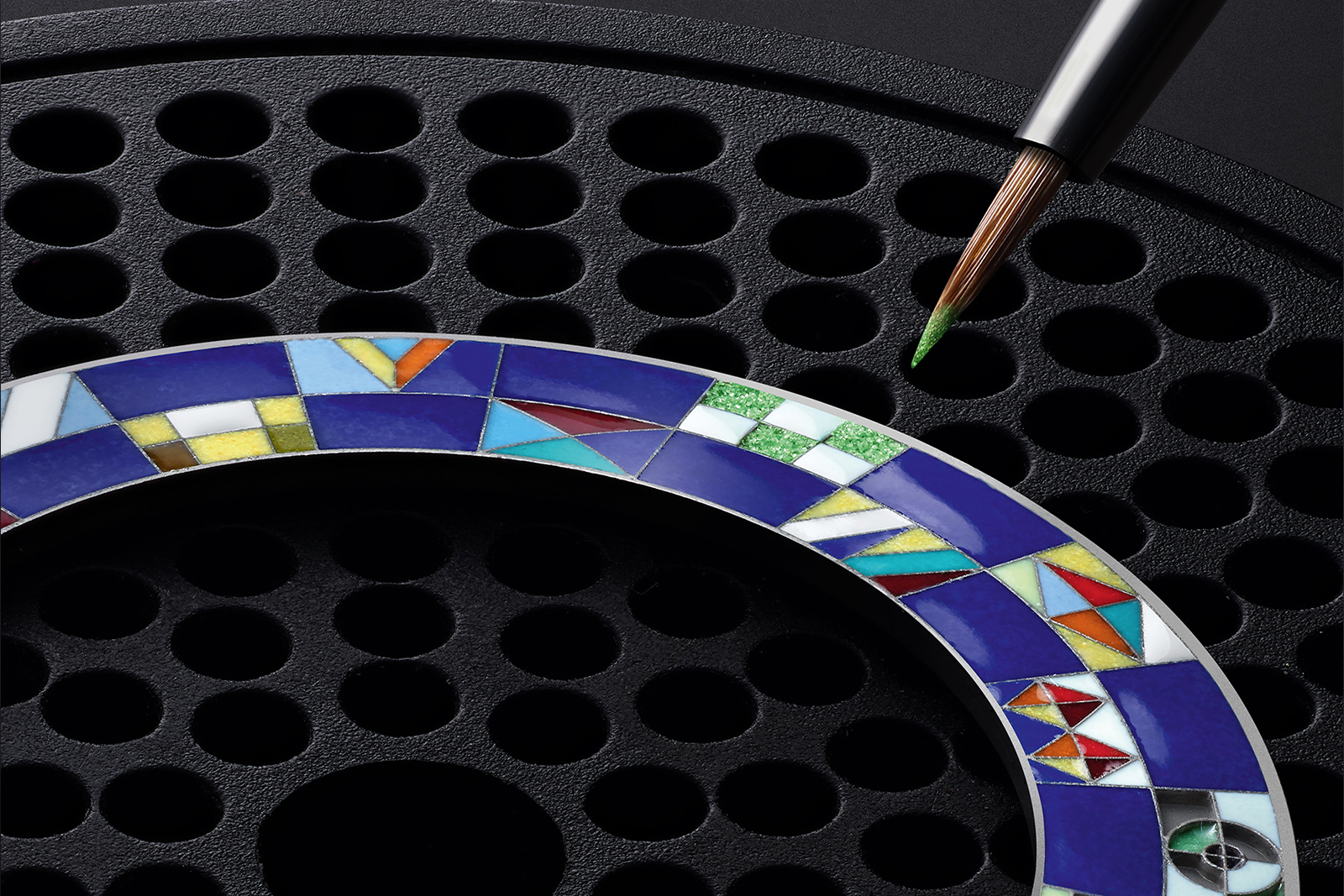
Another example comes from another brand known primarily for leather goods: Louis Vuitton. The Escale Worldtime, which was just refreshed this year, features a hand-painted cities ring that is both decorative and functional. Each dial features 24 individually painted flags inspired by actual historical monograms that customers could commission to have painted on their Louis Vuitton trunks.
The vibrant polychromatic “V” above Paris, for example, was commissioned by Gaston-Louis Vuitton to label his own luggage. Such monograms made it much easier to recognise one’s own cargo, especially on trains and ships crowded with affluent passengers.
The artistry is expressed in both the concept, which would only work in a watch from Louis Vuitton, and the craft, which marries simple, pared-back elements of graphic design with the hand-painted execution that makes each dial an original work.
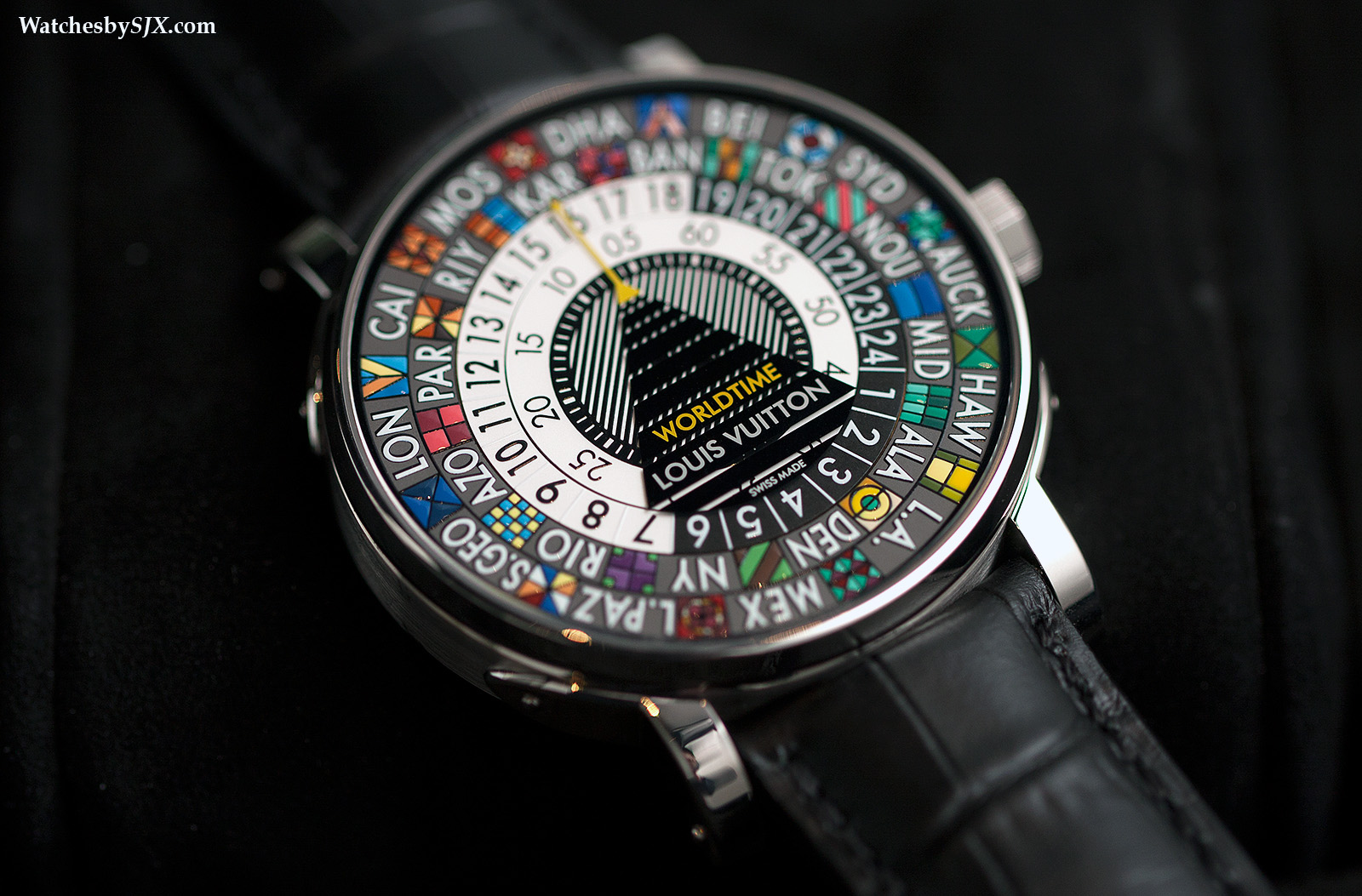

While the original from 2014 featured a cities ring painted in acrylic, like that of the updated model, the top-of-the-line Escale Worldtime Flying Tourbillon features a cities ring in champlevé grand feu enamel, a technique closely associated with the cloisonné dials of the midcentury period.
For the purpose of this case study, it’s important to underscore that the work is functional, forming the basis of the world time display. It could be displayed outside the watch, but its essence would be lost, since it exists to bring the romance of vintage travel to the rotatable cities ring.
Authorship and value
The topic of hand painted dials naturally extends to the nature of authorship and recognition. For miniature enamel painting, it was long considered customary for the artist to sign their work. This practice seems to have largely died out with the rise of templatised mid-century cloisonné designs, though enough clues were left behind for historians like Ivan Ponzo to fill in some of the gaps after the fact.

A coveted signature.
In this regard, the Vacheron Constantin Mercator prototype from 1993 can be seen as something of a turning point. Devised in the early 1990s by Belgian watchmaker-turned-enameller Jean Genbrugge, the Mercator, named for influential cartographer and fellow Belgian Gerardus Mercator (1512-1594), featured unusual bi-retrograde hour and minute hands in the form of a compass, read against a hand-painted cartographic dial.
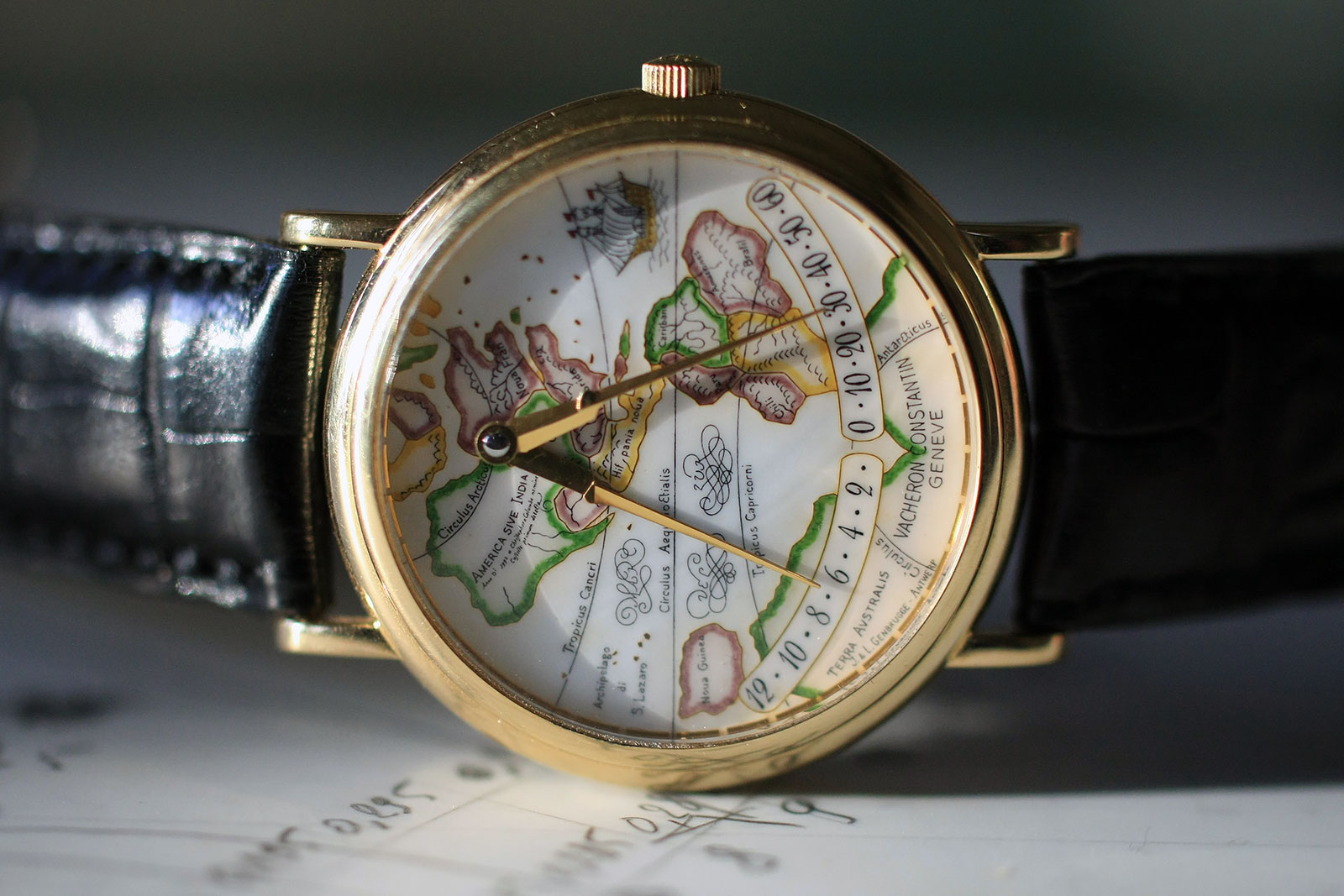
It was an original concept that Mr Genbrugge originally conceived to commercialise independently, but Dr Helmut Crott’s introduction to Vacheron Constantin’s then-chief executive Claude-Daniel Proellochs resulted in a successful partnership that later developed into a full collection. In recognition of Mr Genbrugge’s contributions, as well as those of his wife Lucie, the Mercator dials they produced were signed “J&L Genbrugge”, honouring the artists’ conceptual vision and artistic craftsmanship.
Where once these dial artists would toil in anonymity, and many still do, prominent names like Anita Porchet are asked to sign because of the gravitas that her signature gives the finished product. Ms Porchet now employs a small team of apprentices, and her studio produces some dials collaboratively. Though she starts and finishes every dial personally, the studio-produced dials are typically signed with a discreet “AP” to distinguish them from those she makes in their entirety, which are signed “A. Porchet”.
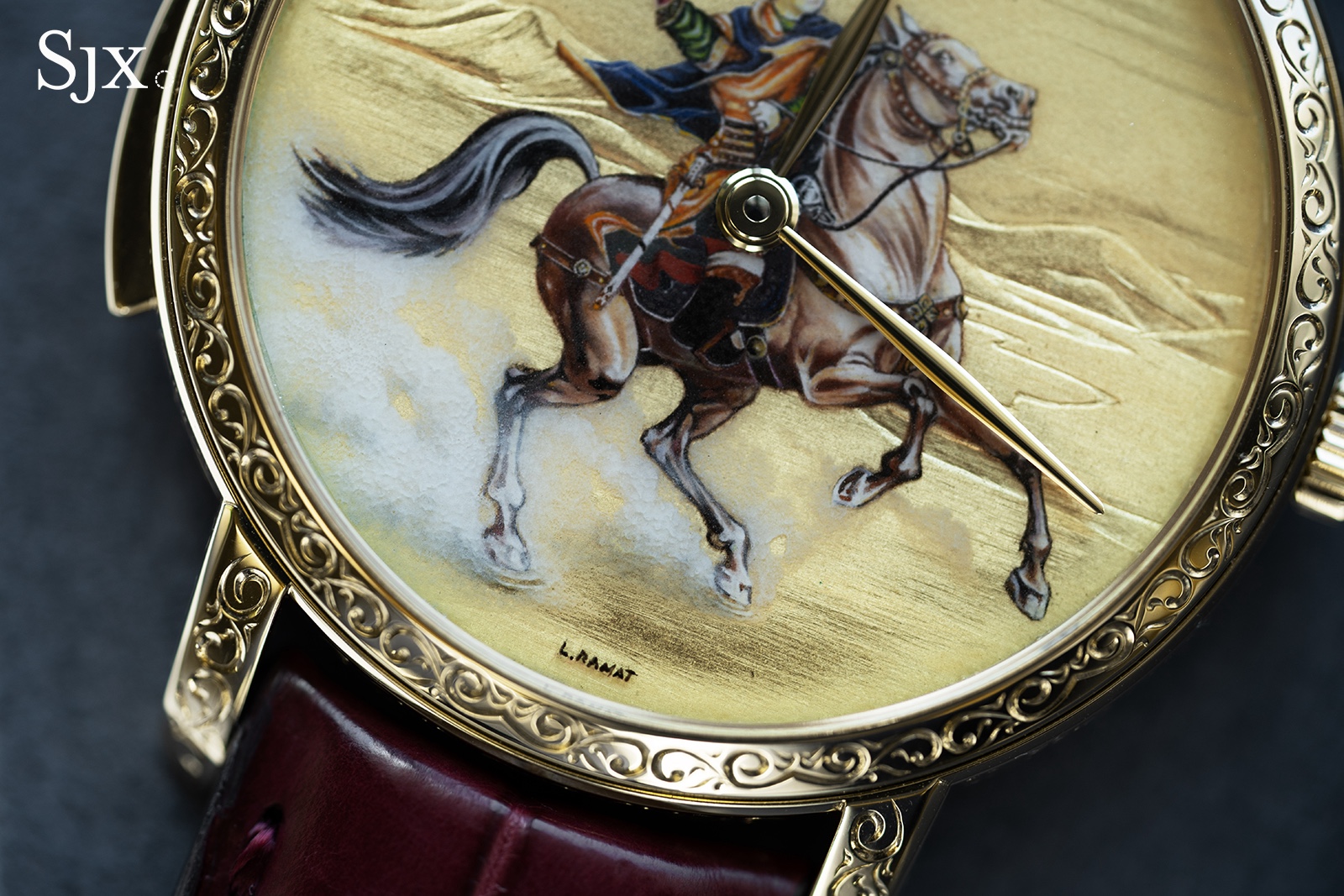
The signature of Vacheron Constantin’s in-house enamel artist Laurent Ramat.
The artist’s signature conveys value because it tells a story about the person (or people) behind the product. The story is important, because as Dr Elizabeth Currid-Halkett, author of The Sum of Small Things, explains, “…consumers now prize production information nearly as much as the product itself.”
Contemporary collecting culture prizes these kinds of details as significant differentiators, which is why an Anita Porchet-signed cloisonné enamel dial (or a case signed by Jean-Pierre Hagmann) adds meaningful market value. Perhaps for this reason, even brands with in-house enamel artists, which have historically presented a unified front, are now giving the artists more credit.
The increasing recognition of individual artists is important for another reason entirely separate from the value it brings to the watch: it raises the prominence and attractiveness of the profession, which might help the art and craft of painted dials survive another few hundred years.
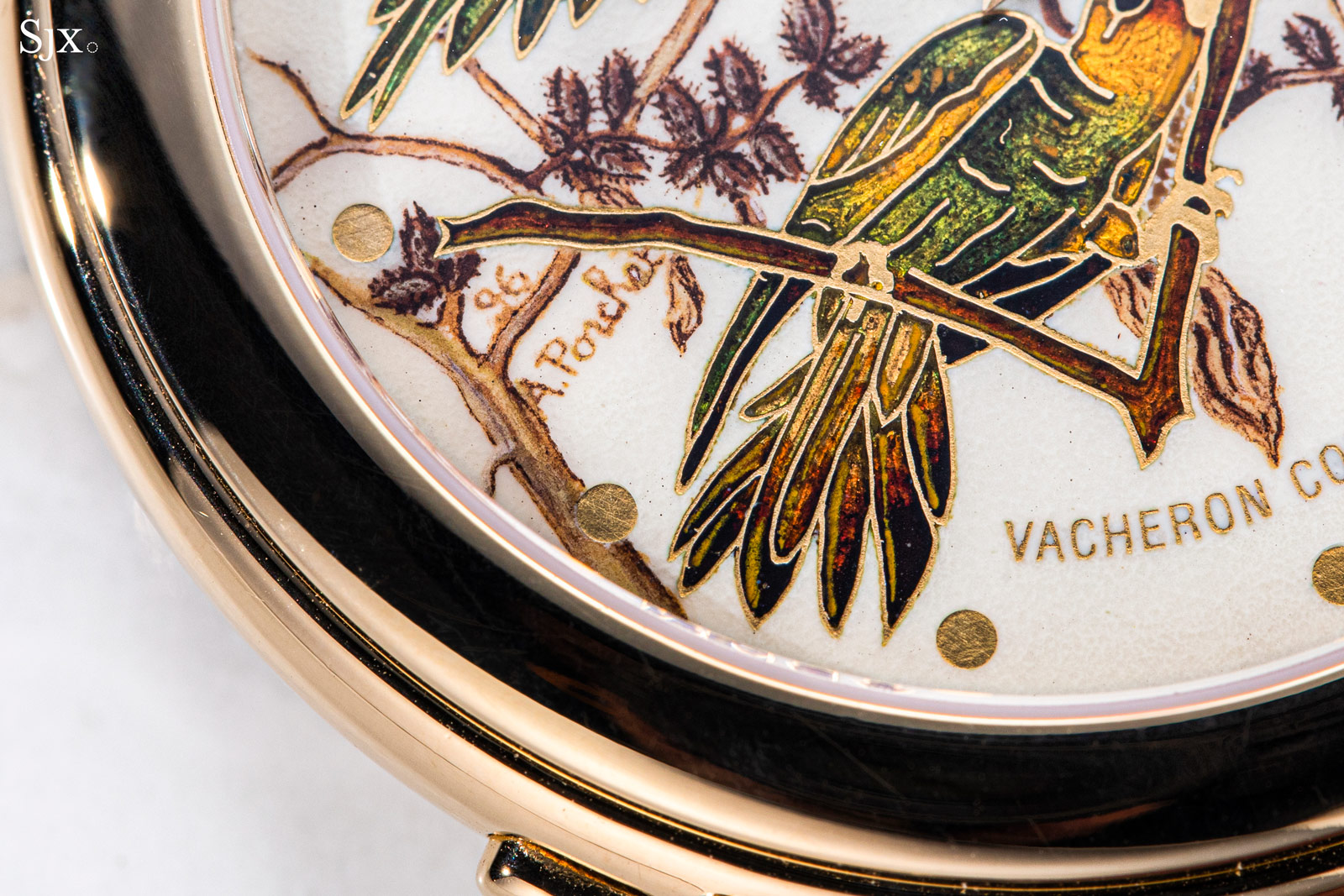
The all important “A. Porchet” signature
Conclusion
Since the renewal of interest in metiers d’art in the early 1990s, painted dials have once again captured collectors’ attention. Brands have responded with recreations of famous works, carrying on traditions that took shape in 18th-century Geneva, and by creating original cloisonné designs in the spirit of midcentury masters. Some have found ways to make art tell time by fusing form and function.
The rebirth has brought new attention to artists that have historically worked in anonymity — a trend that coincides with contemporary collector appetite for the mark of a master.
Through it all, the primary creators have been women — from Suzanne Rohr’s perseverance through the dark ages of the 1970s and 1980s to Anita Porchet’s apprentices today — ensuring the craft’s survival for at least one more generation.
Back to top.